Effective Teaching & Learning
By: Ajay Kumar
MBA-IB, UGC- NET, Ph.D - Scholar
Academic Consultant
Next Education India Pvt. Ltd
Figure out the basics
 Who are my students?
 In what context will my students engage with course information?
 Take into account the “Me, Here, Now”.
 Establish cognitive/behavioral objectives for students learning.
2
The first day, Openings & Closing
 The first day:
 Summarize most of that need to have information on paper or online and
Distribute it.
 Introduce content - relate why it is important?
 Clarify your objectives - for students
 Establish tone and Expectations - yours of them, theirs of you.
3
Openings
 Stay away from the predictable.
 Begin with a Provocative question, anecdote, or current event.
 Ask student to Summarize what happened in the last session.
 Use a question box.
 Set up a problem
4
Closings
 Don’t talk until the end of the class--and say, "See you next time."
Instead:
 Plan a rhythm for your class—
 Plan to end with content 5 minutes early,
 Summarize, Raise Questions, Preview The Next Topic.
 Set aside a time for question
 Frame/suggest an approach for assigned reading, etc.
5
Preparation
 Decide what is essential, what is important, and what is helpful (what
would be nice).
 Cover the Essential; try to cover the Important; forget about the Helpful.
6
Set Objectives
 What do you want to have accomplished at the end of the lecture?
 What do you want the students to know?
 What they should be able to do at the end of the lecture?
7
Plan a lecture to cover less than the entire
period
 It takes some time to get going.
 Questions always take up more time than you expect.
8
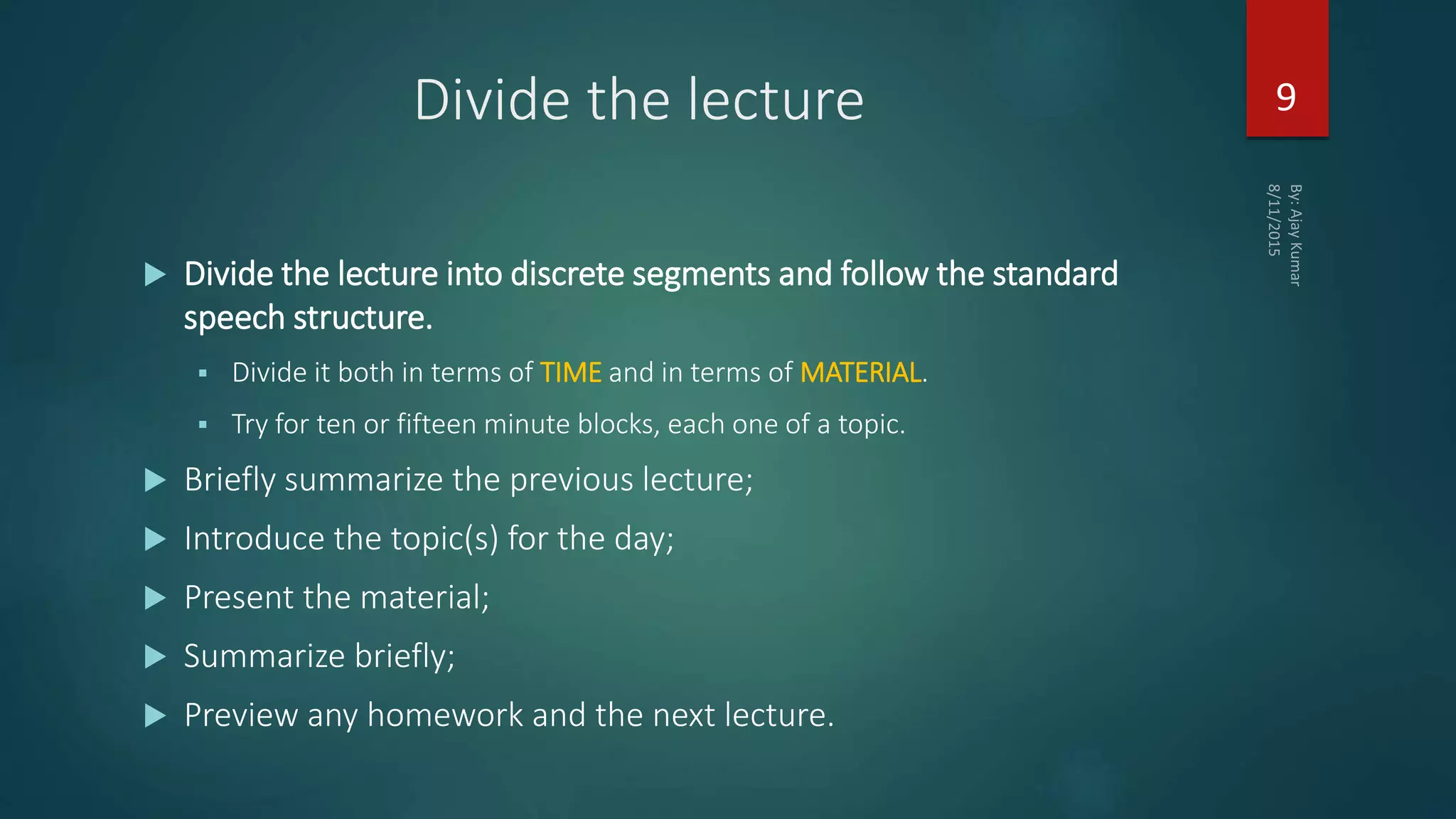
Divide the lecture
 Divide the lecture into discrete segments and follow the standard
speech structure.
 Divide it both in terms of TIME and in terms of MATERIAL.
 Try for ten or fifteen minute blocks, each one of a topic.
 Briefly summarize the previous lecture;
 Introduce the topic(s) for the day;
 Present the material;
 Summarize briefly;
 Preview any homework and the next lecture.
9
Delivery
 Lecture from notes or an outline, rather than a complete text.
 It's too tempting to simply read, rather than lecture, from a complete text.
 Reading also creates a barrier between teaching and students.
 Writing up an entire lecture is very time consuming.
 A written lecture often becomes a fossil that never gets updated
10
Delivery
 Be Conversational; speak Naturally; be Yourself (or your best self).
 Talk about the material; don't Lecture about it.
11
Delivery
 Vary your pacing and voice
 Gauge audience reaction, and
 Repeat critical points immediately if you sense the necessity.
 Use your voice to underline and italicize the important points.
 Pause before new points.
 Use transitional statements to move to the next idea.
12
Delivery
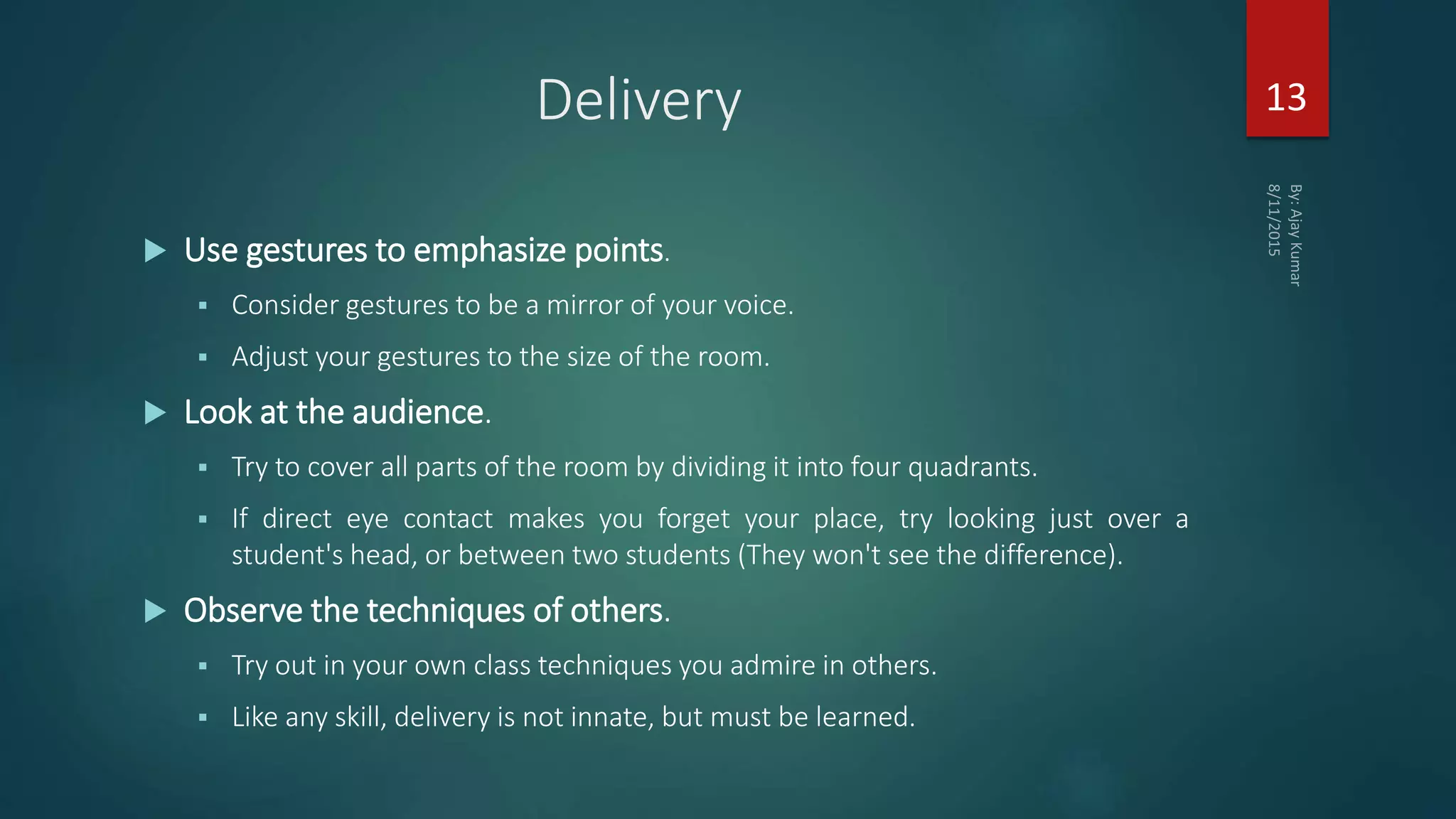
 Use gestures to emphasize points.
 Consider gestures to be a mirror of your voice.
 Adjust your gestures to the size of the room.
 Look at the audience.
 Try to cover all parts of the room by dividing it into four quadrants.
 If direct eye contact makes you forget your place, try looking just over a
student's head, or between two students (They won't see the difference).
 Observe the techniques of others.
 Try out in your own class techniques you admire in others.
 Like any skill, delivery is not innate, but must be learned.
13
Credibility & Commitment
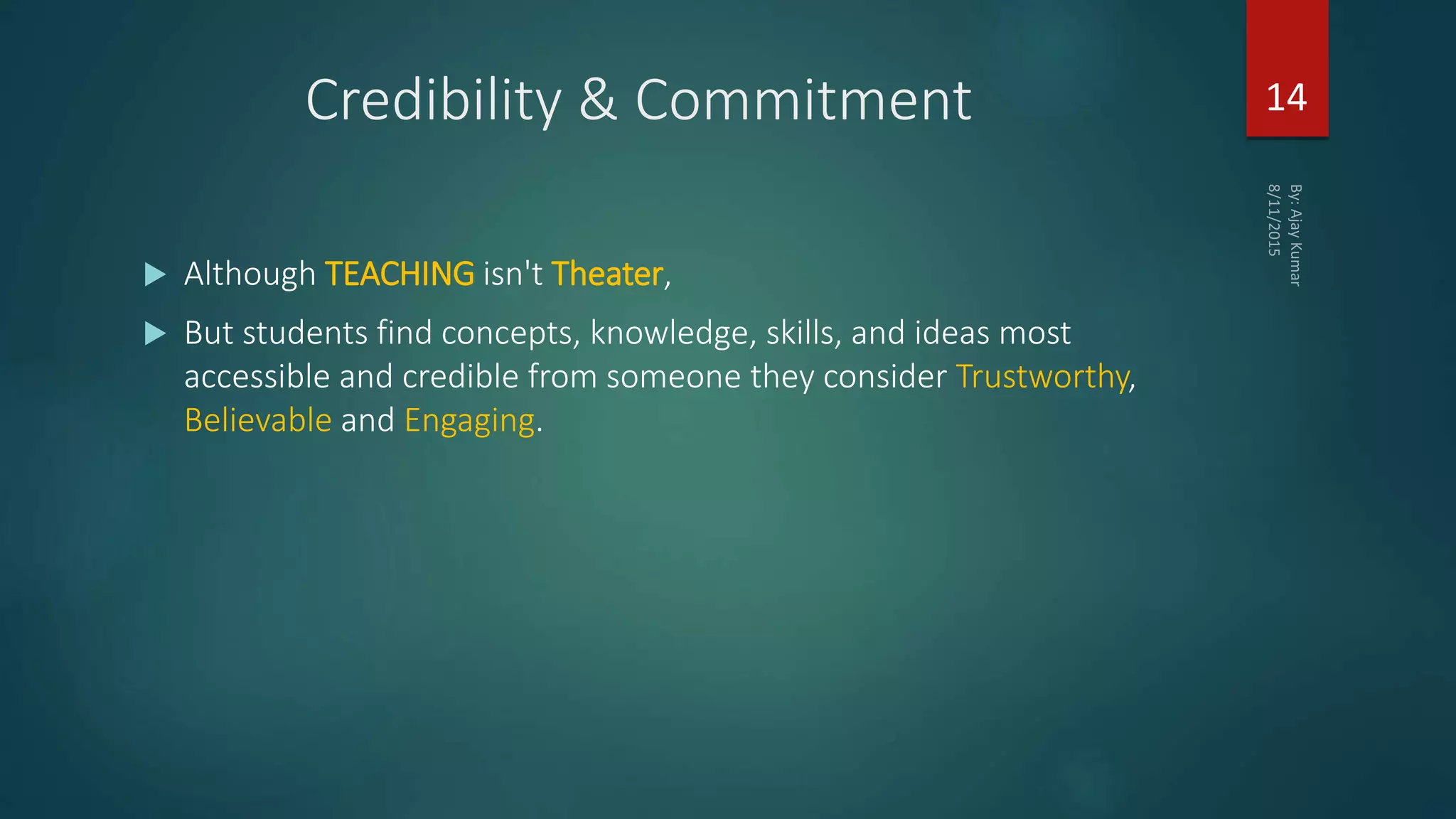
 Although TEACHING isn't Theater,
 But students find concepts, knowledge, skills, and ideas most
accessible and credible from someone they consider Trustworthy,
Believable and Engaging.
14
Credibility is enhanced by:
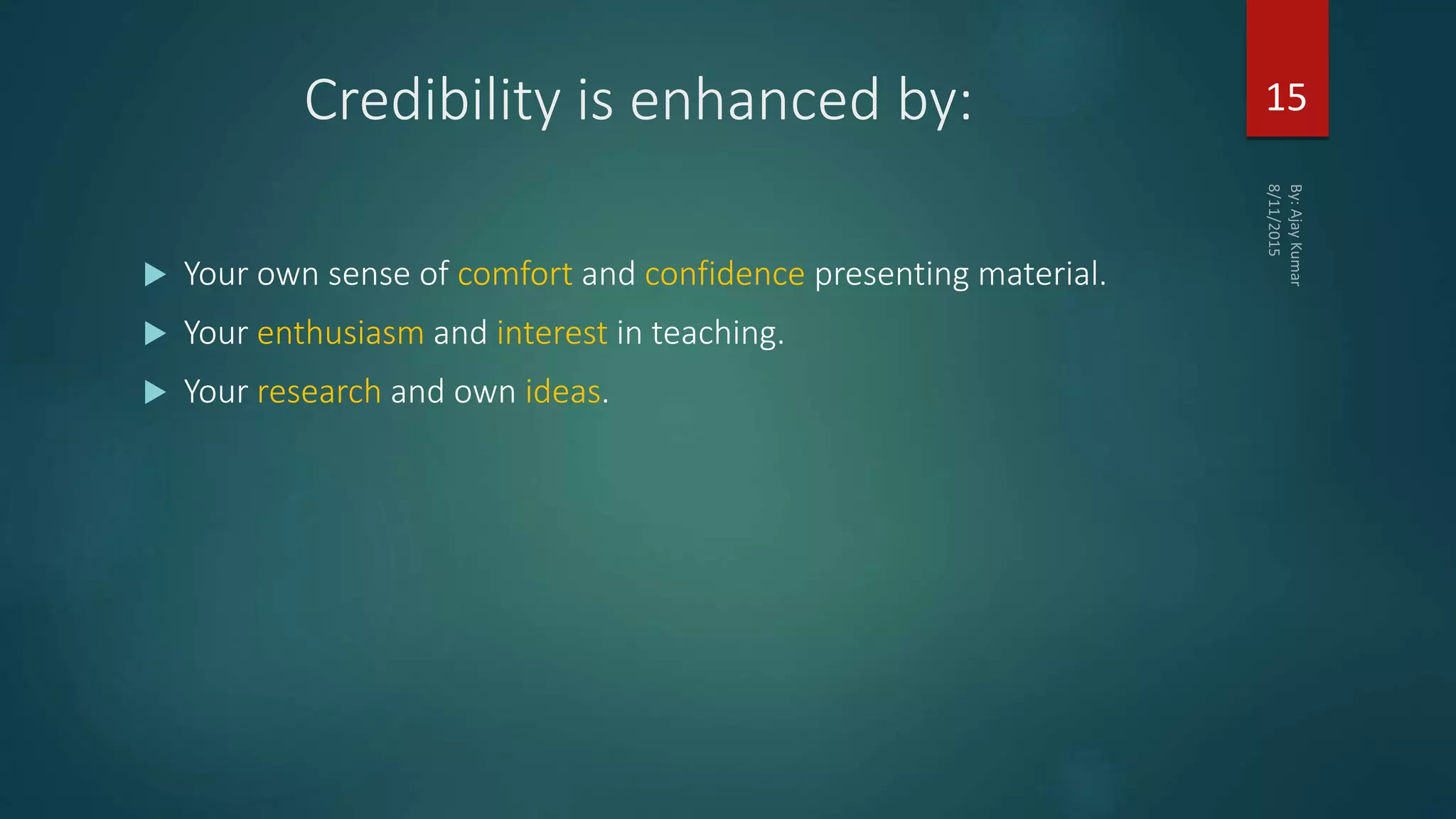
 Your own sense of comfort and confidence presenting material.
 Your enthusiasm and interest in teaching.
 Your research and own ideas.
15
Commitment is enhanced by:
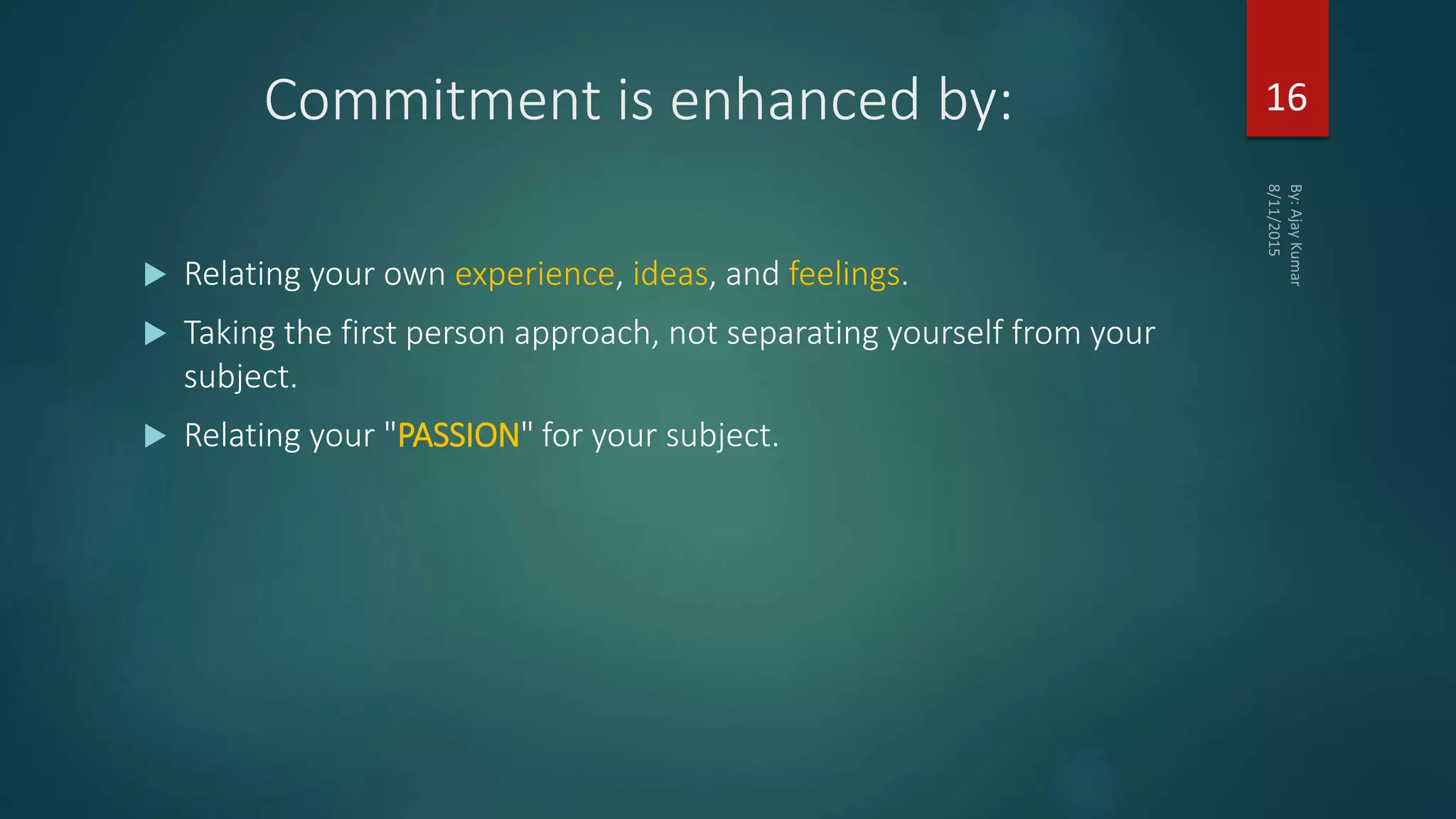
 Relating your own experience, ideas, and feelings.
 Taking the first person approach, not separating yourself from your
subject.
 Relating your "PASSION" for your subject.
16
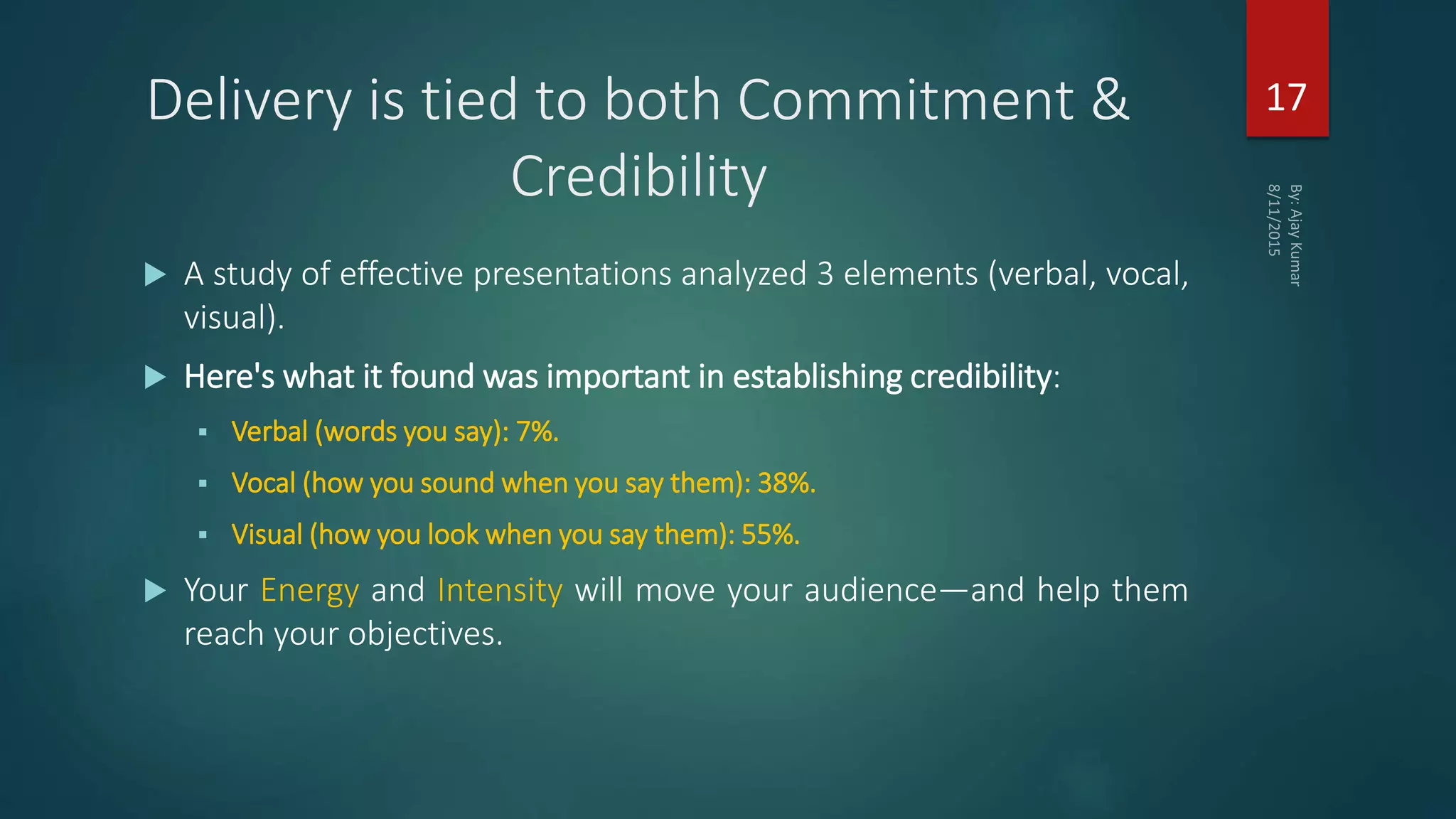
Delivery is tied to both Commitment &
Credibility
 A study of effective presentations analyzed 3 elements (verbal, vocal,
visual).
 Here's what it found was important in establishing credibility:
 Verbal (words you say): 7%.
 Vocal (how you sound when you say them): 38%.
 Visual (how you look when you say them): 55%.
 Your Energy and Intensity will move your audience—and help them
reach your objectives.
17
Building Interaction
 Learning is not a spectator sport.
 Learning takes place best in an active, not a passive environment.
 Create a safe learning environment.
 Variety is the key to engaging students.
 Praise is a powerful tool.
18
Interaction is a continuous way to
 Assess the Me, Here, Now.
 Determine whether or not your content is understood.
 Share the responsibility of learning more equitably and
appropriately.
 Foster a learning community.
19
How to build interaction?
 Have questions prepared--begin with relatively easy, accessible ones.
 Set up hypotheticals, problem-solving exercises, brainstorming.
 Work to get everyone involved, even in large classes.
20
Chalkboards (and other high tech media)
 Use the board (slides/overheads) to reinforce your points visually.
 Saying it and showing it can often forestall your having to repeat it.
 Use visuals to outline your lecture for the class.
21
If you have a great deal of board work
 Consider having most of it put on the board before class.
 Make a copy of it as a handout or make available online.
 Consider using a computer with a projector.
22
Don't talk while you write
 (Unless you can contort your body so that you're more or less facing
the class.)
 Students lose most of your words when they're spoken to the board.
 This holds true for using a pointer. Point, then speak, unless you are
already facing the class.
23
Limit the Amount
 Limit the amount of material you put on a slide or board.
 Focus slide/board material on key words, concepts, processes.
24
Have a plan for your board work
 Research has shown that the most prominent part of a chalkboard is
the upper left-hand corner.
 Some students might not be able to see material written on the very
bottom of the board.
 Remember: all visuals are supplements or complements, not
substitutes.
25
Handling Questions
 It's hard to answer a good question--and even harder to pose one.
 Explicitly request and encourage questions.
 Be aware of how your behavior and comments can set the tone for
questioning.
 A negative response discourages further questions and may make students
think you don't really want questions.
 Make sure everyone hears the question, So
 Be loud
 Clear
 And repeat if necessary
26
Answer questions as directly as possible
 Address your answer to the whole class.
 Ask students whether you have adequately answered the question.
 Be diplomatic when students raise tangential, overly-complicated
questions, or persistently ask questions just to be asking.
 Ask them to stop by after class or see you in office hours.
 If a student is simply confused, say, "Let me go over this point a bit more
slowly."
27
Getting Feedback
 Get regular feedback.
 Use eye contact as a tool for continuous feedback.
 If you notice students with questioning looks, stop what you're doing and ask if
you need to clarify.
 If you get no response, go ahead and clarify.
28
Tests and Grades
 Assessments should look forward, not back
 Poor answers are often the result of poor questions, not poor minds.
 Decide what your goal in testing is.
 Do you want students to regurgitate material? to synthesize? to be able to go
beyond it?
 Consider the format of questions.
 Try to ask only one question at a time.
 “The simplest thing to do is to require every kid on every test to
correct every problem,”
29
Teacher – Parent Relation
 Parents have two main expectations of teachers:
 Are you a PROFESSIONAL?
 Do you CARE about my child?
 Indicate to parents the potential for Growth in their child.
30
 Thank you so much for your kind attention!
 House is open for Discussion.
31

Effective Teaching & Learning Process in the Classroom

  • 1.
    Effective Teaching &Learning By: Ajay Kumar MBA-IB, UGC- NET, Ph.D - Scholar Academic Consultant Next Education India Pvt. Ltd
  • 2.
    Figure out thebasics  Who are my students?  In what context will my students engage with course information?  Take into account the “Me, Here, Now”.  Establish cognitive/behavioral objectives for students learning. 2
  • 3.
    The first day,Openings & Closing  The first day:  Summarize most of that need to have information on paper or online and Distribute it.  Introduce content - relate why it is important?  Clarify your objectives - for students  Establish tone and Expectations - yours of them, theirs of you. 3
  • 4.
    Openings  Stay awayfrom the predictable.  Begin with a Provocative question, anecdote, or current event.  Ask student to Summarize what happened in the last session.  Use a question box.  Set up a problem 4
  • 5.
    Closings  Don’t talkuntil the end of the class--and say, "See you next time." Instead:  Plan a rhythm for your class—  Plan to end with content 5 minutes early,  Summarize, Raise Questions, Preview The Next Topic.  Set aside a time for question  Frame/suggest an approach for assigned reading, etc. 5
  • 6.
    Preparation  Decide whatis essential, what is important, and what is helpful (what would be nice).  Cover the Essential; try to cover the Important; forget about the Helpful. 6
  • 7.
    Set Objectives  Whatdo you want to have accomplished at the end of the lecture?  What do you want the students to know?  What they should be able to do at the end of the lecture? 7
  • 8.
    Plan a lectureto cover less than the entire period  It takes some time to get going.  Questions always take up more time than you expect. 8
  • 9.
    Divide the lecture Divide the lecture into discrete segments and follow the standard speech structure.  Divide it both in terms of TIME and in terms of MATERIAL.  Try for ten or fifteen minute blocks, each one of a topic.  Briefly summarize the previous lecture;  Introduce the topic(s) for the day;  Present the material;  Summarize briefly;  Preview any homework and the next lecture. 9
  • 10.
    Delivery  Lecture fromnotes or an outline, rather than a complete text.  It's too tempting to simply read, rather than lecture, from a complete text.  Reading also creates a barrier between teaching and students.  Writing up an entire lecture is very time consuming.  A written lecture often becomes a fossil that never gets updated 10
  • 11.
    Delivery  Be Conversational;speak Naturally; be Yourself (or your best self).  Talk about the material; don't Lecture about it. 11
  • 12.
    Delivery  Vary yourpacing and voice  Gauge audience reaction, and  Repeat critical points immediately if you sense the necessity.  Use your voice to underline and italicize the important points.  Pause before new points.  Use transitional statements to move to the next idea. 12
  • 13.
    Delivery  Use gesturesto emphasize points.  Consider gestures to be a mirror of your voice.  Adjust your gestures to the size of the room.  Look at the audience.  Try to cover all parts of the room by dividing it into four quadrants.  If direct eye contact makes you forget your place, try looking just over a student's head, or between two students (They won't see the difference).  Observe the techniques of others.  Try out in your own class techniques you admire in others.  Like any skill, delivery is not innate, but must be learned. 13
  • 14.
    Credibility & Commitment Although TEACHING isn't Theater,  But students find concepts, knowledge, skills, and ideas most accessible and credible from someone they consider Trustworthy, Believable and Engaging. 14
  • 15.
    Credibility is enhancedby:  Your own sense of comfort and confidence presenting material.  Your enthusiasm and interest in teaching.  Your research and own ideas. 15
  • 16.
    Commitment is enhancedby:  Relating your own experience, ideas, and feelings.  Taking the first person approach, not separating yourself from your subject.  Relating your "PASSION" for your subject. 16
  • 17.
    Delivery is tiedto both Commitment & Credibility  A study of effective presentations analyzed 3 elements (verbal, vocal, visual).  Here's what it found was important in establishing credibility:  Verbal (words you say): 7%.  Vocal (how you sound when you say them): 38%.  Visual (how you look when you say them): 55%.  Your Energy and Intensity will move your audience—and help them reach your objectives. 17
  • 18.
    Building Interaction  Learningis not a spectator sport.  Learning takes place best in an active, not a passive environment.  Create a safe learning environment.  Variety is the key to engaging students.  Praise is a powerful tool. 18
  • 19.
    Interaction is acontinuous way to  Assess the Me, Here, Now.  Determine whether or not your content is understood.  Share the responsibility of learning more equitably and appropriately.  Foster a learning community. 19
  • 20.
    How to buildinteraction?  Have questions prepared--begin with relatively easy, accessible ones.  Set up hypotheticals, problem-solving exercises, brainstorming.  Work to get everyone involved, even in large classes. 20
  • 21.
    Chalkboards (and otherhigh tech media)  Use the board (slides/overheads) to reinforce your points visually.  Saying it and showing it can often forestall your having to repeat it.  Use visuals to outline your lecture for the class. 21
  • 22.
    If you havea great deal of board work  Consider having most of it put on the board before class.  Make a copy of it as a handout or make available online.  Consider using a computer with a projector. 22
  • 23.
    Don't talk whileyou write  (Unless you can contort your body so that you're more or less facing the class.)  Students lose most of your words when they're spoken to the board.  This holds true for using a pointer. Point, then speak, unless you are already facing the class. 23
  • 24.
    Limit the Amount Limit the amount of material you put on a slide or board.  Focus slide/board material on key words, concepts, processes. 24
  • 25.
    Have a planfor your board work  Research has shown that the most prominent part of a chalkboard is the upper left-hand corner.  Some students might not be able to see material written on the very bottom of the board.  Remember: all visuals are supplements or complements, not substitutes. 25
  • 26.
    Handling Questions  It'shard to answer a good question--and even harder to pose one.  Explicitly request and encourage questions.  Be aware of how your behavior and comments can set the tone for questioning.  A negative response discourages further questions and may make students think you don't really want questions.  Make sure everyone hears the question, So  Be loud  Clear  And repeat if necessary 26
  • 27.
    Answer questions asdirectly as possible  Address your answer to the whole class.  Ask students whether you have adequately answered the question.  Be diplomatic when students raise tangential, overly-complicated questions, or persistently ask questions just to be asking.  Ask them to stop by after class or see you in office hours.  If a student is simply confused, say, "Let me go over this point a bit more slowly." 27
  • 28.
    Getting Feedback  Getregular feedback.  Use eye contact as a tool for continuous feedback.  If you notice students with questioning looks, stop what you're doing and ask if you need to clarify.  If you get no response, go ahead and clarify. 28
  • 29.
    Tests and Grades Assessments should look forward, not back  Poor answers are often the result of poor questions, not poor minds.  Decide what your goal in testing is.  Do you want students to regurgitate material? to synthesize? to be able to go beyond it?  Consider the format of questions.  Try to ask only one question at a time.  “The simplest thing to do is to require every kid on every test to correct every problem,” 29
  • 30.
    Teacher – ParentRelation  Parents have two main expectations of teachers:  Are you a PROFESSIONAL?  Do you CARE about my child?  Indicate to parents the potential for Growth in their child. 30
  • 31.
     Thank youso much for your kind attention!  House is open for Discussion. 31