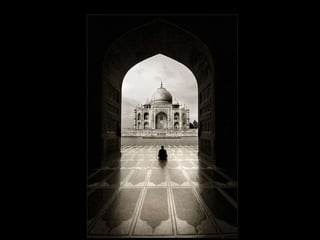
A tear on the face of Eternity
~ Ravindranath Tagore
T A J M A H A L
I n t r o d u c t i o n
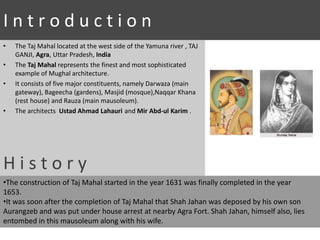
• The Taj Mahal located at the west side of the Yamuna river , TAJ
GANJI, Agra, Uttar Pradesh, India
• The Taj Mahal represents the finest and most sophisticated
example of Mughal architecture.
• It consists of five major constituents, namely Darwaza (main
gateway), Bageecha (gardens), Masjid (mosque),Naqqar Khana
(rest house) and Rauza (main mausoleum).
• The architects Ustad Ahmad Lahauri and Mir Abd-ul Karim .
H i s t o r y
•The construction of Taj Mahal started in the year 1631 was finally completed in the year
1653.
•It was soon after the completion of Taj Mahal that Shah Jahan was deposed by his own son
Aurangzeb and was put under house arrest at nearby Agra Fort. Shah Jahan, himself also, lies
entombed in this mausoleum along with his wife.
About Islamic Architecture
Concept of Space
Sacred vs. Profane
Permanent vs. Temporal
Concept of Man on Earth
Life Cycle of a Grave
Geometric Drivers
Patterns in Nature
Sufi Elements on Design
Environmental Constraints
Form addresses climate
Forms follow Function or visa
versa?
PRINCIPLES
Courtyard
Garden
Water,Char
Bagh
Technology
Dome ,Arch
Bara Dari
Awan
Mashabia
Chadar
China Kari
ELEMENTS
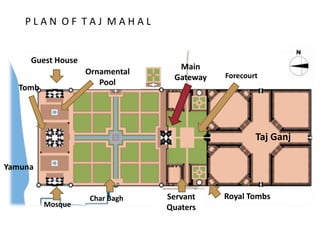
P L A N O F T A J M A H A L
Tomb
Ornamental
Pool
Mosque
Guest House
Main
Gateway Forecourt
Servant
Quaters
Royal Tombs
Taj Ganj
Yamuna
Char Bagh
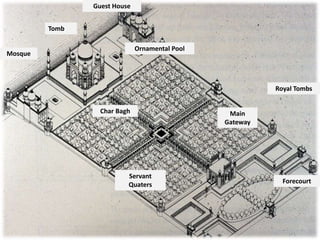
Tomb
Mosque
Guest House
Main
Gateway
Servant
Quaters
Royal Tombs
Char Bagh
Ornamental Pool
Forecourt
Concepts, Symbolism and Interpretation
• This theme, common in most Mughal
funerary architecture, permeates the entire
complex and informs the detailed design of
all the elements. A number of secondary
principles also inform the design, of which
hierarchy is the most dominant.
• A deliberate interplay is established between
the building's elements, its surface
decoration, materials, geometric planning
and its acoustics.
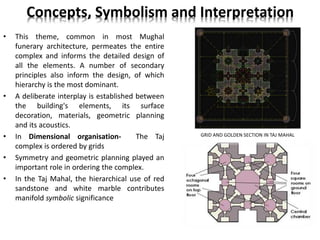
• In Dimensional organisation- The Taj
complex is ordered by grids
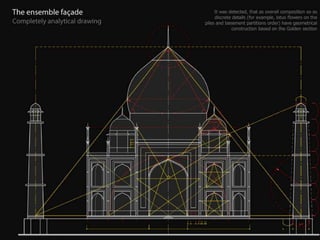
• Symmetry and geometric planning played an
important role in ordering the complex.
• In the Taj Mahal, the hierarchical use of red
sandstone and white marble contributes
manifold symbolic significance
GRID AND GOLDEN SECTION IN TAJ MAHAL
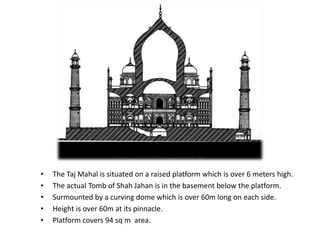
• The Taj Mahal is situated on a raised platform which is over 6 meters high.
• The actual Tomb of Shah Jahan is in the basement below the platform.
• Surmounted by a curving dome which is over 60m long on each side.
• Height is over 60m at its pinnacle.
• Platform covers 94 sq m area.
The dome
60 m
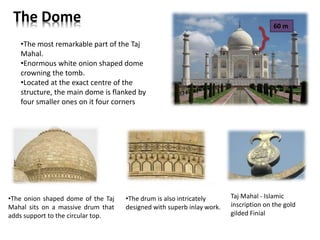
The Dome
•The most remarkable part of the Taj
Mahal.
•Enormous white onion shaped dome
crowning the tomb.
•Located at the exact centre of the
structure, the main dome is flanked by
four smaller ones on it four corners
•The onion shaped dome of the Taj
Mahal sits on a massive drum that
adds support to the circular top.
•The drum is also intricately
designed with superb inlay work.
Taj Mahal - Islamic
inscription on the gold
gilded Finial
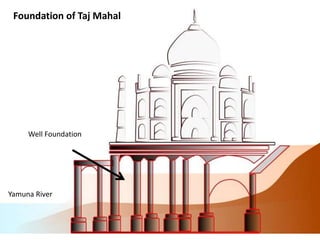
Yamuna River
Well Foundation
Foundation of Taj Mahal
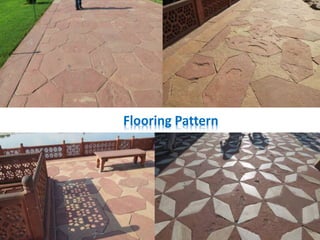
Flooring Pattern
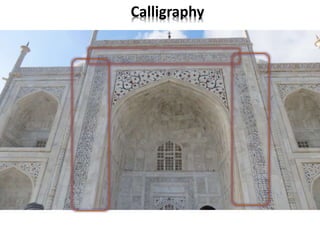
Calligraphy
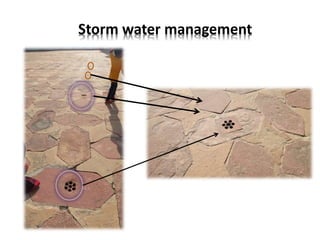
Storm water management
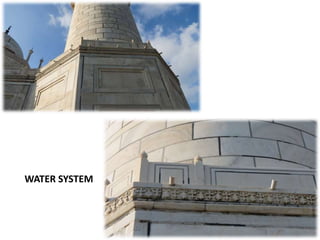
WATER SYSTEM
References:
~ IRJABS (Study on the Architecture of Taj Mahal)
~ Ar. NAVIN PIPLANI – TEDx
~ History Channel
~ Google (images)
~ www.archnet.org
~ www.issuu.com/taj-mahal_9282012.html
Submitted to :
Ar. Ketki Moholkar
Submitted by :
Ankit Sinha, Kritika Verma and Aditi Borkar
Taj Mahal - Architecture

Taj Mahal - Architecture

  • 2.
    A tear onthe face of Eternity ~ Ravindranath Tagore T A J M A H A L
  • 3.
    I n tr o d u c t i o n • The Taj Mahal located at the west side of the Yamuna river , TAJ GANJI, Agra, Uttar Pradesh, India • The Taj Mahal represents the finest and most sophisticated example of Mughal architecture. • It consists of five major constituents, namely Darwaza (main gateway), Bageecha (gardens), Masjid (mosque),Naqqar Khana (rest house) and Rauza (main mausoleum). • The architects Ustad Ahmad Lahauri and Mir Abd-ul Karim . H i s t o r y •The construction of Taj Mahal started in the year 1631 was finally completed in the year 1653. •It was soon after the completion of Taj Mahal that Shah Jahan was deposed by his own son Aurangzeb and was put under house arrest at nearby Agra Fort. Shah Jahan, himself also, lies entombed in this mausoleum along with his wife.
  • 4.
    About Islamic Architecture Conceptof Space Sacred vs. Profane Permanent vs. Temporal Concept of Man on Earth Life Cycle of a Grave Geometric Drivers Patterns in Nature Sufi Elements on Design Environmental Constraints Form addresses climate Forms follow Function or visa versa? PRINCIPLES Courtyard Garden Water,Char Bagh Technology Dome ,Arch Bara Dari Awan Mashabia Chadar China Kari ELEMENTS
  • 5.
    P L AN O F T A J M A H A L Tomb Ornamental Pool Mosque Guest House Main Gateway Forecourt Servant Quaters Royal Tombs Taj Ganj Yamuna Char Bagh
  • 6.
  • 7.
    Concepts, Symbolism andInterpretation • This theme, common in most Mughal funerary architecture, permeates the entire complex and informs the detailed design of all the elements. A number of secondary principles also inform the design, of which hierarchy is the most dominant. • A deliberate interplay is established between the building's elements, its surface decoration, materials, geometric planning and its acoustics. • In Dimensional organisation- The Taj complex is ordered by grids • Symmetry and geometric planning played an important role in ordering the complex. • In the Taj Mahal, the hierarchical use of red sandstone and white marble contributes manifold symbolic significance GRID AND GOLDEN SECTION IN TAJ MAHAL
  • 10.
    • The TajMahal is situated on a raised platform which is over 6 meters high. • The actual Tomb of Shah Jahan is in the basement below the platform. • Surmounted by a curving dome which is over 60m long on each side. • Height is over 60m at its pinnacle. • Platform covers 94 sq m area.
  • 12.
    The dome 60 m TheDome •The most remarkable part of the Taj Mahal. •Enormous white onion shaped dome crowning the tomb. •Located at the exact centre of the structure, the main dome is flanked by four smaller ones on it four corners •The onion shaped dome of the Taj Mahal sits on a massive drum that adds support to the circular top. •The drum is also intricately designed with superb inlay work. Taj Mahal - Islamic inscription on the gold gilded Finial
  • 13.
  • 14.
  • 15.
  • 16.
  • 17.
  • 19.
    References: ~ IRJABS (Studyon the Architecture of Taj Mahal) ~ Ar. NAVIN PIPLANI – TEDx ~ History Channel ~ Google (images) ~ www.archnet.org ~ www.issuu.com/taj-mahal_9282012.html Submitted to : Ar. Ketki Moholkar Submitted by : Ankit Sinha, Kritika Verma and Aditi Borkar