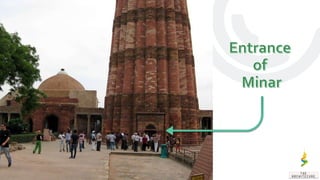
QUTUB MINAR
COMPLEX
SUBTITLE COMES HERE
INTRODUCTION
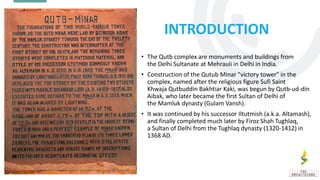
• The Qutb complex are monuments and buildings from
the Delhi Sultanate at Mehrauli in Delhi in India.
• Construction of the Qutub Minar "victory tower" in the
complex, named after the religious figure Sufi Saint
Khwaja Qutbuddin Bakhtiar Kaki, was begun by Qutb-ud-din
Aibak, who later became the first Sultan of Delhi of
the Mamluk dynasty (Gulam Vansh).
• It was continued by his successor Iltutmish (a.k.a. Altamash),
and finally completed much later by Firoz Shah Tughlaq,
a Sultan of Delhi from the Tughlaq dynasty (1320-1412) in
1368 AD.
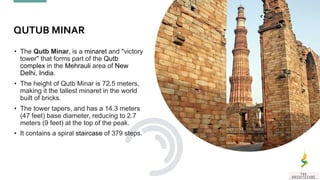
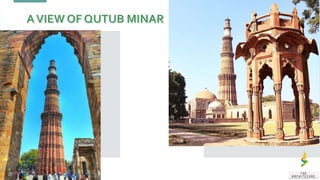
• The Qutb Minar, is a minaret and "victory
tower" that forms part of the Qutb
complex in the Mehrauli area of New
Delhi, India.
• The height of Qutb Minar is 72.5 meters,
making it the tallest minaret in the world
built of bricks.
• The tower tapers, and has a 14.3 meters
(47 feet) base diameter, reducing to 2.7
meters (9 feet) at the top of the peak.
• It contains a spiral staircase of 379 steps.
QUTUB MINAR
ARCHITECTURE
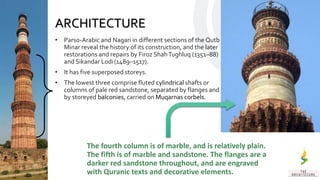
The fourth column is of marble, and is relatively plain.
The fifth is of marble and sandstone. The flanges are a
darker red sandstone throughout, and are engraved
with Quranic texts and decorative elements.
• Parso-Arabic and Nagari in different sections of the Qutb
Minar reveal the history of its construction, and the later
restorations and repairs by Firoz ShahTughluq (1351–88)
and Sikandar Lodi(1489–1517).
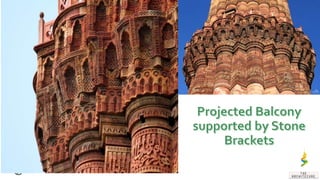
• It has five superposed storeys.
• The lowest three comprise fluted cylindrical shafts or
columns of pale red sandstone, separated by flanges and
by storeyed balconies, carried on Muqarnas corbels.
CALLIGRAPHY
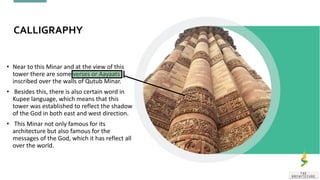
• Near to this Minar and at the view of this
tower there are some verses or Aayaats
inscribed over the walls of Qutub Minar.
• Besides this, there is also certain word in
Kupee language, which means that this
tower was established to reflect the shadow
of the God in both east and west direction.
• This Minar not only famous for its
architecture but also famous for the
messages of the God, which it has reflect all
over the world.
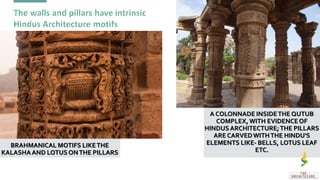
BRAHMANICAL MOTIFS LIKETHE
KALASHAAND LOTUS ONTHE PILLARS
A COLONNADE INSIDETHE QUTUB
COMPLEX,WITH EVIDENCE OF
HINDUSARCHITECTURE;THE PILLARS
ARE CARVEDWITHTHE HINDU'S
ELEMENTS LIKE- BELLS, LOTUS LEAF
ETC.
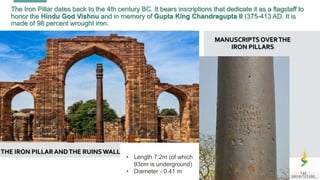
The Iron Pillar dates back to the 4th century BC. It bears inscriptions that dedicate it as a flagstaff to
honor the Hindu God Vishnu and in memory of Gupta King Chandragupta II (375-413 AD. It is
made of 98 percent wrought iron.
THE IRON PILLARANDTHE RUINSWALL
MANUSCRIPTSOVERTHE
IRON PILLARS
• Length 7.2m (of which
93cm is underground)
• Diameter - 0.41 m
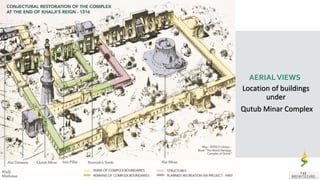
Location of buildings
under
Qutub Minar Complex
AERIALVIEWS
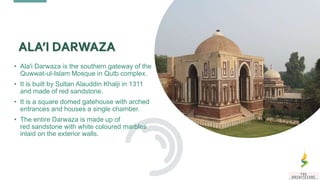
• Ala'i Darwaza is the southern gateway of the
Quwwat-ul-Islam Mosque in Qutb complex.
• It is built by Sultan Alauddin Khalji in 1311
and made of red sandstone.
• It is a square domed gatehouse with arched
entrances and houses a single chamber.
• The entire Darwaza is made up of
red sandstone with white coloured marbles
inlaid on the exterior walls.
ALA’I DARWAZA
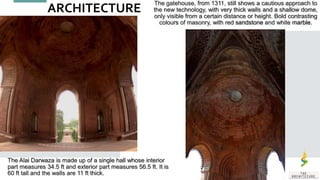
ARCHITECTURE
The Alai Darwaza is made up of a single hall whose interior
part measures 34.5 ft and exterior part measures 56.5 ft. It is
60 ft tall and the walls are 11 ft thick.
The gatehouse, from 1311, still shows a cautious approach to
the new technology, with very thick walls and a shallow dome,
only visible from a certain distance or height. Bold contrasting
colours of masonry, with red sandstone and white marble.
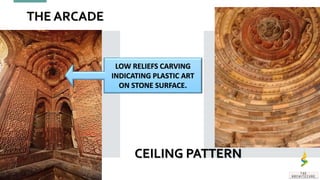
THE ARCADE
CEILING PATTERN
LOW RELIEFS CARVING
INDICATING PLASTIC ART
ON STONE SURFACE.
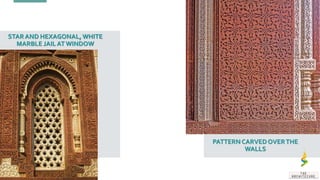
STAR AND HEXAGONAL,WHITE
MARBLE JAIL ATWINDOW
PATTERN CARVED OVERTHE
WALLS
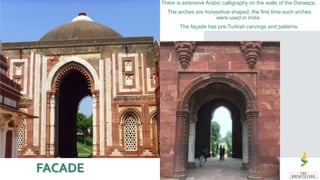
FACADE
There is extensive Arabic calligraphy on the walls of the Darwaza.
The arches are horseshoe shaped, the first time such arches
were used in India.
The façade has pre-Turkish carvings and patterns
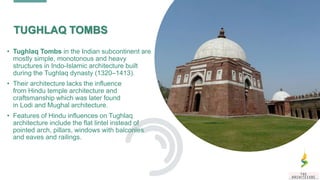
• Tughlaq Tombs in the Indian subcontinent are
mostly simple, monotonous and heavy
structures in Indo-Islamic architecture built
during the Tughlaq dynasty (1320–1413).
• Their architecture lacks the influence
from Hindu temple architecture and
craftsmanship which was later found
in Lodi and Mughal architecture.
• Features of Hindu influences on Tughlaq
architecture include the flat lintel instead of
pointed arch, pillars, windows with balconies
and eaves and railings.
TUGHLAQ TOMBS
ARCHITECTURE
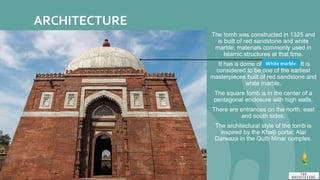
The tomb was constructed in 1325 and
is built of red sandstone and white
marble, materials commonly used in
Islamic structures at that time.
It has a dome of white marble. It is
considered to be one of the earliest
masterpieces built of red sandstone and
white marble.
The square tomb is in the center of a
pentagonal enclosure with high walls.
There are entrances on the north, east
and south sides.
The architectural style of the tomb is
inspired by the Khalji portal; Alai
Darwaza in the Qutb Minar complex.
White marble
THANKYOU !

Qutub Minar complex

  • 1.
  • 2.
    INTRODUCTION • The Qutbcomplex are monuments and buildings from the Delhi Sultanate at Mehrauli in Delhi in India. • Construction of the Qutub Minar "victory tower" in the complex, named after the religious figure Sufi Saint Khwaja Qutbuddin Bakhtiar Kaki, was begun by Qutb-ud-din Aibak, who later became the first Sultan of Delhi of the Mamluk dynasty (Gulam Vansh). • It was continued by his successor Iltutmish (a.k.a. Altamash), and finally completed much later by Firoz Shah Tughlaq, a Sultan of Delhi from the Tughlaq dynasty (1320-1412) in 1368 AD.
  • 3.
    • The QutbMinar, is a minaret and "victory tower" that forms part of the Qutb complex in the Mehrauli area of New Delhi, India. • The height of Qutb Minar is 72.5 meters, making it the tallest minaret in the world built of bricks. • The tower tapers, and has a 14.3 meters (47 feet) base diameter, reducing to 2.7 meters (9 feet) at the top of the peak. • It contains a spiral staircase of 379 steps. QUTUB MINAR
  • 4.
    ARCHITECTURE The fourth columnis of marble, and is relatively plain. The fifth is of marble and sandstone. The flanges are a darker red sandstone throughout, and are engraved with Quranic texts and decorative elements. • Parso-Arabic and Nagari in different sections of the Qutb Minar reveal the history of its construction, and the later restorations and repairs by Firoz ShahTughluq (1351–88) and Sikandar Lodi(1489–1517). • It has five superposed storeys. • The lowest three comprise fluted cylindrical shafts or columns of pale red sandstone, separated by flanges and by storeyed balconies, carried on Muqarnas corbels.
  • 5.
    CALLIGRAPHY • Near tothis Minar and at the view of this tower there are some verses or Aayaats inscribed over the walls of Qutub Minar. • Besides this, there is also certain word in Kupee language, which means that this tower was established to reflect the shadow of the God in both east and west direction. • This Minar not only famous for its architecture but also famous for the messages of the God, which it has reflect all over the world.
  • 9.
    BRAHMANICAL MOTIFS LIKETHE KALASHAANDLOTUS ONTHE PILLARS A COLONNADE INSIDETHE QUTUB COMPLEX,WITH EVIDENCE OF HINDUSARCHITECTURE;THE PILLARS ARE CARVEDWITHTHE HINDU'S ELEMENTS LIKE- BELLS, LOTUS LEAF ETC.
  • 10.
    The Iron Pillardates back to the 4th century BC. It bears inscriptions that dedicate it as a flagstaff to honor the Hindu God Vishnu and in memory of Gupta King Chandragupta II (375-413 AD. It is made of 98 percent wrought iron. THE IRON PILLARANDTHE RUINSWALL MANUSCRIPTSOVERTHE IRON PILLARS • Length 7.2m (of which 93cm is underground) • Diameter - 0.41 m
  • 11.
    Location of buildings under QutubMinar Complex AERIALVIEWS
  • 12.
    • Ala'i Darwazais the southern gateway of the Quwwat-ul-Islam Mosque in Qutb complex. • It is built by Sultan Alauddin Khalji in 1311 and made of red sandstone. • It is a square domed gatehouse with arched entrances and houses a single chamber. • The entire Darwaza is made up of red sandstone with white coloured marbles inlaid on the exterior walls. ALA’I DARWAZA
  • 13.
    ARCHITECTURE The Alai Darwazais made up of a single hall whose interior part measures 34.5 ft and exterior part measures 56.5 ft. It is 60 ft tall and the walls are 11 ft thick. The gatehouse, from 1311, still shows a cautious approach to the new technology, with very thick walls and a shallow dome, only visible from a certain distance or height. Bold contrasting colours of masonry, with red sandstone and white marble.
  • 14.
    THE ARCADE CEILING PATTERN LOWRELIEFS CARVING INDICATING PLASTIC ART ON STONE SURFACE.
  • 15.
    STAR AND HEXAGONAL,WHITE MARBLEJAIL ATWINDOW PATTERN CARVED OVERTHE WALLS
  • 16.
    FACADE There is extensiveArabic calligraphy on the walls of the Darwaza. The arches are horseshoe shaped, the first time such arches were used in India. The façade has pre-Turkish carvings and patterns
  • 17.
    • Tughlaq Tombsin the Indian subcontinent are mostly simple, monotonous and heavy structures in Indo-Islamic architecture built during the Tughlaq dynasty (1320–1413). • Their architecture lacks the influence from Hindu temple architecture and craftsmanship which was later found in Lodi and Mughal architecture. • Features of Hindu influences on Tughlaq architecture include the flat lintel instead of pointed arch, pillars, windows with balconies and eaves and railings. TUGHLAQ TOMBS
  • 18.
    ARCHITECTURE The tomb wasconstructed in 1325 and is built of red sandstone and white marble, materials commonly used in Islamic structures at that time. It has a dome of white marble. It is considered to be one of the earliest masterpieces built of red sandstone and white marble. The square tomb is in the center of a pentagonal enclosure with high walls. There are entrances on the north, east and south sides. The architectural style of the tomb is inspired by the Khalji portal; Alai Darwaza in the Qutb Minar complex. White marble
  • 19.