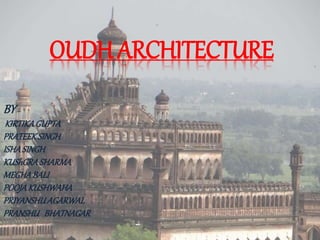
OUDH ARCHITECTURE
BY–
KIRTIKAGUPTA
PRATEEKSINGH
ISHASINGH
KUShGRASHARMA
MEGHABALI
POOJAKUSHWAHA
PRIYANSHUAGARWAL
PRANSHU BHATNAGAR
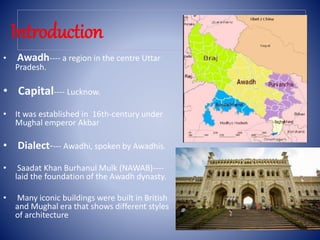
• Awadh---- a region in the centre Uttar
Pradesh.
• Capital---- Lucknow.
• It was established in 16th-century under
Mughal emperor Akbar
• Dialect---- Awadhi, spoken by Awadhis.
• Saadat Khan Burhanul Mulk (NAWAB)----
laid the foundation of the Awadh dynasty.
• Many iconic buildings were built in British
and Mughal era that shows different styles
of architecture
Introduction
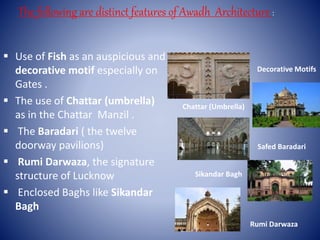
 Use of Fish as an auspicious and
decorative motif especially on
Gates .
 The use of Chattar (umbrella)
as in the Chattar Manzil .
 The Baradari ( the twelve
doorway pavilions)
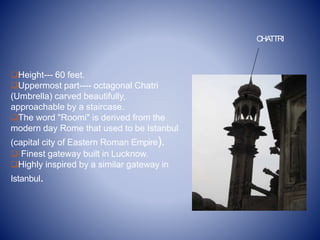
 Rumi Darwaza, the signature
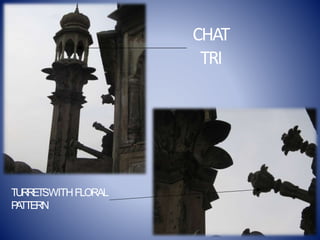
structure of Lucknow
 Enclosed Baghs like Sikandar
Bagh
The following are distinct features of Awadh Architecture :
Rumi Darwaza
Sikandar Bagh
Safed Baradari
Chattar (Umbrella)
Decorative Motifs
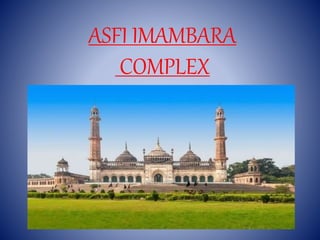
ASFI IMAMBARA
COMPLEX
ASFI IMAMBARA COMPLEX
Also called the “Asafi Imambara”.
Bara means big, and an imambara is a
shrine built by Shia Muslims. Bara
Imambara ---- Lucknow, India. Important
Nawabi religious building.
Built by Asaf-ud-daulah, Nawab of
Lucknow, in 1784,
Designed by architect Kifayt Ulla
. Plan---- 50 m x 16` m
Height--- 15 m
ASFI IMAMBARA COMPLEX
.
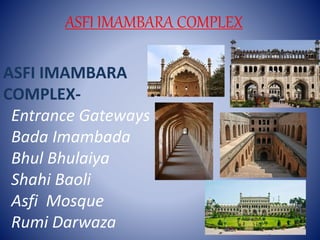
ASFI IMAMBARA
COMPLEX-
Entrance Gateways
Bada Imambada
Bhul Bhulaiya
Shahi Baoli
Asfi Mosque
Rumi Darwaza
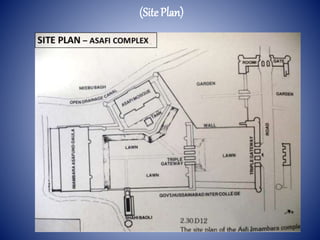
(SitePlan)
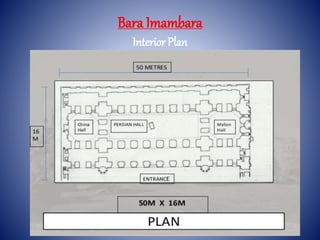
Bara Imambara
Interior Plan
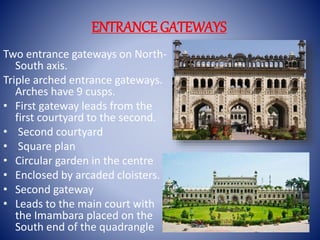
ENTRANCE GATEWAYS
Two entrance gateways on North-
South axis.
Triple arched entrance gateways.
Arches have 9 cusps.
• First gateway leads from the
first courtyard to the second.
• Second courtyard
• Square plan
• Circular garden in the centre
• Enclosed by arcaded cloisters.
• Second gateway
• Leads to the main court with
the Imambara placed on the
South end of the quadrangle
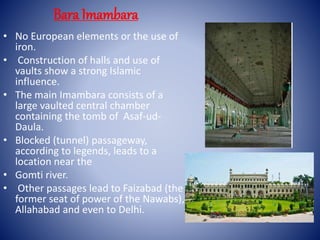
• No European elements or the use of
iron.
• Construction of halls and use of
vaults show a strong Islamic
influence.
• The main Imambara consists of a
large vaulted central chamber
containing the tomb of Asaf-ud-
Daula.
• Blocked (tunnel) passageway,
according to legends, leads to a
location near the
• Gomti river.
• Other passages lead to Faizabad (the
former seat of power of the Nawabs),
Allahabad and even to Delhi.
Bara Imambara
Bara Imambara
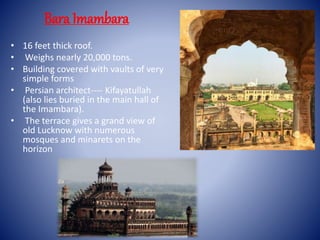
• 16 feet thick roof.
• Weighs nearly 20,000 tons.
• Building covered with vaults of very
simple forms
• Persian architect---- Kifayatullah
(also lies buried in the main hall of
the Imambara).
• The terrace gives a grand view of
old Lucknow with numerous
mosques and minarets on the
horizon
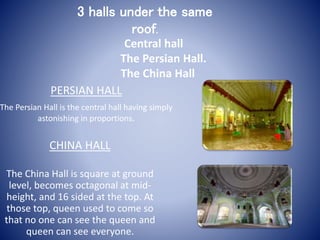
PERSIAN HALL
The Persian Hall is the central hall having simply
astonishing in proportions.
CHINA HALL
The China Hall is square at ground
level, becomes octagonal at mid-
height, and 16 sided at the top. At
those top, queen used to come so
that no one can see the queen and
queen can see everyone.
3 halls under the same
roof.
Central hall
The Persian Hall.
The China Hall
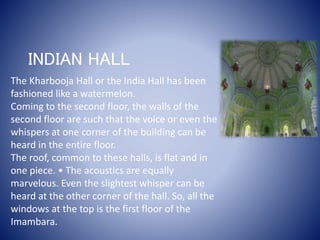
The Kharbooja Hall or the India Hall has been
fashioned like a watermelon.
Coming to the second floor, the walls of the
second floor are such that the voice or even the
whispers at one corner of the building can be
heard in the entire floor.
The roof, common to these halls, is flat and in
one piece. • The acoustics are equally
marvelous. Even the slightest whisper can be
heard at the other corner of the hall. So, all the
windows at the top is the first floor of the
Imambara.
INDIAN HALL
CONSTRUCTIONMATERIALS
• One of the most amazing thing about the architecture is that
the whole support for the building is hollow and is made of
sugarcane juice, jaggery ( ) and udat daal.
• The roof of Imam Bara is made up from the rice husk which
make this Imambara a unique building.
• Except for the galleries in the interior, there is no woodwork in
the entire structure.
• There is also a blocked (tunnel) passageway which, according
to legends, is a secret underground passageway to the other
cities.
• The whole building is made of Lakhanui bricks (small size
bricks) and lime plaster. No wood or metal has been used in
the construction .
BHULBHULAIYAH
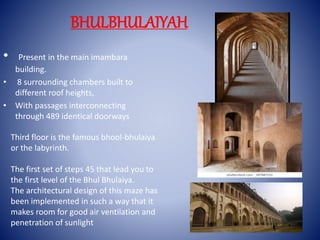
• Present in the main imambara
building.
• 8 surrounding chambers built to
different roof heights,
• With passages interconnecting
through 489 identical doorways
Third floor is the famous bhool-bhulaiya
or the labyrinth.
The first set of steps 45 that lead you to
the first level of the Bhul Bhulaiya.
The architectural design of this maze has
been implemented in such a way that it
makes room for good air ventilation and
penetration of sunlight
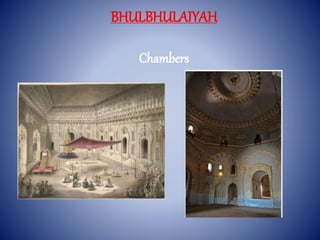
BHULBHULAIYAH
Chambers
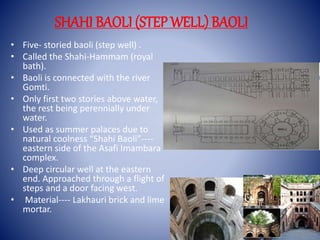
SHAHI BAOLI (STEP WELL) BAOLI
• Five- storied baoli (step well) .
• Called the Shahi-Hammam (royal
bath).
• Baoli is connected with the river
Gomti.
• Only first two stories above water,
the rest being perennially under
water.
• Used as summer palaces due to
natural coolness “Shahi Baoli”----
eastern side of the Asafi Imambara
complex.
• Deep circular well at the eastern
end. Approached through a flight of
steps and a door facing west.
• Material---- Lakhauri brick and lime
mortar.
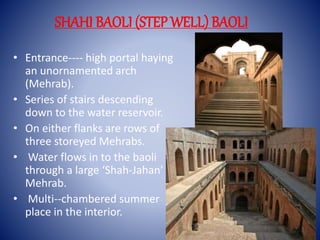
SHAHI BAOLI (STEP WELL) BAOLI
• Entrance---- high portal haying
an unornamented arch
(Mehrab).
• Series of stairs descending
down to the water reservoir.
• On either flanks are rows of
three storeyed Mehrabs.
• Water flows in to the baoli
through a large ‘Shah-Jahan’
Mehrab.
• Multi--chambered summer
place in the interior.
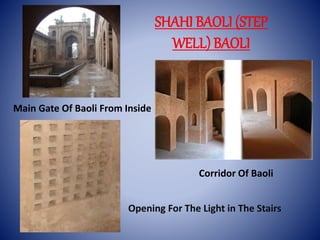
Opening For The Light in The Stairs
Main Gate Of Baoli From Inside
Corridor Of Baoli
SHAHI BAOLI (STEP
WELL) BAOLI
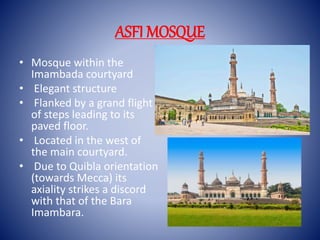
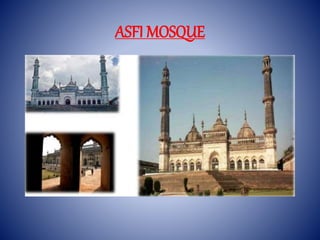
ASFI MOSQUE
• Mosque within the
Imambada courtyard
• Elegant structure
• Flanked by a grand flight
of steps leading to its
paved floor.
• Located in the west of
the main courtyard.
• Due to Quibla orientation
(towards Mecca) its
axiality strikes a discord
with that of the Bara
Imambara.
ASFI MOSQUE
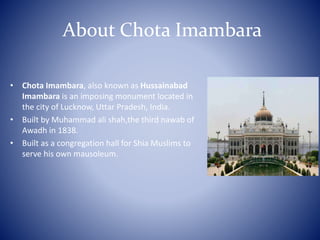
Chota Imambara
About Chota Imambara
• Chota Imambara, also known as Hussainabad
Imambara is an imposing monument located in
the city of Lucknow, Uttar Pradesh, India.
• Built by Muhammad ali shah,the third nawab of
Awadh in 1838.
• Built as a congregation hall for Shia Muslims to
serve his own mausoleum.
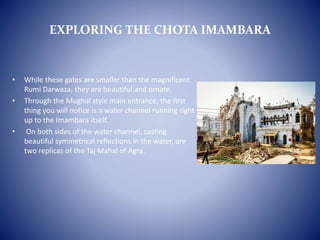
EXPLORING THE CHOTA IMAMBARA
• While these gates are smaller than the magnificent
Rumi Darwaza, they are beautiful and ornate.
• Through the Mughal style main entrance, the first
thing you will notice is a water channel running right
up to the Imambara itself.
• On both sides of the water channel, casting
beautiful symmetrical reflections in the water, are
two replicas of the Taj Mahal of Agra.
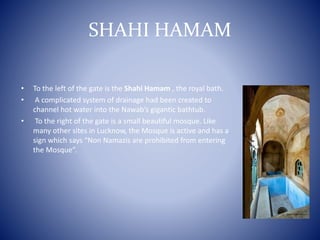
SHAHI HAMAM
• To the left of the gate is the Shahi Hamam , the royal bath.
• A complicated system of drainage had been created to
channel hot water into the Nawab’s gigantic bathtub.
• To the right of the gate is a small beautiful mosque. Like
many other sites in Lucknow, the Mosque is active and has a
sign which says “Non Namazis are prohibited from entering
the Mosque”.
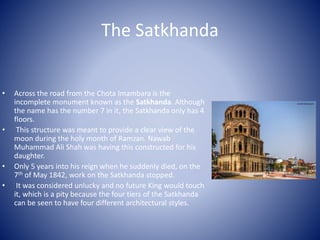
The Satkhanda
• Across the road from the Chota Imambara is the
incomplete monument known as the Satkhanda. Although
the name has the number 7 in it, the Satkhanda only has 4
floors.
• This structure was meant to provide a clear view of the
moon during the holy month of Ramzan. Nawab
Muhammad Ali Shah was having this constructed for his
daughter.
• Only 5 years into his reign when he suddenly died, on the
7th of May 1842, work on the Satkhanda stopped.
• It was considered unlucky and no future King would touch
it, which is a pity because the four tiers of the Satkhanda
can be seen to have four different architectural styles.
ROOMIDARWAZA
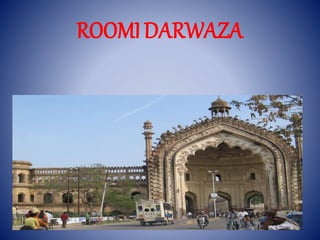
ROOMI DARWAZA
Constructed in the year 1784
by Nawab Asaf-ud-daula.
Construction completed by
1786.
Example of the fine
architectural style of Awadh.
Also known by the name of
“Turkish Gateway”.
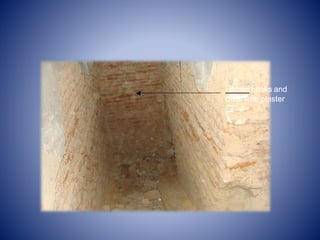
Construction material----
lakhori bricks, brown lime.
Height--- 60 feet.
Uppermost part---- octagonal Chatri
(Umbrella) carved beautifully,
approachable by a staircase.
The word "Roomi" is derived from the
modern day Rome that used to be Istanbul
(capital city of Eastern Roman Empire).
 Finest gateway built in Lucknow.
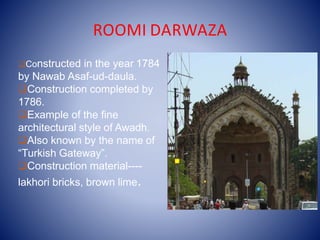
Highly inspired by a similar gateway in
Istanbul.
CHATTRI

Surmounted by an
elaborate cupola.
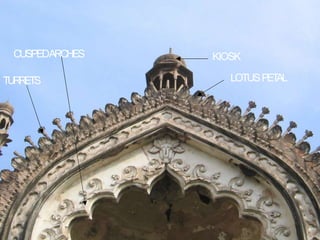
• Flanked by low curtain walls pierced by cusped
windows.
• Octagonal bastions at the sides.
• Floral motifs crowning the apex of the inner arch.
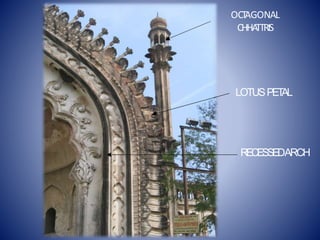
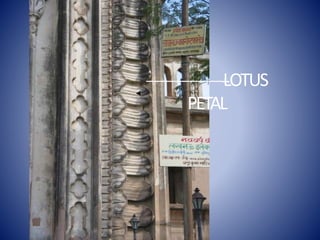
• Bold and broad lotus petals altered by solid turrets with
floral patterns on the outer arch.
• Mughal element is noticeable in minarets, crowned by
octagonal chhatris.
• Apex of the outer arch crowned by an octagonal domed
kiosk, adding symmetry and grandeur.
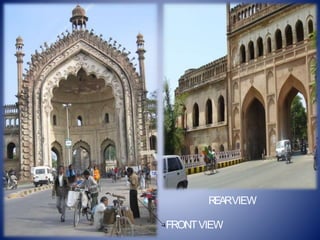
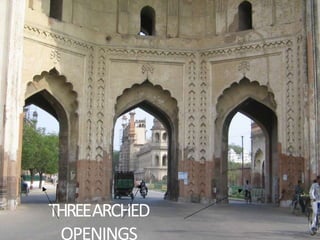
• Western side of gateway--- 3 arched openings.







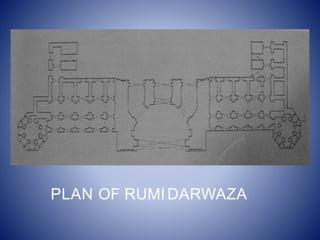
PLAN OF RUMIDARWAZA
CUSPEDARCHES KIOSK
LOTUSPETALTURRETS
REARVIEW
FRONTVIEW
RECESSEDARCH
OCTAGONAL
CHHATTRIS
LOTUSPETAL
lakhuri bricks and
thick lime plaster
LOTUS
PETAL
THREEARCHED
OPENINGS
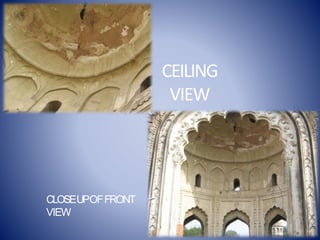
CEILING
VIEW
CLOSEUPOFFRONT
VIEW
TURRETSWITHFLORAL
PATTERN
CHAT
TRI
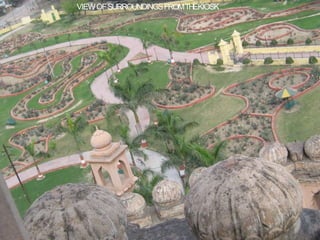
VIEWOFSURROUNDINGSFROMTHEKIOSK
CHATTAR MANZIL
CHATTAR MANZIL
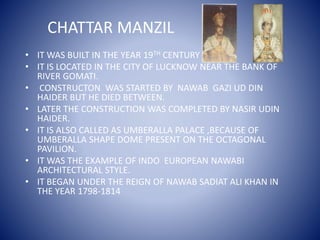
• IT WAS BUILT IN THE YEAR 19TH CENTURY .
• IT IS LOCATED IN THE CITY OF LUCKNOW NEAR THE BANK OF
RIVER GOMATI.
• CONSTRUCTON WAS STARTED BY NAWAB GAZI UD DIN
HAIDER BUT HE DIED BETWEEN.
• LATER THE CONSTRUCTION WAS COMPLETED BY NASIR UDIN
HAIDER.
• IT IS ALSO CALLED AS UMBERALLA PALACE ,BECAUSE OF
UMBERALLA SHAPE DOME PRESENT ON THE OCTAGONAL
PAVILION.
• IT WAS THE EXAMPLE OF INDO EUROPEAN NAWABI
ARCHITECTURAL STYLE.
• IT BEGAN UNDER THE REIGN OF NAWAB SADIAT ALI KHAN IN
THE YEAR 1798-1814
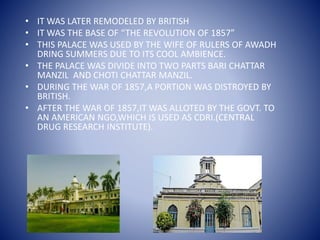
• IT WAS LATER REMODELED BY BRITISH
• IT WAS THE BASE OF “THE REVOLUTION OF 1857”
• THIS PALACE WAS USED BY THE WIFE OF RULERS OF AWADH
DRING SUMMERS DUE TO ITS COOL AMBIENCE.
• THE PALACE WAS DIVIDE INTO TWO PARTS BARI CHATTAR
MANZIL AND CHOTI CHATTAR MANZIL.
• DURING THE WAR OF 1857,A PORTION WAS DISTROYED BY
BRITISH.
• AFTER THE WAR OF 1857,IT WAS ALLOTED BY THE GOVT. TO
AN AMERICAN NGO,WHICH IS USED AS CDRI.(CENTRAL
DRUG RESEARCH INSTITUTE).
ARCHITECTURAL FEATURE
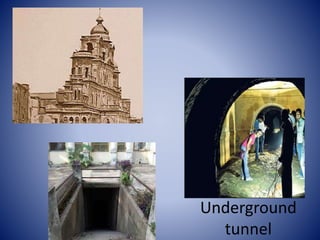
• IT WAS HAVING UNDER GROUND TUNNEL , THAT WAS
USED AS AN ESCAPE ROUTES.
• IT WAS HAVE AN MULTI CIRCULAR ARCH.
• IT WAS HAVING A PILLARED BALCONY WHICH WAS USED BY
NAWAB TO VIEW THE GOMTI RIVER
• IT IS ALSO CALLED AS UMBERALLA PALACE ,BECAUSE OF
UMBERALLA SHAPE DOME, ON THE OCTAGONAL PAVILION.
• MATERIAL USED- LIMESTONE AND LAKHAURI BRICKS.
• CLEAR STORY WINDOWS WERE USED IN THE PALACE FOR
NATURAL LIGHT,VENTILATION AND FOR THE COOL
AMBIENCE.
• THE DOORS AND WINDOWS WERE USED OF EUROPEAN
STYLE.
Underground
tunnel
DILKUSHA KOTHI
INTRODUCTION
• THIS HOUSE WAS CONSTRUCTED BY BRITISH
ARCHITECT GORE OUSELYE WHO WAS THE FRIEND
OF NAWAB SAADAT ALI KHAN
• IT WAS USED AS A FARMHOUSE FOR THE NAWAB
WHEN HE WENT FOR HUNTING
• AFTER THE ATTACK OF THE BRITISH ARMY IS WAS
GIVEN TO THE VICEROY OF AWADH
• IT WAS BUILT IN 18TH CENTURY AND WAS
COMPLETED IN TH YEAR 1805 AND WAS
DEMOLISHED IN THE YEAR 1888
• IT IS HAVING AND AWADH BAROQUE STYLE
• IT IS FOUND IN THE CITY OF LUCKNOW
ARCHITECTURAL FEATURE
• IT WAS MADE FORM LAKHAURI BRICK AND LIME
MOTAR
• IT WAS HAVING SAMLL BULIDING NEAR IT WHICH
SERVED AS THE STABLE FOR HORSES
• THIS KHOTI WAS A THREE STORIED BUILDING WHICH
WAS HAVING FOUR TOWERS
• IT WAS HAVING SPIRAL STAIRCASE
• IT WAS HAVING A LARGE CANTILIVER BALCONY IN THE
SECOND FLOOR WHICH WAS SUPPORTED BY LARGE
COLUMNS
• IT WAS HAVIN IONIC STYLE PILLAR
Oudh architecture

Oudh architecture

  • 1.
  • 2.
    • Awadh---- aregion in the centre Uttar Pradesh. • Capital---- Lucknow. • It was established in 16th-century under Mughal emperor Akbar • Dialect---- Awadhi, spoken by Awadhis. • Saadat Khan Burhanul Mulk (NAWAB)---- laid the foundation of the Awadh dynasty. • Many iconic buildings were built in British and Mughal era that shows different styles of architecture Introduction
  • 3.
     Use ofFish as an auspicious and decorative motif especially on Gates .  The use of Chattar (umbrella) as in the Chattar Manzil .  The Baradari ( the twelve doorway pavilions)  Rumi Darwaza, the signature structure of Lucknow  Enclosed Baghs like Sikandar Bagh The following are distinct features of Awadh Architecture : Rumi Darwaza Sikandar Bagh Safed Baradari Chattar (Umbrella) Decorative Motifs
  • 4.
  • 5.
    ASFI IMAMBARA COMPLEX Alsocalled the “Asafi Imambara”. Bara means big, and an imambara is a shrine built by Shia Muslims. Bara Imambara ---- Lucknow, India. Important Nawabi religious building. Built by Asaf-ud-daulah, Nawab of Lucknow, in 1784, Designed by architect Kifayt Ulla . Plan---- 50 m x 16` m Height--- 15 m
  • 6.
    ASFI IMAMBARA COMPLEX . ASFIIMAMBARA COMPLEX- Entrance Gateways Bada Imambada Bhul Bhulaiya Shahi Baoli Asfi Mosque Rumi Darwaza
  • 7.
  • 8.
  • 9.
    ENTRANCE GATEWAYS Two entrancegateways on North- South axis. Triple arched entrance gateways. Arches have 9 cusps. • First gateway leads from the first courtyard to the second. • Second courtyard • Square plan • Circular garden in the centre • Enclosed by arcaded cloisters. • Second gateway • Leads to the main court with the Imambara placed on the South end of the quadrangle
  • 10.
    • No Europeanelements or the use of iron. • Construction of halls and use of vaults show a strong Islamic influence. • The main Imambara consists of a large vaulted central chamber containing the tomb of Asaf-ud- Daula. • Blocked (tunnel) passageway, according to legends, leads to a location near the • Gomti river. • Other passages lead to Faizabad (the former seat of power of the Nawabs), Allahabad and even to Delhi. Bara Imambara
  • 11.
    Bara Imambara • 16feet thick roof. • Weighs nearly 20,000 tons. • Building covered with vaults of very simple forms • Persian architect---- Kifayatullah (also lies buried in the main hall of the Imambara). • The terrace gives a grand view of old Lucknow with numerous mosques and minarets on the horizon
  • 12.
    PERSIAN HALL The PersianHall is the central hall having simply astonishing in proportions. CHINA HALL The China Hall is square at ground level, becomes octagonal at mid- height, and 16 sided at the top. At those top, queen used to come so that no one can see the queen and queen can see everyone. 3 halls under the same roof. Central hall The Persian Hall. The China Hall
  • 13.
    The Kharbooja Hallor the India Hall has been fashioned like a watermelon. Coming to the second floor, the walls of the second floor are such that the voice or even the whispers at one corner of the building can be heard in the entire floor. The roof, common to these halls, is flat and in one piece. • The acoustics are equally marvelous. Even the slightest whisper can be heard at the other corner of the hall. So, all the windows at the top is the first floor of the Imambara. INDIAN HALL
  • 14.
    CONSTRUCTIONMATERIALS • One ofthe most amazing thing about the architecture is that the whole support for the building is hollow and is made of sugarcane juice, jaggery ( ) and udat daal. • The roof of Imam Bara is made up from the rice husk which make this Imambara a unique building. • Except for the galleries in the interior, there is no woodwork in the entire structure. • There is also a blocked (tunnel) passageway which, according to legends, is a secret underground passageway to the other cities. • The whole building is made of Lakhanui bricks (small size bricks) and lime plaster. No wood or metal has been used in the construction .
  • 15.
    BHULBHULAIYAH • Present inthe main imambara building. • 8 surrounding chambers built to different roof heights, • With passages interconnecting through 489 identical doorways Third floor is the famous bhool-bhulaiya or the labyrinth. The first set of steps 45 that lead you to the first level of the Bhul Bhulaiya. The architectural design of this maze has been implemented in such a way that it makes room for good air ventilation and penetration of sunlight
  • 16.
  • 17.
    SHAHI BAOLI (STEPWELL) BAOLI • Five- storied baoli (step well) . • Called the Shahi-Hammam (royal bath). • Baoli is connected with the river Gomti. • Only first two stories above water, the rest being perennially under water. • Used as summer palaces due to natural coolness “Shahi Baoli”---- eastern side of the Asafi Imambara complex. • Deep circular well at the eastern end. Approached through a flight of steps and a door facing west. • Material---- Lakhauri brick and lime mortar.
  • 18.
    SHAHI BAOLI (STEPWELL) BAOLI • Entrance---- high portal haying an unornamented arch (Mehrab). • Series of stairs descending down to the water reservoir. • On either flanks are rows of three storeyed Mehrabs. • Water flows in to the baoli through a large ‘Shah-Jahan’ Mehrab. • Multi--chambered summer place in the interior.
  • 19.
    Opening For TheLight in The Stairs Main Gate Of Baoli From Inside Corridor Of Baoli SHAHI BAOLI (STEP WELL) BAOLI
  • 20.
    ASFI MOSQUE • Mosquewithin the Imambada courtyard • Elegant structure • Flanked by a grand flight of steps leading to its paved floor. • Located in the west of the main courtyard. • Due to Quibla orientation (towards Mecca) its axiality strikes a discord with that of the Bara Imambara.
  • 21.
  • 22.
  • 23.
    About Chota Imambara •Chota Imambara, also known as Hussainabad Imambara is an imposing monument located in the city of Lucknow, Uttar Pradesh, India. • Built by Muhammad ali shah,the third nawab of Awadh in 1838. • Built as a congregation hall for Shia Muslims to serve his own mausoleum.
  • 24.
    EXPLORING THE CHOTAIMAMBARA • While these gates are smaller than the magnificent Rumi Darwaza, they are beautiful and ornate. • Through the Mughal style main entrance, the first thing you will notice is a water channel running right up to the Imambara itself. • On both sides of the water channel, casting beautiful symmetrical reflections in the water, are two replicas of the Taj Mahal of Agra.
  • 25.
    SHAHI HAMAM • Tothe left of the gate is the Shahi Hamam , the royal bath. • A complicated system of drainage had been created to channel hot water into the Nawab’s gigantic bathtub. • To the right of the gate is a small beautiful mosque. Like many other sites in Lucknow, the Mosque is active and has a sign which says “Non Namazis are prohibited from entering the Mosque”.
  • 26.
    The Satkhanda • Acrossthe road from the Chota Imambara is the incomplete monument known as the Satkhanda. Although the name has the number 7 in it, the Satkhanda only has 4 floors. • This structure was meant to provide a clear view of the moon during the holy month of Ramzan. Nawab Muhammad Ali Shah was having this constructed for his daughter. • Only 5 years into his reign when he suddenly died, on the 7th of May 1842, work on the Satkhanda stopped. • It was considered unlucky and no future King would touch it, which is a pity because the four tiers of the Satkhanda can be seen to have four different architectural styles.
  • 27.
  • 28.
    ROOMI DARWAZA Constructed inthe year 1784 by Nawab Asaf-ud-daula. Construction completed by 1786. Example of the fine architectural style of Awadh. Also known by the name of “Turkish Gateway”. Construction material---- lakhori bricks, brown lime.
  • 29.
    Height--- 60 feet. Uppermostpart---- octagonal Chatri (Umbrella) carved beautifully, approachable by a staircase. The word "Roomi" is derived from the modern day Rome that used to be Istanbul (capital city of Eastern Roman Empire).  Finest gateway built in Lucknow. Highly inspired by a similar gateway in Istanbul. CHATTRI
  • 30.
     Surmounted by an elaboratecupola. • Flanked by low curtain walls pierced by cusped windows. • Octagonal bastions at the sides. • Floral motifs crowning the apex of the inner arch. • Bold and broad lotus petals altered by solid turrets with floral patterns on the outer arch. • Mughal element is noticeable in minarets, crowned by octagonal chhatris. • Apex of the outer arch crowned by an octagonal domed kiosk, adding symmetry and grandeur. • Western side of gateway--- 3 arched openings.       
  • 31.
  • 32.
  • 33.
  • 34.
  • 35.
  • 36.
  • 37.
  • 38.
  • 39.
  • 40.
  • 41.
  • 42.
    CHATTAR MANZIL • ITWAS BUILT IN THE YEAR 19TH CENTURY . • IT IS LOCATED IN THE CITY OF LUCKNOW NEAR THE BANK OF RIVER GOMATI. • CONSTRUCTON WAS STARTED BY NAWAB GAZI UD DIN HAIDER BUT HE DIED BETWEEN. • LATER THE CONSTRUCTION WAS COMPLETED BY NASIR UDIN HAIDER. • IT IS ALSO CALLED AS UMBERALLA PALACE ,BECAUSE OF UMBERALLA SHAPE DOME PRESENT ON THE OCTAGONAL PAVILION. • IT WAS THE EXAMPLE OF INDO EUROPEAN NAWABI ARCHITECTURAL STYLE. • IT BEGAN UNDER THE REIGN OF NAWAB SADIAT ALI KHAN IN THE YEAR 1798-1814
  • 43.
    • IT WASLATER REMODELED BY BRITISH • IT WAS THE BASE OF “THE REVOLUTION OF 1857” • THIS PALACE WAS USED BY THE WIFE OF RULERS OF AWADH DRING SUMMERS DUE TO ITS COOL AMBIENCE. • THE PALACE WAS DIVIDE INTO TWO PARTS BARI CHATTAR MANZIL AND CHOTI CHATTAR MANZIL. • DURING THE WAR OF 1857,A PORTION WAS DISTROYED BY BRITISH. • AFTER THE WAR OF 1857,IT WAS ALLOTED BY THE GOVT. TO AN AMERICAN NGO,WHICH IS USED AS CDRI.(CENTRAL DRUG RESEARCH INSTITUTE).
  • 44.
    ARCHITECTURAL FEATURE • ITWAS HAVING UNDER GROUND TUNNEL , THAT WAS USED AS AN ESCAPE ROUTES. • IT WAS HAVE AN MULTI CIRCULAR ARCH. • IT WAS HAVING A PILLARED BALCONY WHICH WAS USED BY NAWAB TO VIEW THE GOMTI RIVER • IT IS ALSO CALLED AS UMBERALLA PALACE ,BECAUSE OF UMBERALLA SHAPE DOME, ON THE OCTAGONAL PAVILION. • MATERIAL USED- LIMESTONE AND LAKHAURI BRICKS. • CLEAR STORY WINDOWS WERE USED IN THE PALACE FOR NATURAL LIGHT,VENTILATION AND FOR THE COOL AMBIENCE. • THE DOORS AND WINDOWS WERE USED OF EUROPEAN STYLE.
  • 45.
  • 46.
  • 47.
    INTRODUCTION • THIS HOUSEWAS CONSTRUCTED BY BRITISH ARCHITECT GORE OUSELYE WHO WAS THE FRIEND OF NAWAB SAADAT ALI KHAN • IT WAS USED AS A FARMHOUSE FOR THE NAWAB WHEN HE WENT FOR HUNTING • AFTER THE ATTACK OF THE BRITISH ARMY IS WAS GIVEN TO THE VICEROY OF AWADH • IT WAS BUILT IN 18TH CENTURY AND WAS COMPLETED IN TH YEAR 1805 AND WAS DEMOLISHED IN THE YEAR 1888 • IT IS HAVING AND AWADH BAROQUE STYLE • IT IS FOUND IN THE CITY OF LUCKNOW
  • 48.
    ARCHITECTURAL FEATURE • ITWAS MADE FORM LAKHAURI BRICK AND LIME MOTAR • IT WAS HAVING SAMLL BULIDING NEAR IT WHICH SERVED AS THE STABLE FOR HORSES • THIS KHOTI WAS A THREE STORIED BUILDING WHICH WAS HAVING FOUR TOWERS • IT WAS HAVING SPIRAL STAIRCASE • IT WAS HAVING A LARGE CANTILIVER BALCONY IN THE SECOND FLOOR WHICH WAS SUPPORTED BY LARGE COLUMNS • IT WAS HAVIN IONIC STYLE PILLAR