History of Architecture12th
Sept, 2015
BENGAL ARCHITECTURE
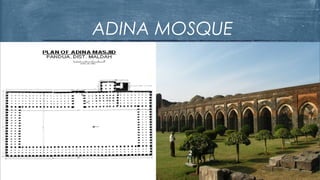
ADINA MOSQUE
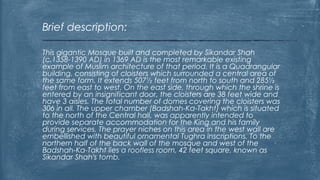
This gigantic Mosque built and completed by Sikandar Shah
(c.1358-1390 AD) in 1369 AD is the most remarkable existing
example of Muslim architecture of that period. It is a Quadrangular
building, consisting of cloisters which surrounded a central area of
the same form. It extends 507½ feet from north to south and 285½
feet from east to west. On the east side, through which the shrine is
entered by an insignificant door, the cloisters are 38 feet wide and
have 3 aisles. The total number of domes covering the cloisters was
306 in all. The upper chamber (Badshah-Ka-Takht) which is situated
to the north of the Central hall, was apparently intended to
provide separate accommodation for the King and his family
during services. The prayer niches on this area in the west wall are
embellished with beautiful ornamental Tughra inscriptions. To the
northern half of the back wall of the mosque and west of the
Badshah-Ka-Takht lies a roofless room, 42 feet square, known as
Sikandar Shah's tomb.
Brief description:
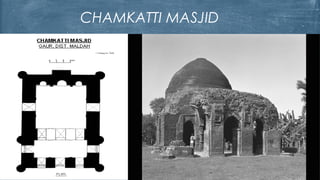
CHAMKATTI MASJID
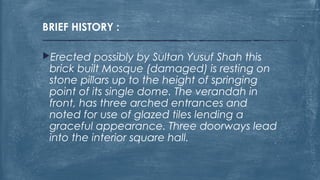
BRIEF HISTORY :
Erected possibly by Sultan Yusuf Shah this
brick built Mosque (damaged) is resting on
stone pillars up to the height of springing
point of its single dome. The verandah in
front, has three arched entrances and
noted for use of glazed tiles lending a
graceful appearance. Three doorways lead
into the interior square hall.
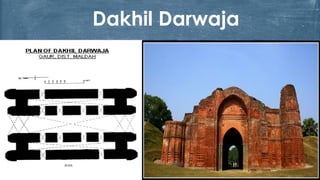
Dakhil Darwaja
BRIEF HISTORY :
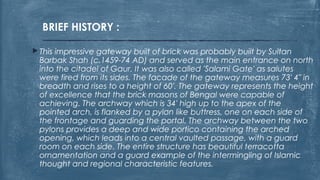
 This impressive gateway built of brick was probably built by Sultan
Barbak Shah (c.1459-74 AD) and served as the main entrance on north
into the citadel of Gaur. It was also called 'Salami Gate' as salutes
were fired from its sides. The facade of the gateway measures 73' 4" in
breadth and rises to a height of 60'. The gateway represents the height
of excellence that the brick masons of Bengal were capable of
achieving. The archway which is 34' high up to the apex of the
pointed arch, is flanked by a pylon like buttress, one on each side of
the frontage and guarding the portal. The archway between the two
pylons provides a deep and wide portico containing the arched
opening, which leads into a central vaulted passage, with a guard
room on each side. The entire structure has beautiful terracotta
ornamentation and a guard example of the intermingling of Islamic
thought and regional characteristic features.
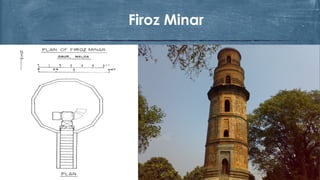
Firoz Minar
BRIEF HISTORY :
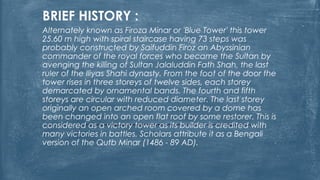
Alternately known as Firoza Minar or 'Blue Tower' this tower
25.60 m high with spiral staircase having 73 steps was
probably constructed by Saifuddin Firoz an Abyssinian
commander of the royal forces who became the Sultan by
avenging the killing of Sultan Jalaluddin Fath Shah, the last
ruler of the Iliyas Shahi dynasty. From the foot of the door the
tower rises in three storeys of twelve sides, each storey
demarcated by ornamental bands. The fourth and fifth
storeys are circular with reduced diameter. The last storey
originally an open arched room covered by a dome has
been changed into an open flat roof by some restorer. This is
considered as a victory tower as its builder is credited with
many victories in battles. Scholars attribute it as a Bengali
version of the Qutb Minar (1486 - 89 AD).
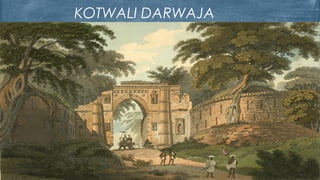
KOTWALI DARWAJA
BRIEF HISTORY :
This magnificent arched gateway top part of which
collapsed long back is the central gate in the south
wall of the city of Gaur. The gateway had a brick
arch 30 feet high and 16 feet vine metes span.
There are battlements on the east and west sides. It
approximates in style to Delhi architecture and was
probably built between the date of the earliest
Muslim inscription found in Gaur, 1235 i.e. the time
of Iltutmish and the death of Alauddin Khalji in 1315
when the influence of Delhi was strong in Lakhnauti
(Gaur). However, there is difference of opinion
among scholars about its date.
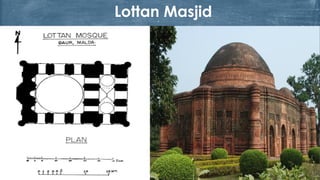
Lottan Masjid
BRIEF HISTORY:
The Mosque was probably built by Sultan
Yusuf Shah (c.1474-81 AD) but traditionally
ascribed to a Royal Courtesan without much
ground. This is a single domed building with a
square chamber and a corridor in front.
There are three arched entrances on the
east and sides. It was once covered with a
enameled brick work of four colors, green,
yellow, blue and white lending a colorful
appearance.
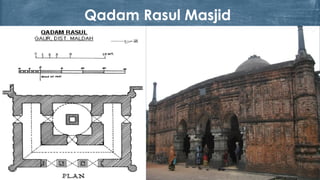
Qadam Rasul Masjid
BRIEF HISTORY :
It is a misnomer to call this a mosque, in
actuality is a building to contain the
prophet's foot prints in stone said to have
been brought by a saint from Arabia. The
building has a central square room with a
wide verandah. The eastern facade is highly
decorated. The central room is covered by a
single dome, crowned with a lotus finial.
There is no mihrab inside. An inscription over
the front door records its erection by Sultan
Nusrat Shah son of Husain Shah in AD 1531.
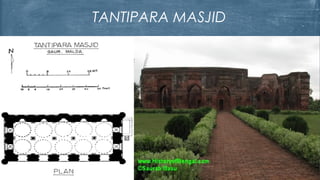
TANTIPARA MASJID
BRIEF HISTORY :
This brick-built Mosque is an oblong building
with stone columns in double aisles and was
originally covered with 10 domes, 5 in each
row. It has also bold floral panels on its
surface.
Its ornamentation is rich and effective, and
the large decorated panels stand out in
high relief against the plain walls. Tanti Para
means the quarter for the weaver class. This
mosque was probably built by Mirshad
Khan in 1480 AD.
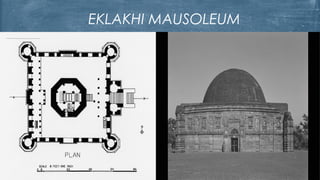
EKLAKHI MAUSOLEUM
BRIEF HISTORY :
This brick built Mausoleum is the most beautiful building in
this place. It forms a square roofed by a dome with a
small turret at each corner. The inside plan of the
structure is octagonal. The walls are exquisitely
ornamented in the outer part by carved tiles and
decorative motifs on bricks. Tradition runs that this
construction cost 1 lakh rupees so the name. Amongst
the three graves inside, one is regarded as tomb of
Sultan Jalaluddin, son of Raja Khans, the other two of his
wife and son Ahmad Shah. There is divergence of
opinion among scholars about the identification and
orientation of the graves. This structure was probably built
in the early c.15th century AD.
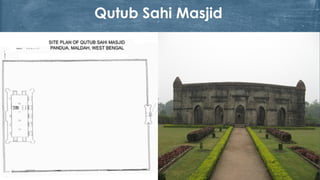
Qutub Sahi Masjid
BRIEF HISTORY :
This Masjid was built by Makhdum Sheikh
in c.1582 AD. It was built of brick and
stone and had ten domes. The roof has
fell down, but the walls and pulpit are
standing. It was called Qutub Shahi
Masjid as a mark of respect to the Saint
Noor Qutb Ul Alam.

Bengal architecture

  • 1.
    History of Architecture12th Sept,2015 BENGAL ARCHITECTURE
  • 2.
  • 3.
    This gigantic Mosquebuilt and completed by Sikandar Shah (c.1358-1390 AD) in 1369 AD is the most remarkable existing example of Muslim architecture of that period. It is a Quadrangular building, consisting of cloisters which surrounded a central area of the same form. It extends 507½ feet from north to south and 285½ feet from east to west. On the east side, through which the shrine is entered by an insignificant door, the cloisters are 38 feet wide and have 3 aisles. The total number of domes covering the cloisters was 306 in all. The upper chamber (Badshah-Ka-Takht) which is situated to the north of the Central hall, was apparently intended to provide separate accommodation for the King and his family during services. The prayer niches on this area in the west wall are embellished with beautiful ornamental Tughra inscriptions. To the northern half of the back wall of the mosque and west of the Badshah-Ka-Takht lies a roofless room, 42 feet square, known as Sikandar Shah's tomb. Brief description:
  • 4.
  • 5.
    BRIEF HISTORY : Erectedpossibly by Sultan Yusuf Shah this brick built Mosque (damaged) is resting on stone pillars up to the height of springing point of its single dome. The verandah in front, has three arched entrances and noted for use of glazed tiles lending a graceful appearance. Three doorways lead into the interior square hall.
  • 6.
  • 7.
    BRIEF HISTORY : This impressive gateway built of brick was probably built by Sultan Barbak Shah (c.1459-74 AD) and served as the main entrance on north into the citadel of Gaur. It was also called 'Salami Gate' as salutes were fired from its sides. The facade of the gateway measures 73' 4" in breadth and rises to a height of 60'. The gateway represents the height of excellence that the brick masons of Bengal were capable of achieving. The archway which is 34' high up to the apex of the pointed arch, is flanked by a pylon like buttress, one on each side of the frontage and guarding the portal. The archway between the two pylons provides a deep and wide portico containing the arched opening, which leads into a central vaulted passage, with a guard room on each side. The entire structure has beautiful terracotta ornamentation and a guard example of the intermingling of Islamic thought and regional characteristic features.
  • 8.
  • 9.
    BRIEF HISTORY : Alternatelyknown as Firoza Minar or 'Blue Tower' this tower 25.60 m high with spiral staircase having 73 steps was probably constructed by Saifuddin Firoz an Abyssinian commander of the royal forces who became the Sultan by avenging the killing of Sultan Jalaluddin Fath Shah, the last ruler of the Iliyas Shahi dynasty. From the foot of the door the tower rises in three storeys of twelve sides, each storey demarcated by ornamental bands. The fourth and fifth storeys are circular with reduced diameter. The last storey originally an open arched room covered by a dome has been changed into an open flat roof by some restorer. This is considered as a victory tower as its builder is credited with many victories in battles. Scholars attribute it as a Bengali version of the Qutb Minar (1486 - 89 AD).
  • 10.
  • 11.
    BRIEF HISTORY : Thismagnificent arched gateway top part of which collapsed long back is the central gate in the south wall of the city of Gaur. The gateway had a brick arch 30 feet high and 16 feet vine metes span. There are battlements on the east and west sides. It approximates in style to Delhi architecture and was probably built between the date of the earliest Muslim inscription found in Gaur, 1235 i.e. the time of Iltutmish and the death of Alauddin Khalji in 1315 when the influence of Delhi was strong in Lakhnauti (Gaur). However, there is difference of opinion among scholars about its date.
  • 12.
  • 13.
    BRIEF HISTORY: The Mosquewas probably built by Sultan Yusuf Shah (c.1474-81 AD) but traditionally ascribed to a Royal Courtesan without much ground. This is a single domed building with a square chamber and a corridor in front. There are three arched entrances on the east and sides. It was once covered with a enameled brick work of four colors, green, yellow, blue and white lending a colorful appearance.
  • 14.
  • 15.
    BRIEF HISTORY : Itis a misnomer to call this a mosque, in actuality is a building to contain the prophet's foot prints in stone said to have been brought by a saint from Arabia. The building has a central square room with a wide verandah. The eastern facade is highly decorated. The central room is covered by a single dome, crowned with a lotus finial. There is no mihrab inside. An inscription over the front door records its erection by Sultan Nusrat Shah son of Husain Shah in AD 1531.
  • 16.
  • 17.
    BRIEF HISTORY : Thisbrick-built Mosque is an oblong building with stone columns in double aisles and was originally covered with 10 domes, 5 in each row. It has also bold floral panels on its surface. Its ornamentation is rich and effective, and the large decorated panels stand out in high relief against the plain walls. Tanti Para means the quarter for the weaver class. This mosque was probably built by Mirshad Khan in 1480 AD.
  • 18.
  • 19.
    BRIEF HISTORY : Thisbrick built Mausoleum is the most beautiful building in this place. It forms a square roofed by a dome with a small turret at each corner. The inside plan of the structure is octagonal. The walls are exquisitely ornamented in the outer part by carved tiles and decorative motifs on bricks. Tradition runs that this construction cost 1 lakh rupees so the name. Amongst the three graves inside, one is regarded as tomb of Sultan Jalaluddin, son of Raja Khans, the other two of his wife and son Ahmad Shah. There is divergence of opinion among scholars about the identification and orientation of the graves. This structure was probably built in the early c.15th century AD.
  • 20.
  • 21.
    BRIEF HISTORY : ThisMasjid was built by Makhdum Sheikh in c.1582 AD. It was built of brick and stone and had ten domes. The roof has fell down, but the walls and pulpit are standing. It was called Qutub Shahi Masjid as a mark of respect to the Saint Noor Qutb Ul Alam.