Joseph Allen Stein
Submitted to
Ar. Preeti bhatia.
Submitted by
Gaurav bhatt
B.Arch (3 year)
1461567.
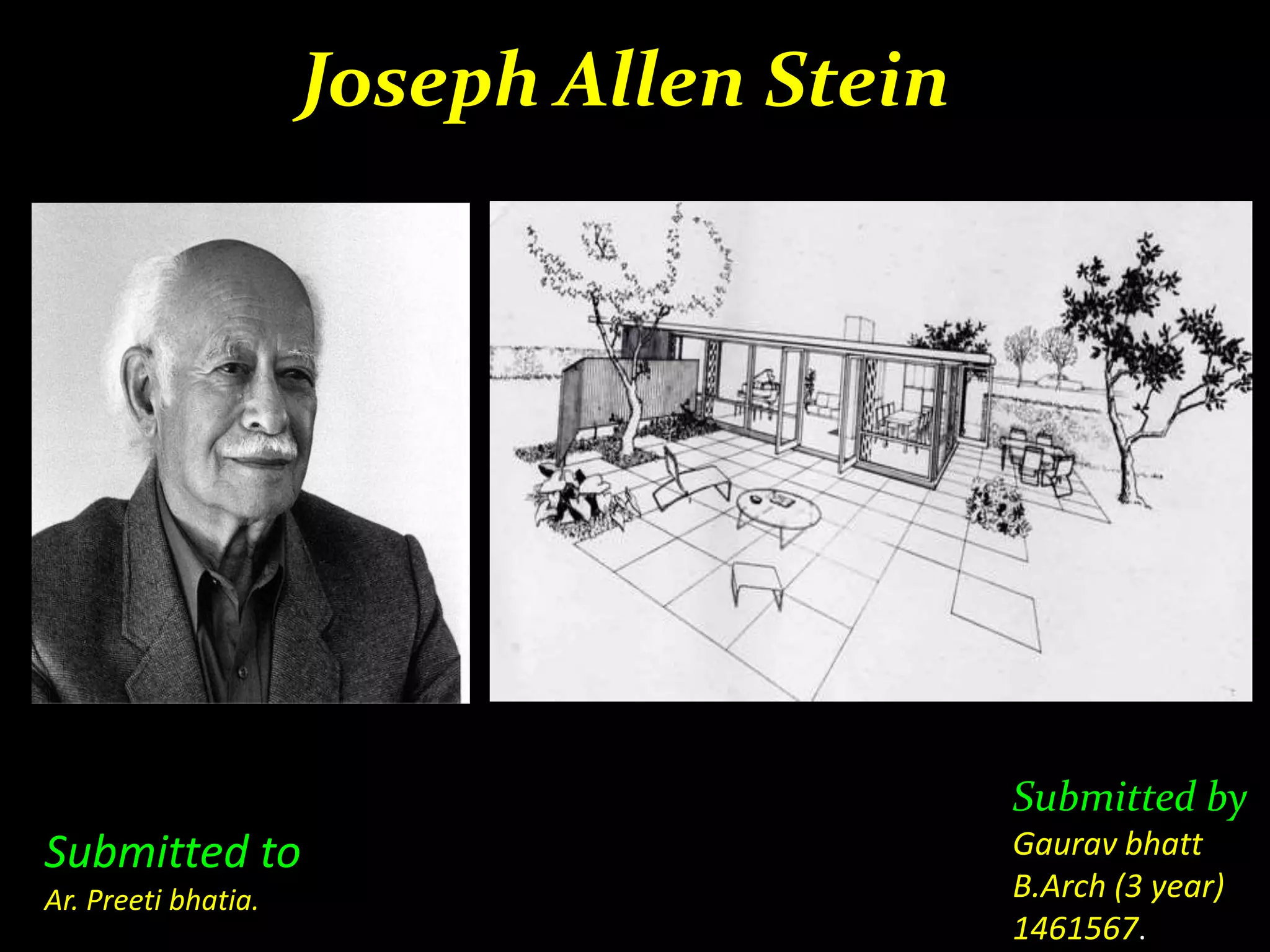
Joseph Allen Stein
• Joseph Stein, (10 April 1912 – 6 October 2001)
• He was an American architect.
• Major figure in the establishment of a regional modern architecture in the San
Francisco Bay area in the 1940s and 1950s during the early days of the
environmental design movement.
• In 1952 he moved to India.
• He is noted for designing several important buildings in India, most notably
in Lodhi Estate in Central Delhi, nicknamed "Steinabad“.
• After him, and where today the 'Joseph Stein Lane', is the only road in Delhi
named after an architect.
• The Government of India awarded him the fourth highest civilian award of
Padma Shri in 1992.
BIOGRAPHY
• Joseph Allen Stein was born on 10 April 1912, in Omaha, Nebraska.
• He studied architecture at the University of Illinois, in Paris and
the Cranbrook Academy of Art.
• He worked for Eli Jacques Kahn in New York and with Richard Neutra in
Los Angeles, before establishing his own practice in San Francisco.
• In San Francisco, he designed modest homes in the California style, but also
became increasingly interested in the issues of low cost housing.
• In 1952 he moved to India, and became head of the department of architecture
at the Bengal Engineering College in Calcutta.
• He worked in New Delhi from 1955 onwards, starting with another American
architect, Benjamin Polk and even after retirement in 1995, continued to
design for the architecture firm he founded.
• Over the year, he brought in 'California modernism' to several buildings he
designed and working classes.
philosophy
• Mr. Stein brought a california modernism sensitivity to the
country. His approach is called modern regionalism.
• According to him “regional without modern
is reactionary, and modern without regional
is insensitive, inappropriate.”
Which means…….
• Building should reflect the culture and tradition
of its region through its design and materials.
EXAMPLES
Critical Regionalism in architecture
• In the early 20th century came the
intellectual movement of Modernism,
which was all about rationality, logic and
efficiency. Slogans like "less is more" and
"form follows function" originated in this
era of design.
• In the field of architecture, all forms of
ornamentation were seen as wasteful,
decadent, and generally useless
• This style became known as
the International Style.
Postmodernism.
• After Modernism settled into the mainstream
and the International Style became the dominant
architectural style throughout the world.
• People began to realize that these rational,
identity-less modernist buildings were extremely
boring.
• A new school of thought emerged as a reaction to
this boringness: Postmodernism.
• This new movement celebrated ornament as
essential to architecture, and postmodern
designers freely combined decorative elements
from all eras and styles to create chaotic,
colorful and whimsical buildings.
philosophy
• His second guiding factor was to seek the character of the
solution in the nature of the problem.`
• how building related to the site.”
philosophy
• Mr Stein’s designs were modernistic, but inspired by India’s past.
• He was good at working with local materials, be it granite or
glazed tiles, both influences of Tughlaq architecture. He also used
jalis in most of his works.
• In the wider landscape of nature, he used local materials where he
tried to merge his buildings with nature
philosophy
• He typically designed two- to four-
storey buildings that fused with the
surrounding trees, gardens and pools;
flowers and vines would spill over the
walls.
• He would have vertical gardens,
courtyards covered with trees and
plants, ponds blooming with lotuses,
and vast landscaped lawns. He was
described as “building in the garden”.
His thoughts:-
• Two things have essentially guided my work. One is what you
might call an interest in and search for an appropriate modern
regionalism. I would put equal emphasis on both words, 'regional'
and 'modern', because regional without modern is reactionary, and
modern without regional is insensitive, inappropriate. The second
one is to seek the character of the solution in the nature of the
problem, as much as one possibly can.
• - J A Stein
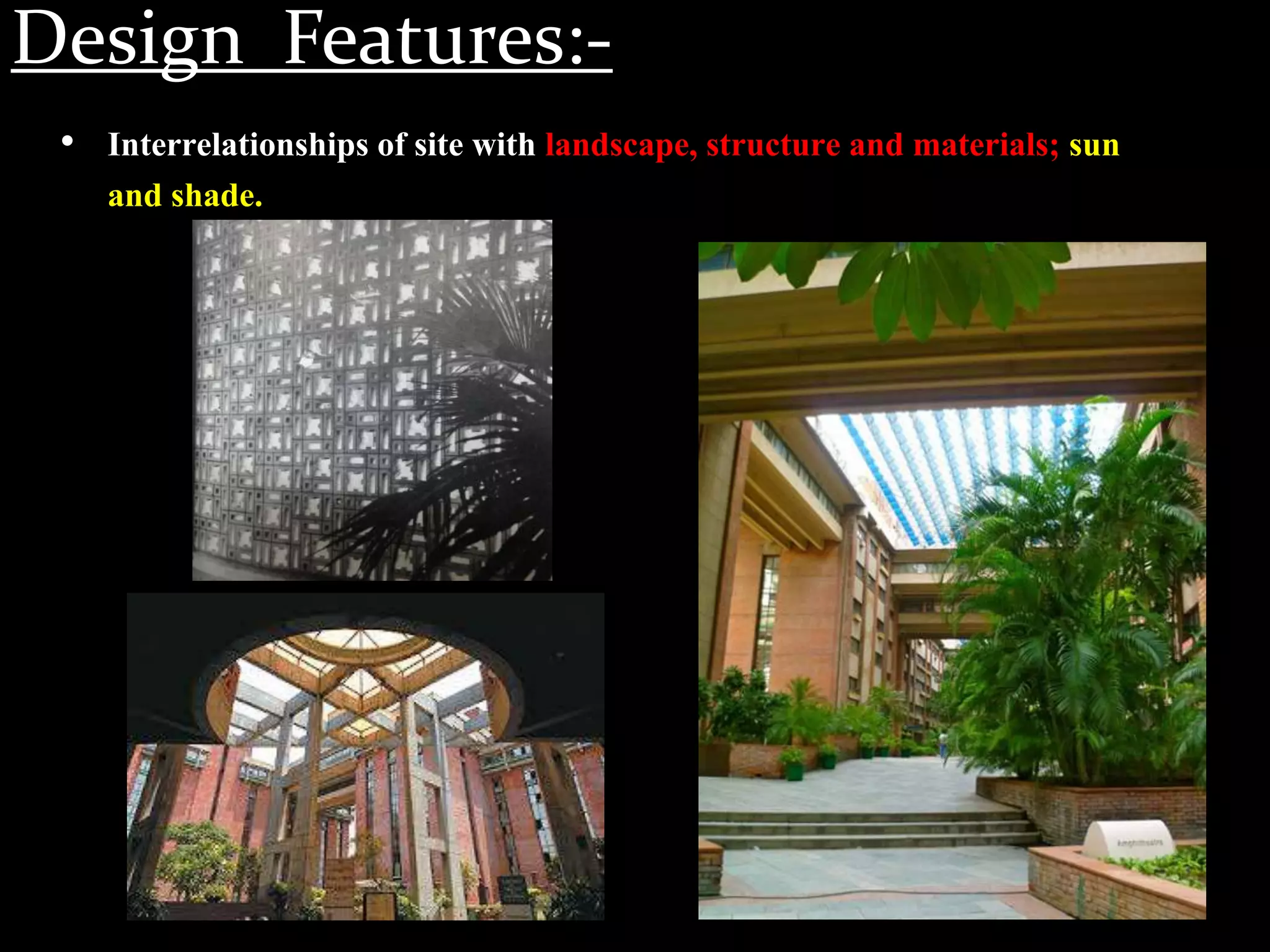
Design Features:-
• Interrelationships of site with landscape, structure and
materials; sun and shade.
• Horizontal and vertical Garden.
• Use of local material.
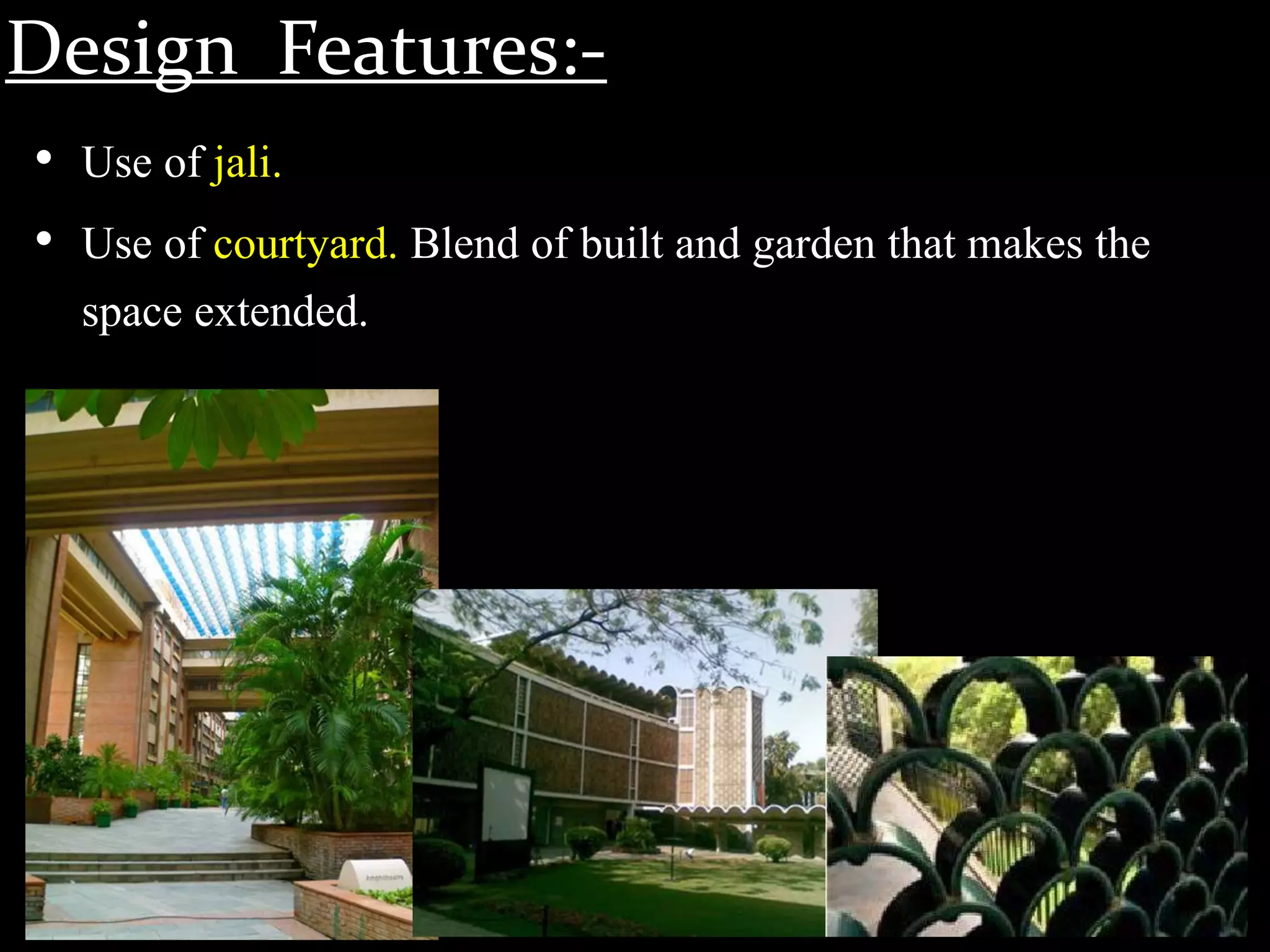
• Use of jali.
• Use of courtyard. Blend of built and garden that makes the
space extended.
• Use of modern construction techniques.
• Shell geometries – Dome, Vault and factory roof system.
Design Features:-
• Interrelationships of site with landscape, structure and materials; sun
and shade.
Design Features:-
• Horizontal and vertical Garden.
Design Features:-
(meterials)
• Use of local material.
• granite or glazed tiles,
• Exposed brickwork
• Precast concrete panels
• Local stone
• Cast concrete jalis.
• Blue and green ceramic tiles `
Design Features:-
• Use of jali.
• Use of courtyard. Blend of built and garden that makes the
space extended.
Design Features:-
• Use of modern construction techniques.
• Shell geometries – Dome, Vault and factory roof system
Hyperbolic parabolic lattice shell
Barrel vault lattice shell
Octagonal steel lattice domes,
Popular Buildings
• American international school
• Gandhi-King Plaza
• Triveni Kala Sangam.
• Indian express tower
• Lodhi Estate.
• Ford foundation head quarters
• UNICEF building
• India international centre
• India Habitat centre
INDIA INTERNATIONAL CENTRE
• IIC facilities for a variety of
artistic and scholarly
activities, conference and
symposia organized by nation
and international groups.
• The centre’s 18600 square
meter(4.6acres) site at Lodi
estate was designed
• so that the grounds of the IIC
and adjacent Lodi gardens
could function as one entity.
PLAN
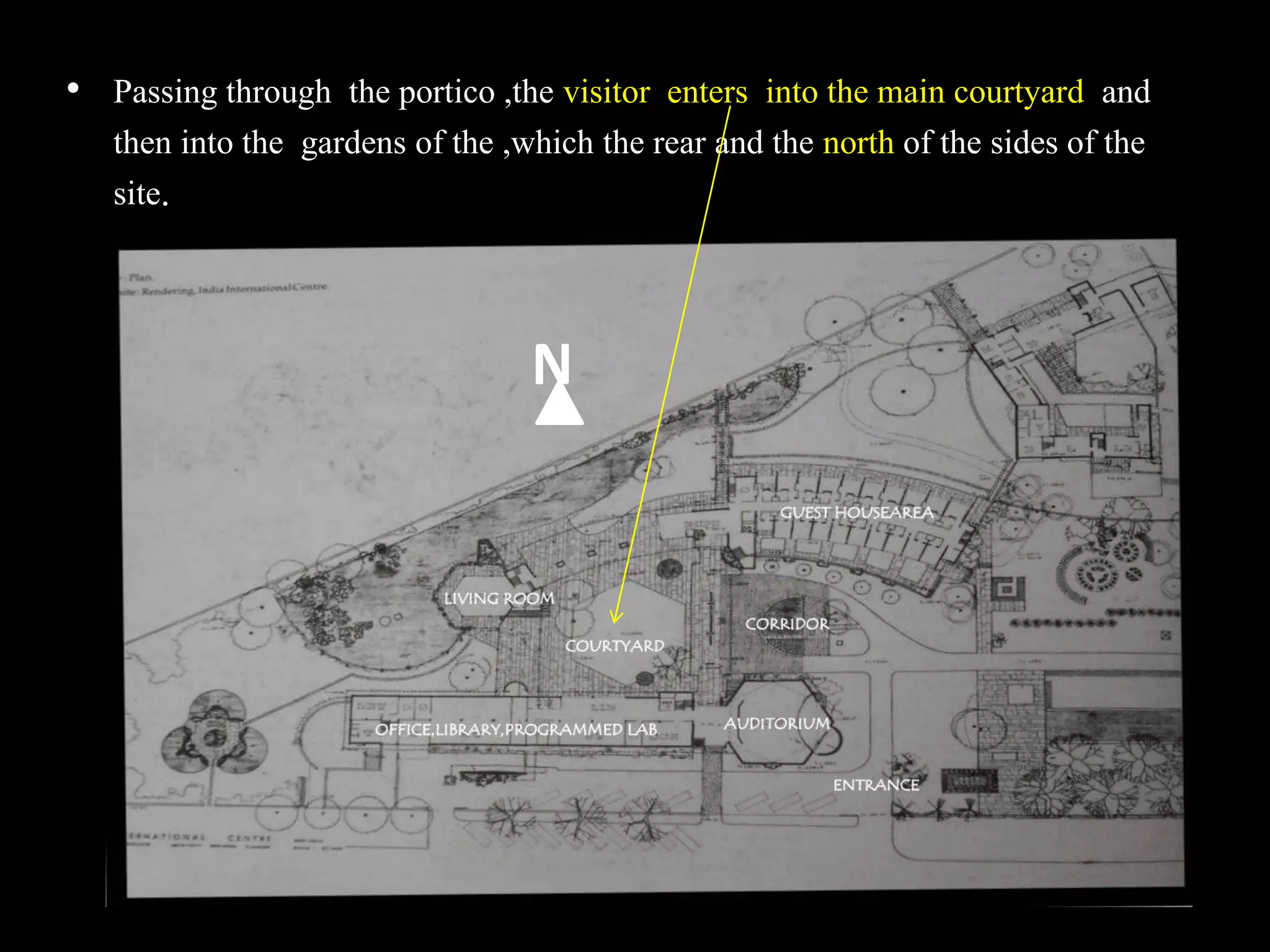
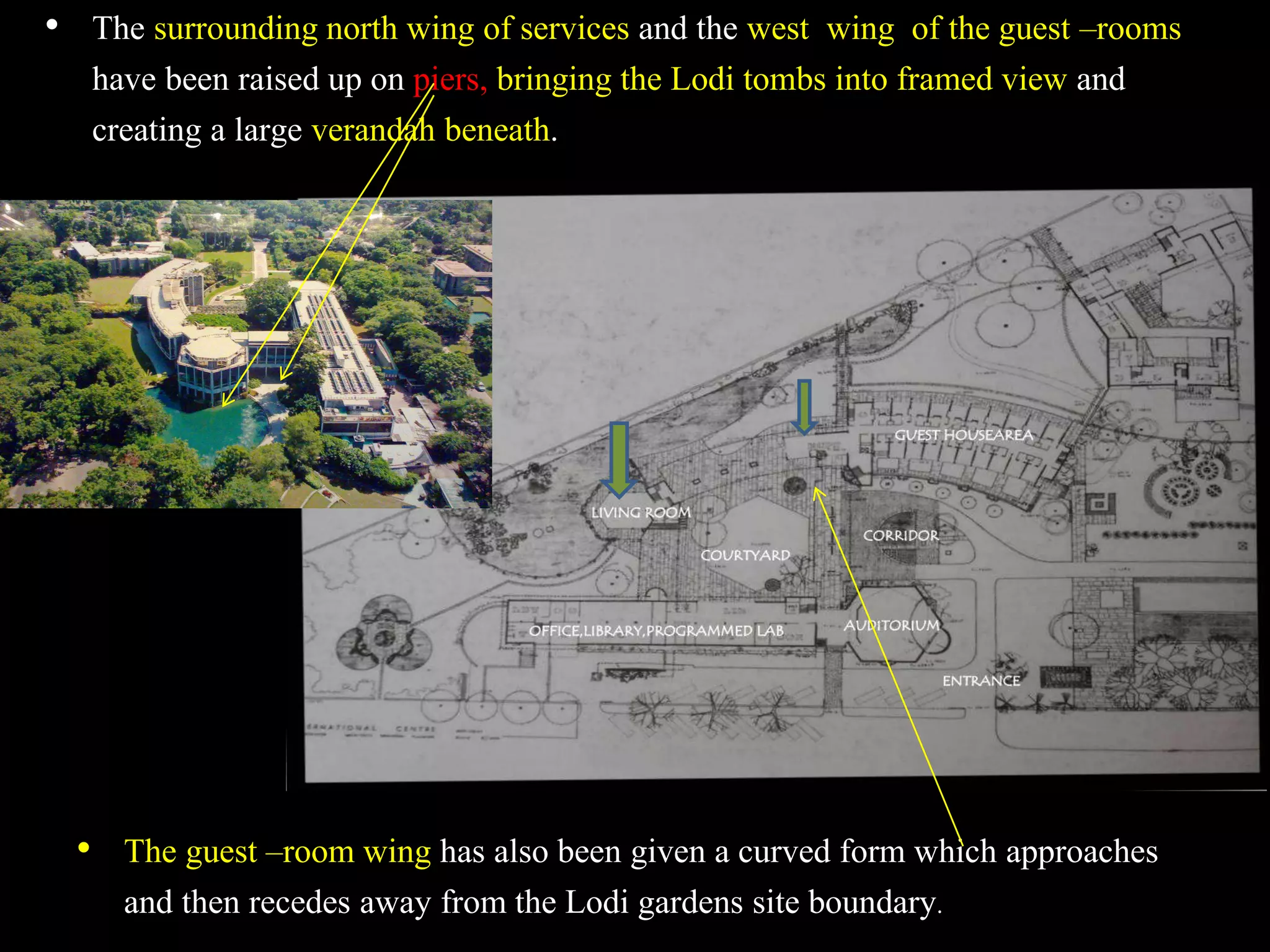
• The first, or entrance court, provides access on the north side to
the guest room
• On the south to the auditorium and programmed block of library
and offices .
N
• Passing through the portico ,the visitor enters into the main courtyard and
then into the gardens of the ,which the rear and the north of the sides of the
site.
N
• The guest –room wing has also been given a curved form which approaches
and then recedes away from the Lodi gardens site boundary.
• The surrounding north wing of services and the west wing of the guest –rooms
have been raised up on piers, bringing the Lodi tombs into framed view and
creating a large verandah beneath.
N
COURTYARD AND GARDENS
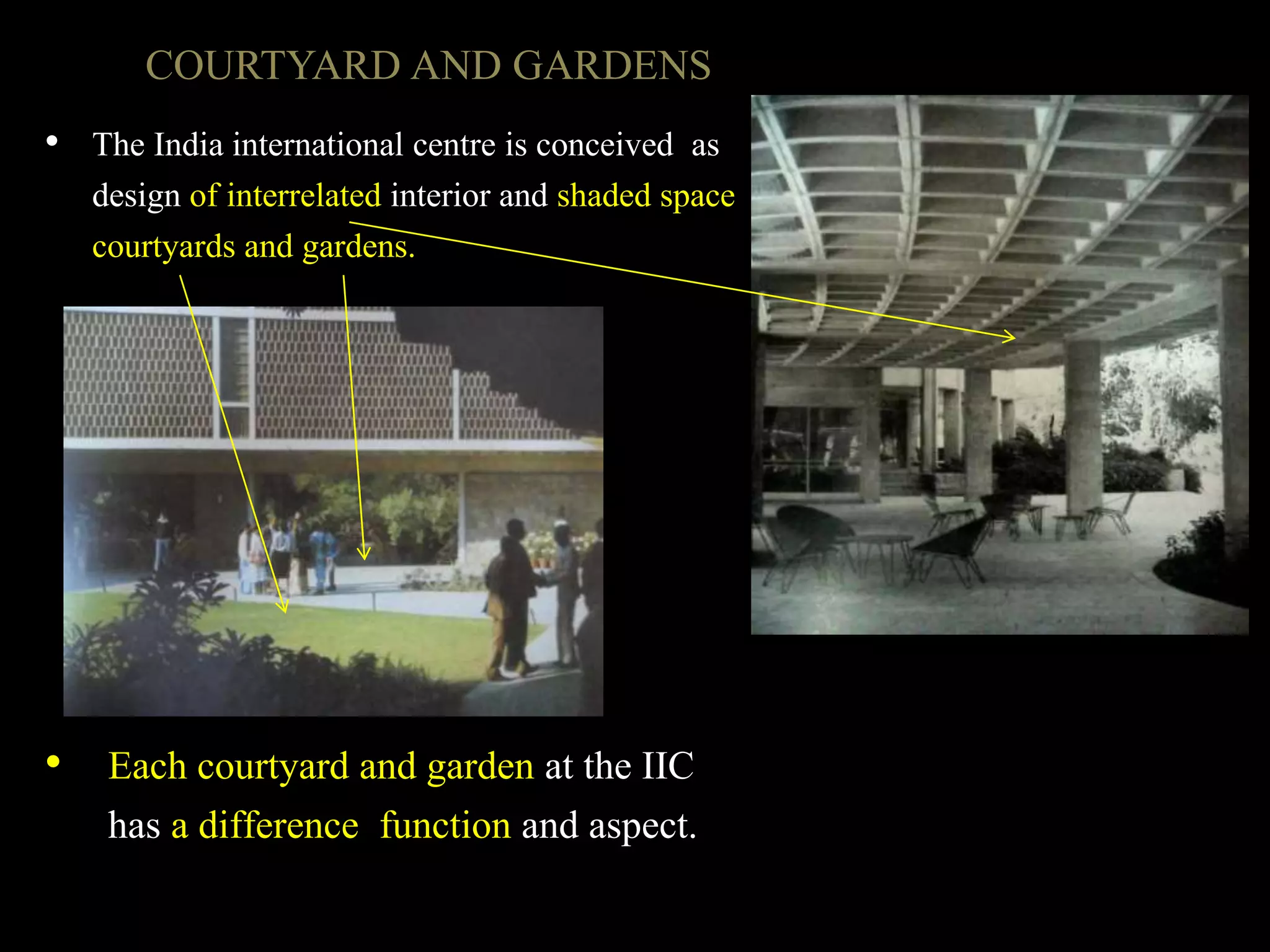
• The India international centre is conceived as
design of interrelated interior and shaded space
courtyards and gardens.
• Each courtyard and garden at the IIC
has a difference function and aspect.
CONSTRUCTION
• The construction methods and
procedures employed in the building of
the India international centre were
typical of the methods and skill levels
available in India at the time of
construction(1958-62).
• The pre-casting of some of the elements
on the ground was undertaken in order
to ensure high –quality construction,
both in terms of structural integrity and
finish.
• The IIC is virtually a hand-made
building.
India habitat centre
Introduction
• It is a complex of institutional and office
spaces , conferences and library facility
for groups involved with environment
and habitat issues
• The concept of IHC is based on
environmental and regional planning
energy and its judicious use, relevance
of technology, transport and
communication, lifestyle social and
cultural linkage, fiscal policies, legal and
management system and information
technology
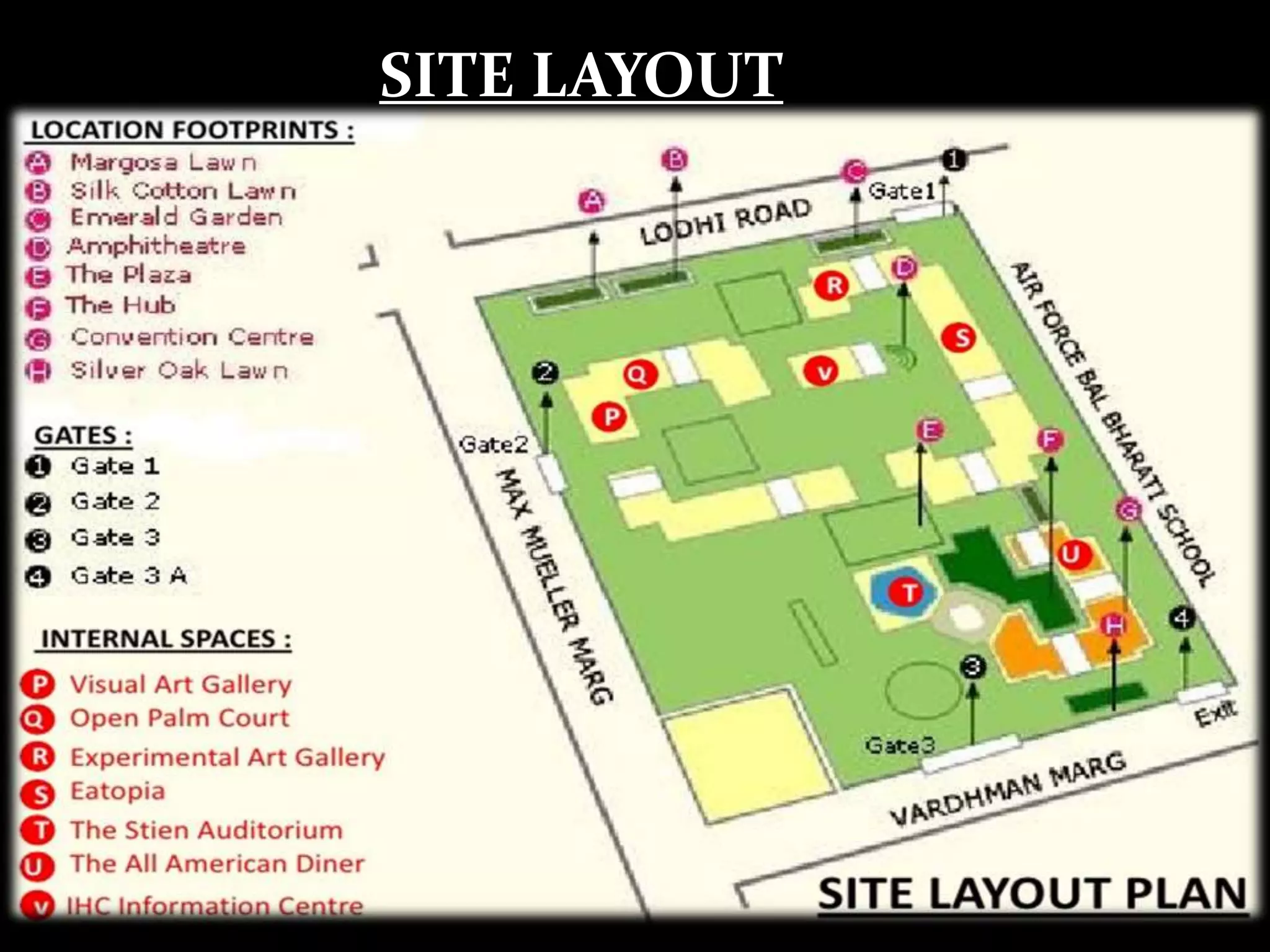
SITE LAYOUT
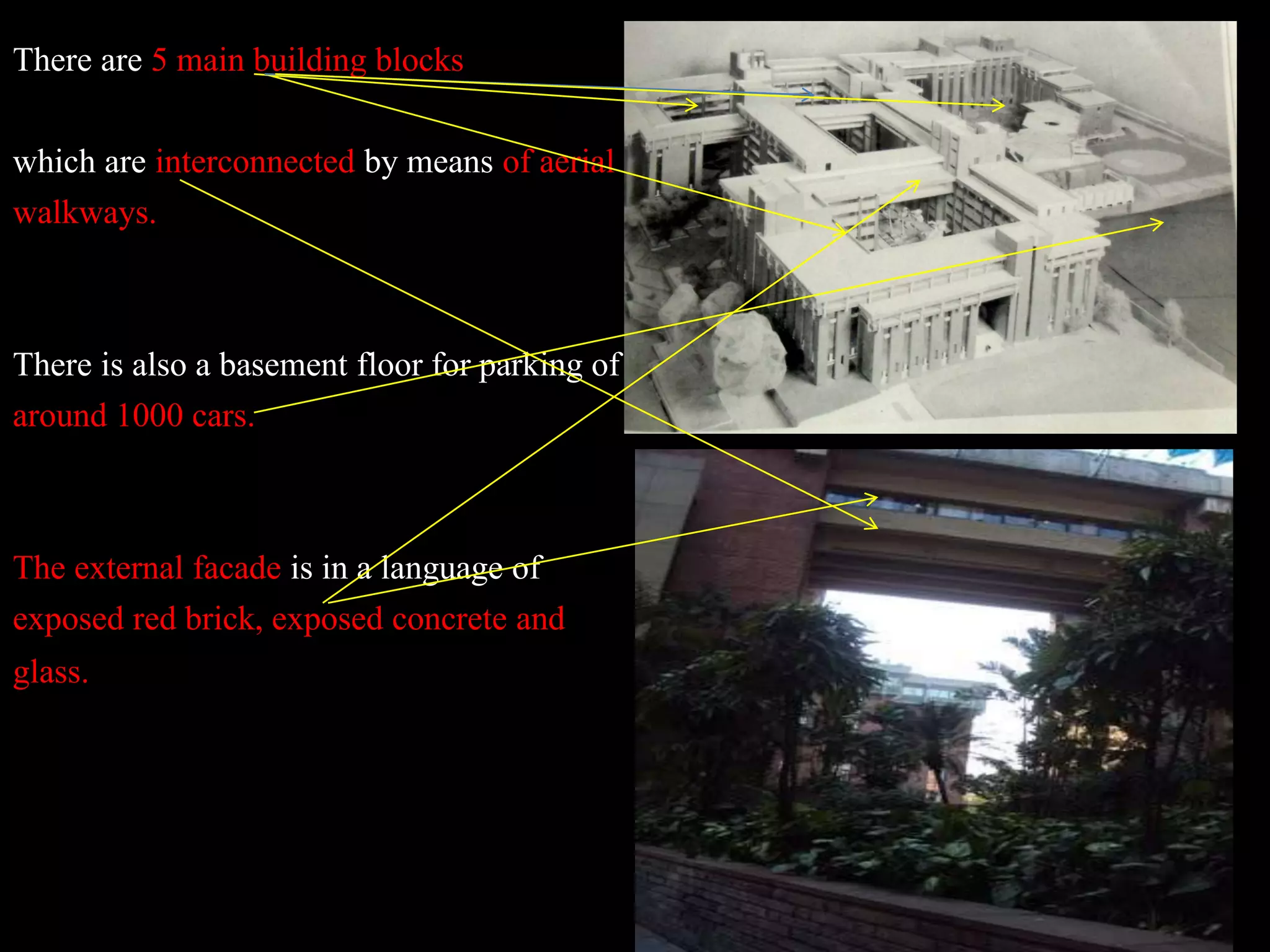
There are 5 main building blocks
which are interconnected by means of aerial
walkways.
There is also a basement floor for parking of
around 1000 cars.
The external facade is in a language of
exposed red brick, exposed concrete and
glass.
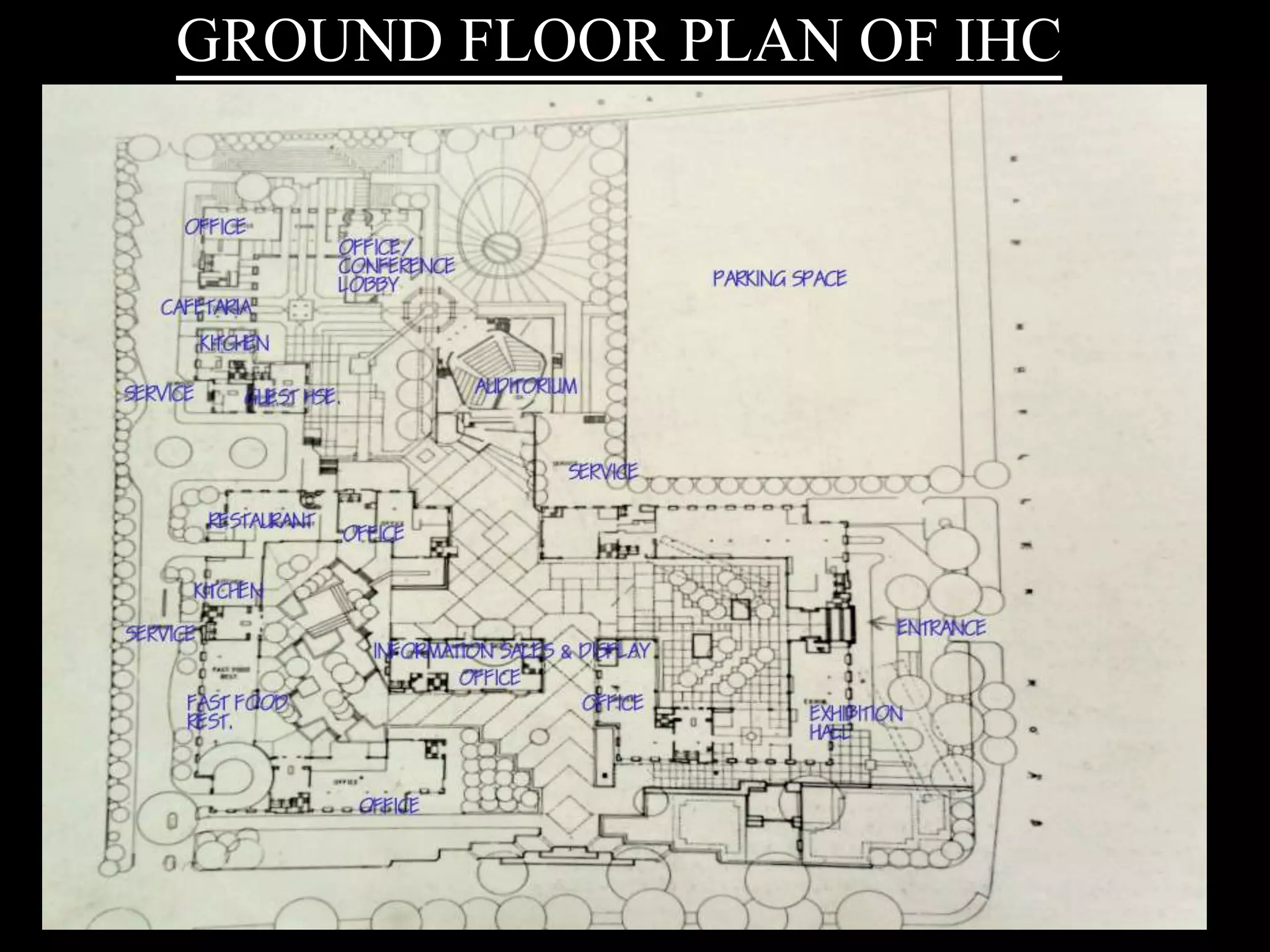
GROUND FLOOR PLAN OF IHC
• The centre groups a significant number of plots together, so that requirements
such as food service ,
• Car parking and meeting facilities can be solved mutually
• Building are grouped around climate temperate
courts
• shade by overhead sun screens and enlivened
by vertical gardens
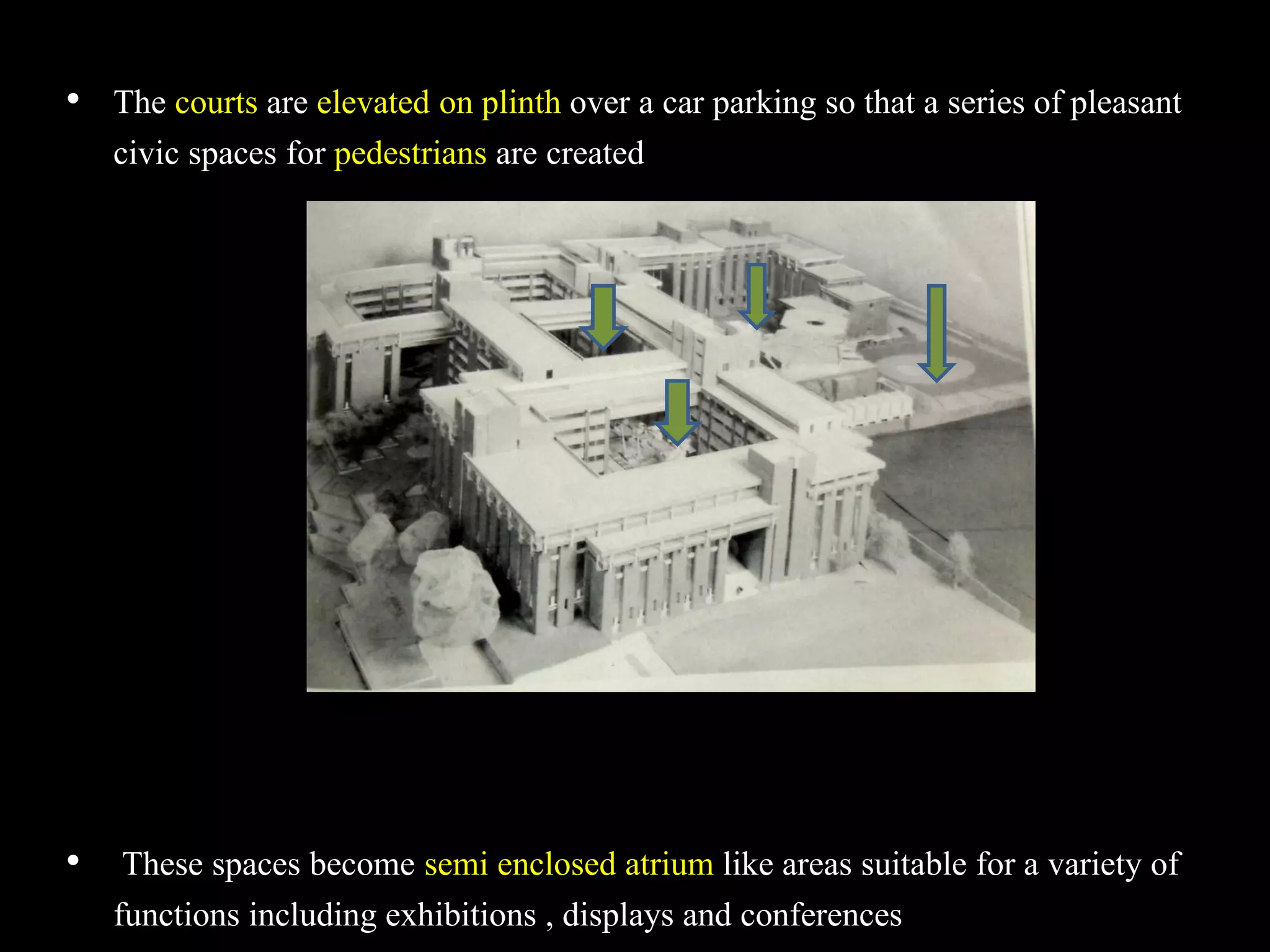
• The courts are elevated on plinth over a car parking so that a series of pleasant
civic spaces for pedestrians are created
• These spaces become semi enclosed atrium like areas suitable for a variety of
functions including exhibitions , displays and conferences
DESIGN REVIEW :
• The whole complex consists of five main
building blocks. The heights of the buildings are
30m, interconnected by aerial walkways.
• The entire facade is cladded with exposed
red bricks work gives a majestic look.
• Use of shading devices (Truss) reflects
back 70% of the summer heat. It is designed
as a space frame structure with blue
reflectors that can be aligned providing
shade during summer and allows winter sun
to enter.
• The building blocks being separated create
interesting courtyards landscaped with
walkways.• Use of horizontal and vertical ribbon
windows having slots in them for
plantation purpose.
• The interesting glass/steel structure
(Ventilation Shafts/ Sky Lights) near
the second entrance provides natural light
to the underground parking area.
• Walls are cladded with Beautiful textured
surface with stone chips and cement, joins
additional feature on walls.
• The glass fiber/steel structure standing upon
concrete pillars, gives attractive look to the Semi
spherical dome.
• Solar panels are provided for lighting
purposes inside the gardens, it makes
building energy efficient and
environment friendly.
• Well designed drainage system eliminates
use of rainwater pipes and adds to the
beauty of the structure.
• Triangular bricks work at
• outside the Gulin Tower provides
ventilation and aesthetic view to
the structure.
CONCLUSION:
• The India Habitat Centre was conceived to provide a physical
environment which would serve as a catalyst for synergetic
relationship between individuals and institutions working in
diverse habitat related areas and therefore, maximize their
total effectiveness.
• The principal resolve of the centre – “to restore at every level
– environment and ecological , a balanced, harmonious and
improved way of life”, is to be reflected in its concept &
design .
TRIVENI KALA SANGAM
Founded in 1952 as an academy of dance, music and painting.
Triveni Garden Theatre
RESIDENCESMUSIC ROOMS
DANCE ROOMS
ART GALLERIES
OPEN
LANDSCAPED
COURTYARD
CAFETERIA
SEMI-OPEN ART
GALLERY
Clad reinforced concrete frame structure with several infill materials: jaali
panels along the classroom block corridor and stairs, concrete block with a
plastered finish and rough-cut stone facing presented to the street.
Jaali detail in the courtyard
Entrance
Triveni Garden Theatre Jaali detail in the courtyard
• Joseph Allen
Stein
• An American Architect
who made India his
home…….
• Thank you all.
Thank you all 

Joseph allen stein

  • 1.
    Joseph Allen Stein Submittedto Ar. Preeti bhatia. Submitted by Gaurav bhatt B.Arch (3 year) 1461567.
  • 2.
    Joseph Allen Stein •Joseph Stein, (10 April 1912 – 6 October 2001) • He was an American architect. • Major figure in the establishment of a regional modern architecture in the San Francisco Bay area in the 1940s and 1950s during the early days of the environmental design movement. • In 1952 he moved to India. • He is noted for designing several important buildings in India, most notably in Lodhi Estate in Central Delhi, nicknamed "Steinabad“. • After him, and where today the 'Joseph Stein Lane', is the only road in Delhi named after an architect. • The Government of India awarded him the fourth highest civilian award of Padma Shri in 1992.
  • 3.
    BIOGRAPHY • Joseph AllenStein was born on 10 April 1912, in Omaha, Nebraska. • He studied architecture at the University of Illinois, in Paris and the Cranbrook Academy of Art. • He worked for Eli Jacques Kahn in New York and with Richard Neutra in Los Angeles, before establishing his own practice in San Francisco. • In San Francisco, he designed modest homes in the California style, but also became increasingly interested in the issues of low cost housing. • In 1952 he moved to India, and became head of the department of architecture at the Bengal Engineering College in Calcutta. • He worked in New Delhi from 1955 onwards, starting with another American architect, Benjamin Polk and even after retirement in 1995, continued to design for the architecture firm he founded. • Over the year, he brought in 'California modernism' to several buildings he designed and working classes.
  • 4.
    philosophy • Mr. Steinbrought a california modernism sensitivity to the country. His approach is called modern regionalism. • According to him “regional without modern is reactionary, and modern without regional is insensitive, inappropriate.”
  • 5.
    Which means……. • Buildingshould reflect the culture and tradition of its region through its design and materials.
  • 6.
  • 8.
    Critical Regionalism inarchitecture • In the early 20th century came the intellectual movement of Modernism, which was all about rationality, logic and efficiency. Slogans like "less is more" and "form follows function" originated in this era of design. • In the field of architecture, all forms of ornamentation were seen as wasteful, decadent, and generally useless • This style became known as the International Style.
  • 9.
    Postmodernism. • After Modernismsettled into the mainstream and the International Style became the dominant architectural style throughout the world. • People began to realize that these rational, identity-less modernist buildings were extremely boring. • A new school of thought emerged as a reaction to this boringness: Postmodernism. • This new movement celebrated ornament as essential to architecture, and postmodern designers freely combined decorative elements from all eras and styles to create chaotic, colorful and whimsical buildings.
  • 12.
    philosophy • His secondguiding factor was to seek the character of the solution in the nature of the problem.` • how building related to the site.”
  • 13.
    philosophy • Mr Stein’sdesigns were modernistic, but inspired by India’s past. • He was good at working with local materials, be it granite or glazed tiles, both influences of Tughlaq architecture. He also used jalis in most of his works. • In the wider landscape of nature, he used local materials where he tried to merge his buildings with nature
  • 14.
    philosophy • He typicallydesigned two- to four- storey buildings that fused with the surrounding trees, gardens and pools; flowers and vines would spill over the walls. • He would have vertical gardens, courtyards covered with trees and plants, ponds blooming with lotuses, and vast landscaped lawns. He was described as “building in the garden”.
  • 15.
    His thoughts:- • Twothings have essentially guided my work. One is what you might call an interest in and search for an appropriate modern regionalism. I would put equal emphasis on both words, 'regional' and 'modern', because regional without modern is reactionary, and modern without regional is insensitive, inappropriate. The second one is to seek the character of the solution in the nature of the problem, as much as one possibly can. • - J A Stein
  • 16.
    Design Features:- • Interrelationshipsof site with landscape, structure and materials; sun and shade. • Horizontal and vertical Garden. • Use of local material. • Use of jali. • Use of courtyard. Blend of built and garden that makes the space extended. • Use of modern construction techniques. • Shell geometries – Dome, Vault and factory roof system.
  • 17.
    Design Features:- • Interrelationshipsof site with landscape, structure and materials; sun and shade.
  • 18.
  • 19.
    Design Features:- (meterials) • Useof local material. • granite or glazed tiles, • Exposed brickwork • Precast concrete panels • Local stone • Cast concrete jalis. • Blue and green ceramic tiles `
  • 20.
    Design Features:- • Useof jali. • Use of courtyard. Blend of built and garden that makes the space extended.
  • 21.
    Design Features:- • Useof modern construction techniques. • Shell geometries – Dome, Vault and factory roof system Hyperbolic parabolic lattice shell Barrel vault lattice shell Octagonal steel lattice domes,
  • 22.
    Popular Buildings • Americaninternational school • Gandhi-King Plaza • Triveni Kala Sangam. • Indian express tower • Lodhi Estate. • Ford foundation head quarters • UNICEF building • India international centre • India Habitat centre
  • 23.
  • 24.
    INDIA INTERNATIONAL CENTRE •IIC facilities for a variety of artistic and scholarly activities, conference and symposia organized by nation and international groups. • The centre’s 18600 square meter(4.6acres) site at Lodi estate was designed • so that the grounds of the IIC and adjacent Lodi gardens could function as one entity.
  • 25.
    PLAN • The first,or entrance court, provides access on the north side to the guest room • On the south to the auditorium and programmed block of library and offices . N
  • 26.
    • Passing throughthe portico ,the visitor enters into the main courtyard and then into the gardens of the ,which the rear and the north of the sides of the site. N
  • 27.
    • The guest–room wing has also been given a curved form which approaches and then recedes away from the Lodi gardens site boundary. • The surrounding north wing of services and the west wing of the guest –rooms have been raised up on piers, bringing the Lodi tombs into framed view and creating a large verandah beneath. N
  • 28.
    COURTYARD AND GARDENS •The India international centre is conceived as design of interrelated interior and shaded space courtyards and gardens. • Each courtyard and garden at the IIC has a difference function and aspect.
  • 29.
    CONSTRUCTION • The constructionmethods and procedures employed in the building of the India international centre were typical of the methods and skill levels available in India at the time of construction(1958-62). • The pre-casting of some of the elements on the ground was undertaken in order to ensure high –quality construction, both in terms of structural integrity and finish. • The IIC is virtually a hand-made building.
  • 30.
  • 31.
    Introduction • It isa complex of institutional and office spaces , conferences and library facility for groups involved with environment and habitat issues • The concept of IHC is based on environmental and regional planning energy and its judicious use, relevance of technology, transport and communication, lifestyle social and cultural linkage, fiscal policies, legal and management system and information technology
  • 32.
  • 33.
    There are 5main building blocks which are interconnected by means of aerial walkways. There is also a basement floor for parking of around 1000 cars. The external facade is in a language of exposed red brick, exposed concrete and glass.
  • 34.
  • 35.
    • The centregroups a significant number of plots together, so that requirements such as food service , • Car parking and meeting facilities can be solved mutually
  • 36.
    • Building aregrouped around climate temperate courts • shade by overhead sun screens and enlivened by vertical gardens
  • 37.
    • The courtsare elevated on plinth over a car parking so that a series of pleasant civic spaces for pedestrians are created • These spaces become semi enclosed atrium like areas suitable for a variety of functions including exhibitions , displays and conferences
  • 38.
    DESIGN REVIEW : •The whole complex consists of five main building blocks. The heights of the buildings are 30m, interconnected by aerial walkways. • The entire facade is cladded with exposed red bricks work gives a majestic look. • Use of shading devices (Truss) reflects back 70% of the summer heat. It is designed as a space frame structure with blue reflectors that can be aligned providing shade during summer and allows winter sun to enter.
  • 39.
    • The buildingblocks being separated create interesting courtyards landscaped with walkways.• Use of horizontal and vertical ribbon windows having slots in them for plantation purpose.
  • 40.
    • The interestingglass/steel structure (Ventilation Shafts/ Sky Lights) near the second entrance provides natural light to the underground parking area. • Walls are cladded with Beautiful textured surface with stone chips and cement, joins additional feature on walls.
  • 41.
    • The glassfiber/steel structure standing upon concrete pillars, gives attractive look to the Semi spherical dome. • Solar panels are provided for lighting purposes inside the gardens, it makes building energy efficient and environment friendly.
  • 42.
    • Well designeddrainage system eliminates use of rainwater pipes and adds to the beauty of the structure. • Triangular bricks work at • outside the Gulin Tower provides ventilation and aesthetic view to the structure.
  • 43.
    CONCLUSION: • The IndiaHabitat Centre was conceived to provide a physical environment which would serve as a catalyst for synergetic relationship between individuals and institutions working in diverse habitat related areas and therefore, maximize their total effectiveness. • The principal resolve of the centre – “to restore at every level – environment and ecological , a balanced, harmonious and improved way of life”, is to be reflected in its concept & design .
  • 44.
    TRIVENI KALA SANGAM Foundedin 1952 as an academy of dance, music and painting.
  • 45.
  • 46.
    RESIDENCESMUSIC ROOMS DANCE ROOMS ARTGALLERIES OPEN LANDSCAPED COURTYARD CAFETERIA SEMI-OPEN ART GALLERY
  • 47.
    Clad reinforced concreteframe structure with several infill materials: jaali panels along the classroom block corridor and stairs, concrete block with a plastered finish and rough-cut stone facing presented to the street. Jaali detail in the courtyard Entrance
  • 48.
    Triveni Garden TheatreJaali detail in the courtyard
  • 49.
    • Joseph Allen Stein •An American Architect who made India his home…….
  • 50.
    • Thank youall. Thank you all 

Editor's Notes

  • #46 4 storey classroom block with a canteen and shaded dining terrace to the north. Ground floor gallery block with a shaded roof terrace to the West.
  • #49 Jali panels were assembled from small pre-cast concrete units. Filter light into the corridors.