High Level
Waste
Management
Chapter 10
Section 3
Dr. John Ringle
NE 112

Jump to first
page
I. Radioactive Waste
A. Classification &
Characteristics of
Radioactive Waste
B. Quantities of Waste
C. Sources of Waste
D. Current Location

Jump to first
page
II. Radioactive
Waste
Management
A.
B.
C.
D.
E.
F.
G.
H.
I.
J.
K.
L.

Principles
Responsibility
HLW - Disposal Options
HLW Acts - Congress
Characteristics of a Good Geologic
Repository
Hazards of Deep Geologic Disposal
HLW Activity in Other Countries
LLW -Disposal Options
Hazards of LLW Disposal
LLW Acts - Congress
LLW Activity in Other Countries
TRU Waste Disposal

Jump to first
page
I. Radioactive Waste
A.
CLASSIFICATION &
CHARACTERISTICS OF
RADIOACTIVE WASTE
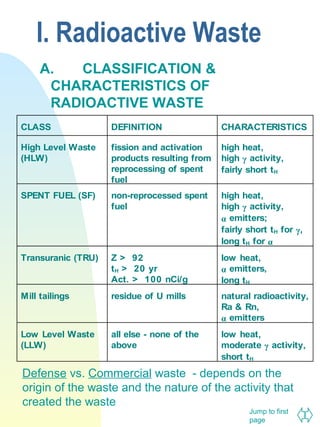
CLASS

DEFINITION

CHARACTERISTICS

High Level Waste
(HLW)

fission and activation
products resulting from
reprocessing of spent
fuel

high heat,
high γ activity,
fairly short t H

SPENT FUEL (SF)

non-reprocessed spent
fuel

high heat,
high γ activity,
α emitters;
fairly short t H for γ,
long t H for α

Transuranic (TRU)

Z > 92
t H > 20 yr
Act. > 100 nCi/g

low heat,
α emitters,
long t H

Mill tailings

residue of U mills

natural radioactivity,
Ra & Rn,
α emitters

Low Level Waste
(LLW)

all else - none of the
above

low heat,
moderate γ activity,
short t H

Defense vs. Commercial waste - depends on the
origin of the waste and the nature of the activity that
created the waste
Jump to first
page
Jump to first
page
Jump to first
page
Jump to first
page
Jump to first
page
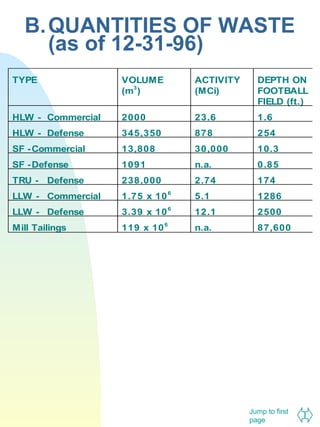
B. QUANTITIES OF WASTE
(as of 12-31-96)
TYPE

VOLUME
(m3 )

ACTIVITY
(MCi)

DEPTH ON
FOOTBALL
FIELD (ft.)

HLW - Commercial

2000

23.6

1.6

HLW - Defense

345,350

878

254

SF - Commercial

13,808

30,000

10.3

SF - Defense

1091

n.a.

0.85

TRU - Defense

238,000

2.74

174

LLW - Commercial

1.75 x 10 6

5.1

1286

LLW - Defense

3.39 x 10 6

12.1

2500

Mill Tailings

119 x 10 6

n.a.

87,600

Jump to first
page
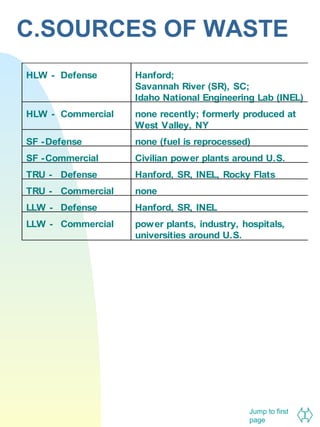
C.SOURCES OF WASTE
HLW - Defense

Hanford;
Savannah River (SR), SC;
Idaho National Engineering Lab (INEL)

HLW - Commercial

none recently; formerly produced at
West Valley, NY

SF - Defense

none (fuel is reprocessed)

SF - Commercial

Civilian power plants around U.S.

TRU - Defense

Hanford, SR, INEL, Rocky Flats

TRU - Commercial

none

LLW - Defense

Hanford, SR, INEL

LLW - Commercial

power plants, industry, hospitals,
universities around U.S.

Jump to first
page
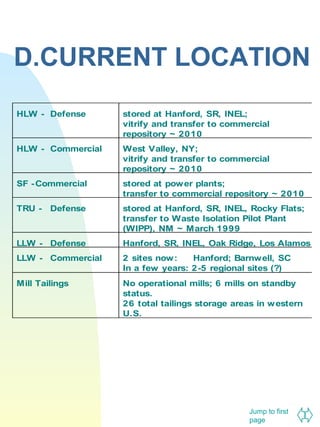
D.CURRENT LOCATION
HLW - Defense

stored at Hanford, SR, INEL;
vitrify and transfer to commercial
repository ~ 2010

HLW - Commercial

West Valley, NY;
vitrify and transfer to commercial
repository ~ 2010

SF - Commercial

stored at pow er plants;
transfer to commercial repository ~ 2010

TRU -

stored at Hanford, SR, INEL, Rocky Flats;
transfer to Waste Isolation Pilot Plant
(WIPP), NM ~ March 1999

Defense

LLW - Defense

Hanford, SR, INEL, Oak Ridge, Los Alamos

LLW - Commercial

2 sites now :
Hanford; Barnwell, SC
In a few years: 2-5 regional sites (?)

Mill Tailings

No operational mills; 6 mills on standby
status.
26 total tailings storage areas in w estern
U.S.

Jump to first
page
II. RADIOACTIVE
WASTE
MANAGEMENT
A. Principles
B. Responsibility
C. HLW - Disposal Options
D. HLW Acts - Congress
E. Characteristics of a Good Geologic
Repository
F. Hazards of Deep Geologic Disposal
G.HLW Activity in Other Countries
H. LLW -Disposal Options
I. Hazards of LLW Disposal
J. LLW Acts - Congress
K. LLW Activity in Other Countries
L. TRU Waste Disposal

Jump to first
page
II. RADIOACTIVE
WASTE
MANAGEMENT
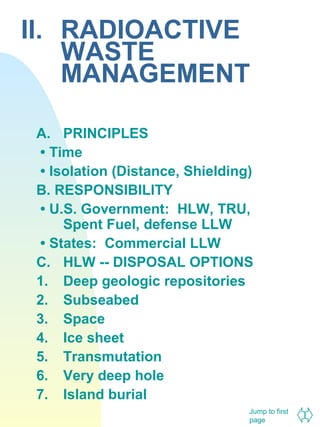
A. PRINCIPLES
• Time
• Isolation (Distance, Shielding)
B. RESPONSIBILITY
• U.S. Government: HLW, TRU,
Spent Fuel, defense LLW
• States: Commercial LLW
C. HLW -- DISPOSAL OPTIONS
1. Deep geologic repositories
2. Subseabed
3. Space
4. Ice sheet
5. Transmutation
6. Very deep hole
7. Island burial
Jump to first
page
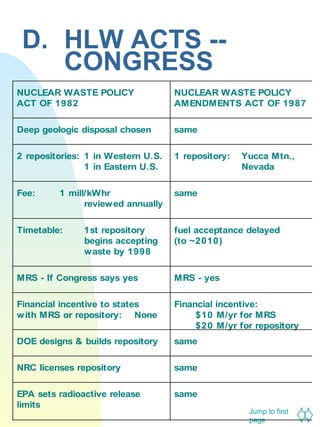
D. HLW ACTS -CONGRESS
NUCLEAR WASTE POLICY
ACT OF 1982

NUCLEAR WASTE POLICY
AMENDMENTS ACT OF 1987

Deep geologic disposal chosen

same

2 repositories: 1 in Western U.S.
1 in Eastern U.S.

1 repository:

Fee:

same

1 mill/kWhr
review ed annually

Timetable:

1st repository
begins accepting
w aste by 1998

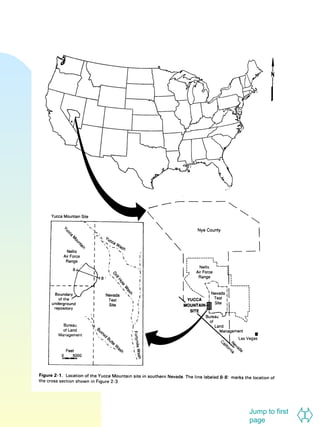
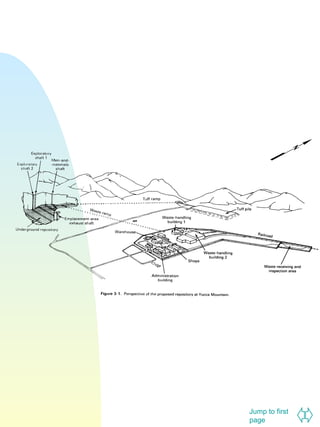
Yucca Mtn.,
Nevada

fuel acceptance delayed
(to ~2010)

MRS - If Congress says yes

MRS - yes

Financial incentive to states
w ith MRS or repository: None

Financial incentive:
$10 M/yr for MRS
$20 M/yr for repository

DOE designs & builds repository

same

NRC licenses repository

same

EPA sets radioactive release
limits

same
Jump to first
page
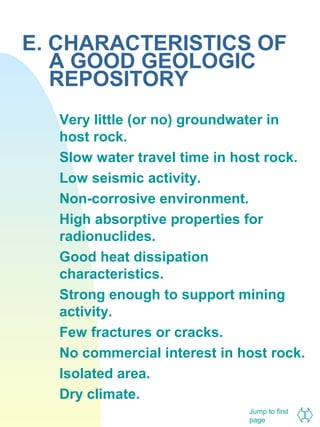
E. CHARACTERISTICS OF
A GOOD GEOLOGIC
REPOSITORY
Very little (or no) groundwater in
host rock.
Slow water travel time in host rock.
Low seismic activity.
Non-corrosive environment.
High absorptive properties for
radionuclides.
Good heat dissipation
characteristics.
Strong enough to support mining
activity.
Few fractures or cracks.
No commercial interest in host rock.
Isolated area.
Dry climate.
Jump to first
page
F. HAZARDS OF DEEP
GEOLOGIC
DISPOSAL
Transportation of HLW or SF to
repository
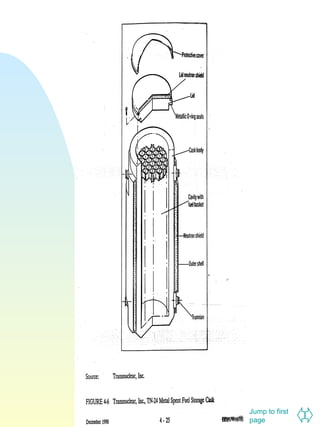
Shipping casks very important
Release to ground water.
Barriers:





Waste form (glass or ceramic)
Waste canister (metal)
Backfill (host rock/clay)
Host rock

Jump to first
page
G. HLW ACTIVITY IN
OTHER COUNTRIES
Reprocess →HLW disposal
Argentina, Belgium, Brazil, China,
France, Germany, India, Italy,
Japan, Netherlands, Spain,
Switzerland, United Kingdom, former
USSR states

No reprocessing →SF disposal
Canada, Sweden, United States

Storage of HLW (vitrified) or SF in
water or dry storage
Investigate geological repositories

Jump to first
page
Jump to first
page
Jump to first
page
Jump to first
page
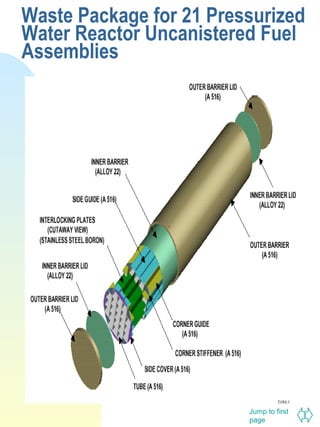
Waste Package for 21 Pressurized
Water Reactor Uncanistered Fuel
Assemblies

Jump to first
page
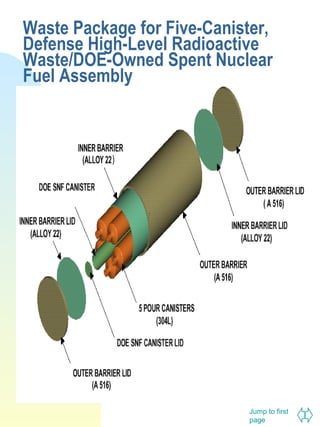
Waste Package for Five-Canister,
Defense High-Level Radioactive
Waste/DOE-Owned Spent Nuclear
Fuel Assembly

Jump to first
page
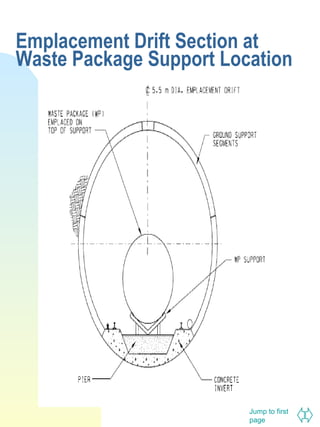
Emplacement Drift Section at
Waste Package Support Location

Jump to first
page
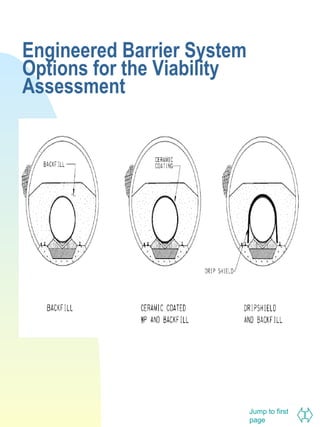
Engineered Barrier System
Options for the Viability
Assessment

Jump to first
page
Jump to first
page
Jump to first
page
Jump to first
page
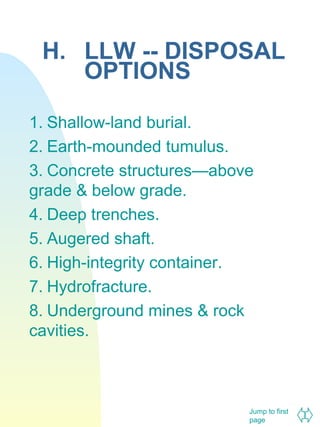
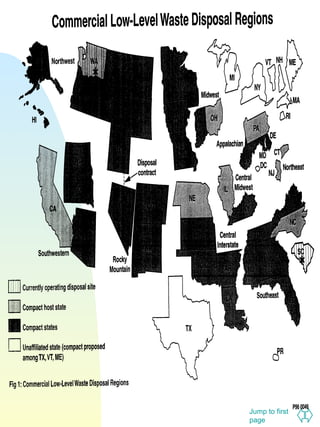
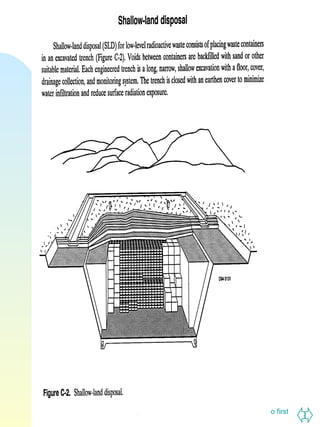
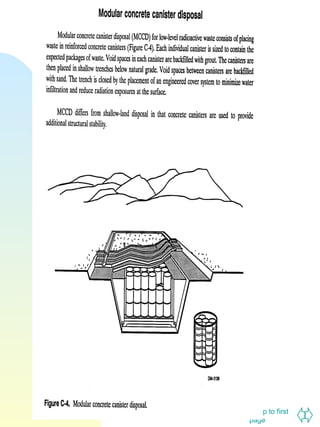
H. LLW -- DISPOSAL
OPTIONS
1. Shallow-land burial.
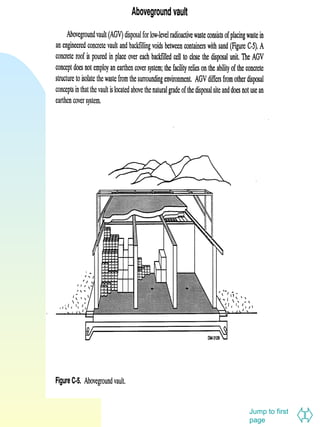
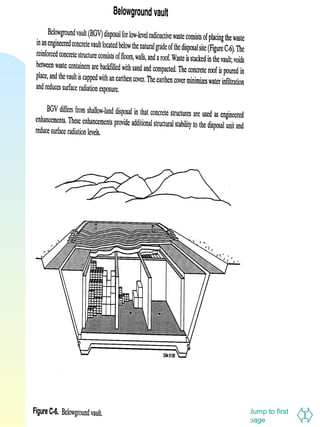
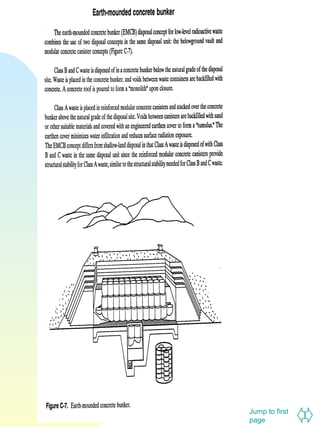
2. Earth-mounded tumulus.
3. Concrete structures—above
grade & below grade.
4. Deep trenches.
5. Augered shaft.
6. High-integrity container.
7. Hydrofracture.
8. Underground mines & rock
cavities.

Jump to first
page
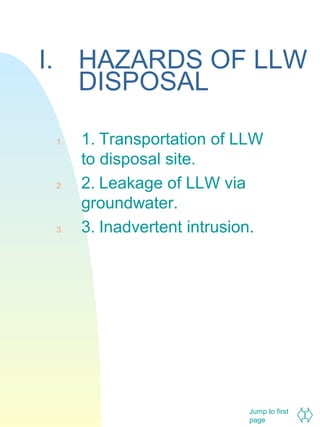
I. HAZARDS OF LLW
DISPOSAL
1.

2.

3.

1. Transportation of LLW
to disposal site.
2. Leakage of LLW via
groundwater.
3. Inadvertent intrusion.

Jump to first
page
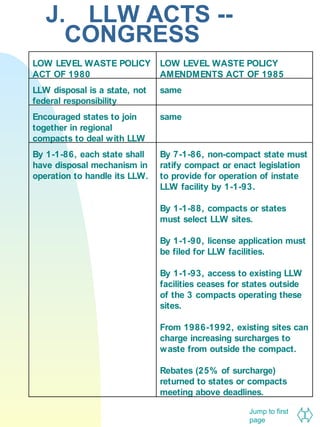
J. LLW ACTS -CONGRESS
LOW LEVEL WASTE POLICY
ACT OF 1980

LOW LEVEL WASTE POLICY
AMENDMENTS ACT OF 1985

LLW disposal is a state, not
federal responsibility

same

Encouraged states to join
together in regional
compacts to deal w ith LLW

same

By 1-1-86, each state shall
have disposal mechanism in
operation to handle its LLW.

By 7-1-86, non-compact state must
ratify compact or enact legislation
to provide for operation of instate
LLW facility by 1-1-93.
By 1-1-88, compacts or states
must select LLW sites.
By 1-1-90, license application must
be filed for LLW facilities.
By 1-1-93, access to existing LLW
facilities ceases for states outside
of the 3 compacts operating these
sites.
From 1986-1992, existing sites can
charge increasing surcharges to
w aste from outside the compact.
Rebates (25% of surcharge)
returned to states or compacts
meeting above deadlines.
Jump to first
page
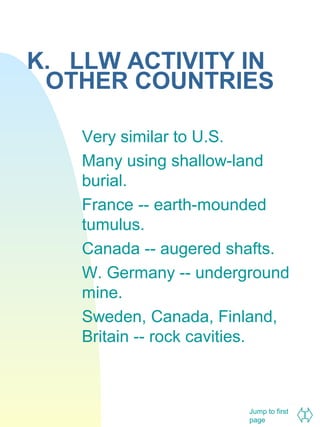
K. LLW ACTIVITY IN
OTHER COUNTRIES
Very similar to U.S.
Many using shallow-land
burial.
France -- earth-mounded
tumulus.
Canada -- augered shafts.
W. Germany -- underground
mine.
Sweden, Canada, Finland,
Britain -- rock cavities.

Jump to first
page
L. TRU WASTE
DISPOSAL
Very similar in most aspects to
HLW disposal.
Repository is selected and
constructed: Waste Isolation Pilot
Plant, near Carlsbad, NM.
Repository is 2150 ft. below
surface in bedded salt.
Test phase of WIPP started in
1994.
Repository began accepting TRU
waste March 1999.

Jump to first
page
Jump to first
page
Jump to first
page
Jump to first
page
Jump to first
page
Jump to first
page
Jump to first
page

Lecture 9-High Level Waste Management

  • 1.
    High Level Waste Management Chapter 10 Section3 Dr. John Ringle NE 112 Jump to first page
  • 2.
    I. Radioactive Waste A.Classification & Characteristics of Radioactive Waste B. Quantities of Waste C. Sources of Waste D. Current Location Jump to first page
  • 3.
    II. Radioactive Waste Management A. B. C. D. E. F. G. H. I. J. K. L. Principles Responsibility HLW -Disposal Options HLW Acts - Congress Characteristics of a Good Geologic Repository Hazards of Deep Geologic Disposal HLW Activity in Other Countries LLW -Disposal Options Hazards of LLW Disposal LLW Acts - Congress LLW Activity in Other Countries TRU Waste Disposal Jump to first page
  • 4.
    I. Radioactive Waste A. CLASSIFICATION& CHARACTERISTICS OF RADIOACTIVE WASTE CLASS DEFINITION CHARACTERISTICS High Level Waste (HLW) fission and activation products resulting from reprocessing of spent fuel high heat, high γ activity, fairly short t H SPENT FUEL (SF) non-reprocessed spent fuel high heat, high γ activity, α emitters; fairly short t H for γ, long t H for α Transuranic (TRU) Z > 92 t H > 20 yr Act. > 100 nCi/g low heat, α emitters, long t H Mill tailings residue of U mills natural radioactivity, Ra & Rn, α emitters Low Level Waste (LLW) all else - none of the above low heat, moderate γ activity, short t H Defense vs. Commercial waste - depends on the origin of the waste and the nature of the activity that created the waste Jump to first page
  • 5.
  • 6.
  • 7.
  • 8.
  • 9.
    B. QUANTITIES OFWASTE (as of 12-31-96) TYPE VOLUME (m3 ) ACTIVITY (MCi) DEPTH ON FOOTBALL FIELD (ft.) HLW - Commercial 2000 23.6 1.6 HLW - Defense 345,350 878 254 SF - Commercial 13,808 30,000 10.3 SF - Defense 1091 n.a. 0.85 TRU - Defense 238,000 2.74 174 LLW - Commercial 1.75 x 10 6 5.1 1286 LLW - Defense 3.39 x 10 6 12.1 2500 Mill Tailings 119 x 10 6 n.a. 87,600 Jump to first page
  • 10.
    C.SOURCES OF WASTE HLW- Defense Hanford; Savannah River (SR), SC; Idaho National Engineering Lab (INEL) HLW - Commercial none recently; formerly produced at West Valley, NY SF - Defense none (fuel is reprocessed) SF - Commercial Civilian power plants around U.S. TRU - Defense Hanford, SR, INEL, Rocky Flats TRU - Commercial none LLW - Defense Hanford, SR, INEL LLW - Commercial power plants, industry, hospitals, universities around U.S. Jump to first page
  • 11.
    D.CURRENT LOCATION HLW -Defense stored at Hanford, SR, INEL; vitrify and transfer to commercial repository ~ 2010 HLW - Commercial West Valley, NY; vitrify and transfer to commercial repository ~ 2010 SF - Commercial stored at pow er plants; transfer to commercial repository ~ 2010 TRU - stored at Hanford, SR, INEL, Rocky Flats; transfer to Waste Isolation Pilot Plant (WIPP), NM ~ March 1999 Defense LLW - Defense Hanford, SR, INEL, Oak Ridge, Los Alamos LLW - Commercial 2 sites now : Hanford; Barnwell, SC In a few years: 2-5 regional sites (?) Mill Tailings No operational mills; 6 mills on standby status. 26 total tailings storage areas in w estern U.S. Jump to first page
  • 12.
    II. RADIOACTIVE WASTE MANAGEMENT A. Principles B.Responsibility C. HLW - Disposal Options D. HLW Acts - Congress E. Characteristics of a Good Geologic Repository F. Hazards of Deep Geologic Disposal G.HLW Activity in Other Countries H. LLW -Disposal Options I. Hazards of LLW Disposal J. LLW Acts - Congress K. LLW Activity in Other Countries L. TRU Waste Disposal Jump to first page
  • 13.
    II. RADIOACTIVE WASTE MANAGEMENT A. PRINCIPLES •Time • Isolation (Distance, Shielding) B. RESPONSIBILITY • U.S. Government: HLW, TRU, Spent Fuel, defense LLW • States: Commercial LLW C. HLW -- DISPOSAL OPTIONS 1. Deep geologic repositories 2. Subseabed 3. Space 4. Ice sheet 5. Transmutation 6. Very deep hole 7. Island burial Jump to first page
  • 14.
    D. HLW ACTS-CONGRESS NUCLEAR WASTE POLICY ACT OF 1982 NUCLEAR WASTE POLICY AMENDMENTS ACT OF 1987 Deep geologic disposal chosen same 2 repositories: 1 in Western U.S. 1 in Eastern U.S. 1 repository: Fee: same 1 mill/kWhr review ed annually Timetable: 1st repository begins accepting w aste by 1998 Yucca Mtn., Nevada fuel acceptance delayed (to ~2010) MRS - If Congress says yes MRS - yes Financial incentive to states w ith MRS or repository: None Financial incentive: $10 M/yr for MRS $20 M/yr for repository DOE designs & builds repository same NRC licenses repository same EPA sets radioactive release limits same Jump to first page
  • 15.
    E. CHARACTERISTICS OF AGOOD GEOLOGIC REPOSITORY Very little (or no) groundwater in host rock. Slow water travel time in host rock. Low seismic activity. Non-corrosive environment. High absorptive properties for radionuclides. Good heat dissipation characteristics. Strong enough to support mining activity. Few fractures or cracks. No commercial interest in host rock. Isolated area. Dry climate. Jump to first page
  • 16.
    F. HAZARDS OFDEEP GEOLOGIC DISPOSAL Transportation of HLW or SF to repository Shipping casks very important Release to ground water. Barriers:     Waste form (glass or ceramic) Waste canister (metal) Backfill (host rock/clay) Host rock Jump to first page
  • 17.
    G. HLW ACTIVITYIN OTHER COUNTRIES Reprocess →HLW disposal Argentina, Belgium, Brazil, China, France, Germany, India, Italy, Japan, Netherlands, Spain, Switzerland, United Kingdom, former USSR states No reprocessing →SF disposal Canada, Sweden, United States Storage of HLW (vitrified) or SF in water or dry storage Investigate geological repositories Jump to first page
  • 18.
  • 19.
  • 20.
  • 21.
    Waste Package for21 Pressurized Water Reactor Uncanistered Fuel Assemblies Jump to first page
  • 22.
    Waste Package forFive-Canister, Defense High-Level Radioactive Waste/DOE-Owned Spent Nuclear Fuel Assembly Jump to first page
  • 23.
    Emplacement Drift Sectionat Waste Package Support Location Jump to first page
  • 24.
    Engineered Barrier System Optionsfor the Viability Assessment Jump to first page
  • 25.
  • 26.
  • 27.
  • 28.
    H. LLW --DISPOSAL OPTIONS 1. Shallow-land burial. 2. Earth-mounded tumulus. 3. Concrete structures—above grade & below grade. 4. Deep trenches. 5. Augered shaft. 6. High-integrity container. 7. Hydrofracture. 8. Underground mines & rock cavities. Jump to first page
  • 29.
    I. HAZARDS OFLLW DISPOSAL 1. 2. 3. 1. Transportation of LLW to disposal site. 2. Leakage of LLW via groundwater. 3. Inadvertent intrusion. Jump to first page
  • 30.
    J. LLW ACTS-CONGRESS LOW LEVEL WASTE POLICY ACT OF 1980 LOW LEVEL WASTE POLICY AMENDMENTS ACT OF 1985 LLW disposal is a state, not federal responsibility same Encouraged states to join together in regional compacts to deal w ith LLW same By 1-1-86, each state shall have disposal mechanism in operation to handle its LLW. By 7-1-86, non-compact state must ratify compact or enact legislation to provide for operation of instate LLW facility by 1-1-93. By 1-1-88, compacts or states must select LLW sites. By 1-1-90, license application must be filed for LLW facilities. By 1-1-93, access to existing LLW facilities ceases for states outside of the 3 compacts operating these sites. From 1986-1992, existing sites can charge increasing surcharges to w aste from outside the compact. Rebates (25% of surcharge) returned to states or compacts meeting above deadlines. Jump to first page
  • 31.
    K. LLW ACTIVITYIN OTHER COUNTRIES Very similar to U.S. Many using shallow-land burial. France -- earth-mounded tumulus. Canada -- augered shafts. W. Germany -- underground mine. Sweden, Canada, Finland, Britain -- rock cavities. Jump to first page
  • 32.
    L. TRU WASTE DISPOSAL Verysimilar in most aspects to HLW disposal. Repository is selected and constructed: Waste Isolation Pilot Plant, near Carlsbad, NM. Repository is 2150 ft. below surface in bedded salt. Test phase of WIPP started in 1994. Repository began accepting TRU waste March 1999. Jump to first page
  • 33.
  • 34.
  • 35.
  • 36.
  • 37.
  • 38.