Reading Materials Week 8
Contents: Four stages in reading Areas of concern in the selection of texts Role of texts in the L2 classroom Simplified vs. authentic texts Channel conversion Implications for L2 teachers
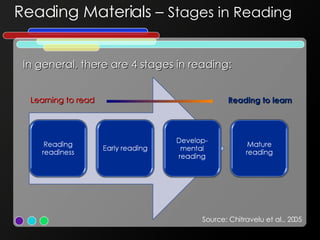
Reading Materials –  Stages in Reading In general, there are 4 stages in reading: Source: Chitravelu et al., 2005 Learning to read Reading to learn
Major areas of concern in the selection of texts: Balance, Suitability of language, Concepts in the text, Level of reasoning required, Content, and Pedagogic suitability. Source: Chitravelu et al., 2005 Reading Materials –  Selection of Texts
Teacher need to skillfully exploit texts to help students acquire new reading skills or become fluent in using the skills: Learning  to read  stage Outcome of reading is to acquire the skills  required when reading to learn; Texts should contain pedagogic as well as real  reading purposes. Reading Materials -  Selection of Texts Source: Chitravelu et al., 2005
Reading  to learn  stage Students tend to read slowly in order to  understand & remember what they have read; Texts should be information-rich; Students read text to learn from the content;  Outcome of reading is to gain knowledge. Source: Chitravelu et al., 2005 Reading Materials -  Selection of Texts
Role of text in the L2 classroom: Text as a vehicle for teaching language structure & vocabulary; Texts which teach language through reading; Texts which offer high-interest content. Reading Materials – Role of Texts Source: Wallace, 2003
Text as a vehicle for teaching language structure & vocabulary Language-focused texts; Reading solely to learn a language – not for information or interest (Williams, 1984); “ Usage” rather than “use” (Widdowson, 1978); Lack of communicative function as texts aim at reinforcing sentence patterns; Text-focused activities – focus on sentence patterns text & to highlight cohesive features; Reading Materials – Role of Texts Source: Wallace, 2003
2. Texts which teach language through reading Select texts to promote reading - learners develop language awareness through reading; Select texts that can develop reading strategies; Wide access to meaningful written language is effective in reinforcing English structures as well as learning new ones (Elley,1984); To motivate L2 learners to read widely in the L2, the overall content of the selected text is more important than the linguistic features contained in the text. Reading Materials – Role of Texts Source: Wallace, 2003
3. Texts which offer high-interest content Text must be interesting for the learner to read; However, difficult to address the issue of interest (individual differences and preferences); Therefore, select texts that are inherently motivating – something about the content that makes learners interested to read; E.g. in narratives that can stimulate readers’ schema; Reading Materials – Role of Texts Source: Wallace, 2003
Activity Which opening lines might be of the greatest general interest to secondary level students? ………………………………………………………………… . Joanne works for the Lincoln Company. There are two shifts in the Lincoln Company, a day shift and a night shift. Joanne works the day shift. Her schedule is Tuesday through Saturday from 8 o’clock to 5 pm. Her lunch time is 12.00 noon to1.00 pm. ………………………………………………………………… . Many, many years ago there was a very rich landlord who owned a lot of land and houses. ………………………………………………………………… . Reading Materials – Role of Texts Source: Wallace, 2003
Activity - Discussion Both texts are linguistically simple; However, something about the content in T2 make students more interested in reading; Why? T2 begins with a recognizable kind of narrative and students engage with the text by activating a relevant schema; T1 is not what we perceive as a “story”, events are unexceptional. Reading Materials – Role of Texts Source: Wallace, 2003
Texts are  simplified  for L2 learners for easy comprehension and to help prepare them for more advanced, authentic text (Young 1999); Advantages of  simplified texts : - excludes unnecessary & distracting, idiosyncratic styles without suffering a loss of valuable communication features & concepts (Allen & Widdowson 1979), and - contains increased redundancy & amplified explanation (Kuo 1993). Reading Materials -  Simplified Texts Source: Crossley & McNamara, 2008
However,  simplified texts  contain simplified & frequent forms; Widely criticized for removing authentic language, Thus, denying learners the opportunity to learn natural forms of language (Long & Ross 1993). Reading Materials -  Simplified Texts Source: Crossley & McNamara, 2008
Definitions of Authenticity: “ genuine communicative acts ” - written or spoken language between native speakers (Meinhof, 1987); Authenticity is not a characteristic of the text in itself - the text can only be truly  authentic in the context  for which it was originally written (Hutchinson & Waters, 1987); Authenticity does not lie in the materials but is created by the reader’s response –  congruence between the writer’s intention & reader’s interpretation (Widdowson,1979). Reading Materials -  Authentic Texts
Authentic text  written to fulfill a social purpose for native speakers within a language community (Lee, 1995) Advantages: introduces students to natural & contextualized language Use of authentic linguistic features (e.g. cohesive devices) – development of reading comprehension skills & information processing skills, contain natural lexical redundancy – aids in reconstructing text & understanding unfamiliar lexicon. Reading Materials -  Authentic Texts Source: Crossley & McNamara, 2008
Simplified  Vs.  Authentic  text?  Authentic text  is assumed to provide more natural language and more naturally occurring cohesion than simplified text; Simplified text  is criticized as creating discourse that is unnatural and serves to reduce helpful redundancy, thus increasing text readability; Simplified text , however, is thought to benefit L2 learners because it is lexically, syntactically, and rhetorically less difficult than authentic text. Reading Materials -  Simplified vs. Authentic  Source: Crossley & McNamara, 2008
Readers from a different sociocultural background may find the meaning of a simple text difficult to comprehend. This is due to the lack of familiarity with culture-specific features of the discourses in the text (Wallace, 2003). Explore  critically  the discourse in minimal texts such as the following advertisement. In what way are the discourses in it culture-specific? Activity – Authentic Texts
TITLE: "Sucky Vacations" BRAND: San Diego AGENCY: NYCA
Message written to young parents who are considering where to take their children for a holiday; Message makes assumptions that are culture specific, e.g.: Parents are expected to take their children on family  vacations; The vacations are normally related to having fun at  the  beach; Refer to a particular sociocultural practice – parents  are sent to retirement homes when they get older. Discussion – Authentic Texts
Channel Conversion Information transfer; Information expressed in one medium, is converted  into another medium; E.g. from words to graphics, materials, actions, etc. Reading Materials –  Channel Conversion   Source: Chitravelu et al., 2005
Channel Conversion (Cont’d) Why it is important? Whenever the receptive skill is higher than the productive skill, we might use non-verbal responses; Some information is better presented using tables, graphs, etc.; Sometimes, information in graphs, diagrams, etc. is easier to remember; Source: Chitravelu et al., 2005 Reading Materials –  Channel Conversion
Channel Conversion (Cont’d) Why it is important? Since many texts/textbooks include charts, graphs, etc. , it is important to teach students how to interpret them: - students learn how to make sense of the forms & the special way of presenting information; - students learn how to relate these forms to the verbal texts they accompany. Source: Chitravelu et al., 2005 Reading Materials –  Channel Conversion
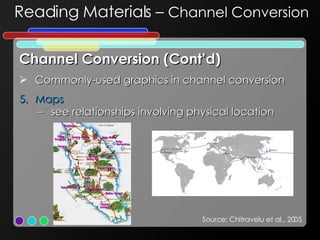
Channel Conversion (Cont’d) Commonly-used graphics in channel conversion Maps  –  see relationships involving physical location Source: Chitravelu et al., 2005 Reading Materials –  Channel Conversion
Channel Conversion (Cont’d) Floor plans  -  see relationships involving physical location Source: Chitravelu et al., 2005 Reading Materials –  Channel Conversion
Channel Conversion (Cont’d) Bus/train schedule  –  gather information from schedules & how best  to use them Source: Chitravelu et al., 2005 Reading Materials –  Channel Conversion
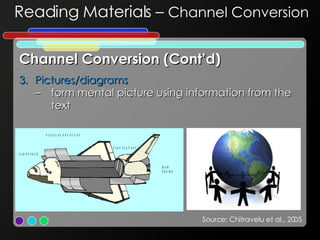
Channel Conversion (Cont’d) Pictures/diagrams  –  form mental picture using information from the  text Source: Chitravelu et al., 2005 Reading Materials –  Channel Conversion
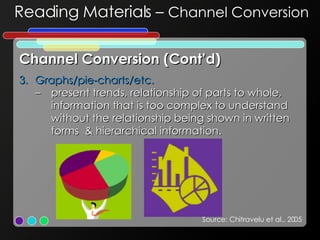
Channel Conversion (Cont’d) Graphs/pie-charts/etc.  –  present trends, relationship of parts to whole,  information that is too complex to understand  without the relationship being shown in written  forms  & hierarchical information. Source: Chitravelu et al., 2005 Reading Materials –  Channel Conversion
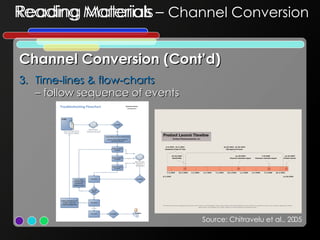
Channel Conversion (Cont’d) Time-lines & flow-charts  –  follow sequence of events Reading Materials  Source: Chitravelu et al., 2005 Reading Materials –  Channel Conversion
Implications for L2 teachers: Reading Materials - Conclusion Need to be aware of criteria involving the preparation & selection of material for teaching reading; Need to expose learners to authentic materials at earlier stage; Need to make reading lessons more enjoyable by introducing texts that are of interest to the learners; Authentic reading is interactive – teachers need to facilitate interactions between readers and texts in the classroom.


Lecture 8 Reading Materials

  • 1.
  • 2.
    Contents: Four stagesin reading Areas of concern in the selection of texts Role of texts in the L2 classroom Simplified vs. authentic texts Channel conversion Implications for L2 teachers
  • 3.
    Reading Materials – Stages in Reading In general, there are 4 stages in reading: Source: Chitravelu et al., 2005 Learning to read Reading to learn
  • 4.
    Major areas ofconcern in the selection of texts: Balance, Suitability of language, Concepts in the text, Level of reasoning required, Content, and Pedagogic suitability. Source: Chitravelu et al., 2005 Reading Materials – Selection of Texts
  • 5.
    Teacher need toskillfully exploit texts to help students acquire new reading skills or become fluent in using the skills: Learning to read stage Outcome of reading is to acquire the skills required when reading to learn; Texts should contain pedagogic as well as real reading purposes. Reading Materials - Selection of Texts Source: Chitravelu et al., 2005
  • 6.
    Reading tolearn stage Students tend to read slowly in order to understand & remember what they have read; Texts should be information-rich; Students read text to learn from the content; Outcome of reading is to gain knowledge. Source: Chitravelu et al., 2005 Reading Materials - Selection of Texts
  • 7.
    Role of textin the L2 classroom: Text as a vehicle for teaching language structure & vocabulary; Texts which teach language through reading; Texts which offer high-interest content. Reading Materials – Role of Texts Source: Wallace, 2003
  • 8.
    Text as avehicle for teaching language structure & vocabulary Language-focused texts; Reading solely to learn a language – not for information or interest (Williams, 1984); “ Usage” rather than “use” (Widdowson, 1978); Lack of communicative function as texts aim at reinforcing sentence patterns; Text-focused activities – focus on sentence patterns text & to highlight cohesive features; Reading Materials – Role of Texts Source: Wallace, 2003
  • 9.
    2. Texts whichteach language through reading Select texts to promote reading - learners develop language awareness through reading; Select texts that can develop reading strategies; Wide access to meaningful written language is effective in reinforcing English structures as well as learning new ones (Elley,1984); To motivate L2 learners to read widely in the L2, the overall content of the selected text is more important than the linguistic features contained in the text. Reading Materials – Role of Texts Source: Wallace, 2003
  • 10.
    3. Texts whichoffer high-interest content Text must be interesting for the learner to read; However, difficult to address the issue of interest (individual differences and preferences); Therefore, select texts that are inherently motivating – something about the content that makes learners interested to read; E.g. in narratives that can stimulate readers’ schema; Reading Materials – Role of Texts Source: Wallace, 2003
  • 11.
    Activity Which openinglines might be of the greatest general interest to secondary level students? ………………………………………………………………… . Joanne works for the Lincoln Company. There are two shifts in the Lincoln Company, a day shift and a night shift. Joanne works the day shift. Her schedule is Tuesday through Saturday from 8 o’clock to 5 pm. Her lunch time is 12.00 noon to1.00 pm. ………………………………………………………………… . Many, many years ago there was a very rich landlord who owned a lot of land and houses. ………………………………………………………………… . Reading Materials – Role of Texts Source: Wallace, 2003
  • 12.
    Activity - DiscussionBoth texts are linguistically simple; However, something about the content in T2 make students more interested in reading; Why? T2 begins with a recognizable kind of narrative and students engage with the text by activating a relevant schema; T1 is not what we perceive as a “story”, events are unexceptional. Reading Materials – Role of Texts Source: Wallace, 2003
  • 13.
    Texts are simplified for L2 learners for easy comprehension and to help prepare them for more advanced, authentic text (Young 1999); Advantages of simplified texts : - excludes unnecessary & distracting, idiosyncratic styles without suffering a loss of valuable communication features & concepts (Allen & Widdowson 1979), and - contains increased redundancy & amplified explanation (Kuo 1993). Reading Materials - Simplified Texts Source: Crossley & McNamara, 2008
  • 14.
    However, simplifiedtexts contain simplified & frequent forms; Widely criticized for removing authentic language, Thus, denying learners the opportunity to learn natural forms of language (Long & Ross 1993). Reading Materials - Simplified Texts Source: Crossley & McNamara, 2008
  • 15.
    Definitions of Authenticity:“ genuine communicative acts ” - written or spoken language between native speakers (Meinhof, 1987); Authenticity is not a characteristic of the text in itself - the text can only be truly authentic in the context for which it was originally written (Hutchinson & Waters, 1987); Authenticity does not lie in the materials but is created by the reader’s response – congruence between the writer’s intention & reader’s interpretation (Widdowson,1979). Reading Materials - Authentic Texts
  • 16.
    Authentic text written to fulfill a social purpose for native speakers within a language community (Lee, 1995) Advantages: introduces students to natural & contextualized language Use of authentic linguistic features (e.g. cohesive devices) – development of reading comprehension skills & information processing skills, contain natural lexical redundancy – aids in reconstructing text & understanding unfamiliar lexicon. Reading Materials - Authentic Texts Source: Crossley & McNamara, 2008
  • 17.
    Simplified Vs. Authentic text? Authentic text is assumed to provide more natural language and more naturally occurring cohesion than simplified text; Simplified text is criticized as creating discourse that is unnatural and serves to reduce helpful redundancy, thus increasing text readability; Simplified text , however, is thought to benefit L2 learners because it is lexically, syntactically, and rhetorically less difficult than authentic text. Reading Materials - Simplified vs. Authentic Source: Crossley & McNamara, 2008
  • 18.
    Readers from adifferent sociocultural background may find the meaning of a simple text difficult to comprehend. This is due to the lack of familiarity with culture-specific features of the discourses in the text (Wallace, 2003). Explore critically the discourse in minimal texts such as the following advertisement. In what way are the discourses in it culture-specific? Activity – Authentic Texts
  • 19.
    TITLE: "Sucky Vacations"BRAND: San Diego AGENCY: NYCA
  • 20.
    Message written toyoung parents who are considering where to take their children for a holiday; Message makes assumptions that are culture specific, e.g.: Parents are expected to take their children on family vacations; The vacations are normally related to having fun at the beach; Refer to a particular sociocultural practice – parents are sent to retirement homes when they get older. Discussion – Authentic Texts
  • 21.
    Channel Conversion Informationtransfer; Information expressed in one medium, is converted into another medium; E.g. from words to graphics, materials, actions, etc. Reading Materials – Channel Conversion Source: Chitravelu et al., 2005
  • 22.
    Channel Conversion (Cont’d)Why it is important? Whenever the receptive skill is higher than the productive skill, we might use non-verbal responses; Some information is better presented using tables, graphs, etc.; Sometimes, information in graphs, diagrams, etc. is easier to remember; Source: Chitravelu et al., 2005 Reading Materials – Channel Conversion
  • 23.
    Channel Conversion (Cont’d)Why it is important? Since many texts/textbooks include charts, graphs, etc. , it is important to teach students how to interpret them: - students learn how to make sense of the forms & the special way of presenting information; - students learn how to relate these forms to the verbal texts they accompany. Source: Chitravelu et al., 2005 Reading Materials – Channel Conversion
  • 24.
    Channel Conversion (Cont’d)Commonly-used graphics in channel conversion Maps – see relationships involving physical location Source: Chitravelu et al., 2005 Reading Materials – Channel Conversion
  • 25.
    Channel Conversion (Cont’d)Floor plans - see relationships involving physical location Source: Chitravelu et al., 2005 Reading Materials – Channel Conversion
  • 26.
    Channel Conversion (Cont’d)Bus/train schedule – gather information from schedules & how best to use them Source: Chitravelu et al., 2005 Reading Materials – Channel Conversion
  • 27.
    Channel Conversion (Cont’d)Pictures/diagrams – form mental picture using information from the text Source: Chitravelu et al., 2005 Reading Materials – Channel Conversion
  • 28.
    Channel Conversion (Cont’d)Graphs/pie-charts/etc. – present trends, relationship of parts to whole, information that is too complex to understand without the relationship being shown in written forms & hierarchical information. Source: Chitravelu et al., 2005 Reading Materials – Channel Conversion
  • 29.
    Channel Conversion (Cont’d)Time-lines & flow-charts – follow sequence of events Reading Materials Source: Chitravelu et al., 2005 Reading Materials – Channel Conversion
  • 30.
    Implications for L2teachers: Reading Materials - Conclusion Need to be aware of criteria involving the preparation & selection of material for teaching reading; Need to expose learners to authentic materials at earlier stage; Need to make reading lessons more enjoyable by introducing texts that are of interest to the learners; Authentic reading is interactive – teachers need to facilitate interactions between readers and texts in the classroom.
  • 31.
  • 32.