Chapter 4
   Designing
Materials in ESP
                        By:
     Bazrina binti Ramly
                      (159209)
     Lylia binti Aziz
                        (161759)
 Nik Nor Nabillah Anis binti Nik Yahya (157814)
     Sayidatul Fatima binti Mohd Mazeli
                      (160121)
   Definition
   Forms of Materials
   Roles of Materials
   Characteristics of Materials
   Where to get Materials
   Sample of Materials
   Conclusion
   Questions
Materials can be anything in
linguistic, visual, auditory and
kinaesthetic forms that are used to
facilitate the teaching and learning
process. (Tomlinsom,1998)
a) linguistic
b) auditory
c) visual
d) kinaesthetic
According to Harsono (2007), materials can also be:
  a) experiential
  b) elicitative
  c) instructional
  d) exploratory
Consider:
     1. needs and wants of the learners
     2. language choice
     3. development of specific skills
     4. Strategies for operating in ESP
     context
   Stimulation and motivation
   Source of language
   Learning support
   For reference and enrichment
   Revision
   Teacher-generated Materials
   Learner-generated Materials
   Authentic Materials
   Materials specifically generated for
    teachers that teach ESP.
   Factors that need to be taken into
    account:
    •   Matching carrier content to real
        content
    •   Providing variety
    •   Grading exercises
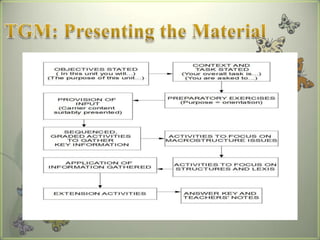
    •   Presenting the material well
Real content
  - the main purpose of the course
Carrier content
  - aspects that is used to assist the
  real content


(e.g.: English for Banking)
   Variety in micro-skills
- Focus on more than one macro-skill (e.g
   writing, speaking, reading, listening)
   Variety in types of activities
- Using visuals & thinking based activities (e.g
  diagrams, flowcharts)
   Variety in interaction
- Changes from teacher input to individual
  work to pair work to class discussion
   Grading basically helps provide
    learners with tasks at different
    levels of difficulty.
   One way to achieve this is by
    setting tasks in three levels. (e.g
    unsupported, partially
    supported, fully supported)
   Materials specifically generated by
    learners for their own learning
    experience.
   Examples:
       Framework materials
       Activities that are devised by learners
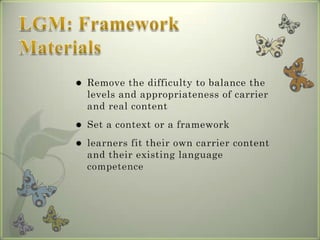
   Remove the difficulty to balance the
    levels and appropriateness of carrier
    and real content
   Set a context or a framework
   learners fit their own carrier content
    and their existing language
    competence
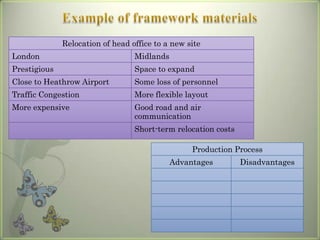
Relocation of head office to a new site
London                            Midlands
Prestigious                       Space to expand
Close to Heathrow Airport         Some loss of personnel
Traffic Congestion                More flexible layout
More expensive                    Good road and air
                                  communication
                                  Short-term relocation costs

                                                  Production Process
                                             Advantages         Disadvantages
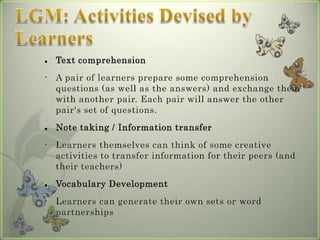
   Text comprehension
- A pair of learners prepare some comprehension
  questions (as well as the answers) and exchange them
  with another pair. Each pair will answer the other
  pair's set of questions.
   Note taking / Information transfer
- Learners themselves can think of some creative
  activities to transfer information for their peers (and
  their teachers)
   Vocabulary Development
- Learners can generate their own sets or word
  partnerships
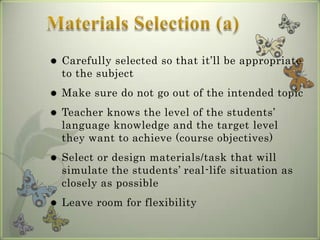
   Carefully selected so that it’ll be appropriate
    to the subject
   Make sure do not go out of the intended topic
   Teacher knows the level of the students’
    language knowledge and the target level
    they want to achieve (course objectives)
   Select or design materials/task that will
    simulate the students’ real-life situation as
    closely as possible
   Leave room for flexibility
Teachers should consider the following
questions in selecting the materials (Lewis &
Hill,1993) :
   Will the materials be useful to the
    students?
   Do they stimulate students’ curiosity?
   Are the materials relevant to the students
    and their needs?
   Are they fun to do?
   Will the students find the tasks and
    activities worth doing?
I) Textbook-based
   Readily available
   Psychologically represents something
    concrete
   Publishers, commercial companies
   Bookstores, conferences, colleagues, friends,
    web pages
   Teachers will know what materials are
    available and what materials are
    appropriate for various purposes
   Be creative
II) Tailor-made
   More precisely geared to the needs of the
    students
   Collecting the materials when the teachers
    go abroad to English speaking country
   Browsing the internet for ideas
   TVs and radios (current information)
   Printed materials
   Provide the teachers with the opportunity to
    decide on the vocabulary, functions and
    structures combination that will be most
    relevant
Teachers can rely on some important
considerations (Haycraft, 1987):
   length of the course.
   The target audience of the course.
   The appropriate structural grading: students
    should be taught what they need to know “in
    the right order with the right priorities”.
   The vocabulary should be useful and in current
    use.
   The appropriate idiomatic English.
   The materials should be “visually alive” and
    “well presented”.
   Refer to PDF documents.
   Definition of materials
   Forms of materials
   The role of materials
   Categories of materials
   Materials Selection
   Sources of materials
   Sample of materials
   Materials are not just a mere tools
    that can be randomly use to assist
    the teaching and learning process,
    but, materials are also one of the
    important aspects in teaching ESP
    to guide the teachers and students
    in understanding the subjects
    better.
   Briefly define the meaning of
    materials.
   Briefly explain two roles of materials
    for ESP teaching and learning.
   What are the three categories of the
    materials?
   How does a teacher get ideas for
    tailor-made materials? Explain.
   Give one benefit each for textbook
    and tailor-made materials.
Esp chap 4   materials design (finished)

Esp chap 4 materials design (finished)

  • 1.
    Chapter 4 Designing Materials in ESP By: Bazrina binti Ramly (159209) Lylia binti Aziz (161759) Nik Nor Nabillah Anis binti Nik Yahya (157814) Sayidatul Fatima binti Mohd Mazeli (160121)
  • 2.
    Definition  Forms of Materials  Roles of Materials  Characteristics of Materials  Where to get Materials  Sample of Materials  Conclusion  Questions
  • 3.
    Materials can beanything in linguistic, visual, auditory and kinaesthetic forms that are used to facilitate the teaching and learning process. (Tomlinsom,1998)
  • 4.
    a) linguistic b) auditory c)visual d) kinaesthetic
  • 5.
    According to Harsono(2007), materials can also be: a) experiential b) elicitative c) instructional d) exploratory
  • 6.
    Consider: 1. needs and wants of the learners 2. language choice 3. development of specific skills 4. Strategies for operating in ESP context
  • 7.
    Stimulation and motivation  Source of language  Learning support  For reference and enrichment  Revision
  • 8.
    Teacher-generated Materials  Learner-generated Materials  Authentic Materials
  • 9.
    Materials specifically generated for teachers that teach ESP.  Factors that need to be taken into account: • Matching carrier content to real content • Providing variety • Grading exercises • Presenting the material well
  • 10.
    Real content - the main purpose of the course Carrier content - aspects that is used to assist the real content (e.g.: English for Banking)
  • 12.
    Variety in micro-skills - Focus on more than one macro-skill (e.g writing, speaking, reading, listening)  Variety in types of activities - Using visuals & thinking based activities (e.g diagrams, flowcharts)  Variety in interaction - Changes from teacher input to individual work to pair work to class discussion
  • 13.
    Grading basically helps provide learners with tasks at different levels of difficulty.  One way to achieve this is by setting tasks in three levels. (e.g unsupported, partially supported, fully supported)
  • 15.
    Materials specifically generated by learners for their own learning experience.  Examples:  Framework materials  Activities that are devised by learners
  • 16.
    Remove the difficulty to balance the levels and appropriateness of carrier and real content  Set a context or a framework  learners fit their own carrier content and their existing language competence
  • 17.
    Relocation of headoffice to a new site London Midlands Prestigious Space to expand Close to Heathrow Airport Some loss of personnel Traffic Congestion More flexible layout More expensive Good road and air communication Short-term relocation costs Production Process Advantages Disadvantages
  • 18.
    Text comprehension - A pair of learners prepare some comprehension questions (as well as the answers) and exchange them with another pair. Each pair will answer the other pair's set of questions.  Note taking / Information transfer - Learners themselves can think of some creative activities to transfer information for their peers (and their teachers)  Vocabulary Development - Learners can generate their own sets or word partnerships
  • 19.
    Carefully selected so that it’ll be appropriate to the subject  Make sure do not go out of the intended topic  Teacher knows the level of the students’ language knowledge and the target level they want to achieve (course objectives)  Select or design materials/task that will simulate the students’ real-life situation as closely as possible  Leave room for flexibility
  • 20.
    Teachers should considerthe following questions in selecting the materials (Lewis & Hill,1993) :  Will the materials be useful to the students?  Do they stimulate students’ curiosity?  Are the materials relevant to the students and their needs?  Are they fun to do?  Will the students find the tasks and activities worth doing?
  • 21.
    I) Textbook-based  Readily available  Psychologically represents something concrete  Publishers, commercial companies  Bookstores, conferences, colleagues, friends, web pages  Teachers will know what materials are available and what materials are appropriate for various purposes  Be creative
  • 22.
    II) Tailor-made  More precisely geared to the needs of the students  Collecting the materials when the teachers go abroad to English speaking country  Browsing the internet for ideas  TVs and radios (current information)  Printed materials  Provide the teachers with the opportunity to decide on the vocabulary, functions and structures combination that will be most relevant
  • 23.
    Teachers can relyon some important considerations (Haycraft, 1987):  length of the course.  The target audience of the course.  The appropriate structural grading: students should be taught what they need to know “in the right order with the right priorities”.  The vocabulary should be useful and in current use.  The appropriate idiomatic English.  The materials should be “visually alive” and “well presented”.
  • 24.
    Refer to PDF documents.
  • 25.
    Definition of materials  Forms of materials  The role of materials  Categories of materials  Materials Selection  Sources of materials  Sample of materials
  • 26.
    Materials are not just a mere tools that can be randomly use to assist the teaching and learning process, but, materials are also one of the important aspects in teaching ESP to guide the teachers and students in understanding the subjects better.
  • 27.
    Briefly define the meaning of materials.  Briefly explain two roles of materials for ESP teaching and learning.  What are the three categories of the materials?  How does a teacher get ideas for tailor-made materials? Explain.  Give one benefit each for textbook and tailor-made materials.