Materials for
Developing
Reading Skills
The Reading Behavior of L2 Learners
•Masuhara (2003) noted the
striking similarities in the
descriptions of unsuccessful
reading behaviors across wide
varieties of readers (e.g.
Cooper, 1984; Hosenfeld,
1984; Kim and Krashen, 1997;
Masuhara, 2000; Tomlinson,
2011b)
...Behavior of L2 Learners
•learners in Kim and Krashen (1997),
Masuhara (2000) and Tomlinson
(2011b) are proficient L1 readers
and yet, even at intermediate and
advanced level in an L2, they seem
to retain many of the typical reading
behaviours of unsuccessful readers.
...Behavior of L2 Learners
•as language competence is
concerned they are classified as far
above the threshold level of
language competence (Alderson,
1984; Clarke, 1988; Cummins and
Swain, 1986; Bernhardt and Kamil,
1995)
...Behavior of L2 Learners
3 Dimensions (Pang, 2008)
• language knowledge and
processing ability
•cognitive ability
•metacognitive strategic
competence.
...Behavior of L2 Learners
4 components of L2 reading fluency
(Grabe, 2009)
•automaticity
•accuracy
•reading rate
•prosodic structuring
An Overview of the
Major Approaches to
Teaching L2 Reading
Materials
The Reading
Comprehension-
Based Approaches
◾English becomes an International Lanaguage.
◾It demands all the society in every background
especially the students to master it well.
◾Reading approach is one of the way to help
the students solve their problem in reading
◾In reading approach, many things an be achieved
by the students and they can master English well.
INTRODUCTION
READING APPROACH or READING
METHOD was first devised for
English Learners in India and
French learners in United States of
America who have not mastered
the oral use of language.
A BRIEF HISTORY
◾The students are able to identify
meaning rather than letters or words
◾The students are able to understand
and read the text quickly
◾The students are able to read actively
OBJECTIVE
SKIMMING
-It is an activity to read shorter texts to extract accurate
detailed information.
-It is done at a speed of three to four times faster than
normal reading.
SCANNING
-quickly read the text to get the gist of it.
-involves moving eyes quickly down the page seeking
specific words and phrases
TYPES OF TEACHING AND
LEARNING ACTIVITIES
EXTENSIVE READING
-reading longer text usually for pleasure INTENSIVE
READING
-it is reading in depth and is usually done in the class
with each pupil having the same text.
-is a reading for a high degree of
comprehension and retention over a long period of time.
TYPES OF TEACHING AND
LEARNING ACTIVITIES
◾READING ALOUD by the teacher is an important
component of the struggling reader’s literacy program.
Teacher is a model in reading process and students listen
and repond to the teacher.
◾SHARED READING – the teacher reads a text while the
students observe and follows along silently.
◾WORD STUDY – fosters recognition of the individual
sounds of the words.
KINDS OF INSTRUCTIONAL EXPERIENCES
AND MATERIALS
◾INDEPENDENT READING – is what struggling
readers most need to practice.
◾GUIDED READING – involves teachers’
structuring learning situation in which children
work in small group on material that is challenging
to them.
KINDS OF INSTRUCTIONAL EXPERIENCES
AND MATERIALS
◾MOTIVATE LEARNERS
◾ENCOURAGING TO SET READING
STRATEGIES
◾SUPPORT THE STUDENTS TO
DEVELOP READING
COMPREHENSION
TEACHER ROLES
◾To get the meaning from the whole text
◾To have good vocabulary and integrate
naturally with other class work
ROLES OF INSTRUCTIONAL MATERIALS
The teacher teaches students about prior knowledge.
Making connection is when a student can relate to an
experience.
Questioning is another strategy that wil greatly benefit a
student.
“All our knowledge results from questions which is
another way of saying that question/asking is our
most important intellectual tool”
--- Dr. Niel Postman
COMPREHENSION STRATEGIES
Visualization is when a student can create a picture or
movie in their mind while reading text.
Summarizing is telling what is important about the
text.
Evaluation is about making judgements on what you
read and then explaining why you made those
judgements.
Synthesizing is putting the pieces together to see them
in a new way.
COMPREHENSION STRATEGIES
Language Based
Approach
in teaching
•Carter (1988) : Language-based
approach helps students to focus
attention on the way as to how
the language is used.
•Lazar (1993) : Literary texts as
resources that cater for language
practice through series of
language activities rather than
studying literature for the
purpose of acquiring facts and
information.
•A student-centred approach
•Utilizing the poem as a tool to
learn a language
• Teacher writes the
word “hero” on the
whiteboard.
• Get the students to be
in a group of five (6
groups)
• Instruct them to
discuss about the
word written on the
whiteboard
• Pick students from a
random group to share
their ideas.
Teacher’s guidelines of
using the lesson plan
•Stage: Pre-reading
•Material:
1. Whiteboard and marker
• Teacher plays a
video while reciting
the poem
• Ask them to read
the poem aloud
• Ask the students to
remain seated in
the group
• Distribute the task
sheet, glue and an
envelope to each
group
• Instruct the students
to match the word
with their meaning
on the task sheet
Teacher’s guidelines of
using the lesson plan
•Stage: While reading
•Materials:
• YouTube video
• Task sheet
• Glue
• An envelope containing words in the
poem (refer to appendix 4)
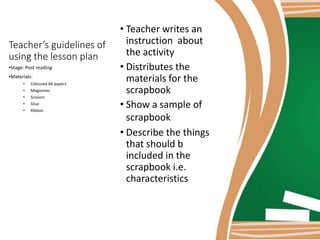
• Teacher writes an
instruction about
the activity
• Distributes the
materials for the
scrapbook
• Show a sample of
scrapbook
• Describe the things
that should b
included in the
scrapbook i.e.
characteristics
Teacher’s guidelines of
using the lesson plan
•Stage: Post reading
•Materials:
• Coloured A4 papers
• Magazines
• Scissors
• Glue
• Ribbon
Rationale
• The activity used in the lesson promotes the
language used among the students; group
discussions
• “activities like prediction, cloze, ranking tasks,
role play, poetry recital, forum, debate and
discussions can be used to create opportunities
for language use in the classroom” (Carter,
1996; Rosli, 1995).
• The loud reading session gives opportunity for
teacher to correct any pronunciation error
made by students
• The making of scrapbook promotes the
students to use the language to describe their
hero, as each students need to use language in
describing their hero

Teaching reading skill

  • 1.
  • 2.
    The Reading Behaviorof L2 Learners •Masuhara (2003) noted the striking similarities in the descriptions of unsuccessful reading behaviors across wide varieties of readers (e.g. Cooper, 1984; Hosenfeld, 1984; Kim and Krashen, 1997; Masuhara, 2000; Tomlinson, 2011b)
  • 3.
    ...Behavior of L2Learners •learners in Kim and Krashen (1997), Masuhara (2000) and Tomlinson (2011b) are proficient L1 readers and yet, even at intermediate and advanced level in an L2, they seem to retain many of the typical reading behaviours of unsuccessful readers.
  • 4.
    ...Behavior of L2Learners •as language competence is concerned they are classified as far above the threshold level of language competence (Alderson, 1984; Clarke, 1988; Cummins and Swain, 1986; Bernhardt and Kamil, 1995)
  • 5.
    ...Behavior of L2Learners 3 Dimensions (Pang, 2008) • language knowledge and processing ability •cognitive ability •metacognitive strategic competence.
  • 6.
    ...Behavior of L2Learners 4 components of L2 reading fluency (Grabe, 2009) •automaticity •accuracy •reading rate •prosodic structuring
  • 7.
    An Overview ofthe Major Approaches to Teaching L2 Reading Materials
  • 8.
  • 9.
    ◾English becomes anInternational Lanaguage. ◾It demands all the society in every background especially the students to master it well. ◾Reading approach is one of the way to help the students solve their problem in reading ◾In reading approach, many things an be achieved by the students and they can master English well. INTRODUCTION
  • 10.
    READING APPROACH orREADING METHOD was first devised for English Learners in India and French learners in United States of America who have not mastered the oral use of language. A BRIEF HISTORY
  • 11.
    ◾The students areable to identify meaning rather than letters or words ◾The students are able to understand and read the text quickly ◾The students are able to read actively OBJECTIVE
  • 12.
    SKIMMING -It is anactivity to read shorter texts to extract accurate detailed information. -It is done at a speed of three to four times faster than normal reading. SCANNING -quickly read the text to get the gist of it. -involves moving eyes quickly down the page seeking specific words and phrases TYPES OF TEACHING AND LEARNING ACTIVITIES
  • 13.
    EXTENSIVE READING -reading longertext usually for pleasure INTENSIVE READING -it is reading in depth and is usually done in the class with each pupil having the same text. -is a reading for a high degree of comprehension and retention over a long period of time. TYPES OF TEACHING AND LEARNING ACTIVITIES
  • 14.
    ◾READING ALOUD bythe teacher is an important component of the struggling reader’s literacy program. Teacher is a model in reading process and students listen and repond to the teacher. ◾SHARED READING – the teacher reads a text while the students observe and follows along silently. ◾WORD STUDY – fosters recognition of the individual sounds of the words. KINDS OF INSTRUCTIONAL EXPERIENCES AND MATERIALS
  • 15.
    ◾INDEPENDENT READING –is what struggling readers most need to practice. ◾GUIDED READING – involves teachers’ structuring learning situation in which children work in small group on material that is challenging to them. KINDS OF INSTRUCTIONAL EXPERIENCES AND MATERIALS
  • 16.
    ◾MOTIVATE LEARNERS ◾ENCOURAGING TOSET READING STRATEGIES ◾SUPPORT THE STUDENTS TO DEVELOP READING COMPREHENSION TEACHER ROLES
  • 17.
    ◾To get themeaning from the whole text ◾To have good vocabulary and integrate naturally with other class work ROLES OF INSTRUCTIONAL MATERIALS
  • 18.
    The teacher teachesstudents about prior knowledge. Making connection is when a student can relate to an experience. Questioning is another strategy that wil greatly benefit a student. “All our knowledge results from questions which is another way of saying that question/asking is our most important intellectual tool” --- Dr. Niel Postman COMPREHENSION STRATEGIES
  • 19.
    Visualization is whena student can create a picture or movie in their mind while reading text. Summarizing is telling what is important about the text. Evaluation is about making judgements on what you read and then explaining why you made those judgements. Synthesizing is putting the pieces together to see them in a new way. COMPREHENSION STRATEGIES
  • 20.
  • 21.
    •Carter (1988) :Language-based approach helps students to focus attention on the way as to how the language is used. •Lazar (1993) : Literary texts as resources that cater for language practice through series of language activities rather than studying literature for the purpose of acquiring facts and information. •A student-centred approach •Utilizing the poem as a tool to learn a language
  • 22.
    • Teacher writesthe word “hero” on the whiteboard. • Get the students to be in a group of five (6 groups) • Instruct them to discuss about the word written on the whiteboard • Pick students from a random group to share their ideas. Teacher’s guidelines of using the lesson plan •Stage: Pre-reading •Material: 1. Whiteboard and marker
  • 23.
    • Teacher playsa video while reciting the poem • Ask them to read the poem aloud • Ask the students to remain seated in the group • Distribute the task sheet, glue and an envelope to each group • Instruct the students to match the word with their meaning on the task sheet Teacher’s guidelines of using the lesson plan •Stage: While reading •Materials: • YouTube video • Task sheet • Glue • An envelope containing words in the poem (refer to appendix 4)
  • 24.
    • Teacher writesan instruction about the activity • Distributes the materials for the scrapbook • Show a sample of scrapbook • Describe the things that should b included in the scrapbook i.e. characteristics Teacher’s guidelines of using the lesson plan •Stage: Post reading •Materials: • Coloured A4 papers • Magazines • Scissors • Glue • Ribbon
  • 25.
    Rationale • The activityused in the lesson promotes the language used among the students; group discussions • “activities like prediction, cloze, ranking tasks, role play, poetry recital, forum, debate and discussions can be used to create opportunities for language use in the classroom” (Carter, 1996; Rosli, 1995). • The loud reading session gives opportunity for teacher to correct any pronunciation error made by students • The making of scrapbook promotes the students to use the language to describe their hero, as each students need to use language in describing their hero