Replacement Problems
Introduction:
The efficiency of all industrial and military
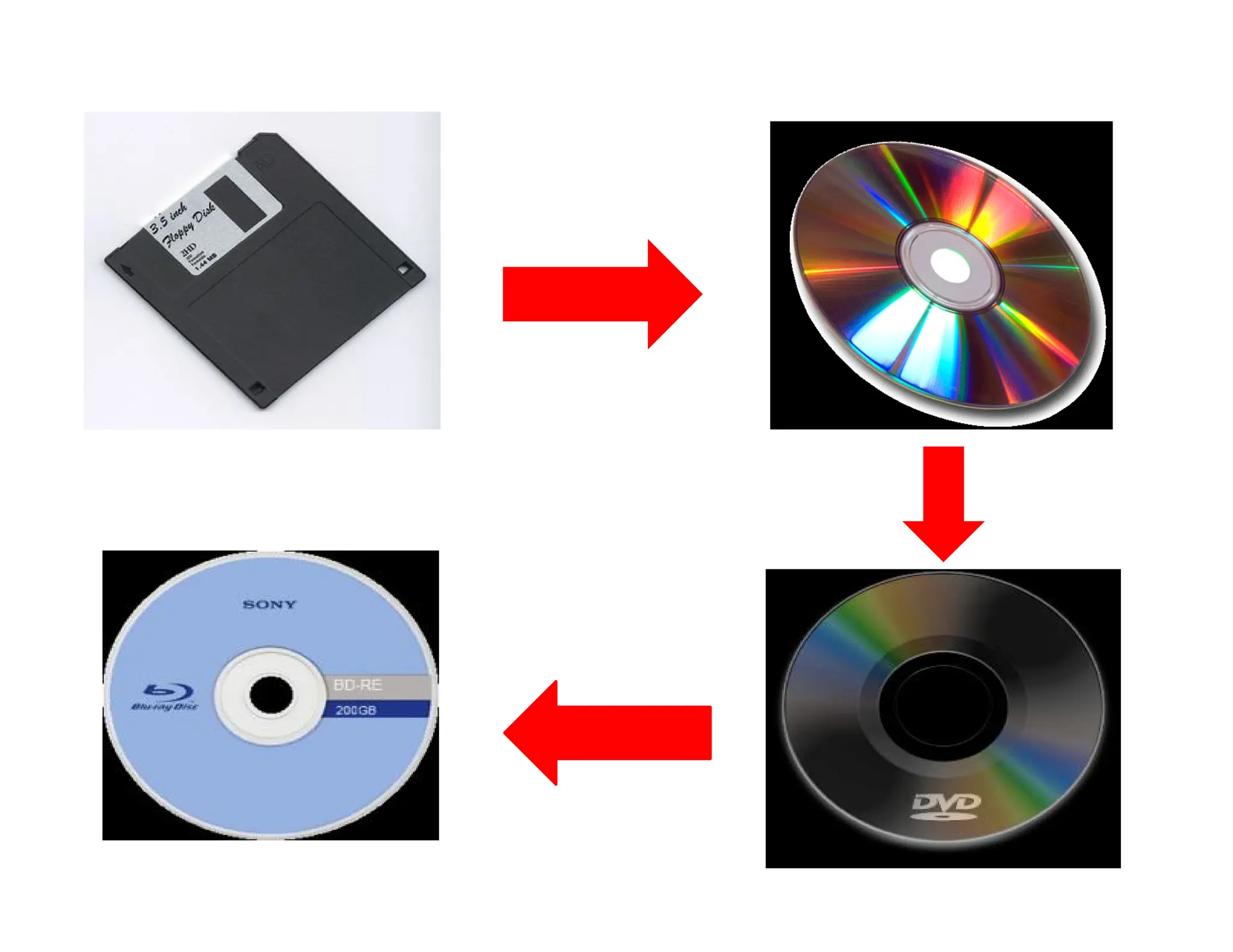
equipments deteriorates with time. Sometimes the
equipment fails completely and effects the whole
system. The maintenance costs (running costs) of an
equipment also go on increasing with time. Thus it
becomes more economical to replace the old
equipment with a new one. Hence there is a need to
formulae a most economical replacement policy
which is in the best interest of the system.
1. Replacement of major or capital item (equipment) that
deteriorates with time; e.g., Machines, Trucks etc.
There are following types of Replacement problems under
discussion:
2. Replacement of an item (equipment) in anticipation of complete
failure, the probability of which increases with time (or age).
3. Problems in morality and staffing.
4. Replacement of an equipment (or item) may be necessary due to
new researches, otherwise the system may become out of date.
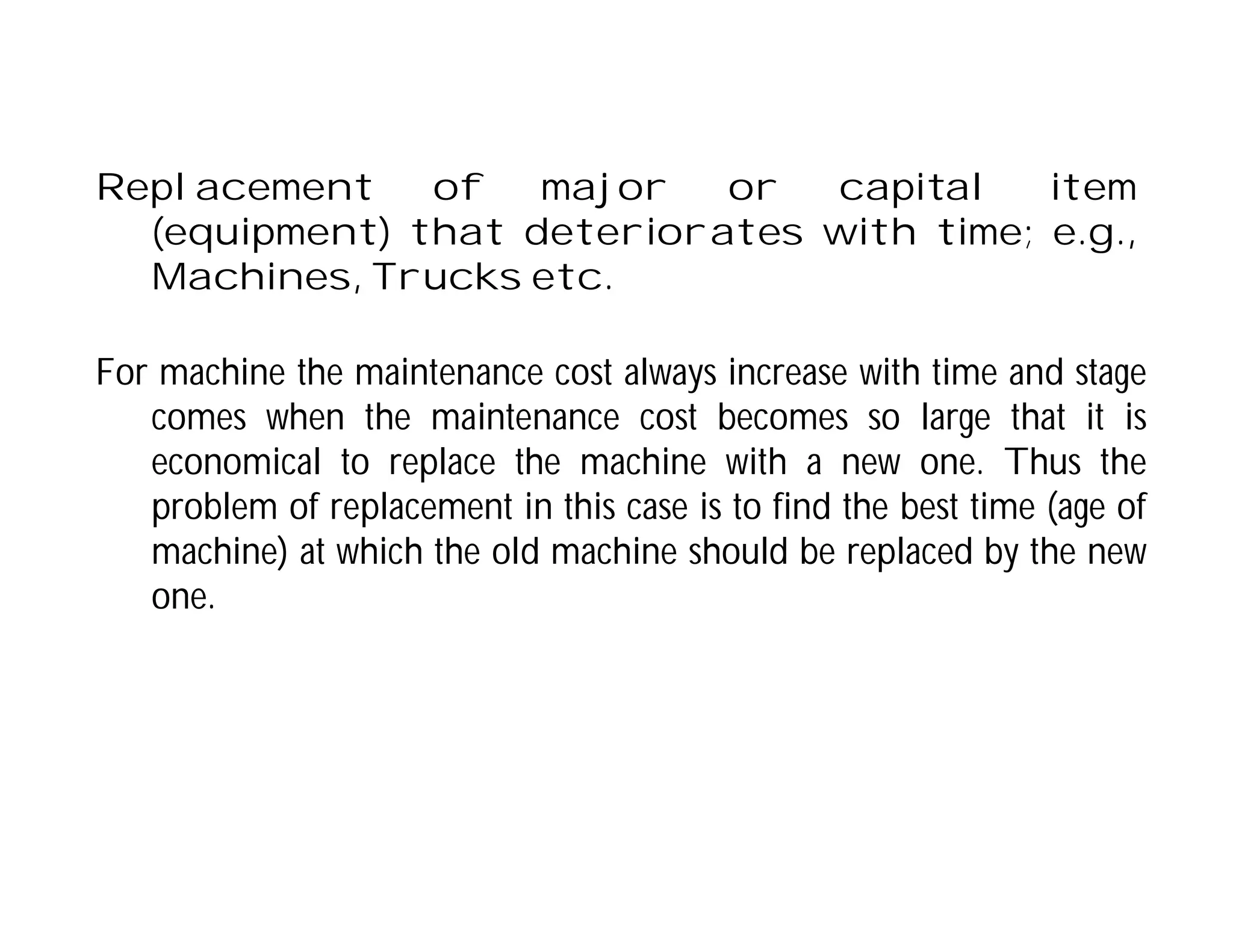
Replacement of major or capital item
(equipment) that deteriorates with time; e.g.,
Machines, Trucks etc.
For machine the maintenance cost always increase with time and stage
comes when the maintenance cost becomes so large that it is
economical to replace the machine with a new one. Thus the
problem of replacement in this case is to find the best time (age of
machine) at which the old machine should be replaced by the new
one.
To Find The Best Replacement Age (Time) of a
Machine When
(1) Its maintenance cost is given by a function increasing
with time.
(2) Its scrap value is constant and,
(3) The Money value is not considered.
Let C = Cost of Machine
S = Scrap value of the machine at time t.
and, Cm(t) = Maintenance cost of machine at time t, [Cm(t) increases with t].
Case 1 : When time ‘t’ is a continuous variable.
Total maintenance cost of the machine in n years
The total cost of machine in n years
= Cost of machine – Scrap value of machine + Total maintenance cost in n years.


n
m dt
t
C
0
)
(
dt
t
C
S
C
n
m




0
)
(
The average cost of maintenance per year during n years is given by
Now for A (n) to be minimum,
[ from (1) ]
)
1
...(
..........
..........
)
(
1
)
(
)
(
)
(
0
0








n
m
n
m
dt
t
C
n
n
S
C
n
A
n
dt
t
C
S
C
n
A
 
)
(
)
(
)
(
)
(
1
)
(
1
)
(
0
0
2
2
n
A
n
dt
t
C
S
C
t
C
t
C
n
dt
t
C
n
n
S
C
n
A
dn
d
n
m
m
m
n
m












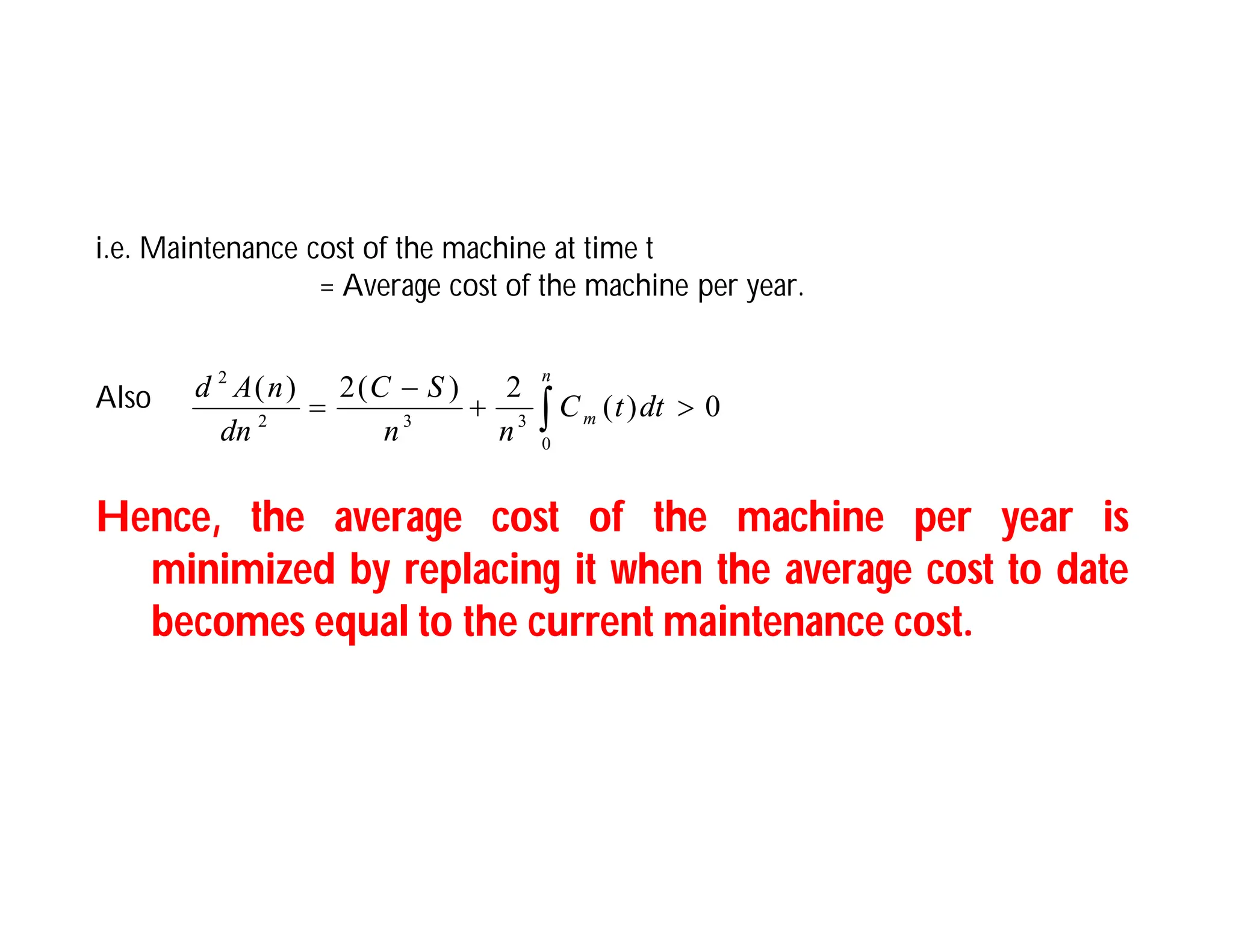
i.e. Maintenance cost of the machine at time t
= Average cost of the machine per year.
Also
Hence, the average cost of the machine per year is
minimized by replacing it when the average cost to date
becomes equal to the current maintenance cost.
 



n
m dt
t
C
n
n
S
C
dn
n
A
d
0
3
3
2
2
0
)
(
2
)
(
2
)
(
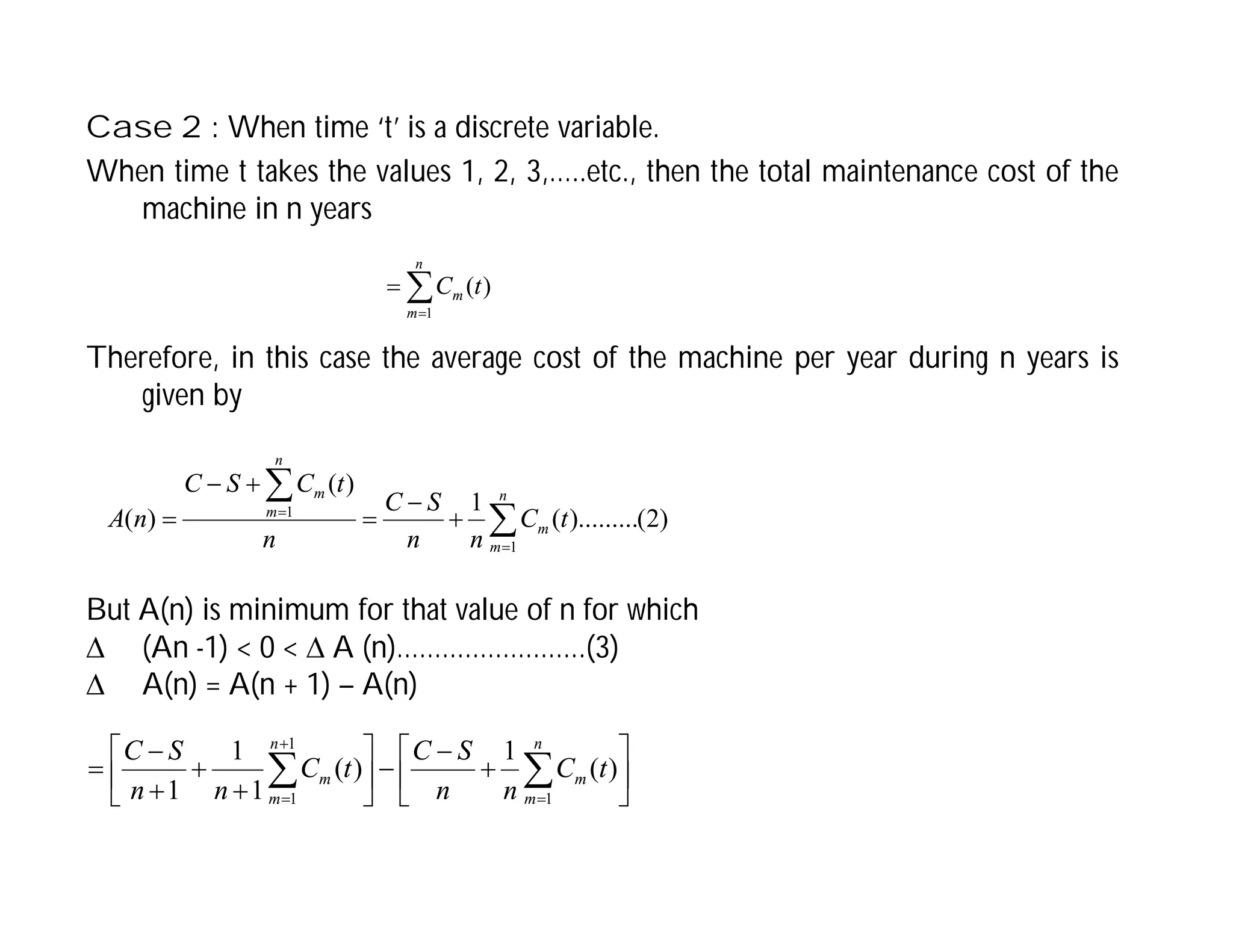
Case 2 : When time ‘t’ is a discrete variable.
When time t takes the values 1, 2, 3,…..etc., then the total maintenance cost of the
machine in n years



n
m
m t
C
1
)
(
Therefore, in this case the average cost of the machine per year during n years is
given by










n
m
m
n
m
m
t
C
n
n
S
C
n
t
C
S
C
n
A
1
1
)
2
(
).........
(
1
)
(
)
(
But A(n) is minimum for that value of n for which
 (An -1) < 0 <  A (n)…………………….(3)
 A(n) = A(n + 1) – A(n)



















 
 


n
m
m
n
m
m t
C
n
n
S
C
t
C
n
n
S
C
1
1
1
)
(
1
)
(
1
1
1
 
)
(
1
)
1
(
)
1
(
)
2
...(
)
(
1
1
1
)
(
)
(
1
1
)
1
(
)
(
)
(
)
(
1
1
)
(
1
1
1
)
1
(
)
(
)
(
1
)
(
)
(
1
1
1
1
1
1
1
1
1
1
1
1
1
t
C
n
n
n
A
n
A
from
t
C
n
n
n
A
t
C
n
n
n
t
C
S
C
t
C
n
t
C
n
n
n
n
S
C
t
C
n
t
C
t
C
n
n
n
S
C
n
n
n
n
m
m
m
n
m
m
n
m
m
n
m
m
m



















































































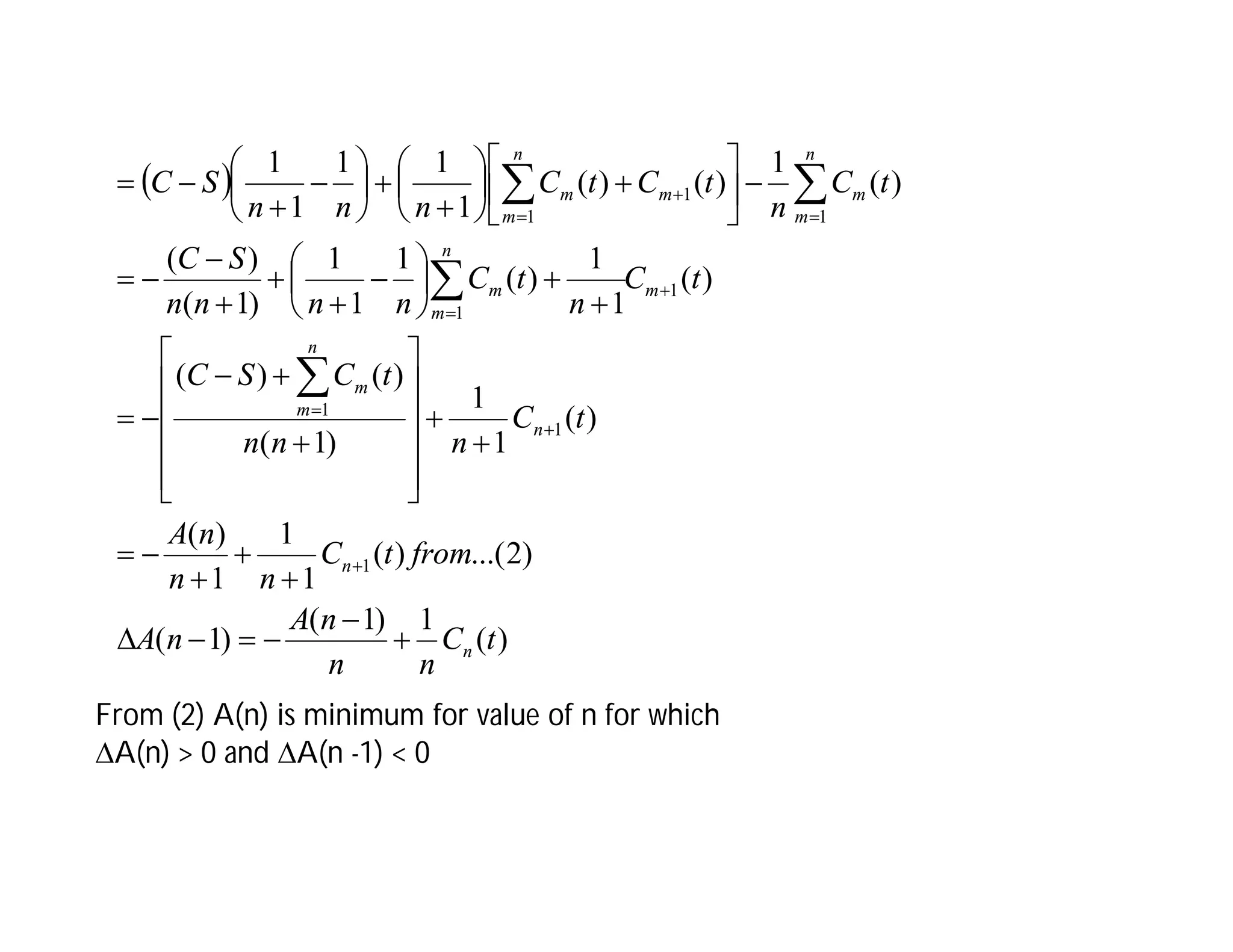
From (2) A(n) is minimum for value of n for which
A(n) > 0 and A(n -1) < 0
)
1
(
)
(
)
(
)
(
0
)
(
1
)
1
(
0
)
(
1
1
1
)
(
1
1














n
A
t
C
n
A
t
C
t
C
n
n
n
A
t
C
n
n
n
A
n
n
n
n
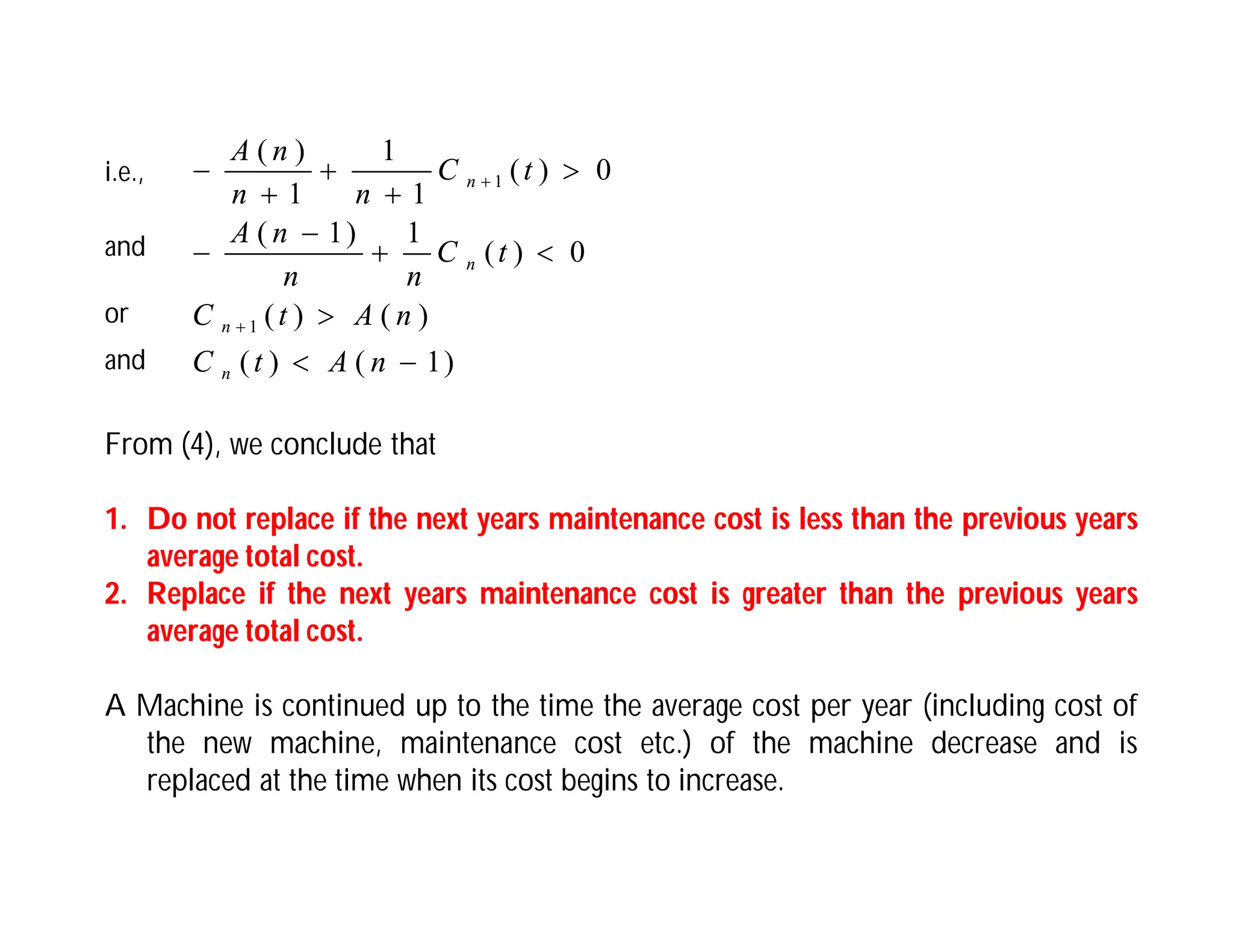
i.e.,
and
or
and
From (4), we conclude that
1. Do not replace if the next years maintenance cost is less than the previous years
average total cost.
2. Replace if the next years maintenance cost is greater than the previous years
average total cost.
A Machine is continued up to the time the average cost per year (including cost of
the new machine, maintenance cost etc.) of the machine decrease and is
replaced at the time when its cost begins to increase.
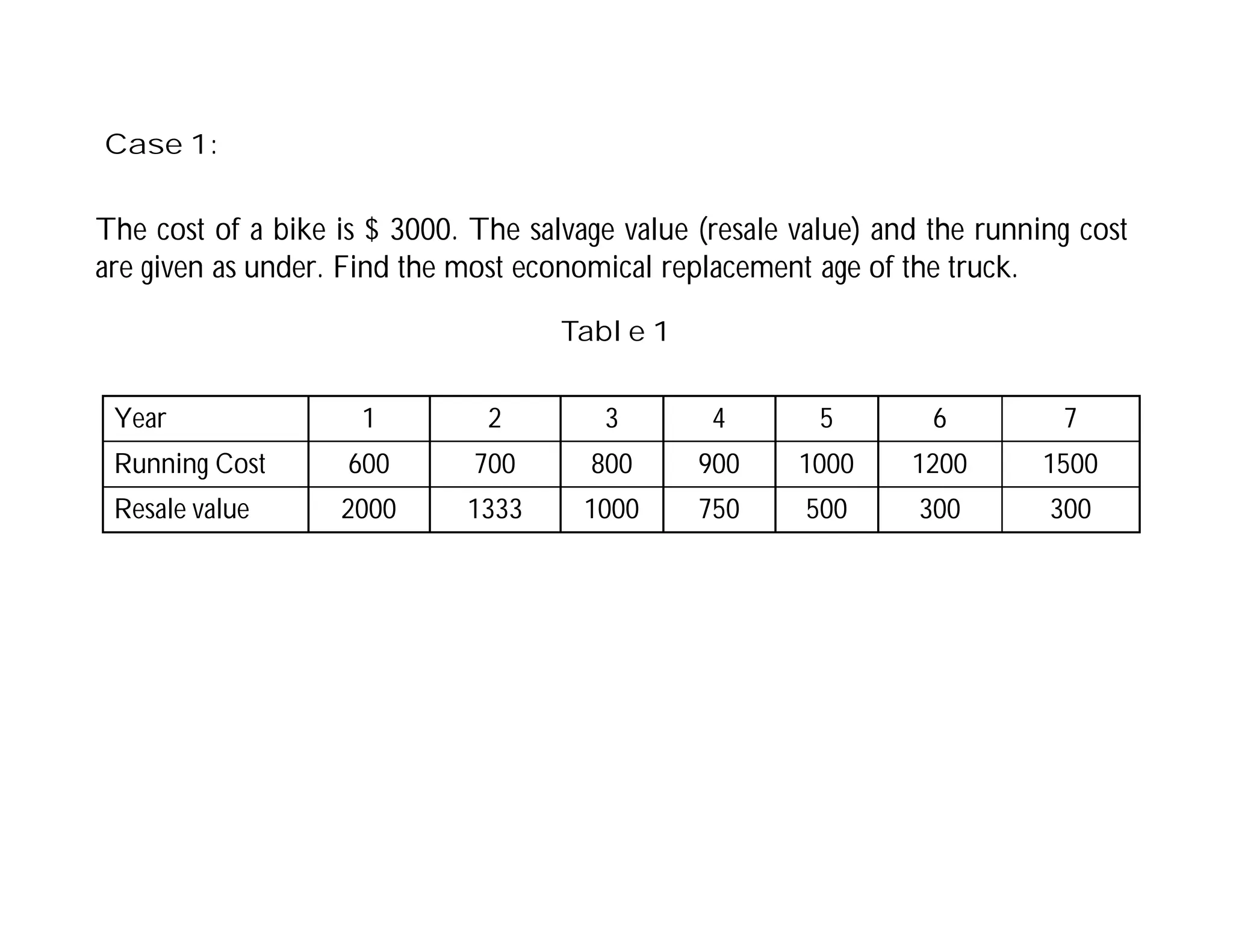
The cost of a bike is $ 3000. The salvage value (resale value) and the running cost
are given as under. Find the most economical replacement age of the truck.
Year 1 2 3 4 5 6 7
Running Cost 600 700 800 900 1000 1200 1500
Resale value 2000 1333 1000 750 500 300 300
Table 1
Case 1:
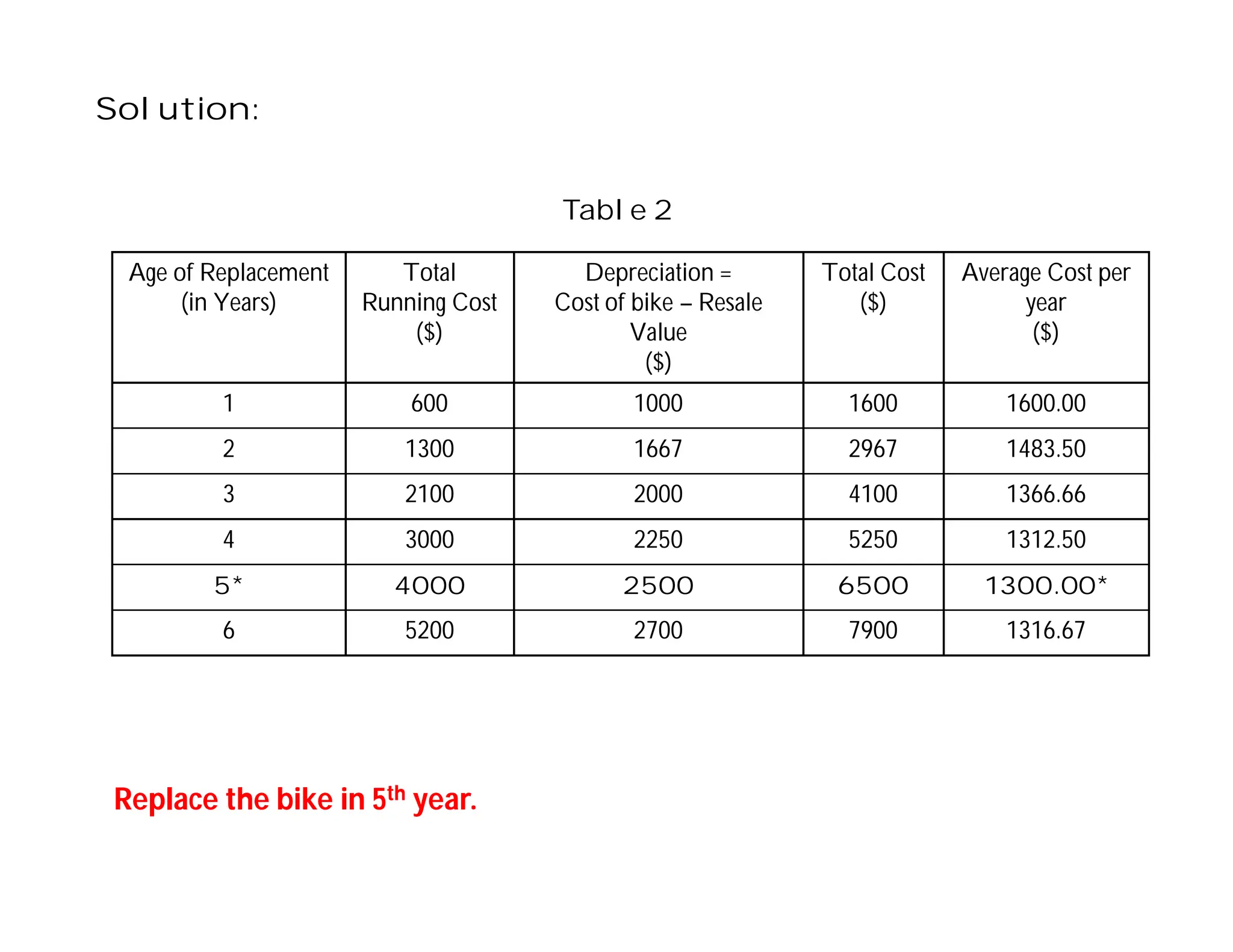
Solution:
Age of Replacement
(in Years)
Total
Running Cost
($)
Depreciation =
Cost of bike – Resale
Value
($)
Total Cost
($)
Average Cost per
year
($)
1 600 1000 1600 1600.00
2 1300 1667 2967 1483.50
3 2100 2000 4100 1366.66
4 3000 2250 5250 1312.50
5* 4000 2500 6500 1300.00*
6 5200 2700 7900 1316.67
Table 2
Replace the bike in 5th year.
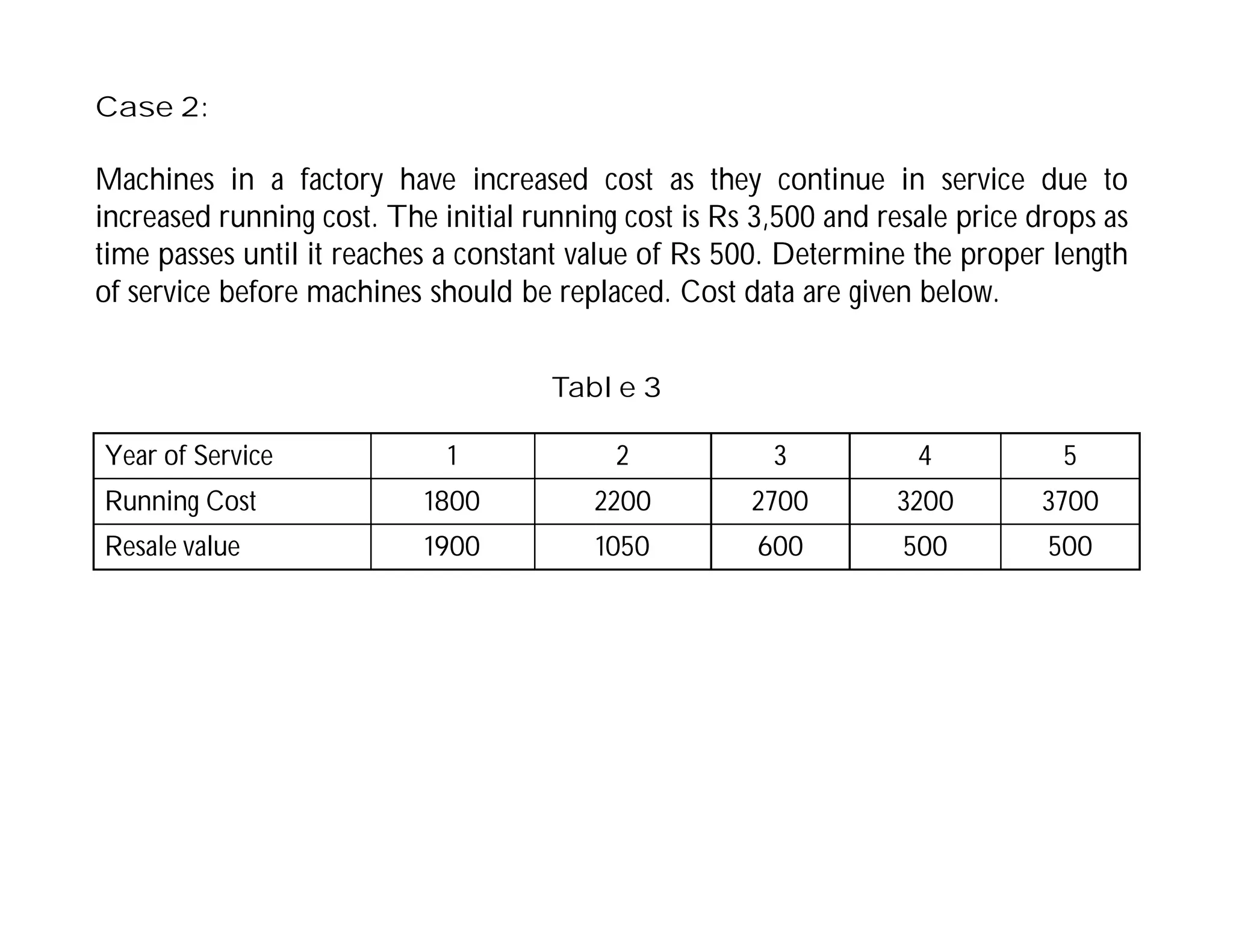
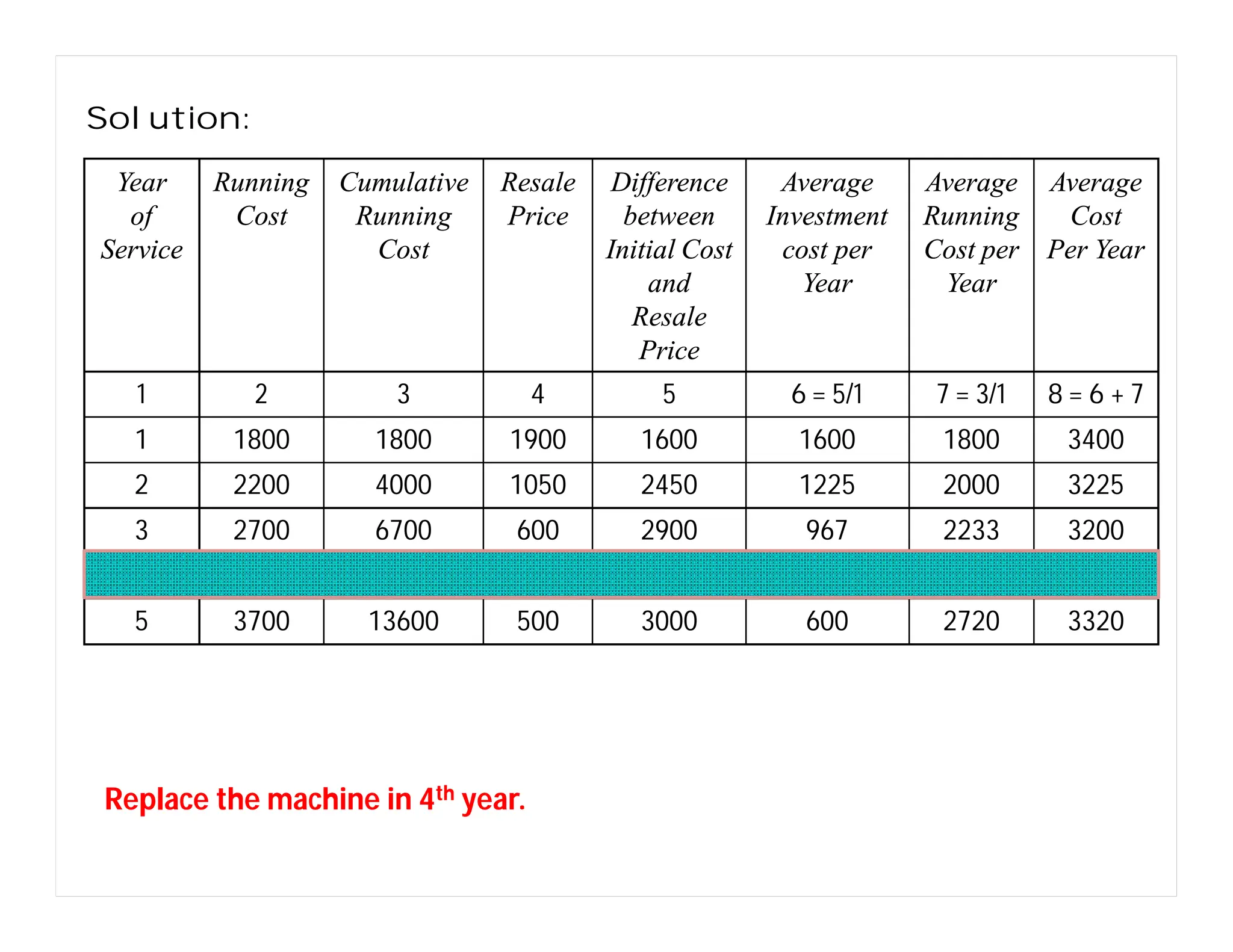
Machines in a factory have increased cost as they continue in service due to
increased running cost. The initial running cost is Rs 3,500 and resale price drops as
time passes until it reaches a constant value of Rs 500. Determine the proper length
of service before machines should be replaced. Cost data are given below.
Case 2:
Year of Service 1 2 3 4 5
Running Cost 1800 2200 2700 3200 3700
Resale value 1900 1050 600 500 500
Table 3
Solution:
Year
of
Service
Running
Cost
Cumulative
Running
Cost
Resale
Price
Difference
between
Initial Cost
and
Resale
Price
Average
Investment
cost per
Year
Average
Running
Cost per
Year
Average
Cost
Per Year
1 2 3 4 5 6 = 5/1 7 = 3/1 8 = 6 + 7
1 1800 1800 1900 1600 1600 1800 3400
2 2200 4000 1050 2450 1225 2000 3225
3 2700 6700 600 2900 967 2233 3200
4 3200 9900 500 3000 750 2475 3225
5 3700 13600 500 3000 600 2720 3320
Replace the machine in 4th year.
Case 3:
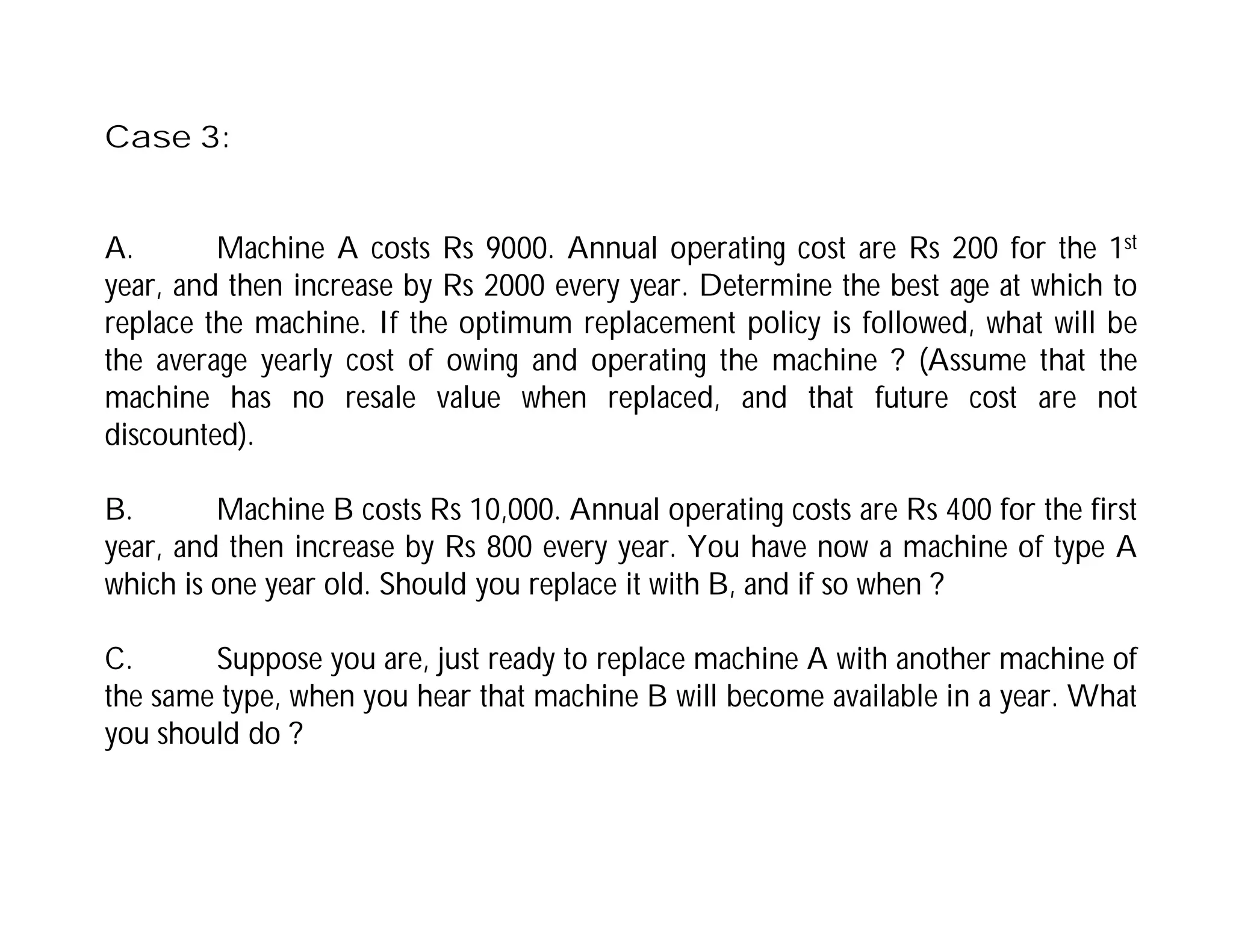
A. Machine A costs Rs 9000. Annual operating cost are Rs 200 for the 1st
year, and then increase by Rs 2000 every year. Determine the best age at which to
replace the machine. If the optimum replacement policy is followed, what will be
the average yearly cost of owing and operating the machine ? (Assume that the
machine has no resale value when replaced, and that future cost are not
discounted).
B. Machine B costs Rs 10,000. Annual operating costs are Rs 400 for the first
year, and then increase by Rs 800 every year. You have now a machine of type A
which is one year old. Should you replace it with B, and if so when ?
C. Suppose you are, just ready to replace machine A with another machine of
the same type, when you hear that machine B will become available in a year. What
you should do ?
Solution:
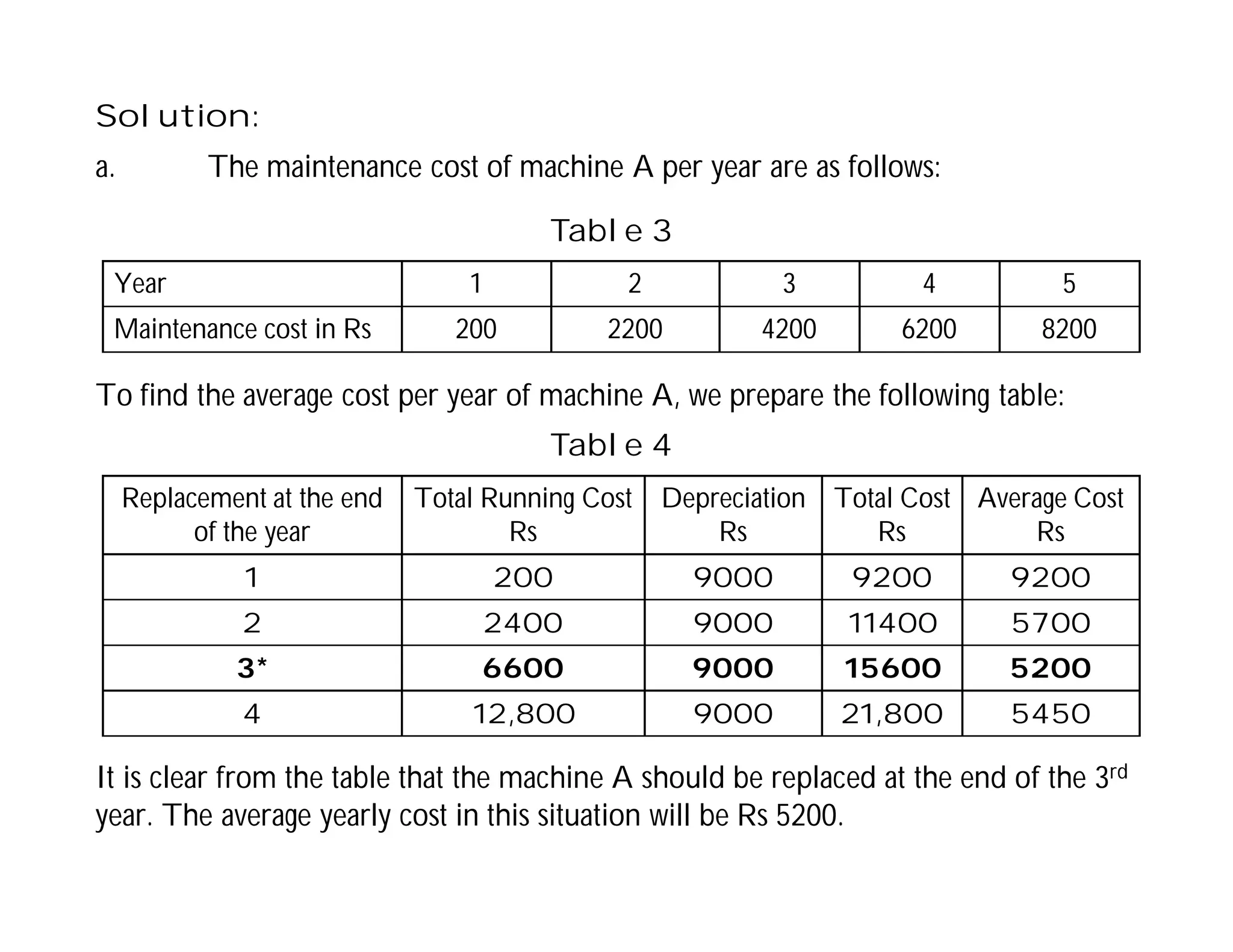
a. The maintenance cost of machine A per year are as follows:
Year 1 2 3 4 5
Maintenance cost in Rs 200 2200 4200 6200 8200
To find the average cost per year of machine A, we prepare the following table:
Table 4
Replacement at the end
of the year
Total Running Cost
Rs
Depreciation
Rs
Total Cost
Rs
Average Cost
Rs
1 200 9000 9200 9200
2 2400 9000 11400 5700
3* 6600 9000 15600 5200
4 12,800 9000 21,800 5450
It is clear from the table that the machine A should be replaced at the end of the 3rd
year. The average yearly cost in this situation will be Rs 5200.
Table 3
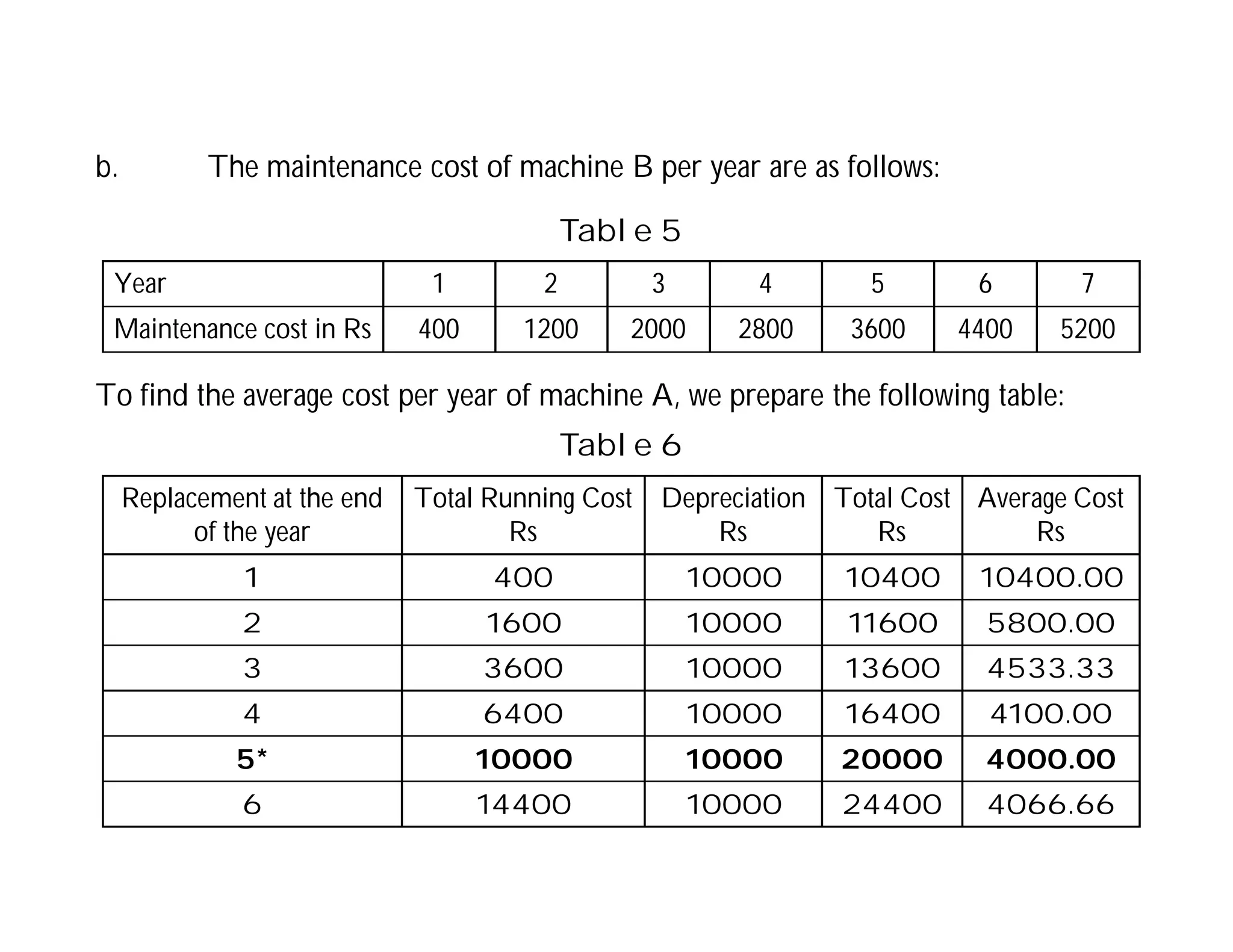
b. The maintenance cost of machine B per year are as follows:
Year 1 2 3 4 5 6 7
Maintenance cost in Rs 400 1200 2000 2800 3600 4400 5200
Table 5
To find the average cost per year of machine A, we prepare the following table:
Table 6
Replacement at the end
of the year
Total Running Cost
Rs
Depreciation
Rs
Total Cost
Rs
Average Cost
Rs
1 400 10000 10400 10400.00
2 1600 10000 11600 5800.00
3 3600 10000 13600 4533.33
4 6400 10000 16400 4100.00
5* 10000 10000 20000 4000.00
6 14400 10000 24400 4066.66
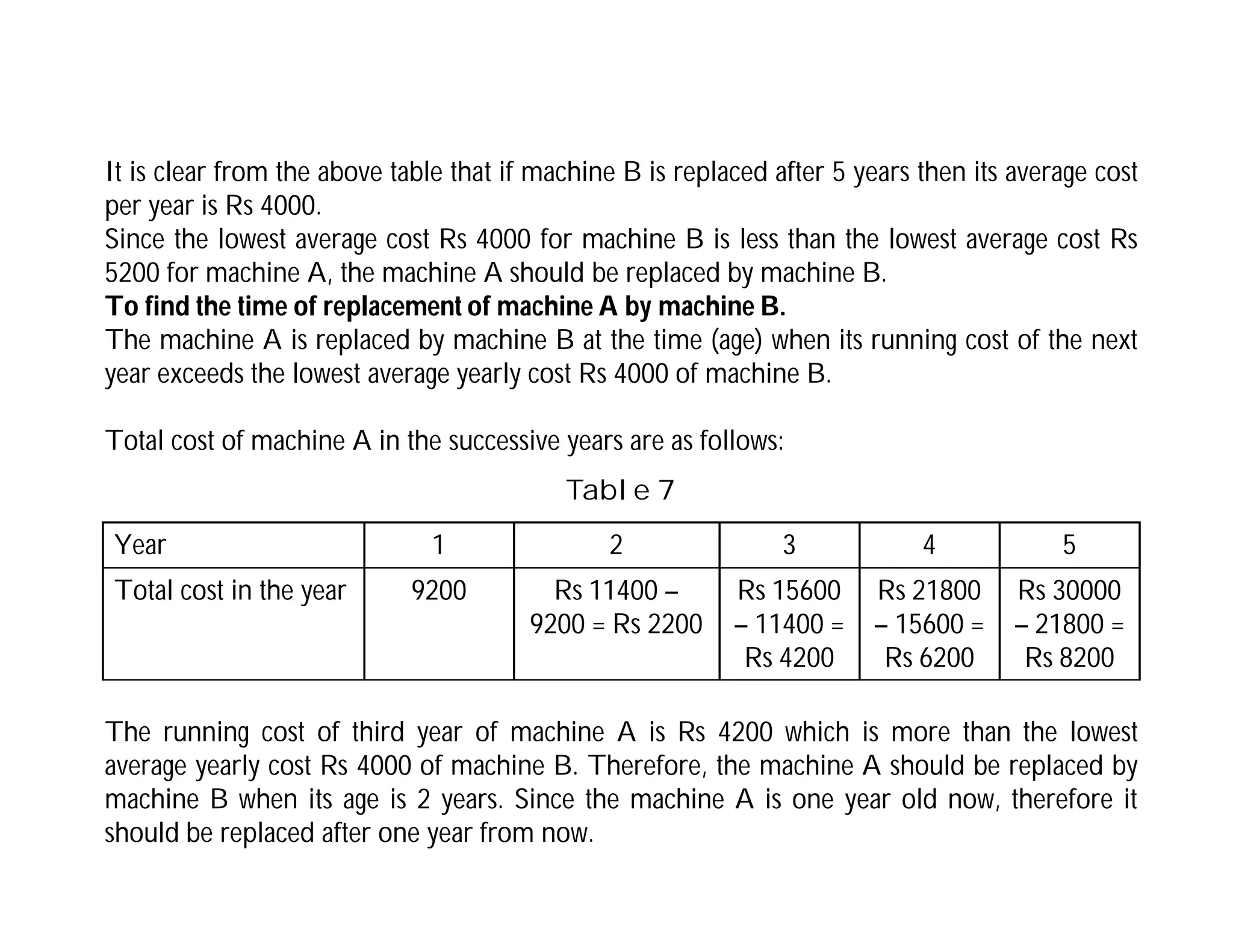
It is clear from the above table that if machine B is replaced after 5 years then its average cost
per year is Rs 4000.
Since the lowest average cost Rs 4000 for machine B is less than the lowest average cost Rs
5200 for machine A, the machine A should be replaced by machine B.
To find the time of replacement of machine A by machine B.
The machine A is replaced by machine B at the time (age) when its running cost of the next
year exceeds the lowest average yearly cost Rs 4000 of machine B.
Total cost of machine A in the successive years are as follows:
Year 1 2 3 4 5
Total cost in the year 9200 Rs 11400 –
9200 = Rs 2200
Rs 15600
– 11400 =
Rs 4200
Rs 21800
– 15600 =
Rs 6200
Rs 30000
– 21800 =
Rs 8200
Table 7
The running cost of third year of machine A is Rs 4200 which is more than the lowest
average yearly cost Rs 4000 of machine B. Therefore, the machine A should be replaced by
machine B when its age is 2 years. Since the machine A is one year old now, therefore it
should be replaced after one year from now.
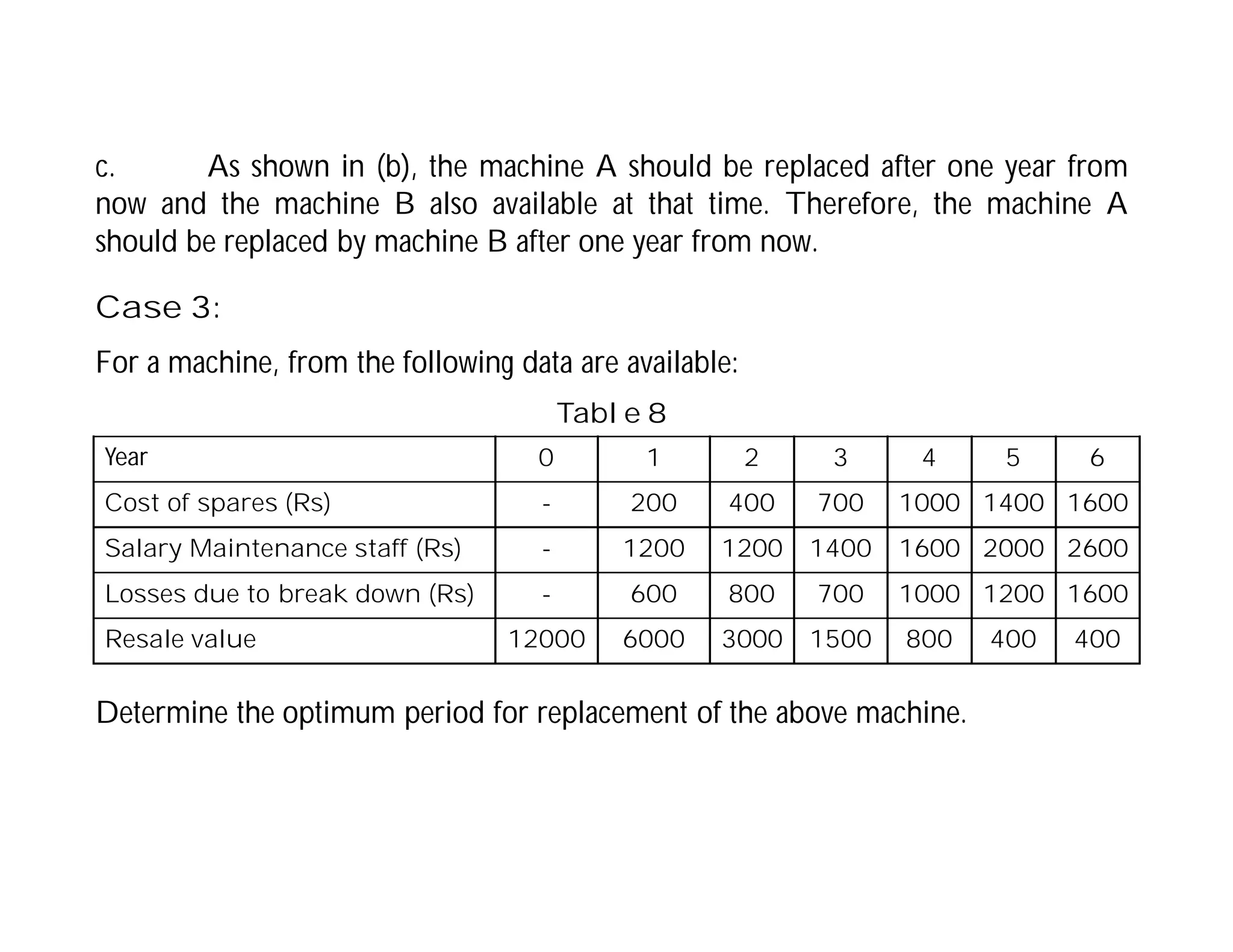
c. As shown in (b), the machine A should be replaced after one year from
now and the machine B also available at that time. Therefore, the machine A
should be replaced by machine B after one year from now.
Case 3:
For a machine, from the following data are available:
Year 0 1 2 3 4 5 6
Cost of spares (Rs) - 200 400 700 1000 1400 1600
Salary Maintenance staff (Rs) - 1200 1200 1400 1600 2000 2600
Losses due to break down (Rs) - 600 800 700 1000 1200 1600
Resale value 12000 6000 3000 1500 800 400 400
Determine the optimum period for replacement of the above machine.
Table 8
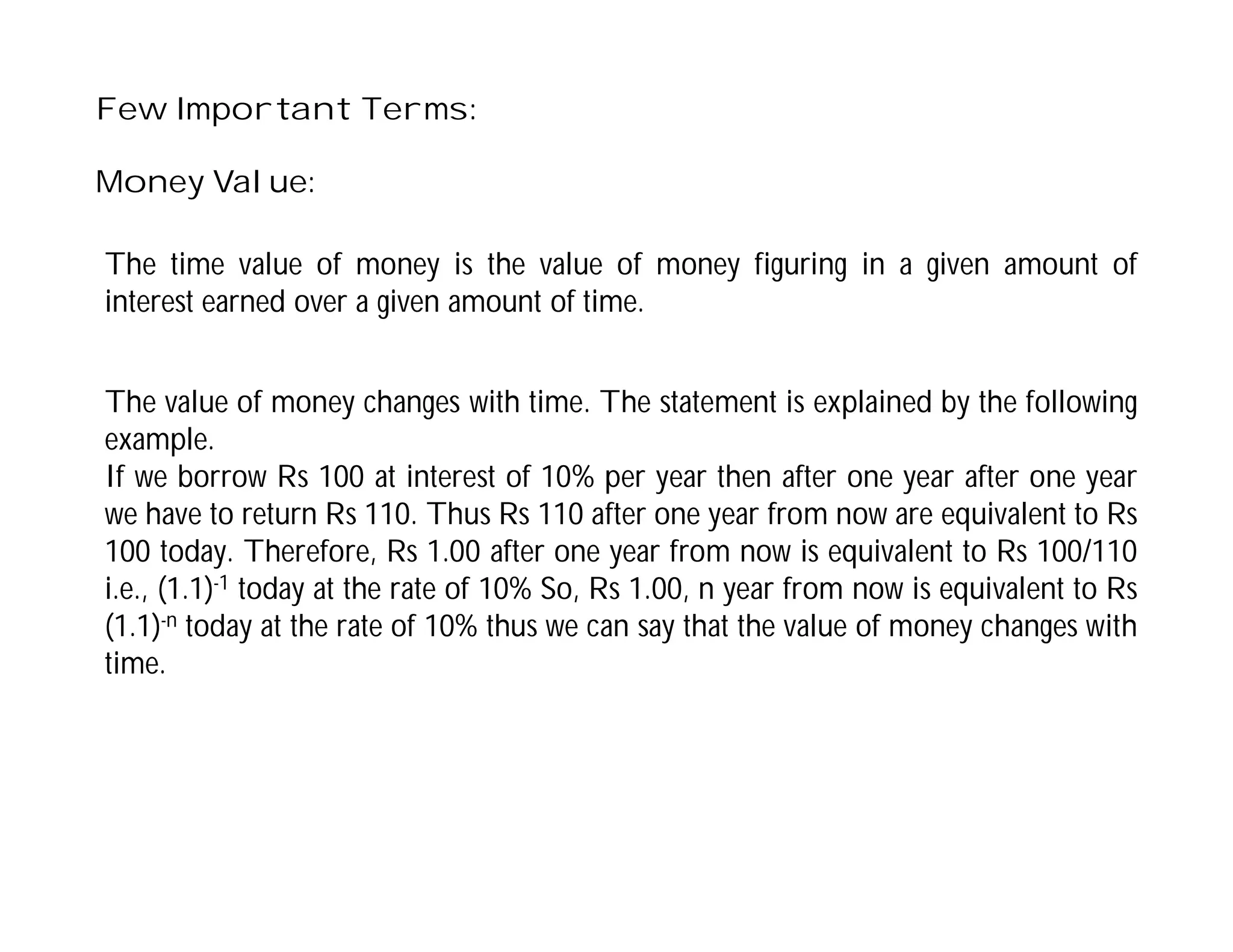
Few Important Terms:
Money Value:
The value of money changes with time. The statement is explained by the following
example.
If we borrow Rs 100 at interest of 10% per year then after one year after one year
we have to return Rs 110. Thus Rs 110 after one year from now are equivalent to Rs
100 today. Therefore, Rs 1.00 after one year from now is equivalent to Rs 100/110
i.e., (1.1)-1 today at the rate of 10% So, Rs 1.00, n year from now is equivalent to Rs
(1.1)-n today at the rate of 10% thus we can say that the value of money changes with
time.
The time value of money is the value of money figuring in a given amount of
interest earned over a given amount of time.
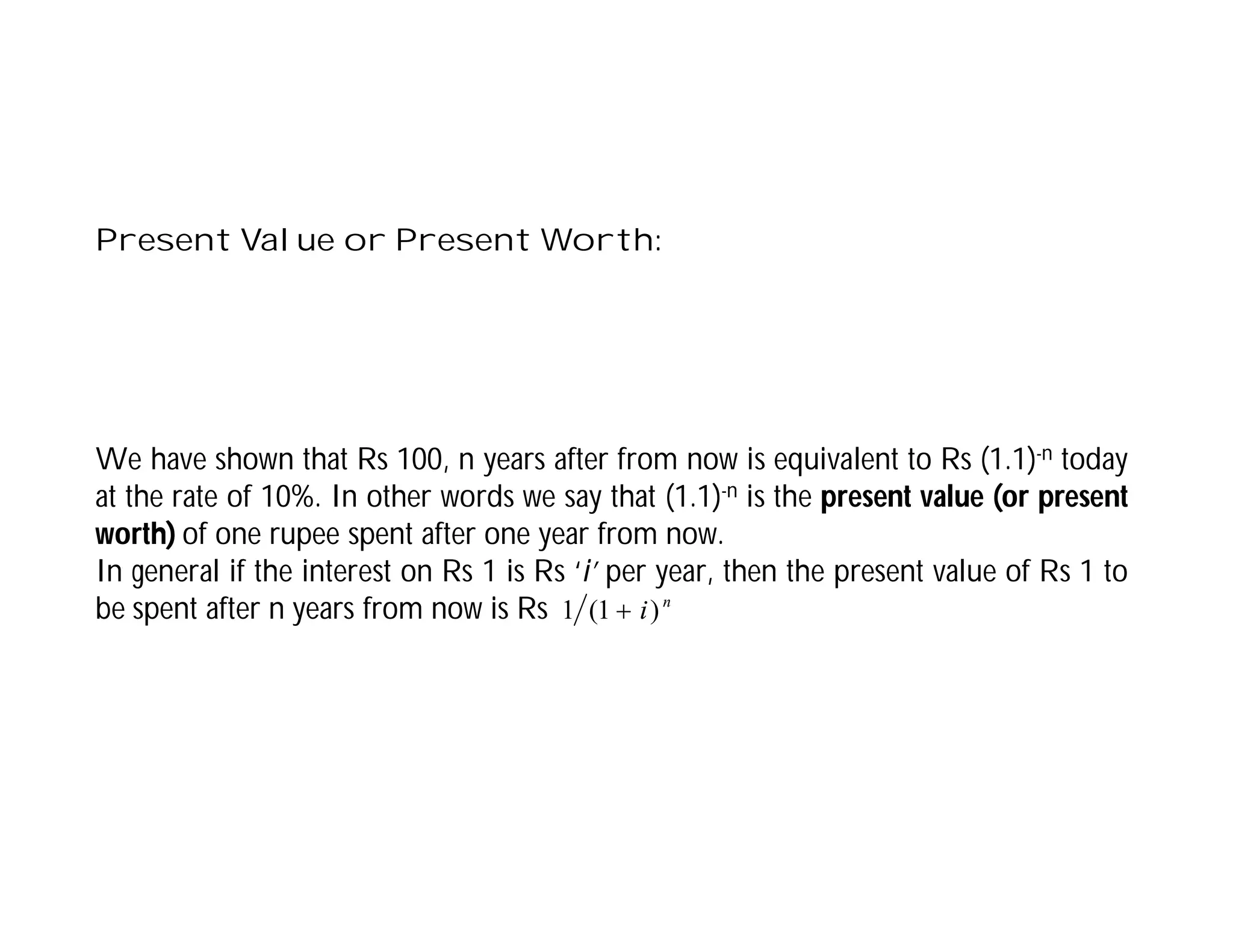
Present Value or Present Worth:
We have shown that Rs 100, n years after from now is equivalent to Rs (1.1)-n today
at the rate of 10%. In other words we say that (1.1)-n is the present value (or present
worth) of one rupee spent after one year from now.
In general if the interest on Rs 1 is Rs ‘i’ per year, then the present value of Rs 1 to
be spent after n years from now is Rs n
i)
1
(
1 
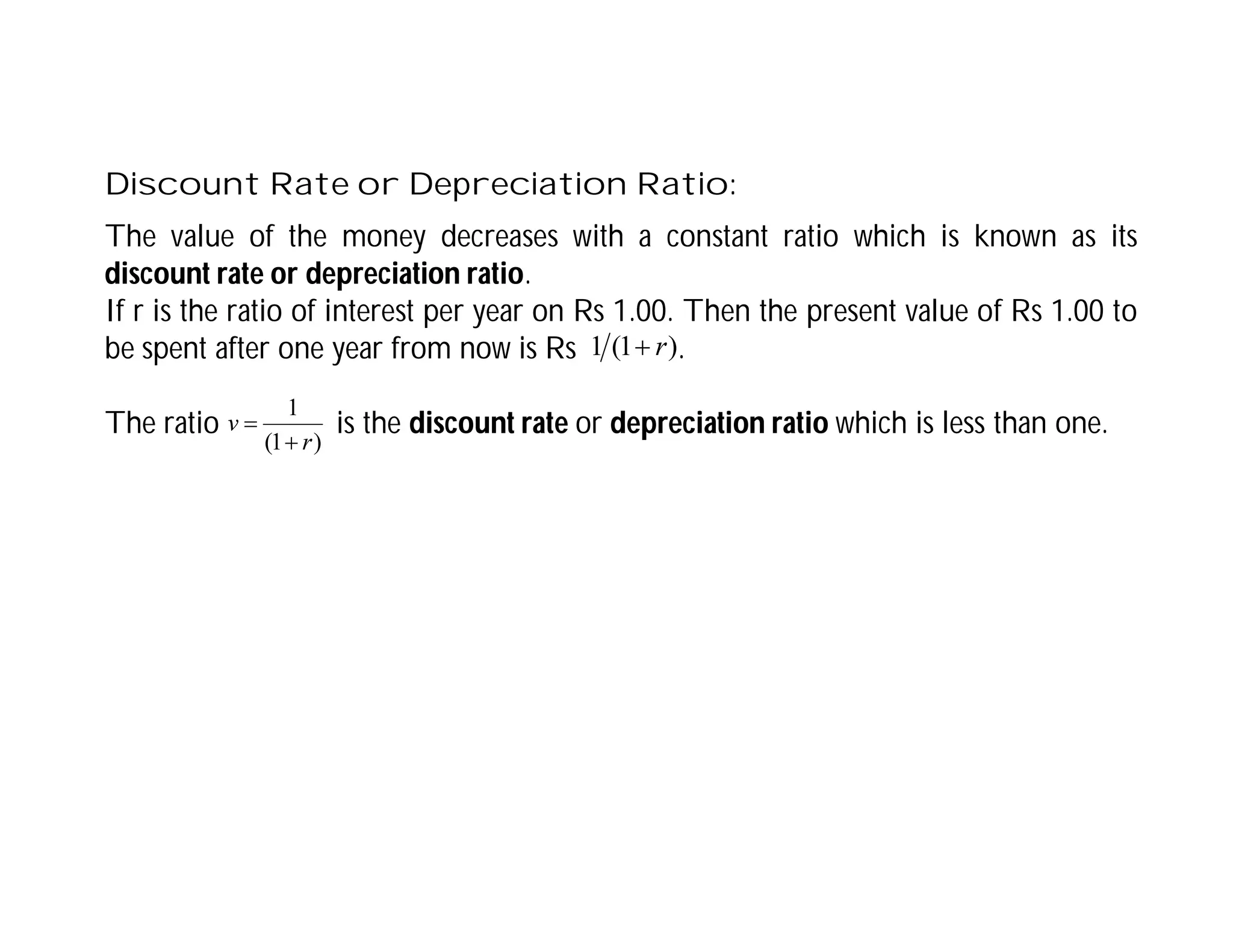
Discount Rate or Depreciation Ratio:
The value of the money decreases with a constant ratio which is known as its
discount rate or depreciation ratio.
If r is the ratio of interest per year on Rs 1.00. Then the present value of Rs 1.00 to
be spent after one year from now is Rs .
The ratio is the discount rate or depreciation ratio which is less than one.
)
1
(
1 r

)
1
(
1
r
v


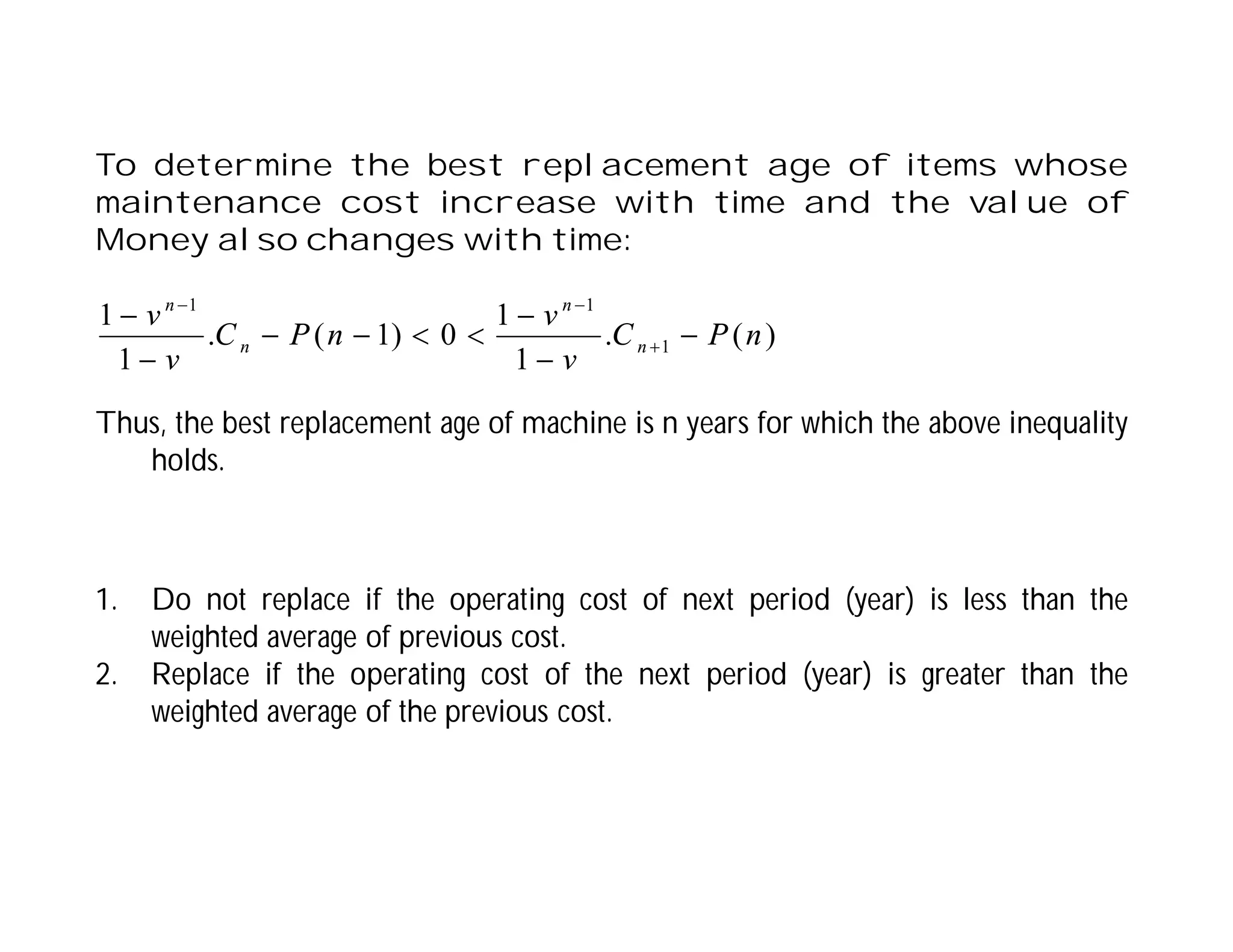
To determine the best replacement age of items whose
maintenance cost increase with time and the value of
Money also changes with time:
1. Do not replace if the operating cost of next period (year) is less than the
weighted average of previous cost.
2. Replace if the operating cost of the next period (year) is greater than the
weighted average of the previous cost.
)
(
.
1
1
0
)
1
(
.
1
1
1
1
1
n
P
C
v
v
n
P
C
v
v
n
n
n
n












Thus, the best replacement age of machine is n years for which the above inequality
holds.
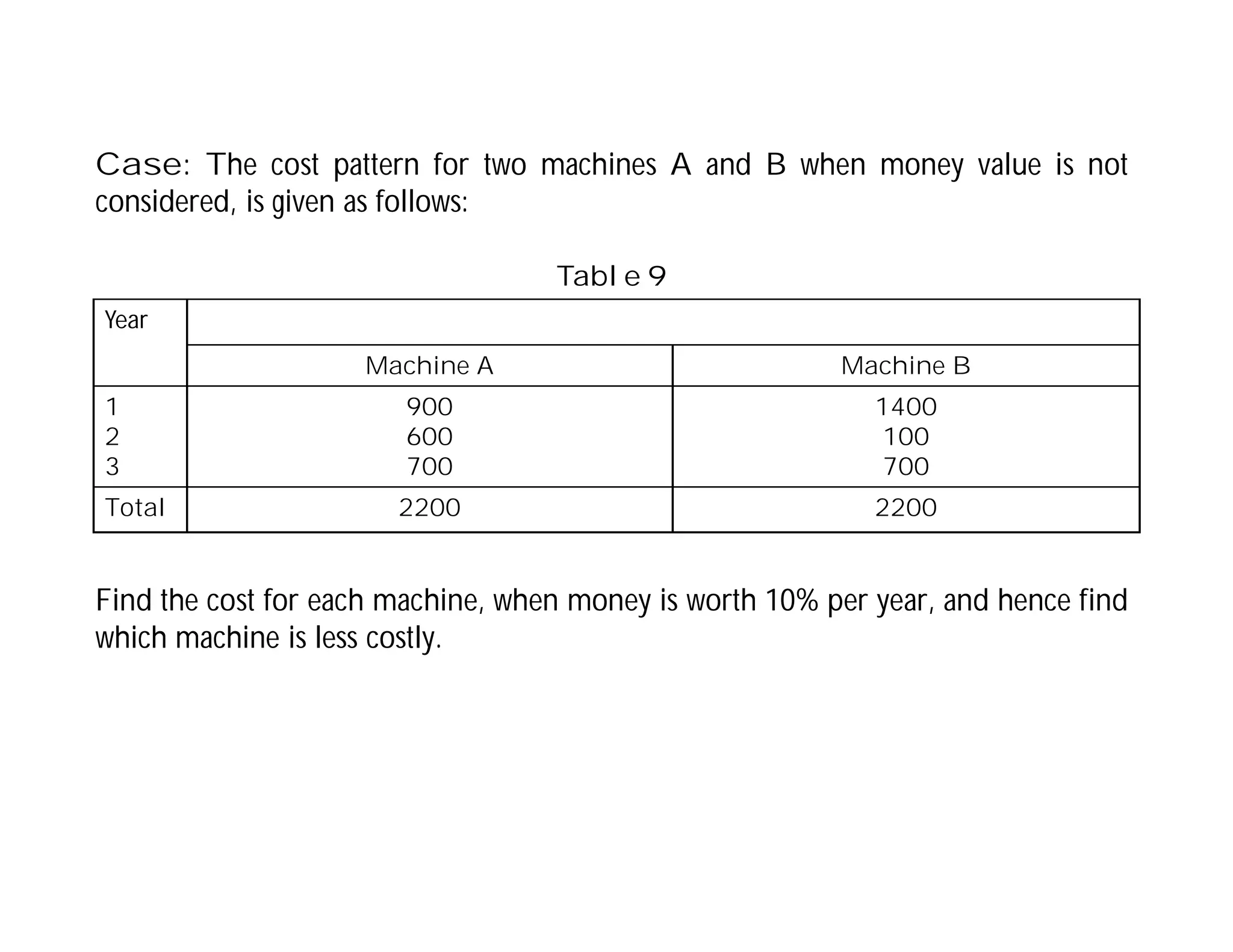
Case: The cost pattern for two machines A and B when money value is not
considered, is given as follows:
Year
Machine A Machine B
1
2
3
900
600
700
1400
100
700
Total 2200 2200
Table 9
Find the cost for each machine, when money is worth 10% per year, and hence find
which machine is less costly.
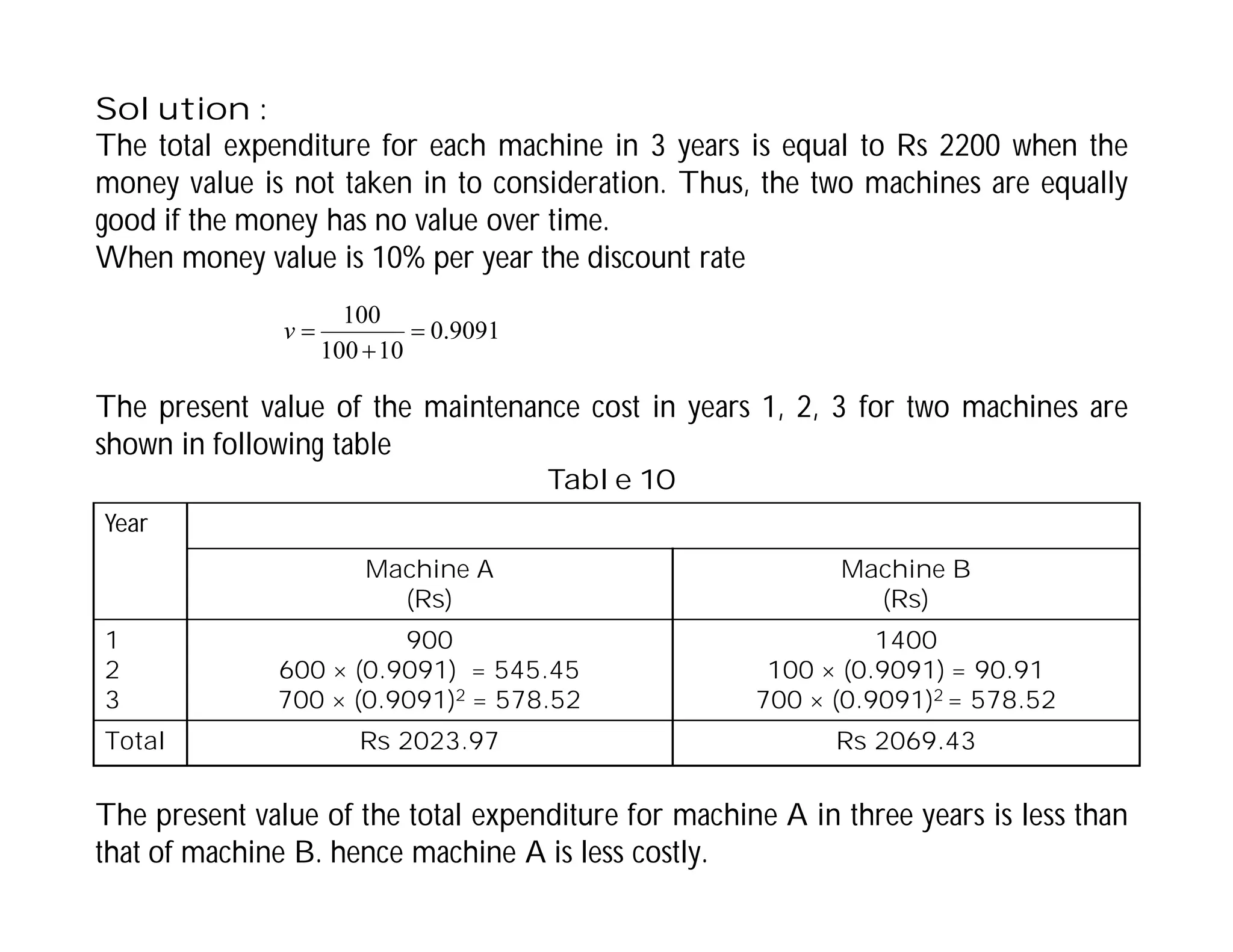
Solution :
The total expenditure for each machine in 3 years is equal to Rs 2200 when the
money value is not taken in to consideration. Thus, the two machines are equally
good if the money has no value over time.
When money value is 10% per year the discount rate
The present value of the maintenance cost in years 1, 2, 3 for two machines are
shown in following table
9091
.
0
10
100
100



v
Year
Machine A
(Rs)
Machine B
(Rs)
1
2
3
900
600 × (0.9091) = 545.45
700 × (0.9091)2 = 578.52
1400
100 × (0.9091) = 90.91
700 × (0.9091)2 = 578.52
Total Rs 2023.97 Rs 2069.43
Table 10
The present value of the total expenditure for machine A in three years is less than
that of machine B. hence machine A is less costly.
Case :
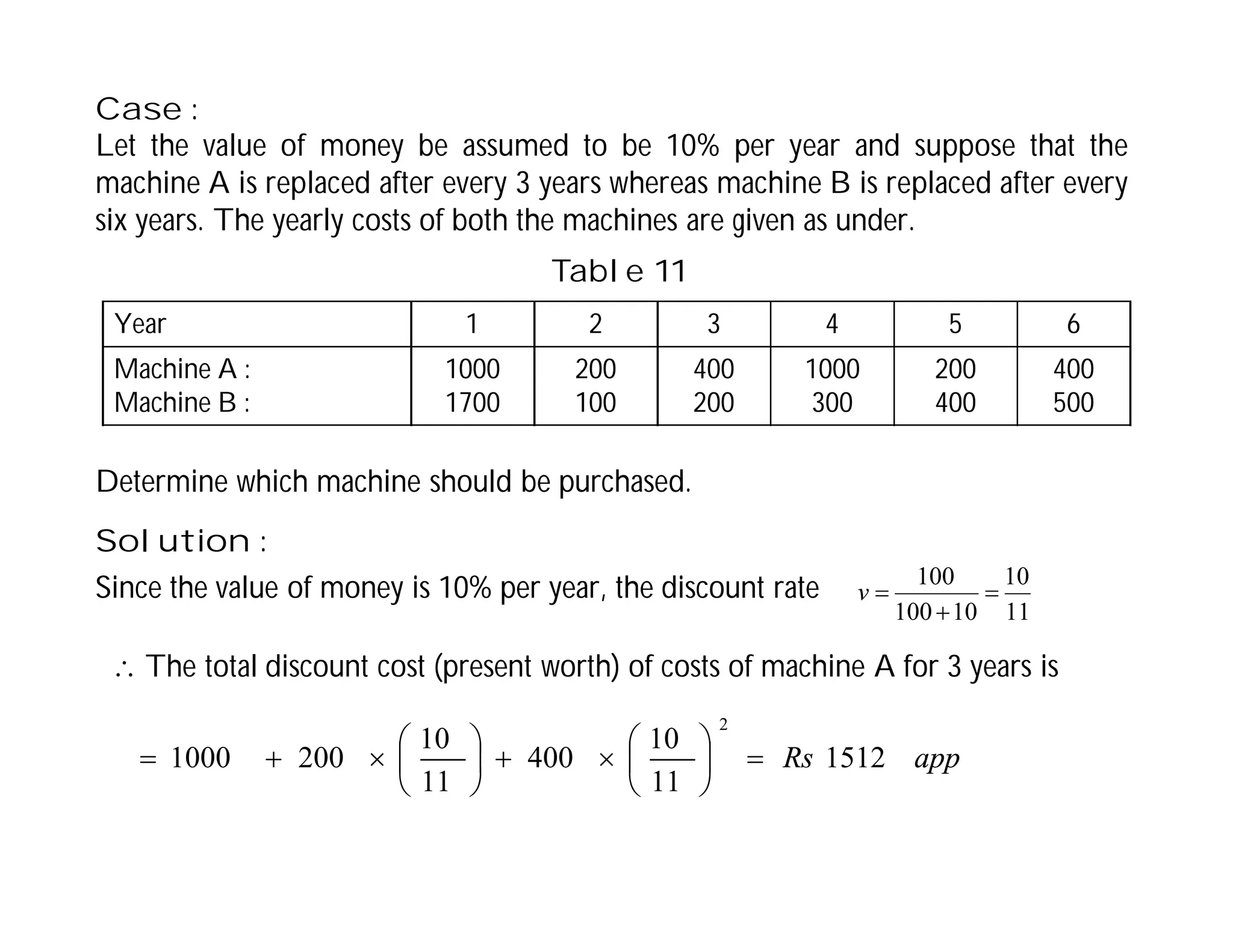
Let the value of money be assumed to be 10% per year and suppose that the
machine A is replaced after every 3 years whereas machine B is replaced after every
six years. The yearly costs of both the machines are given as under.
Determine which machine should be purchased.
Year 1 2 3 4 5 6
Machine A :
Machine B :
1000
1700
200
100
400
200
1000
300
200
400
400
500
Table 11
Solution :
Since the value of money is 10% per year, the discount rate
11
10
10
100
100



v
 The total discount cost (present worth) of costs of machine A for 3 years is
app
Rs 1512
11
10
400
11
10
200
1000
2


















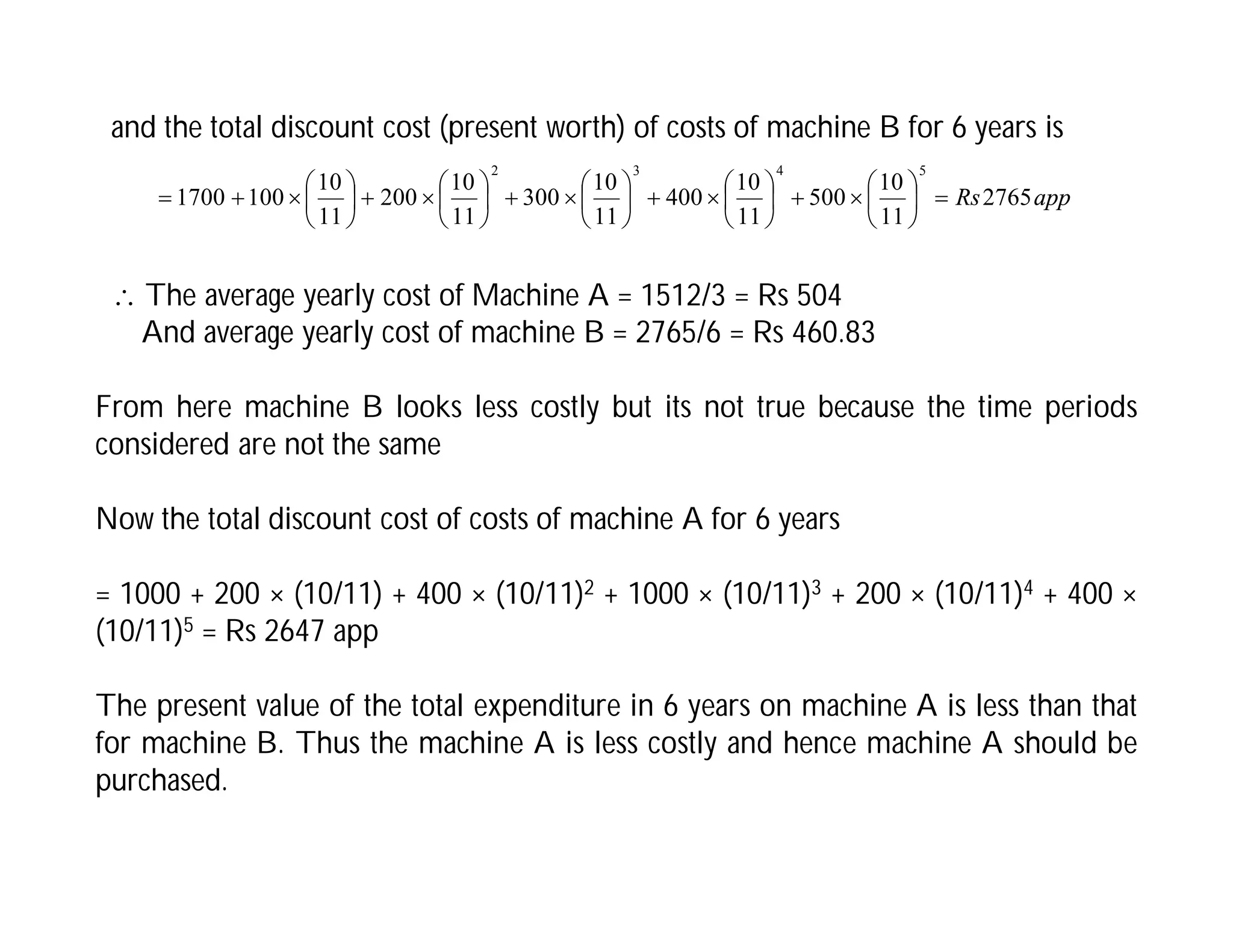
and the total discount cost (present worth) of costs of machine B for 6 years is
app
Rs2765
11
10
500
11
10
400
11
10
300
11
10
200
11
10
100
1700
5
4
3
2










































 The average yearly cost of Machine A = 1512/3 = Rs 504
And average yearly cost of machine B = 2765/6 = Rs 460.83
From here machine B looks less costly but its not true because the time periods
considered are not the same
Now the total discount cost of costs of machine A for 6 years
= 1000 + 200 × (10/11) + 400 × (10/11)2 + 1000 × (10/11)3 + 200 × (10/11)4 + 400 ×
(10/11)5 = Rs 2647 app
The present value of the total expenditure in 6 years on machine A is less than that
for machine B. Thus the machine A is less costly and hence machine A should be
purchased.
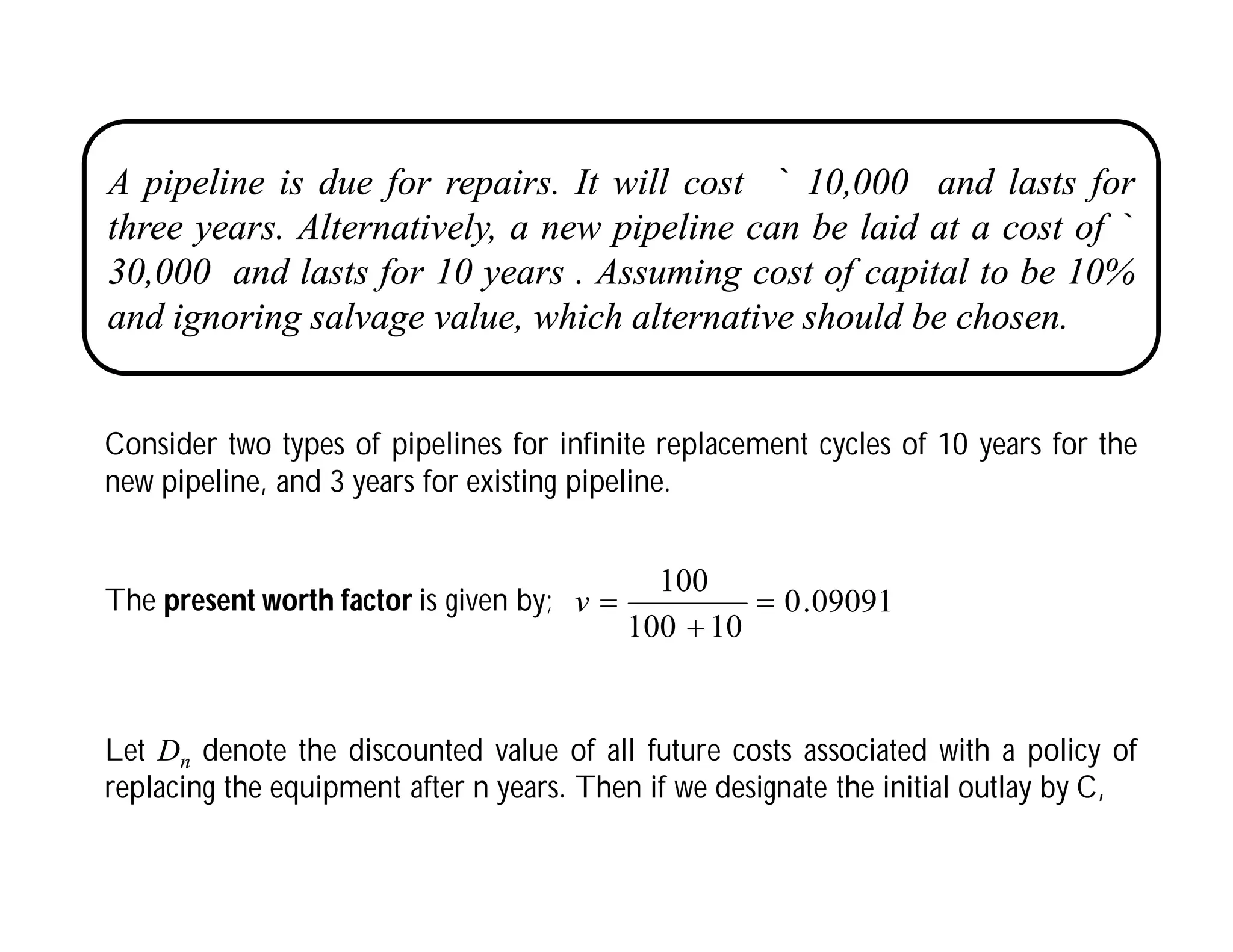
A pipeline is due for repairs. It will cost ` 10,000 and lasts for
three years. Alternatively, a new pipeline can be laid at a cost of `
30,000 and lasts for 10 years . Assuming cost of capital to be 10%
and ignoring salvage value, which alternative should be chosen.
Consider two types of pipelines for infinite replacement cycles of 10 years for the
new pipeline, and 3 years for existing pipeline.
The present worth factor is given by; 09091
.
0
10
100
100



v
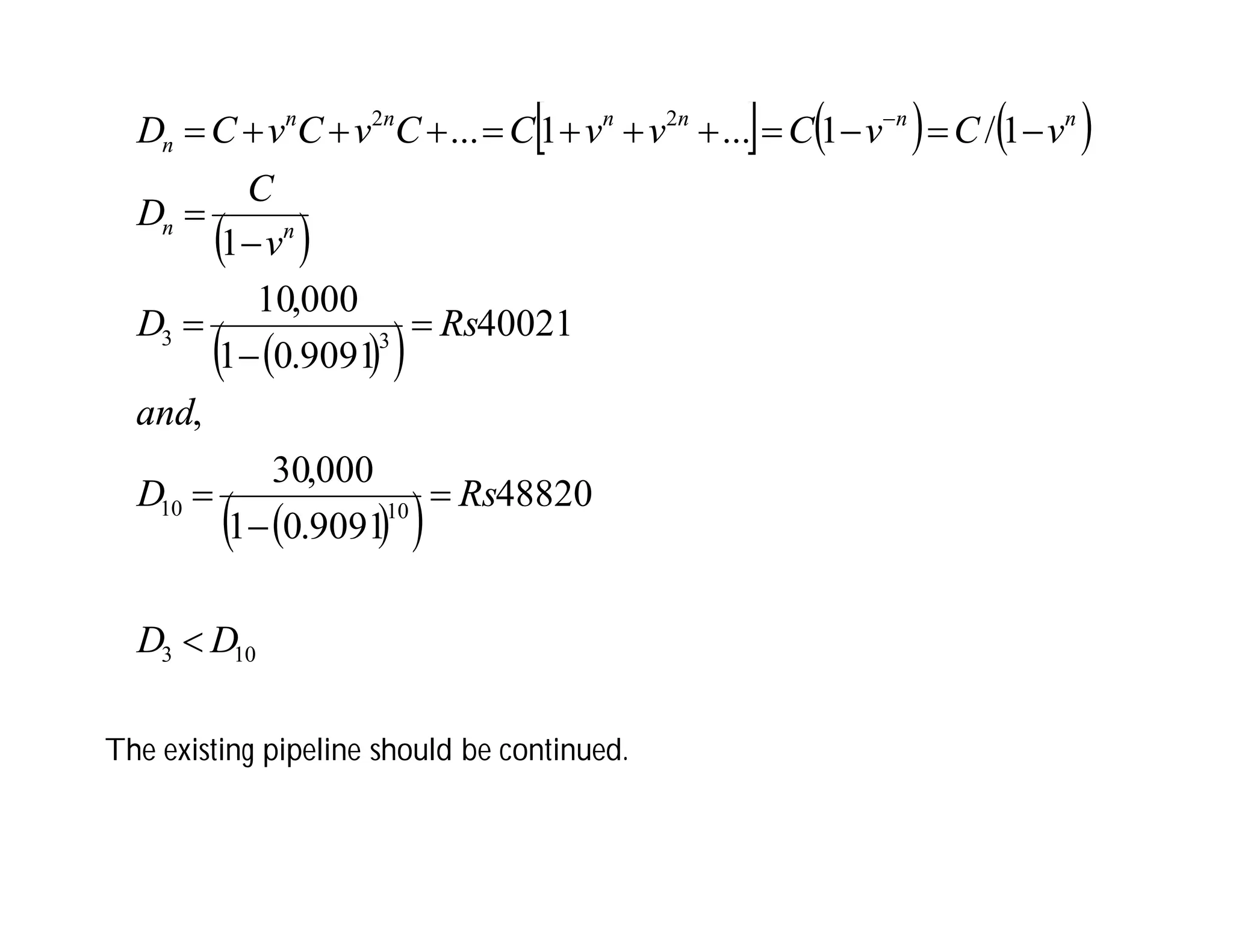
Let Dn denote the discounted value of all future costs associated with a policy of
replacing the equipment after n years. Then if we designate the initial outlay by C,
     
 
 
 
 
 
10
3
10
10
3
3
2
2
48820
9091
.
0
1
000
,
30
,
40021
9091
.
0
1
000
,
10
1
1
/
1
...
1
...
D
D
Rs
D
and
Rs
D
v
C
D
v
C
v
C
v
v
C
C
v
C
v
C
D
n
n
n
n
n
n
n
n
n




















 
The existing pipeline should be continued.
Case 4:
A manufacturer offered two machines A and B. A is priced at Rs 5000 and running
cost are estimated at Rs 800 for each of the first 5 years, increasing by Rs 200 per
year in the 6th and subsequent years. Machine B, which has the same capacity as A,
costs Rs 2500 but with running cost of Rs 1200 per year for the first six years,
increasing by Rs 200 per year there after. If money is worth 10% per year, which
machine should be purchased?
(Assume that the machine will eventually be sold for scrap at negligible price.)
Solution:
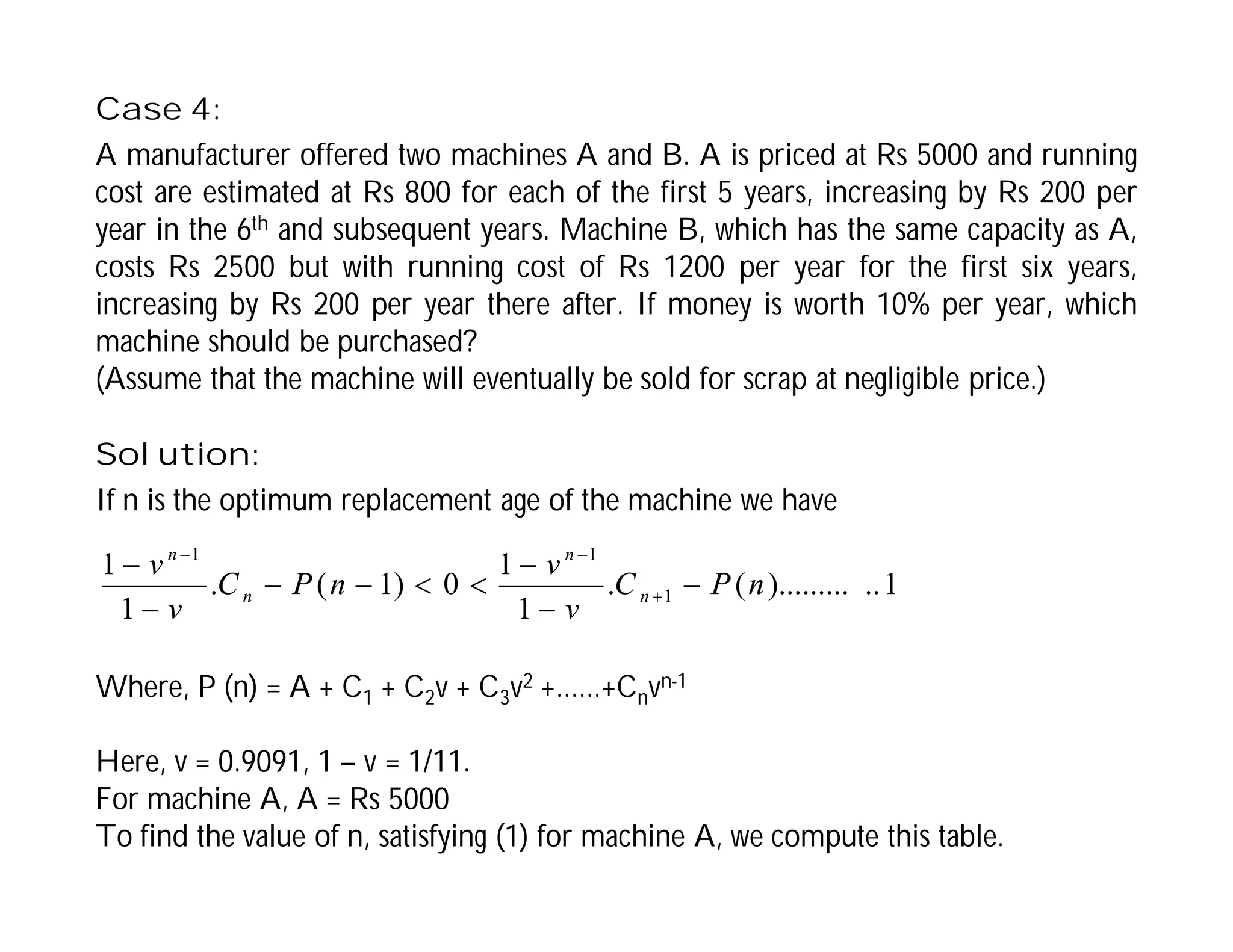
If n is the optimum replacement age of the machine we have
Where, P (n) = A + C1 + C2v + C3v2 +……+Cnvn-1
Here, v = 0.9091, 1 – v = 1/11.
For machine A, A = Rs 5000
To find the value of n, satisfying (1) for machine A, we compute this table.
1
..
).........
(
.
1
1
0
)
1
(
.
1
1
1
1
1
n
P
C
v
v
n
P
C
v
v
n
n
n
n












Year
n
Cn vn-1=(0.909)n-1 (vn-1) Cn (1-vn-1) Cn P(n)
1 2 3 4 = 2 × 3 5 = 2 – 4 6 7 8 = 6 – 7
1
2
3
4
5
6
7
8
9*
10
800
800
800
800
800
1000
1200
1400
1600
1800
1.0000
0.9091
0.8264
0.7513
0.6830
0.6209
0.5645
0.5132
0.4665
0.4241
800
727
661
601
546
621
677
718
746
763
0
73
139
199
254
379
523
682
854
1037
800
1529
2189
2794
4169
5753
7502
9394
11407
-
5800
6527
7188
7789
8335
8956
9633
10351
11097
-
< 0
< 0
< 0
< 0
< 0
< 0
< 0
< 0
> 0
1
1
)
1
(



n
n
C
v
v
)
(
1
)
1
(
1 n
P
C
v
v
n
n




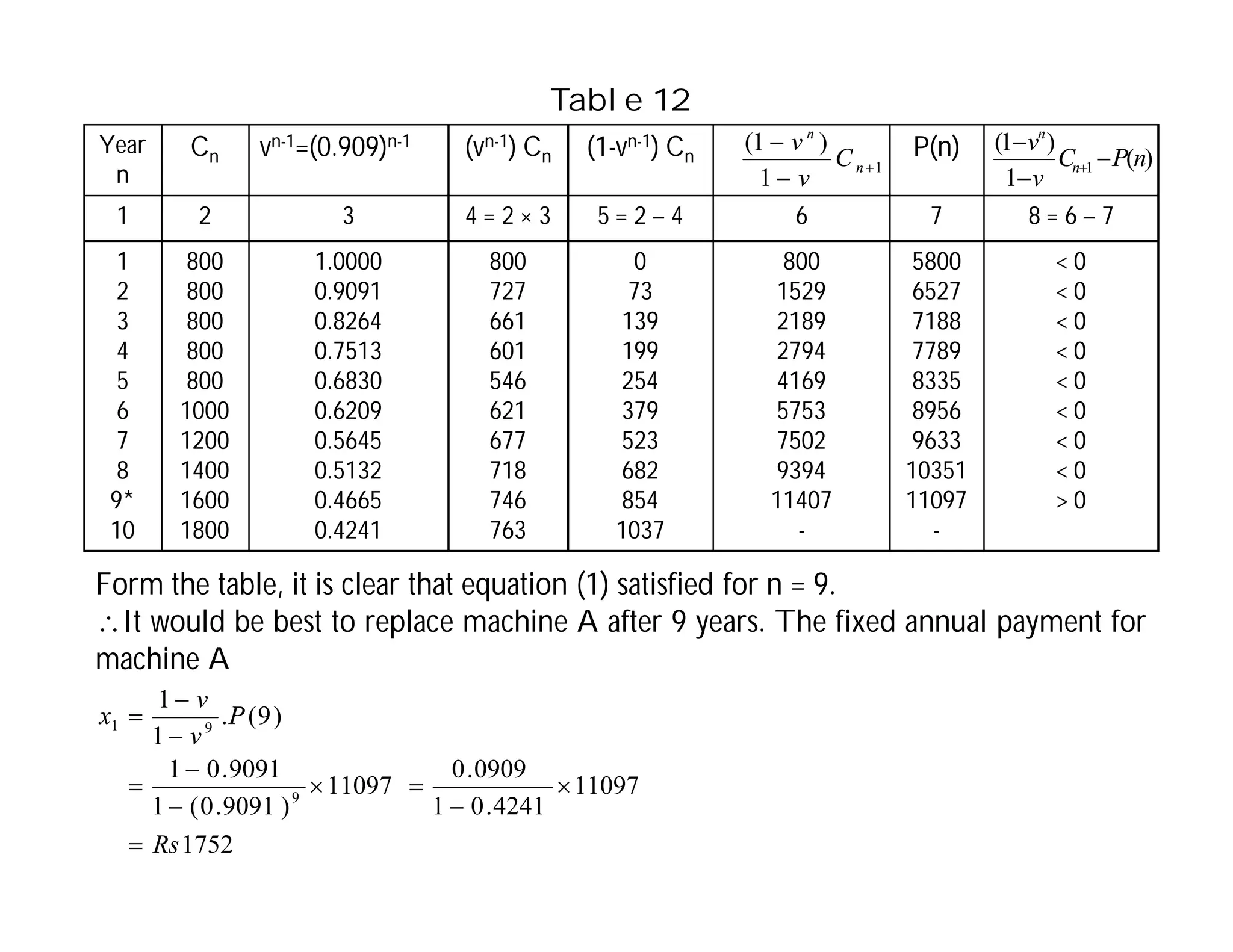
Table 12
Form the table, it is clear that equation (1) satisfied for n = 9.
It would be best to replace machine A after 9 years. The fixed annual payment for
machine A
1752
11097
4241
.
0
1
0909
.
0
11097
)
9091
.
0
(
1
9091
.
0
1
)
9
(
.
1
1
9
9
1
Rs
P
v
v
x











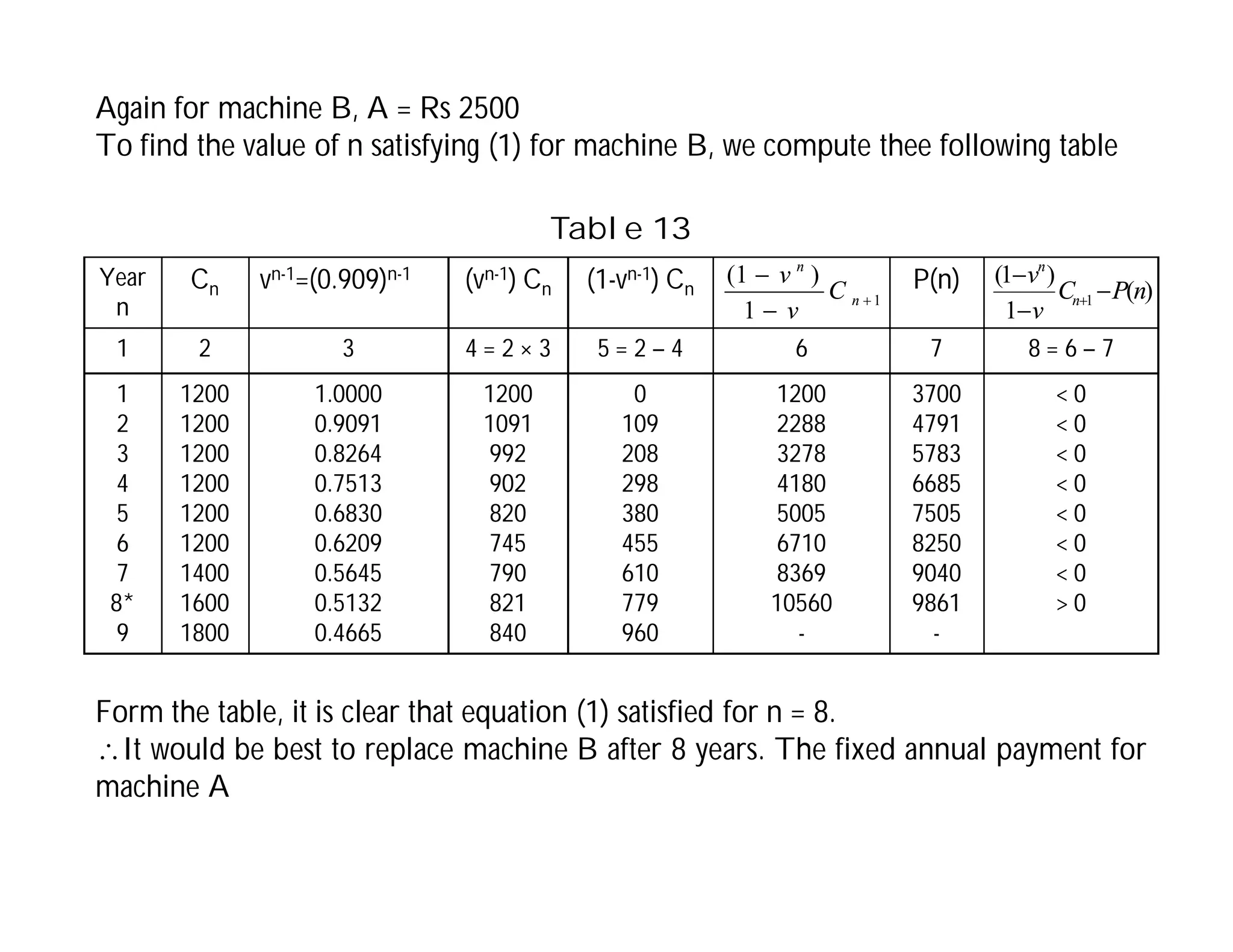
Again for machine B, A = Rs 2500
To find the value of n satisfying (1) for machine B, we compute thee following table
Year
n
Cn vn-1=(0.909)n-1 (vn-1) Cn (1-vn-1) Cn P(n)
1 2 3 4 = 2 × 3 5 = 2 – 4 6 7 8 = 6 – 7
1
2
3
4
5
6
7
8*
9
1200
1200
1200
1200
1200
1200
1400
1600
1800
1.0000
0.9091
0.8264
0.7513
0.6830
0.6209
0.5645
0.5132
0.4665
1200
1091
992
902
820
745
790
821
840
0
109
208
298
380
455
610
779
960
1200
2288
3278
4180
5005
6710
8369
10560
-
3700
4791
5783
6685
7505
8250
9040
9861
-
< 0
< 0
< 0
< 0
< 0
< 0
< 0
> 0
1
1
)
1
(



n
n
C
v
v
)
(
1
)
1
(
1 n
P
C
v
v
n
n




Form the table, it is clear that equation (1) satisfied for n = 8.
It would be best to replace machine B after 8 years. The fixed annual payment for
machine A
Table 13
1680
)
8
(
.
1
1
8
2
Rs
P
v
v
x




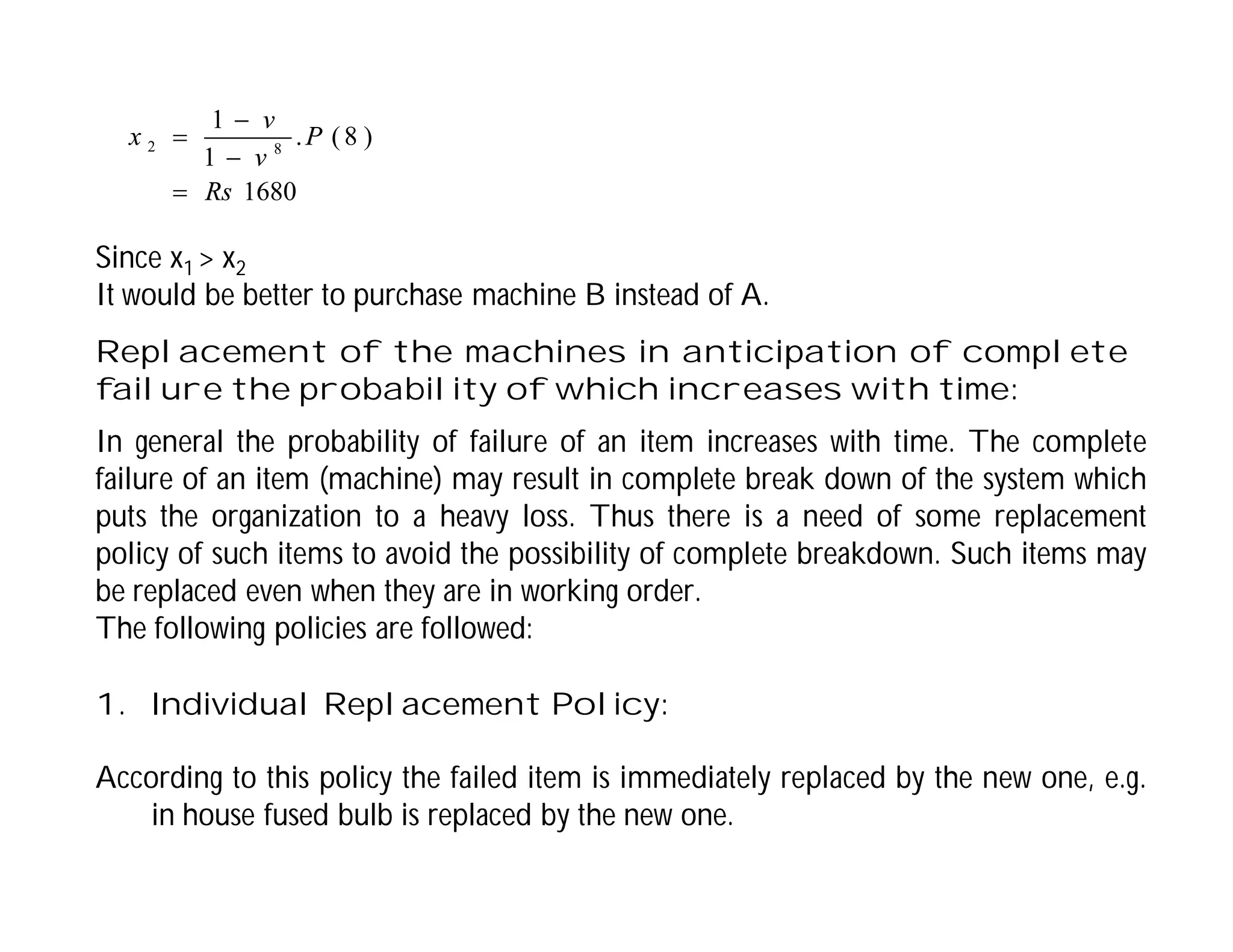
Since x1 > x2
It would be better to purchase machine B instead of A.
Replacement of the machines in anticipation of complete
failure the probability of which increases with time:
In general the probability of failure of an item increases with time. The complete
failure of an item (machine) may result in complete break down of the system which
puts the organization to a heavy loss. Thus there is a need of some replacement
policy of such items to avoid the possibility of complete breakdown. Such items may
be replaced even when they are in working order.
The following policies are followed:
1. Individual Replacement Policy:
According to this policy the failed item is immediately replaced by the new one, e.g.
in house fused bulb is replaced by the new one.
1. Group Replacement Policy:
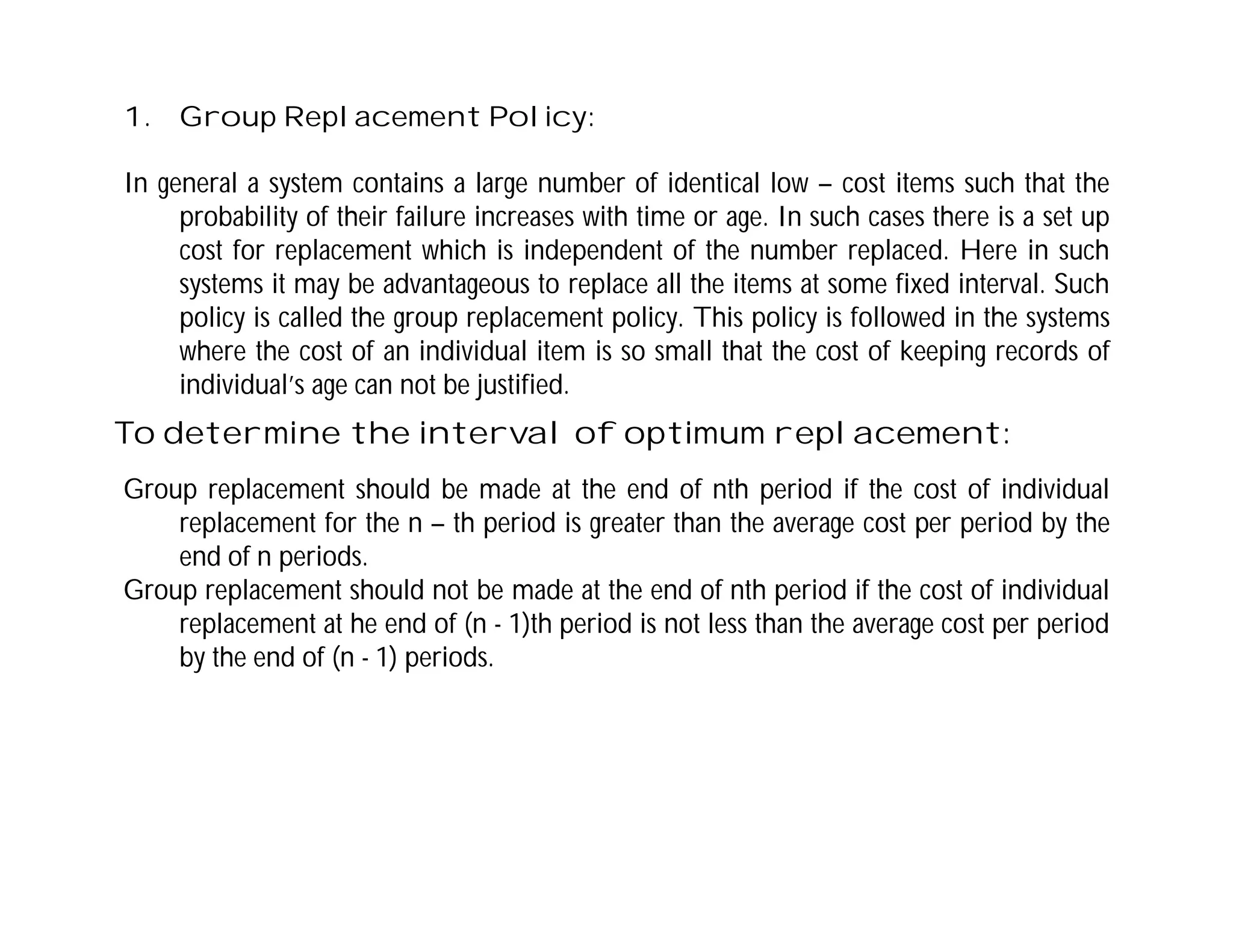
In general a system contains a large number of identical low – cost items such that the
probability of their failure increases with time or age. In such cases there is a set up
cost for replacement which is independent of the number replaced. Here in such
systems it may be advantageous to replace all the items at some fixed interval. Such
policy is called the group replacement policy. This policy is followed in the systems
where the cost of an individual item is so small that the cost of keeping records of
individual’s age can not be justified.
To determine the interval of optimum replacement:
Group replacement should be made at the end of nth period if the cost of individual
replacement for the n – th period is greater than the average cost per period by the
end of n periods.
Group replacement should not be made at the end of nth period if the cost of individual
replacement at he end of (n - 1)th period is not less than the average cost per period
by the end of (n - 1) periods.
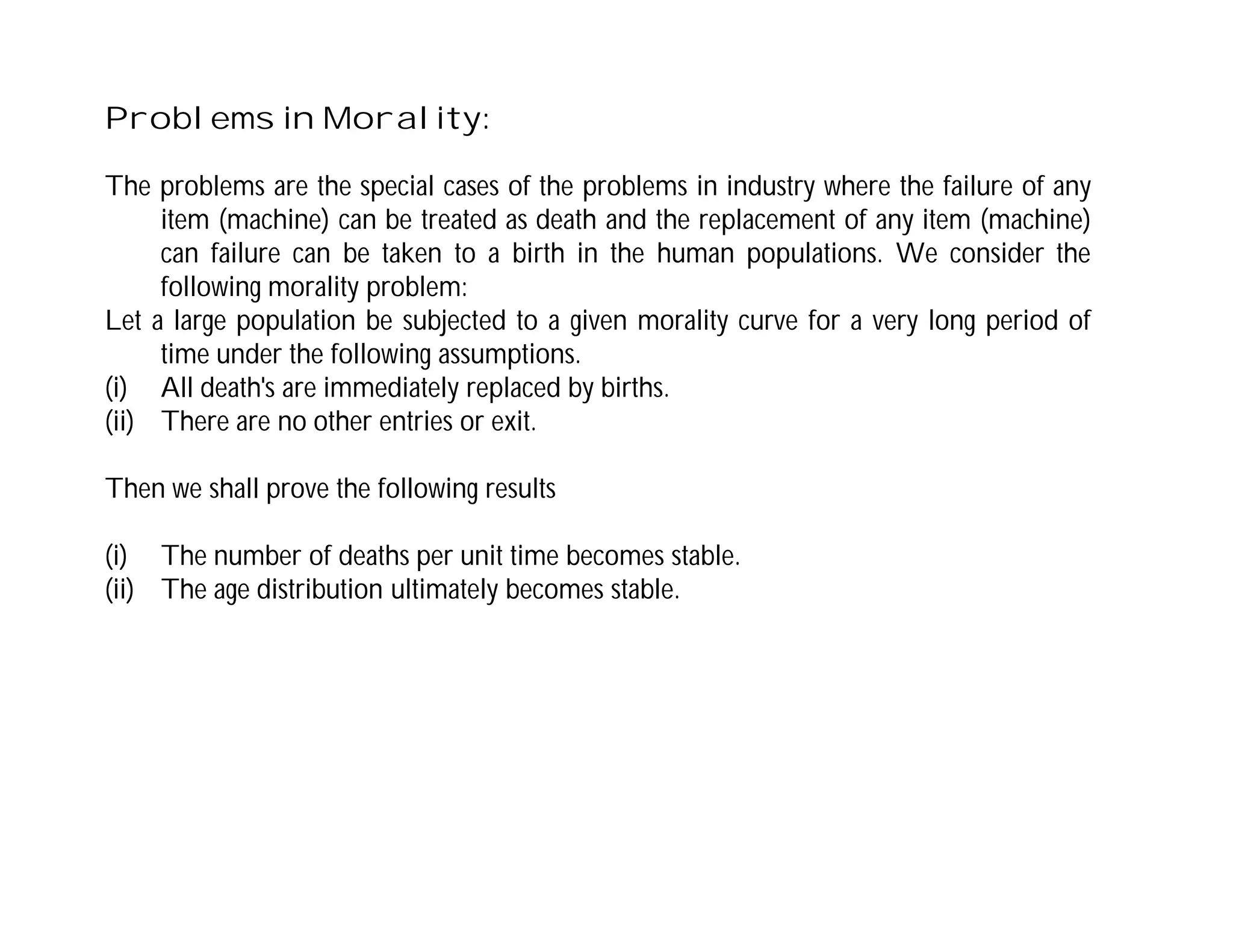
Problems in Morality:
The problems are the special cases of the problems in industry where the failure of any
item (machine) can be treated as death and the replacement of any item (machine)
can failure can be taken to a birth in the human populations. We consider the
following morality problem:
Let a large population be subjected to a given morality curve for a very long period of
time under the following assumptions.
(i) All death's are immediately replaced by births.
(ii) There are no other entries or exit.
Then we shall prove the following results
(i) The number of deaths per unit time becomes stable.
(ii) The age distribution ultimately becomes stable.
Staffing Problem:
The problems connected with recruitment and promotion of the staff in any system
(organization)are known as the staffing problems. These problems are also treated
as the replacement problem where the staff of the system is treated like a machine
part. The problem of staff replacement arises due to resignation, retirements deaths
of the staff members from time to time. Therefore to maintain a suitable strength of
the staff in a system there is a need of some useful recruitment policy.
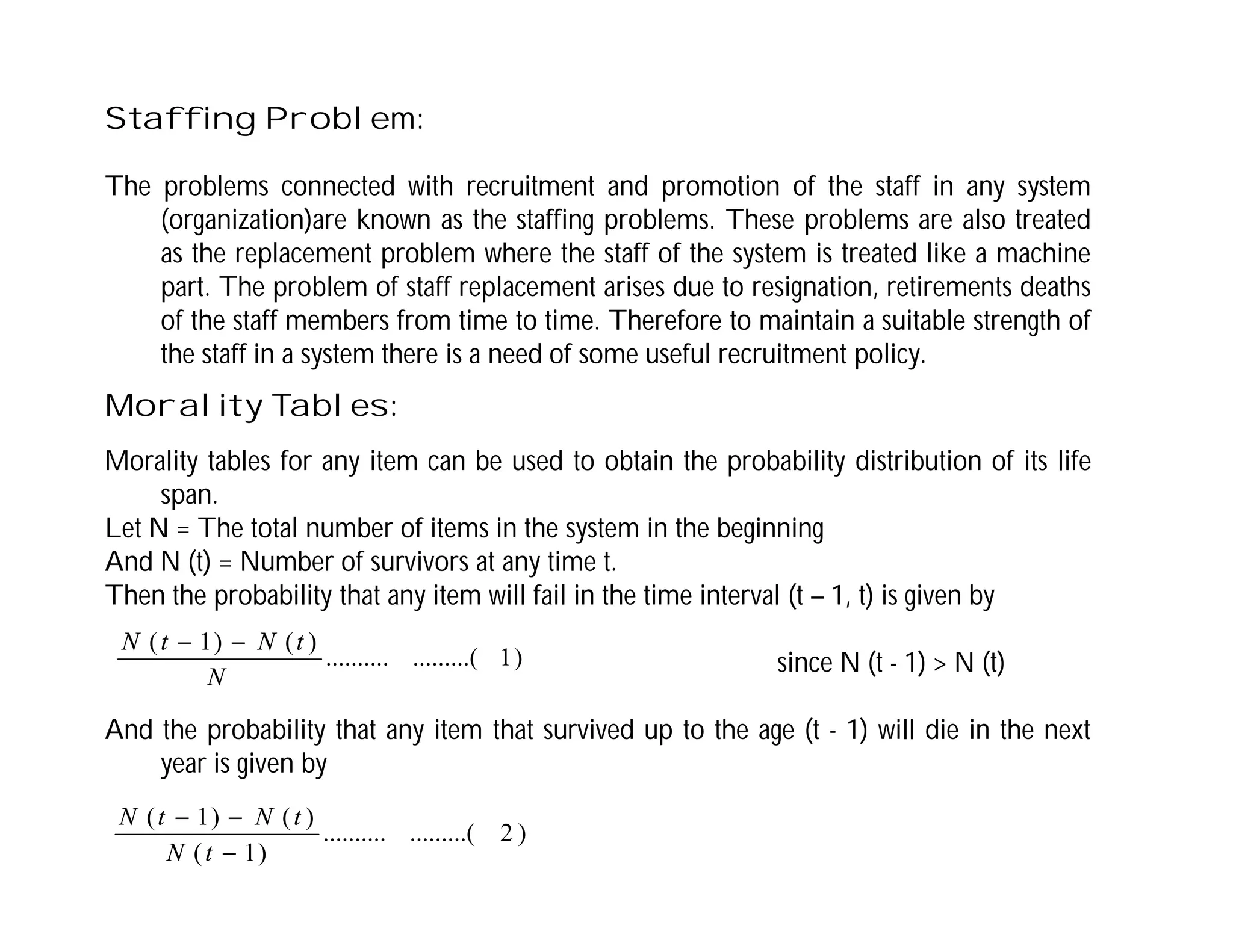
Morality Tables:
Morality tables for any item can be used to obtain the probability distribution of its life
span.
Let N = The total number of items in the system in the beginning
And N (t) = Number of survivors at any time t.
Then the probability that any item will fail in the time interval (t – 1, t) is given by
since N (t - 1) > N (t)
And the probability that any item that survived up to the age (t - 1) will die in the next
year is given by
)
1
.........(
..........
)
(
)
1
(
N
t
N
t
N 

)
2
.........(
..........
)
1
(
)
(
)
1
(



t
N
t
N
t
N
Case:
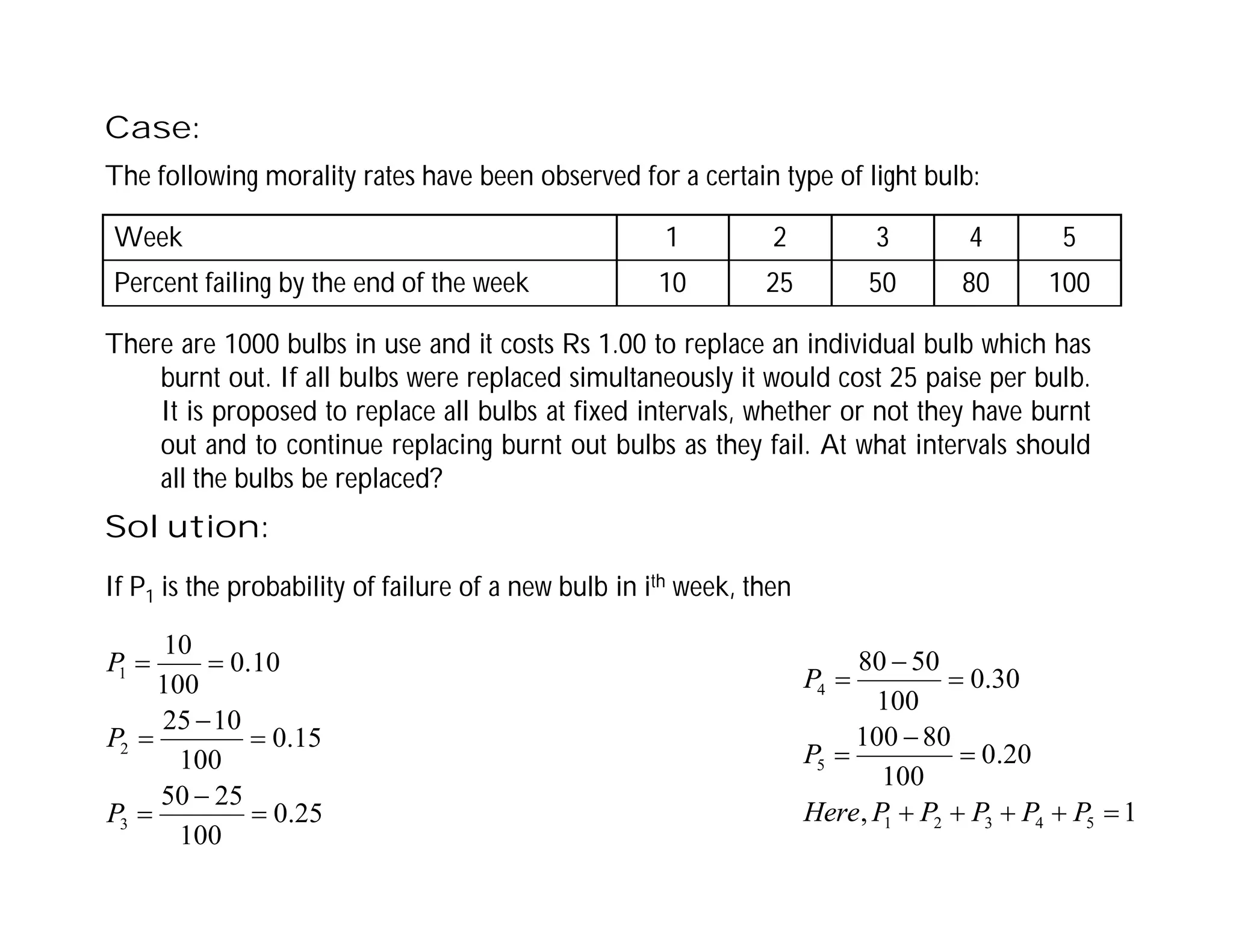
The following morality rates have been observed for a certain type of light bulb:
There are 1000 bulbs in use and it costs Rs 1.00 to replace an individual bulb which has
burnt out. If all bulbs were replaced simultaneously it would cost 25 paise per bulb.
It is proposed to replace all bulbs at fixed intervals, whether or not they have burnt
out and to continue replacing burnt out bulbs as they fail. At what intervals should
all the bulbs be replaced?
Week 1 2 3 4 5
Percent failing by the end of the week 10 25 50 80 100
Solution:
If P1 is the probability of failure of a new bulb in ith week, then
25
.
0
100
25
50
15
.
0
100
10
25
10
.
0
100
10
3
2
1








P
P
P
1
,
20
.
0
100
80
100
30
.
0
100
50
80
5
4
3
2
1
5
4











P
P
P
P
P
Here
P
P
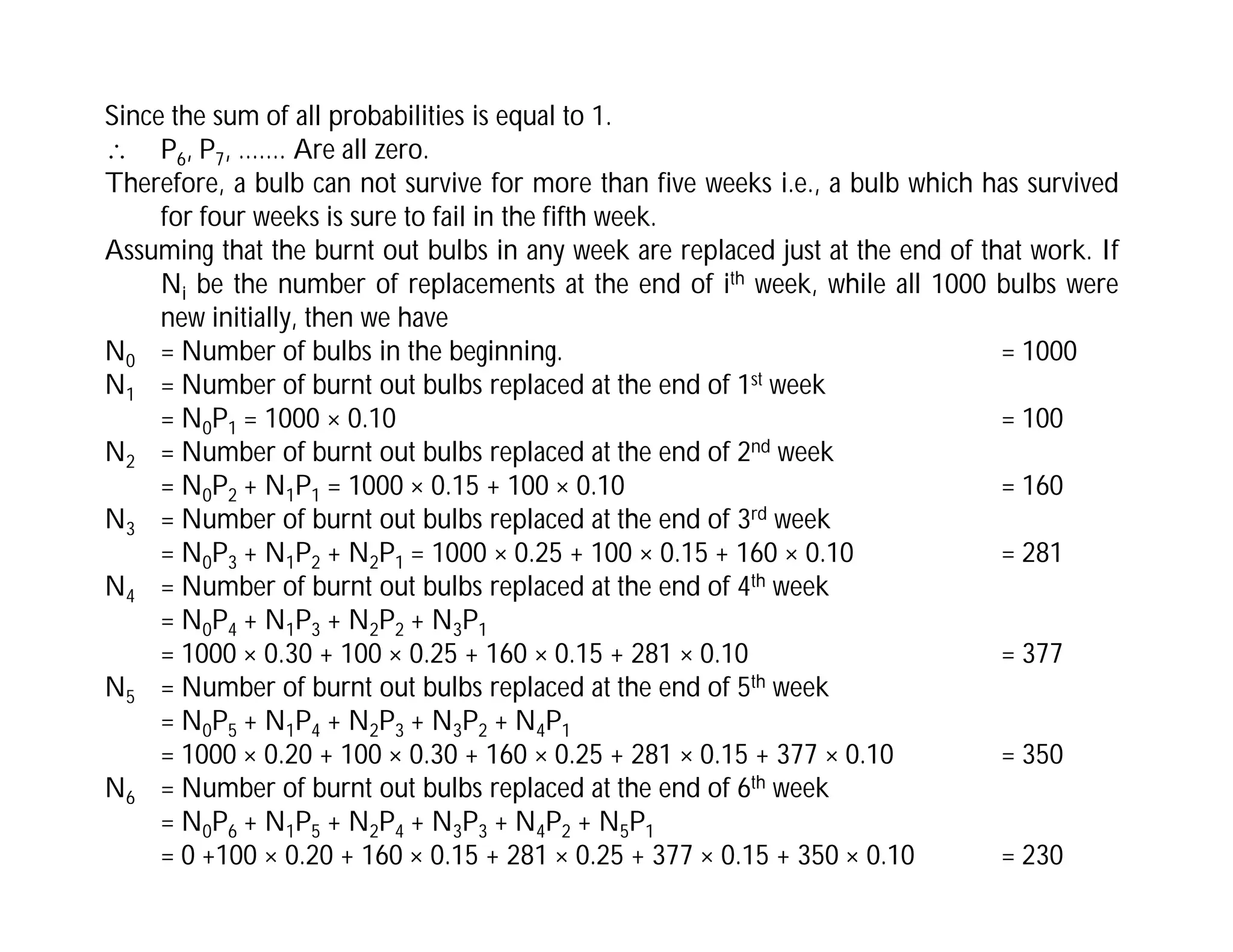
Since the sum of all probabilities is equal to 1.
 P6, P7, ……. Are all zero.
Therefore, a bulb can not survive for more than five weeks i.e., a bulb which has survived
for four weeks is sure to fail in the fifth week.
Assuming that the burnt out bulbs in any week are replaced just at the end of that work. If
Ni be the number of replacements at the end of ith week, while all 1000 bulbs were
new initially, then we have
N0 = Number of bulbs in the beginning. = 1000
N1 = Number of burnt out bulbs replaced at the end of 1st week
= N0P1 = 1000 × 0.10 = 100
N2 = Number of burnt out bulbs replaced at the end of 2nd week
= N0P2 + N1P1 = 1000 × 0.15 + 100 × 0.10 = 160
N3 = Number of burnt out bulbs replaced at the end of 3rd week
= N0P3 + N1P2 + N2P1 = 1000 × 0.25 + 100 × 0.15 + 160 × 0.10 = 281
N4 = Number of burnt out bulbs replaced at the end of 4th week
= N0P4 + N1P3 + N2P2 + N3P1
= 1000 × 0.30 + 100 × 0.25 + 160 × 0.15 + 281 × 0.10 = 377
N5 = Number of burnt out bulbs replaced at the end of 5th week
= N0P5 + N1P4 + N2P3 + N3P2 + N4P1
= 1000 × 0.20 + 100 × 0.30 + 160 × 0.25 + 281 × 0.15 + 377 × 0.10 = 350
N6 = Number of burnt out bulbs replaced at the end of 6th week
= N0P6 + N1P5 + N2P4 + N3P3 + N4P2 + N5P1
= 0 +100 × 0.20 + 160 × 0.15 + 281 × 0.25 + 377 × 0.15 + 350 × 0.10 = 230
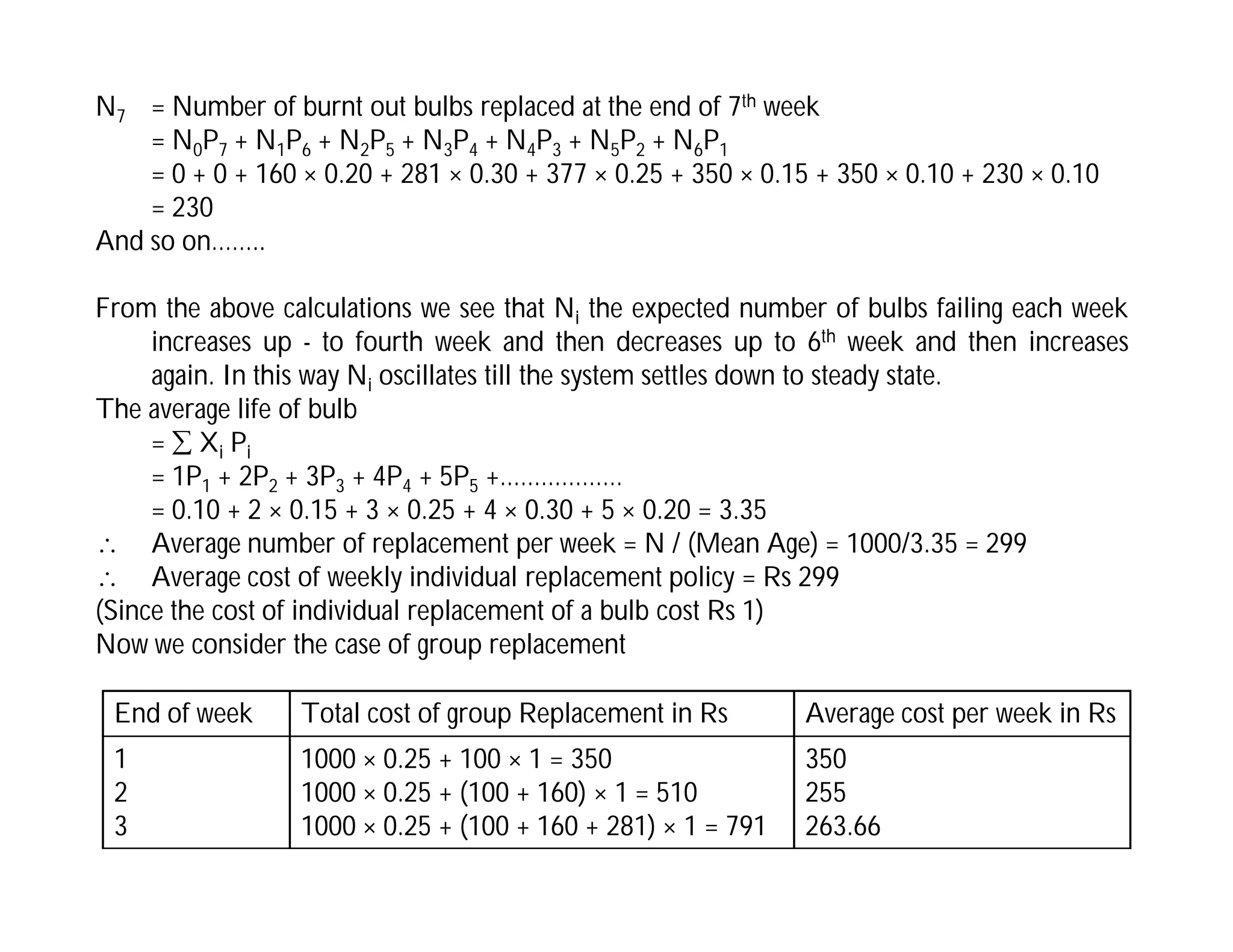
N7 = Number of burnt out bulbs replaced at the end of 7th week
= N0P7 + N1P6 + N2P5 + N3P4 + N4P3 + N5P2 + N6P1
= 0 + 0 + 160 × 0.20 + 281 × 0.30 + 377 × 0.25 + 350 × 0.15 + 350 × 0.10 + 230 × 0.10
= 230
And so on……..
From the above calculations we see that Ni the expected number of bulbs failing each week
increases up - to fourth week and then decreases up to 6th week and then increases
again. In this way Ni oscillates till the system settles down to steady state.
The average life of bulb
=  Xi Pi
= 1P1 + 2P2 + 3P3 + 4P4 + 5P5 +………………
= 0.10 + 2 × 0.15 + 3 × 0.25 + 4 × 0.30 + 5 × 0.20 = 3.35
 Average number of replacement per week = N / (Mean Age) = 1000/3.35 = 299
 Average cost of weekly individual replacement policy = Rs 299
(Since the cost of individual replacement of a bulb cost Rs 1)
Now we consider the case of group replacement
End of week Total cost of group Replacement in Rs Average cost per week in Rs
1
2
3
1000 × 0.25 + 100 × 1 = 350
1000 × 0.25 + (100 + 160) × 1 = 510
1000 × 0.25 + (100 + 160 + 281) × 1 = 791
350
255
263.66
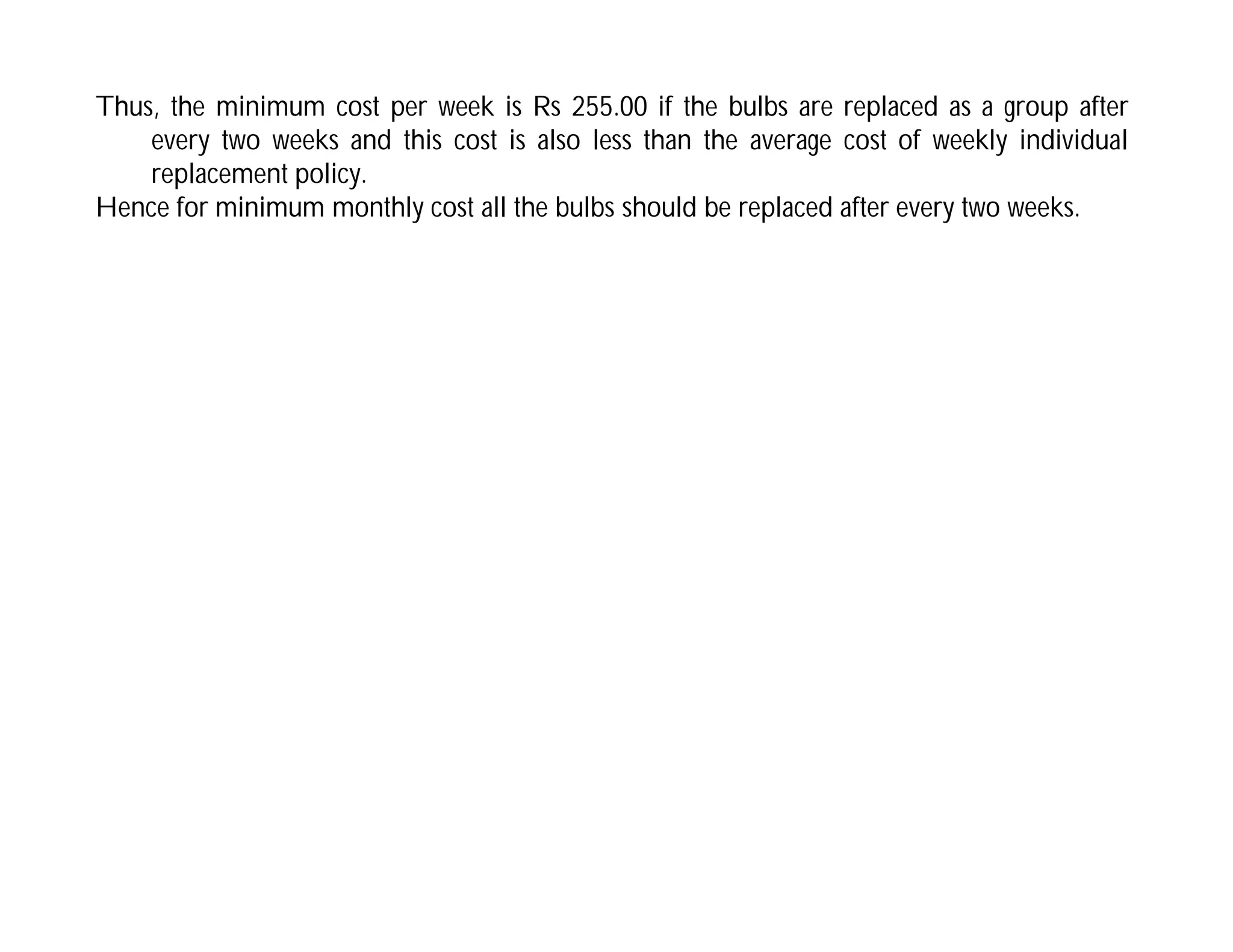
Thus, the minimum cost per week is Rs 255.00 if the bulbs are replaced as a group after
every two weeks and this cost is also less than the average cost of weekly individual
replacement policy.
Hence for minimum monthly cost all the bulbs should be replaced after every two weeks.

Lecture 5 - Replacement Problem for industrial equipments

  • 1.
  • 3.
    Introduction: The efficiency ofall industrial and military equipments deteriorates with time. Sometimes the equipment fails completely and effects the whole system. The maintenance costs (running costs) of an equipment also go on increasing with time. Thus it becomes more economical to replace the old equipment with a new one. Hence there is a need to formulae a most economical replacement policy which is in the best interest of the system.
  • 4.
    1. Replacement ofmajor or capital item (equipment) that deteriorates with time; e.g., Machines, Trucks etc. There are following types of Replacement problems under discussion: 2. Replacement of an item (equipment) in anticipation of complete failure, the probability of which increases with time (or age). 3. Problems in morality and staffing. 4. Replacement of an equipment (or item) may be necessary due to new researches, otherwise the system may become out of date.
  • 5.
    Replacement of majoror capital item (equipment) that deteriorates with time; e.g., Machines, Trucks etc. For machine the maintenance cost always increase with time and stage comes when the maintenance cost becomes so large that it is economical to replace the machine with a new one. Thus the problem of replacement in this case is to find the best time (age of machine) at which the old machine should be replaced by the new one.
  • 6.
    To Find TheBest Replacement Age (Time) of a Machine When (1) Its maintenance cost is given by a function increasing with time. (2) Its scrap value is constant and, (3) The Money value is not considered. Let C = Cost of Machine S = Scrap value of the machine at time t. and, Cm(t) = Maintenance cost of machine at time t, [Cm(t) increases with t]. Case 1 : When time ‘t’ is a continuous variable. Total maintenance cost of the machine in n years The total cost of machine in n years = Cost of machine – Scrap value of machine + Total maintenance cost in n years.   n m dt t C 0 ) (
  • 7.
    dt t C S C n m     0 ) ( The average costof maintenance per year during n years is given by Now for A (n) to be minimum, [ from (1) ] ) 1 ...( .......... .......... ) ( 1 ) ( ) ( ) ( 0 0         n m n m dt t C n n S C n A n dt t C S C n A   ) ( ) ( ) ( ) ( 1 ) ( 1 ) ( 0 0 2 2 n A n dt t C S C t C t C n dt t C n n S C n A dn d n m m m n m            
  • 8.
    i.e. Maintenance costof the machine at time t = Average cost of the machine per year. Also Hence, the average cost of the machine per year is minimized by replacing it when the average cost to date becomes equal to the current maintenance cost.      n m dt t C n n S C dn n A d 0 3 3 2 2 0 ) ( 2 ) ( 2 ) (
  • 9.
    Case 2 :When time ‘t’ is a discrete variable. When time t takes the values 1, 2, 3,…..etc., then the total maintenance cost of the machine in n years    n m m t C 1 ) ( Therefore, in this case the average cost of the machine per year during n years is given by           n m m n m m t C n n S C n t C S C n A 1 1 ) 2 ( )......... ( 1 ) ( ) ( But A(n) is minimum for that value of n for which  (An -1) < 0 <  A (n)…………………….(3)  A(n) = A(n + 1) – A(n)                          n m m n m m t C n n S C t C n n S C 1 1 1 ) ( 1 ) ( 1 1 1
  • 10.
  • 11.
    ) 1 ( ) ( ) ( ) ( 0 ) ( 1 ) 1 ( 0 ) ( 1 1 1 ) ( 1 1               n A t C n A t C t C n n n A t C n n n A n n n n i.e., and or and From (4), weconclude that 1. Do not replace if the next years maintenance cost is less than the previous years average total cost. 2. Replace if the next years maintenance cost is greater than the previous years average total cost. A Machine is continued up to the time the average cost per year (including cost of the new machine, maintenance cost etc.) of the machine decrease and is replaced at the time when its cost begins to increase.
  • 12.
    The cost ofa bike is $ 3000. The salvage value (resale value) and the running cost are given as under. Find the most economical replacement age of the truck. Year 1 2 3 4 5 6 7 Running Cost 600 700 800 900 1000 1200 1500 Resale value 2000 1333 1000 750 500 300 300 Table 1 Case 1:
  • 13.
    Solution: Age of Replacement (inYears) Total Running Cost ($) Depreciation = Cost of bike – Resale Value ($) Total Cost ($) Average Cost per year ($) 1 600 1000 1600 1600.00 2 1300 1667 2967 1483.50 3 2100 2000 4100 1366.66 4 3000 2250 5250 1312.50 5* 4000 2500 6500 1300.00* 6 5200 2700 7900 1316.67 Table 2 Replace the bike in 5th year.
  • 14.
    Machines in afactory have increased cost as they continue in service due to increased running cost. The initial running cost is Rs 3,500 and resale price drops as time passes until it reaches a constant value of Rs 500. Determine the proper length of service before machines should be replaced. Cost data are given below. Case 2: Year of Service 1 2 3 4 5 Running Cost 1800 2200 2700 3200 3700 Resale value 1900 1050 600 500 500 Table 3
  • 15.
    Solution: Year of Service Running Cost Cumulative Running Cost Resale Price Difference between Initial Cost and Resale Price Average Investment cost per Year Average Running Costper Year Average Cost Per Year 1 2 3 4 5 6 = 5/1 7 = 3/1 8 = 6 + 7 1 1800 1800 1900 1600 1600 1800 3400 2 2200 4000 1050 2450 1225 2000 3225 3 2700 6700 600 2900 967 2233 3200 4 3200 9900 500 3000 750 2475 3225 5 3700 13600 500 3000 600 2720 3320 Replace the machine in 4th year.
  • 16.
    Case 3: A. MachineA costs Rs 9000. Annual operating cost are Rs 200 for the 1st year, and then increase by Rs 2000 every year. Determine the best age at which to replace the machine. If the optimum replacement policy is followed, what will be the average yearly cost of owing and operating the machine ? (Assume that the machine has no resale value when replaced, and that future cost are not discounted). B. Machine B costs Rs 10,000. Annual operating costs are Rs 400 for the first year, and then increase by Rs 800 every year. You have now a machine of type A which is one year old. Should you replace it with B, and if so when ? C. Suppose you are, just ready to replace machine A with another machine of the same type, when you hear that machine B will become available in a year. What you should do ?
  • 17.
    Solution: a. The maintenancecost of machine A per year are as follows: Year 1 2 3 4 5 Maintenance cost in Rs 200 2200 4200 6200 8200 To find the average cost per year of machine A, we prepare the following table: Table 4 Replacement at the end of the year Total Running Cost Rs Depreciation Rs Total Cost Rs Average Cost Rs 1 200 9000 9200 9200 2 2400 9000 11400 5700 3* 6600 9000 15600 5200 4 12,800 9000 21,800 5450 It is clear from the table that the machine A should be replaced at the end of the 3rd year. The average yearly cost in this situation will be Rs 5200. Table 3
  • 18.
    b. The maintenancecost of machine B per year are as follows: Year 1 2 3 4 5 6 7 Maintenance cost in Rs 400 1200 2000 2800 3600 4400 5200 Table 5 To find the average cost per year of machine A, we prepare the following table: Table 6 Replacement at the end of the year Total Running Cost Rs Depreciation Rs Total Cost Rs Average Cost Rs 1 400 10000 10400 10400.00 2 1600 10000 11600 5800.00 3 3600 10000 13600 4533.33 4 6400 10000 16400 4100.00 5* 10000 10000 20000 4000.00 6 14400 10000 24400 4066.66
  • 19.
    It is clearfrom the above table that if machine B is replaced after 5 years then its average cost per year is Rs 4000. Since the lowest average cost Rs 4000 for machine B is less than the lowest average cost Rs 5200 for machine A, the machine A should be replaced by machine B. To find the time of replacement of machine A by machine B. The machine A is replaced by machine B at the time (age) when its running cost of the next year exceeds the lowest average yearly cost Rs 4000 of machine B. Total cost of machine A in the successive years are as follows: Year 1 2 3 4 5 Total cost in the year 9200 Rs 11400 – 9200 = Rs 2200 Rs 15600 – 11400 = Rs 4200 Rs 21800 – 15600 = Rs 6200 Rs 30000 – 21800 = Rs 8200 Table 7 The running cost of third year of machine A is Rs 4200 which is more than the lowest average yearly cost Rs 4000 of machine B. Therefore, the machine A should be replaced by machine B when its age is 2 years. Since the machine A is one year old now, therefore it should be replaced after one year from now.
  • 20.
    c. As shownin (b), the machine A should be replaced after one year from now and the machine B also available at that time. Therefore, the machine A should be replaced by machine B after one year from now. Case 3: For a machine, from the following data are available: Year 0 1 2 3 4 5 6 Cost of spares (Rs) - 200 400 700 1000 1400 1600 Salary Maintenance staff (Rs) - 1200 1200 1400 1600 2000 2600 Losses due to break down (Rs) - 600 800 700 1000 1200 1600 Resale value 12000 6000 3000 1500 800 400 400 Determine the optimum period for replacement of the above machine. Table 8
  • 21.
    Few Important Terms: MoneyValue: The value of money changes with time. The statement is explained by the following example. If we borrow Rs 100 at interest of 10% per year then after one year after one year we have to return Rs 110. Thus Rs 110 after one year from now are equivalent to Rs 100 today. Therefore, Rs 1.00 after one year from now is equivalent to Rs 100/110 i.e., (1.1)-1 today at the rate of 10% So, Rs 1.00, n year from now is equivalent to Rs (1.1)-n today at the rate of 10% thus we can say that the value of money changes with time. The time value of money is the value of money figuring in a given amount of interest earned over a given amount of time.
  • 22.
    Present Value orPresent Worth: We have shown that Rs 100, n years after from now is equivalent to Rs (1.1)-n today at the rate of 10%. In other words we say that (1.1)-n is the present value (or present worth) of one rupee spent after one year from now. In general if the interest on Rs 1 is Rs ‘i’ per year, then the present value of Rs 1 to be spent after n years from now is Rs n i) 1 ( 1 
  • 23.
    Discount Rate orDepreciation Ratio: The value of the money decreases with a constant ratio which is known as its discount rate or depreciation ratio. If r is the ratio of interest per year on Rs 1.00. Then the present value of Rs 1.00 to be spent after one year from now is Rs . The ratio is the discount rate or depreciation ratio which is less than one. ) 1 ( 1 r  ) 1 ( 1 r v  
  • 24.
    To determine thebest replacement age of items whose maintenance cost increase with time and the value of Money also changes with time: 1. Do not replace if the operating cost of next period (year) is less than the weighted average of previous cost. 2. Replace if the operating cost of the next period (year) is greater than the weighted average of the previous cost. ) ( . 1 1 0 ) 1 ( . 1 1 1 1 1 n P C v v n P C v v n n n n             Thus, the best replacement age of machine is n years for which the above inequality holds.
  • 25.
    Case: The costpattern for two machines A and B when money value is not considered, is given as follows: Year Machine A Machine B 1 2 3 900 600 700 1400 100 700 Total 2200 2200 Table 9 Find the cost for each machine, when money is worth 10% per year, and hence find which machine is less costly.
  • 26.
    Solution : The totalexpenditure for each machine in 3 years is equal to Rs 2200 when the money value is not taken in to consideration. Thus, the two machines are equally good if the money has no value over time. When money value is 10% per year the discount rate The present value of the maintenance cost in years 1, 2, 3 for two machines are shown in following table 9091 . 0 10 100 100    v Year Machine A (Rs) Machine B (Rs) 1 2 3 900 600 × (0.9091) = 545.45 700 × (0.9091)2 = 578.52 1400 100 × (0.9091) = 90.91 700 × (0.9091)2 = 578.52 Total Rs 2023.97 Rs 2069.43 Table 10 The present value of the total expenditure for machine A in three years is less than that of machine B. hence machine A is less costly.
  • 27.
    Case : Let thevalue of money be assumed to be 10% per year and suppose that the machine A is replaced after every 3 years whereas machine B is replaced after every six years. The yearly costs of both the machines are given as under. Determine which machine should be purchased. Year 1 2 3 4 5 6 Machine A : Machine B : 1000 1700 200 100 400 200 1000 300 200 400 400 500 Table 11 Solution : Since the value of money is 10% per year, the discount rate 11 10 10 100 100    v  The total discount cost (present worth) of costs of machine A for 3 years is app Rs 1512 11 10 400 11 10 200 1000 2                  
  • 28.
    and the totaldiscount cost (present worth) of costs of machine B for 6 years is app Rs2765 11 10 500 11 10 400 11 10 300 11 10 200 11 10 100 1700 5 4 3 2                                            The average yearly cost of Machine A = 1512/3 = Rs 504 And average yearly cost of machine B = 2765/6 = Rs 460.83 From here machine B looks less costly but its not true because the time periods considered are not the same Now the total discount cost of costs of machine A for 6 years = 1000 + 200 × (10/11) + 400 × (10/11)2 + 1000 × (10/11)3 + 200 × (10/11)4 + 400 × (10/11)5 = Rs 2647 app The present value of the total expenditure in 6 years on machine A is less than that for machine B. Thus the machine A is less costly and hence machine A should be purchased.
  • 29.
    A pipeline isdue for repairs. It will cost ` 10,000 and lasts for three years. Alternatively, a new pipeline can be laid at a cost of ` 30,000 and lasts for 10 years . Assuming cost of capital to be 10% and ignoring salvage value, which alternative should be chosen. Consider two types of pipelines for infinite replacement cycles of 10 years for the new pipeline, and 3 years for existing pipeline. The present worth factor is given by; 09091 . 0 10 100 100    v Let Dn denote the discounted value of all future costs associated with a policy of replacing the equipment after n years. Then if we designate the initial outlay by C,
  • 30.
                   10 3 10 10 3 3 2 2 48820 9091 . 0 1 000 , 30 , 40021 9091 . 0 1 000 , 10 1 1 / 1 ... 1 ... D D Rs D and Rs D v C D v C v C v v C C v C v C D n n n n n n n n n                       The existing pipeline should be continued.
  • 31.
    Case 4: A manufactureroffered two machines A and B. A is priced at Rs 5000 and running cost are estimated at Rs 800 for each of the first 5 years, increasing by Rs 200 per year in the 6th and subsequent years. Machine B, which has the same capacity as A, costs Rs 2500 but with running cost of Rs 1200 per year for the first six years, increasing by Rs 200 per year there after. If money is worth 10% per year, which machine should be purchased? (Assume that the machine will eventually be sold for scrap at negligible price.) Solution: If n is the optimum replacement age of the machine we have Where, P (n) = A + C1 + C2v + C3v2 +……+Cnvn-1 Here, v = 0.9091, 1 – v = 1/11. For machine A, A = Rs 5000 To find the value of n, satisfying (1) for machine A, we compute this table. 1 .. )......... ( . 1 1 0 ) 1 ( . 1 1 1 1 1 n P C v v n P C v v n n n n            
  • 32.
    Year n Cn vn-1=(0.909)n-1 (vn-1)Cn (1-vn-1) Cn P(n) 1 2 3 4 = 2 × 3 5 = 2 – 4 6 7 8 = 6 – 7 1 2 3 4 5 6 7 8 9* 10 800 800 800 800 800 1000 1200 1400 1600 1800 1.0000 0.9091 0.8264 0.7513 0.6830 0.6209 0.5645 0.5132 0.4665 0.4241 800 727 661 601 546 621 677 718 746 763 0 73 139 199 254 379 523 682 854 1037 800 1529 2189 2794 4169 5753 7502 9394 11407 - 5800 6527 7188 7789 8335 8956 9633 10351 11097 - < 0 < 0 < 0 < 0 < 0 < 0 < 0 < 0 > 0 1 1 ) 1 (    n n C v v ) ( 1 ) 1 ( 1 n P C v v n n     Table 12 Form the table, it is clear that equation (1) satisfied for n = 9. It would be best to replace machine A after 9 years. The fixed annual payment for machine A 1752 11097 4241 . 0 1 0909 . 0 11097 ) 9091 . 0 ( 1 9091 . 0 1 ) 9 ( . 1 1 9 9 1 Rs P v v x           
  • 33.
    Again for machineB, A = Rs 2500 To find the value of n satisfying (1) for machine B, we compute thee following table Year n Cn vn-1=(0.909)n-1 (vn-1) Cn (1-vn-1) Cn P(n) 1 2 3 4 = 2 × 3 5 = 2 – 4 6 7 8 = 6 – 7 1 2 3 4 5 6 7 8* 9 1200 1200 1200 1200 1200 1200 1400 1600 1800 1.0000 0.9091 0.8264 0.7513 0.6830 0.6209 0.5645 0.5132 0.4665 1200 1091 992 902 820 745 790 821 840 0 109 208 298 380 455 610 779 960 1200 2288 3278 4180 5005 6710 8369 10560 - 3700 4791 5783 6685 7505 8250 9040 9861 - < 0 < 0 < 0 < 0 < 0 < 0 < 0 > 0 1 1 ) 1 (    n n C v v ) ( 1 ) 1 ( 1 n P C v v n n     Form the table, it is clear that equation (1) satisfied for n = 8. It would be best to replace machine B after 8 years. The fixed annual payment for machine A Table 13
  • 34.
    1680 ) 8 ( . 1 1 8 2 Rs P v v x     Since x1 >x2 It would be better to purchase machine B instead of A. Replacement of the machines in anticipation of complete failure the probability of which increases with time: In general the probability of failure of an item increases with time. The complete failure of an item (machine) may result in complete break down of the system which puts the organization to a heavy loss. Thus there is a need of some replacement policy of such items to avoid the possibility of complete breakdown. Such items may be replaced even when they are in working order. The following policies are followed: 1. Individual Replacement Policy: According to this policy the failed item is immediately replaced by the new one, e.g. in house fused bulb is replaced by the new one.
  • 35.
    1. Group ReplacementPolicy: In general a system contains a large number of identical low – cost items such that the probability of their failure increases with time or age. In such cases there is a set up cost for replacement which is independent of the number replaced. Here in such systems it may be advantageous to replace all the items at some fixed interval. Such policy is called the group replacement policy. This policy is followed in the systems where the cost of an individual item is so small that the cost of keeping records of individual’s age can not be justified. To determine the interval of optimum replacement: Group replacement should be made at the end of nth period if the cost of individual replacement for the n – th period is greater than the average cost per period by the end of n periods. Group replacement should not be made at the end of nth period if the cost of individual replacement at he end of (n - 1)th period is not less than the average cost per period by the end of (n - 1) periods.
  • 36.
    Problems in Morality: Theproblems are the special cases of the problems in industry where the failure of any item (machine) can be treated as death and the replacement of any item (machine) can failure can be taken to a birth in the human populations. We consider the following morality problem: Let a large population be subjected to a given morality curve for a very long period of time under the following assumptions. (i) All death's are immediately replaced by births. (ii) There are no other entries or exit. Then we shall prove the following results (i) The number of deaths per unit time becomes stable. (ii) The age distribution ultimately becomes stable.
  • 37.
    Staffing Problem: The problemsconnected with recruitment and promotion of the staff in any system (organization)are known as the staffing problems. These problems are also treated as the replacement problem where the staff of the system is treated like a machine part. The problem of staff replacement arises due to resignation, retirements deaths of the staff members from time to time. Therefore to maintain a suitable strength of the staff in a system there is a need of some useful recruitment policy. Morality Tables: Morality tables for any item can be used to obtain the probability distribution of its life span. Let N = The total number of items in the system in the beginning And N (t) = Number of survivors at any time t. Then the probability that any item will fail in the time interval (t – 1, t) is given by since N (t - 1) > N (t) And the probability that any item that survived up to the age (t - 1) will die in the next year is given by ) 1 .........( .......... ) ( ) 1 ( N t N t N   ) 2 .........( .......... ) 1 ( ) ( ) 1 (    t N t N t N
  • 38.
    Case: The following moralityrates have been observed for a certain type of light bulb: There are 1000 bulbs in use and it costs Rs 1.00 to replace an individual bulb which has burnt out. If all bulbs were replaced simultaneously it would cost 25 paise per bulb. It is proposed to replace all bulbs at fixed intervals, whether or not they have burnt out and to continue replacing burnt out bulbs as they fail. At what intervals should all the bulbs be replaced? Week 1 2 3 4 5 Percent failing by the end of the week 10 25 50 80 100 Solution: If P1 is the probability of failure of a new bulb in ith week, then 25 . 0 100 25 50 15 . 0 100 10 25 10 . 0 100 10 3 2 1         P P P 1 , 20 . 0 100 80 100 30 . 0 100 50 80 5 4 3 2 1 5 4            P P P P P Here P P
  • 39.
    Since the sumof all probabilities is equal to 1.  P6, P7, ……. Are all zero. Therefore, a bulb can not survive for more than five weeks i.e., a bulb which has survived for four weeks is sure to fail in the fifth week. Assuming that the burnt out bulbs in any week are replaced just at the end of that work. If Ni be the number of replacements at the end of ith week, while all 1000 bulbs were new initially, then we have N0 = Number of bulbs in the beginning. = 1000 N1 = Number of burnt out bulbs replaced at the end of 1st week = N0P1 = 1000 × 0.10 = 100 N2 = Number of burnt out bulbs replaced at the end of 2nd week = N0P2 + N1P1 = 1000 × 0.15 + 100 × 0.10 = 160 N3 = Number of burnt out bulbs replaced at the end of 3rd week = N0P3 + N1P2 + N2P1 = 1000 × 0.25 + 100 × 0.15 + 160 × 0.10 = 281 N4 = Number of burnt out bulbs replaced at the end of 4th week = N0P4 + N1P3 + N2P2 + N3P1 = 1000 × 0.30 + 100 × 0.25 + 160 × 0.15 + 281 × 0.10 = 377 N5 = Number of burnt out bulbs replaced at the end of 5th week = N0P5 + N1P4 + N2P3 + N3P2 + N4P1 = 1000 × 0.20 + 100 × 0.30 + 160 × 0.25 + 281 × 0.15 + 377 × 0.10 = 350 N6 = Number of burnt out bulbs replaced at the end of 6th week = N0P6 + N1P5 + N2P4 + N3P3 + N4P2 + N5P1 = 0 +100 × 0.20 + 160 × 0.15 + 281 × 0.25 + 377 × 0.15 + 350 × 0.10 = 230
  • 40.
    N7 = Numberof burnt out bulbs replaced at the end of 7th week = N0P7 + N1P6 + N2P5 + N3P4 + N4P3 + N5P2 + N6P1 = 0 + 0 + 160 × 0.20 + 281 × 0.30 + 377 × 0.25 + 350 × 0.15 + 350 × 0.10 + 230 × 0.10 = 230 And so on…….. From the above calculations we see that Ni the expected number of bulbs failing each week increases up - to fourth week and then decreases up to 6th week and then increases again. In this way Ni oscillates till the system settles down to steady state. The average life of bulb =  Xi Pi = 1P1 + 2P2 + 3P3 + 4P4 + 5P5 +……………… = 0.10 + 2 × 0.15 + 3 × 0.25 + 4 × 0.30 + 5 × 0.20 = 3.35  Average number of replacement per week = N / (Mean Age) = 1000/3.35 = 299  Average cost of weekly individual replacement policy = Rs 299 (Since the cost of individual replacement of a bulb cost Rs 1) Now we consider the case of group replacement End of week Total cost of group Replacement in Rs Average cost per week in Rs 1 2 3 1000 × 0.25 + 100 × 1 = 350 1000 × 0.25 + (100 + 160) × 1 = 510 1000 × 0.25 + (100 + 160 + 281) × 1 = 791 350 255 263.66
  • 41.
    Thus, the minimumcost per week is Rs 255.00 if the bulbs are replaced as a group after every two weeks and this cost is also less than the average cost of weekly individual replacement policy. Hence for minimum monthly cost all the bulbs should be replaced after every two weeks.