5
CONTENTS
 STERILIZATION
 RETORT
 MACHINERY & UTILITIES OF RETORT PROCESSING
 RETORT OPERATION
 TYPES OF RETORT
 RETORT POUCH
 RETORT POUCH STYLES
(contd……)
CONTENTS
 CHARACTERISTIC OF RETORT POUCH
 CONSTRUCTION OF RETORT POUCH
 POUCH LAYERS AND ITS FUNCTIONS
 ADVANTAGES AND DISADVANTAGES OF RETORT POUCH
 PRODUCT PACKED IN RETORT POUCH
 ADVANTAGES OF RETORT PACKAGING
STERILIZATION
 Sterilization is the thermal process for complete
destruction of all micro organism at above
100°C.
Types of sterilized Products:
• Retorted
• Aseptically packaged
RETORT
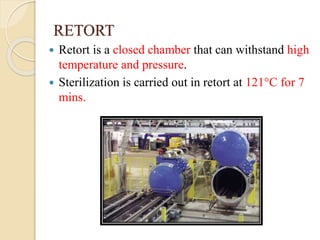
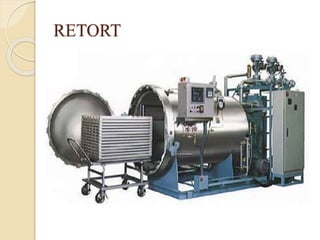
 Retort is a closed chamber that can withstand high
temperature and pressure.
 Sterilization is carried out in retort at 121°C for 7
mins.
RETORT
MACHINERY & UTILITIES OF RETORT
PROCESSING
MACHINERY
 Automatic Filling Machine
 Band Sealer
 Canning Seamer
 Cartoner
 Check Weigher
MACHINERY & UTILITIES OF RETORT
PROCESSING (contd..)
UTILITIES
 Air Compressor
 Blower Web
 Exhaust Pipes
 Boiler
RETORT OPERATION
 Containers are loaded into the chamber.
 The retort lid is sealed.
Venting stage
 Air trapped inside the retort is removed prior processing.
 if air is present at a given pressure the temperature inside
the retort will be lower than that attained by steam alone.
 A mixture of air and steam may stratify leading to cool
spots where there is air.
RETORT OPERATION (cont..)
 This mixture is a less efficient heat transfer medium than
steam alone.
 Air in the retort cuts down the heat penetration of steam
by insulating the cans and can accelerate external
corrosion
RETORT OPERATION (cont..)
.
 When venting is completed, the venting valve
closes and pressure begins to build up in the retort.
 When process temperature is reached, the
thermometer and pressure gauge readings must
agree.
RETORT OPERATION(cont..)
Pressure range in retort operation:
 High acid foods (pH less than 4.5) are usually
processed at low pressures of around 34kpa.
 Low acid foods (pH greater than 4.5) are
processed at 73 or 103kpa
RETORT OPERATION (cont..)
 The time from when the steam is turned on to when the
process temperature is reached is the come-up time.
 Once this has finished, the process begins.
 Process time is from the end of the come-up time to the
commencement of cooling.
 During cooling, the steam is turned off and water is added
to the retort immediately to prevent overcooking.
RETORT OPERATION (cont..)
Cooling:
There are two methods of cooling;
 for small cans at temperatures less than 116°C, atmospheric
cooling may be used.
 for large cans (with a diameter greater than 6cm) are processed
at temperatures greater than 116°C, pressure cooling is used.
RETORT OPERATION (cont..)
 In pressure cooling, the pressure around the containers is
maintained by compressed air during the addition of water.
 The water addition causes the steam to condense and the
pressure outside the package drops suddenly.
 As the internal pressure inside the container does not drop
until the contents cool, steam distortion may occur if the
external pressure is not kept high.
OVERVIEW RETORT OPERATION-FROM PRODUCTION TO CASING
TYPES OF RETORT
Batch type
 In batch systems, the retort is filled with
product, closed, and then put through a processing
cycle.
 Batch retorts are available in a number of
configurations for various applications, including
static, rotary, steam heated, and water heated with
or without
air
Continuous type
 In continuous retorting systems, containers are
continuously fed into and out of the retort.
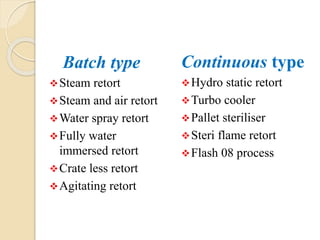
Batch type
Steam retort
Steam and air retort
Water spray retort
Fully water
immersed retort
Crate less retort
Agitating retort
Continuous type
Hydro static retort
Turbo cooler
Pallet steriliser
Steri flame retort
Flash 08 process
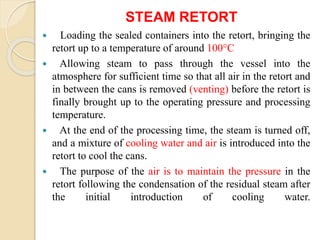
STEAM RETORT
 Loading the sealed containers into the retort, bringing the
retort up to a temperature of around 100°C
 Allowing steam to pass through the vessel into the
atmosphere for sufficient time so that all air in the retort and
in between the cans is removed (venting) before the retort is
finally brought up to the operating pressure and processing
temperature.
 At the end of the processing time, the steam is turned off,
and a mixture of cooling water and air is introduced into the
retort to cool the cans.
 The purpose of the air is to maintain the pressure in the
retort following the condensation of the residual steam after
the initial introduction of cooling water.
STEAM/AIR RETORT
 Sterilization is through introduction of steam
 In steam/air processing, heat is supplied primarily from the
latent heat of condensing steam, in contrast to sensible heat
transfer in superheated water systems.
 A fan circulates the steam to provide uniform heating
 Suitable for multiple package types
 Packages are cooled with recirculated water
WATER SPRAY RETORT
 Uses pump to force super heated water (>121°C)
throughout the vessel
 Nozzles provide very uniform heating pattern
FULL WATER IMMERSION RETORT
Water is heated in a vessel above the cook
chamber to 133°C
Super‐heated water is used to immerse packages
A circulation pump is used to ensure proper heat
distribution
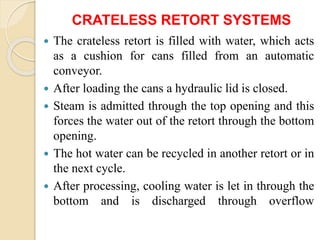
CRATELESS RETORT SYSTEMS
 The crateless retort is filled with water, which acts
as a cushion for cans filled from an automatic
conveyor.
 After loading the cans a hydraulic lid is closed.
 Steam is admitted through the top opening and this
forces the water out of the retort through the bottom
opening.
 The hot water can be recycled in another retort or in
the next cycle.
 After processing, cooling water is let in through the
bottom and is discharged through overflow
AGITATING RETORT
 Some retorts agitate the cans during processing in
order to increase the rate of heat penetration into the
cans.
 Agitation is useful for products which are too
viscous to heat or cool by natural convection.
 By using agitation, the process time may be reduced
by up to 80%.
 Mixing is largely due to the movement of the
headspace during agitation and to be effective there
must be a sufficiently large headspace inside the can.
HYDROSTATIC PRESSURE RETORT
 Hydrostatic cookers are continuous pressure cookers in
which the operating pressure is maintained by water
pressure.
 Hydrostatic cookers have two components:
water chambers and steam chambers.
• The temperature of the steam in the steam chamber is
controlled by pressure produced by the water legs and can
be regulated by moving the level of water in the leg.
 In the lower part of this leg, the water temperature
reaches about 100°C
 In the steam chamber, the can is exposed to a
temperature of 115°C–130°C, the steam temperature
being set to suit the product undergoing sterilization.
 Upon leaving the steam chamber, the can again
goes through a water seal into water at a temperature
of about 107°C where the cooling cycle commences,
under pressure.
FLAME STERILISATION RETORT
 Infrared radiation as an indirect heat source was
developed into flame sterilizers/cookers.
 Flame sterilization involves heating cans by
passing them over a gas flame.
 The can will reach 116°C in a few minutes.
 The entire operations of preheat, process to 130°C,
hold and cool takes 12 minutes.
 The process is limited to low viscosity
liquids or solids.
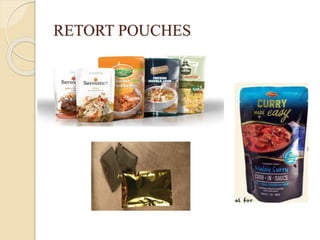
RETORT POUCH
 A retort pouch is a type of food packaging made from
a rectangular laminate of flexible plastic and metal foils,
four side hermetically sealed pouch.
 It allows the sterile packaging of a wide variety of
foods and drinks handled by aseptic processing, and is
used as an alternative to traditional industrial canning
methods.
RETORT POUCH (contd..)
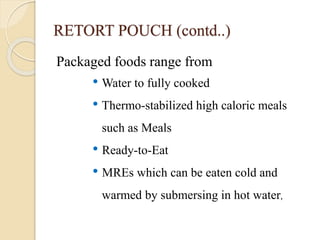
Packaged foods range from
• Water to fully cooked
• Thermo-stabilized high caloric meals
such as Meals
• Ready-to-Eat
• MREs which can be eaten cold and
warmed by submersing in hot water,
RETORT POUCHES
CHARACTERISTIC OF RETORT POUCH
 Low gas permeability (oxygen)
 Low moisture permeability
 Low hydrophilic properties
 Heat sealable and sterilizable
 Constructed of appropriate material.
 High barrier structure for thermal processing.
 Light-weight, shelf stable, cost saving alternative to
metal cans.
CHARACTERISTIC OF RETORT POUCH(contd…)
 Physical strength to resist physical abuse during processing.
 Absence of solvent residues.
 Bonding materials for the laminates must not migrate into
the foods.
 Resistant to penetration by fats, oils and other food
components.
 Straight-tear technology to ensure clean and easy opening.
CONSTRUCTION OF RETORT
POUCH
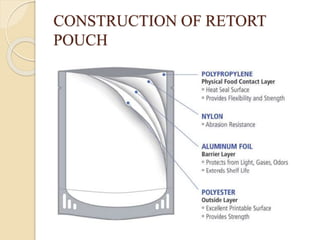
 A retort pouch is constructed from a flexible metal
plastic laminate that is able to withstand the thermal
processing used for sterilization
 Retort pouch is a 3-ply laminate consisting mainly
made of
• PE film (Polyester)
• Aluminum foil
• PP film (Polypropylene) with adhesive material
CONSTRUCTION OF RETORT
POUCH
LAYERS AND ITS FUNCTIONS
 Polyester (PE)
• Provides a gloss and rigid layer
• Withstand to high processing temperature
• Resistance to transportation and storage
• Good printing property
 Aluminum (Al)
• Provides a barrier to 𝑂2, C𝑂2, and water vapor
• Extend the shelf life of product
LAYERS AND ITS FUNCTIONS
 Food-grade cast polypropylene (CPP)
• Heat sealing integrity
• Flexibility and strength
• Odourless and withstand to high temperature
 Polyethylene
• Used instead of PP as a sealing and bonding layer
 Nylon (bi-oriented polyamide)
• Provides puncture resistance
ADVANTAGES OF RETORT POUCH
• Offer good shelf life
• Doesn’t require freezing or refrigeration for
• storage
• Easy to open
• Require less storage space
• Easy to dispose
• Reconstitution of products in pouch can be
• done quickly by dipping in hot water for 5
• minutes.
DISADVANTAGES OF RETORT POUCH
 Filling rate is low (30-60 pouch/min) as
compared to other
 Thermal processing is more complicated and
requires special provision of overhead pressure
 Require overwrapping of paper carton which
increase the cost
 High initial capital investment.
PRODUCT PACKED IN RETORT POUCH
Fruit products
 Peach slice (at 37°C, 4 month) pH = 4
 Mango pulp (at 20-25° C, 4 month)
 Pouches are made from laminate of PE/ AL Foil
EVA.
PRODUCT PACKED IN RETORT POUCH
Vegetables Products
 High rate of ascorbic acid degradation in pouches.
e.g. green bean
 Retention of thiamine and riboflavin in
Sweet potato
 Leaching of vitamin-c and calcium can be
avoided in food product by controlling the fluid
content.
PRODUCT PACKED IN RETORT POUCH
Meat/Fish/Poultry Products:
 It has been suitable for the Packaging of fish
based product.
 Best suitable for meat product.
 Not suitable where high degree of oxygen
permeability required.
QUALITY OF RETORT FOOD
 Safety - should be free from chemical additives
and preservatives
 High Nutritional value – proteins, fat, vitamins,
carbohydrate, minerals etc.
 Good Taste
QUALITY OF RETORT FOOD(contd..)
 Food Appeal – is the sum of sensory characteristics:
appearance, flavor, smell and texture.
 Suitability and Consumer Value: - freshness, shelf
stability, suitability for the intended purpose and
convenience.
 Reasonable price.
ADVANTAGES OF RETORT PACKAGING
 Pouch laminates permits less chance to overcook during the
retorting thus product having better color, texture & less
nutrients loss.
 It requires less energy for sterilization.
 It requires less disposal & storage space.
 Low oxygen & moisture permeability.
 Shelf stable for longer time & requires no
refrigeration.
 Sun light barrier, light weight, easy to open.
Retort Processing and Equipment's for it

Retort Processing and Equipment's for it

  • 1.
  • 2.
    CONTENTS  STERILIZATION  RETORT MACHINERY & UTILITIES OF RETORT PROCESSING  RETORT OPERATION  TYPES OF RETORT  RETORT POUCH  RETORT POUCH STYLES (contd……)
  • 3.
    CONTENTS  CHARACTERISTIC OFRETORT POUCH  CONSTRUCTION OF RETORT POUCH  POUCH LAYERS AND ITS FUNCTIONS  ADVANTAGES AND DISADVANTAGES OF RETORT POUCH  PRODUCT PACKED IN RETORT POUCH  ADVANTAGES OF RETORT PACKAGING
  • 4.
    STERILIZATION  Sterilization isthe thermal process for complete destruction of all micro organism at above 100°C. Types of sterilized Products: • Retorted • Aseptically packaged
  • 5.
    RETORT  Retort isa closed chamber that can withstand high temperature and pressure.  Sterilization is carried out in retort at 121°C for 7 mins.
  • 6.
  • 7.
    MACHINERY & UTILITIESOF RETORT PROCESSING MACHINERY  Automatic Filling Machine  Band Sealer  Canning Seamer  Cartoner  Check Weigher
  • 8.
    MACHINERY & UTILITIESOF RETORT PROCESSING (contd..) UTILITIES  Air Compressor  Blower Web  Exhaust Pipes  Boiler
  • 9.
    RETORT OPERATION  Containersare loaded into the chamber.  The retort lid is sealed. Venting stage  Air trapped inside the retort is removed prior processing.  if air is present at a given pressure the temperature inside the retort will be lower than that attained by steam alone.  A mixture of air and steam may stratify leading to cool spots where there is air.
  • 10.
    RETORT OPERATION (cont..) This mixture is a less efficient heat transfer medium than steam alone.  Air in the retort cuts down the heat penetration of steam by insulating the cans and can accelerate external corrosion
  • 11.
    RETORT OPERATION (cont..) . When venting is completed, the venting valve closes and pressure begins to build up in the retort.  When process temperature is reached, the thermometer and pressure gauge readings must agree.
  • 12.
    RETORT OPERATION(cont..) Pressure rangein retort operation:  High acid foods (pH less than 4.5) are usually processed at low pressures of around 34kpa.  Low acid foods (pH greater than 4.5) are processed at 73 or 103kpa
  • 13.
    RETORT OPERATION (cont..) The time from when the steam is turned on to when the process temperature is reached is the come-up time.  Once this has finished, the process begins.  Process time is from the end of the come-up time to the commencement of cooling.  During cooling, the steam is turned off and water is added to the retort immediately to prevent overcooking.
  • 14.
    RETORT OPERATION (cont..) Cooling: Thereare two methods of cooling;  for small cans at temperatures less than 116°C, atmospheric cooling may be used.  for large cans (with a diameter greater than 6cm) are processed at temperatures greater than 116°C, pressure cooling is used.
  • 15.
    RETORT OPERATION (cont..) In pressure cooling, the pressure around the containers is maintained by compressed air during the addition of water.  The water addition causes the steam to condense and the pressure outside the package drops suddenly.  As the internal pressure inside the container does not drop until the contents cool, steam distortion may occur if the external pressure is not kept high.
  • 16.
    OVERVIEW RETORT OPERATION-FROMPRODUCTION TO CASING
  • 17.
    TYPES OF RETORT Batchtype  In batch systems, the retort is filled with product, closed, and then put through a processing cycle.  Batch retorts are available in a number of configurations for various applications, including static, rotary, steam heated, and water heated with or without air Continuous type  In continuous retorting systems, containers are continuously fed into and out of the retort.
  • 18.
    Batch type Steam retort Steamand air retort Water spray retort Fully water immersed retort Crate less retort Agitating retort Continuous type Hydro static retort Turbo cooler Pallet steriliser Steri flame retort Flash 08 process
  • 19.
    STEAM RETORT  Loadingthe sealed containers into the retort, bringing the retort up to a temperature of around 100°C  Allowing steam to pass through the vessel into the atmosphere for sufficient time so that all air in the retort and in between the cans is removed (venting) before the retort is finally brought up to the operating pressure and processing temperature.  At the end of the processing time, the steam is turned off, and a mixture of cooling water and air is introduced into the retort to cool the cans.  The purpose of the air is to maintain the pressure in the retort following the condensation of the residual steam after the initial introduction of cooling water.
  • 21.
    STEAM/AIR RETORT  Sterilizationis through introduction of steam  In steam/air processing, heat is supplied primarily from the latent heat of condensing steam, in contrast to sensible heat transfer in superheated water systems.  A fan circulates the steam to provide uniform heating  Suitable for multiple package types  Packages are cooled with recirculated water
  • 22.
    WATER SPRAY RETORT Uses pump to force super heated water (>121°C) throughout the vessel  Nozzles provide very uniform heating pattern
  • 23.
    FULL WATER IMMERSIONRETORT Water is heated in a vessel above the cook chamber to 133°C Super‐heated water is used to immerse packages A circulation pump is used to ensure proper heat distribution
  • 24.
    CRATELESS RETORT SYSTEMS The crateless retort is filled with water, which acts as a cushion for cans filled from an automatic conveyor.  After loading the cans a hydraulic lid is closed.  Steam is admitted through the top opening and this forces the water out of the retort through the bottom opening.  The hot water can be recycled in another retort or in the next cycle.  After processing, cooling water is let in through the bottom and is discharged through overflow
  • 25.
    AGITATING RETORT  Someretorts agitate the cans during processing in order to increase the rate of heat penetration into the cans.  Agitation is useful for products which are too viscous to heat or cool by natural convection.  By using agitation, the process time may be reduced by up to 80%.  Mixing is largely due to the movement of the headspace during agitation and to be effective there must be a sufficiently large headspace inside the can.
  • 26.
    HYDROSTATIC PRESSURE RETORT Hydrostatic cookers are continuous pressure cookers in which the operating pressure is maintained by water pressure.  Hydrostatic cookers have two components: water chambers and steam chambers. • The temperature of the steam in the steam chamber is controlled by pressure produced by the water legs and can be regulated by moving the level of water in the leg.
  • 27.
     In thelower part of this leg, the water temperature reaches about 100°C  In the steam chamber, the can is exposed to a temperature of 115°C–130°C, the steam temperature being set to suit the product undergoing sterilization.  Upon leaving the steam chamber, the can again goes through a water seal into water at a temperature of about 107°C where the cooling cycle commences, under pressure.
  • 28.
    FLAME STERILISATION RETORT Infrared radiation as an indirect heat source was developed into flame sterilizers/cookers.  Flame sterilization involves heating cans by passing them over a gas flame.  The can will reach 116°C in a few minutes.  The entire operations of preheat, process to 130°C, hold and cool takes 12 minutes.  The process is limited to low viscosity liquids or solids.
  • 29.
    RETORT POUCH  Aretort pouch is a type of food packaging made from a rectangular laminate of flexible plastic and metal foils, four side hermetically sealed pouch.  It allows the sterile packaging of a wide variety of foods and drinks handled by aseptic processing, and is used as an alternative to traditional industrial canning methods.
  • 30.
    RETORT POUCH (contd..) Packagedfoods range from • Water to fully cooked • Thermo-stabilized high caloric meals such as Meals • Ready-to-Eat • MREs which can be eaten cold and warmed by submersing in hot water,
  • 31.
  • 32.
    CHARACTERISTIC OF RETORTPOUCH  Low gas permeability (oxygen)  Low moisture permeability  Low hydrophilic properties  Heat sealable and sterilizable  Constructed of appropriate material.  High barrier structure for thermal processing.  Light-weight, shelf stable, cost saving alternative to metal cans.
  • 33.
    CHARACTERISTIC OF RETORTPOUCH(contd…)  Physical strength to resist physical abuse during processing.  Absence of solvent residues.  Bonding materials for the laminates must not migrate into the foods.  Resistant to penetration by fats, oils and other food components.  Straight-tear technology to ensure clean and easy opening.
  • 34.
    CONSTRUCTION OF RETORT POUCH A retort pouch is constructed from a flexible metal plastic laminate that is able to withstand the thermal processing used for sterilization  Retort pouch is a 3-ply laminate consisting mainly made of • PE film (Polyester) • Aluminum foil • PP film (Polypropylene) with adhesive material
  • 35.
  • 36.
    LAYERS AND ITSFUNCTIONS  Polyester (PE) • Provides a gloss and rigid layer • Withstand to high processing temperature • Resistance to transportation and storage • Good printing property  Aluminum (Al) • Provides a barrier to 𝑂2, C𝑂2, and water vapor • Extend the shelf life of product
  • 37.
    LAYERS AND ITSFUNCTIONS  Food-grade cast polypropylene (CPP) • Heat sealing integrity • Flexibility and strength • Odourless and withstand to high temperature  Polyethylene • Used instead of PP as a sealing and bonding layer  Nylon (bi-oriented polyamide) • Provides puncture resistance
  • 38.
    ADVANTAGES OF RETORTPOUCH • Offer good shelf life • Doesn’t require freezing or refrigeration for • storage • Easy to open • Require less storage space • Easy to dispose • Reconstitution of products in pouch can be • done quickly by dipping in hot water for 5 • minutes.
  • 39.
    DISADVANTAGES OF RETORTPOUCH  Filling rate is low (30-60 pouch/min) as compared to other  Thermal processing is more complicated and requires special provision of overhead pressure  Require overwrapping of paper carton which increase the cost  High initial capital investment.
  • 40.
    PRODUCT PACKED INRETORT POUCH Fruit products  Peach slice (at 37°C, 4 month) pH = 4  Mango pulp (at 20-25° C, 4 month)  Pouches are made from laminate of PE/ AL Foil EVA.
  • 41.
    PRODUCT PACKED INRETORT POUCH Vegetables Products  High rate of ascorbic acid degradation in pouches. e.g. green bean  Retention of thiamine and riboflavin in Sweet potato  Leaching of vitamin-c and calcium can be avoided in food product by controlling the fluid content.
  • 42.
    PRODUCT PACKED INRETORT POUCH Meat/Fish/Poultry Products:  It has been suitable for the Packaging of fish based product.  Best suitable for meat product.  Not suitable where high degree of oxygen permeability required.
  • 43.
    QUALITY OF RETORTFOOD  Safety - should be free from chemical additives and preservatives  High Nutritional value – proteins, fat, vitamins, carbohydrate, minerals etc.  Good Taste
  • 44.
    QUALITY OF RETORTFOOD(contd..)  Food Appeal – is the sum of sensory characteristics: appearance, flavor, smell and texture.  Suitability and Consumer Value: - freshness, shelf stability, suitability for the intended purpose and convenience.  Reasonable price.
  • 45.
    ADVANTAGES OF RETORTPACKAGING  Pouch laminates permits less chance to overcook during the retorting thus product having better color, texture & less nutrients loss.  It requires less energy for sterilization.  It requires less disposal & storage space.  Low oxygen & moisture permeability.  Shelf stable for longer time & requires no refrigeration.  Sun light barrier, light weight, easy to open.