REPLACEMENT
THEORY
Presented by:-
Ashish kumar
Dhanwantri Kumar Bindal
Ketan Anand
Shweta Divedi
TABLE OF CONTENTS
Introduction
01
Types of Failure
02
Replacement
Model 2
04
Replacement
Model 1
03
Introduction
01
Introduction: Replacement
• The problem of replacement is felt when
the job performing units such as
• Men
• Machine
• Equipment
• Parts etc.. Become less effective
or useless due to either sudden or
gradual deterioration in their
efficiency, failure or breakdown
• By replacing them with new ones at
frequent intervals maintenance and
other overhead cost can be reduced
Types of Failure
02
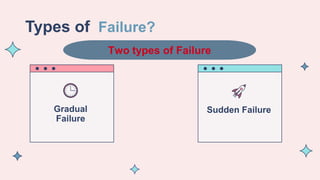
Types of Failure?
Sudden Failure
Gradual
Failure
Two types of Failure
Gradual failure cases
• Increased running costs
( maintenance +
operating cost)
• Decrease in productivity
• Decrease in the resale
or salvage value
Sudden failure cases
This type of failure occurs in
items after some period of
giving desired service rather
than deteriorating while in
service
TYPES OF REPLACEMENT THEORY
1. Constant-Interval Replacement Policy (CIRP)
• Constant Interval Replacement Policy. Preventive
replacements occur at fixed Intervals of time, while failure
replacements are carried out when necessary. The problem is to
determine the optimal interval between preventive replacements
so that the total expected cost per unit of time of replacing assets
is minimized.
Age-Based Replacement Policy
• One of a number of different types of asset replacement
policies. which falls into the preventive replacement
class (see figure).A conscious decision by the Owner
Group to replace certain assets at failure, or at a
specified age, whichever comes first. A preventive
replacement of the asset is carried out once the age of
the asset has reached a specific/critical operational
age. If the asset fails prior to that year, a failure
replacement is performed and the next preventive
replacement is rescheduled.
3.Time based replacement policy
• Time-Based Replacement Policy. One of a number of
different types of asset replacement policies.
Replacement of an asset after a pre-defined
amount of time has transpired.
4. Inspection Replacement Policy (IRP)
• Inspection Replacement Policy. A form of asset
replacement policy that may fall into the preventive
replacement class but only if the inspection takes
places before Functional Failure ("F") has occurred. An
asset is replaced only if it fails to meet the
standards established by a Facility Condition
Assessment (FCA).
5. Modified-Age Replacement Policy
(MARP)
• One of a number of asset replacement policies. that
falls into the preventive replacement class (see
figure).Replacement of the asset is delayed until the
end of the ongoing demand period, but does not deviate
too far from age of the asset has reached a
specific/critical operational age . MARP attempts to
deal with the shortcomings of Age-Based Replacement
Policies which rely too heavily on absolute time.
6.Block Replacement Policy (BRP)
• Block Replacement Policy. A form of asset
replacement policy that falls into the preventive
replacement class (see figure). If a system, such
as electrical or mechanical, consists of a group
of assets (the block), a unit is replaced upon
failure and at times
Model 01
Replacement of items
whose running cost
increases with time and
value of money remains
constant during a period
03
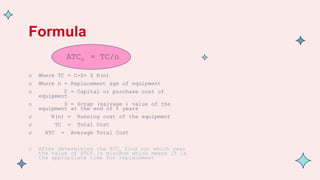
Formula
o Where TC = C-S+ Σ R(n)
o Where n = Replacement age of equipment
o C = Capital or purchase cost of
equipment
o S = Scrap (salvage ) value of the
equipment at the end of t years
o R(n) = Running cost of the equipment
o TC = Total Cost
o ATC = Average Total Cost
o After determining the ATCn find out which year
the value of ATCn is minimum which means it is
the appropriate time for replacement
ATCn = TC/n
Example
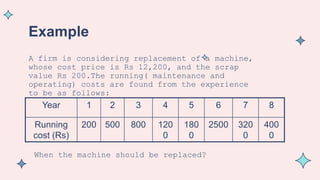
When the machine should be replaced?
A firm is considering replacement of a machine,
whose cost price is Rs 12,200, and the scrap
value Rs 200.The running( maintenance and
operating) costs are found from the experience
to be as follows:
Year 1 2 3 4 5 6 7 8
Running
cost (Rs)
200 500 800 120
0
180
0
2500 320
0
400
0
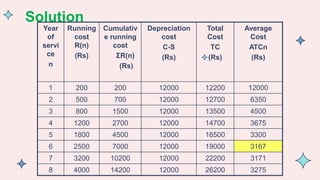
Solution
Year
of
servi
ce
n
Running
cost
R(n)
(Rs)
Cumulativ
e running
cost
ΣR(n)
(Rs)
Depreciation
cost
C-S
(Rs)
Total
Cost
TC
(Rs)
Average
Cost
ATCn
(Rs)
1 200 200 12000 12200 12000
2 500 700 12000 12700 6350
3 800 1500 12000 13500 4500
4 1200 2700 12000 14700 3675
5 1800 4500 12000 16500 3300
6 2500 7000 12000 19000 3167
7 3200 10200 12000 22200 3171
8 4000 14200 12000 26200 3275
Model 02
Replacement policy for
items whose running cost
increases with time but
value of money changes
with constant rate during
the period
04
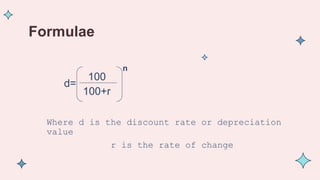
Formulae
Where d is the discount rate or depreciation
value
r is the rate of change
100
100+r
d=
n
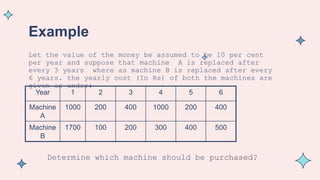
Example
Determine which machine should be purchased?
Let the value of the money be assumed to be 10 per cent
per year and suppose that machine A is replaced after
every 3 years where as machine B is replaced after every
6 years. the yearly cost (In Rs) of both the machines are
given as under:
Year 1 2 3 4 5 6
Machine
A
1000 200 400 1000 200 400
Machine
B
1700 100 200 300 400 500
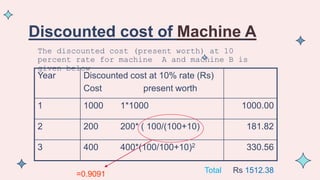
Discounted cost of Machine A
The discounted cost (present worth) at 10
percent rate for machine A and machine B is
given below
Year Discounted cost at 10% rate (Rs)
Cost present worth
1 1000 1*1000 1000.00
2 200 200* ( 100/(100+10) 181.82
3 400 400*(100/100+10)2 330.56
=0.9091 Total Rs 1512.38
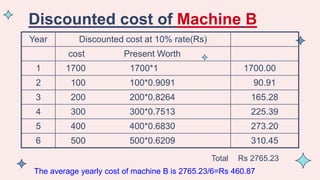
Discounted cost of Machine B
Year Discounted cost at 10% rate(Rs)
cost Present Worth
1 1700 1700*1 1700.00
2 100 100*0.9091 90.91
3 200 200*0.8264 165.28
4 300 300*0.7513 225.39
5 400 400*0.6830 273.20
6 500 500*0.6209 310.45
Total Rs 2765.23
The average yearly cost of machine B is 2765.23/6=Rs 460.87
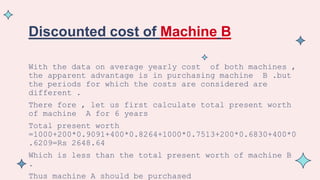
Discounted cost of Machine B
With the data on average yearly cost of both machines ,
the apparent advantage is in purchasing machine B .but
the periods for which the costs are considered are
different .
There fore , let us first calculate total present worth
of machine A for 6 years
Total present worth
=1000+200*0.9091+400*0.8264+1000*0.7513+200*0.6830+400*0
.6209=Rs 2648.64
Which is less than the total present worth of machine B
.
Thus machine A should be purchased
CREDITS: This presentation template was created by Slidesgo, including
icons by Flaticon, and infographics & images by Freepik
THANKS!
Do you have any questions?
harshapradhan@fmsbhu.ac.in
+91 993 0034241
Credits:- Dr. Harsh Pradhan

Operations REsearch

  • 1.
    REPLACEMENT THEORY Presented by:- Ashish kumar DhanwantriKumar Bindal Ketan Anand Shweta Divedi
  • 2.
    TABLE OF CONTENTS Introduction 01 Typesof Failure 02 Replacement Model 2 04 Replacement Model 1 03
  • 3.
  • 4.
    Introduction: Replacement • Theproblem of replacement is felt when the job performing units such as • Men • Machine • Equipment • Parts etc.. Become less effective or useless due to either sudden or gradual deterioration in their efficiency, failure or breakdown • By replacing them with new ones at frequent intervals maintenance and other overhead cost can be reduced
  • 5.
  • 6.
    Types of Failure? SuddenFailure Gradual Failure Two types of Failure
  • 7.
    Gradual failure cases •Increased running costs ( maintenance + operating cost) • Decrease in productivity • Decrease in the resale or salvage value
  • 8.
    Sudden failure cases Thistype of failure occurs in items after some period of giving desired service rather than deteriorating while in service
  • 9.
    TYPES OF REPLACEMENTTHEORY 1. Constant-Interval Replacement Policy (CIRP) • Constant Interval Replacement Policy. Preventive replacements occur at fixed Intervals of time, while failure replacements are carried out when necessary. The problem is to determine the optimal interval between preventive replacements so that the total expected cost per unit of time of replacing assets is minimized.
  • 10.
    Age-Based Replacement Policy •One of a number of different types of asset replacement policies. which falls into the preventive replacement class (see figure).A conscious decision by the Owner Group to replace certain assets at failure, or at a specified age, whichever comes first. A preventive replacement of the asset is carried out once the age of the asset has reached a specific/critical operational age. If the asset fails prior to that year, a failure replacement is performed and the next preventive replacement is rescheduled.
  • 11.
    3.Time based replacementpolicy • Time-Based Replacement Policy. One of a number of different types of asset replacement policies. Replacement of an asset after a pre-defined amount of time has transpired.
  • 12.
    4. Inspection ReplacementPolicy (IRP) • Inspection Replacement Policy. A form of asset replacement policy that may fall into the preventive replacement class but only if the inspection takes places before Functional Failure ("F") has occurred. An asset is replaced only if it fails to meet the standards established by a Facility Condition Assessment (FCA).
  • 13.
    5. Modified-Age ReplacementPolicy (MARP) • One of a number of asset replacement policies. that falls into the preventive replacement class (see figure).Replacement of the asset is delayed until the end of the ongoing demand period, but does not deviate too far from age of the asset has reached a specific/critical operational age . MARP attempts to deal with the shortcomings of Age-Based Replacement Policies which rely too heavily on absolute time.
  • 14.
    6.Block Replacement Policy(BRP) • Block Replacement Policy. A form of asset replacement policy that falls into the preventive replacement class (see figure). If a system, such as electrical or mechanical, consists of a group of assets (the block), a unit is replaced upon failure and at times
  • 15.
    Model 01 Replacement ofitems whose running cost increases with time and value of money remains constant during a period 03
  • 16.
    Formula o Where TC= C-S+ Σ R(n) o Where n = Replacement age of equipment o C = Capital or purchase cost of equipment o S = Scrap (salvage ) value of the equipment at the end of t years o R(n) = Running cost of the equipment o TC = Total Cost o ATC = Average Total Cost o After determining the ATCn find out which year the value of ATCn is minimum which means it is the appropriate time for replacement ATCn = TC/n
  • 17.
    Example When the machineshould be replaced? A firm is considering replacement of a machine, whose cost price is Rs 12,200, and the scrap value Rs 200.The running( maintenance and operating) costs are found from the experience to be as follows: Year 1 2 3 4 5 6 7 8 Running cost (Rs) 200 500 800 120 0 180 0 2500 320 0 400 0
  • 18.
    Solution Year of servi ce n Running cost R(n) (Rs) Cumulativ e running cost ΣR(n) (Rs) Depreciation cost C-S (Rs) Total Cost TC (Rs) Average Cost ATCn (Rs) 1 200200 12000 12200 12000 2 500 700 12000 12700 6350 3 800 1500 12000 13500 4500 4 1200 2700 12000 14700 3675 5 1800 4500 12000 16500 3300 6 2500 7000 12000 19000 3167 7 3200 10200 12000 22200 3171 8 4000 14200 12000 26200 3275
  • 19.
    Model 02 Replacement policyfor items whose running cost increases with time but value of money changes with constant rate during the period 04
  • 20.
    Formulae Where d isthe discount rate or depreciation value r is the rate of change 100 100+r d= n
  • 21.
    Example Determine which machineshould be purchased? Let the value of the money be assumed to be 10 per cent per year and suppose that machine A is replaced after every 3 years where as machine B is replaced after every 6 years. the yearly cost (In Rs) of both the machines are given as under: Year 1 2 3 4 5 6 Machine A 1000 200 400 1000 200 400 Machine B 1700 100 200 300 400 500
  • 22.
    Discounted cost ofMachine A The discounted cost (present worth) at 10 percent rate for machine A and machine B is given below Year Discounted cost at 10% rate (Rs) Cost present worth 1 1000 1*1000 1000.00 2 200 200* ( 100/(100+10) 181.82 3 400 400*(100/100+10)2 330.56 =0.9091 Total Rs 1512.38
  • 23.
    Discounted cost ofMachine B Year Discounted cost at 10% rate(Rs) cost Present Worth 1 1700 1700*1 1700.00 2 100 100*0.9091 90.91 3 200 200*0.8264 165.28 4 300 300*0.7513 225.39 5 400 400*0.6830 273.20 6 500 500*0.6209 310.45 Total Rs 2765.23 The average yearly cost of machine B is 2765.23/6=Rs 460.87
  • 24.
    Discounted cost ofMachine B With the data on average yearly cost of both machines , the apparent advantage is in purchasing machine B .but the periods for which the costs are considered are different . There fore , let us first calculate total present worth of machine A for 6 years Total present worth =1000+200*0.9091+400*0.8264+1000*0.7513+200*0.6830+400*0 .6209=Rs 2648.64 Which is less than the total present worth of machine B . Thus machine A should be purchased
  • 25.
    CREDITS: This presentationtemplate was created by Slidesgo, including icons by Flaticon, and infographics & images by Freepik THANKS! Do you have any questions? harshapradhan@fmsbhu.ac.in +91 993 0034241 Credits:- Dr. Harsh Pradhan