6. Replacement Analysis
6.1. Reasons for Replacement Analysis, Factors to
Consider in Replacement Studies
6.2. Determining the Economic Life of a New and
an Existing Asset
Replacement Analysis
• Replacement analysis is one of the crucial
analysis in capital budgeting. An asset life
may be reduced due to physical impairment,
changes in economic requirements and rapid
changes in technology that may obsolete an
assets prior to expectation. The replacement
of assets offer economic opportunity for the
firm.
Reasons for Replacement Analysis
• Replacement of the existing equipment with a
new one.
• Augmenting the existing one with an additional
equipment.
• Replacement of assets that deteriorate with time
(Replacement due to gradual failure, or wear and
tear of the components of the machines).
• (a) Obsolescence (b) Deterioration (c) Working
conditions (d) Inadequacy (e) Rapid technological
changes
Factors to Consider in Replacement
Studies
• Technical factors:
Whether the present equipment has deteriorated, i.e.,
whether it is functioning properly or not?
Whether the present equipment has become obsolete?
Is the present equipment inadequate in meeting production
rate?
Can the present equipment hold tight tolerances?
Can the present equipment provide required surface finish?
Is the new equipment better designed from a method’s
standpoint?
Is the present equipment polluting or spoiling working
conditions of the factory?
Is the present equipment making more noise and vibrations
and thus distracting the attention of the workers?
Factors to Consider in Replacement
Studies
Is the existing equipment hard on the workers?
Does the existing equipment increase likelihood
of accidents?
To what extent the existing equipment is not
capable of making use of the newer
developments in the field?
How often the existing equipment needs
maintenance and repair
Factors to Consider in Replacement
Studies
• Financial factors:
The initial cost of the challenger.
If an existing equipment is considered for replacement with a new
equipment, then the existing equipment is known as the defender
and the new equipment is known as challenger. Defender is an
existing asset
• Operating expenses:
Direct and indirect labor cost
Direct and indirect material cost
Power
Maintenance cost
Cost of replacing parts,
Insurance, and
Interest on invested capital, etc.
• Expected salvage value at the end of the service life.
Determining the Economic Life of a
New and an Existing Asset
• The concept of comparison of replacement of
an existing asset with a new asset is presented
here. In this analysis, the annual equivalent
cost of each alternative should be computed
first. Then the alternative which has the least
cost should be selected as the best
alternative. Before discussing details, some
preliminary concepts which are essential for
this type of replacement analysis are
presented.
Economic life
• The economic life of an asset is the period of
time during which it remains profitable to its
owner.
• Financial considerations required for
calculating the economic life on asset include
its cost at the time of purchase, the amount of
time an asset is used in production, and
existing regulations pertaining to it.
Economic life
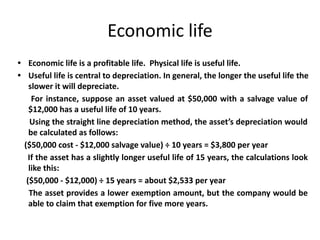
• Economic life is a profitable life. Physical life is useful life.
• Useful life is central to depreciation. In general, the longer the useful life the
slower it will depreciate.
For instance, suppose an asset valued at $50,000 with a salvage value of
$12,000 has a useful life of 10 years.
Using the straight line depreciation method, the asset’s depreciation would
be calculated as follows:
($50,000 cost - $12,000 salvage value) ÷ 10 years = $3,800 per year
If the asset has a slightly longer useful life of 15 years, the calculations look
like this:
($50,000 - $12,000) ÷ 15 years = about $2,533 per year
The asset provides a lower exemption amount, but the company would be
able to claim that exemption for five more years.
Concept of Challenger and Defender
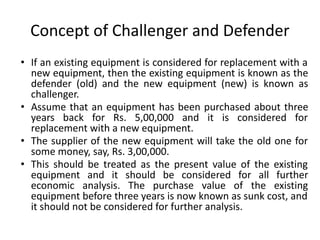
• If an existing equipment is considered for replacement with a
new equipment, then the existing equipment is known as the
defender (old) and the new equipment (new) is known as
challenger.
• Assume that an equipment has been purchased about three
years back for Rs. 5,00,000 and it is considered for
replacement with a new equipment.
• The supplier of the new equipment will take the old one for
some money, say, Rs. 3,00,000.
• This should be treated as the present value of the existing
equipment and it should be considered for all further
economic analysis. The purchase value of the existing
equipment before three years is now known as sunk cost, and
it should not be considered for further analysis.
Example
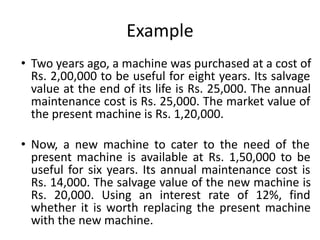
• Two years ago, a machine was purchased at a cost of
Rs. 2,00,000 to be useful for eight years. Its salvage
value at the end of its life is Rs. 25,000. The annual
maintenance cost is Rs. 25,000. The market value of
the present machine is Rs. 1,20,000.
• Now, a new machine to cater to the need of the
present machine is available at Rs. 1,50,000 to be
useful for six years. Its annual maintenance cost is
Rs. 14,000. The salvage value of the new machine is
Rs. 20,000. Using an interest rate of 12%, find
whether it is worth replacing the present machine
with the new machine.
Solution
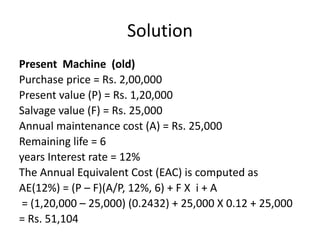
Present Machine (old)
Purchase price = Rs. 2,00,000
Present value (P) = Rs. 1,20,000
Salvage value (F) = Rs. 25,000
Annual maintenance cost (A) = Rs. 25,000
Remaining life = 6
years Interest rate = 12%
The Annual Equivalent Cost (EAC) is computed as
AE(12%) = (P – F)(A/P, 12%, 6) + F X i + A
= (1,20,000 – 25,000) (0.2432) + 25,000 X 0.12 + 25,000
= Rs. 51,104
Solution
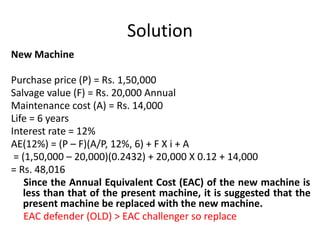
New Machine
Purchase price (P) = Rs. 1,50,000
Salvage value (F) = Rs. 20,000 Annual
Maintenance cost (A) = Rs. 14,000
Life = 6 years
Interest rate = 12%
AE(12%) = (P – F)(A/P, 12%, 6) + F X i + A
= (1,50,000 – 20,000)(0.2432) + 20,000 X 0.12 + 14,000
= Rs. 48,016
Since the Annual Equivalent Cost (EAC) of the new machine is
less than that of the present machine, it is suggested that the
present machine be replaced with the new machine.
EAC defender (OLD) > EAC challenger so replace
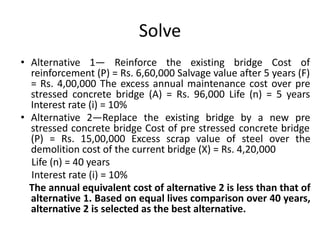
Solve
• Alternative 1— Reinforce the existing bridge Cost of
reinforcement (P) = Rs. 6,60,000 Salvage value after 5 years (F)
= Rs. 4,00,000 The excess annual maintenance cost over pre
stressed concrete bridge (A) = Rs. 96,000 Life (n) = 5 years
Interest rate (i) = 10%
• Alternative 2—Replace the existing bridge by a new pre
stressed concrete bridge Cost of pre stressed concrete bridge
(P) = Rs. 15,00,000 Excess scrap value of steel over the
demolition cost of the current bridge (X) = Rs. 4,20,000
Life (n) = 40 years
Interest rate (i) = 10%
The annual equivalent cost of alternative 2 is less than that of
alternative 1. Based on equal lives comparison over 40 years,
alternative 2 is selected as the best alternative.

unit-6 (1).pdf

  • 1.
    6. Replacement Analysis 6.1.Reasons for Replacement Analysis, Factors to Consider in Replacement Studies 6.2. Determining the Economic Life of a New and an Existing Asset
  • 2.
    Replacement Analysis • Replacementanalysis is one of the crucial analysis in capital budgeting. An asset life may be reduced due to physical impairment, changes in economic requirements and rapid changes in technology that may obsolete an assets prior to expectation. The replacement of assets offer economic opportunity for the firm.
  • 3.
    Reasons for ReplacementAnalysis • Replacement of the existing equipment with a new one. • Augmenting the existing one with an additional equipment. • Replacement of assets that deteriorate with time (Replacement due to gradual failure, or wear and tear of the components of the machines). • (a) Obsolescence (b) Deterioration (c) Working conditions (d) Inadequacy (e) Rapid technological changes
  • 4.
    Factors to Considerin Replacement Studies • Technical factors: Whether the present equipment has deteriorated, i.e., whether it is functioning properly or not? Whether the present equipment has become obsolete? Is the present equipment inadequate in meeting production rate? Can the present equipment hold tight tolerances? Can the present equipment provide required surface finish? Is the new equipment better designed from a method’s standpoint? Is the present equipment polluting or spoiling working conditions of the factory? Is the present equipment making more noise and vibrations and thus distracting the attention of the workers?
  • 5.
    Factors to Considerin Replacement Studies Is the existing equipment hard on the workers? Does the existing equipment increase likelihood of accidents? To what extent the existing equipment is not capable of making use of the newer developments in the field? How often the existing equipment needs maintenance and repair
  • 6.
    Factors to Considerin Replacement Studies • Financial factors: The initial cost of the challenger. If an existing equipment is considered for replacement with a new equipment, then the existing equipment is known as the defender and the new equipment is known as challenger. Defender is an existing asset • Operating expenses: Direct and indirect labor cost Direct and indirect material cost Power Maintenance cost Cost of replacing parts, Insurance, and Interest on invested capital, etc. • Expected salvage value at the end of the service life.
  • 7.
    Determining the EconomicLife of a New and an Existing Asset • The concept of comparison of replacement of an existing asset with a new asset is presented here. In this analysis, the annual equivalent cost of each alternative should be computed first. Then the alternative which has the least cost should be selected as the best alternative. Before discussing details, some preliminary concepts which are essential for this type of replacement analysis are presented.
  • 8.
    Economic life • Theeconomic life of an asset is the period of time during which it remains profitable to its owner. • Financial considerations required for calculating the economic life on asset include its cost at the time of purchase, the amount of time an asset is used in production, and existing regulations pertaining to it.
  • 9.
    Economic life • Economiclife is a profitable life. Physical life is useful life. • Useful life is central to depreciation. In general, the longer the useful life the slower it will depreciate. For instance, suppose an asset valued at $50,000 with a salvage value of $12,000 has a useful life of 10 years. Using the straight line depreciation method, the asset’s depreciation would be calculated as follows: ($50,000 cost - $12,000 salvage value) ÷ 10 years = $3,800 per year If the asset has a slightly longer useful life of 15 years, the calculations look like this: ($50,000 - $12,000) ÷ 15 years = about $2,533 per year The asset provides a lower exemption amount, but the company would be able to claim that exemption for five more years.
  • 10.
    Concept of Challengerand Defender • If an existing equipment is considered for replacement with a new equipment, then the existing equipment is known as the defender (old) and the new equipment (new) is known as challenger. • Assume that an equipment has been purchased about three years back for Rs. 5,00,000 and it is considered for replacement with a new equipment. • The supplier of the new equipment will take the old one for some money, say, Rs. 3,00,000. • This should be treated as the present value of the existing equipment and it should be considered for all further economic analysis. The purchase value of the existing equipment before three years is now known as sunk cost, and it should not be considered for further analysis.
  • 11.
    Example • Two yearsago, a machine was purchased at a cost of Rs. 2,00,000 to be useful for eight years. Its salvage value at the end of its life is Rs. 25,000. The annual maintenance cost is Rs. 25,000. The market value of the present machine is Rs. 1,20,000. • Now, a new machine to cater to the need of the present machine is available at Rs. 1,50,000 to be useful for six years. Its annual maintenance cost is Rs. 14,000. The salvage value of the new machine is Rs. 20,000. Using an interest rate of 12%, find whether it is worth replacing the present machine with the new machine.
  • 12.
    Solution Present Machine (old) Purchaseprice = Rs. 2,00,000 Present value (P) = Rs. 1,20,000 Salvage value (F) = Rs. 25,000 Annual maintenance cost (A) = Rs. 25,000 Remaining life = 6 years Interest rate = 12% The Annual Equivalent Cost (EAC) is computed as AE(12%) = (P – F)(A/P, 12%, 6) + F X i + A = (1,20,000 – 25,000) (0.2432) + 25,000 X 0.12 + 25,000 = Rs. 51,104
  • 13.
    Solution New Machine Purchase price(P) = Rs. 1,50,000 Salvage value (F) = Rs. 20,000 Annual Maintenance cost (A) = Rs. 14,000 Life = 6 years Interest rate = 12% AE(12%) = (P – F)(A/P, 12%, 6) + F X i + A = (1,50,000 – 20,000)(0.2432) + 20,000 X 0.12 + 14,000 = Rs. 48,016 Since the Annual Equivalent Cost (EAC) of the new machine is less than that of the present machine, it is suggested that the present machine be replaced with the new machine. EAC defender (OLD) > EAC challenger so replace
  • 14.
    Solve • Alternative 1—Reinforce the existing bridge Cost of reinforcement (P) = Rs. 6,60,000 Salvage value after 5 years (F) = Rs. 4,00,000 The excess annual maintenance cost over pre stressed concrete bridge (A) = Rs. 96,000 Life (n) = 5 years Interest rate (i) = 10% • Alternative 2—Replace the existing bridge by a new pre stressed concrete bridge Cost of pre stressed concrete bridge (P) = Rs. 15,00,000 Excess scrap value of steel over the demolition cost of the current bridge (X) = Rs. 4,20,000 Life (n) = 40 years Interest rate (i) = 10% The annual equivalent cost of alternative 2 is less than that of alternative 1. Based on equal lives comparison over 40 years, alternative 2 is selected as the best alternative.