OSMOTIC DEHYDRATION
CONTENTS
 Introduction
 Principle
 Factors affecting osmotic dehydration
 Enhancement of osmotic dehydration
 Advantages and disadvantages
Introduction
⚫Osmotic dehydration is the process of water removal by
immersion of water containing cellular solid in a
concentrated aqueous solution.
⚫Osmotic dehydration has been recognized as a good pre-
treatment prior to regular drying.
⚫Osmotic dehydration has the potential to remove water at
low temperatures.
⚫ It is an energy efficient method, as water does not go
through a phase change.
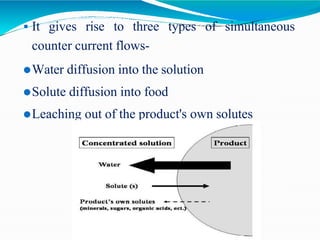
 It gives rise to three types of simultaneous
counter current flows-
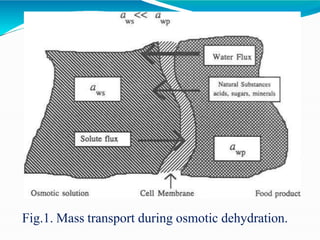
⚫Water diffusion into the solution
⚫Solute diffusion into food
⚫Leaching out of the product's own solutes
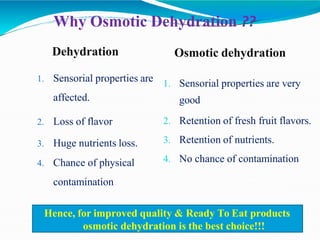
Why Osmotic Dehydration ??
Dehydration Osmotic dehydration
1. Sensorial properties are
affected.
2. Loss of flavor
3. Huge nutrients loss.
4. Chance of physical
contamination
1. Sensorial properties are very
good
2. Retention of fresh fruit flavors.
3. Retention of nutrients.
4. No chance of contamination
Hence, for improved quality & Ready To Eat products
osmotic dehydration is the best choice!!!
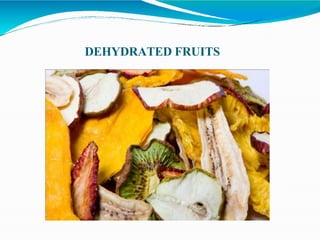
DEHYDRATED FRUITS
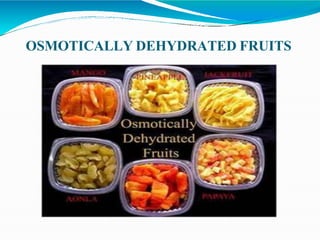
OSMOTICALLY DEHYDRATED FRUITS
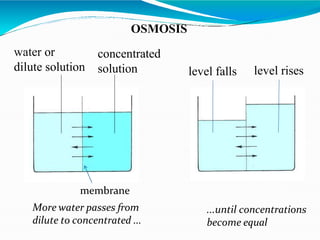
OSMOSIS
water or
dilute solution
concentrated
solution
membrane
More water passes from
dilute to concentrated ...
...until concentrations
become equal
level rises
level falls
Fig.1. Mass transport during osmotic dehydration.
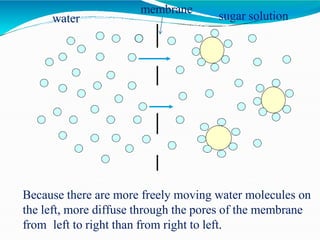
Because there are more freely moving water molecules on
the left, more diffuse through the pores of the membrane
from left to right than from right to left.
membrane
water sugar solution
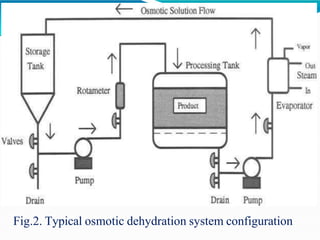
Fig.2. Typical osmotic dehydration system configuration
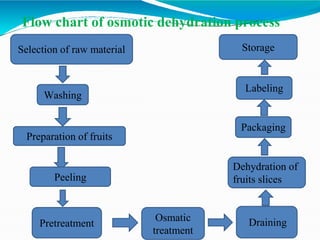
Flow chart of osmotic dehydration process
Selection of raw material
Washing
Preparation of fruits
Osmatic
treatment
Draining
Pretreatment
Packaging
Dehydration of
fruits slices
Storage
Peeling
Labeling
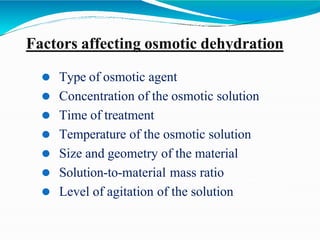
Factors affecting osmotic dehydration
⚫ Type of osmotic agent
⚫ Concentration of the osmotic solution
⚫ Time of treatment
⚫ Temperature of the osmotic solution
⚫ Size and geometry of the material
⚫ Solution-to-material mass ratio
⚫ Level of agitation of the solution
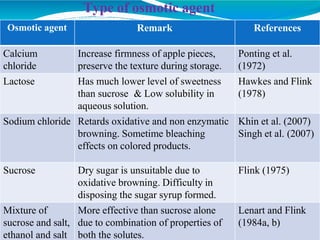
Osmotic agent Remark References
Calcium
chloride
Increase firmness of apple pieces,
preserve the texture during storage.
Ponting et al.
(1972)
Lactose Has much lower level of sweetness
than sucrose & Low solubility in
aqueous solution.
Hawkes and Flink
(1978)
Sodium chloride Retards oxidative and non enzymatic
browning. Sometime bleaching
effects on colored products.
Khin et al. (2007)
Singh et al. (2007)
Sucrose Dry sugar is unsuitable due to
oxidative browning. Difficulty in
disposing the sugar syrup formed.
Flink (1975)
Mixture of
sucrose and salt,
ethanol and salt
More effective than sucrose alone
due to combination of properties of
both the solutes.
Lenart and Flink
(1984a, b)
Type of osmotic agent
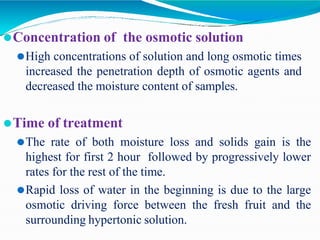
⚫Concentration of the osmotic solution
⚫High concentrations of solution and long osmotic times
increased the penetration depth of osmotic agents and
decreased the moisture content of samples.
⚫Time of treatment
⚫The rate of both moisture loss and solids gain is the
highest for first 2 hour followed by progressively lower
rates for the rest of the time.
⚫Rapid loss of water in the beginning is due to the large
osmotic driving force between the fresh fruit and the
surrounding hypertonic solution.
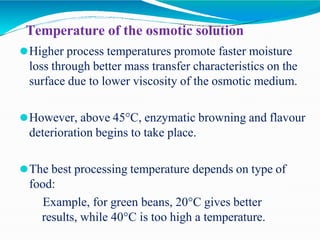
Temperature of the osmotic solution
⚫Higher process temperatures promote faster moisture
loss through better mass transfer characteristics on the
surface due to lower viscosity of the osmotic medium.
⚫However, above 45°C, enzymatic browning and flavour
deterioration begins to take place.
⚫The best processing temperature depends on type of
food:
Example, for green beans, 20°C gives better
results, while 40°C is too high a temperature.
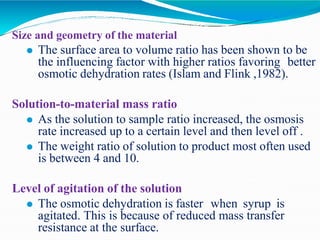
Size and geometry of the material
⚫ The surface area to volume ratio has been shown to be
the influencing factor with higher ratios favoring better
osmotic dehydration rates (Islam and Flink ,1982).
Solution-to-material mass ratio
⚫ As the solution to sample ratio increased, the osmosis
rate increased up to a certain level and then level off .
⚫ The weight ratio of solution to product most often used
is between 4 and 10.
Level of agitation of the solution
⚫ The osmotic dehydration is faster when syrup is
agitated. This is because of reduced mass transfer
resistance at the surface.
Enhancement of osmotic dehydration
Application of
⚫ Microwave during osmotic dehydration
⚫ Blanching as a pretreatment
⚫ High hydrostatic pressure as a pretreatment
Application of microwave during osmotic
dehydration
⚫Material absorbing microwave energy directly and
internally and converting it into heat.
⚫Moisture outflux effectiveness of the microwaves in
immersion mode is reduced due resistance of medium
itself for absorption of microwaves.
⚫The spray mode uses a thin layer of osmotic solution
that is continuously flushed down.
⚫This eliminates the problem of sample floating.
Application of blanching as a pretreatment
⚫ Hot water or steam blanching is a pretreatment
before osmotic dehydration with the purpose of
⚫Enzyme inactivation
⚫To promote gas removal from surfaces and
intercellular spaces
⚫Prevention of oxidation, discoloration, and off-
flavour development and microbial growth.
⚫ Water blanching (85–100 °C) usually results in loss
of nutrients such as minerals and vitamins (Akyol et
al., 2006).
Application of high hydrostatic pressure as a
pretreatment
⚫High-pressure treatments can be applied to liquid and
solid foods, with or without packaging, at pressures
between 100 and 800 MPa.
⚫High pressures cause permeabilization of the cell
structure leading to the enhancement of mass transfer
rates during osmotic dehydration.
⚫ High hydrostatic pressure with the combination of
mild heat treatment can be used for blanching
purposes in carrots, green beans, and green peas.
Advantages
⚫Quality improvement in terms of color, flavor and
texture
⚫Lower energy requirements
⚫Packaging and distribution cost reduction
⚫Retention of nutrients during storage
⚫This provides better retention of volatile flavours and
reduces tissue damage compared with conventional air
and sun drying processes.
Disadvantages
• The reduction in acidity level reduces the
characteristic taste of some products. This can
overcome by adding fruit acid in the solution.
• Sugar coating is not desirable in some products and
quick rinsing in water may be necessary after the
treatment.
• Osmotic dehydration with other combined processes
such as vacuum drying, air drying or blanching were
found expensive
• It is a time taking process

Osmotic Dehydration in Food Processing Sector

  • 1.
  • 2.
    CONTENTS  Introduction  Principle Factors affecting osmotic dehydration  Enhancement of osmotic dehydration  Advantages and disadvantages
  • 3.
    Introduction ⚫Osmotic dehydration isthe process of water removal by immersion of water containing cellular solid in a concentrated aqueous solution. ⚫Osmotic dehydration has been recognized as a good pre- treatment prior to regular drying. ⚫Osmotic dehydration has the potential to remove water at low temperatures. ⚫ It is an energy efficient method, as water does not go through a phase change.
  • 4.
     It givesrise to three types of simultaneous counter current flows- ⚫Water diffusion into the solution ⚫Solute diffusion into food ⚫Leaching out of the product's own solutes
  • 5.
    Why Osmotic Dehydration?? Dehydration Osmotic dehydration 1. Sensorial properties are affected. 2. Loss of flavor 3. Huge nutrients loss. 4. Chance of physical contamination 1. Sensorial properties are very good 2. Retention of fresh fruit flavors. 3. Retention of nutrients. 4. No chance of contamination Hence, for improved quality & Ready To Eat products osmotic dehydration is the best choice!!!
  • 6.
  • 7.
  • 8.
    OSMOSIS water or dilute solution concentrated solution membrane Morewater passes from dilute to concentrated ... ...until concentrations become equal level rises level falls
  • 9.
    Fig.1. Mass transportduring osmotic dehydration.
  • 10.
    Because there aremore freely moving water molecules on the left, more diffuse through the pores of the membrane from left to right than from right to left. membrane water sugar solution
  • 11.
    Fig.2. Typical osmoticdehydration system configuration
  • 12.
    Flow chart ofosmotic dehydration process Selection of raw material Washing Preparation of fruits Osmatic treatment Draining Pretreatment Packaging Dehydration of fruits slices Storage Peeling Labeling
  • 13.
    Factors affecting osmoticdehydration ⚫ Type of osmotic agent ⚫ Concentration of the osmotic solution ⚫ Time of treatment ⚫ Temperature of the osmotic solution ⚫ Size and geometry of the material ⚫ Solution-to-material mass ratio ⚫ Level of agitation of the solution
  • 14.
    Osmotic agent RemarkReferences Calcium chloride Increase firmness of apple pieces, preserve the texture during storage. Ponting et al. (1972) Lactose Has much lower level of sweetness than sucrose & Low solubility in aqueous solution. Hawkes and Flink (1978) Sodium chloride Retards oxidative and non enzymatic browning. Sometime bleaching effects on colored products. Khin et al. (2007) Singh et al. (2007) Sucrose Dry sugar is unsuitable due to oxidative browning. Difficulty in disposing the sugar syrup formed. Flink (1975) Mixture of sucrose and salt, ethanol and salt More effective than sucrose alone due to combination of properties of both the solutes. Lenart and Flink (1984a, b) Type of osmotic agent
  • 15.
    ⚫Concentration of theosmotic solution ⚫High concentrations of solution and long osmotic times increased the penetration depth of osmotic agents and decreased the moisture content of samples. ⚫Time of treatment ⚫The rate of both moisture loss and solids gain is the highest for first 2 hour followed by progressively lower rates for the rest of the time. ⚫Rapid loss of water in the beginning is due to the large osmotic driving force between the fresh fruit and the surrounding hypertonic solution.
  • 16.
    Temperature of theosmotic solution ⚫Higher process temperatures promote faster moisture loss through better mass transfer characteristics on the surface due to lower viscosity of the osmotic medium. ⚫However, above 45°C, enzymatic browning and flavour deterioration begins to take place. ⚫The best processing temperature depends on type of food: Example, for green beans, 20°C gives better results, while 40°C is too high a temperature.
  • 17.
    Size and geometryof the material ⚫ The surface area to volume ratio has been shown to be the influencing factor with higher ratios favoring better osmotic dehydration rates (Islam and Flink ,1982). Solution-to-material mass ratio ⚫ As the solution to sample ratio increased, the osmosis rate increased up to a certain level and then level off . ⚫ The weight ratio of solution to product most often used is between 4 and 10. Level of agitation of the solution ⚫ The osmotic dehydration is faster when syrup is agitated. This is because of reduced mass transfer resistance at the surface.
  • 18.
    Enhancement of osmoticdehydration Application of ⚫ Microwave during osmotic dehydration ⚫ Blanching as a pretreatment ⚫ High hydrostatic pressure as a pretreatment
  • 19.
    Application of microwaveduring osmotic dehydration ⚫Material absorbing microwave energy directly and internally and converting it into heat. ⚫Moisture outflux effectiveness of the microwaves in immersion mode is reduced due resistance of medium itself for absorption of microwaves. ⚫The spray mode uses a thin layer of osmotic solution that is continuously flushed down. ⚫This eliminates the problem of sample floating.
  • 20.
    Application of blanchingas a pretreatment ⚫ Hot water or steam blanching is a pretreatment before osmotic dehydration with the purpose of ⚫Enzyme inactivation ⚫To promote gas removal from surfaces and intercellular spaces ⚫Prevention of oxidation, discoloration, and off- flavour development and microbial growth. ⚫ Water blanching (85–100 °C) usually results in loss of nutrients such as minerals and vitamins (Akyol et al., 2006).
  • 21.
    Application of highhydrostatic pressure as a pretreatment ⚫High-pressure treatments can be applied to liquid and solid foods, with or without packaging, at pressures between 100 and 800 MPa. ⚫High pressures cause permeabilization of the cell structure leading to the enhancement of mass transfer rates during osmotic dehydration. ⚫ High hydrostatic pressure with the combination of mild heat treatment can be used for blanching purposes in carrots, green beans, and green peas.
  • 22.
    Advantages ⚫Quality improvement interms of color, flavor and texture ⚫Lower energy requirements ⚫Packaging and distribution cost reduction ⚫Retention of nutrients during storage ⚫This provides better retention of volatile flavours and reduces tissue damage compared with conventional air and sun drying processes.
  • 23.
    Disadvantages • The reductionin acidity level reduces the characteristic taste of some products. This can overcome by adding fruit acid in the solution. • Sugar coating is not desirable in some products and quick rinsing in water may be necessary after the treatment. • Osmotic dehydration with other combined processes such as vacuum drying, air drying or blanching were found expensive • It is a time taking process