Dr. Vithalrao Vikhe Patil Foundation, Ahmednagar
Medical College and Hospital
Dr. Mhaske Sunil Natha
M.B.B.S., M.D. (Paediatrics), M.B.A. (Hospital Administration), M. A. (Public
Administration), PhD Scholar (Paediatrics)
Dean and Professor (Paediatrics)
Dr. Vithalrao Vikhe Patil Foundation’s Medical College and Hospital, Ahmednagar
Cleft Lip and Cleft Palate in Children
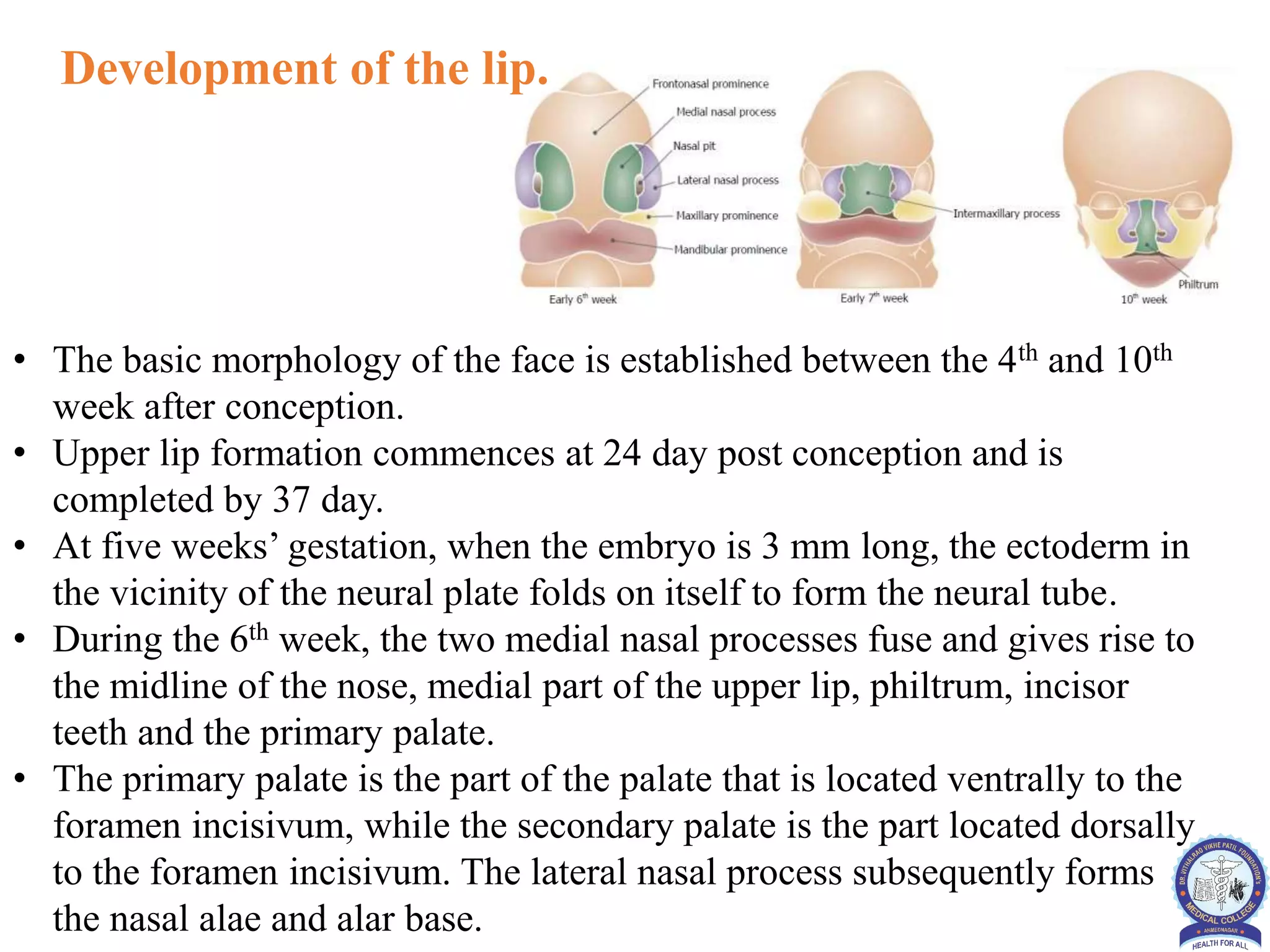
• Cleft lip and cleft palate are among the most common birth defects.
• They most commonly occur as isolated birth defects but are also
associated with many inherited genetic conditions or syndromes.
• The condition was formerly known as a "hare-lip" because of its
resemblance to a hare or rabbit, but that term is now generally
considered to be offensive.
• Also known as “orofacial clefts.”
• Worldwide, less than one child in 3000 has a cleft lip alone, and
one child in every 1500 has a cleft lip and palate.
• There is no national register of birth defects.
• Cleft lip and palate occurs in about 1 to 2 per 1000 births in the
developed world.
• One in 700 hundred children are born with clefts in India.
• India has more than 72,000 children and adults with unrepaired
cleft lip or cleft palate.
Development of the lip.
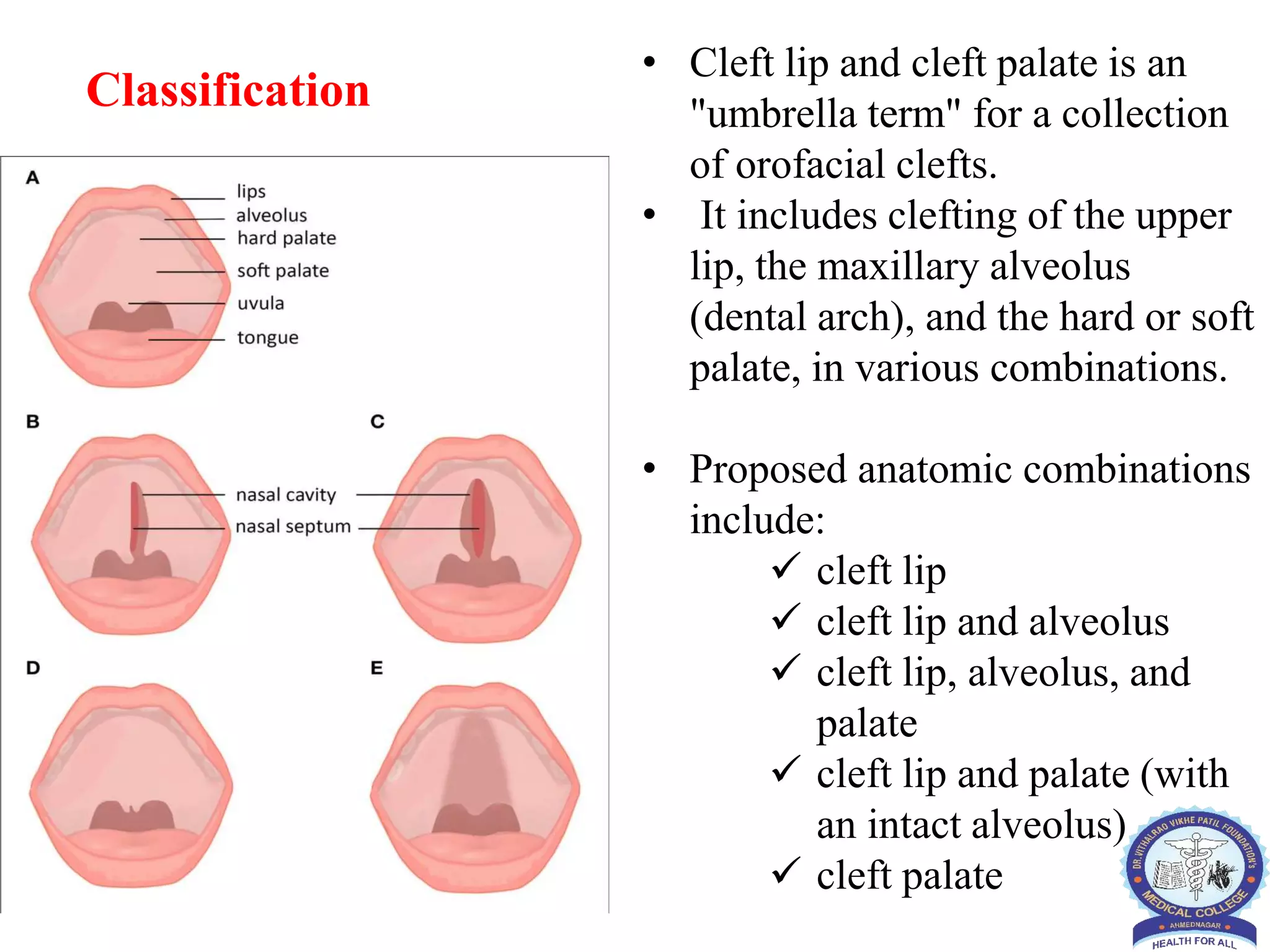
• The basic morphology of the face is established between the 4th and 10th
week after conception.
• Upper lip formation commences at 24 day post conception and is
completed by 37 day.
• At five weeks’ gestation, when the embryo is 3 mm long, the ectoderm in
the vicinity of the neural plate folds on itself to form the neural tube.
• During the 6th week, the two medial nasal processes fuse and gives rise to
the midline of the nose, medial part of the upper lip, philtrum, incisor
teeth and the primary palate.
• The primary palate is the part of the palate that is located ventrally to the
foramen incisivum, while the secondary palate is the part located dorsally
to the foramen incisivum. The lateral nasal process subsequently forms
the nasal alae and alar base.
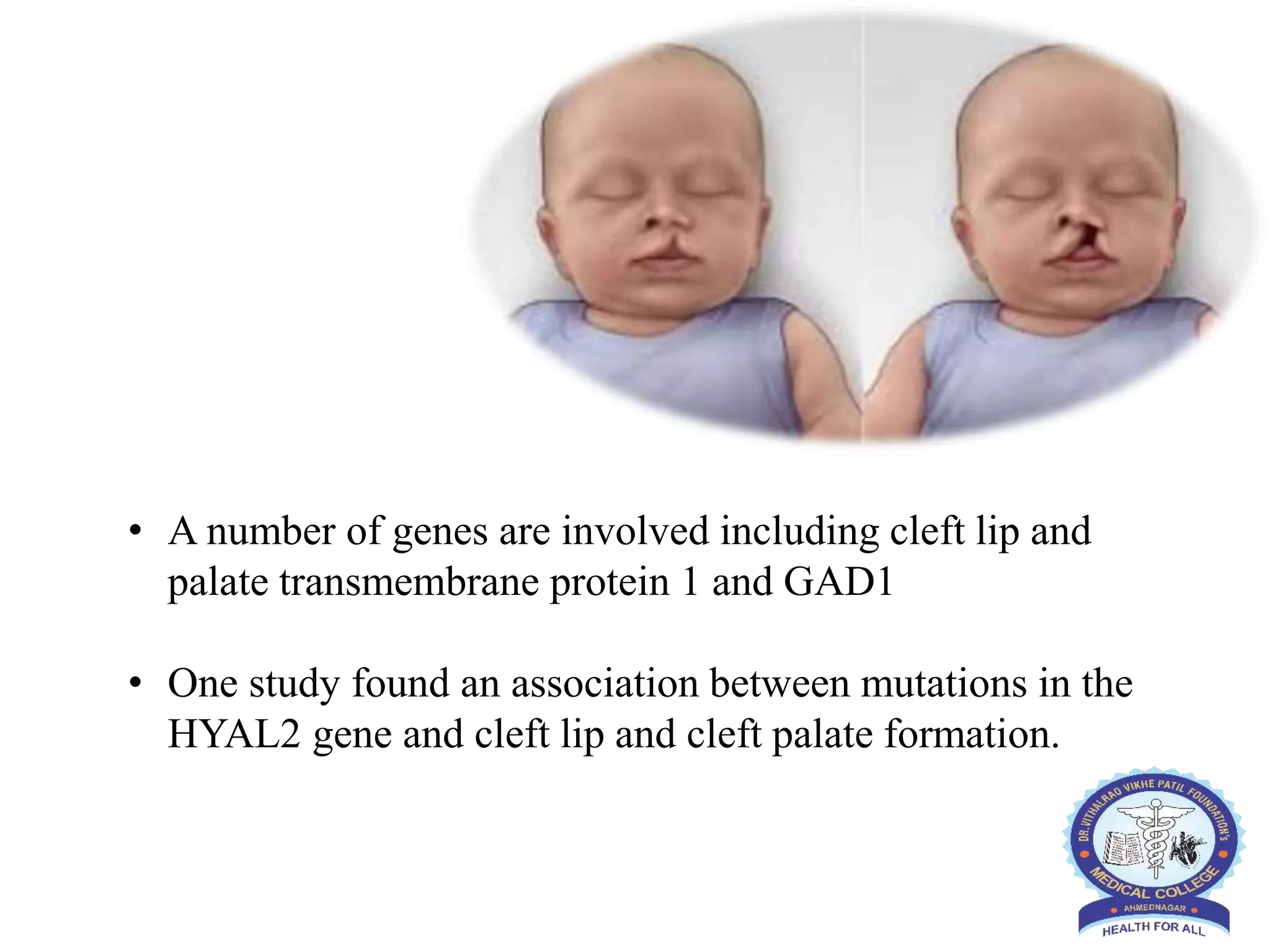
• A cleft lip happens if the tissue that makes up the lip does not join
completely before birth.
• Cleft lip and cleft palate are birth defects that occur when a baby’s
lip or mouth do not form properly during pregnancy. Together, these
birth defects commonly are called “orofacial clefts”.
• There is a physical separation of the two sides of the upper lip.
• It appears as a narrow or wide opening or gap in all layers of the
upper lip.
• This separation can include the gum line or the palate.
• Children with a cleft lip also can have a cleft palate.
Cleft Lip
• A cleft lip can be on one or both sides of the
lip or in the middle of the lip, which occurs
very rarely.
Cleft Palate
• The roof of the mouth (palate) is
formed between the sixth and ninth
weeks of pregnancy.
• A cleft palate happens if the tissue
that makes up the roof of the mouth
does not join together completely
during pregnancy.
• That means a split or opening in the
roof of the mouth.
• A cleft palate can involve the hard
palate (the bony front portion of the
roof of the mouth) and/or the soft
palate (the soft back portion of the
roof of the mouth), and can be
associated with a cleft lip.
Submucous Cleft Palate-
• Less commonly, a cleft occurs only in the muscles of the soft
palate -submucous cleft palate.
• At the back of the mouth and covered by the mouth's lining.
• This type of cleft often goes unnoticed at birth and may not be
diagnosed until later when signs develop.
• Signs and symptoms of submucous cleft palate may include:
 Difficulty with feedings
 Difficulty swallowing.
 Liquids or foods to come out the nose
 Nasal speaking voice
 Chronic ear infections
• Cleft lip and cleft palate is an
"umbrella term" for a collection
of orofacial clefts.
• It includes clefting of the upper
lip, the maxillary alveolus
(dental arch), and the hard or soft
palate, in various combinations.
• Proposed anatomic combinations
include:
 cleft lip
 cleft lip and alveolus
 cleft lip, alveolus, and
palate
 cleft lip and palate (with
an intact alveolus)
 cleft palate
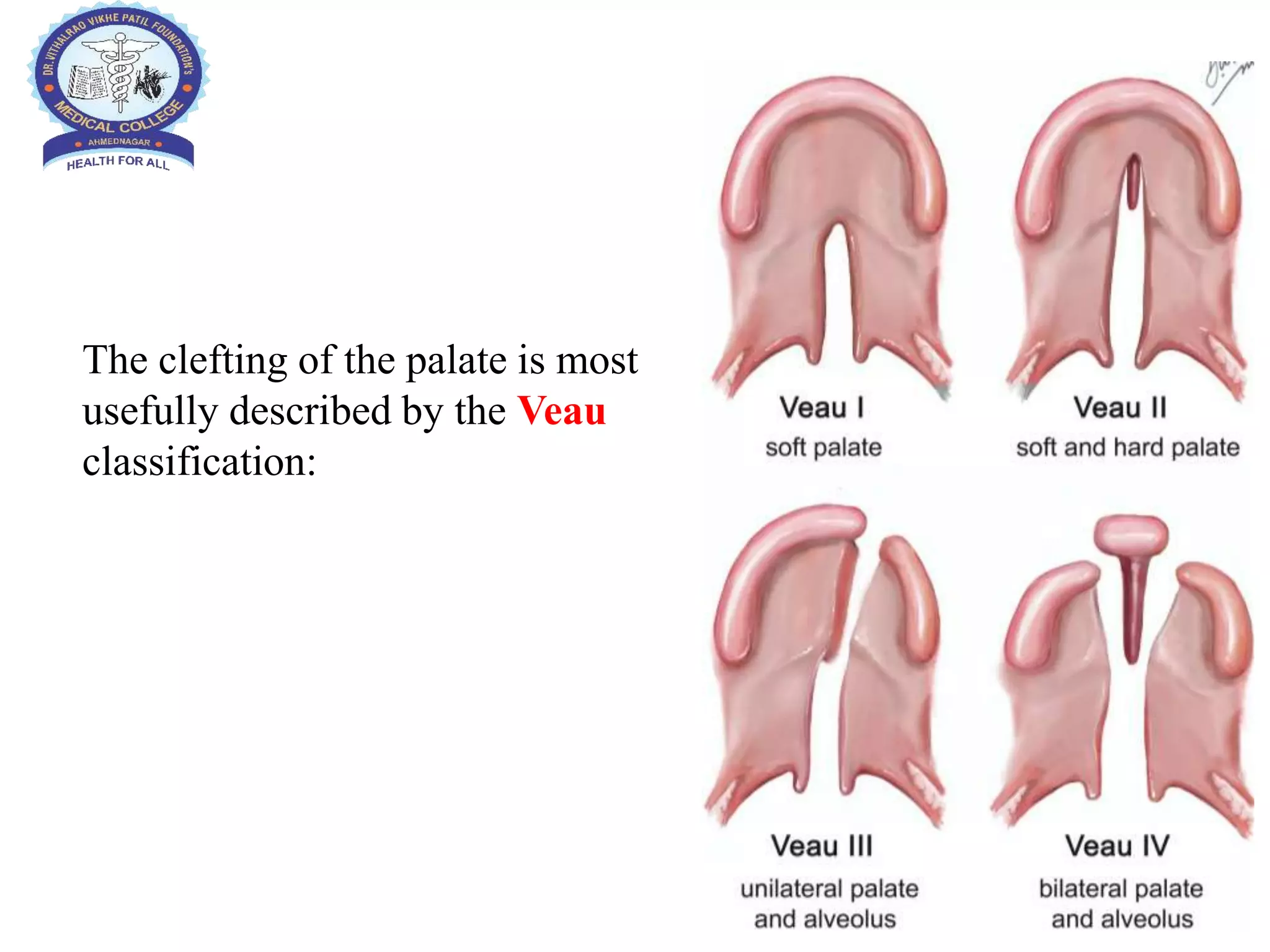
Classification
The clefting of the palate is most
usefully described by the Veau
classification:
Risk factors
• Parents with a family history of cleft lip or cleft palate a higher risk.
• Pregnant women who drink alcohol.
• Women who smoke during pregnancy.
• Women with diabetes diagnosed before pregnancy.
• Being obese during pregnancy.
• Use of certain medicines―Women who used medicines to treat
epilepsy, such as topiramate or valproic acid, during the first
trimester (the first 3 months) of pregnancy also for acne treatment
medications containing Accutane®, or methotrexate.
• Vitamin deficiency (folic acid)
• Substance abuse
• Males are more likely to have a cleft lip with or without cleft palate.
• Cleft palate without cleft lip is more common in females.
• A number of genes are involved including cleft lip and
palate transmembrane protein 1 and GAD1
• One study found an association between mutations in the
HYAL2 gene and cleft lip and cleft palate formation.
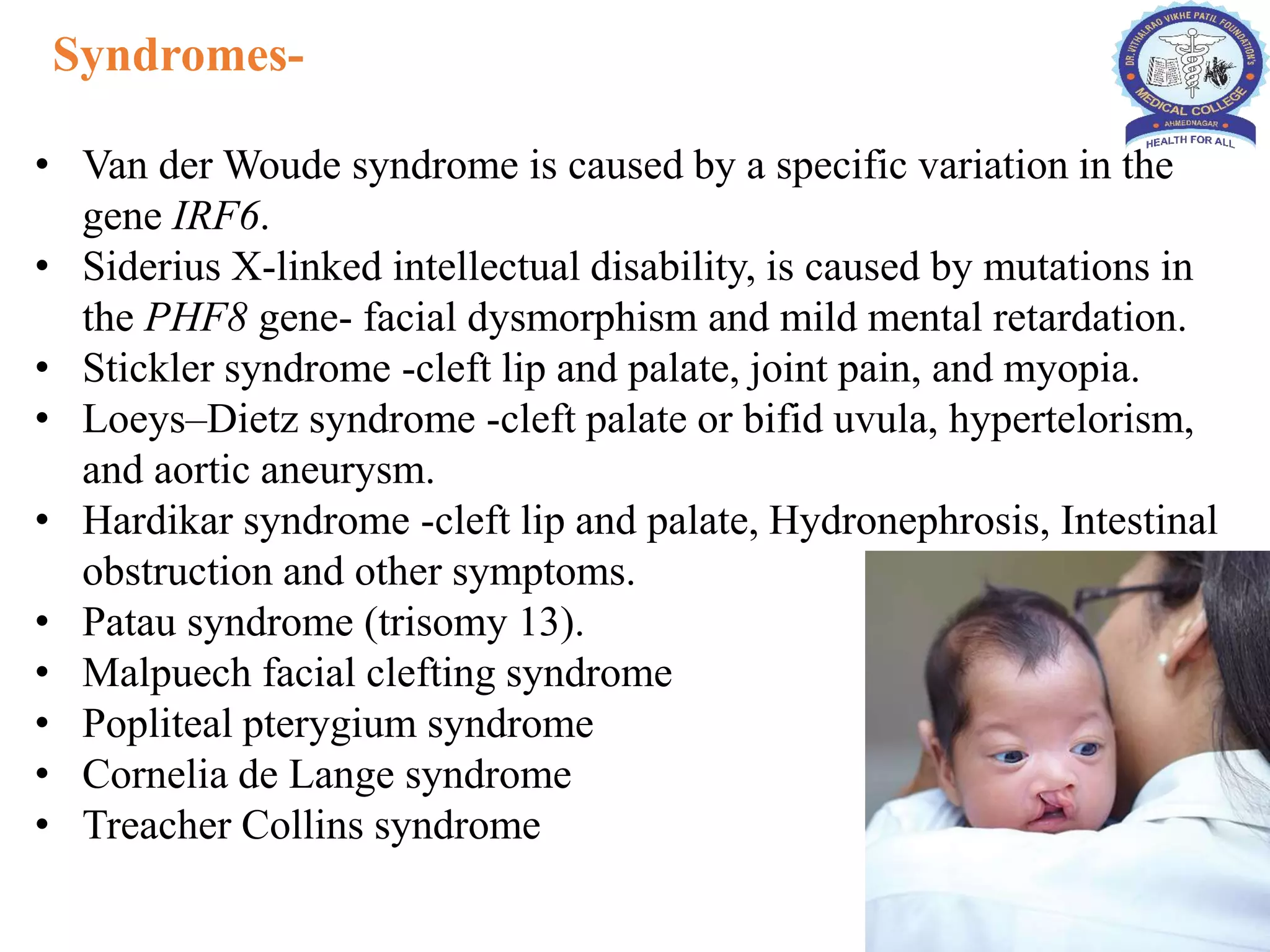
• Van der Woude syndrome is caused by a specific variation in the
gene IRF6.
• Siderius X-linked intellectual disability, is caused by mutations in
the PHF8 gene- facial dysmorphism and mild mental retardation.
• Stickler syndrome -cleft lip and palate, joint pain, and myopia.
• Loeys–Dietz syndrome -cleft palate or bifid uvula, hypertelorism,
and aortic aneurysm.
• Hardikar syndrome -cleft lip and palate, Hydronephrosis, Intestinal
obstruction and other symptoms.
• Patau syndrome (trisomy 13).
• Malpuech facial clefting syndrome
• Popliteal pterygium syndrome
• Cornelia de Lange syndrome
• Treacher Collins syndrome
Syndromes-
• The chance of having more than one child with a cleft lip and/or
cleft palate is different for each family.
• In general, if there is one affected person in the family with a
cleft, the likelihood of having a child with a cleft lip and/or palate
is 2 to 5 percent.
• If there is a second affected person in the family (either another
sibling or a parent), the chance of future children having a cleft lip
increases to 10 to 14 percent, and the risk of a future child having
an isolated cleft palate rises to 8 percent.
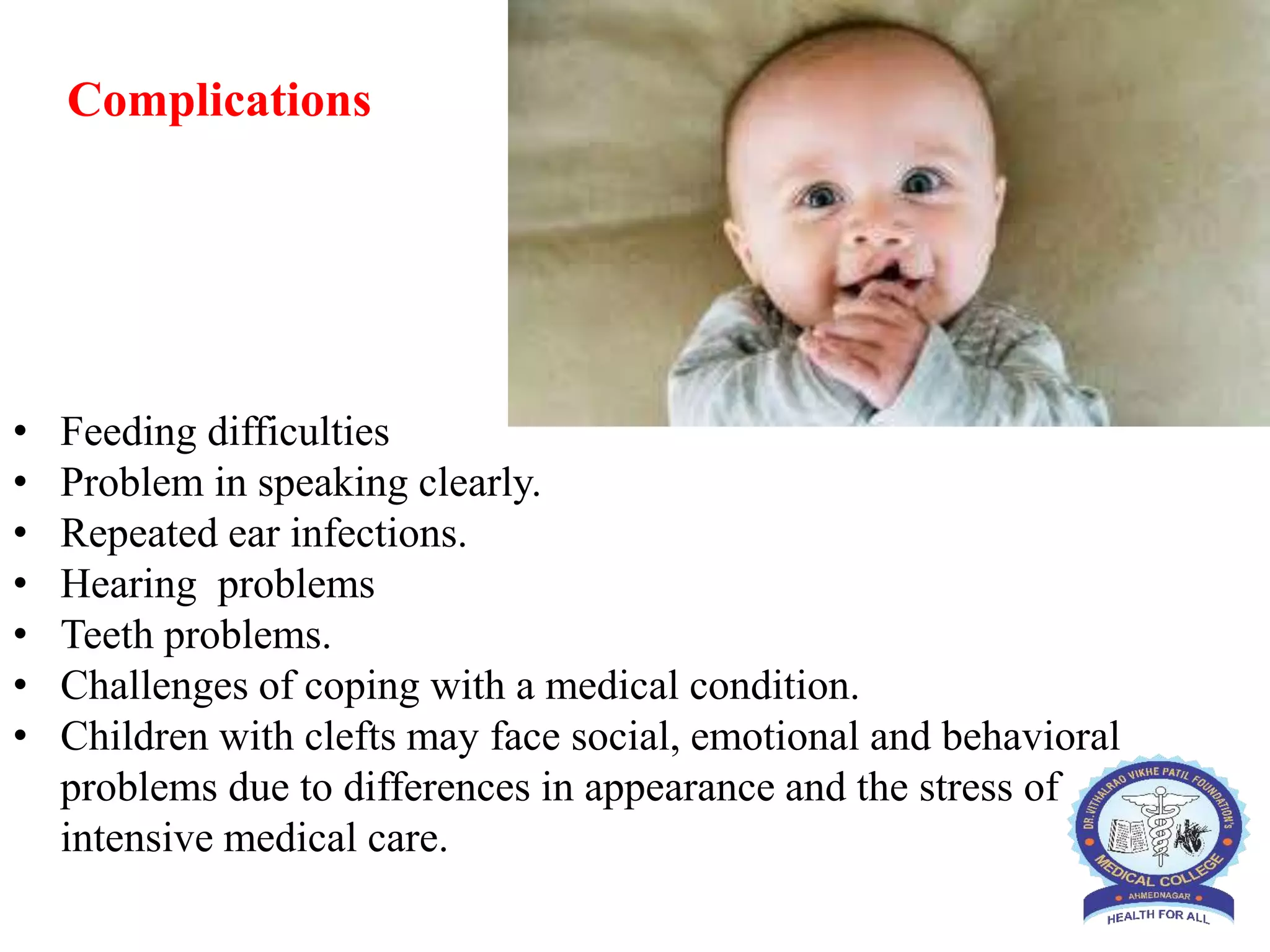
• Feeding difficulties
• Problem in speaking clearly.
• Repeated ear infections.
• Hearing problems
• Teeth problems.
• Challenges of coping with a medical condition.
• Children with clefts may face social, emotional and behavioral
problems due to differences in appearance and the stress of
intensive medical care.
Complications
Diagnosis
Cleft lip may be detected with ultrasound beginning around the 13th week of pregnancy.
Management
• The first documented cleft lip surgery was in China around 390 BC on 18
year old Wey Young-Chi, who would later become a soldier.
• Treatment usually begins in infancy and often continues through early
adulthood.
• Treatment can vary depending on the severity of the cleft; the child’s age
and needs; and the presence of associated syndromes or other birth defects,
or both.
• Surgery to repair a cleft lip usually occurs in the first few months of life
and is recommended within the first 12 months of life.
• Surgery to repair a cleft palate is recommended within the first 18 months
of life or earlier if possible.
• Many children will need additional surgical procedures as they get older.
• Surgical repair can improve the look and appearance of a child’s face and
might also improve breathing, hearing, and speech and language
development.
• Children born with orofacial clefts might need other types of
treatments and services, such as special dental or orthodontic care
or speech therapy.
• With treatment, most children with orofacial clefts do well and lead
a healthy life.
• Some children with orofacial clefts may have issues with self-
esteem if they are concerned with visible differences between
themselves and other children.
• Parent-to-parent support groups can prove to be useful for families
of babies with birth defects of the head and face, such as orofacial
clefts.
• Within the first 2–3 months after birth, surgery is performed to
close the cleft lip.
• While surgery to repair a cleft lip can be performed soon after
birth,
• “Rule of 10s“- coined by surgeons Wilhelmmesen and Musgrave
in 1969-
- the child is at least 10 weeks of age;
- weighs at least 10 pounds,
- least 10g hemoglobin
Cleft lip Repair -
• The goal of cleft lip surgery is to restore normal appearance and function
to the upper lip.
• Cleft lip surgery is usually recommended at three to four months of life.
• In most cases, the tissue in the area around the cleft is rearranged to close
the opening.
• An important part of the surgery involves detaching and repositioning the
muscle of the lip to recreate the circular muscle around the mouth.
• The cleft lip can be repaired in a single step or in two procedures,
depending on factors such as the width and extent of the cleft.
• The surgeon may try to provide some additional support for the nose.
• Reconstruction of the nose is usually accomplished at the time of cleft lip
repair.
Cleft palate repair
Surgical techniques for cleft lip and palate are continuously evolving.
There are many variations of each of these techniques-von Langenbeck's bipedicle
flap technique.
 Veau-Wardill-Kilner Pushback technique
 Bardach's two-flap technique
 Furlow Double opposing Z-Plasty
 Two-stage palatal repair
 Hole in one repair
 Raw area free palatoplasty
 Alveolar extension palatoplasty (AEP)
 Primary pharyngeal flap
 Intravelar veloplasty
 Vomer flap
 Buccal myomucosal flap
Feeding
Nasoalveolar Moulding plate
• There is still a stigma associated
with cleft lip and palate.
• The history of the cleft lip is based
on a combination of religion,
superstition and charlatanism,
according to the Indian Journal of
Plastic Surgery.
• Spartans and Romans would kill
these children as they were
considered to harbor evil spirits.
• Today in developing countries such
as Uganda, a child who is born with
a cleft lip or palate is named ‘Ajok’
which means ‘Cursed by God,”
according to Smile Train.
False beliefs/Superstitions- .
• Mother walking in the hot sun or late
at night, or having eaten rabbit meat
while pregnant, are some of the
beliefs.
• Some believe a solar eclipse, or an
inauspicious day like that of a new
moon, can cause a baby to be born
with a cleft.
• A cleft could be the result of crossing
an axe forgotten on the ground,
crushing a pumpkin during
pregnancy, or tearing a yam or some
other leaves during pregnancy.
• David Baron, author of “American Eclipse,” says that there was a time
in the 1970s that the Indonesian government advised pregnant women
to stay indoors during a solar eclipse. (That’s no longer the case.)
• Dr. Shafia Bhutto, an obstetrician-gynecologist at Mercy Hospital in
St. Louis, says expectant women in Pakistan might be told Bhutto
remembers a woman from many years ago who was distraught
throughout her pregnancy because she accidentally looked at a lunar
eclipse. That woman’s baby was born with a cleft palate that was never
picked up in the ultrasounds.
Oscar award-winning documentary.
https://www.youtube.com/watch?v=m6yge_MqLF0
"Smile Pinki"
Cleft care
Website: www.cleftcare.in
Cleft care provides treatment of cleft lip and palate from childhood to adolescence as
well as high quality, holistic management and support. They also organise
sensitisation programs.
Email: chennaicleftcenter@gmail.com, Contact: +91 98410 39820, +91 92832 22957
Indian Society of Cleft Lip Palate and Craniofacial Anomalies
Website: www.isclpca.org
Indian Society of Cleft-lip Palate and Craniofacial Anomalies provides medical care
and awareness about cleft lip, palate and craniofacial anomalies.
Email: drmustafaisxlpca@gmail.com, Contact: +91 98450 82220, +91 824 252 4304
Smile train
Website: www.smiletrainindia.org
The Smile train provides free treatment centres for children affected with cleft lip and
palate. They have tie-ups with local hospitals across India.
Email: info@smiletrainindia.org, Contact: +91 11 2601 3648
NGO’s
Cleft lip and cleft palate in children

Cleft lip and cleft palate in children

  • 1.
    Dr. Vithalrao VikhePatil Foundation, Ahmednagar Medical College and Hospital Dr. Mhaske Sunil Natha M.B.B.S., M.D. (Paediatrics), M.B.A. (Hospital Administration), M. A. (Public Administration), PhD Scholar (Paediatrics) Dean and Professor (Paediatrics) Dr. Vithalrao Vikhe Patil Foundation’s Medical College and Hospital, Ahmednagar Cleft Lip and Cleft Palate in Children
  • 2.
    • Cleft lipand cleft palate are among the most common birth defects. • They most commonly occur as isolated birth defects but are also associated with many inherited genetic conditions or syndromes. • The condition was formerly known as a "hare-lip" because of its resemblance to a hare or rabbit, but that term is now generally considered to be offensive. • Also known as “orofacial clefts.”
  • 3.
    • Worldwide, lessthan one child in 3000 has a cleft lip alone, and one child in every 1500 has a cleft lip and palate. • There is no national register of birth defects. • Cleft lip and palate occurs in about 1 to 2 per 1000 births in the developed world. • One in 700 hundred children are born with clefts in India. • India has more than 72,000 children and adults with unrepaired cleft lip or cleft palate.
  • 4.
    Development of thelip. • The basic morphology of the face is established between the 4th and 10th week after conception. • Upper lip formation commences at 24 day post conception and is completed by 37 day. • At five weeks’ gestation, when the embryo is 3 mm long, the ectoderm in the vicinity of the neural plate folds on itself to form the neural tube. • During the 6th week, the two medial nasal processes fuse and gives rise to the midline of the nose, medial part of the upper lip, philtrum, incisor teeth and the primary palate. • The primary palate is the part of the palate that is located ventrally to the foramen incisivum, while the secondary palate is the part located dorsally to the foramen incisivum. The lateral nasal process subsequently forms the nasal alae and alar base.
  • 5.
    • A cleftlip happens if the tissue that makes up the lip does not join completely before birth. • Cleft lip and cleft palate are birth defects that occur when a baby’s lip or mouth do not form properly during pregnancy. Together, these birth defects commonly are called “orofacial clefts”. • There is a physical separation of the two sides of the upper lip. • It appears as a narrow or wide opening or gap in all layers of the upper lip. • This separation can include the gum line or the palate. • Children with a cleft lip also can have a cleft palate. Cleft Lip
  • 6.
    • A cleftlip can be on one or both sides of the lip or in the middle of the lip, which occurs very rarely.
  • 7.
    Cleft Palate • Theroof of the mouth (palate) is formed between the sixth and ninth weeks of pregnancy. • A cleft palate happens if the tissue that makes up the roof of the mouth does not join together completely during pregnancy. • That means a split or opening in the roof of the mouth. • A cleft palate can involve the hard palate (the bony front portion of the roof of the mouth) and/or the soft palate (the soft back portion of the roof of the mouth), and can be associated with a cleft lip.
  • 9.
    Submucous Cleft Palate- •Less commonly, a cleft occurs only in the muscles of the soft palate -submucous cleft palate. • At the back of the mouth and covered by the mouth's lining. • This type of cleft often goes unnoticed at birth and may not be diagnosed until later when signs develop. • Signs and symptoms of submucous cleft palate may include:  Difficulty with feedings  Difficulty swallowing.  Liquids or foods to come out the nose  Nasal speaking voice  Chronic ear infections
  • 12.
    • Cleft lipand cleft palate is an "umbrella term" for a collection of orofacial clefts. • It includes clefting of the upper lip, the maxillary alveolus (dental arch), and the hard or soft palate, in various combinations. • Proposed anatomic combinations include:  cleft lip  cleft lip and alveolus  cleft lip, alveolus, and palate  cleft lip and palate (with an intact alveolus)  cleft palate Classification
  • 13.
    The clefting ofthe palate is most usefully described by the Veau classification:
  • 15.
    Risk factors • Parentswith a family history of cleft lip or cleft palate a higher risk. • Pregnant women who drink alcohol. • Women who smoke during pregnancy. • Women with diabetes diagnosed before pregnancy. • Being obese during pregnancy. • Use of certain medicines―Women who used medicines to treat epilepsy, such as topiramate or valproic acid, during the first trimester (the first 3 months) of pregnancy also for acne treatment medications containing Accutane®, or methotrexate. • Vitamin deficiency (folic acid) • Substance abuse • Males are more likely to have a cleft lip with or without cleft palate. • Cleft palate without cleft lip is more common in females.
  • 16.
    • A numberof genes are involved including cleft lip and palate transmembrane protein 1 and GAD1 • One study found an association between mutations in the HYAL2 gene and cleft lip and cleft palate formation.
  • 17.
    • Van derWoude syndrome is caused by a specific variation in the gene IRF6. • Siderius X-linked intellectual disability, is caused by mutations in the PHF8 gene- facial dysmorphism and mild mental retardation. • Stickler syndrome -cleft lip and palate, joint pain, and myopia. • Loeys–Dietz syndrome -cleft palate or bifid uvula, hypertelorism, and aortic aneurysm. • Hardikar syndrome -cleft lip and palate, Hydronephrosis, Intestinal obstruction and other symptoms. • Patau syndrome (trisomy 13). • Malpuech facial clefting syndrome • Popliteal pterygium syndrome • Cornelia de Lange syndrome • Treacher Collins syndrome Syndromes-
  • 18.
    • The chanceof having more than one child with a cleft lip and/or cleft palate is different for each family. • In general, if there is one affected person in the family with a cleft, the likelihood of having a child with a cleft lip and/or palate is 2 to 5 percent. • If there is a second affected person in the family (either another sibling or a parent), the chance of future children having a cleft lip increases to 10 to 14 percent, and the risk of a future child having an isolated cleft palate rises to 8 percent.
  • 19.
    • Feeding difficulties •Problem in speaking clearly. • Repeated ear infections. • Hearing problems • Teeth problems. • Challenges of coping with a medical condition. • Children with clefts may face social, emotional and behavioral problems due to differences in appearance and the stress of intensive medical care. Complications
  • 20.
    Diagnosis Cleft lip maybe detected with ultrasound beginning around the 13th week of pregnancy.
  • 21.
    Management • The firstdocumented cleft lip surgery was in China around 390 BC on 18 year old Wey Young-Chi, who would later become a soldier. • Treatment usually begins in infancy and often continues through early adulthood. • Treatment can vary depending on the severity of the cleft; the child’s age and needs; and the presence of associated syndromes or other birth defects, or both. • Surgery to repair a cleft lip usually occurs in the first few months of life and is recommended within the first 12 months of life. • Surgery to repair a cleft palate is recommended within the first 18 months of life or earlier if possible. • Many children will need additional surgical procedures as they get older. • Surgical repair can improve the look and appearance of a child’s face and might also improve breathing, hearing, and speech and language development.
  • 22.
    • Children bornwith orofacial clefts might need other types of treatments and services, such as special dental or orthodontic care or speech therapy. • With treatment, most children with orofacial clefts do well and lead a healthy life. • Some children with orofacial clefts may have issues with self- esteem if they are concerned with visible differences between themselves and other children. • Parent-to-parent support groups can prove to be useful for families of babies with birth defects of the head and face, such as orofacial clefts.
  • 24.
    • Within thefirst 2–3 months after birth, surgery is performed to close the cleft lip. • While surgery to repair a cleft lip can be performed soon after birth, • “Rule of 10s“- coined by surgeons Wilhelmmesen and Musgrave in 1969- - the child is at least 10 weeks of age; - weighs at least 10 pounds, - least 10g hemoglobin Cleft lip Repair -
  • 25.
    • The goalof cleft lip surgery is to restore normal appearance and function to the upper lip. • Cleft lip surgery is usually recommended at three to four months of life. • In most cases, the tissue in the area around the cleft is rearranged to close the opening. • An important part of the surgery involves detaching and repositioning the muscle of the lip to recreate the circular muscle around the mouth. • The cleft lip can be repaired in a single step or in two procedures, depending on factors such as the width and extent of the cleft. • The surgeon may try to provide some additional support for the nose. • Reconstruction of the nose is usually accomplished at the time of cleft lip repair.
  • 26.
    Cleft palate repair Surgicaltechniques for cleft lip and palate are continuously evolving. There are many variations of each of these techniques-von Langenbeck's bipedicle flap technique.  Veau-Wardill-Kilner Pushback technique  Bardach's two-flap technique  Furlow Double opposing Z-Plasty  Two-stage palatal repair  Hole in one repair  Raw area free palatoplasty  Alveolar extension palatoplasty (AEP)  Primary pharyngeal flap  Intravelar veloplasty  Vomer flap  Buccal myomucosal flap
  • 27.
  • 28.
    • There isstill a stigma associated with cleft lip and palate. • The history of the cleft lip is based on a combination of religion, superstition and charlatanism, according to the Indian Journal of Plastic Surgery. • Spartans and Romans would kill these children as they were considered to harbor evil spirits. • Today in developing countries such as Uganda, a child who is born with a cleft lip or palate is named ‘Ajok’ which means ‘Cursed by God,” according to Smile Train. False beliefs/Superstitions- .
  • 29.
    • Mother walkingin the hot sun or late at night, or having eaten rabbit meat while pregnant, are some of the beliefs. • Some believe a solar eclipse, or an inauspicious day like that of a new moon, can cause a baby to be born with a cleft. • A cleft could be the result of crossing an axe forgotten on the ground, crushing a pumpkin during pregnancy, or tearing a yam or some other leaves during pregnancy.
  • 30.
    • David Baron,author of “American Eclipse,” says that there was a time in the 1970s that the Indonesian government advised pregnant women to stay indoors during a solar eclipse. (That’s no longer the case.) • Dr. Shafia Bhutto, an obstetrician-gynecologist at Mercy Hospital in St. Louis, says expectant women in Pakistan might be told Bhutto remembers a woman from many years ago who was distraught throughout her pregnancy because she accidentally looked at a lunar eclipse. That woman’s baby was born with a cleft palate that was never picked up in the ultrasounds.
  • 32.
  • 34.
    Cleft care Website: www.cleftcare.in Cleftcare provides treatment of cleft lip and palate from childhood to adolescence as well as high quality, holistic management and support. They also organise sensitisation programs. Email: chennaicleftcenter@gmail.com, Contact: +91 98410 39820, +91 92832 22957 Indian Society of Cleft Lip Palate and Craniofacial Anomalies Website: www.isclpca.org Indian Society of Cleft-lip Palate and Craniofacial Anomalies provides medical care and awareness about cleft lip, palate and craniofacial anomalies. Email: drmustafaisxlpca@gmail.com, Contact: +91 98450 82220, +91 824 252 4304 Smile train Website: www.smiletrainindia.org The Smile train provides free treatment centres for children affected with cleft lip and palate. They have tie-ups with local hospitals across India. Email: info@smiletrainindia.org, Contact: +91 11 2601 3648 NGO’s