Lecture 5. Gas Exchange

• cellular respiration, oxidative processes within
  cells

• external respiration, exchange of O2 and CO2
  between the organism and its environment
Gas Exchange Surfaces
•
    for diffusion to be effective, gas-exchange
    regions must be:
    –
        moist
    –
        thin
    –
        relatively large
•
    effectiveness of diffusion is enhanced by
    vascularization
Respiratory Organs
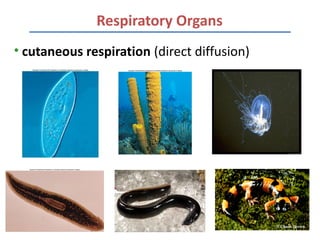
• cutaneous respiration (direct diffusion)
Respiratory Organs
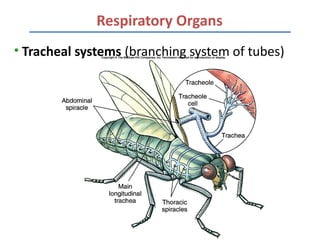
• Tracheal systems (branching system of tubes)
Respiratory Organs
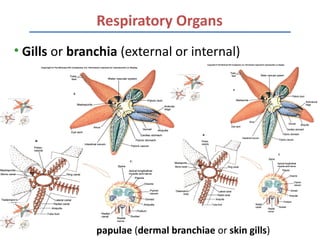
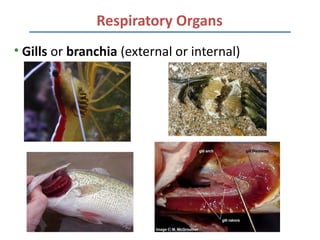
• Gills or branchia (external or internal)


               papulae (dermal branchiae or skin gills)
Respiratory Organs
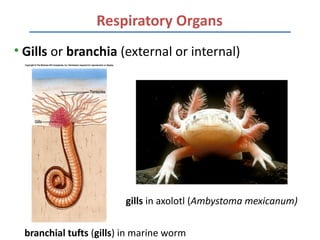
• Gills or branchia (external or internal)


                        gills in axolotl (Ambystoma mexicanum)


 branchial tufts (gills) in marine worm
Respiratory Organs
• Gills or branchia (external or internal)


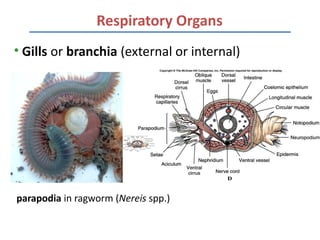
parapodia in ragworm (Nereis spp.)
Respiratory Organs
• Gills or branchia (external or internal)
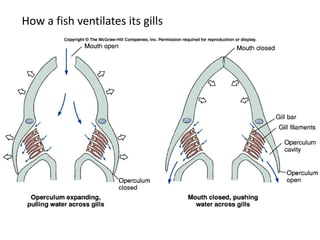
How a fish ventilates its gills
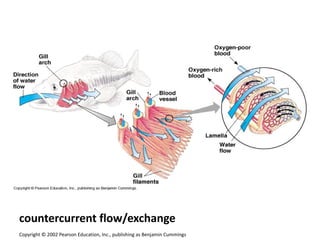
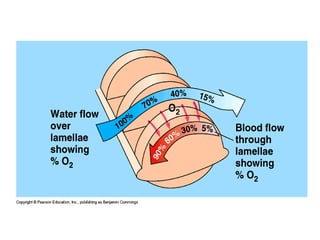
countercurrent flow/exchange
Copyright © 2002 Pearson Education, Inc., publishing as Benjamin Cummings
Respiratory Organs
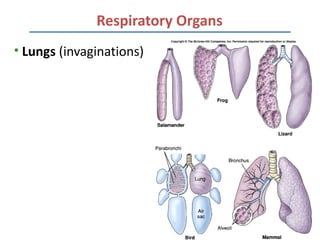
• Lungs (invaginations)
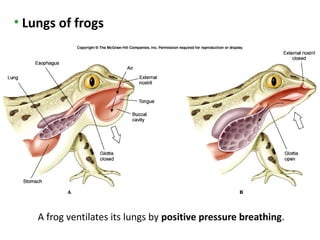
• Lungs of frogs


    A frog ventilates its lungs by positive pressure breathing.
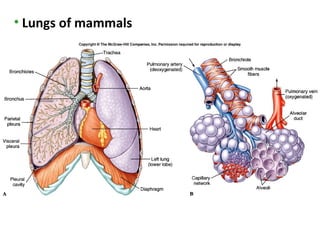
• Lungs of mammals
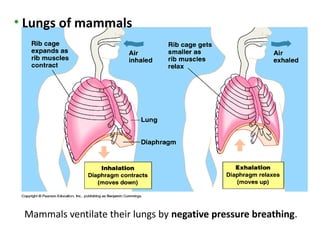
• Lungs of mammals


 Mammals ventilate their lungs by negative pressure breathing.
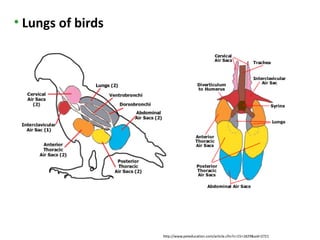
• Lungs of birds


                   http://www.peteducation.com/article.cfm?c=15+1829&aid=2721
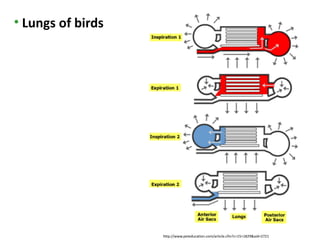
• Lungs of birds


                   http://www.peteducation.com/article.cfm?c=15+1829&aid=2721
•
    the volume of air an animal inhales and exhales
    with each breath is called tidal volume
    –
        it averages about 500 mL in resting humans


•
    the maximum tidal volume during forced
    breathing is the vital capacity
    –
        about 3.4 L and 4.8 L for college-age females and
        males, respectively
•
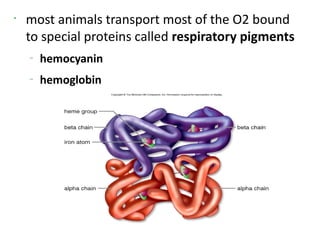
    most animals transport most of the O2 bound
    to special proteins called respiratory pigments
    –
        hemocyanin
    –
        hemoglobin
•
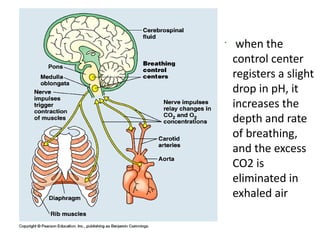
     when the
    control center
    registers a slight
    drop in pH, it
    increases the
    depth and rate
    of breathing,
    and the excess
    CO2 is
    eliminated in
    exhaled air
•
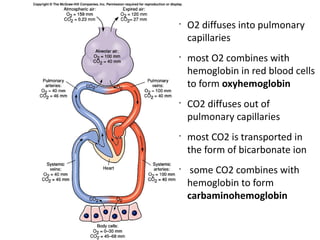
    O2 diffuses into pulmonary
    capillaries
•
    most O2 combines with
    hemoglobin in red blood cells
    to form oxyhemoglobin
•
    CO2 diffuses out of
    pulmonary capillaries
•
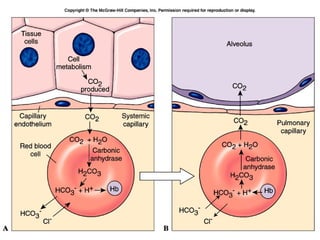
    most CO2 is transported in
    the form of bicarbonate ion
•
     some CO2 combines with
    hemoglobin to form
    carbaminohemoglobin
Fig. 31.27
•
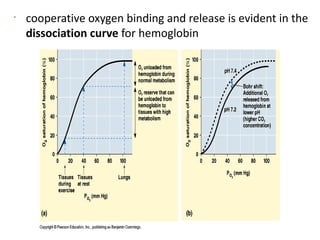
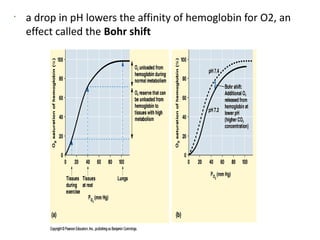
    cooperative oxygen binding and release is evident in the
    dissociation curve for hemoglobin
•
    a drop in pH lowers the affinity of hemoglobin for O2, an
    effect called the Bohr shift

Lecture 5 gas exchange

  • 1.
    Lecture 5. GasExchange • cellular respiration, oxidative processes within cells • external respiration, exchange of O2 and CO2 between the organism and its environment
  • 2.
    Gas Exchange Surfaces • for diffusion to be effective, gas-exchange regions must be: – moist – thin – relatively large • effectiveness of diffusion is enhanced by vascularization
  • 3.
    Respiratory Organs • cutaneousrespiration (direct diffusion)
  • 4.
    Respiratory Organs • Trachealsystems (branching system of tubes)
  • 5.
    Respiratory Organs • Gillsor branchia (external or internal) papulae (dermal branchiae or skin gills)
  • 6.
    Respiratory Organs • Gillsor branchia (external or internal) gills in axolotl (Ambystoma mexicanum) branchial tufts (gills) in marine worm
  • 7.
    Respiratory Organs • Gillsor branchia (external or internal) parapodia in ragworm (Nereis spp.)
  • 8.
    Respiratory Organs • Gillsor branchia (external or internal)
  • 9.
    How a fishventilates its gills
  • 10.
    countercurrent flow/exchange Copyright ©2002 Pearson Education, Inc., publishing as Benjamin Cummings
  • 12.
  • 13.
    • Lungs offrogs A frog ventilates its lungs by positive pressure breathing.
  • 14.
    • Lungs ofmammals
  • 15.
    • Lungs ofmammals Mammals ventilate their lungs by negative pressure breathing.
  • 16.
    • Lungs ofbirds http://www.peteducation.com/article.cfm?c=15+1829&aid=2721
  • 17.
    • Lungs ofbirds http://www.peteducation.com/article.cfm?c=15+1829&aid=2721
  • 18.
    the volume of air an animal inhales and exhales with each breath is called tidal volume – it averages about 500 mL in resting humans • the maximum tidal volume during forced breathing is the vital capacity – about 3.4 L and 4.8 L for college-age females and males, respectively
  • 19.
    most animals transport most of the O2 bound to special proteins called respiratory pigments – hemocyanin – hemoglobin
  • 20.
    when the control center registers a slight drop in pH, it increases the depth and rate of breathing, and the excess CO2 is eliminated in exhaled air
  • 21.
    O2 diffuses into pulmonary capillaries • most O2 combines with hemoglobin in red blood cells to form oxyhemoglobin • CO2 diffuses out of pulmonary capillaries • most CO2 is transported in the form of bicarbonate ion • some CO2 combines with hemoglobin to form carbaminohemoglobin
  • 22.
  • 23.
    cooperative oxygen binding and release is evident in the dissociation curve for hemoglobin
  • 24.
    a drop in pH lowers the affinity of hemoglobin for O2, an effect called the Bohr shift