RESPIRATION
RESPIRATION
• Why the need for gas exchange (respiration)?
Gas exchange involves uptake of O2 and release of CO2
• What is oxygen used for?
Aerobic respiration uses energy of electrons to produce ATP
Energy-depleted electrons (and associated proton in H)
accepted by O2 to form H2O
• Where does CO2 come from?
CO2 released when glucose broken down to release
electrons in the Kreb’s Cycle
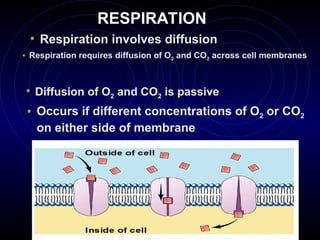
• Respiration involves diffusion
RESPIRATION
• Respiration requires diffusion of O2 and CO2 across cell membranes
• Diffusion of O2 and CO2 is passive
• Occurs if different concentrations of O2 or CO2
on either side of membrane
Aquatic Gas Exchange
• Advantage:
• Keeping surface moist is no problem
• Disadvantage:
• O2 concentrations in water are low,
especially in warmer and saltier
environments
Terrestrial Gas Exchange
• Advantages:
• O2 diffuses faster in air
• Air contains much more O2 than
water
• Disadvantage:
• Surfaces must be internal to avoid
loss of water due to evaporation
Respiratory Surface
• Must accommodate diffusion of CO2
out, O2 in
• Typically very thin
• Always moist or wet
• If they dry out, they cannot function
Protists and Less Complex Animals
• Once again, less complex organisms
do not need complex organ systems
• Gas exchange takes place due to
diffusion
4 Types of Respiratory Organs
• Skin
• Tracheae
• Gills
• Lungs
Skin
• For skin breathers, respiratory surface = body
covering
• Must live in moist or wet places
• Must maintain high surface area to volume ratio
• Keep body small
• Keep body flat
• Or both
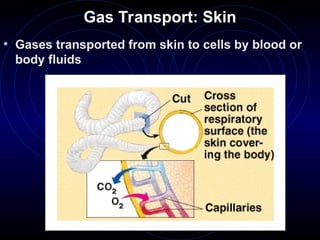
Gas Transport: Skin
• Gases transported from skin to cells by blood or
body fluids
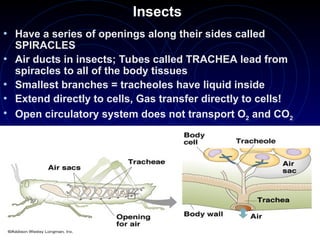
Insects
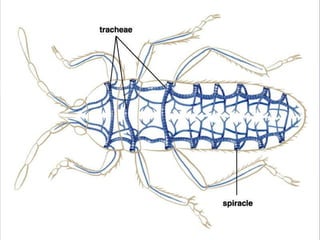
• Have a series of openings along their sides called
SPIRACLES
• Air ducts in insects; Tubes called TRACHEA lead from
spiracles to all of the body tissues
• Smallest branches = tracheoles have liquid inside
• Extend directly to cells, Gas transfer directly to cells!
• Open circulatory system does not transport O2 and CO2
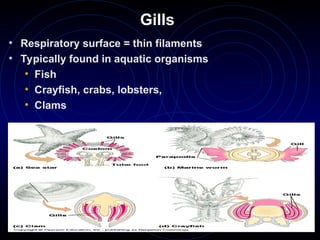
Gills
• Respiratory surface = thin filaments
• Typically found in aquatic organisms
• Fish
• Crayfish, crabs, lobsters,
• Clams
Fish
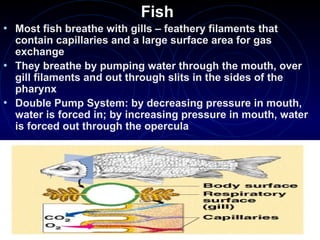
• Most fish breathe with gills – feathery filaments that
contain capillaries and a large surface area for gas
exchange
• They breathe by pumping water through the mouth, over
gill filaments and out through slits in the sides of the
pharynx
• Double Pump System: by decreasing pressure in mouth,
water is forced in; by increasing pressure in mouth, water
is forced out through the opercula
Advantages of Gills to Fish
• Because the gills are so VASCULAR and have a large
surface area, gas exchange can happen adequately
• Increase surface area to volume ratio
• Overcome shape, size limitations associated with skin
breathers
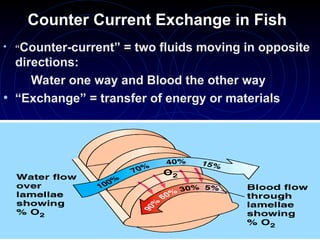
Counter Current Exchange in Fish
• “Counter-current” = two fluids moving in opposite
directions:
Water one way and Blood the other way
• “Exchange” = transfer of energy or materials
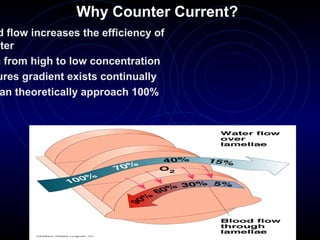
d flow increases the efficiency of
ater
n from high to low concentration
ures gradient exists continually
an theoretically approach 100%
Why Counter Current?
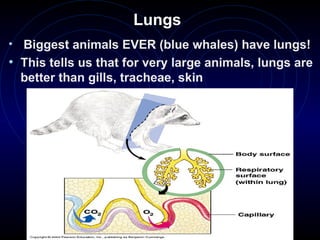
Lungs
• Biggest animals EVER (blue whales) have lungs!
• This tells us that for very large animals, lungs are
better than gills, tracheae, skin
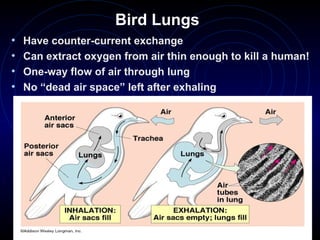
Bird Lungs
• Have counter-current exchange
• Can extract oxygen from air thin enough to kill a human!
• One-way flow of air through lung
• No “dead air space” left after exhaling
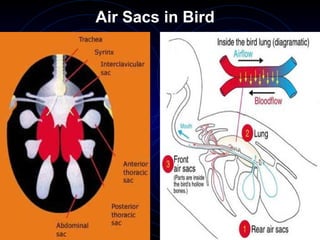
Air Sacs in Bird
• Basic types of respiratory systems in animals
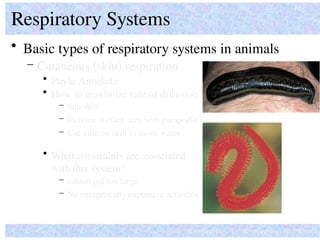
Respiratory Systems
How do organisms ‘solve’ common problems?
– Cutaneous (skin) respiration
• How to maximize rate of diffusion?
– thin skin
• What constraints are associated
with this system?
– Increase surface area with parapodia
– cannot get too large
– No energetically expensive activities
– Use cilia on skin to move water
• Phyla Annelida
• Basic types of respiratory systems in animals
Respiratory Systems
How do organisms ‘solve’ common problems?
– Direct diffusion through cells
• How to maximize rate of diffusion?
– thin cell or tissue layers
• What constraints are associated
with this system?
– circulate water across outer surface
– cannot be large in size
• Phyla Cnidaria
– Cannot be involved in energy-
consuming activities
• Basic types of respiratory systems in animals
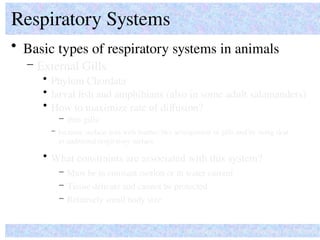
Respiratory Systems
How do organisms ‘solve’ common problems?
– External Gills
• Phylum Chordata
– thin gills
• What constraints are associated with this system?
– Increase surface area with feather-like arrangement of gills and by using skin
as additional respiratory surface
– Must be in constant motion or in water current
– Tissue delicate and cannot be protected
• larval fish and amphibians (also in some adult salamanders)
• How to maximize rate of diffusion?
– Relatively small body size
• Basic types of respiratory systems in animals
Respiratory Systems
How do organisms ‘solve’ common problems?
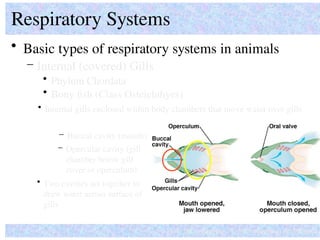
– Internal (covered) Gills
• Phylum Chordata
– Buccal cavity (mouth)
• Two cavities act together to
draw water across surface of
gills
– Opercular cavity (gill
chamber below gill
cover or operculum)
• Bony fish (Class Osteichthyes)
• Internal gills enclosed within body chambers that move water over gills
• Basic types of respiratory systems in animals
Respiratory Systems
How do organisms ‘solve’ common problems?
– Internal (covered) Gills
– thin gills (blood vessels close to surface of gill)
– Increase surface area of gill with feather-like arrangement
– Uses counter-current system in gills to increase P
• How to maximize rate of diffusion?
– Constantly ‘pump’ water across gills with buccal and opercular cavities
• Basic types of respiratory systems in animals
Respiratory Systems
How do organisms ‘solve’ common problems?
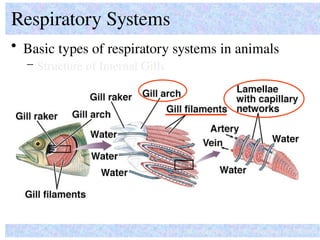
– Structure of Internal Gills

respiratory structures and organs in animals_56450.ppt

  • 1.
  • 2.
    RESPIRATION • Why theneed for gas exchange (respiration)? Gas exchange involves uptake of O2 and release of CO2 • What is oxygen used for? Aerobic respiration uses energy of electrons to produce ATP Energy-depleted electrons (and associated proton in H) accepted by O2 to form H2O • Where does CO2 come from? CO2 released when glucose broken down to release electrons in the Kreb’s Cycle
  • 3.
    • Respiration involvesdiffusion RESPIRATION • Respiration requires diffusion of O2 and CO2 across cell membranes • Diffusion of O2 and CO2 is passive • Occurs if different concentrations of O2 or CO2 on either side of membrane
  • 4.
    Aquatic Gas Exchange •Advantage: • Keeping surface moist is no problem • Disadvantage: • O2 concentrations in water are low, especially in warmer and saltier environments
  • 5.
    Terrestrial Gas Exchange •Advantages: • O2 diffuses faster in air • Air contains much more O2 than water • Disadvantage: • Surfaces must be internal to avoid loss of water due to evaporation
  • 6.
    Respiratory Surface • Mustaccommodate diffusion of CO2 out, O2 in • Typically very thin • Always moist or wet • If they dry out, they cannot function
  • 7.
    Protists and LessComplex Animals • Once again, less complex organisms do not need complex organ systems • Gas exchange takes place due to diffusion
  • 8.
    4 Types ofRespiratory Organs • Skin • Tracheae • Gills • Lungs
  • 9.
    Skin • For skinbreathers, respiratory surface = body covering • Must live in moist or wet places • Must maintain high surface area to volume ratio • Keep body small • Keep body flat • Or both
  • 10.
    Gas Transport: Skin •Gases transported from skin to cells by blood or body fluids
  • 11.
    Insects • Have aseries of openings along their sides called SPIRACLES • Air ducts in insects; Tubes called TRACHEA lead from spiracles to all of the body tissues • Smallest branches = tracheoles have liquid inside • Extend directly to cells, Gas transfer directly to cells! • Open circulatory system does not transport O2 and CO2
  • 13.
    Gills • Respiratory surface= thin filaments • Typically found in aquatic organisms • Fish • Crayfish, crabs, lobsters, • Clams
  • 14.
    Fish • Most fishbreathe with gills – feathery filaments that contain capillaries and a large surface area for gas exchange • They breathe by pumping water through the mouth, over gill filaments and out through slits in the sides of the pharynx • Double Pump System: by decreasing pressure in mouth, water is forced in; by increasing pressure in mouth, water is forced out through the opercula
  • 15.
    Advantages of Gillsto Fish • Because the gills are so VASCULAR and have a large surface area, gas exchange can happen adequately • Increase surface area to volume ratio • Overcome shape, size limitations associated with skin breathers
  • 16.
    Counter Current Exchangein Fish • “Counter-current” = two fluids moving in opposite directions: Water one way and Blood the other way • “Exchange” = transfer of energy or materials
  • 17.
    d flow increasesthe efficiency of ater n from high to low concentration ures gradient exists continually an theoretically approach 100% Why Counter Current?
  • 19.
    Lungs • Biggest animalsEVER (blue whales) have lungs! • This tells us that for very large animals, lungs are better than gills, tracheae, skin
  • 20.
    Bird Lungs • Havecounter-current exchange • Can extract oxygen from air thin enough to kill a human! • One-way flow of air through lung • No “dead air space” left after exhaling
  • 21.
  • 22.
    • Basic typesof respiratory systems in animals Respiratory Systems How do organisms ‘solve’ common problems? – Cutaneous (skin) respiration • How to maximize rate of diffusion? – thin skin • What constraints are associated with this system? – Increase surface area with parapodia – cannot get too large – No energetically expensive activities – Use cilia on skin to move water • Phyla Annelida
  • 23.
    • Basic typesof respiratory systems in animals Respiratory Systems How do organisms ‘solve’ common problems? – Direct diffusion through cells • How to maximize rate of diffusion? – thin cell or tissue layers • What constraints are associated with this system? – circulate water across outer surface – cannot be large in size • Phyla Cnidaria – Cannot be involved in energy- consuming activities
  • 24.
    • Basic typesof respiratory systems in animals Respiratory Systems How do organisms ‘solve’ common problems? – External Gills • Phylum Chordata – thin gills • What constraints are associated with this system? – Increase surface area with feather-like arrangement of gills and by using skin as additional respiratory surface – Must be in constant motion or in water current – Tissue delicate and cannot be protected • larval fish and amphibians (also in some adult salamanders) • How to maximize rate of diffusion? – Relatively small body size
  • 25.
    • Basic typesof respiratory systems in animals Respiratory Systems How do organisms ‘solve’ common problems? – Internal (covered) Gills • Phylum Chordata – Buccal cavity (mouth) • Two cavities act together to draw water across surface of gills – Opercular cavity (gill chamber below gill cover or operculum) • Bony fish (Class Osteichthyes) • Internal gills enclosed within body chambers that move water over gills
  • 26.
    • Basic typesof respiratory systems in animals Respiratory Systems How do organisms ‘solve’ common problems? – Internal (covered) Gills – thin gills (blood vessels close to surface of gill) – Increase surface area of gill with feather-like arrangement – Uses counter-current system in gills to increase P • How to maximize rate of diffusion? – Constantly ‘pump’ water across gills with buccal and opercular cavities
  • 27.
    • Basic typesof respiratory systems in animals Respiratory Systems How do organisms ‘solve’ common problems? – Structure of Internal Gills