Accounting
The Role of Accounting Accounting is the process of recording, analyzing, and interpreting the economic activities of a business. Accounting functions are performed for the purpose of: Accountability of employees Budgeting Taxation Financial Statements and Annual Reports
Accounting Records Accounting records are kept according to certain rules.  Because of this: Someone not involved with the company can understand key aspects of its activities or performance by looking at the accounting records and reports A person can use the financial records and reports to compare different businesses This is why accounting is often referred to as “the language of business”
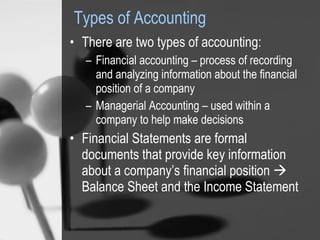
 Types of Accounting There are two types of accounting: Financial accounting – process of recording and analyzing information about the financial position of a company Managerial Accounting – used within a company to help make decisions Financial Statements are formal documents that provide key information about a company’s financial position    Balance Sheet and the Income Statement
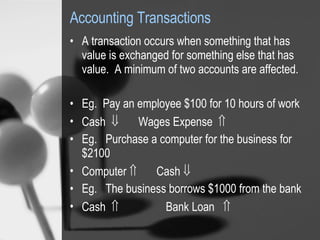
Accounting Transactions A transaction occurs when something that has value is exchanged for something else that has value.  A minimum of two accounts are affected. Eg.  Pay an employee $100 for 10 hours of work Cash     Wages Expense   Eg.  Purchase a computer for the business for $2100 Computer     Cash   Eg.  The business borrows $1000 from the bank Cash     Bank Loan  
The Balance Sheet The Balance Sheet measures the financial health of a business at a specific point in time. To make a balance sheet you must ask yourself: 1. What are the things the business owns? (assets) 2. What are the debts (liabilities) 3. What is the difference? (equity)
Assets Items of value that the business owns Cash:  The bank balance Accounts Receivable:  Money owed to the business Inventory: Goods on hand for re-sale Supplies: Pens, paper, pencils, etc. Building Land
Asset Classification Current Assets are items that the business owns that will be used up or disappear within one year. Eg.  Cash, Accounts Receivable, Inventory, Supplies Long-term (Capital) Assets are items that the business owns that will last for longer than one year. Eg.  Automobiles, Building, Land
Liabilities Liabilities  are the debts of the business Bank Loan: money the business owes to the bank Accounts Payable: money the business owes for previous purchases Mortgage: money the business owes for the purchase of the building
Liability Classifications Current Liabilities Debts that will be paid off within one year Eg.  Bank Loan (current portion), Accounts Payable Long-term Liabilities  Debts that will take longer than one year to pay off Eg.  Bank Loan (remaining), Mortgage
Owner’s Equity Owner’s Equity  is the owner’s portion of the business A residual amount calculated from assets and liabilities Formula:  Assets – Liabilities = Owner’s Equity The Accounting Equation: Assets = Liabilities + Owner’s Equity
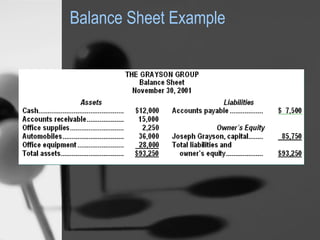
Formatting The set-up of the balance sheet is always  Assets = Liabilities + Owner’s Equity There is a three line heading (who, what & when) Assets are listed in order of liquidity (ease at which things are converted into cash) Liabilities are listed in order in which they are paid.
Balance Sheet Example
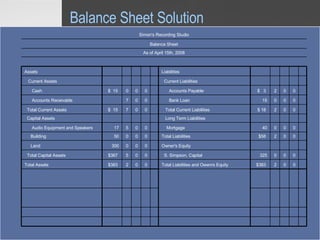
Balance Sheet Solution                                                                                               0 0 2 $383  Total Liabilities and Owenrs Equity   0 0 2 $383  Total Assets   0 0 0 325 S. Simpson, Capital   0 0 5 $367  Total Capital Assets           Owner's Equity   0 0 0 300 Land   0 0 2 $58  Total Liabilities   0 0 0 50 Building   0 0 0 40 Mortgage   0 0 5 17 Audio Equipment and Speakers           Long Term Liabilities           Capital Assets   0 0 2 $ 18  Total Current Liabilities   0 0 7 $  15  Total Current Assets   0 0 0 15 Bank Loan   0 0 7   Accounts Receivable   0 0 2 $  3  Accounts Payable   0 0 0 $  15  Cash           Current Liabilities           Current Assets           Liabilities           Assets                         As of April 15th, 2008 Balance Sheet Simon's Recording Studio
Income Statement The statement that reports a business’s income and expenses for a fiscal period It is also known as a statement of financial performance Income (revenue) is money earned by the business by selling a good or service Expenses are incurred to help earn revenue    Advertising, Salaries, Rent etc. Allows you to analyze trends Net Income is transferred to the Balance Sheet as Owner’s Equity
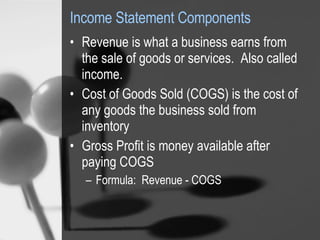
Income Statement Components Revenue is what a business earns from the sale of goods or services.  Also called income.  Cost of Goods Sold (COGS) is the cost of any goods the business sold from inventory  Gross Profit is money available after paying COGS Formula:  Revenue - COGS
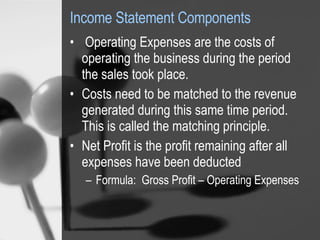
Income Statement Components   Operating Expenses are the costs of operating the business during the period the sales took place.  Costs need to be matched to the revenue generated during this same time period.  This is called the matching principle.  Net Profit is the profit remaining after all expenses have been deducted Formula:  Gross Profit – Operating Expenses
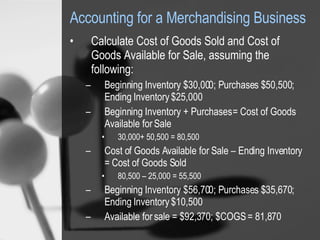
Accounting for a Merchandising Business Calculate Cost of Goods Sold and Cost of Goods Available for Sale, assuming the following: Beginning Inventory $30,000; Purchases $50,500; Ending Inventory $25,000 Beginning Inventory + Purchases = Cost of Goods Available for Sale 30,000+ 50,500 = 80,500 Cost of Goods Available for Sale – Ending Inventory = Cost of Goods Sold 80,500 – 25,000 = 55,500 Beginning Inventory $56,700; Purchases $35,670; Ending Inventory $10,500 Available for sale = $92,370; $COGS = 81,870
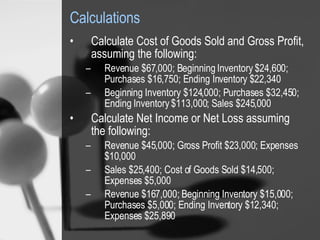
Calculations Calculate Cost of Goods Sold and Gross Profit, assuming the following: Revenue $67,000; Beginning Inventory $24,600; Purchases $16,750; Ending Inventory $22,340 Beginning Inventory $124,000; Purchases $32,450; Ending Inventory $113,000; Sales $245,000 Calculate Net Income or Net Loss assuming the following: Revenue $45,000; Gross Profit $23,000; Expenses $10,000 Sales $25,400; Cost of Goods Sold $14,500; Expenses $5,000 Revenue $167,000; Beginning Inventory $15,000; Purchases $5,000; Ending Inventory $12,340; Expenses $25,890
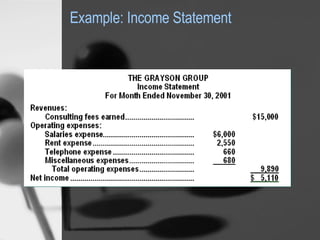
Example: Income Statement
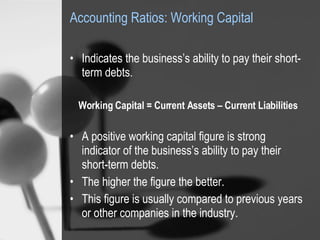
Accounting Ratios: Working Capital Indicates the business’s ability to pay their short-term debts. Working Capital = Current Assets – Current Liabilities A positive working capital figure is strong indicator of the business’s ability to pay their short-term debts.  The higher the figure the better.  This figure is usually compared to previous years or other companies in the industry.
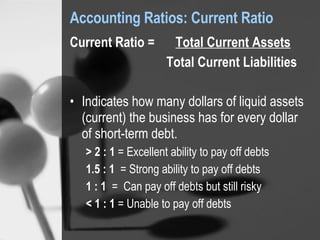
Accounting Ratios: Current Ratio Current Ratio =    Total Current Assets   Total Current Liabilities Indicates how many dollars of liquid assets (current) the business has for every dollar of short-term debt. > 2 : 1  = Excellent ability to pay off debts 1.5 : 1   = Strong ability to pay off debts 1 : 1  =  Can pay off debts but still risky < 1 : 1  = Unable to pay off debts
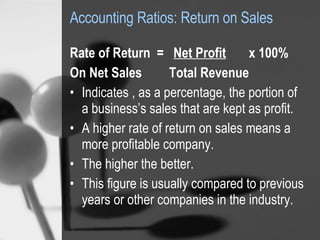
Accounting Ratios: Return on Sales Rate of Return  =  Net Profit   x 100% On Net Sales  Total Revenue Indicates , as a percentage, the portion of a business’s sales that are kept as profit. A higher rate of return on sales means a more profitable company.  The higher the better.  This figure is usually compared to previous years or other companies in the industry.
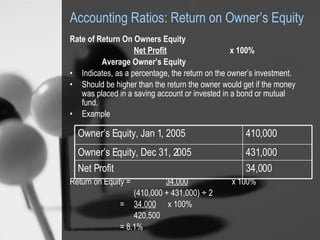
Accounting Ratios: Return on Owner’s Equity Rate of Return On Owners Equity   Net Profit   x 100%   Average Owner’s Equity Indicates, as a percentage, the return on the owner’s investment.  Should be higher than the return the owner would get if the money was placed in a saving account or invested in a bond or mutual fund. Example Return on Equity =  34,000  x 100% (410,000 + 431,000) ÷ 2   =  34,000  x 100% 420,500   = 8.1% 34,000 Net Profit 431,000 Owner’s Equity, Dec 31, 2005 410,000 Owner’s Equity, Jan 1, 2005

Intro To Accounting

  • 1.
  • 2.
    The Role ofAccounting Accounting is the process of recording, analyzing, and interpreting the economic activities of a business. Accounting functions are performed for the purpose of: Accountability of employees Budgeting Taxation Financial Statements and Annual Reports
  • 3.
    Accounting Records Accountingrecords are kept according to certain rules. Because of this: Someone not involved with the company can understand key aspects of its activities or performance by looking at the accounting records and reports A person can use the financial records and reports to compare different businesses This is why accounting is often referred to as “the language of business”
  • 4.
     Types of AccountingThere are two types of accounting: Financial accounting – process of recording and analyzing information about the financial position of a company Managerial Accounting – used within a company to help make decisions Financial Statements are formal documents that provide key information about a company’s financial position  Balance Sheet and the Income Statement
  • 5.
    Accounting Transactions Atransaction occurs when something that has value is exchanged for something else that has value. A minimum of two accounts are affected. Eg. Pay an employee $100 for 10 hours of work Cash  Wages Expense  Eg. Purchase a computer for the business for $2100 Computer  Cash  Eg. The business borrows $1000 from the bank Cash  Bank Loan 
  • 6.
    The Balance SheetThe Balance Sheet measures the financial health of a business at a specific point in time. To make a balance sheet you must ask yourself: 1. What are the things the business owns? (assets) 2. What are the debts (liabilities) 3. What is the difference? (equity)
  • 7.
    Assets Items ofvalue that the business owns Cash: The bank balance Accounts Receivable: Money owed to the business Inventory: Goods on hand for re-sale Supplies: Pens, paper, pencils, etc. Building Land
  • 8.
    Asset Classification CurrentAssets are items that the business owns that will be used up or disappear within one year. Eg. Cash, Accounts Receivable, Inventory, Supplies Long-term (Capital) Assets are items that the business owns that will last for longer than one year. Eg. Automobiles, Building, Land
  • 9.
    Liabilities Liabilities are the debts of the business Bank Loan: money the business owes to the bank Accounts Payable: money the business owes for previous purchases Mortgage: money the business owes for the purchase of the building
  • 10.
    Liability Classifications CurrentLiabilities Debts that will be paid off within one year Eg. Bank Loan (current portion), Accounts Payable Long-term Liabilities Debts that will take longer than one year to pay off Eg. Bank Loan (remaining), Mortgage
  • 11.
    Owner’s Equity Owner’sEquity is the owner’s portion of the business A residual amount calculated from assets and liabilities Formula: Assets – Liabilities = Owner’s Equity The Accounting Equation: Assets = Liabilities + Owner’s Equity
  • 12.
    Formatting The set-upof the balance sheet is always Assets = Liabilities + Owner’s Equity There is a three line heading (who, what & when) Assets are listed in order of liquidity (ease at which things are converted into cash) Liabilities are listed in order in which they are paid.
  • 13.
  • 14.
    Balance Sheet Solution                                                                                              0 0 2 $383 Total Liabilities and Owenrs Equity   0 0 2 $383 Total Assets   0 0 0 325 S. Simpson, Capital   0 0 5 $367 Total Capital Assets           Owner's Equity   0 0 0 300 Land   0 0 2 $58 Total Liabilities   0 0 0 50 Building   0 0 0 40 Mortgage   0 0 5 17 Audio Equipment and Speakers           Long Term Liabilities           Capital Assets   0 0 2 $ 18 Total Current Liabilities   0 0 7 $ 15 Total Current Assets   0 0 0 15 Bank Loan   0 0 7   Accounts Receivable   0 0 2 $ 3 Accounts Payable   0 0 0 $ 15 Cash           Current Liabilities           Current Assets           Liabilities           Assets                         As of April 15th, 2008 Balance Sheet Simon's Recording Studio
  • 15.
    Income Statement Thestatement that reports a business’s income and expenses for a fiscal period It is also known as a statement of financial performance Income (revenue) is money earned by the business by selling a good or service Expenses are incurred to help earn revenue  Advertising, Salaries, Rent etc. Allows you to analyze trends Net Income is transferred to the Balance Sheet as Owner’s Equity
  • 16.
    Income Statement ComponentsRevenue is what a business earns from the sale of goods or services. Also called income. Cost of Goods Sold (COGS) is the cost of any goods the business sold from inventory Gross Profit is money available after paying COGS Formula: Revenue - COGS
  • 17.
    Income Statement Components  Operating Expenses are the costs of operating the business during the period the sales took place. Costs need to be matched to the revenue generated during this same time period. This is called the matching principle. Net Profit is the profit remaining after all expenses have been deducted Formula: Gross Profit – Operating Expenses
  • 18.
    Accounting for aMerchandising Business Calculate Cost of Goods Sold and Cost of Goods Available for Sale, assuming the following: Beginning Inventory $30,000; Purchases $50,500; Ending Inventory $25,000 Beginning Inventory + Purchases = Cost of Goods Available for Sale 30,000+ 50,500 = 80,500 Cost of Goods Available for Sale – Ending Inventory = Cost of Goods Sold 80,500 – 25,000 = 55,500 Beginning Inventory $56,700; Purchases $35,670; Ending Inventory $10,500 Available for sale = $92,370; $COGS = 81,870
  • 19.
    Calculations Calculate Costof Goods Sold and Gross Profit, assuming the following: Revenue $67,000; Beginning Inventory $24,600; Purchases $16,750; Ending Inventory $22,340 Beginning Inventory $124,000; Purchases $32,450; Ending Inventory $113,000; Sales $245,000 Calculate Net Income or Net Loss assuming the following: Revenue $45,000; Gross Profit $23,000; Expenses $10,000 Sales $25,400; Cost of Goods Sold $14,500; Expenses $5,000 Revenue $167,000; Beginning Inventory $15,000; Purchases $5,000; Ending Inventory $12,340; Expenses $25,890
  • 20.
  • 21.
    Accounting Ratios: WorkingCapital Indicates the business’s ability to pay their short-term debts. Working Capital = Current Assets – Current Liabilities A positive working capital figure is strong indicator of the business’s ability to pay their short-term debts. The higher the figure the better. This figure is usually compared to previous years or other companies in the industry.
  • 22.
    Accounting Ratios: CurrentRatio Current Ratio = Total Current Assets Total Current Liabilities Indicates how many dollars of liquid assets (current) the business has for every dollar of short-term debt. > 2 : 1 = Excellent ability to pay off debts 1.5 : 1 = Strong ability to pay off debts 1 : 1 = Can pay off debts but still risky < 1 : 1 = Unable to pay off debts
  • 23.
    Accounting Ratios: Returnon Sales Rate of Return = Net Profit x 100% On Net Sales Total Revenue Indicates , as a percentage, the portion of a business’s sales that are kept as profit. A higher rate of return on sales means a more profitable company. The higher the better. This figure is usually compared to previous years or other companies in the industry.
  • 24.
    Accounting Ratios: Returnon Owner’s Equity Rate of Return On Owners Equity Net Profit x 100% Average Owner’s Equity Indicates, as a percentage, the return on the owner’s investment. Should be higher than the return the owner would get if the money was placed in a saving account or invested in a bond or mutual fund. Example Return on Equity = 34,000 x 100% (410,000 + 431,000) ÷ 2 = 34,000 x 100% 420,500 = 8.1% 34,000 Net Profit 431,000 Owner’s Equity, Dec 31, 2005 410,000 Owner’s Equity, Jan 1, 2005