VERTICAL FORMAT
INCOME STATEMENT
CONVENTIONAL
HORIZONTAL FORM Expenses Rs Income Rs
To Opening Stock xx By Sales (Net) xx
To Purchase (Net) xx By Closing Stock xx
To Direct Expenses xx By Misc. Income xx
To Other Expenses xx
To Depreciation xx
To Provision for Tax xx
To Net Profit xx
Total xxx Total xxx
Income and closing stock on the right
hand side and expenses and opening
stock on the left hand side
Direct income (Sales) is shown first,
followed by Misc. Income and closing stock
Opening Stock and Direct Costs
(purchase of goods, freight) are shown
first, followed by other expenses,
depreciation and payment of taxes.
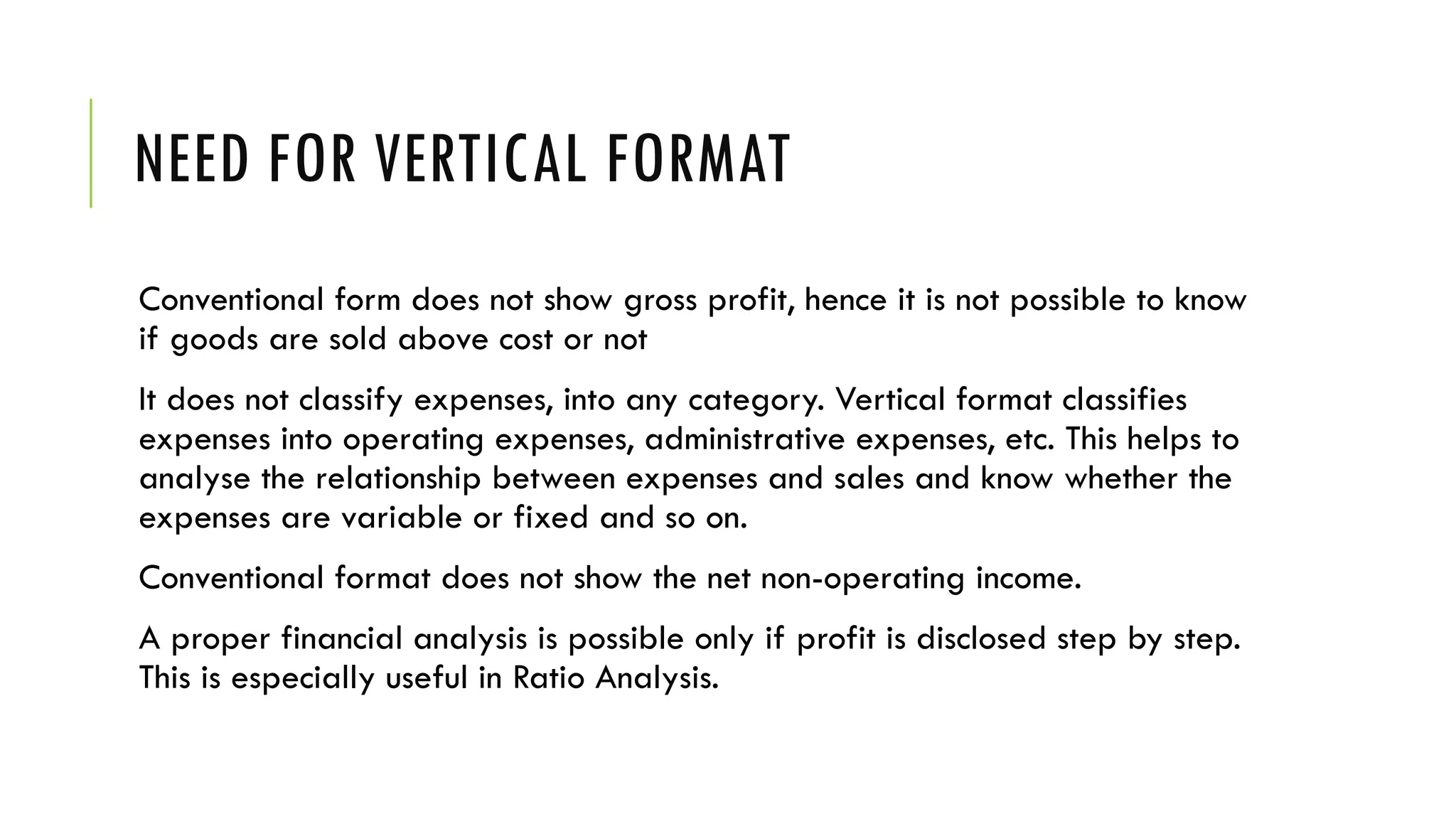
NEED FOR VERTICAL FORMAT
Conventional form does not show gross profit, hence it is not possible to know
if goods are sold above cost or not
It does not classify expenses, into any category. Vertical format classifies
expenses into operating expenses, administrative expenses, etc. This helps to
analyse the relationship between expenses and sales and know whether the
expenses are variable or fixed and so on.
Conventional format does not show the net non-operating income.
A proper financial analysis is possible only if profit is disclosed step by step.
This is especially useful in Ratio Analysis.
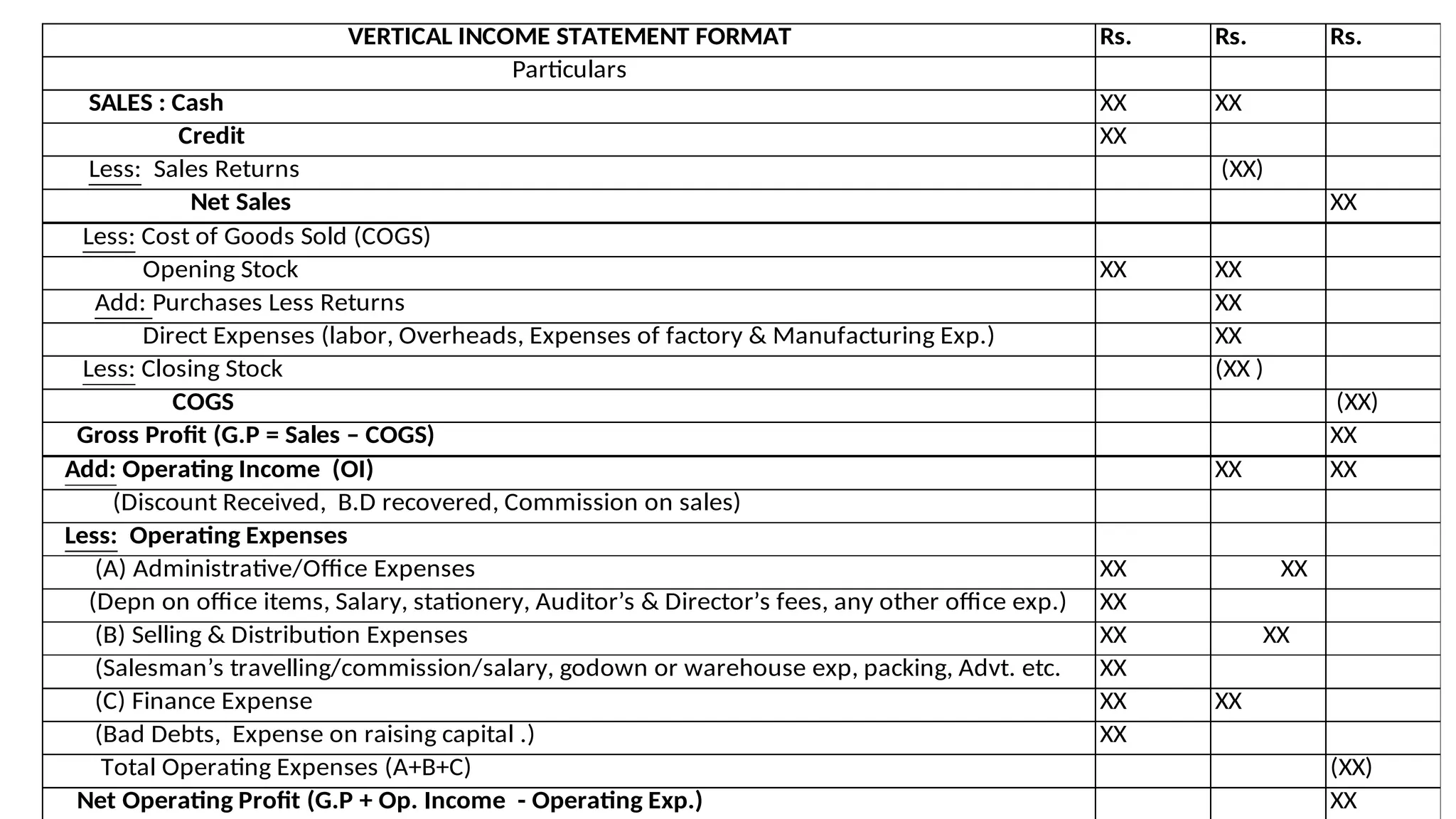
VERTICAL INCOME STATEMENT FORMAT Rs. Rs. Rs.
Particulars
SALES : Cash XX XX
Credit XX
Less: Sales Returns (XX)
Net Sales XX
Less: Cost of Goods Sold (COGS)
Opening Stock XX XX
Add: Purchases Less Returns XX
Direct Expenses (labor, Overheads, Expenses of factory & Manufacturing Exp.) XX
Less: Closing Stock (XX )
COGS (XX)
Gross Profit (G.P = Sales – COGS) XX
Add: Operating Income (OI) XX XX
(Discount Received, B.D recovered, Commission on sales)
Less: Operating Expenses
(A) Administrative/Office Expenses XX XX
(Depn on office items, Salary, stationery, Auditor’s & Director’s fees, any other office exp.) XX
(B) Selling & Distribution Expenses XX XX
(Salesman’s travelling/commission/salary, godown or warehouse exp, packing, Advt. etc. XX
(C) Finance Expense XX XX
(Bad Debts, Expense on raising capital .) XX
Total Operating Expenses (A+B+C) (XX)
Net Operating Profit (G.P + Op. Income - Operating Exp.) XX
Add : Non - Operating Incomes (NOI) XX XX
( Rent, interest, dividend, royalty, commission received, Profit on sale of assets or XX
investment , Misc. Income recd., any other non-recurring income)
Less: Non - Operating Expenses (NOE) XX (XX)
(Goodwill/ Preliminary Exp. w/o, Penalty paid, Loss on sale of Asset / Invt,, Loss due XX
to fire or theft , any other non-recurring exp.)
Earnings Before Interest and Tax(EBIT) ( Net Op. Profit (without interest) + NOI + NOE) XX
Less : Interest on loan/Debenture, (XX)
Net Profit Before Tax (NPBT) ( Net Op. Profit + NOI + NOE - Interest) XX
Less: Tax/Taxation/ Provision for Tax (XX)
Net Profit After Tax (NPAT) XX
Add: Opening Balance P&L (cr.) XX
Or (XX)
Less: Opening Balance P&L (dr.)
Less: Appropriations
Transfer to Reserves XX (XX)
Proposed Divided XX
Interim Dividend XX
RETAINED EARNINGS (Closing Balance) XX
LINE ITEMS
Sales
Gross Sales is also known as Revenue from Operations/Turnover, it includes both
cash and credit sales.
*Allowances are trade discounts or allowance for defective goods
COST OF GOODS SOLD
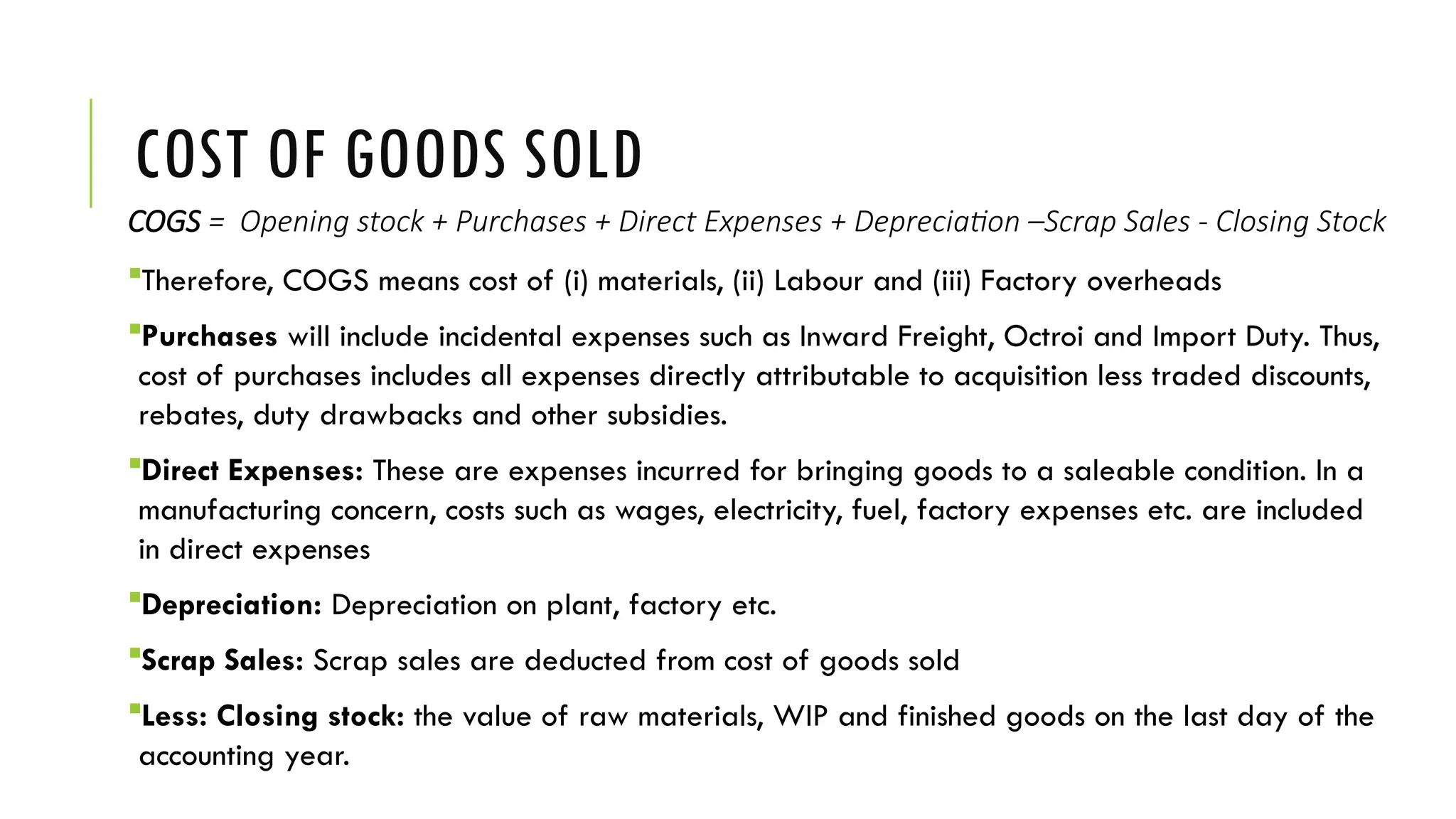
COGS = Opening stock + Purchases + Direct Expenses + Depreciation –Scrap Sales - Closing Stock
Therefore, COGS means cost of (i) materials, (ii) Labour and (iii) Factory overheads
Purchases will include incidental expenses such as Inward Freight, Octroi and Import Duty. Thus,
cost of purchases includes all expenses directly attributable to acquisition less traded discounts,
rebates, duty drawbacks and other subsidies.
Direct Expenses: These are expenses incurred for bringing goods to a saleable condition. In a
manufacturing concern, costs such as wages, electricity, fuel, factory expenses etc. are included
in direct expenses
Depreciation: Depreciation on plant, factory etc.
Scrap Sales: Scrap sales are deducted from cost of goods sold
Less: Closing stock: the value of raw materials, WIP and finished goods on the last day of the
accounting year.
LINE ITEMS
Profit on manufacturing only, does not take into account selling & distribution exp.
Operating Expenses
Things to note – Normal bad debts will be part of selling exp and abnormal bad debts will be
part of finance charges.
Interest includes, interest on debentures or bonds, interest on loans from banks and financial
institutions, interest on public deposits, interest on short-term loans.
BAJAJ AUTO
LTD. P&L
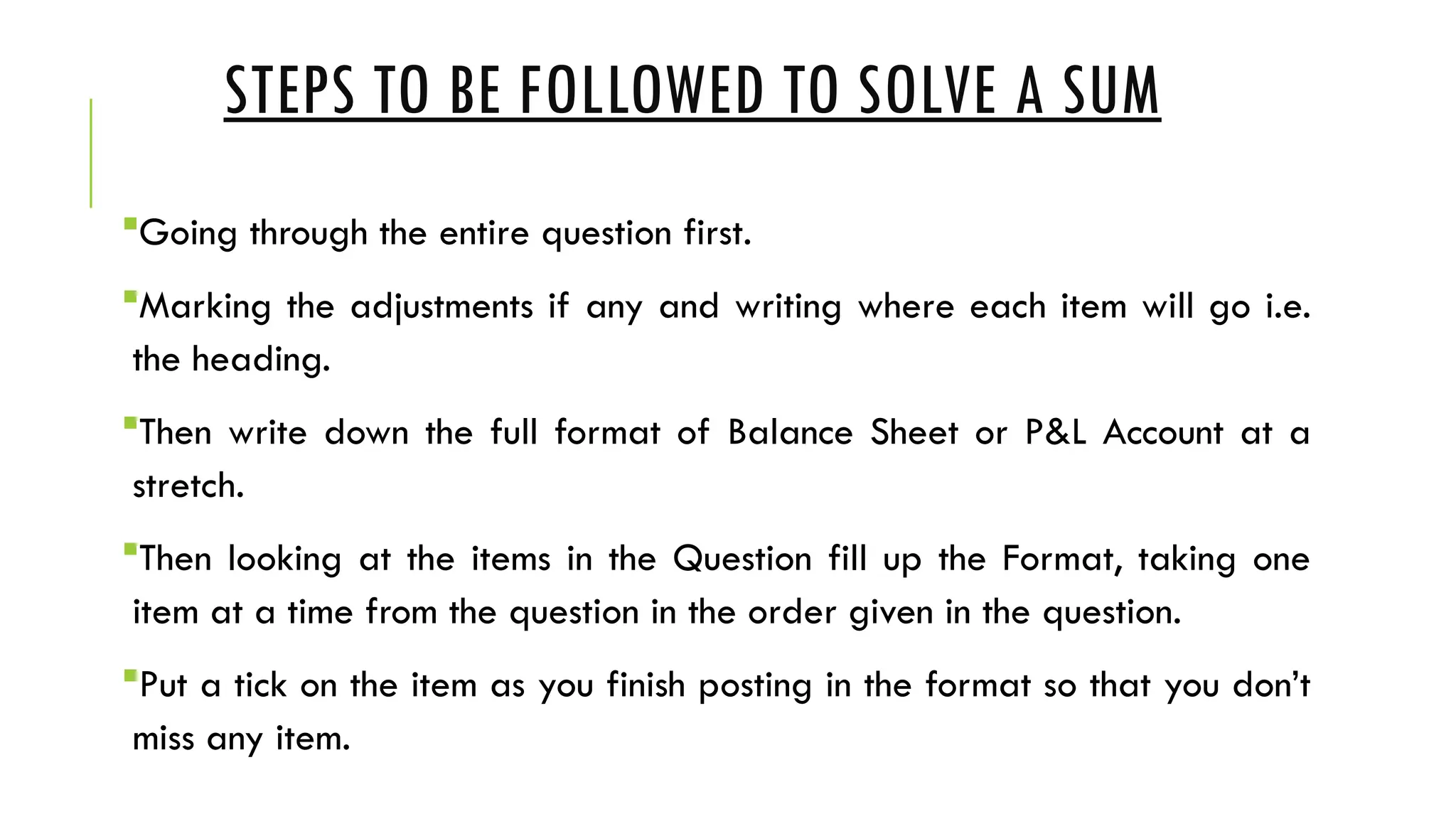
STEPS TO BE FOLLOWED TO SOLVE A SUM
Going through the entire question first.
Marking the adjustments if any and writing where each item will go i.e.
the heading.
Then write down the full format of Balance Sheet or P&L Account at a
stretch.
Then looking at the items in the Question fill up the Format, taking one
item at a time from the question in the order given in the question.
Put a tick on the item as you finish posting in the format so that you don’t
miss any item.
Trading and Profit and Loss Account for the Year ended 31st March, 2017
Particulars Rs. Particulars Rs.
To Opening Stock 70,000 By Sales 16,60,000
To Purchases 15,30,000 By Closing Stock 1,60,000
( - ) Returns 30,000 15,00,000
To Gross Profit 2,50,000
18,20,000 18,20,000
To Depreciation 36,000 By Gross Profit 2,50,000
To Administration Expenses 50,000 By Interest 10,000
To Selling & Distribution Expenses 24,000
To Provision for Income-tax 40,000
To Proposed Dividend 16,000
To Profit Balance 94,000
2,60,000 2,60,000
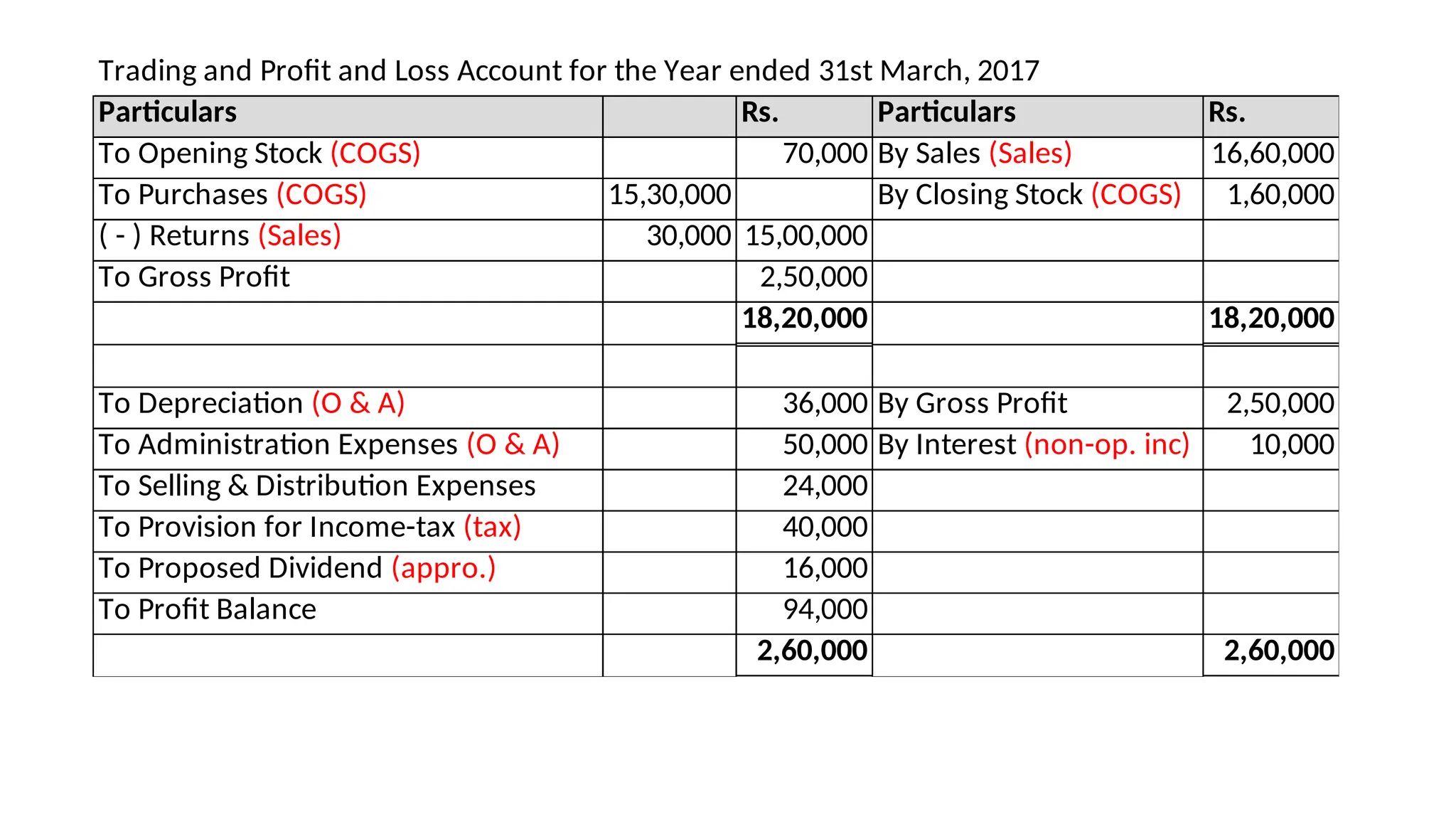
Trading and Profit and Loss Account for the Year ended 31st March, 2017
Particulars Rs. Particulars Rs.
To Opening Stock (COGS) 70,000 By Sales (Sales) 16,60,000
To Purchases (COGS) 15,30,000 By Closing Stock (COGS) 1,60,000
( - ) Returns (Sales) 30,000 15,00,000
To Gross Profit 2,50,000
18,20,000 18,20,000
To Depreciation (O & A) 36,000 By Gross Profit 2,50,000
To Administration Expenses (O & A) 50,000 By Interest (non-op. inc) 10,000
To Selling & Distribution Expenses 24,000
To Provision for Income-tax (tax) 40,000
To Proposed Dividend (appro.) 16,000
To Profit Balance 94,000
2,60,000 2,60,000
BALANCE SHEET
CONVENTIONAL/T-FORM
• Assets on the right hand side, Liabilities on the left
• Assets are shown in order of permanence, Least
liquid i.e. fixed assets followed by most liquid i.e.
current assets. Even under this, items are arranged
in order of permanence e.g. stock appears first,
followed by cash balance
• Liabilities are shown in order of priority of re-
payment. E.g. Permanent liabilities i.e. Capital is
shown first followed by Long Term Loans and then
Short term Loans etc.
Liabilities Rs Assets Rs
Capital xx Fixed Assets xx
Reserves & Surplus xx Investments xx
Long Term Loans xx Current Assets xx
Short Term Loans xx Loans & Advances xx
Current Liabilities xx
Provisions xx
Total xxx xxx
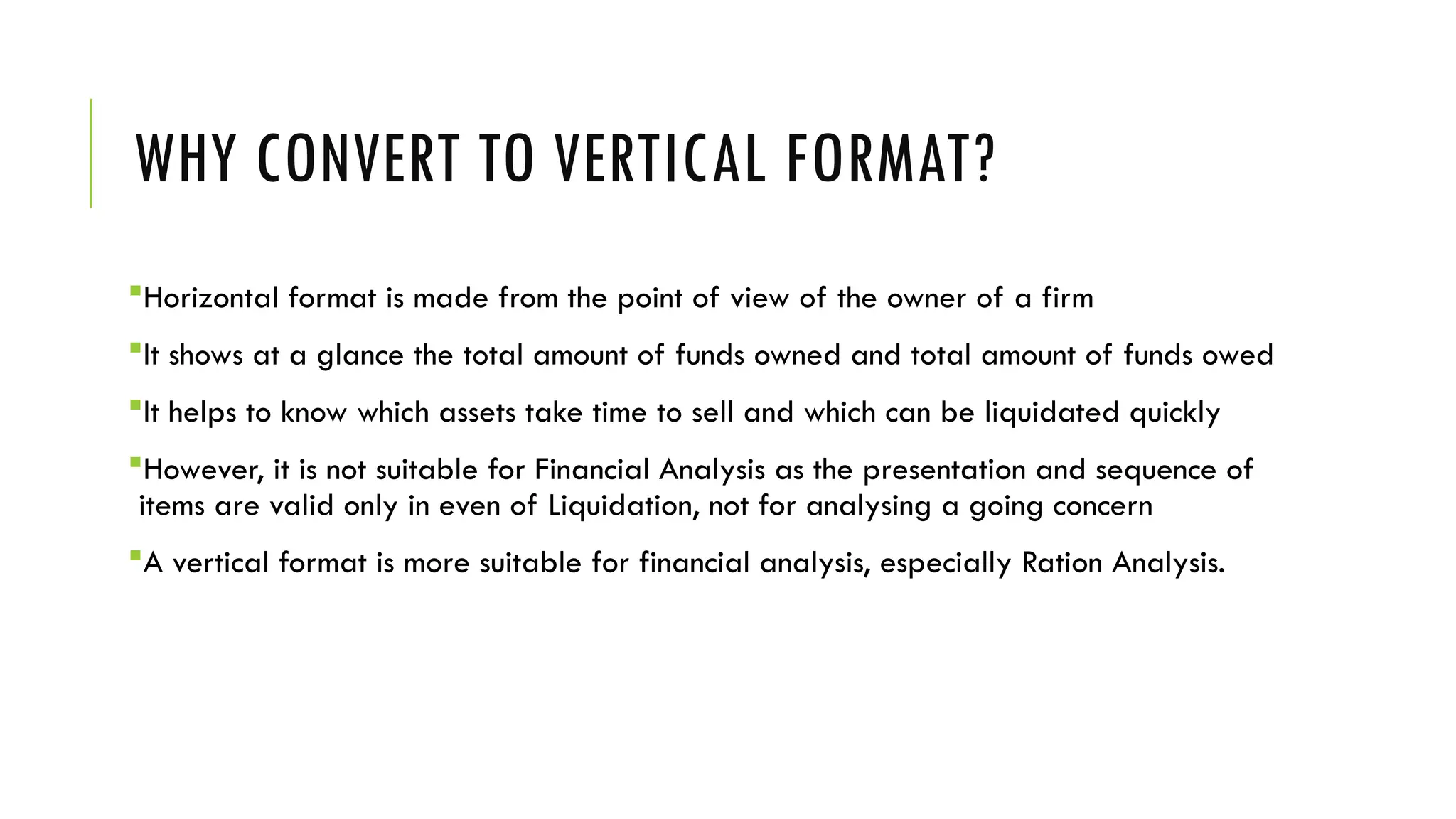
WHY CONVERT TO VERTICAL FORMAT?
Horizontal format is made from the point of view of the owner of a firm
It shows at a glance the total amount of funds owned and total amount of funds owed
It helps to know which assets take time to sell and which can be liquidated quickly
However, it is not suitable for Financial Analysis as the presentation and sequence of
items are valid only in even of Liquidation, not for analysing a going concern
A vertical format is more suitable for financial analysis, especially Ration Analysis.
I. Source of Funds:
1. Shareholder’s Funds:
(a) Share capital
Equity
Preference
Less: Calls Unpaid:
Add: Forfeited Shares
(b) Reserves and Surplus
Capital Reserve
Capital Redemption Reserve
Securities Premium
Other Reserves
Profit and Loss Account
Less: Deferred Revenue expenditure to the extent not written-off.
Preliminary Expenses
Discount on Issue of Shares
Profit and Loss account (debit balance, if any)
2. Loan Funds:
(a) Secured loans
Debentures
Loans and Advance from Banks
Loans from subsidiary Companies
(b) Unsecured loans
Public Deposits
TOTAL (Capital Employed)
II. Application of Funds
1. Non Current Assets:
Tangible Assets
Land
Building
Leasehold Premises
Railway Sidings
Plant and Machinery
Furniture
Vehicles
Less: Provision for Depreciation
Intangible Assets
Goodwill
Patents and Trademarks
Less: Amortisation
2. Investments:
Government or Trust Securities, Shares, Debentures, Bonds
3. Current Assets, Loans and Advances:
Quick
Sundry Debtors
Cash and Bank balances
Bills Receivable
Interest Accrued on investments
Other Current Assets
Short term Loans and Advances
Non Quick
Loose Tools / Stock in Trade, Inventories
Prepaid Expenses
Less: Current Liabilities and Provisions:
Quick liabilities & Provisions
Bills payables
Sundry Creditors
Outstanding Expenses
Provisions for Taxation
Proposed Dividends
Non Quick
Bank Overdraft / Cash Credit
Pre received Income
TOTAL
KEY DIFFERENCES
In a Vertical Balance Sheet,
Current Liabilities are deducted from Current Assets to form the Working Capital
Fictitious assets are deducted from Owner’s Funds
At times, Application of funds (FA+WC) is shown first, followed by Sources of Funds
(OF + LF)
Net worth i.e. Owner’s Funds = Assets – Liabilities
Total Funds Available is total of Own and Owed Funds
Tangible Assets are shown at net cost, i.e. Cost – Depreciation
QUICK ASSETS & QUICK LIABILITIES
Quick Assets are those which are quickly realisable
Quick Assets = Current Assets – Inventories & Prepayments
Liabilities which are payable immediately are called quick liabilities. Overdraft is not,
in practice immediately payable, so,
Quick Liabilities = Current Liabilities – Bank Overdraft
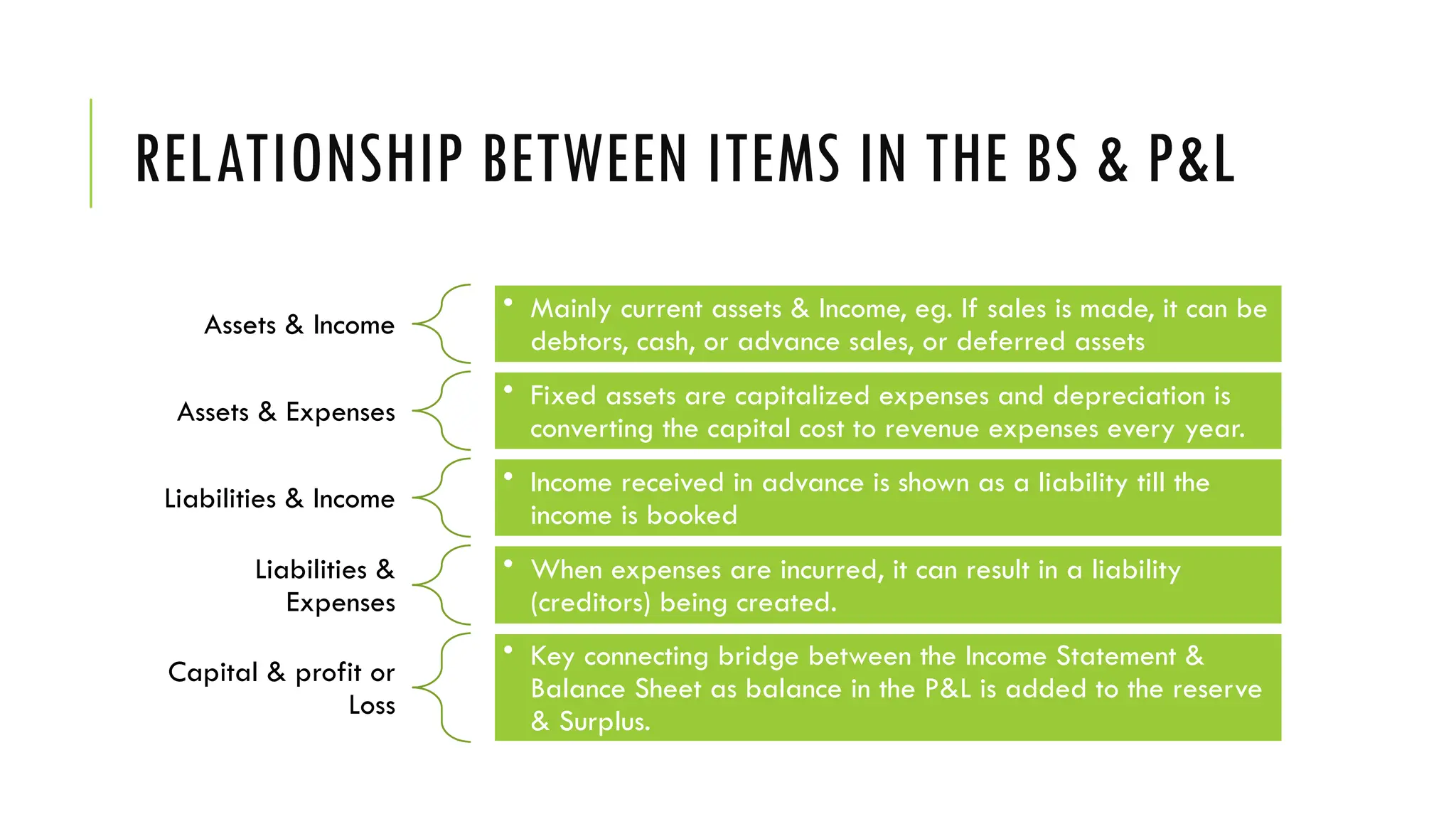
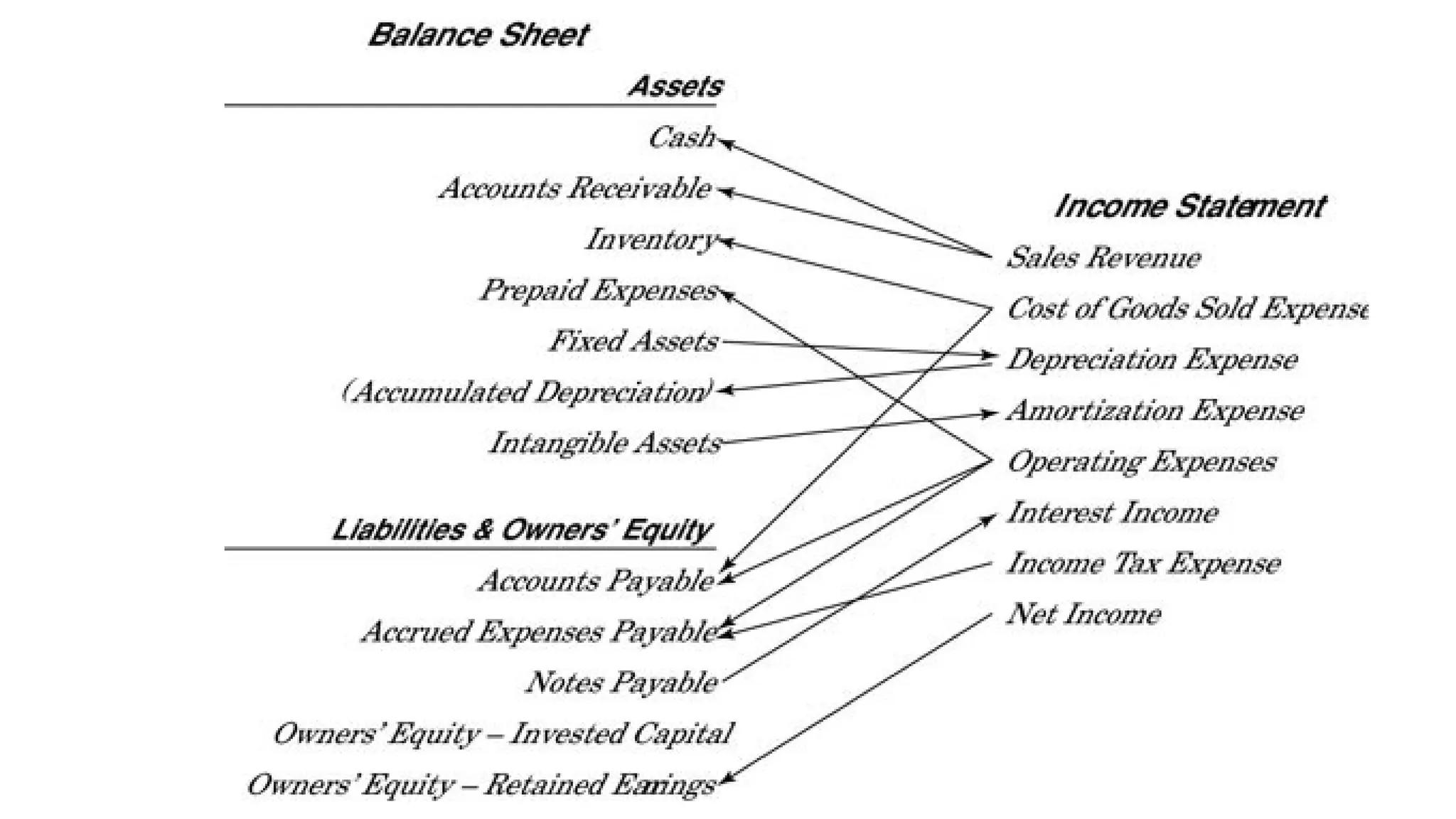
RELATIONSHIP BETWEEN ITEMS IN THE BS & P&L
Assets & Income
• Mainly current assets & Income, eg. If sales is made, it can be
debtors, cash, or advance sales, or deferred assets
Assets & Expenses
• Fixed assets are capitalized expenses and depreciation is
converting the capital cost to revenue expenses every year.
Liabilities & Income
• Income received in advance is shown as a liability till the
income is booked
Liabilities &
Expenses
• When expenses are incurred, it can result in a liability
(creditors) being created.
Capital & profit or
Loss
• Key connecting bridge between the Income Statement &
Balance Sheet as balance in the P&L is added to the reserve
& Surplus.
Vertical Format of Financial Statements.

Vertical Format of Financial Statements.

  • 1.
  • 2.
  • 3.
    CONVENTIONAL HORIZONTAL FORM ExpensesRs Income Rs To Opening Stock xx By Sales (Net) xx To Purchase (Net) xx By Closing Stock xx To Direct Expenses xx By Misc. Income xx To Other Expenses xx To Depreciation xx To Provision for Tax xx To Net Profit xx Total xxx Total xxx Income and closing stock on the right hand side and expenses and opening stock on the left hand side Direct income (Sales) is shown first, followed by Misc. Income and closing stock Opening Stock and Direct Costs (purchase of goods, freight) are shown first, followed by other expenses, depreciation and payment of taxes.
  • 4.
    NEED FOR VERTICALFORMAT Conventional form does not show gross profit, hence it is not possible to know if goods are sold above cost or not It does not classify expenses, into any category. Vertical format classifies expenses into operating expenses, administrative expenses, etc. This helps to analyse the relationship between expenses and sales and know whether the expenses are variable or fixed and so on. Conventional format does not show the net non-operating income. A proper financial analysis is possible only if profit is disclosed step by step. This is especially useful in Ratio Analysis.
  • 5.
    VERTICAL INCOME STATEMENTFORMAT Rs. Rs. Rs. Particulars SALES : Cash XX XX Credit XX Less: Sales Returns (XX) Net Sales XX Less: Cost of Goods Sold (COGS) Opening Stock XX XX Add: Purchases Less Returns XX Direct Expenses (labor, Overheads, Expenses of factory & Manufacturing Exp.) XX Less: Closing Stock (XX ) COGS (XX) Gross Profit (G.P = Sales – COGS) XX Add: Operating Income (OI) XX XX (Discount Received, B.D recovered, Commission on sales) Less: Operating Expenses (A) Administrative/Office Expenses XX XX (Depn on office items, Salary, stationery, Auditor’s & Director’s fees, any other office exp.) XX (B) Selling & Distribution Expenses XX XX (Salesman’s travelling/commission/salary, godown or warehouse exp, packing, Advt. etc. XX (C) Finance Expense XX XX (Bad Debts, Expense on raising capital .) XX Total Operating Expenses (A+B+C) (XX) Net Operating Profit (G.P + Op. Income - Operating Exp.) XX
  • 6.
    Add : Non- Operating Incomes (NOI) XX XX ( Rent, interest, dividend, royalty, commission received, Profit on sale of assets or XX investment , Misc. Income recd., any other non-recurring income) Less: Non - Operating Expenses (NOE) XX (XX) (Goodwill/ Preliminary Exp. w/o, Penalty paid, Loss on sale of Asset / Invt,, Loss due XX to fire or theft , any other non-recurring exp.) Earnings Before Interest and Tax(EBIT) ( Net Op. Profit (without interest) + NOI + NOE) XX Less : Interest on loan/Debenture, (XX) Net Profit Before Tax (NPBT) ( Net Op. Profit + NOI + NOE - Interest) XX Less: Tax/Taxation/ Provision for Tax (XX) Net Profit After Tax (NPAT) XX Add: Opening Balance P&L (cr.) XX Or (XX) Less: Opening Balance P&L (dr.) Less: Appropriations Transfer to Reserves XX (XX) Proposed Divided XX Interim Dividend XX RETAINED EARNINGS (Closing Balance) XX
  • 7.
    LINE ITEMS Sales Gross Salesis also known as Revenue from Operations/Turnover, it includes both cash and credit sales. *Allowances are trade discounts or allowance for defective goods
  • 8.
    COST OF GOODSSOLD COGS = Opening stock + Purchases + Direct Expenses + Depreciation –Scrap Sales - Closing Stock Therefore, COGS means cost of (i) materials, (ii) Labour and (iii) Factory overheads Purchases will include incidental expenses such as Inward Freight, Octroi and Import Duty. Thus, cost of purchases includes all expenses directly attributable to acquisition less traded discounts, rebates, duty drawbacks and other subsidies. Direct Expenses: These are expenses incurred for bringing goods to a saleable condition. In a manufacturing concern, costs such as wages, electricity, fuel, factory expenses etc. are included in direct expenses Depreciation: Depreciation on plant, factory etc. Scrap Sales: Scrap sales are deducted from cost of goods sold Less: Closing stock: the value of raw materials, WIP and finished goods on the last day of the accounting year.
  • 9.
    LINE ITEMS Profit onmanufacturing only, does not take into account selling & distribution exp. Operating Expenses Things to note – Normal bad debts will be part of selling exp and abnormal bad debts will be part of finance charges. Interest includes, interest on debentures or bonds, interest on loans from banks and financial institutions, interest on public deposits, interest on short-term loans.
  • 10.
  • 11.
    STEPS TO BEFOLLOWED TO SOLVE A SUM Going through the entire question first. Marking the adjustments if any and writing where each item will go i.e. the heading. Then write down the full format of Balance Sheet or P&L Account at a stretch. Then looking at the items in the Question fill up the Format, taking one item at a time from the question in the order given in the question. Put a tick on the item as you finish posting in the format so that you don’t miss any item.
  • 12.
    Trading and Profitand Loss Account for the Year ended 31st March, 2017 Particulars Rs. Particulars Rs. To Opening Stock 70,000 By Sales 16,60,000 To Purchases 15,30,000 By Closing Stock 1,60,000 ( - ) Returns 30,000 15,00,000 To Gross Profit 2,50,000 18,20,000 18,20,000 To Depreciation 36,000 By Gross Profit 2,50,000 To Administration Expenses 50,000 By Interest 10,000 To Selling & Distribution Expenses 24,000 To Provision for Income-tax 40,000 To Proposed Dividend 16,000 To Profit Balance 94,000 2,60,000 2,60,000
  • 13.
    Trading and Profitand Loss Account for the Year ended 31st March, 2017 Particulars Rs. Particulars Rs. To Opening Stock (COGS) 70,000 By Sales (Sales) 16,60,000 To Purchases (COGS) 15,30,000 By Closing Stock (COGS) 1,60,000 ( - ) Returns (Sales) 30,000 15,00,000 To Gross Profit 2,50,000 18,20,000 18,20,000 To Depreciation (O & A) 36,000 By Gross Profit 2,50,000 To Administration Expenses (O & A) 50,000 By Interest (non-op. inc) 10,000 To Selling & Distribution Expenses 24,000 To Provision for Income-tax (tax) 40,000 To Proposed Dividend (appro.) 16,000 To Profit Balance 94,000 2,60,000 2,60,000
  • 14.
  • 15.
    CONVENTIONAL/T-FORM • Assets onthe right hand side, Liabilities on the left • Assets are shown in order of permanence, Least liquid i.e. fixed assets followed by most liquid i.e. current assets. Even under this, items are arranged in order of permanence e.g. stock appears first, followed by cash balance • Liabilities are shown in order of priority of re- payment. E.g. Permanent liabilities i.e. Capital is shown first followed by Long Term Loans and then Short term Loans etc. Liabilities Rs Assets Rs Capital xx Fixed Assets xx Reserves & Surplus xx Investments xx Long Term Loans xx Current Assets xx Short Term Loans xx Loans & Advances xx Current Liabilities xx Provisions xx Total xxx xxx
  • 16.
    WHY CONVERT TOVERTICAL FORMAT? Horizontal format is made from the point of view of the owner of a firm It shows at a glance the total amount of funds owned and total amount of funds owed It helps to know which assets take time to sell and which can be liquidated quickly However, it is not suitable for Financial Analysis as the presentation and sequence of items are valid only in even of Liquidation, not for analysing a going concern A vertical format is more suitable for financial analysis, especially Ration Analysis.
  • 17.
    I. Source ofFunds: 1. Shareholder’s Funds: (a) Share capital Equity Preference Less: Calls Unpaid: Add: Forfeited Shares (b) Reserves and Surplus Capital Reserve Capital Redemption Reserve Securities Premium Other Reserves Profit and Loss Account Less: Deferred Revenue expenditure to the extent not written-off. Preliminary Expenses Discount on Issue of Shares Profit and Loss account (debit balance, if any) 2. Loan Funds: (a) Secured loans Debentures Loans and Advance from Banks Loans from subsidiary Companies (b) Unsecured loans Public Deposits TOTAL (Capital Employed)
  • 18.
    II. Application ofFunds 1. Non Current Assets: Tangible Assets Land Building Leasehold Premises Railway Sidings Plant and Machinery Furniture Vehicles Less: Provision for Depreciation Intangible Assets Goodwill Patents and Trademarks Less: Amortisation 2. Investments: Government or Trust Securities, Shares, Debentures, Bonds 3. Current Assets, Loans and Advances: Quick Sundry Debtors Cash and Bank balances Bills Receivable Interest Accrued on investments Other Current Assets Short term Loans and Advances Non Quick Loose Tools / Stock in Trade, Inventories Prepaid Expenses Less: Current Liabilities and Provisions: Quick liabilities & Provisions Bills payables Sundry Creditors Outstanding Expenses Provisions for Taxation Proposed Dividends Non Quick Bank Overdraft / Cash Credit Pre received Income TOTAL
  • 19.
    KEY DIFFERENCES In aVertical Balance Sheet, Current Liabilities are deducted from Current Assets to form the Working Capital Fictitious assets are deducted from Owner’s Funds At times, Application of funds (FA+WC) is shown first, followed by Sources of Funds (OF + LF) Net worth i.e. Owner’s Funds = Assets – Liabilities Total Funds Available is total of Own and Owed Funds Tangible Assets are shown at net cost, i.e. Cost – Depreciation
  • 20.
    QUICK ASSETS &QUICK LIABILITIES Quick Assets are those which are quickly realisable Quick Assets = Current Assets – Inventories & Prepayments Liabilities which are payable immediately are called quick liabilities. Overdraft is not, in practice immediately payable, so, Quick Liabilities = Current Liabilities – Bank Overdraft
  • 21.
    RELATIONSHIP BETWEEN ITEMSIN THE BS & P&L Assets & Income • Mainly current assets & Income, eg. If sales is made, it can be debtors, cash, or advance sales, or deferred assets Assets & Expenses • Fixed assets are capitalized expenses and depreciation is converting the capital cost to revenue expenses every year. Liabilities & Income • Income received in advance is shown as a liability till the income is booked Liabilities & Expenses • When expenses are incurred, it can result in a liability (creditors) being created. Capital & profit or Loss • Key connecting bridge between the Income Statement & Balance Sheet as balance in the P&L is added to the reserve & Surplus.