2 Understating Financial Statements
Key Concepts and Skills Know the difference type of financial statement Know the meaning of each financial statement Understand the definition of each account Understand how to prepare financial statement Know how to determine a firm’s cash flow from its financial statements
Type of Financial Statement Income Statement Statement of Equities Balance Sheet Statement of Cash Flow
Users of Financial Statement Managers Shareholders Creditors Suppliers Potential Investors Tax Authority
Balance Sheet  The balance sheet is a snapshot of the firm’s assets (owns) and liabilities (owes) at a given point in time.  In Cambodia, an annual balance sheet is normally prepared as at 31 December of each year. Balance Sheet Identity Assets = Liabilities + Stockholders’ Equity
The Balance Sheet
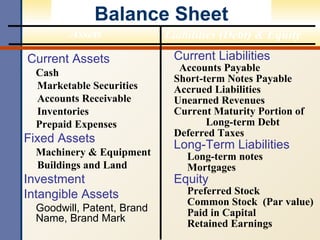
Balance Sheet Current Assets Cash Marketable Securities Accounts Receivable Inventories Prepaid Expenses Fixed Assets Machinery & Equipment Buildings and Land Investment Intangible Assets Goodwill, Patent, Brand Name, Brand Mark Assets Liabilities (Debt) & Equity Current Liabilities Accounts Payable Short-term Notes Payable Accrued Liabilities Unearned Revenues  Current Maturity Portion of  Long-term Debt Deferred Taxes  Long-Term Liabilities Long-term notes  Mortgages Equity Preferred Stock  Common Stock  (Par value) Paid in Capital Retained Earnings
Assets An asset is an item of value owned by the business.
Assets Current Assets :   assets that are relatively liquid, and are expected to be converted to cash within a year. Cash, marketable securities, accounts receivable, inventories, prepaid expenses. Property Plant, and Equipment :   machinery and equipment, buildings, and land. Investment Intangible Assets   such as patents and copyrights.
Cash The most liquid of assets Generally includes currency, coin, balances in checking and other demand or “near demand” accounts
Marketable Securities Refers to short-term investments that the firm INTENDS to hold for less than one year (thus a “current” asset) Generally reported on balance sheet at market value  May include t-bills, CDs, stocks, bonds Sometimes combined with cash and reported as Cash Equivalents
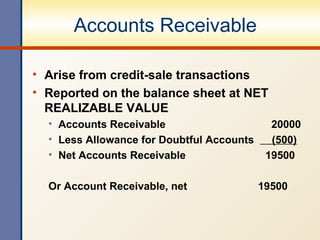
Accounts Receivable Arise from credit-sale transactions Reported on the balance sheet at NET REALIZABLE VALUE Accounts Receivable   20000 Less Allowance for Doubtful Accounts  (500) Net Accounts Receivable     19500 Or Account Receivable, net    19500
Inventory Consist of items held for sale or used in manufacture of goods for sale Merchandising Company one type of inventory (finished goods) Manufacturing Company three types of inventories (raw materials, work-in-process, finished goods)
Prepaid Expenses Represent expenses paid in advance -- included in current assets if they expire within one year or operating cycle Usually not a material item Present few or no reporting or valuation issues ON TO NONCURRENT ASSETS…….
Property, Plant & Equipment (PP&E) Often called “fixed assets” Represent  major resource commitments which benefit a firm for more than one year Recorded at HISTORICAL cost; cost allocated over asset’s useful life through DEPRECIATION (exception:  land is not depreciated) PP&E is reported on balance sheet at historical cost less accumulated depreciation to date
Investment Investments of a business represent assets of a permanent nature that will yield benefits a year or more after the date of the financial statement. These may include: investments in related companies such as affiliates (partly owned) and subsidiaries (owned and controlled); stocks and bonds maturing later than one year; securities placed in special funds; and fixed assets not used in production. The value of these items should be shown at cost.
Intangible Assets Resources with expected future economic benefits but lacking a physical substance Some examples are patents, copyrights, goodwill Goodwill can be material if firm is heavily involved in acquisition activity
LIABILITIES & EQUITIES REPRESENT CLAIMS TO ASSETS LIABILITIES:   Creditor Claims EQUITIES:   Owner Claims Constitute the “right” side of equation
LIABILITIES May be CURRENT or LONG-TERM -- same criteria of “one-year or operating cycle, whichever is longer” applies here as well Represent claims by creditors of the firm
A Look at Current Liabilities Accounts Payable Short-term Notes Payable Accrued Liabilities Unearned Revenues (Deferred Credits) Current Maturity Portion of Long-term Debt Deferred Taxes (some, not all or even most…)
…and Long-Term Liabilities? Notes or Mortgages Payables Bonds Payable Pension and Lease Obligations
Accounts Payable Usually defined as obligations arising from purchases of merchandise for resale or of raw materials Few valuation or reporting issues Significant changes from period to period often result from changes in sales volume
Short-Term Notes Payable Promissory notes due within a year (or operating cycle if more appropriate) Usually are interest-bearing Usually reported at face value because of short-term nature
Accrued Liabilities Result from accrual basis of accounting Represent expenses that have been INCURRED and thus ACCRUED, but have NOT BEEN PAID in cash Examples are Interest Payable and Wages Payable In this case, cash flow  follows  expense recognition
Unearned Revenue Sometimes called “deferred credits” Results from a prepayment received in advance for services or products Under accrual accounting, revenue is recognized when EARNED, not when received in cash -- in this case, cash flow  precedes  revenue recognition
Current Maturities - LT Debt Represent principal payments on debt that are due within one year Confirms the old adage that nothing is long-term forever -- eventually it has to be paid as a current item! Now, how about those items that are STILL LONG-TERM LIABILITIES
Notes or Mortgages Payable Represent any mortgages or notes payable that do not have any principal repayment requirements during the coming year
Bonds Payable Once again, represent items that do not have any principal payment requirements within the next year
Pension & Lease Obligations Generally reported at the present value of expected future cash outflows Can represent MAJOR liabilities for many firms and have a significant impact on the balance sheet
Stockholders’ Equity Represent claims to assets by OWNERS, i.e. stockholders Is often referred to as a RESIDUAL; this flows from a restatement of the basic equation: ASSETS - LIABILITIES = EQUITIES
More on Stockholders’ Equity Usually consists of STOCK ACCOUNTS AND ADDITIONAL PAID-IN CAPITAL and RETAINED EARNINGS -- may have other equity accounts May have more than one “class” of stock: common stock and one or more issues of preferred stock Shares of common stock represent ownership of the firm Stock usually has a PAR VALUE
STOCK AND ADDITIONAL PAID-IN CAPITAL Common and Preferred Stock accounts often carry balances representing “par value” of outstanding shares Preferred Stockholders :   received fixed dividends, and have higher priority than common stockholders in event of liquidation of the firm. Common Stockholders :   residual owners of a business.  They receive whatever is left after creditors and preferred stockholders are paid. Additional paid-in Capital accounts reflect balances over and above par value (from original sales of stock)
Retained Earnings In simplest terms, represents the cumulative undistributed earnings of the business since its inception Represent funds the company has chosen to “retain” and reinvest in the business RETAINED EARNINGS DOES NOT REPRESENT A PILE OF CASH!!!!!!!
Income Statement The income statement is more like a video of the firm’s operations for a specified period of time – “between balance sheets” (IS Equation: Rev-Expenses=Income). In Cambodia, the normal accounting period is the year ended 31 December. You generally report revenues first and then deduct any expenses for the period Matching principle – GAAP say to show revenue when it accrues (not necessarily when the cash comes in) and match the expenses required to generate the revenue
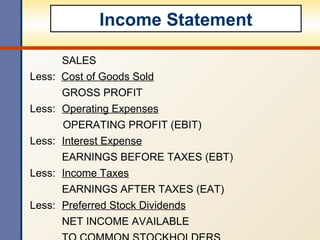
SALES Less:  Cost of Goods Sold GROSS PROFIT Less: Operating Expenses     OPERATING PROFIT (EBIT)  Less: Interest Expense EARNINGS BEFORE TAXES (EBT) Less:  Income Taxes EARNINGS AFTER TAXES (EAT) Less: Preferred Stock Dividends NET INCOME AVAILABLE TO COMMON STOCKHOLDERS Income Statement
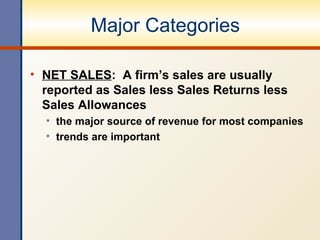
Major Categories NET SALES :  A firm’s sales are usually reported as Sales less Sales Returns less Sales Allowances the major source of revenue for most companies trends are important
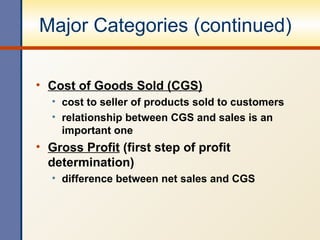
Major Categories (continued) Cost of Goods Sold (CGS) cost to seller of products sold to customers relationship between CGS and sales is an important one Gross Profit  (first step of profit determination) difference between net sales and CGS
Major Categories (continued) Operating Expenses Selling Expenses: Advertising Exp, Salary for Sale Staff, Commission………… Administrative Expenses:  Depreciation, Amortization, Repairs and Maintenance,……….
Major Categories (continued) Operating Profit  (second step of profit determination) -- also called EBIT measures overall performance of company’s operations: sales revenue less expenses. Interest Expense:
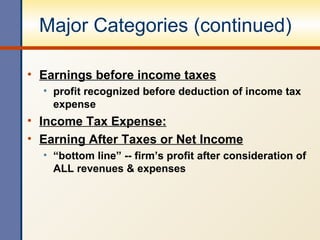
Major Categories (continued) Earnings before income taxes profit recognized before deduction of income tax expense Income Tax Expense: Earning After Taxes or Net Income “bottom line” -- firm’s profit after consideration of ALL revenues & expenses
Major Categories (continued) Preferred Stock Dividend: Net Income Available to Common Stockholders: Earnings per Common Share Determined by dividing earnings available to common shareholders (earnings less any preferred dividend requirements) by average number of common shares outstanding during the period
End of Chapter

Ch02..

  • 1.
  • 2.
    Key Concepts andSkills Know the difference type of financial statement Know the meaning of each financial statement Understand the definition of each account Understand how to prepare financial statement Know how to determine a firm’s cash flow from its financial statements
  • 3.
    Type of FinancialStatement Income Statement Statement of Equities Balance Sheet Statement of Cash Flow
  • 4.
    Users of FinancialStatement Managers Shareholders Creditors Suppliers Potential Investors Tax Authority
  • 5.
    Balance Sheet The balance sheet is a snapshot of the firm’s assets (owns) and liabilities (owes) at a given point in time. In Cambodia, an annual balance sheet is normally prepared as at 31 December of each year. Balance Sheet Identity Assets = Liabilities + Stockholders’ Equity
  • 6.
  • 7.
    Balance Sheet CurrentAssets Cash Marketable Securities Accounts Receivable Inventories Prepaid Expenses Fixed Assets Machinery & Equipment Buildings and Land Investment Intangible Assets Goodwill, Patent, Brand Name, Brand Mark Assets Liabilities (Debt) & Equity Current Liabilities Accounts Payable Short-term Notes Payable Accrued Liabilities Unearned Revenues Current Maturity Portion of Long-term Debt Deferred Taxes Long-Term Liabilities Long-term notes Mortgages Equity Preferred Stock Common Stock (Par value) Paid in Capital Retained Earnings
  • 8.
    Assets An assetis an item of value owned by the business.
  • 9.
    Assets Current Assets: assets that are relatively liquid, and are expected to be converted to cash within a year. Cash, marketable securities, accounts receivable, inventories, prepaid expenses. Property Plant, and Equipment : machinery and equipment, buildings, and land. Investment Intangible Assets such as patents and copyrights.
  • 10.
    Cash The mostliquid of assets Generally includes currency, coin, balances in checking and other demand or “near demand” accounts
  • 11.
    Marketable Securities Refersto short-term investments that the firm INTENDS to hold for less than one year (thus a “current” asset) Generally reported on balance sheet at market value May include t-bills, CDs, stocks, bonds Sometimes combined with cash and reported as Cash Equivalents
  • 12.
    Accounts Receivable Arisefrom credit-sale transactions Reported on the balance sheet at NET REALIZABLE VALUE Accounts Receivable 20000 Less Allowance for Doubtful Accounts (500) Net Accounts Receivable 19500 Or Account Receivable, net 19500
  • 13.
    Inventory Consist ofitems held for sale or used in manufacture of goods for sale Merchandising Company one type of inventory (finished goods) Manufacturing Company three types of inventories (raw materials, work-in-process, finished goods)
  • 14.
    Prepaid Expenses Representexpenses paid in advance -- included in current assets if they expire within one year or operating cycle Usually not a material item Present few or no reporting or valuation issues ON TO NONCURRENT ASSETS…….
  • 15.
    Property, Plant &Equipment (PP&E) Often called “fixed assets” Represent major resource commitments which benefit a firm for more than one year Recorded at HISTORICAL cost; cost allocated over asset’s useful life through DEPRECIATION (exception: land is not depreciated) PP&E is reported on balance sheet at historical cost less accumulated depreciation to date
  • 16.
    Investment Investments ofa business represent assets of a permanent nature that will yield benefits a year or more after the date of the financial statement. These may include: investments in related companies such as affiliates (partly owned) and subsidiaries (owned and controlled); stocks and bonds maturing later than one year; securities placed in special funds; and fixed assets not used in production. The value of these items should be shown at cost.
  • 17.
    Intangible Assets Resourceswith expected future economic benefits but lacking a physical substance Some examples are patents, copyrights, goodwill Goodwill can be material if firm is heavily involved in acquisition activity
  • 18.
    LIABILITIES & EQUITIESREPRESENT CLAIMS TO ASSETS LIABILITIES: Creditor Claims EQUITIES: Owner Claims Constitute the “right” side of equation
  • 19.
    LIABILITIES May beCURRENT or LONG-TERM -- same criteria of “one-year or operating cycle, whichever is longer” applies here as well Represent claims by creditors of the firm
  • 20.
    A Look atCurrent Liabilities Accounts Payable Short-term Notes Payable Accrued Liabilities Unearned Revenues (Deferred Credits) Current Maturity Portion of Long-term Debt Deferred Taxes (some, not all or even most…)
  • 21.
    …and Long-Term Liabilities?Notes or Mortgages Payables Bonds Payable Pension and Lease Obligations
  • 22.
    Accounts Payable Usuallydefined as obligations arising from purchases of merchandise for resale or of raw materials Few valuation or reporting issues Significant changes from period to period often result from changes in sales volume
  • 23.
    Short-Term Notes PayablePromissory notes due within a year (or operating cycle if more appropriate) Usually are interest-bearing Usually reported at face value because of short-term nature
  • 24.
    Accrued Liabilities Resultfrom accrual basis of accounting Represent expenses that have been INCURRED and thus ACCRUED, but have NOT BEEN PAID in cash Examples are Interest Payable and Wages Payable In this case, cash flow follows expense recognition
  • 25.
    Unearned Revenue Sometimescalled “deferred credits” Results from a prepayment received in advance for services or products Under accrual accounting, revenue is recognized when EARNED, not when received in cash -- in this case, cash flow precedes revenue recognition
  • 26.
    Current Maturities -LT Debt Represent principal payments on debt that are due within one year Confirms the old adage that nothing is long-term forever -- eventually it has to be paid as a current item! Now, how about those items that are STILL LONG-TERM LIABILITIES
  • 27.
    Notes or MortgagesPayable Represent any mortgages or notes payable that do not have any principal repayment requirements during the coming year
  • 28.
    Bonds Payable Onceagain, represent items that do not have any principal payment requirements within the next year
  • 29.
    Pension & LeaseObligations Generally reported at the present value of expected future cash outflows Can represent MAJOR liabilities for many firms and have a significant impact on the balance sheet
  • 30.
    Stockholders’ Equity Representclaims to assets by OWNERS, i.e. stockholders Is often referred to as a RESIDUAL; this flows from a restatement of the basic equation: ASSETS - LIABILITIES = EQUITIES
  • 31.
    More on Stockholders’Equity Usually consists of STOCK ACCOUNTS AND ADDITIONAL PAID-IN CAPITAL and RETAINED EARNINGS -- may have other equity accounts May have more than one “class” of stock: common stock and one or more issues of preferred stock Shares of common stock represent ownership of the firm Stock usually has a PAR VALUE
  • 32.
    STOCK AND ADDITIONALPAID-IN CAPITAL Common and Preferred Stock accounts often carry balances representing “par value” of outstanding shares Preferred Stockholders : received fixed dividends, and have higher priority than common stockholders in event of liquidation of the firm. Common Stockholders : residual owners of a business. They receive whatever is left after creditors and preferred stockholders are paid. Additional paid-in Capital accounts reflect balances over and above par value (from original sales of stock)
  • 33.
    Retained Earnings Insimplest terms, represents the cumulative undistributed earnings of the business since its inception Represent funds the company has chosen to “retain” and reinvest in the business RETAINED EARNINGS DOES NOT REPRESENT A PILE OF CASH!!!!!!!
  • 34.
    Income Statement Theincome statement is more like a video of the firm’s operations for a specified period of time – “between balance sheets” (IS Equation: Rev-Expenses=Income). In Cambodia, the normal accounting period is the year ended 31 December. You generally report revenues first and then deduct any expenses for the period Matching principle – GAAP say to show revenue when it accrues (not necessarily when the cash comes in) and match the expenses required to generate the revenue
  • 35.
    SALES Less: Cost of Goods Sold GROSS PROFIT Less: Operating Expenses OPERATING PROFIT (EBIT) Less: Interest Expense EARNINGS BEFORE TAXES (EBT) Less: Income Taxes EARNINGS AFTER TAXES (EAT) Less: Preferred Stock Dividends NET INCOME AVAILABLE TO COMMON STOCKHOLDERS Income Statement
  • 36.
    Major Categories NETSALES : A firm’s sales are usually reported as Sales less Sales Returns less Sales Allowances the major source of revenue for most companies trends are important
  • 37.
    Major Categories (continued)Cost of Goods Sold (CGS) cost to seller of products sold to customers relationship between CGS and sales is an important one Gross Profit (first step of profit determination) difference between net sales and CGS
  • 38.
    Major Categories (continued)Operating Expenses Selling Expenses: Advertising Exp, Salary for Sale Staff, Commission………… Administrative Expenses: Depreciation, Amortization, Repairs and Maintenance,……….
  • 39.
    Major Categories (continued)Operating Profit (second step of profit determination) -- also called EBIT measures overall performance of company’s operations: sales revenue less expenses. Interest Expense:
  • 40.
    Major Categories (continued)Earnings before income taxes profit recognized before deduction of income tax expense Income Tax Expense: Earning After Taxes or Net Income “bottom line” -- firm’s profit after consideration of ALL revenues & expenses
  • 41.
    Major Categories (continued)Preferred Stock Dividend: Net Income Available to Common Stockholders: Earnings per Common Share Determined by dividing earnings available to common shareholders (earnings less any preferred dividend requirements) by average number of common shares outstanding during the period
  • 42.

Editor's Notes

  • #6 Liquidity is a very important concept. Students tend to remember the “convert to cash quickly” component of liquidity, but often forget the part about “without loss of value.” Remind them that we can convert anything to cash quickly if we are willing to lower the price enough, but that doesn’t mean it is liquid. Also, point out that a firm can be TOO liquid. Excess cash holdings lead to overall lower returns. See the IM for a more complete discussion of this issue.
  • #7 The left-hand side lists the assets of the firm. Current assets are listed first because they are the most liquid. Fixed assets can include both tangible and intangible assets, and they are listed at the bottom because they generally are not very liquid. These are direct result of management’s investment decisions. (Please emphasize that “investment decisions” are not limited to investments in financial assets.) Note that the balance sheet does not list some very valuable assets, such as the people who work for the firm. The liabilities and equity (or ownership) components of the firm are listed on the right-hand side. This indicates how the assets are paid for. Since the balance sheet has to balance, total equity = total assets – total liabilities. The portion of equity that can most easily fluctuate to create this balance is retained earnings. The right-hand side of the balance sheet is a direct result of management’s financing decisions. Remember that shareholders’ equity consists of several components and that total equity includes all of these components not just the “common stock” item. In particular, remind students that retained earnings belong to the shareholders.
  • #35 Matching principle – this principle leads to non-cash deductions like depreciation. This is why net income is NOT a measure of the cash flow during the period.