Financial Projections HACC Institute for Entrepreneurial Studies David McNaughton  221-1213  [email_address]
The Ambiguous Financial World How do you handle it?
Dealing with Bankers and Accountants Learn some of the terminology What does the bank look for? Sources of funding Investors
Expectations from this class Understand what your own personal financial obligations are for the next 12 months Use that information to prepare your business forecast Understand the basic accounting terms What records are required by law to be kept Use of the three basic financial sheets
Reason to Keep Records Law  Must be separate, complete, permanent, and accurate Management To properly evaluate your business Assist in decision making
Outside Help If you will be using an accountant for taxes, meet with him prior to the start of your business so that he can help you define exactly what records should be kept Then evaluate how you will create these records – computerized or handwritten ledgers Doing this correctly from the beginning is essential
Personal Budgeting What income do you need to survive? Completing the personal budgeting statement The importance of this information How is this related to my business development?
Personal Budget Preparation Start with all your income Then list actual expenses or calculate an average Plan for savings Adjustments Determine minimum living expenses
Minimum Living expenses Worksheet What does this tell us? How does this relate to my business?
Vocabulary  (The Basics) Account payable – A liability backed by the general reputation and credit standing of the deptor Account receivable – A promise to receive cash from a customer for whom goods and/or services have been provided by the activity Accrual Basis Accounting – Accounting that records the impact of a business event as it occurs, regardless of whether the transaction affected cash.
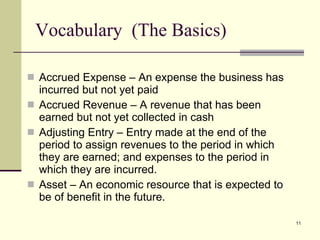
Vocabulary  (The Basics) Accrued Expense – An expense the business has incurred but not yet paid Accrued Revenue – A revenue that has been earned but not yet collected in cash Adjusting Entry – Entry made at the end of the period to assign revenues to the period in which they are earned; and expenses to the period in which they are incurred. Asset – An economic resource that is expected to be of benefit in the future.
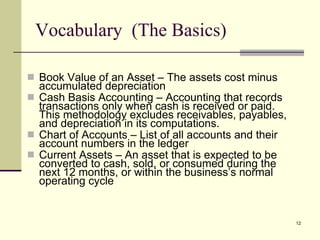
Vocabulary  (The Basics) Book Value of an Asset – The assets cost minus accumulated depreciation Cash Basis Accounting – Accounting that records transactions only when cash is received or paid. This methodology excludes receivables, payables, and depreciation in its computations. Chart of Accounts – List of all accounts and their account numbers in the ledger Current Assets – An asset that is expected to be converted to cash, sold, or consumed during the next 12 months, or within the business’s normal operating cycle
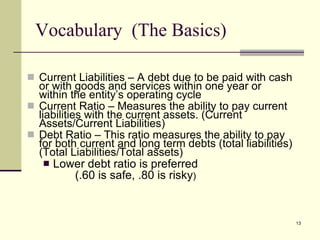
Vocabulary  (The Basics) Current Liabilities – A debt due to be paid with cash or with goods and services within one year or within the entity’s operating cycle Current Ratio – Measures the ability to pay current liabilities with the current assets. (Current Assets/Current Liabilities)  Debt Ratio – This ratio measures the ability to pay for both current and long term debts (total liabilities) (Total Liabilities/Total assets) Lower debt ratio is preferred (.60 is safe, .80 is risky )
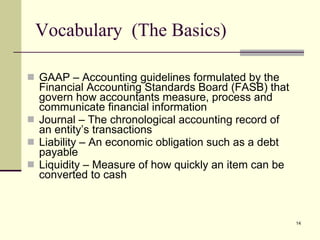
Vocabulary  (The Basics) GAAP – Accounting guidelines formulated by the Financial Accounting Standards Board (FASB) that govern how accountants measure, process and communicate financial information Journal – The chronological accounting record of an entity’s transactions Liability – An economic obligation such as a debt payable Liquidity – Measure of how quickly an item can be converted to cash
Vocabulary  (The Basics) Matching principle – The basis for recording expenses (Identify all expenses, measure expenses and match them against the revenues earned in the same span of time) Net Income – Excess of total revenues over total expenses. (Net Earnings or Net Profit) Net Loss – Excess of total expenses over total revenues Note Payable – A written promise of future payment
Vocabulary  (The Basics) Note Receivable – A written promise for future collection of cash Posting – Copying amounts from the journal to the ledger Revenue – Amounts earned by delivering goods or services to a customer Transaction – An event that affects the financial position of a particular  entity and can be recorded later Trial Balance – A list of all accounts with their balances taken from the ledger used to ensure that total debits equal total credits
Vocabulary  (The Basics) Unearned Revenue – A liability created when a business collects cash from customers in advance of doing work (deferred income)
Business Records Sales records Cash Receipts Cash Disbursements Accounts Receivable Capital Equipment Insurance Payroll
Sales Record All income derived from the sale of your product or service One category or many as total sales  Or many by different products or service
Cash Receipts Money generated through cash sales Money collected from accounts receivable not your sales numbers A cash & carry business only accepts cash at point of sale so all receipts are considered cash
Cash Disbursements Operating expenses or accounts payable Pay by check Problems with petty cash accounts Records kept together Check, invoice, receipt, and record
Accounts Receivable Sales from credit ( not credit cards) Managed monthly and aged Be prudent with extensions of credit beyond 60 days
Capital Equipment Detailed Records on major purchases What is major? Only items you would depreciate Not leased equipment Record should include Date purchased Vendor Description  How paid for Check number
Insurance Records of all insurance Include carriers List of filed claims
Payroll All payroll tax information for at least four years There are 20 different kinds of employee records that must be kept
Ways to keep track of records Bookkeeping Computerized
List of records to keep Amount and sources of gross receipts Cash register tapes Bank deposit slips Receipt Books Invoices Credit card charge slips Any 1099-MISC forms
List of records to keep Purchases Cancelled Checks Cash register receipts Credit card sales slips Invoices
List of records to keep Expenses Cancelled checks Cash register tapes Account statements Credit card sales slips Invoices Petty cash Slips and records Expenses that are subject to special rules
List of records to keep Assets When and how acquired Purchased price Cost of improvements Deductions taken How asset was used How and when asset was disposed of Selling price Expenses of sale
How records are kept Journals and ledgers Business checkbook and reconciliation Single verse double entry system Computerized Microfilm Electronic storage
Cash Accounting vs Accrual  When do I have to use Accural Inventory Accepting credit Not credit cards Structure of business
Financial Statements Balance Sheet Income Statement  (or Profit Statement) Statement of Cash Flow
Order of Importance Cash Flow Statement Balance Sheet Income Statement
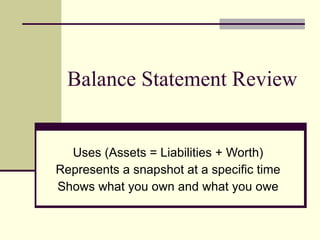
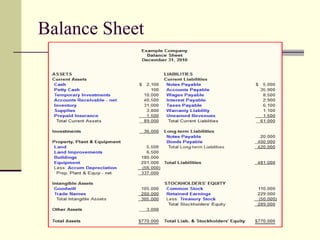
Balance Statement Review Uses (Assets = Liabilities + Worth) Represents a snapshot at a specific time Shows what you own and what you owe
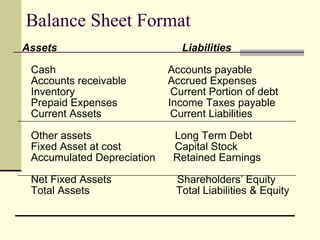
Balance Sheet Format Assets Liabilities Cash   Accounts payable Accounts receivable   Accrued Expenses Inventory  Current Portion of debt Prepaid Expenses  Income Taxes payable Current Assets  Current Liabilities Other assets  Long Term Debt Fixed Asset at cost  Capital Stock Accumulated Depreciation  Retained Earnings Net Fixed Assets  Shareholders’ Equity Total Assets  Total Liabilities & Equity
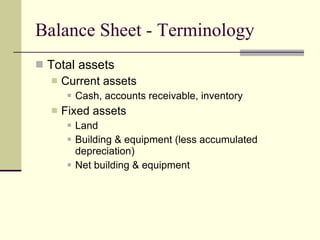
Balance Sheet - Terminology Total assets Current assets Cash, accounts receivable, inventory Fixed assets Land Building & equipment (less accumulated depreciation) Net building & equipment
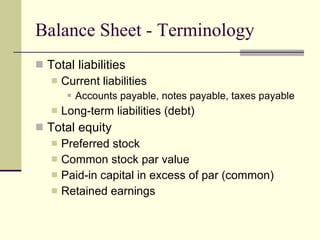
Balance Sheet - Terminology Total liabilities Current liabilities Accounts payable, notes payable, taxes payable Long-term liabilities (debt) Total equity Preferred stock Common stock par value  Paid-in capital in excess of par (common) Retained earnings
Balance Sheet
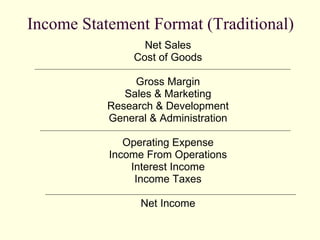
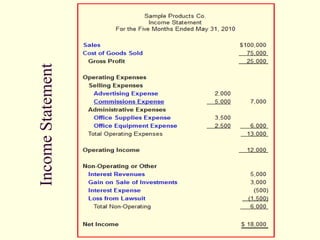
Income Statement Review Sales – Costs – Expenses = Income For a Period of Time Usually a Quarter or Year
Income Statement Format (Traditional) Net Sales Cost of Goods Gross Margin Sales & Marketing Research & Development General & Administration Operating Expense Income From Operations Interest Income Income Taxes Net Income
Income Statement
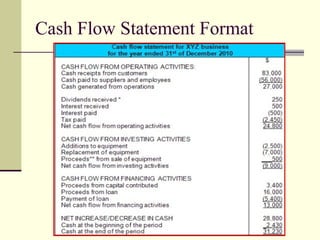
Cash Flow Statement Think of as a Check Register Summary Shows cash in, cash out, and balance.
Cash Flow Statement Format
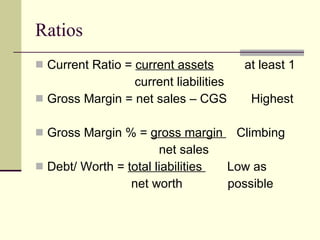
Ratios Current Ratio =  current assets   at least 1   current liabilities Gross Margin = net sales – CGS  Highest Gross Margin % =  gross margin  Climbing   net sales Debt/ Worth =  total liabilities  Low as  net worth  possible
More Ratios Review of other ratios Quick Ratio Debt Ratio Inventory Turnover Days Sales Outstanding Investment Turn-over ratio Operating Margin Gross Margin Net Margin ROI, ROA, ROE
Financial Projection Tool www.entr-203.wikispaces.com

Financial projections 2011 hu

  • 1.
    Financial Projections HACCInstitute for Entrepreneurial Studies David McNaughton 221-1213 [email_address]
  • 2.
    The Ambiguous FinancialWorld How do you handle it?
  • 3.
    Dealing with Bankersand Accountants Learn some of the terminology What does the bank look for? Sources of funding Investors
  • 4.
    Expectations from thisclass Understand what your own personal financial obligations are for the next 12 months Use that information to prepare your business forecast Understand the basic accounting terms What records are required by law to be kept Use of the three basic financial sheets
  • 5.
    Reason to KeepRecords Law Must be separate, complete, permanent, and accurate Management To properly evaluate your business Assist in decision making
  • 6.
    Outside Help Ifyou will be using an accountant for taxes, meet with him prior to the start of your business so that he can help you define exactly what records should be kept Then evaluate how you will create these records – computerized or handwritten ledgers Doing this correctly from the beginning is essential
  • 7.
    Personal Budgeting Whatincome do you need to survive? Completing the personal budgeting statement The importance of this information How is this related to my business development?
  • 8.
    Personal Budget PreparationStart with all your income Then list actual expenses or calculate an average Plan for savings Adjustments Determine minimum living expenses
  • 9.
    Minimum Living expensesWorksheet What does this tell us? How does this relate to my business?
  • 10.
    Vocabulary (TheBasics) Account payable – A liability backed by the general reputation and credit standing of the deptor Account receivable – A promise to receive cash from a customer for whom goods and/or services have been provided by the activity Accrual Basis Accounting – Accounting that records the impact of a business event as it occurs, regardless of whether the transaction affected cash.
  • 11.
    Vocabulary (TheBasics) Accrued Expense – An expense the business has incurred but not yet paid Accrued Revenue – A revenue that has been earned but not yet collected in cash Adjusting Entry – Entry made at the end of the period to assign revenues to the period in which they are earned; and expenses to the period in which they are incurred. Asset – An economic resource that is expected to be of benefit in the future.
  • 12.
    Vocabulary (TheBasics) Book Value of an Asset – The assets cost minus accumulated depreciation Cash Basis Accounting – Accounting that records transactions only when cash is received or paid. This methodology excludes receivables, payables, and depreciation in its computations. Chart of Accounts – List of all accounts and their account numbers in the ledger Current Assets – An asset that is expected to be converted to cash, sold, or consumed during the next 12 months, or within the business’s normal operating cycle
  • 13.
    Vocabulary (TheBasics) Current Liabilities – A debt due to be paid with cash or with goods and services within one year or within the entity’s operating cycle Current Ratio – Measures the ability to pay current liabilities with the current assets. (Current Assets/Current Liabilities) Debt Ratio – This ratio measures the ability to pay for both current and long term debts (total liabilities) (Total Liabilities/Total assets) Lower debt ratio is preferred (.60 is safe, .80 is risky )
  • 14.
    Vocabulary (TheBasics) GAAP – Accounting guidelines formulated by the Financial Accounting Standards Board (FASB) that govern how accountants measure, process and communicate financial information Journal – The chronological accounting record of an entity’s transactions Liability – An economic obligation such as a debt payable Liquidity – Measure of how quickly an item can be converted to cash
  • 15.
    Vocabulary (TheBasics) Matching principle – The basis for recording expenses (Identify all expenses, measure expenses and match them against the revenues earned in the same span of time) Net Income – Excess of total revenues over total expenses. (Net Earnings or Net Profit) Net Loss – Excess of total expenses over total revenues Note Payable – A written promise of future payment
  • 16.
    Vocabulary (TheBasics) Note Receivable – A written promise for future collection of cash Posting – Copying amounts from the journal to the ledger Revenue – Amounts earned by delivering goods or services to a customer Transaction – An event that affects the financial position of a particular entity and can be recorded later Trial Balance – A list of all accounts with their balances taken from the ledger used to ensure that total debits equal total credits
  • 17.
    Vocabulary (TheBasics) Unearned Revenue – A liability created when a business collects cash from customers in advance of doing work (deferred income)
  • 18.
    Business Records Salesrecords Cash Receipts Cash Disbursements Accounts Receivable Capital Equipment Insurance Payroll
  • 19.
    Sales Record Allincome derived from the sale of your product or service One category or many as total sales Or many by different products or service
  • 20.
    Cash Receipts Moneygenerated through cash sales Money collected from accounts receivable not your sales numbers A cash & carry business only accepts cash at point of sale so all receipts are considered cash
  • 21.
    Cash Disbursements Operatingexpenses or accounts payable Pay by check Problems with petty cash accounts Records kept together Check, invoice, receipt, and record
  • 22.
    Accounts Receivable Salesfrom credit ( not credit cards) Managed monthly and aged Be prudent with extensions of credit beyond 60 days
  • 23.
    Capital Equipment DetailedRecords on major purchases What is major? Only items you would depreciate Not leased equipment Record should include Date purchased Vendor Description How paid for Check number
  • 24.
    Insurance Records ofall insurance Include carriers List of filed claims
  • 25.
    Payroll All payrolltax information for at least four years There are 20 different kinds of employee records that must be kept
  • 26.
    Ways to keeptrack of records Bookkeeping Computerized
  • 27.
    List of recordsto keep Amount and sources of gross receipts Cash register tapes Bank deposit slips Receipt Books Invoices Credit card charge slips Any 1099-MISC forms
  • 28.
    List of recordsto keep Purchases Cancelled Checks Cash register receipts Credit card sales slips Invoices
  • 29.
    List of recordsto keep Expenses Cancelled checks Cash register tapes Account statements Credit card sales slips Invoices Petty cash Slips and records Expenses that are subject to special rules
  • 30.
    List of recordsto keep Assets When and how acquired Purchased price Cost of improvements Deductions taken How asset was used How and when asset was disposed of Selling price Expenses of sale
  • 31.
    How records arekept Journals and ledgers Business checkbook and reconciliation Single verse double entry system Computerized Microfilm Electronic storage
  • 32.
    Cash Accounting vsAccrual When do I have to use Accural Inventory Accepting credit Not credit cards Structure of business
  • 33.
    Financial Statements BalanceSheet Income Statement (or Profit Statement) Statement of Cash Flow
  • 34.
    Order of ImportanceCash Flow Statement Balance Sheet Income Statement
  • 35.
    Balance Statement ReviewUses (Assets = Liabilities + Worth) Represents a snapshot at a specific time Shows what you own and what you owe
  • 36.
    Balance Sheet FormatAssets Liabilities Cash Accounts payable Accounts receivable Accrued Expenses Inventory Current Portion of debt Prepaid Expenses Income Taxes payable Current Assets Current Liabilities Other assets Long Term Debt Fixed Asset at cost Capital Stock Accumulated Depreciation Retained Earnings Net Fixed Assets Shareholders’ Equity Total Assets Total Liabilities & Equity
  • 37.
    Balance Sheet -Terminology Total assets Current assets Cash, accounts receivable, inventory Fixed assets Land Building & equipment (less accumulated depreciation) Net building & equipment
  • 38.
    Balance Sheet -Terminology Total liabilities Current liabilities Accounts payable, notes payable, taxes payable Long-term liabilities (debt) Total equity Preferred stock Common stock par value Paid-in capital in excess of par (common) Retained earnings
  • 39.
  • 40.
    Income Statement ReviewSales – Costs – Expenses = Income For a Period of Time Usually a Quarter or Year
  • 41.
    Income Statement Format(Traditional) Net Sales Cost of Goods Gross Margin Sales & Marketing Research & Development General & Administration Operating Expense Income From Operations Interest Income Income Taxes Net Income
  • 42.
  • 43.
    Cash Flow StatementThink of as a Check Register Summary Shows cash in, cash out, and balance.
  • 44.
  • 45.
    Ratios Current Ratio= current assets at least 1 current liabilities Gross Margin = net sales – CGS Highest Gross Margin % = gross margin Climbing net sales Debt/ Worth = total liabilities Low as net worth possible
  • 46.
    More Ratios Reviewof other ratios Quick Ratio Debt Ratio Inventory Turnover Days Sales Outstanding Investment Turn-over ratio Operating Margin Gross Margin Net Margin ROI, ROA, ROE
  • 47.
    Financial Projection Toolwww.entr-203.wikispaces.com