ACCOUNTING FOR MANAGEMENT.
PRESENTED BY:
Team A.B.L.A.Z.E.
- Burning Bright, Bringing
Light to our Generation.
Come, Let’s together take a
tour on the 3 companies of
our choice.
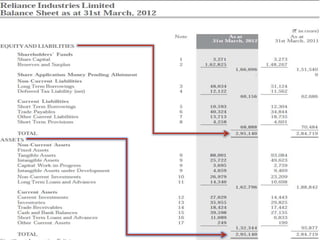
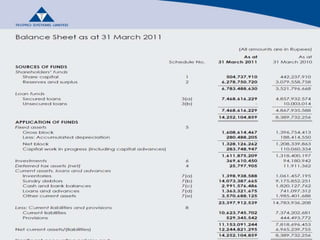
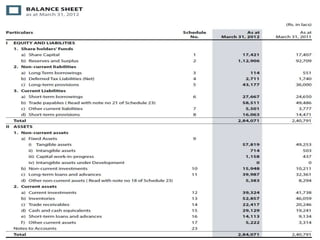
Let us now have a Glance
at the Annual Financial
Statements of these
Companies.
Confused???
Allow me to Help You.
WHAT IS A BALANCE SHEET?
 A Statement showing the ‘Assets’ and
‘Liabilities’ of a business at a certain
date.
AND,
WHY DOES LIABILITIES HAVE
TO BE EQUAL TO ASSETS
??
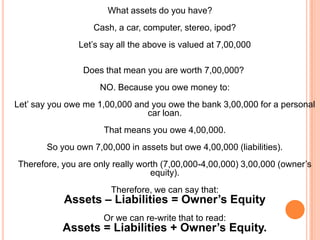
What assets do you have?
Cash, a car, computer, stereo, ipod?
Let’s say all the above is valued at 7,00,000
Does that mean you are worth 7,00,000?
NO. Because you owe money to:
Let’ say you owe me 1,00,000 and you owe the bank 3,00,000 for a personal
car loan.
That means you owe 4,00,000.
So you own 7,00,000 in assets but owe 4,00,000 (liabilities).
Therefore, you are only really worth (7,00,000-4,00,000) 3,00,000 (owner’s
equity).
Therefore, we can say that:
Assets – Liabilities = Owner’s Equity
Or we can re-write that to read:
Assets = Liabilities + Owner’s Equity.
BACK TO BALANCE SHEETS.
Here’s an Exhaustive List of the
Items in a Balance Sheet.
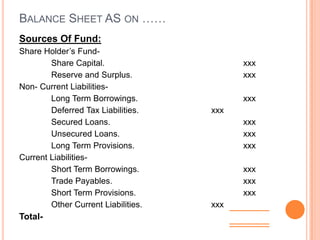
BALANCE SHEET AS ON ……
Sources Of Fund:
Share Holder’s Fund-
Share Capital. xxx
Reserve and Surplus. xxx
Non- Current Liabilities-
Long Term Borrowings. xxx
Deferred Tax Liabilities. xxx
Secured Loans. xxx
Unsecured Loans. xxx
Long Term Provisions. xxx
Current Liabilities-
Short Term Borrowings. xxx
Trade Payables. xxx
Short Term Provisions. xxx
Other Current Liabilities. xxx
Total-
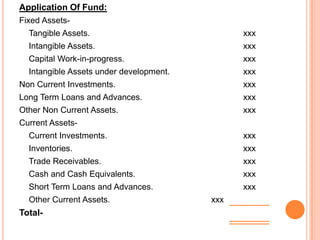
Application Of Fund:
Fixed Assets-
Tangible Assets. xxx
Intangible Assets. xxx
Capital Work-in-progress. xxx
Intangible Assets under development. xxx
Non Current Investments. xxx
Long Term Loans and Advances. xxx
Other Non Current Assets. xxx
Current Assets-
Current Investments. xxx
Inventories. xxx
Trade Receivables. xxx
Cash and Cash Equivalents. xxx
Short Term Loans and Advances. xxx
Other Current Assets. xxx
Total-
AND FINALLY:
GLOSSARY-
 Share Capital- The amount of share capital a company
reports on its balance sheet only accounts for the initial
amount for which the original shareholders purchased the
shares from the issuing company. Any price differences
arising from price appreciation/depreciation as a result of
transactions in the secondary market are not included.
For example, suppose ABC Inc. raised $2 billion from its initial
public offering. Over the next year, the total value of its shares
increases to $5 billion. In this case, the value of the share
capital is still only $2 billion because ABC Inc. had received
only $2 billion from the sale of its securities to the investing
public.
 Reserves and surplus- At the end of an accounting period
the company may decide to transfer part of the profits to a
reserve and retain the balance in the profit and loss account. The
reserve created out of profits transferred from profit and loss
account is called general reserve. The balance in the profit and
loss account is called a surplus and will be shown under this
head in the balance sheet.
The company can use the general reserve for various purposes
including issue of bonus shares to shareholders and payment of
dividend when profits are insufficient.
The premium received when shares are issued at a premium to
the face value is shown under the head reserves and surplus.
 Deferred Tax Liabilities- Because there are differences
between what a company can deduct for tax and accounting
purposes, there will be a difference between a company's taxable
income and income before tax. A deferred tax liability records the
fact that the company will, in the future, pay more income tax
because of a transaction that took place during the current
period, such as an installment sale receivable.
 Secured Loans and Unsecured Loans- If a loan is
‘secured’, it means it is secured against something you own (an
‘asset’) – and failing to repay the loan could result in the lender
taking possession of that asset, and selling it to cover their
losses. An unsecured loan does not require you to secure anything
against the loan – the lender relies on your contractual obligation
to pay it back.
Because there is no security and the risk they are taking is
therefore greater, the amount you can borrow tends to be less, and
the repayment period is usually shorter.
 Provisions- Money earmarked for potential future expenses. A
sum set aside in the accounts of an organization in anticipation of
a future expense, often for doubtful debts is called Provisions.
Could be Long Term as well as Short Term.
 Trade Payables- Liabilities owed to suppliers for purchases or
services rendered. More commonly referred to as Accounts
Payable.
 Intangible Assets- An asset that is not physical in nature.
Corporate intellectual property (items such as
patents, trademarks, copyrights, business
methodologies), goodwill and brand recognition are all common
intangible assets in today's marketplace.
 Work-in-Progress- Material that has entered the production
process but is not yet a finished product. Work in progress (WIP)
therefore refers to all materials and partly finished products that
are at various stages of the production process.
 Non-current Investments- A Company’s long term
investments.
 Trade Receivables- Accounts receivable also known as
Debtors, is money owed to a business by its clients (customers)
and shown on its balance sheet as an asset. It is one of a series
of accounting transactions dealing with the billing of
a customer for goods and services that the customer has
ordered.
HOPE WE COULD HELP YOU
UNDERSTAND THE BALANCE
SHEET.
Thank
You. 

Understanding the Balance Sheet.

  • 1.
    ACCOUNTING FOR MANAGEMENT. PRESENTEDBY: Team A.B.L.A.Z.E. - Burning Bright, Bringing Light to our Generation.
  • 2.
    Come, Let’s togethertake a tour on the 3 companies of our choice.
  • 7.
    Let us nowhave a Glance at the Annual Financial Statements of these Companies.
  • 11.
  • 12.
    WHAT IS ABALANCE SHEET?  A Statement showing the ‘Assets’ and ‘Liabilities’ of a business at a certain date.
  • 13.
    AND, WHY DOES LIABILITIESHAVE TO BE EQUAL TO ASSETS ??
  • 14.
    What assets doyou have? Cash, a car, computer, stereo, ipod? Let’s say all the above is valued at 7,00,000 Does that mean you are worth 7,00,000? NO. Because you owe money to: Let’ say you owe me 1,00,000 and you owe the bank 3,00,000 for a personal car loan. That means you owe 4,00,000. So you own 7,00,000 in assets but owe 4,00,000 (liabilities). Therefore, you are only really worth (7,00,000-4,00,000) 3,00,000 (owner’s equity). Therefore, we can say that: Assets – Liabilities = Owner’s Equity Or we can re-write that to read: Assets = Liabilities + Owner’s Equity.
  • 15.
    BACK TO BALANCESHEETS. Here’s an Exhaustive List of the Items in a Balance Sheet.
  • 16.
    BALANCE SHEET ASON …… Sources Of Fund: Share Holder’s Fund- Share Capital. xxx Reserve and Surplus. xxx Non- Current Liabilities- Long Term Borrowings. xxx Deferred Tax Liabilities. xxx Secured Loans. xxx Unsecured Loans. xxx Long Term Provisions. xxx Current Liabilities- Short Term Borrowings. xxx Trade Payables. xxx Short Term Provisions. xxx Other Current Liabilities. xxx Total-
  • 17.
    Application Of Fund: FixedAssets- Tangible Assets. xxx Intangible Assets. xxx Capital Work-in-progress. xxx Intangible Assets under development. xxx Non Current Investments. xxx Long Term Loans and Advances. xxx Other Non Current Assets. xxx Current Assets- Current Investments. xxx Inventories. xxx Trade Receivables. xxx Cash and Cash Equivalents. xxx Short Term Loans and Advances. xxx Other Current Assets. xxx Total-
  • 18.
    AND FINALLY: GLOSSARY-  ShareCapital- The amount of share capital a company reports on its balance sheet only accounts for the initial amount for which the original shareholders purchased the shares from the issuing company. Any price differences arising from price appreciation/depreciation as a result of transactions in the secondary market are not included. For example, suppose ABC Inc. raised $2 billion from its initial public offering. Over the next year, the total value of its shares increases to $5 billion. In this case, the value of the share capital is still only $2 billion because ABC Inc. had received only $2 billion from the sale of its securities to the investing public.
  • 19.
     Reserves andsurplus- At the end of an accounting period the company may decide to transfer part of the profits to a reserve and retain the balance in the profit and loss account. The reserve created out of profits transferred from profit and loss account is called general reserve. The balance in the profit and loss account is called a surplus and will be shown under this head in the balance sheet. The company can use the general reserve for various purposes including issue of bonus shares to shareholders and payment of dividend when profits are insufficient. The premium received when shares are issued at a premium to the face value is shown under the head reserves and surplus.  Deferred Tax Liabilities- Because there are differences between what a company can deduct for tax and accounting purposes, there will be a difference between a company's taxable income and income before tax. A deferred tax liability records the fact that the company will, in the future, pay more income tax because of a transaction that took place during the current period, such as an installment sale receivable.
  • 20.
     Secured Loansand Unsecured Loans- If a loan is ‘secured’, it means it is secured against something you own (an ‘asset’) – and failing to repay the loan could result in the lender taking possession of that asset, and selling it to cover their losses. An unsecured loan does not require you to secure anything against the loan – the lender relies on your contractual obligation to pay it back. Because there is no security and the risk they are taking is therefore greater, the amount you can borrow tends to be less, and the repayment period is usually shorter.  Provisions- Money earmarked for potential future expenses. A sum set aside in the accounts of an organization in anticipation of a future expense, often for doubtful debts is called Provisions. Could be Long Term as well as Short Term.  Trade Payables- Liabilities owed to suppliers for purchases or services rendered. More commonly referred to as Accounts Payable.
  • 21.
     Intangible Assets-An asset that is not physical in nature. Corporate intellectual property (items such as patents, trademarks, copyrights, business methodologies), goodwill and brand recognition are all common intangible assets in today's marketplace.  Work-in-Progress- Material that has entered the production process but is not yet a finished product. Work in progress (WIP) therefore refers to all materials and partly finished products that are at various stages of the production process.  Non-current Investments- A Company’s long term investments.  Trade Receivables- Accounts receivable also known as Debtors, is money owed to a business by its clients (customers) and shown on its balance sheet as an asset. It is one of a series of accounting transactions dealing with the billing of a customer for goods and services that the customer has ordered.
  • 22.
    HOPE WE COULDHELP YOU UNDERSTAND THE BALANCE SHEET.
  • 23.