19.1
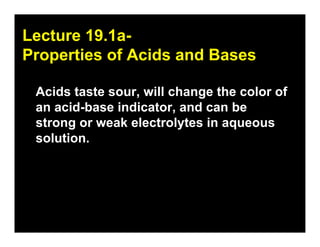
Lecture 19.1a-
Properties of Acids and Bases

 Acids taste sour, will change the color of
 an acid-base indicator, and can be
 strong or weak electrolytes in aqueous
 solution.
19.1

Citrus fruits contain citric acid.

Tea contains tannic acid.
19.1


 Bases taste bitter, feel slippery, will
 change the color of an acid-base
 indicator, and can be strong or weak
 electrolytes in aqueous solution.
Antacids use bases to neutralize
excess stomach acid.

The base calcium hydroxide is a
component of mortar.
The Arrhenius definition of
      ACIDS AND BASES

Acids dissociate to produce H+
        HCl  H+ + Cl-

Bases dissociate to produce OH-
      NaOH  Na+ + OH-
HCl  H+ + Cl-
              Or

   HCl + H2O  H3O+ + Cl-


H+ and H3O+ mean the same thing
H + is   a proton
 Acids form H+ which attaches to
 water forming the hydronium ion
 H+ + H2O  H3O+ hydronium ion


 H+ and H3O+ mean the same thing
An acidic hydrogen can dissociate
       from the acid as H+.
 Acidic hydrogens are written first
 in the chemical formula.
    HNO3 = monoprotic acid

    H2SO4 = diprotic acid

    H3PO4 = triprotic acid

    HC2H3O2 = monoprotic

                         protic aka proton
19.1


              Stomach acid


              Battery acid
              In soda pop

Acetic acid   Vinegar

              Makes bubbles
              in carbonated
              beverages
19.1

Arrhenius Bases

 Hydroxide ions are one of the products of the
 dissolution of an alkali metal in water.
19.1
Milk of magnesia is a base used
as an antacid.
When acids and bases are mixed they
       react to form water in a

Neutralization reaction
  NaOH + HCl  H2O + NaCl(aq)

    An acid/base reaction always
    forms water and an aqueous salt
        The net ionic equation for an
        acid/base reaction is
              H+ + OH-  H2O
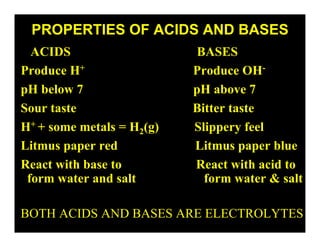
PROPERTIES OF ACIDS AND BASES
  ACIDS                    BASES
Produce H+                 Produce OH-
pH below 7                 pH above 7
Sour taste                 Bitter taste
H+ + some metals = H2(g)   Slippery feel
Litmus paper red           Litmus paper blue
React with base to         React with acid to
 form water and salt         form water & salt

BOTH ACIDS AND BASES ARE ELECTROLYTES

Lecture 19.1a- Acid/Base Properties

  • 1.
    19.1 Lecture 19.1a- Properties ofAcids and Bases Acids taste sour, will change the color of an acid-base indicator, and can be strong or weak electrolytes in aqueous solution.
  • 2.
    19.1 Citrus fruits containcitric acid. Tea contains tannic acid.
  • 3.
    19.1 Bases tastebitter, feel slippery, will change the color of an acid-base indicator, and can be strong or weak electrolytes in aqueous solution.
  • 4.
    Antacids use basesto neutralize excess stomach acid. The base calcium hydroxide is a component of mortar.
  • 5.
    The Arrhenius definitionof ACIDS AND BASES Acids dissociate to produce H+ HCl  H+ + Cl- Bases dissociate to produce OH- NaOH  Na+ + OH-
  • 6.
    HCl  H++ Cl- Or HCl + H2O  H3O+ + Cl- H+ and H3O+ mean the same thing
  • 7.
    H + is a proton Acids form H+ which attaches to water forming the hydronium ion H+ + H2O  H3O+ hydronium ion H+ and H3O+ mean the same thing
  • 8.
    An acidic hydrogencan dissociate from the acid as H+. Acidic hydrogens are written first in the chemical formula. HNO3 = monoprotic acid H2SO4 = diprotic acid H3PO4 = triprotic acid HC2H3O2 = monoprotic protic aka proton
  • 9.
    19.1 Stomach acid Battery acid In soda pop Acetic acid Vinegar Makes bubbles in carbonated beverages
  • 10.
    19.1 Arrhenius Bases Hydroxideions are one of the products of the dissolution of an alkali metal in water.
  • 11.
  • 12.
    Milk of magnesiais a base used as an antacid.
  • 13.
    When acids andbases are mixed they react to form water in a Neutralization reaction NaOH + HCl  H2O + NaCl(aq) An acid/base reaction always forms water and an aqueous salt The net ionic equation for an acid/base reaction is H+ + OH-  H2O
  • 14.
    PROPERTIES OF ACIDSAND BASES ACIDS BASES Produce H+ Produce OH- pH below 7 pH above 7 Sour taste Bitter taste H+ + some metals = H2(g) Slippery feel Litmus paper red Litmus paper blue React with base to React with acid to form water and salt form water & salt BOTH ACIDS AND BASES ARE ELECTROLYTES