Data Structure and
Algorithm (CS 102)
Ashok K Turuk

1
m-Way Search Tree

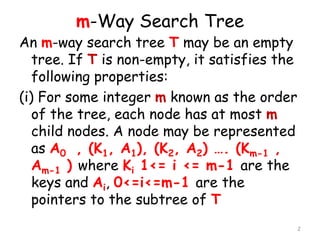
An m-way search tree T may be an empty
tree. If T is non-empty, it satisfies the
following properties:
(i) For some integer m known as the order
of the tree, each node has at most m
child nodes. A node may be represented
as A0 , (K1, A1), (K2, A2) …. (Km-1 ,
Am-1 ) where Ki 1<= i <= m-1 are the
keys and Ai, 0<=i<=m-1 are the
pointers to the subtree of T
2
m-Way Search Tree

[2] If the node has k child nodes where
k<=m, then the node can have only (k-1)
keys, K1 , K2 , …… Kk-1 contained in the
node such that Ki < Ki+1 and each of the
keys partitions all the keys in the subtrees
into k subsets

[3] For a node A0 , (K1 , A1), (K2 , A2) , ….
(Km-1 , Am-1 ) all key values in the subtree
pointed to by Ai are less than the key Ki+1
, 0<=i<=m-2 and all key values in the
subtree pointed to by Am-1 are greater
than Km-1
3
m-Way Search Tree

[4] Each of the subtree Ai , 0<=i<=m-1
are also m-way search tree

4
m-Way Search Tree [ m=5]
18

44

X

7

8
X

X

X

262

141

X

X

148 151 172 186

77

10
X

92
X

X

198

X

80

12

X

76

X

X

X

X

X

X
272 286 350
X

X

X

X
5
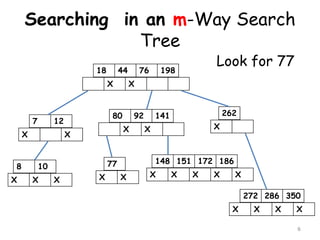
Searching in an m-Way Search
Tree
18

44

X

7

8
X

X

X

262

141

X

X

148 151 172 186

77

10
X

92
X

X

198

X

80

12

X

76

Look for 77

X

X

X

X

X

X
272 286 350
X

X

X

X
6
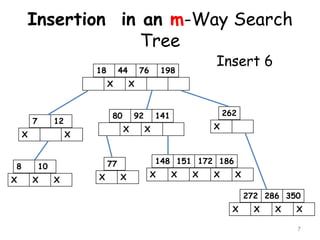
Insertion in an m-Way Search
Tree
18

44

X

7

8
X

X

X

262

141

X

X

148 151 172 186

77

10
X

92
X

X

198

X

80

12

X

76

Insert 6

X

X

X

X

X

X
272 286 350
X

X

X

X
7
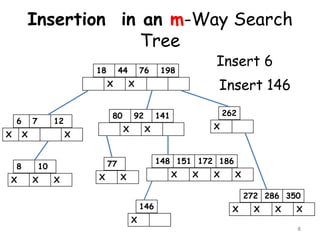
Insertion in an m-Way Search
Tree
18

44

X

6

X

7

8
X

X

X

Insert 146
262

141

X

X

148 151 172 186

77

10
X

92
X

X

198

X

80

12

X

76

Insert 6

X

X
146
X

X

X

X
272 286 350
X

X

X

X
8
Deletion in an m-Way Search
Tree
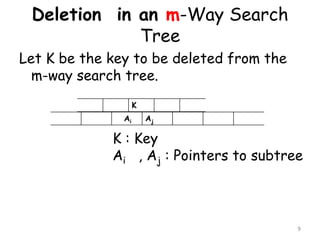
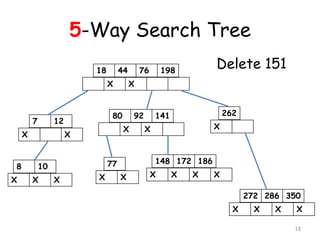
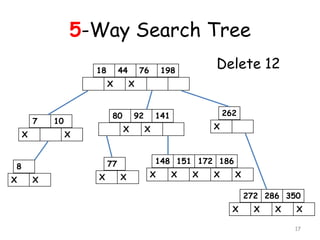
Let K be the key to be deleted from the
m-way search tree.
K
Ai

Aj

K : Key
Ai , Aj : Pointers to subtree

9
Deletion in an m-Way Search
Tree
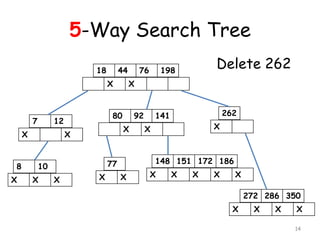
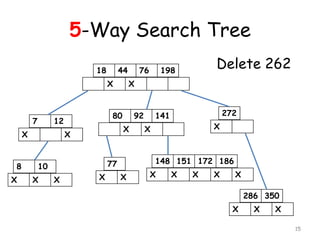
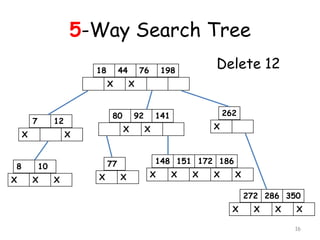
[1] If (Ai = Aj = NULL) then delete K
[2] If (Ai  NULL, Aj = NULL ) then
choose the largest of the key elements
K’ in the child node pointed to by Ai and
replace K by K’.
[3] If (Ai = NULL, Aj  NULL ) then
choose the smallest of the key element
K” from the subtree pointed to by Aj ,
delete K” and replace K by K”.
10
Deletion in an m-Way Search
Tree
[4] If (Ai  NULL, Aj  NULL ) then
choose the largest of the key elements
K’ in the subtree pointed to by Ai or
the smallest of the key element K”
from the subtree pointed to by Aj to
replace K.

11
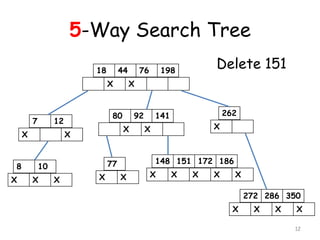
5-Way Search Tree
18

44

X

7

8
X

X

X

262

141

X

X

148 151 172 186

77

10
X

92
X

X

Delete 151

198

X

80

12

X

76

X

X

X

X

X

X
272 286 350
X

X

X

X
12
5-Way Search Tree
18

44

X

7

8
X

X

X

262

141

X

X

148 172 186

77

10
X

92
X

X

Delete 151

198

X

80

12

X

76

X

X

X

X

X
272 286 350
X

X

X

X
13
5-Way Search Tree
18

44

X

7

8
X

X

X

262

141

X

X

148 151 172 186

77

10
X

92
X

X

Delete 262

198

X

80

12

X

76

X

X

X

X

X

X
272 286 350
X

X

X

X
14
5-Way Search Tree
18

44

X

7

8
X

X

X

272

141

X

X

148 151 172 186

77

10
X

92
X

X

Delete 262

198

X

80

12

X

76

X

X

X

X

X

X
286 350
X

X

X
15
5-Way Search Tree
18

44

X

7

8
X

X

X

262

141

X

X

148 151 172 186

77

10
X

92
X

X

Delete 12

198

X

80

12

X

76

X

X

X

X

X

X
272 286 350
X

X

X

X
16
5-Way Search Tree
18

44

X

7

X

X

10

92
X

X

262

141

X

X

148 151 172 186

77
X

Delete 12

198

X

80

X

8

76

X

X

X

X

X

X
272 286 350
X

X

X

X
17
B Trees

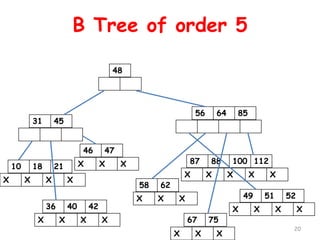
B tree is a balanced m-way search tree

A B tree of order m, if non empty is an mway search tree in which
[i] the root has at least two child nodes and
at most m child nodes
[ii] internal nodes except the root have at
least m/2 child nodes and at most m
child nodes

18
B Trees
[iii] the number of keys in each internal
node is one less than the number of
child nodes and these keys partition the
keys in the subtrees of nodes in a
manner similar to that of m-way search
trees

[iv] all leaf nodes are on the same level
19
B Tree of order 5
48

31

56

45
46

10
X

18
X

X

X

X

36
X

X

21

47

58

40
X

87

X

X

42
X

X

62
X

64

88
X

X

75
X

X

X

X

49
67

X

100 112
X

X

X

85

51
X

52
X

X
20
Searching a B Tree
Searching for a key in a B-tree is similar
to the one on an m-way search tree.

The number of accesses depends on the
height h of the B-tree

21
Insertion in a B-Tree
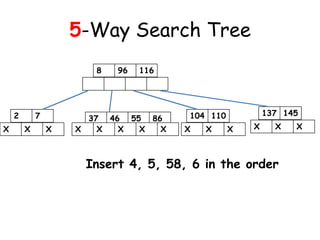
A key is inserted according to the
following procedure
[1] If the leaf node in which the key is to
be inserted is not full, then the
insertion is done in the node.
A node is said to be full if it contains a
maximum of (m-1) keys given the
order of the B-tree to be m
22
Insertion in a B-Tree

[2] If the node were to be full then insert
the key in order into the existing set of
keys in the node. Split the node at its
median into two nodes at the same level,
pushing the median element up by one level.
Accommodate the median element in the
parent node if it is not full. Otherwise
repeat the same procedure and this may
call for rearrangement of the keys in the
root node or the formation of new root
itself.

23
5-Way Search Tree
8

2
X

7
X

X

96

116

37 46 55 86
X
X
X
X
X

137 145

104 110
X

X

X

X

X

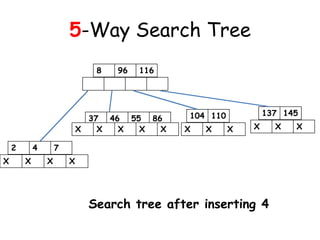
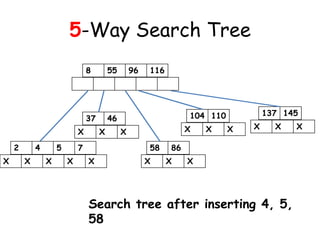
Insert 4, 5, 58, 6 in the order

X
5-Way Search Tree
8

96

116

37 46 55 86
X
X
X
X
X
2
X

4
X

137 145

104 110
X

X

X

X

7
X

X

Search tree after inserting 4

X

X
5-Way Search Tree
8

96

116

37 46 55 86
X
X
X
X
X
2
X

4
X

5
X

137 145

104 110
X

X

X

X

X

7
X

X

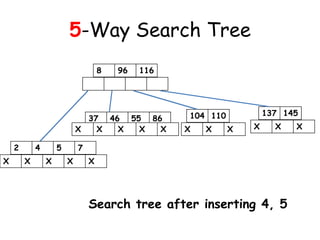
Search tree after inserting 4, 5

X
5-Way Search Tree
8

96

116

37 46 55 86
X
X
X
X
X
2
X

4
X

5
X

137 145

104 110
X

X

X

X

X

7
X

X

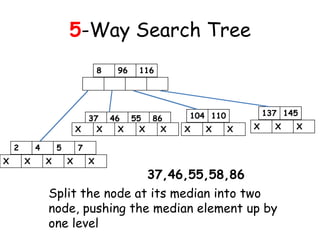
37,46,55,58,86

Split the node at its median into two
node, pushing the median element up by
one level

X
5-Way Search Tree
8

37
X
2
X

4
X

5
X

X

116

X

X
58

X

137 145

104 110

46
X

7

96

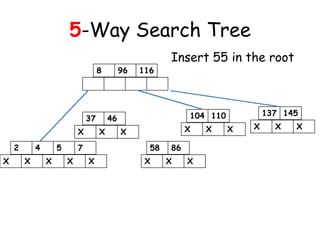
Insert 55 in the root

X

86
X

X

X

X

X

X

X
5-Way Search Tree
8

55

37

46

X
2
X

4
X

5
X

X

7
X

96

116

X

X
58

X

137 145

104 110

X

X

X

X

X

86
X

X

Search tree after inserting 4, 5,
58

X
5-Way Search Tree
8

55

37

46

X
2
X

4
X

5
X

X

7
X

96

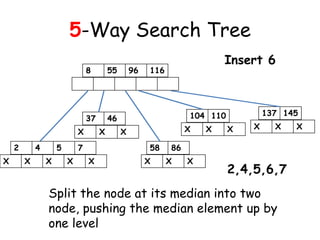
Insert 6

116

X

X
58

X

137 145

104 110

X

X

X

X

X

86
X

X

2,4,5,6,7

Split the node at its median into two
node, pushing the median element up by
one level

X
5-Way Search Tree
8

55

37

46

X
2
X

4
X

X
6

X

X

96

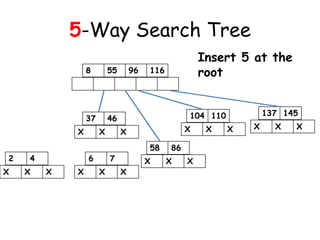
Insert 5 at the
root
137 145

104 110
X

X
58

7
X

116

X

X

86
X

X

X

X

X

X

X
5-Way Search Tree
55

5

96

8

37
X
2
X

4
X

6
X

X

116

X

X
58

7
X

137 145

104 110

46
X

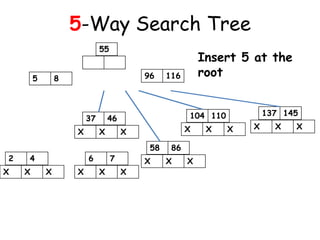
Insert 5 at the
root

X

X

86
X

X

X

X

X

X

X
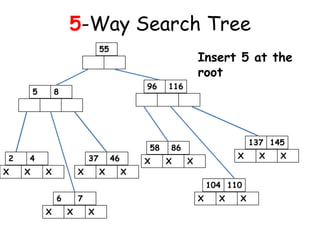
5-Way Search Tree
55

5

2
X

96

8

4
X

Insert 5 at the
root

37
X

X

58

46
X

X

X

116

137 145

86
X

X

X

104 110
6
X

7
X

X
X

X

X

X

X
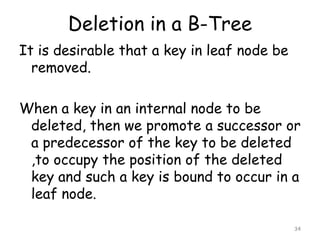
Deletion in a B-Tree
It is desirable that a key in leaf node be
removed.
When a key in an internal node to be
deleted, then we promote a successor or
a predecessor of the key to be deleted
,to occupy the position of the deleted
key and such a key is bound to occur in a
leaf node.
34
Deletion in a B-Tree
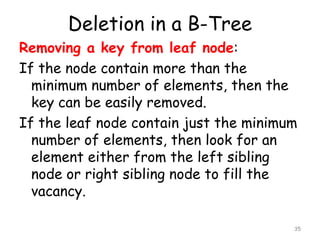
Removing a key from leaf node:
If the node contain more than the
minimum number of elements, then the
key can be easily removed.
If the leaf node contain just the minimum
number of elements, then look for an
element either from the left sibling
node or right sibling node to fill the
vacancy.
35
Deletion in a B-Tree

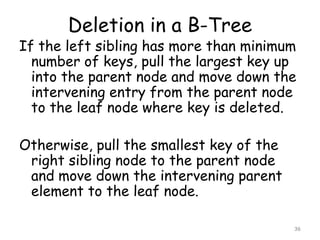
If the left sibling has more than minimum
number of keys, pull the largest key up
into the parent node and move down the
intervening entry from the parent node
to the leaf node where key is deleted.
Otherwise, pull the smallest key of the
right sibling node to the parent node
and move down the intervening parent
element to the leaf node.
36
Deletion in a B-Tree

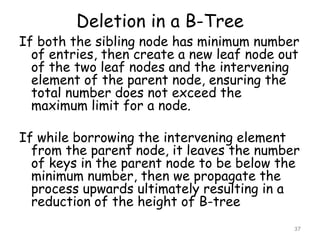
If both the sibling node has minimum number
of entries, then create a new leaf node out
of the two leaf nodes and the intervening
element of the parent node, ensuring the
total number does not exceed the
maximum limit for a node.

If while borrowing the intervening element
from the parent node, it leaves the number
of keys in the parent node to be below the
minimum number, then we propagate the
process upwards ultimately resulting in a
reduction of the height of B-tree
37
B-tree of Order 5
110

65 86

70 81

32 44
X

X

120 226

X

X

X

115 118
X

X
90

X

X

200 221

X

X

X

X

95 100
X

X

X

300 440
X

X

X

550
X

601
X

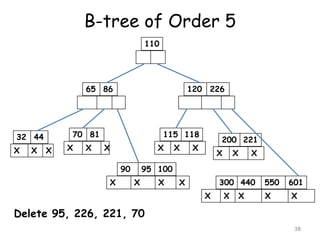
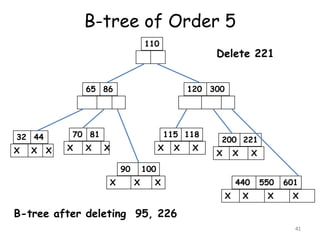
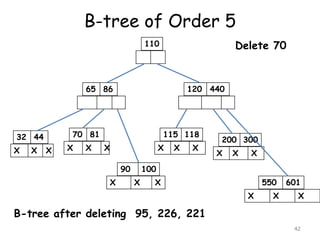
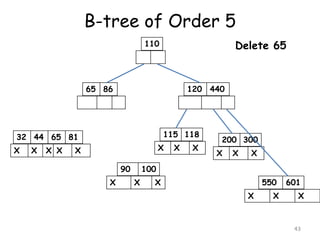
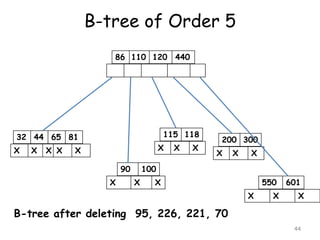
Delete 95, 226, 221, 70
38
B-tree of Order 5
110

65 86

70 81

32 44
X

X

120 226

X

X

X

115 118
X

X
90

X

X

200 221

X

X

X

X

100
X

X

300 440
X

X

X

550
X

601
X

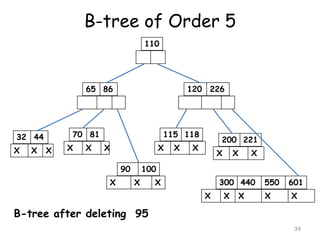
B-tree after deleting 95
39
B-tree of Order 5
110

65 86

70 81

32 44
X

X

120 300

X

X

X

115 118
X

X
90

X

X

200 221

X

X

X

X

100
X

X

300 440
X

X

X

550
X

601
X

40
B-tree of Order 5
110

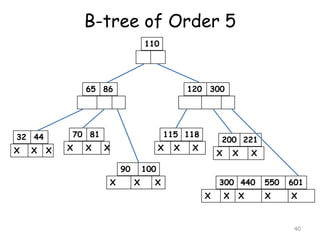
Delete 221

65 86

70 81

32 44
X

X

120 300

X

X

X

115 118
X

X
90

X

X

X

200 221
X

X

X

100
X

X

440
X

550

601

X

X

X

B-tree after deleting 95, 226
41
B-tree of Order 5
Delete 70

110

65 86

70 81

32 44
X

X

120 440

X

X

X

115 118
X

X
90

X

X

X

200 300
X

X

X

100
X

X

550
X

X

601
X

B-tree after deleting 95, 226, 221
42
B-tree of Order 5
Delete 65

110

65 86

120 440

115 118

32 44 65 81
X

X

X X

X

X
90
X

X

X

200 300
X

X

X

100
X

X

550
X

X

601
X

43
B-tree of Order 5
86 110 120 440

115 118

32 44 65 81
X

X

X X

X

X
90
X

X

X

200 300
X

X

X

100
X

X

550
X

X

601
X

B-tree after deleting 95, 226, 221, 70
44
Heap
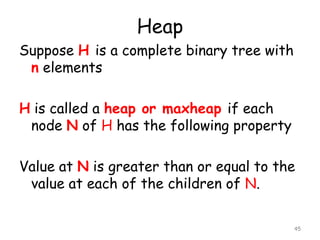
Suppose H is a complete binary tree with
n elements
H is called a heap or maxheap if each
node N of H has the following property
Value at N is greater than or equal to the
value at each of the children of N.
45
Heap
97
95

88
66

55

66

35
40

18

48

48

95

55

62

77

38

25

26 24

30

9
7

8
8

9
5

6
6

5
5

9
5

4
8

6
6

3
5

4
8

5
5

6
2

7
7

2
5

3
8

1
8

4
0

3
0

2
6

2
4

1

2

3

4

5

6

7

8

9

1
0

11 1
2

1
3

1
4

1
5

1
6

1
7

1
8

1
9

2
0

46
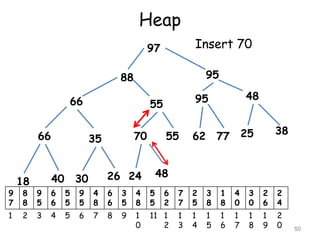
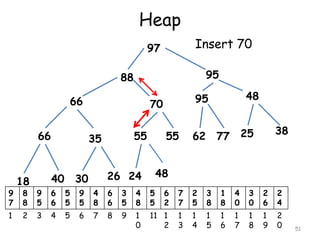
Inserting into a Heap

Suppose H is a heap with N elements
Suppose an ITEM of information is given.

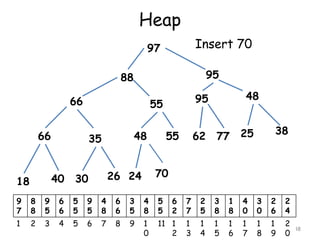
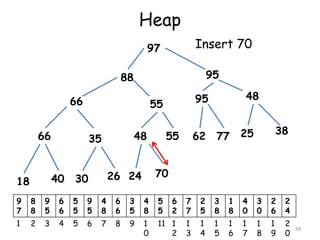
Insertion of ITEM into heap H is given as follows:
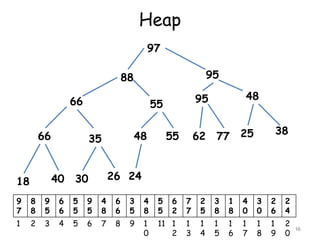
[1] First adjoin ITEM at the end of H so that H is
still a complete tree, but necessarily a heap
[2] Let ITEM rise to its appropriate place in H so
that H is finally a heap

47
Heap
Insert 70

97

95

88
66

55

66

35
40

18

48

55

62

77

38

25

70

26 24

30

48

95

9
7

8
8

9
5

6
6

5
5

9
5

4
8

6
6

3
5

4
8

5
5

6
2

7
7

2
5

3
8

1
8

4
0

3
0

2
6

2
4

1

2

3

4

5

6

7

8

9

1
0

11 1
2

1
3

1
4

1
5

1
6

1
7

1
8

1
9

2
0

48
Heap
Insert 70

97

95

88
66

55

66

35
40

18

48

55

62

77

38

25

70

26 24

30

48

95

9
7

8
8

9
5

6
6

5
5

9
5

4
8

6
6

3
5

4
8

5
5

6
2

7
7

2
5

3
8

1
8

4
0

3
0

2
6

2
4

1

2

3

4

5

6

7

8

9

1
0

11 1
2

1
3

1
4

1
5

1
6

1
7

1
8

1
9

2
0

49
Heap
Insert 70

97

95

88
66

66

9
7
1

18

55

70

35
40

55

62

38

25

77

48

26 24

30

48

95

8
8

9
5

6
6

5
5

9
5

4
8

6
6

3
5

4
8

5
5

6
2

7
7

2
5

3
8

1
8

4
0

3
0

2
6

2
4

2

3

4

5

6

7

8

9

1
0

11 1
2

1
3

1
4

1
5

1
6

1
7

1
8

1
9

2
0

50
Heap
Insert 70

97

95

88
66

66

9
7
1

18

70

55

35
40

55

62

38

25

77

48

26 24

30

48

95

8
8

9
5

6
6

5
5

9
5

4
8

6
6

3
5

4
8

5
5

6
2

7
7

2
5

3
8

1
8

4
0

3
0

2
6

2
4

2

3

4

5

6

7

8

9

1
0

11 1
2

1
3

1
4

1
5

1
6

1
7

1
8

1
9

2
0

51
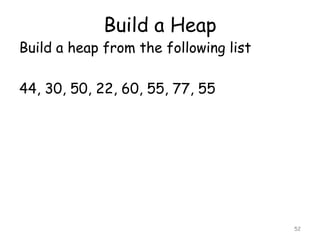
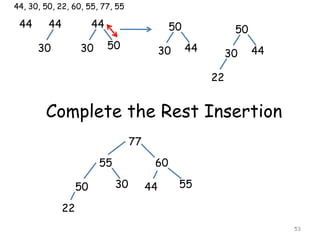
Build a Heap

Build a heap from the following list

44, 30, 50, 22, 60, 55, 77, 55

52
44, 30, 50, 22, 60, 55, 77, 55

44

44

44

30

30

50
50

30

50
44

30

44

22

Complete the Rest Insertion
77
55

50

60
30

44

55

22
53
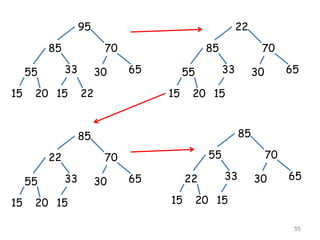
Deleting the Root of a Heap

Suppose H is a heap with N elements
Suppose we want to delete the root R of H
Deletion of root is accomplished as follows
[1] Assign the root R to some variable ITEM
[2] Replace the deleted node R by the last
node L of H so that H is still a complete
tree but necessarily a heap
[3] Reheap. Let L sink to its appropriate
place in H so that H is finally a heap.
54
95
85

15

70
33

55

22

20 15

30

85
65

22

33

55
15

70

20 15

85

85
22
55
15

55

70
33

20 15

65

30

30

65

22
15

70
33

30

65

20 15
55

Lecture 11 data structures and algorithms