RADIX SORT
ADA (2150703)
Presented by,
Arafat Tai
150410107114
S.Y. CE-II Batch : C
Radix Means : The base of a system of
numeration
Examples:
• The decimal number system that we use every day has 10
digits {0,1,2,3,4,5,6,7,8,9} and so the radix is 10.
RADIX SORT
 Radix sort is generalization of bucket sort.
 It uses several passes of bucket sort.
 Radix sort is stable and fast.
• In Computer Science Radix Sort is a non –
comparative integer sorting algorithm that sort
data with integer keys by grouping keys by the
individual digits which share same significant
position and value.
RADIX SORT
• Unlike other sorting algorithms Radix sort is not
based on the general algorithm strategy above,
but on a totally different method. It is
interesting because it requires the absolute
minimum amount of space and the minimum
amount of data movement, and, most amazing
of all, it does no comparisons.
CLASSIFICATIONS
1. Least Significant Digit (LSD) radix sorts
2. Most Significant Digit (MSD) radix sorts
LEAST SIGNIFICANT DIGIT
(LSD) RADIX SORTS
 How many times we will sort the number ?
or
How many passes will required ?
LEAST SIGNIFICANT DIGIT
(LSD) RADIX SORTS
Examples :
4310 , 357 , 251 , 78
LEAST SIGNIFICANT DIGIT
(LSD) RADIX SORTS
Examples :
4310 , 357 , 251 , 78
So 4 passes will require .
4310
EXAMPLE (LSD)
126 328 636 341 416 131 328
Input list :
EXAMPLE (LSD)
126 328 636 341 416 131 328
BinSort on lower digit / Pass
1 :
EXAMPLE (LSD)
126 328 636 341 416 131 328
BinSort on lower digit / Pass
1 :
0 1 2 3 4 5 6 7 8 9
EXAMPLE (LSD)
126 328 636 341 416 131 328
BinSort on lower digit:
0 1 2 3 4 5 6 7 8 9
126
EXAMPLE (LSD)
126 328 636 341 416 131 328
BinSort on lower digit:
0 1 2 3 4 5 6 7 8 9
126 328
EXAMPLE (LSD)
126 328 636 341 416 131 328
BinSort on lower digit:
0 1 2 3 4 5 6 7 8 9
126
636
328
EXAMPLE (LSD)
126 328 636 341 416 131 328
BinSort on lower digit:
0 1 2 3 4 5 6 7 8 9
341 126
636
328
EXAMPLE (LSD)
126 328 636 341 416 131 328
BinSort on lower digit:
0 1 2 3 4 5 6 7 8 9
341 126
636
416
328
EXAMPLE (LSD)
126 328 636 341 416 131 328
BinSort on lower digit:
0 1 2 3 4 5 6 7 8 9
341
131
126
636
416
328
EXAMPLE (LSD)
126 328 636 341 416 131 328
BinSort on lower digit:
0 1 2 3 4 5 6 7 8 9
341
131
126
636
416
328
328
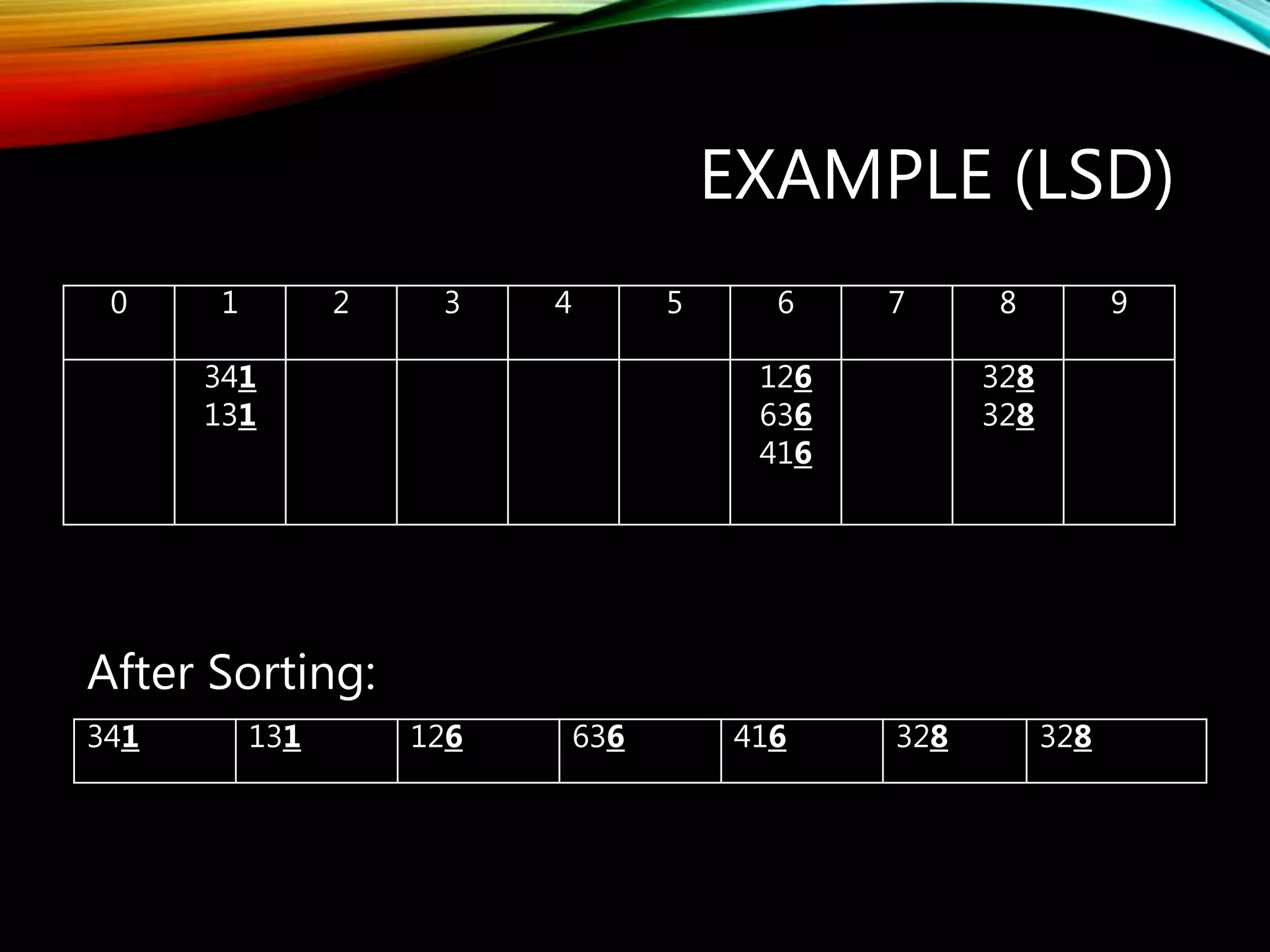
EXAMPLE (LSD)
341 131 126 636 416 328 328
After Sorting:
0 1 2 3 4 5 6 7 8 9
341
131
126
636
416
328
328
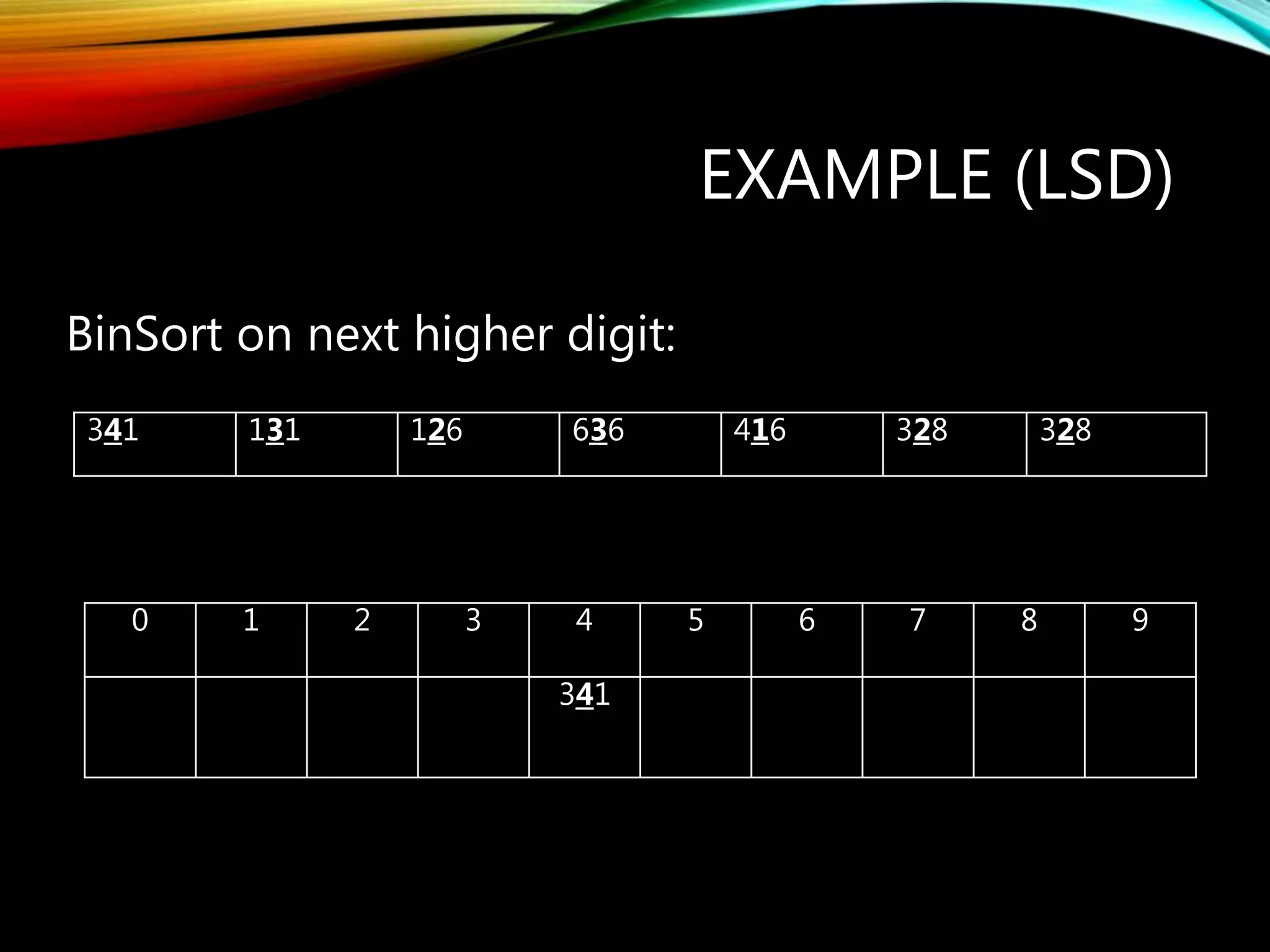
EXAMPLE (LSD)
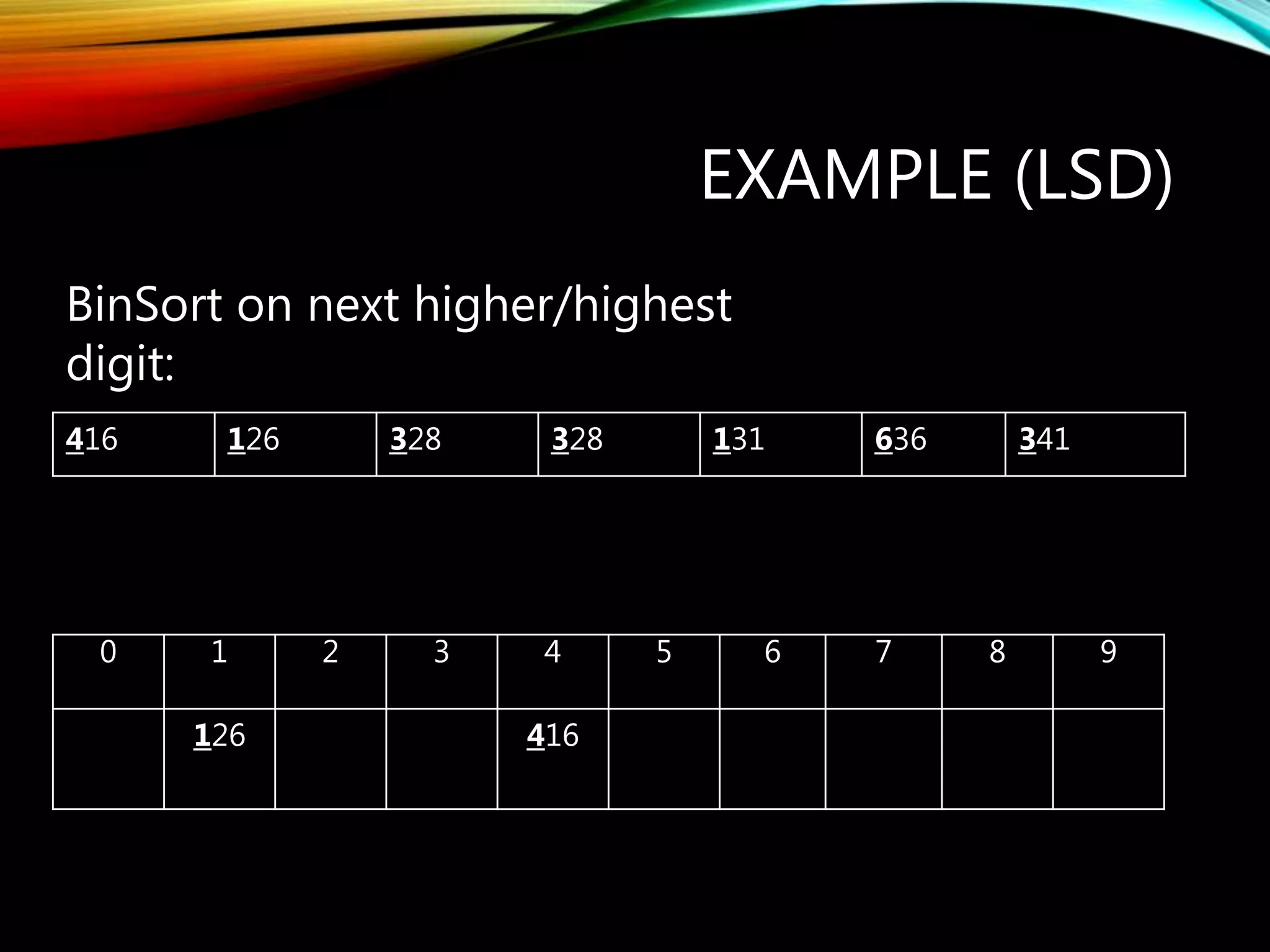
BinSort on next higher digit / Pass 2 :
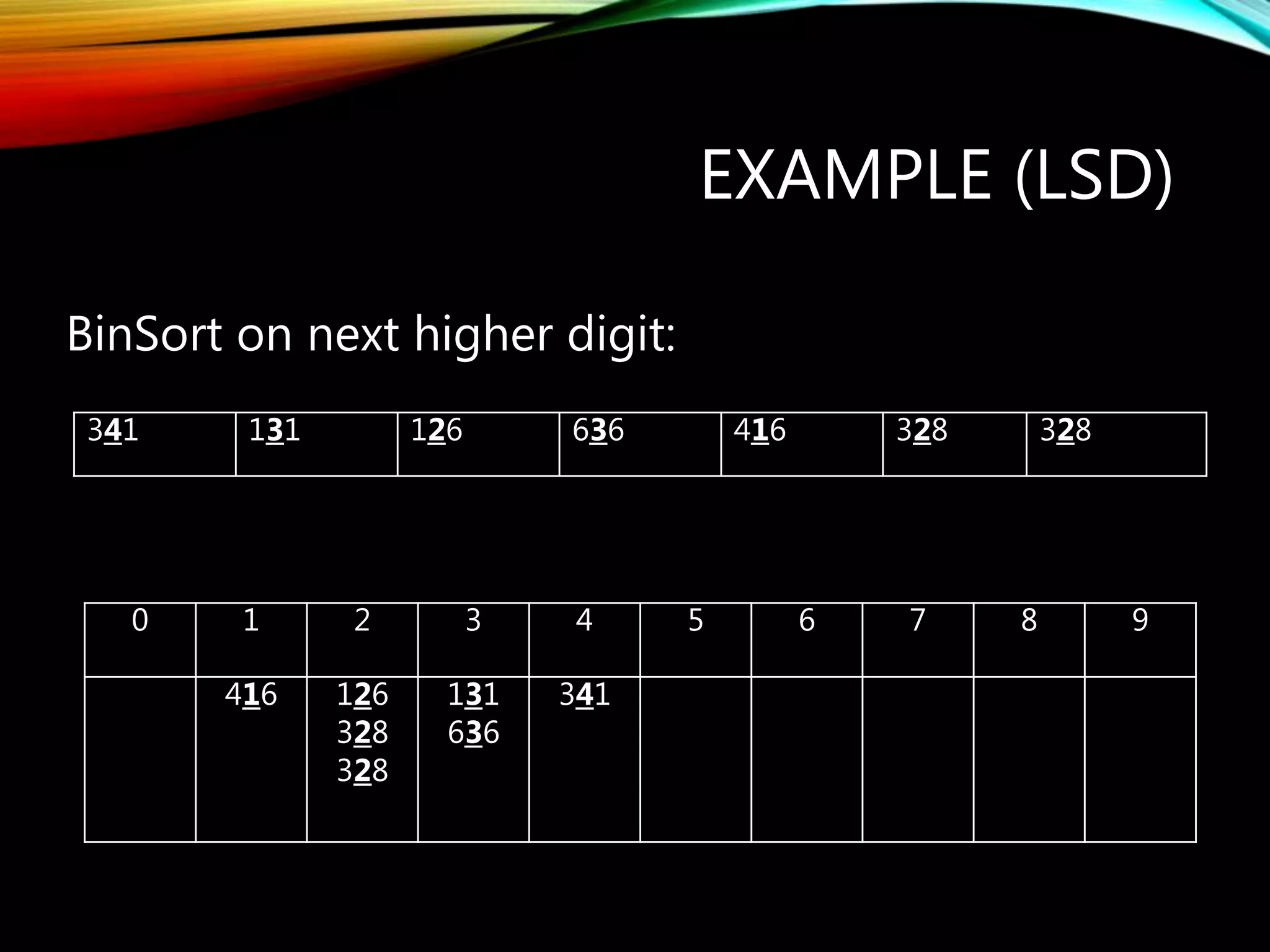
341 131 126 636 416 328 328
EXAMPLE (LSD)
BinSort on next higher digit:
0 1 2 3 4 5 6 7 8 9
341
341 131 126 636 416 328 328
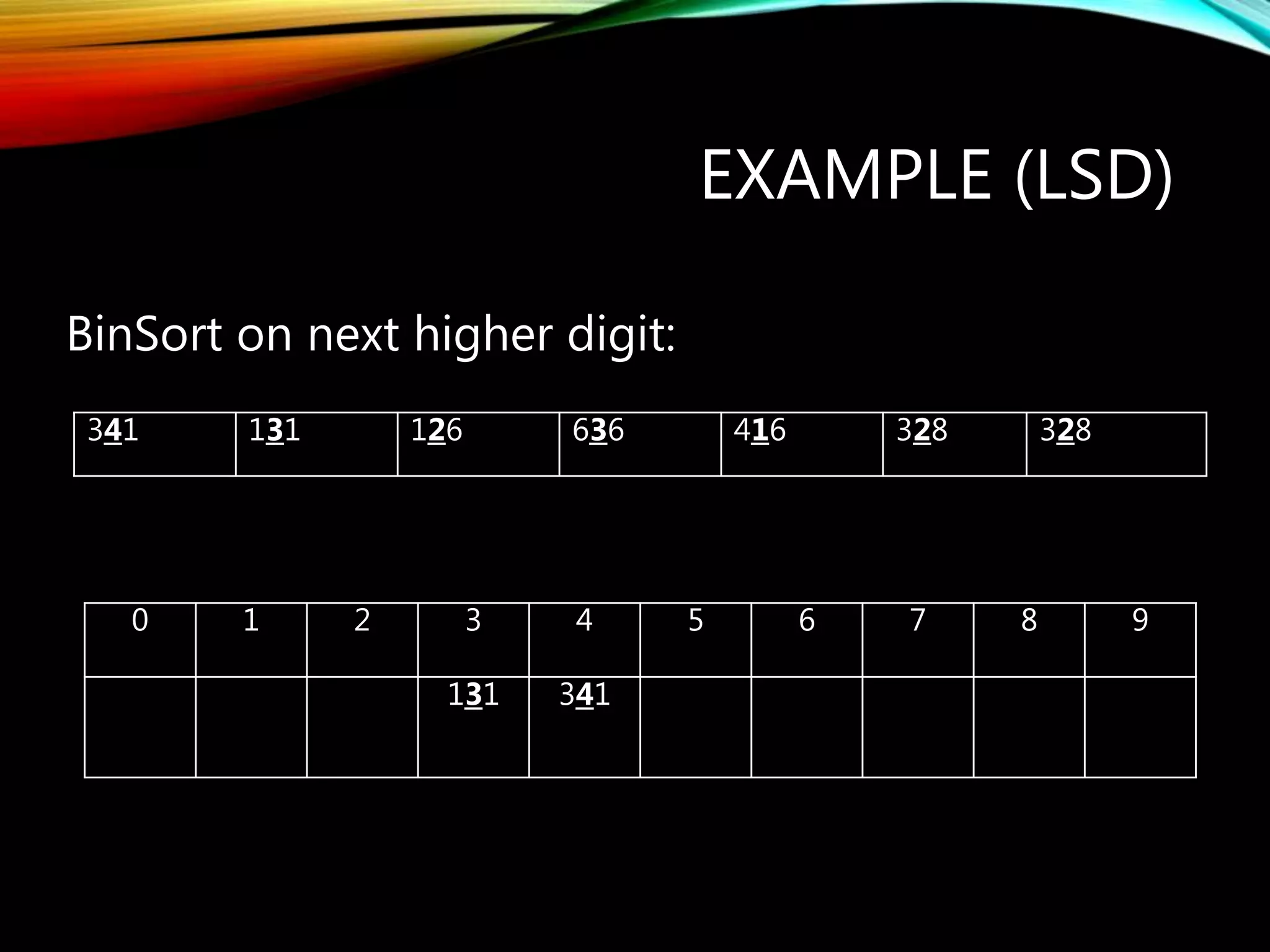
EXAMPLE (LSD)
BinSort on next higher digit:
0 1 2 3 4 5 6 7 8 9
131 341
341 131 126 636 416 328 328
EXAMPLE (LSD)
BinSort on next higher digit:
0 1 2 3 4 5 6 7 8 9
126 131 341
341 131 126 636 416 328 328
EXAMPLE (LSD)
BinSort on next higher digit:
0 1 2 3 4 5 6 7 8 9
126 131
636
341
341 131 126 636 416 328 328
EXAMPLE (LSD)
BinSort on next higher digit:
0 1 2 3 4 5 6 7 8 9
416 126 131
636
341
341 131 126 636 416 328 328
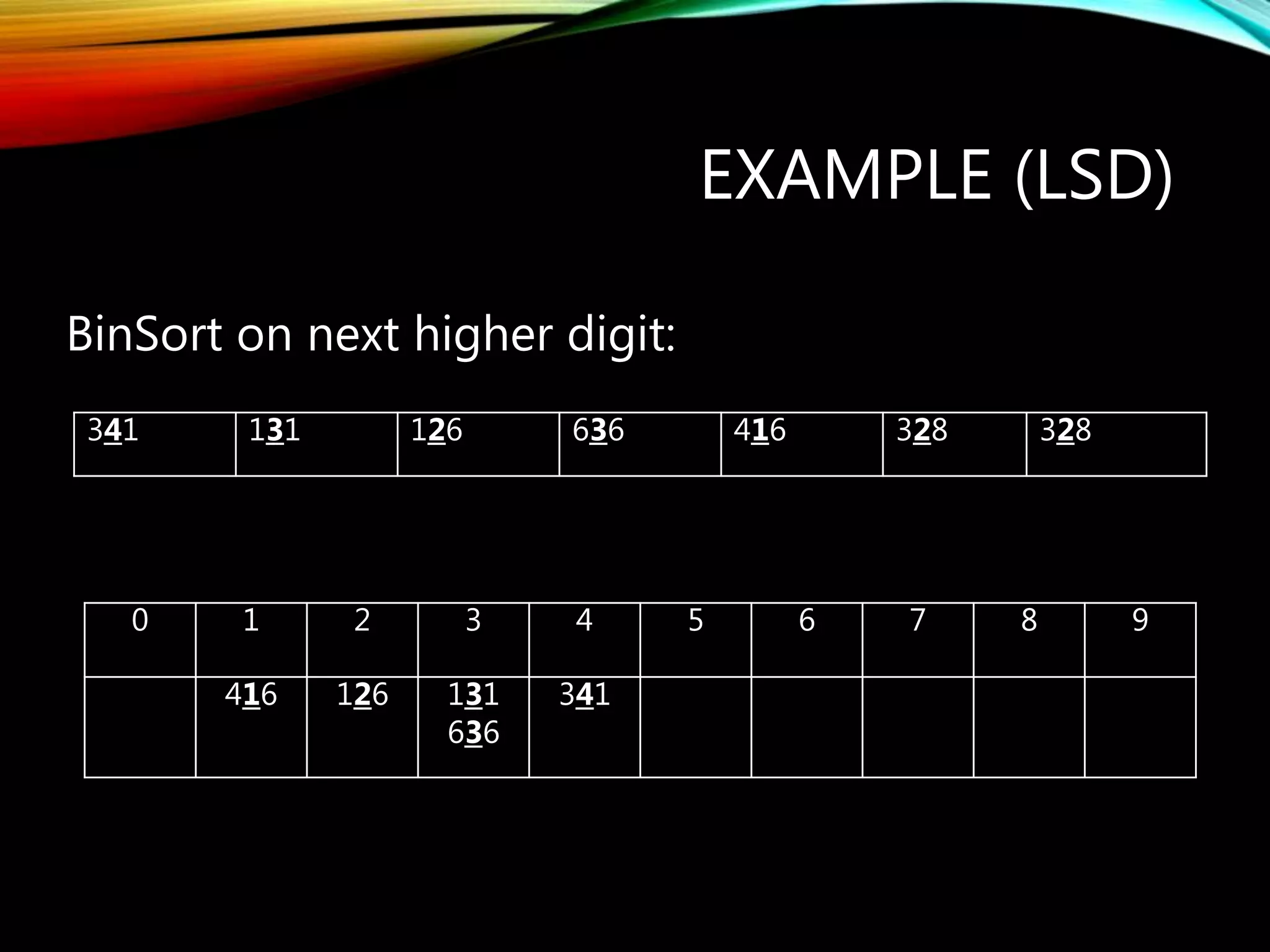
EXAMPLE (LSD)
BinSort on next higher digit:
0 1 2 3 4 5 6 7 8 9
416 126
328
131
636
341
341 131 126 636 416 328 328
EXAMPLE (LSD)
BinSort on next higher digit:
0 1 2 3 4 5 6 7 8 9
416 126
328
328
131
636
341
341 131 126 636 416 328 328
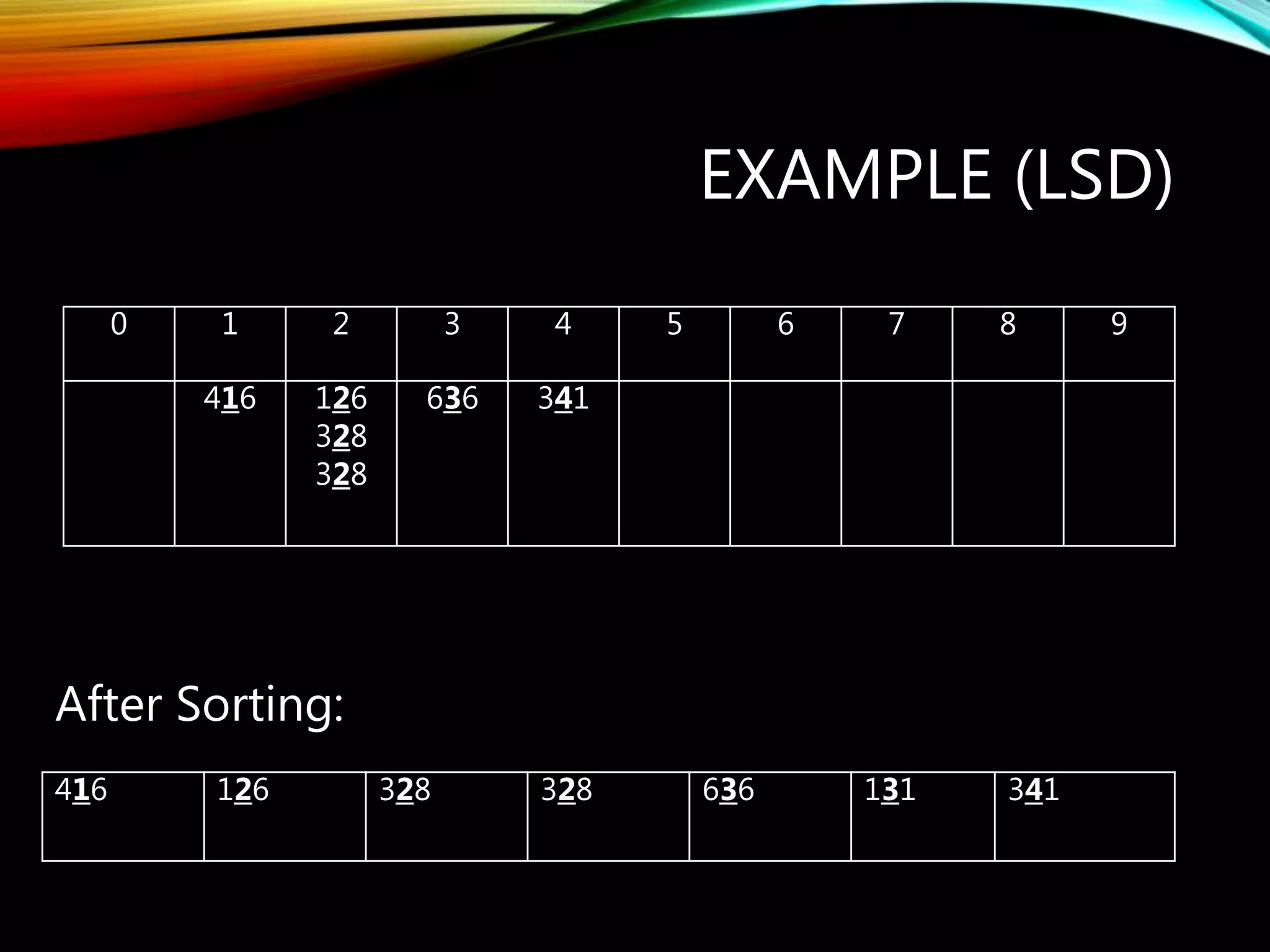
EXAMPLE (LSD)
416 126 328 328 636 131 341
After Sorting:
0 1 2 3 4 5 6 7 8 9
416 126
328
328
636 341
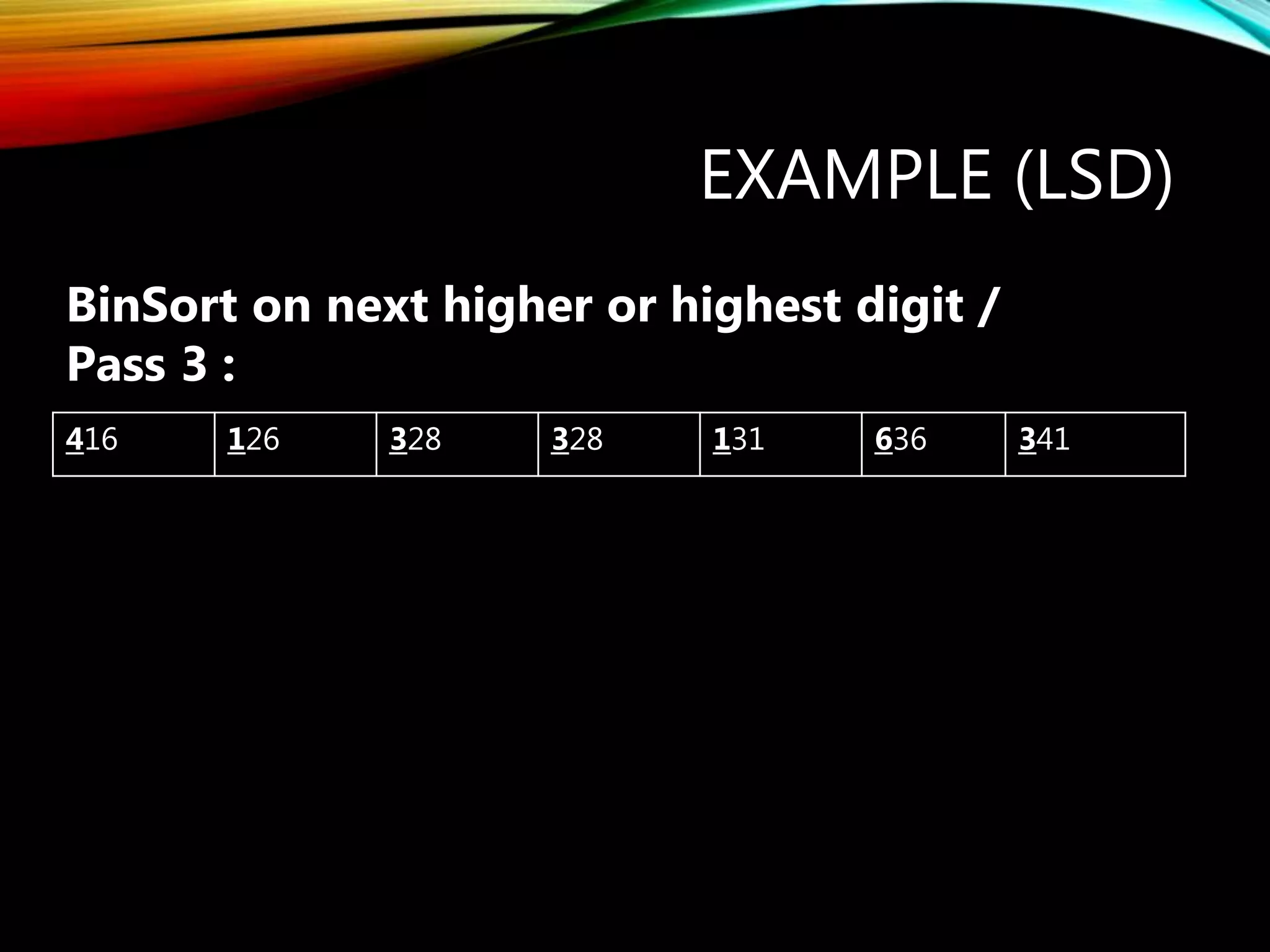
EXAMPLE (LSD)
416 126 328 328 131 636 341
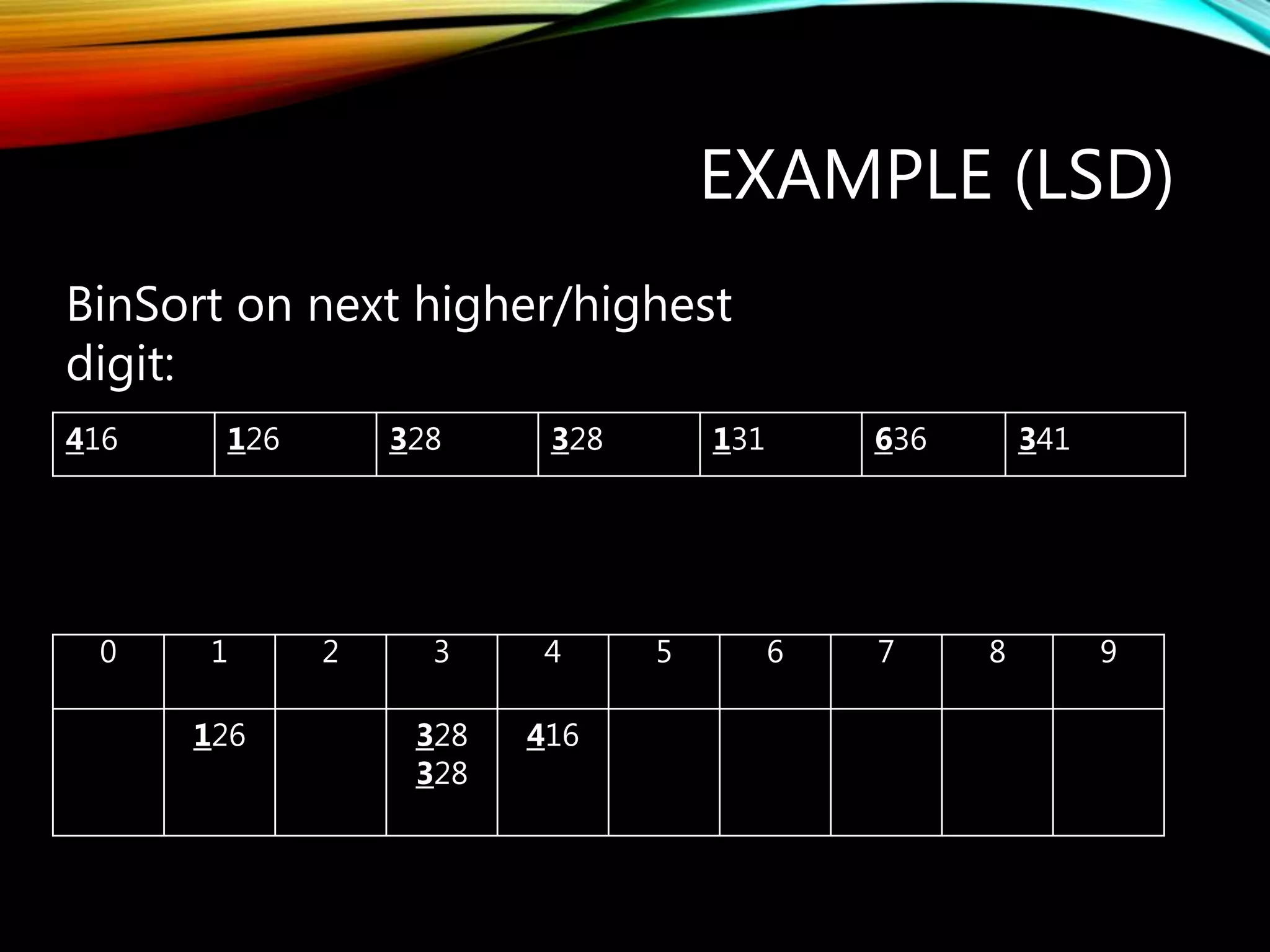
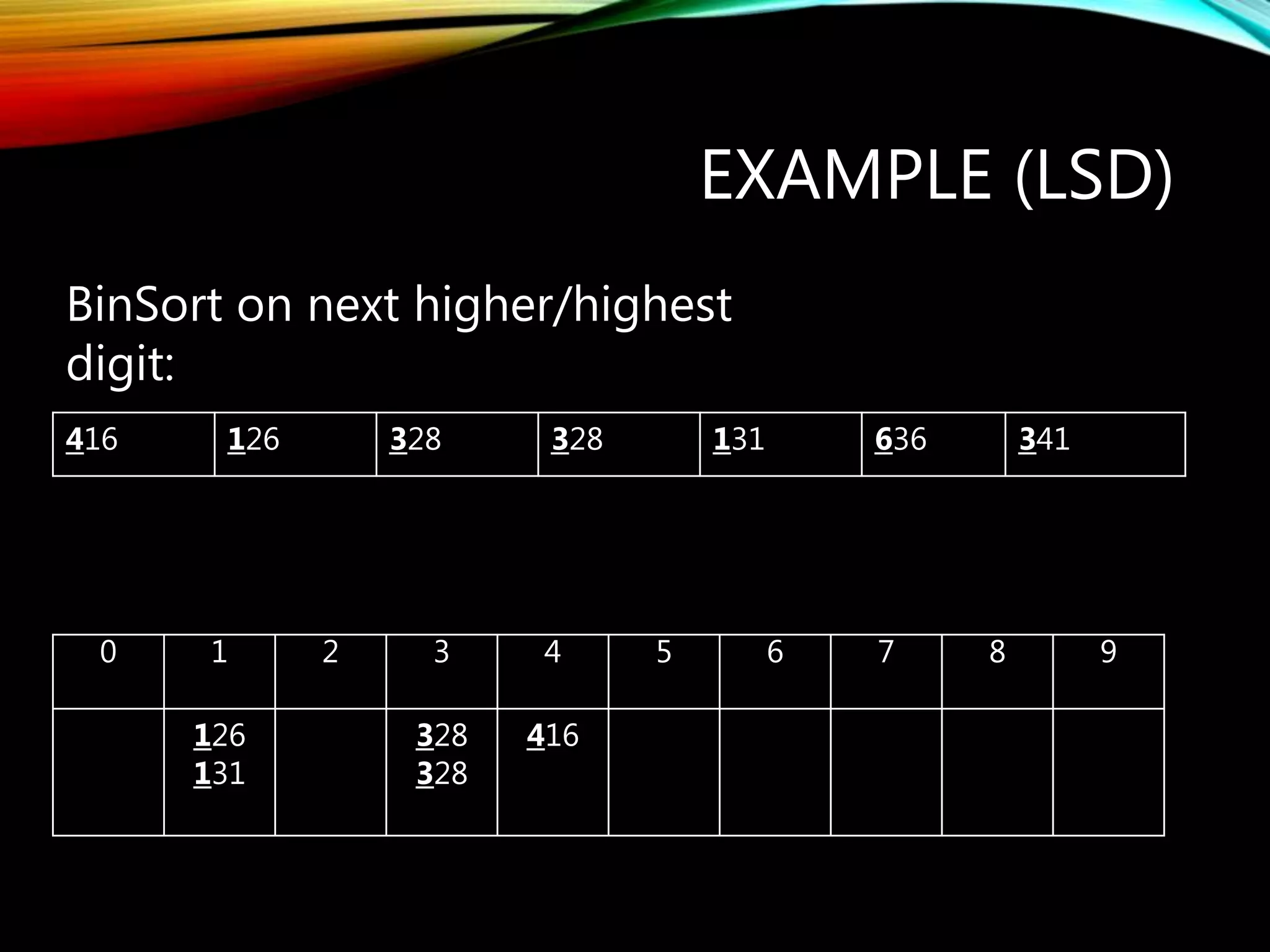
BinSort on next higher or highest digit /
Pass 3 :
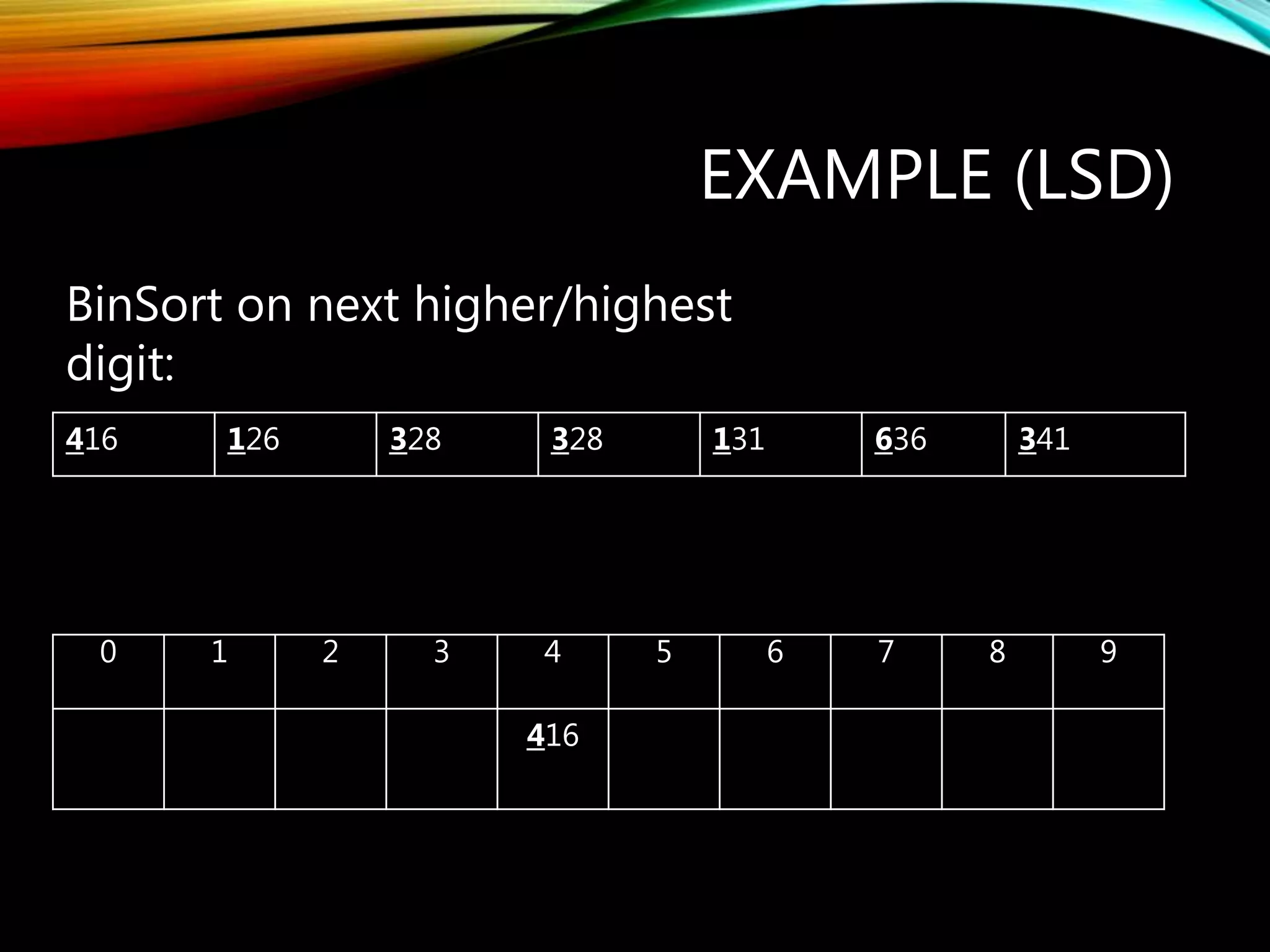
EXAMPLE (LSD)
416 126 328 328 131 636 341
BinSort on next higher/highest
digit:
0 1 2 3 4 5 6 7 8 9
416
EXAMPLE (LSD)
416 126 328 328 131 636 341
BinSort on next higher/highest
digit:
0 1 2 3 4 5 6 7 8 9
126 416
EXAMPLE (LSD)
416 126 328 328 131 636 341
BinSort on next higher/highest
digit:
0 1 2 3 4 5 6 7 8 9
126 328 416
EXAMPLE (LSD)
416 126 328 328 131 636 341
BinSort on next higher/highest
digit:
0 1 2 3 4 5 6 7 8 9
126 328
328
416
EXAMPLE (LSD)
416 126 328 328 131 636 341
BinSort on next higher/highest
digit:
0 1 2 3 4 5 6 7 8 9
126
131
328
328
416
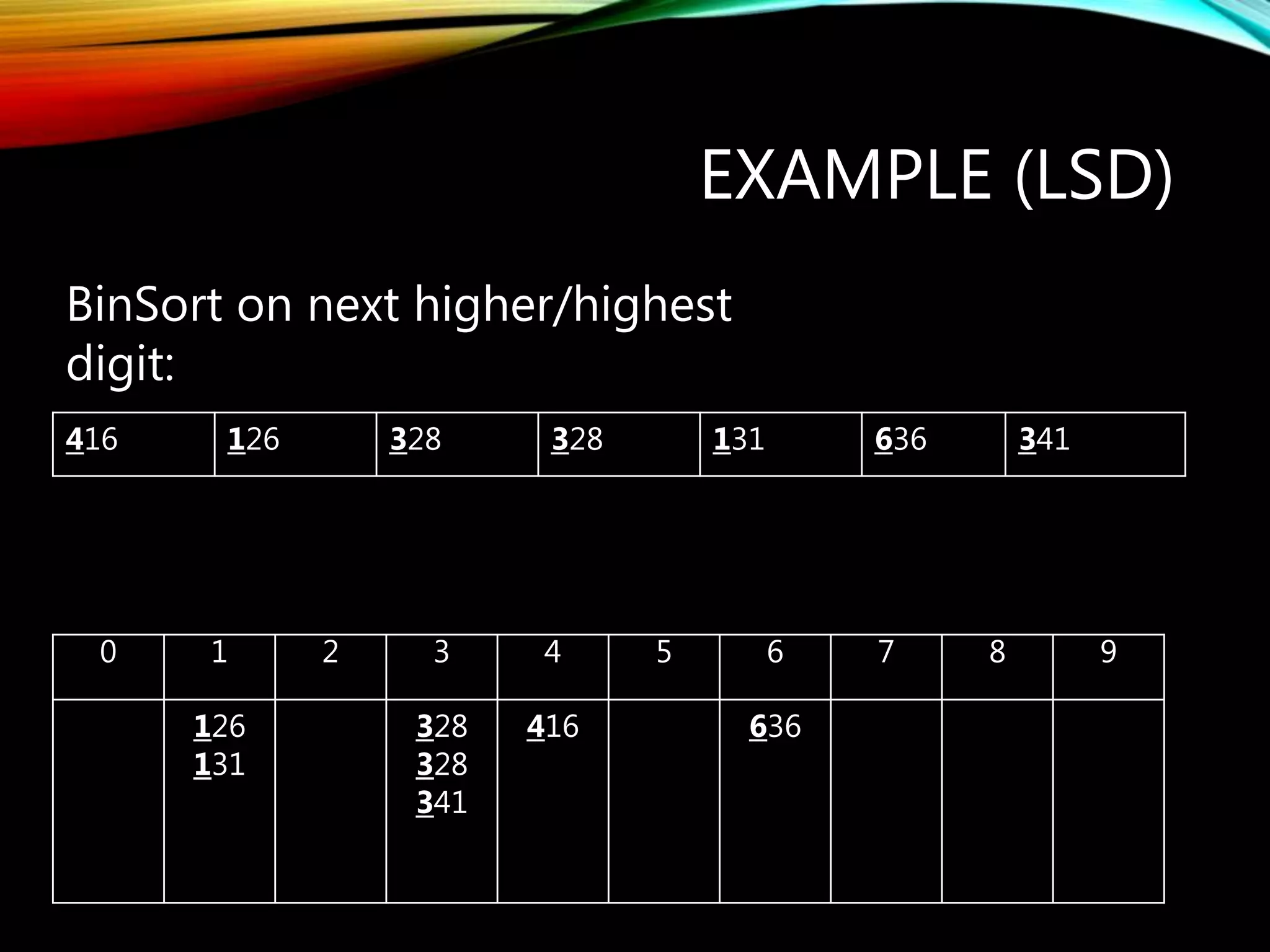
EXAMPLE (LSD)
416 126 328 328 131 636 341
BinSort on next higher/highest
digit:
0 1 2 3 4 5 6 7 8 9
126
131
328
328
416 636
EXAMPLE (LSD)
416 126 328 328 131 636 341
BinSort on next higher/highest
digit:
0 1 2 3 4 5 6 7 8 9
126
131
328
328
341
416 636
EXAMPLE (LSD)
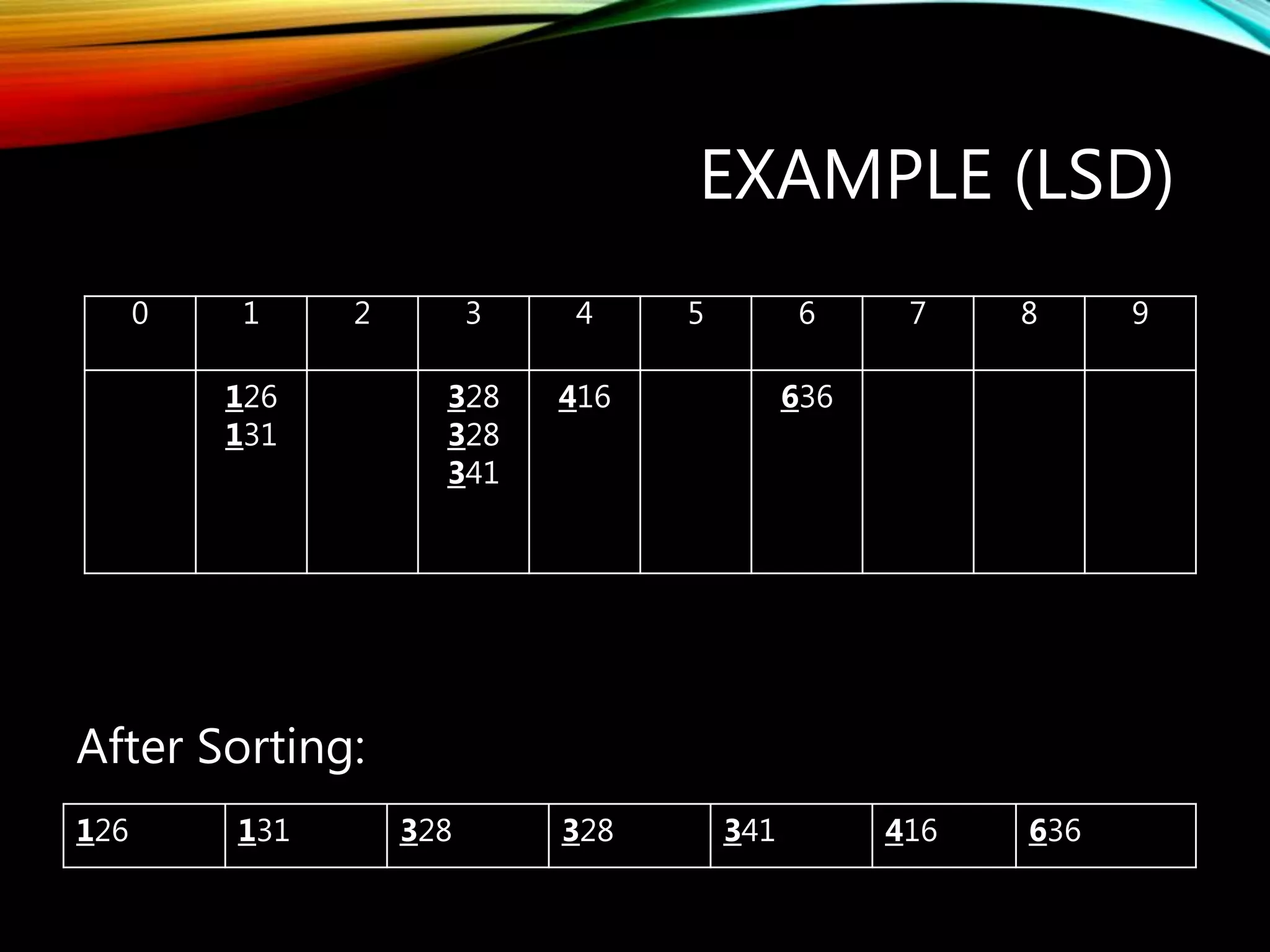
126 131 328 328 341 416 636
After Sorting:
0 1 2 3 4 5 6 7 8 9
126
131
328
328
341
416 636
EXAMPLE (LSD)
126 131 328 328 341 416 636
Completed
EXAMPLE (LSD)
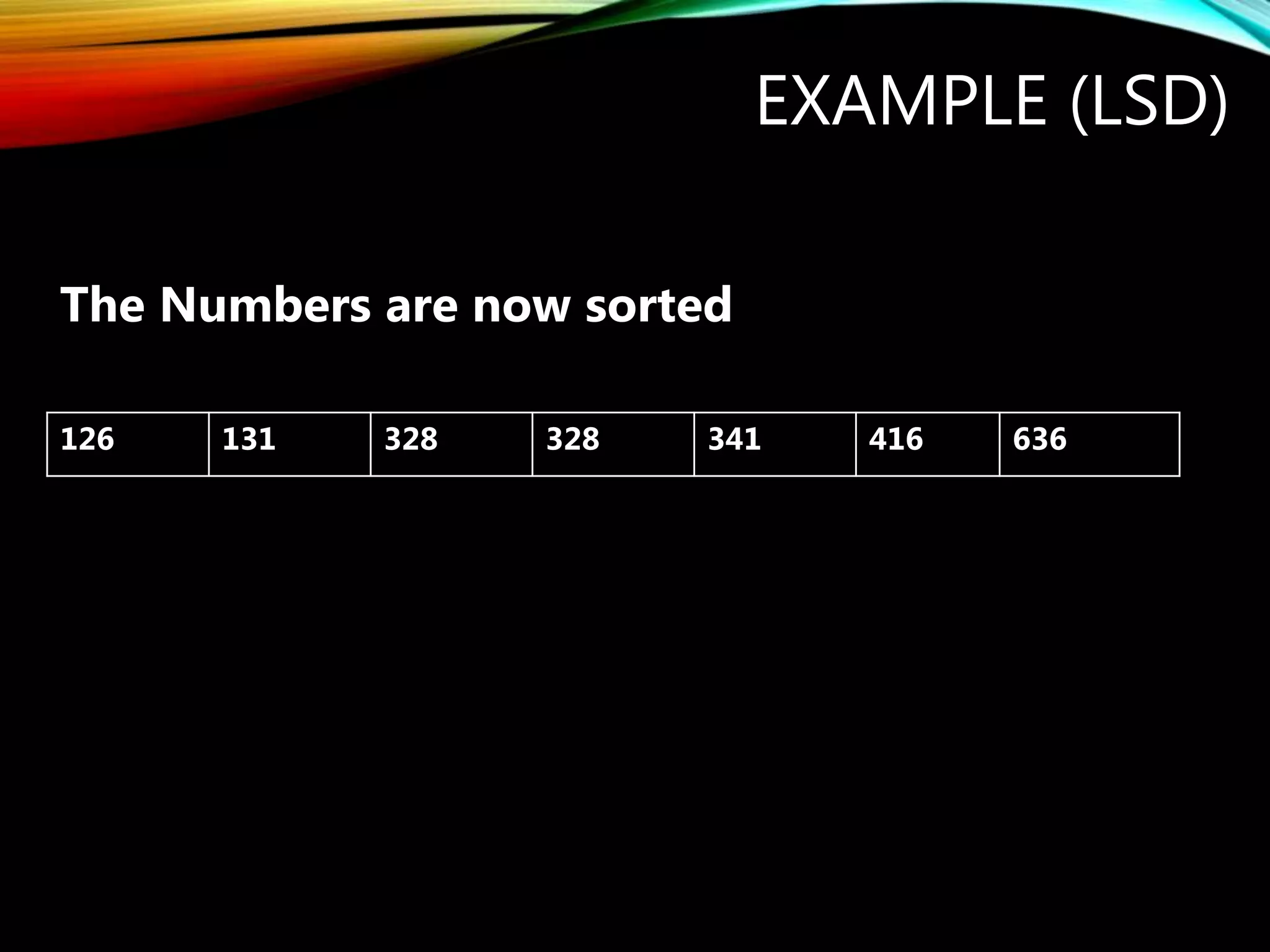
126 131 328 328 341 416 636
The Numbers are now sorted
ALGORITHM
1.Create an array a[ 0…..n-1] elements.
2.Call bucket sort repeatedly on least to most
significant digit of each element as the key.
3.Return the sorted array.
ANALYSIS
Each pass over n d-digit numbers and k base
keys then takes time O(n+k). (Assuming
counting sort is used for each pass.)
There are d passes, so the total time for radix
sort is O(d (n+k)).
When d is a constant and total run time = O(n)
COMPLEXITY ANALYSIS:
The complexity is O((n+b)∗logb(maxx))
where b is the base for representing numbers
and maxx is the maximum element of the input
array. This is clearly visible as we make (n+b)
iterations logb(maxx) times (number of digits in
the maximum element) . If maxx ≤ n^c , then
the complexity can be written as O(n∗logb(n)).
SOURCES
 GeeksForGeeks
 Wikipedia
 Hakerearth
Questions ?
Thank You

Radix sort

  • 1.
    RADIX SORT ADA (2150703) Presentedby, Arafat Tai 150410107114 S.Y. CE-II Batch : C
  • 2.
    Radix Means :The base of a system of numeration Examples: • The decimal number system that we use every day has 10 digits {0,1,2,3,4,5,6,7,8,9} and so the radix is 10.
  • 3.
    RADIX SORT  Radixsort is generalization of bucket sort.  It uses several passes of bucket sort.  Radix sort is stable and fast.
  • 4.
    • In ComputerScience Radix Sort is a non – comparative integer sorting algorithm that sort data with integer keys by grouping keys by the individual digits which share same significant position and value.
  • 5.
    RADIX SORT • Unlikeother sorting algorithms Radix sort is not based on the general algorithm strategy above, but on a totally different method. It is interesting because it requires the absolute minimum amount of space and the minimum amount of data movement, and, most amazing of all, it does no comparisons.
  • 6.
    CLASSIFICATIONS 1. Least SignificantDigit (LSD) radix sorts 2. Most Significant Digit (MSD) radix sorts
  • 7.
    LEAST SIGNIFICANT DIGIT (LSD)RADIX SORTS  How many times we will sort the number ? or How many passes will required ?
  • 8.
    LEAST SIGNIFICANT DIGIT (LSD)RADIX SORTS Examples : 4310 , 357 , 251 , 78
  • 9.
    LEAST SIGNIFICANT DIGIT (LSD)RADIX SORTS Examples : 4310 , 357 , 251 , 78 So 4 passes will require . 4310
  • 10.
    EXAMPLE (LSD) 126 328636 341 416 131 328 Input list :
  • 11.
    EXAMPLE (LSD) 126 328636 341 416 131 328 BinSort on lower digit / Pass 1 :
  • 12.
    EXAMPLE (LSD) 126 328636 341 416 131 328 BinSort on lower digit / Pass 1 : 0 1 2 3 4 5 6 7 8 9
  • 13.
    EXAMPLE (LSD) 126 328636 341 416 131 328 BinSort on lower digit: 0 1 2 3 4 5 6 7 8 9 126
  • 14.
    EXAMPLE (LSD) 126 328636 341 416 131 328 BinSort on lower digit: 0 1 2 3 4 5 6 7 8 9 126 328
  • 15.
    EXAMPLE (LSD) 126 328636 341 416 131 328 BinSort on lower digit: 0 1 2 3 4 5 6 7 8 9 126 636 328
  • 16.
    EXAMPLE (LSD) 126 328636 341 416 131 328 BinSort on lower digit: 0 1 2 3 4 5 6 7 8 9 341 126 636 328
  • 17.
    EXAMPLE (LSD) 126 328636 341 416 131 328 BinSort on lower digit: 0 1 2 3 4 5 6 7 8 9 341 126 636 416 328
  • 18.
    EXAMPLE (LSD) 126 328636 341 416 131 328 BinSort on lower digit: 0 1 2 3 4 5 6 7 8 9 341 131 126 636 416 328
  • 19.
    EXAMPLE (LSD) 126 328636 341 416 131 328 BinSort on lower digit: 0 1 2 3 4 5 6 7 8 9 341 131 126 636 416 328 328
  • 20.
    EXAMPLE (LSD) 341 131126 636 416 328 328 After Sorting: 0 1 2 3 4 5 6 7 8 9 341 131 126 636 416 328 328
  • 21.
    EXAMPLE (LSD) BinSort onnext higher digit / Pass 2 : 341 131 126 636 416 328 328
  • 22.
    EXAMPLE (LSD) BinSort onnext higher digit: 0 1 2 3 4 5 6 7 8 9 341 341 131 126 636 416 328 328
  • 23.
    EXAMPLE (LSD) BinSort onnext higher digit: 0 1 2 3 4 5 6 7 8 9 131 341 341 131 126 636 416 328 328
  • 24.
    EXAMPLE (LSD) BinSort onnext higher digit: 0 1 2 3 4 5 6 7 8 9 126 131 341 341 131 126 636 416 328 328
  • 25.
    EXAMPLE (LSD) BinSort onnext higher digit: 0 1 2 3 4 5 6 7 8 9 126 131 636 341 341 131 126 636 416 328 328
  • 26.
    EXAMPLE (LSD) BinSort onnext higher digit: 0 1 2 3 4 5 6 7 8 9 416 126 131 636 341 341 131 126 636 416 328 328
  • 27.
    EXAMPLE (LSD) BinSort onnext higher digit: 0 1 2 3 4 5 6 7 8 9 416 126 328 131 636 341 341 131 126 636 416 328 328
  • 28.
    EXAMPLE (LSD) BinSort onnext higher digit: 0 1 2 3 4 5 6 7 8 9 416 126 328 328 131 636 341 341 131 126 636 416 328 328
  • 29.
    EXAMPLE (LSD) 416 126328 328 636 131 341 After Sorting: 0 1 2 3 4 5 6 7 8 9 416 126 328 328 636 341
  • 30.
    EXAMPLE (LSD) 416 126328 328 131 636 341 BinSort on next higher or highest digit / Pass 3 :
  • 31.
    EXAMPLE (LSD) 416 126328 328 131 636 341 BinSort on next higher/highest digit: 0 1 2 3 4 5 6 7 8 9 416
  • 32.
    EXAMPLE (LSD) 416 126328 328 131 636 341 BinSort on next higher/highest digit: 0 1 2 3 4 5 6 7 8 9 126 416
  • 33.
    EXAMPLE (LSD) 416 126328 328 131 636 341 BinSort on next higher/highest digit: 0 1 2 3 4 5 6 7 8 9 126 328 416
  • 34.
    EXAMPLE (LSD) 416 126328 328 131 636 341 BinSort on next higher/highest digit: 0 1 2 3 4 5 6 7 8 9 126 328 328 416
  • 35.
    EXAMPLE (LSD) 416 126328 328 131 636 341 BinSort on next higher/highest digit: 0 1 2 3 4 5 6 7 8 9 126 131 328 328 416
  • 36.
    EXAMPLE (LSD) 416 126328 328 131 636 341 BinSort on next higher/highest digit: 0 1 2 3 4 5 6 7 8 9 126 131 328 328 416 636
  • 37.
    EXAMPLE (LSD) 416 126328 328 131 636 341 BinSort on next higher/highest digit: 0 1 2 3 4 5 6 7 8 9 126 131 328 328 341 416 636
  • 38.
    EXAMPLE (LSD) 126 131328 328 341 416 636 After Sorting: 0 1 2 3 4 5 6 7 8 9 126 131 328 328 341 416 636
  • 39.
    EXAMPLE (LSD) 126 131328 328 341 416 636 Completed
  • 40.
    EXAMPLE (LSD) 126 131328 328 341 416 636 The Numbers are now sorted
  • 41.
    ALGORITHM 1.Create an arraya[ 0…..n-1] elements. 2.Call bucket sort repeatedly on least to most significant digit of each element as the key. 3.Return the sorted array.
  • 42.
    ANALYSIS Each pass overn d-digit numbers and k base keys then takes time O(n+k). (Assuming counting sort is used for each pass.) There are d passes, so the total time for radix sort is O(d (n+k)). When d is a constant and total run time = O(n)
  • 43.
    COMPLEXITY ANALYSIS: The complexityis O((n+b)∗logb(maxx)) where b is the base for representing numbers and maxx is the maximum element of the input array. This is clearly visible as we make (n+b) iterations logb(maxx) times (number of digits in the maximum element) . If maxx ≤ n^c , then the complexity can be written as O(n∗logb(n)).
  • 44.
  • 45.
  • 46.

Editor's Notes

  • #7 LSD radix sorts process the integer representations starting from the least digit and move towards the most significant digit. MSD radix sorts work the other way around
  • #8 It depends on how many digits the Highest number have