B TREES
Definition of a B-tree
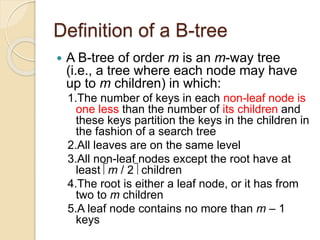
 A B-tree of order m is an m-way tree
(i.e., a tree where each node may have
up to m children) in which:
1.The number of keys in each non-leaf node is
one less than the number of its children and
these keys partition the keys in the children in
the fashion of a search tree
2.All leaves are on the same level
3.All non-leaf nodes except the root have at
least m / 2 children
4.The root is either a leaf node, or it has from
two to m children
5.A leaf node contains no more than m – 1
keys
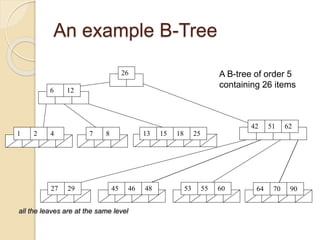
An example B-Tree
51 62
42
6 12
26
55 60 70
64 90
45
1 2 4 7 8 13 15 18 25
27 29 46 48 53
A B-tree of order 5
containing 26 items
all the leaves are at the same level
Constructing a B-tree
 Suppose we start with an empty B-tree
and keys arrive in the following order:
{1 12 8 2 25 6 14 28 17 7 52 16 48
68 3 26 29 53 55 45}
 We want to construct a B-tree of order 5
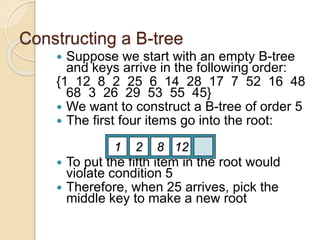
 The first four items go into the root:
 To put the fifth item in the root would
violate condition 5
 Therefore, when 25 arrives, pick the
middle key to make a new root
12
8
1 2
Constructing a B-tree
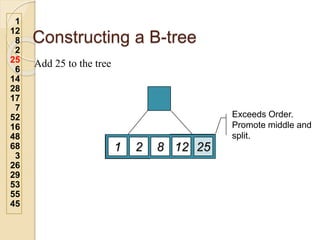
Add 25 to the tree
1
12
8
2
25
6
14
28
17
7
52
16
48
68
3
26
29
53
55
45
12
8
1 2 25
Exceeds Order.
Promote middle and
split.
Constructing a B-tree (contd.)
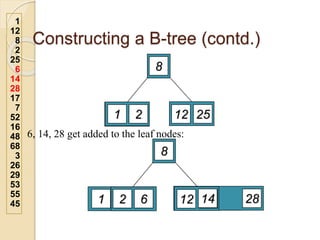
6, 14, 28 get added to the leaf nodes:
1
12
8
2
25
6
14
28
17
7
52
16
48
68
3
26
29
53
55
45
12
8
1 2 25
12
8
1 2 25
6
1 2 28
14
Constructing a B-tree (contd.)
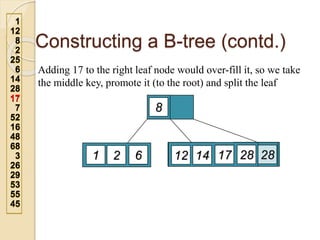
Adding 17 to the right leaf node would over-fill it, so we take
the middle key, promote it (to the root) and split the leaf
1
12
8
2
25
6
14
28
17
7
52
16
48
68
3
26
29
53
55
45
1
12
8
2
25
6
14
28
17
7
52
16
48
68
3
26
29
53
55
45
12
8
2 25
6
1 2 28
14 28
17
Constructing a B-tree (contd.)
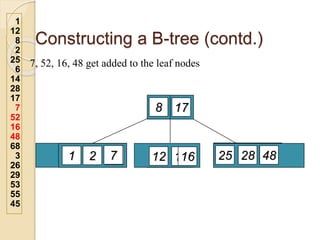
7, 52, 16, 48 get added to the leaf nodes
1
12
8
2
25
6
14
28
17
7
52
16
48
68
3
26
29
53
55
45
12
8
25
6
1 2 28
14
17
7 52
16 48
Constructing a B-tree (contd.)
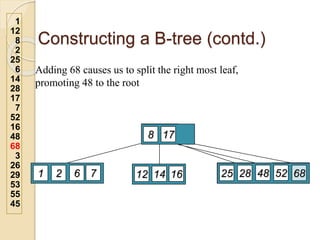
Adding 68 causes us to split the right most leaf,
promoting 48 to the root
1
12
8
2
25
6
14
28
17
7
52
16
48
68
3
26
29
53
55
45
8 17
7
6
2
1 16
14
12 52
48
28
25 68
Constructing a B-tree (contd.)
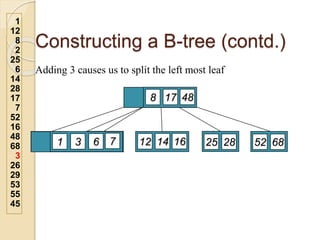
Adding 3 causes us to split the left most leaf
1
12
8
2
25
6
14
28
17
7
52
16
48
68
3
26
29
53
55
45
48
17
8
7
6
2
1 16
14
12 25 28 52 68
3 7
Constructing a B-tree (contd.)
1
12
8
2
25
6
14
28
17
7
52
16
48
68
3
26
29
53
55
45
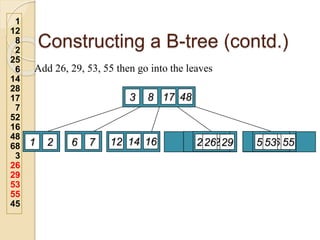
Add 26, 29, 53, 55 then go into the leaves
48
17
8
3
1 2 6 7 52 68
25 28
16
14
12 26 29 53 55
Constructing a B-tree (contd.)
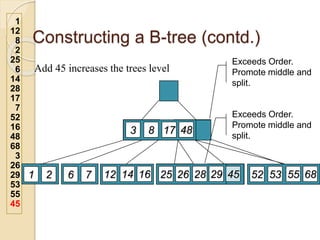
Add 45 increases the trees level
1
12
8
2
25
6
14
28
17
7
52
16
48
68
3
26
29
53
55
45
48
17
8
3
29
28
26
25 68
55
53
52
16
14
12
6 7
1 2 45
Exceeds Order.
Promote middle and
split.
Exceeds Order.
Promote middle and
split.
Inserting into a B-Tree
 If the node contains fewer than the maximum legal
number of elements, then there is room for the new
element. Insert the new element in the node, keeping
the node's elements ordered.
 Otherwise the node is full, evenly split it into two nodes
so:
◦ A single median is chosen from among the leaf's elements
and the new element.
◦ Values less than the median are put in the new left node and
values greater than the median are put in the new right node,
with the median acting as a separation value.
◦ The separation value is inserted in the node's parent, which
may cause it to be split, and so on. If the node has no parent
(i.e., the node was the root), create a new root above this
node (increasing the height of the tree).
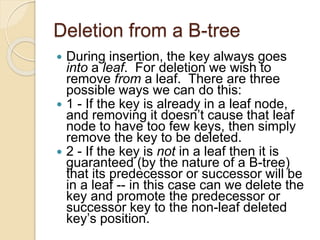
Deletion from a B-tree
 During insertion, the key always goes
into a leaf. For deletion we wish to
remove from a leaf. There are three
possible ways we can do this:
 1 - If the key is already in a leaf node,
and removing it doesn’t cause that leaf
node to have too few keys, then simply
remove the key to be deleted.
 2 - If the key is not in a leaf then it is
guaranteed (by the nature of a B-tree)
that its predecessor or successor will be
in a leaf -- in this case can we delete the
key and promote the predecessor or
successor key to the non-leaf deleted
key’s position.
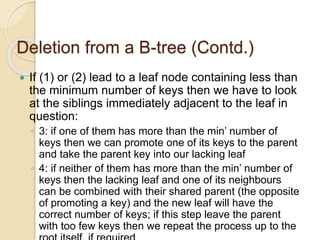
Deletion from a B-tree (Contd.)
 If (1) or (2) lead to a leaf node containing less than
the minimum number of keys then we have to look
at the siblings immediately adjacent to the leaf in
question:
◦ 3: if one of them has more than the min’ number of
keys then we can promote one of its keys to the parent
and take the parent key into our lacking leaf
◦ 4: if neither of them has more than the min’ number of
keys then the lacking leaf and one of its neighbours
can be combined with their shared parent (the opposite
of promoting a key) and the new leaf will have the
correct number of keys; if this step leave the parent
with too few keys then we repeat the process up to the
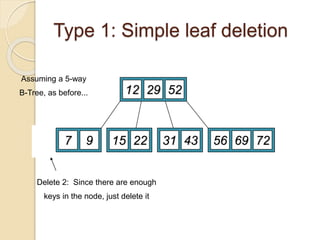
Type 1: Simple leaf deletion
12 29 52
2 7 9 15 22 56 69 72
31 43
Delete 2: Since there are enough
keys in the node, just delete it
Assuming a 5-way
B-Tree, as before...
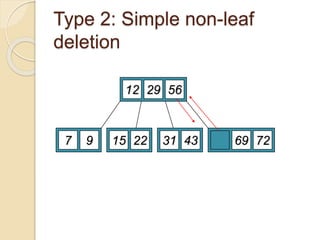
Type 2: Simple non-leaf
deletion
12 29 52
7 9 15 22 56 69 72
31 43
Delete 52
Borrow the predecessor
or (in this case) successor
56
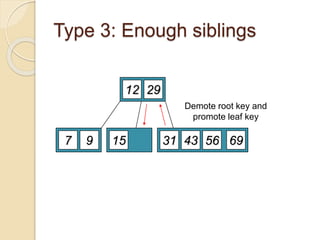
Type 3: Enough siblings
12 29
7 9 15 22 69
56
31 43
Delete 22
Demote root key and
promote leaf key
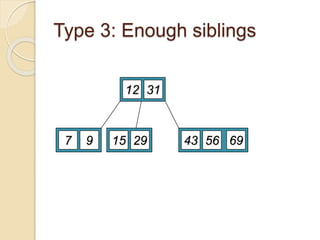
Type 3: Enough siblings
12
29
7 9 15
31
69
56
43
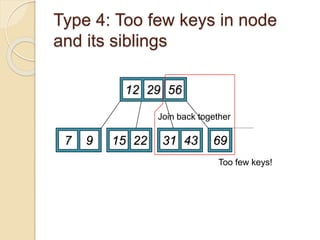
Type 4: Too few keys in node
and its siblings
12 29 56
7 9 15 22 69 72
31 43
Delete 72
Too few keys!
Join back together
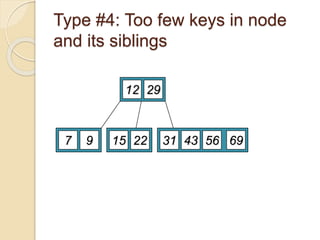
Type #4: Too few keys in node
and its siblings
12 29
7 9 15 22 69
56
31 43
QUESTIONS?
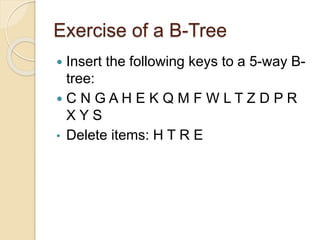
Exercise of a B-Tree
 Insert the following keys to a 5-way B-
tree:
 C N G A H E K Q M F W L T Z D P R
X Y S
• Delete items: H T R E
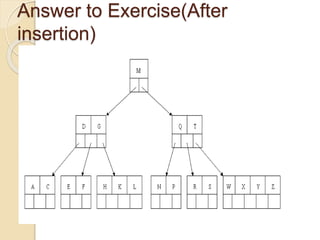
Answer to Exercise(After
insertion)
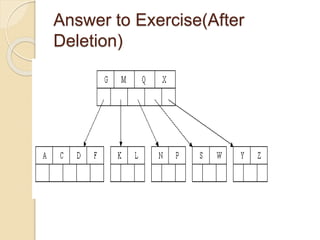
Answer to Exercise(After
Deletion)
THANK YOU

B trees2

  • 1.
  • 2.
    Definition of aB-tree  A B-tree of order m is an m-way tree (i.e., a tree where each node may have up to m children) in which: 1.The number of keys in each non-leaf node is one less than the number of its children and these keys partition the keys in the children in the fashion of a search tree 2.All leaves are on the same level 3.All non-leaf nodes except the root have at least m / 2 children 4.The root is either a leaf node, or it has from two to m children 5.A leaf node contains no more than m – 1 keys
  • 3.
    An example B-Tree 5162 42 6 12 26 55 60 70 64 90 45 1 2 4 7 8 13 15 18 25 27 29 46 48 53 A B-tree of order 5 containing 26 items all the leaves are at the same level
  • 4.
    Constructing a B-tree Suppose we start with an empty B-tree and keys arrive in the following order: {1 12 8 2 25 6 14 28 17 7 52 16 48 68 3 26 29 53 55 45}  We want to construct a B-tree of order 5  The first four items go into the root:  To put the fifth item in the root would violate condition 5  Therefore, when 25 arrives, pick the middle key to make a new root 12 8 1 2
  • 5.
    Constructing a B-tree Add25 to the tree 1 12 8 2 25 6 14 28 17 7 52 16 48 68 3 26 29 53 55 45 12 8 1 2 25 Exceeds Order. Promote middle and split.
  • 6.
    Constructing a B-tree(contd.) 6, 14, 28 get added to the leaf nodes: 1 12 8 2 25 6 14 28 17 7 52 16 48 68 3 26 29 53 55 45 12 8 1 2 25 12 8 1 2 25 6 1 2 28 14
  • 7.
    Constructing a B-tree(contd.) Adding 17 to the right leaf node would over-fill it, so we take the middle key, promote it (to the root) and split the leaf 1 12 8 2 25 6 14 28 17 7 52 16 48 68 3 26 29 53 55 45 1 12 8 2 25 6 14 28 17 7 52 16 48 68 3 26 29 53 55 45 12 8 2 25 6 1 2 28 14 28 17
  • 8.
    Constructing a B-tree(contd.) 7, 52, 16, 48 get added to the leaf nodes 1 12 8 2 25 6 14 28 17 7 52 16 48 68 3 26 29 53 55 45 12 8 25 6 1 2 28 14 17 7 52 16 48
  • 9.
    Constructing a B-tree(contd.) Adding 68 causes us to split the right most leaf, promoting 48 to the root 1 12 8 2 25 6 14 28 17 7 52 16 48 68 3 26 29 53 55 45 8 17 7 6 2 1 16 14 12 52 48 28 25 68
  • 10.
    Constructing a B-tree(contd.) Adding 3 causes us to split the left most leaf 1 12 8 2 25 6 14 28 17 7 52 16 48 68 3 26 29 53 55 45 48 17 8 7 6 2 1 16 14 12 25 28 52 68 3 7
  • 11.
    Constructing a B-tree(contd.) 1 12 8 2 25 6 14 28 17 7 52 16 48 68 3 26 29 53 55 45 Add 26, 29, 53, 55 then go into the leaves 48 17 8 3 1 2 6 7 52 68 25 28 16 14 12 26 29 53 55
  • 12.
    Constructing a B-tree(contd.) Add 45 increases the trees level 1 12 8 2 25 6 14 28 17 7 52 16 48 68 3 26 29 53 55 45 48 17 8 3 29 28 26 25 68 55 53 52 16 14 12 6 7 1 2 45 Exceeds Order. Promote middle and split. Exceeds Order. Promote middle and split.
  • 13.
    Inserting into aB-Tree  If the node contains fewer than the maximum legal number of elements, then there is room for the new element. Insert the new element in the node, keeping the node's elements ordered.  Otherwise the node is full, evenly split it into two nodes so: ◦ A single median is chosen from among the leaf's elements and the new element. ◦ Values less than the median are put in the new left node and values greater than the median are put in the new right node, with the median acting as a separation value. ◦ The separation value is inserted in the node's parent, which may cause it to be split, and so on. If the node has no parent (i.e., the node was the root), create a new root above this node (increasing the height of the tree).
  • 14.
    Deletion from aB-tree  During insertion, the key always goes into a leaf. For deletion we wish to remove from a leaf. There are three possible ways we can do this:  1 - If the key is already in a leaf node, and removing it doesn’t cause that leaf node to have too few keys, then simply remove the key to be deleted.  2 - If the key is not in a leaf then it is guaranteed (by the nature of a B-tree) that its predecessor or successor will be in a leaf -- in this case can we delete the key and promote the predecessor or successor key to the non-leaf deleted key’s position.
  • 15.
    Deletion from aB-tree (Contd.)  If (1) or (2) lead to a leaf node containing less than the minimum number of keys then we have to look at the siblings immediately adjacent to the leaf in question: ◦ 3: if one of them has more than the min’ number of keys then we can promote one of its keys to the parent and take the parent key into our lacking leaf ◦ 4: if neither of them has more than the min’ number of keys then the lacking leaf and one of its neighbours can be combined with their shared parent (the opposite of promoting a key) and the new leaf will have the correct number of keys; if this step leave the parent with too few keys then we repeat the process up to the
  • 16.
    Type 1: Simpleleaf deletion 12 29 52 2 7 9 15 22 56 69 72 31 43 Delete 2: Since there are enough keys in the node, just delete it Assuming a 5-way B-Tree, as before...
  • 17.
    Type 2: Simplenon-leaf deletion 12 29 52 7 9 15 22 56 69 72 31 43 Delete 52 Borrow the predecessor or (in this case) successor 56
  • 18.
    Type 3: Enoughsiblings 12 29 7 9 15 22 69 56 31 43 Delete 22 Demote root key and promote leaf key
  • 19.
    Type 3: Enoughsiblings 12 29 7 9 15 31 69 56 43
  • 20.
    Type 4: Toofew keys in node and its siblings 12 29 56 7 9 15 22 69 72 31 43 Delete 72 Too few keys! Join back together
  • 21.
    Type #4: Toofew keys in node and its siblings 12 29 7 9 15 22 69 56 31 43
  • 22.
  • 23.
    Exercise of aB-Tree  Insert the following keys to a 5-way B- tree:  C N G A H E K Q M F W L T Z D P R X Y S • Delete items: H T R E
  • 24.
  • 25.
  • 26.