Junaid khan
Visiting Lecturer University of
Peshawar
AND ITS TYPES
It is a logical way of storing data and it
also define mechanism of retrieve data.
What are Data Structures?



Data may be organized in many different ways.
A Data Structure is an arrangement of data in a
computer’s memory or on a disk.
 The logical or mathematical model of a particular
organization of a data is called Data Structures.
 The choice of a data model depends on two
consideration:
1) It must be rich enough in structure to mirror the actual
relationships of the data in the real world.
2) The structure should be simple enough that one can
effectively process the data when necessary.
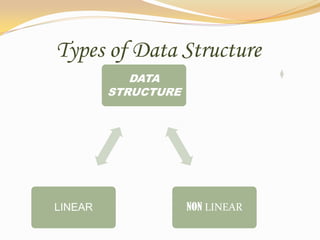
Types of Data Structure
DATA
STRUCTURE

LINEAR

NON LINEAR
The data appearing in data structures are processed by means of
operations. The following are operations are major operations:
a) Traversing: Accessing each record exactly once so that
certain items in the record may be processed.
b) Searching: Finding the location of the record with a
given key value, or finding the locations of all records which satisfy
one or more conditions.
c) Inserting: Adding a new record to the structure.
d) Deleting: Removing a record from the structure.
Following two are special operations:
a) Sorting: Arranging the records in some logical order.
b) Merging: Combining the records in two different sorted
files into a single sorted file.
An algorithm is a well-defined list of steps for solving a particular
problem.
Algorithms manipulate the data present in data structures in various
ways, such as searching for a particular data item and sorting the data.
Flowcharts are pictorial representations of the algorithms.
Properties/ characteristics of the algorithm:
a) Finiteness: Total number of steps used in an algorithm
should be finite.
b) Definiteness: Each step of algorithm must be clear and
unambiguous.

c) Effectiveness: Every step must be basic and essential.
d) Input/output: The algorithm must accept zero or more
input and must produce at least on output.
1.Array
2.Stack
3.Queue
4.Linked List
An array is a collection of homogeneous
type of data elements.
An array is consisting of a collection of
elements .
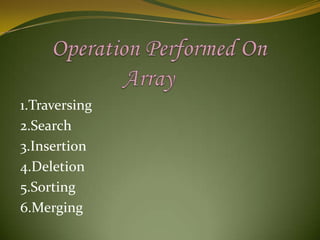
1.Traversing
2.Search
3.Insertion
4.Deletion
5.Sorting
6.Merging
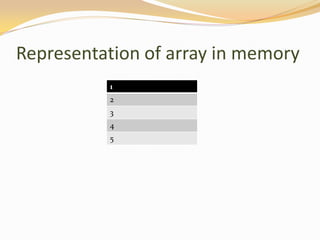
Representation of array in memory
1

2
3
4
5
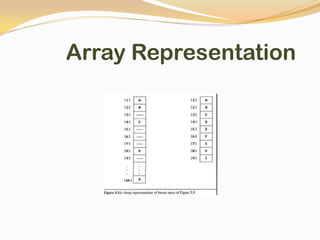
Array Representation
A Stack is a list of elements in which an
element may be inserted or deleted at one
end which is known as TOP of the stack.
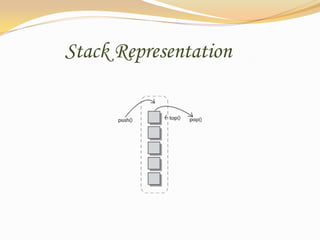
Push: add an element in stack
Pop: remove an element in stack
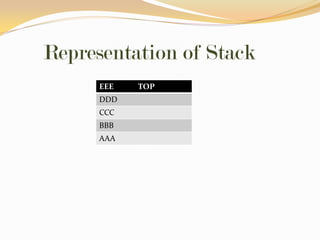
Representation of Stack
EEE

DDD
CCC
BBB
AAA

TOP
Stack Representation
A queue is a linear list of element in which
insertion can be done at one end which is
known as front and deletion can be done
which is known as rear.
Insertion : add a new element in queue
Deletion: Removing an element in queue
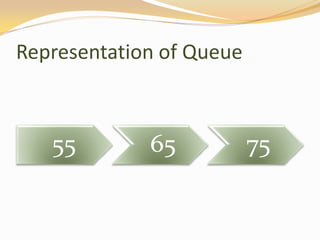
Representation of Queue

55

65

75
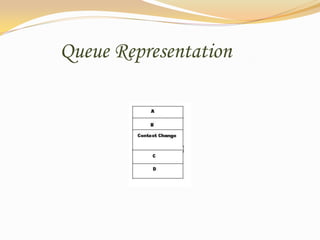
Queue Representation
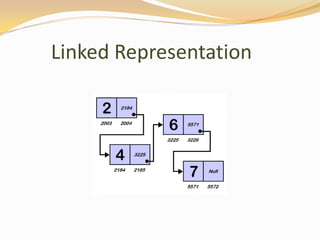
A Linked list is a linear collection of
data elements .It has two part one is
info and other is link part.info part
gives information and link part is
address of next node
1.Traversing
2.Searching
3.Insertion
4.Deletion
Linked Representation
1.Tree
2.Graph
In computer science, a tree is a widely-used data
structure that emulates a hierarchical tree structure
with a set of linked nodes.
1.Insertion
2.Deletion
3.Searching
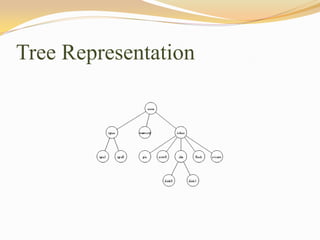
Tree Representation
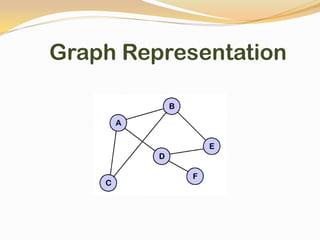
A graph data structure may also associate to each edge some edge
value, such as a symbolic label or a numeric attribute
(cost, capacity, length, etc.).
1.Searching
2.Insertion
3.Deletion
Graph Representation
Data structure

Data structure

  • 1.
    Junaid khan Visiting LecturerUniversity of Peshawar
  • 2.
  • 3.
    It is alogical way of storing data and it also define mechanism of retrieve data.
  • 4.
    What are DataStructures?   Data may be organized in many different ways. A Data Structure is an arrangement of data in a computer’s memory or on a disk.  The logical or mathematical model of a particular organization of a data is called Data Structures.  The choice of a data model depends on two consideration: 1) It must be rich enough in structure to mirror the actual relationships of the data in the real world. 2) The structure should be simple enough that one can effectively process the data when necessary.
  • 5.
    Types of DataStructure DATA STRUCTURE LINEAR NON LINEAR
  • 6.
    The data appearingin data structures are processed by means of operations. The following are operations are major operations: a) Traversing: Accessing each record exactly once so that certain items in the record may be processed. b) Searching: Finding the location of the record with a given key value, or finding the locations of all records which satisfy one or more conditions. c) Inserting: Adding a new record to the structure. d) Deleting: Removing a record from the structure. Following two are special operations: a) Sorting: Arranging the records in some logical order. b) Merging: Combining the records in two different sorted files into a single sorted file.
  • 7.
    An algorithm isa well-defined list of steps for solving a particular problem. Algorithms manipulate the data present in data structures in various ways, such as searching for a particular data item and sorting the data. Flowcharts are pictorial representations of the algorithms. Properties/ characteristics of the algorithm: a) Finiteness: Total number of steps used in an algorithm should be finite. b) Definiteness: Each step of algorithm must be clear and unambiguous. c) Effectiveness: Every step must be basic and essential. d) Input/output: The algorithm must accept zero or more input and must produce at least on output.
  • 8.
  • 9.
    An array isa collection of homogeneous type of data elements. An array is consisting of a collection of elements .
  • 10.
  • 11.
    Representation of arrayin memory 1 2 3 4 5
  • 12.
  • 13.
    A Stack isa list of elements in which an element may be inserted or deleted at one end which is known as TOP of the stack.
  • 14.
    Push: add anelement in stack Pop: remove an element in stack
  • 15.
  • 16.
  • 17.
    A queue isa linear list of element in which insertion can be done at one end which is known as front and deletion can be done which is known as rear.
  • 18.
    Insertion : adda new element in queue Deletion: Removing an element in queue
  • 19.
  • 20.
  • 21.
    A Linked listis a linear collection of data elements .It has two part one is info and other is link part.info part gives information and link part is address of next node
  • 22.
  • 23.
  • 24.
  • 25.
    In computer science,a tree is a widely-used data structure that emulates a hierarchical tree structure with a set of linked nodes.
  • 26.
  • 27.
  • 28.
    A graph datastructure may also associate to each edge some edge value, such as a symbolic label or a numeric attribute (cost, capacity, length, etc.).
  • 29.
  • 30.