Downloaded 172 times
![Algorithm
[1] i = 1
[2] If K = A[i] , Print “Search is
Successful” and Stop
[3] i = i + 1
[4] If (i <= n) then Go To Step [2]
[5] Else Print “Search is
Unsuccessful” and Stop
[6] Exit](https://image.slidesharecdn.com/lecture12-e-131122062300-phpapp02/85/Lecture-12-data-structures-and-algorithms-4-320.jpg)
![Algorithm
[1] i = 1
[2] If K = A[i] , Print “Search is
Successful” and Stop
[3] i = i + 1
[4] If (i <= n) and (A[i] <= K) then Go To
Step [2]
[5] Else Print “Search is
Unsuccessful” and Stop
[6] Exit](https://image.slidesharecdn.com/lecture12-e-131122062300-phpapp02/85/Lecture-12-data-structures-and-algorithms-8-320.jpg)
![Binary Search
l
u
mid
mid = (l + u) /2 K = A[mid] then done
l
u
If K < A[mid]
mid
u = mid -1
mid l
u
If K > A[mid] l = mid +1](https://image.slidesharecdn.com/lecture12-e-131122062300-phpapp02/85/Lecture-12-data-structures-and-algorithms-10-320.jpg)
![Algorithm
[1] l =1, u =n
[2] while (l < u) repeat steps 3 to 7
[3] mid = (l + u) / 2
[4] if K = A[mid] then print Successful
and Stop
[5] if K < A[mid] then
[6] u = mid -1
[7] else l = mid + 1
[8] Print Unsuccessful and Exit](https://image.slidesharecdn.com/lecture12-e-131122062300-phpapp02/85/Lecture-12-data-structures-and-algorithms-11-320.jpg)
![Example
1
15
l
1
15
2
25
2
25
3
35
3
35
4
45
4
45
5
65
5
65
6
75
6
75
7
85
8
95
7
85
u
8
95
l=4+1
u
1
2
3
4
5
6
7
8
15
25
35
45
65
75
85
95
l=4+1
u
K = 75
l=1
u =8
l=1
u =8
mid = 4
K = 75 > A[4]
l=5
u =8
mid = 6
K = 75 = A[6]](https://image.slidesharecdn.com/lecture12-e-131122062300-phpapp02/85/Lecture-12-data-structures-and-algorithms-12-320.jpg)
![Example
1
15
l
1
15
2
25
2
25
3
35
3
35
4
45
4
45
5
65
5
65
6
75
6
75
7
85
8
95
7
85
u
8
95
l=4+1
u
1
2
3
4
5
6
7
8
15
25
35
45
65
75
85
95
l=4+1
u= 6-1
K = 55
l=1
u =8
l=1
u =8
mid = 4
K = 55 > A[4]
l=5
u =8
mid = 6
K = 55 < A[6]](https://image.slidesharecdn.com/lecture12-e-131122062300-phpapp02/85/Lecture-12-data-structures-and-algorithms-13-320.jpg)
![1
2
3
4
5
6
7
8
15
25
35
45
65
75
85
95
u= 5-1
l=5
l=5
u =8
mid = 5
K = 55 < A[5]](https://image.slidesharecdn.com/lecture12-e-131122062300-phpapp02/85/Lecture-12-data-structures-and-algorithms-14-320.jpg)
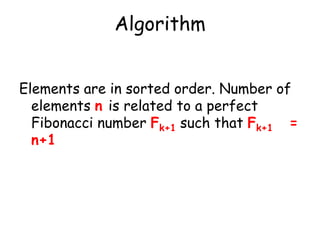
![[1] i = Fk
[2] p = Fk-1 , q = Fk-2
[3] If ( K < Ki ) then
[4] If (q==0) then Print “unsuccessful
and exit”
[5]
Else i = i – q, pold = p, p =q,
q =pold – q
[6] Goto step 3](https://image.slidesharecdn.com/lecture12-e-131122062300-phpapp02/85/Lecture-12-data-structures-and-algorithms-24-320.jpg)
![[7] If (K > Ki ) then
[8] If (p ==1) then Print “Unsuccessful
and Exit”
[9] Else i = i + q, p = p+q, q=q-p
[10] Goto step 3
[11] If ( k == Ki ) then Print “Successful at
ith location”
[12] Stop](https://image.slidesharecdn.com/lecture12-e-131122062300-phpapp02/85/Lecture-12-data-structures-and-algorithms-25-320.jpg)
![Example
1
15
2
20
3
25
4
30
5
35
6
40
7
45
8
50
9
65
10
75
11
85
12
95
K = 25
Initialization: i = Fk = 8, p = Fk-1 = 5, q = Fk-2 = 3
Iteration 1;
K8 = A[8] = 50, K < K8 , q == 3
i = i –q = 8 -3 = 5, pold = p =5
p=q= 3, q = pold – q = 5-3 = 2
Iteration 2;
K5 = A[5] = 35, K < K5 , q == 2
i = i –q = 5 -2 = 3, pold = p =3
p=q= 2, q = pold – q = 3-2 = 1](https://image.slidesharecdn.com/lecture12-e-131122062300-phpapp02/85/Lecture-12-data-structures-and-algorithms-26-320.jpg)
![1
15
2
20
3
25
4
30
Iteration 2;
K3 = A[3] = 25,
5
35
6
40
K = K3
Search is successful
7
45
8
50
9
65
10
75
11
85
12
95](https://image.slidesharecdn.com/lecture12-e-131122062300-phpapp02/85/Lecture-12-data-structures-and-algorithms-27-320.jpg)

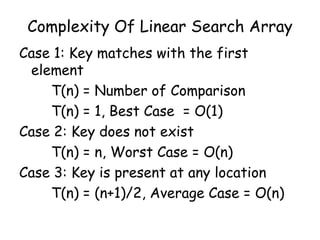
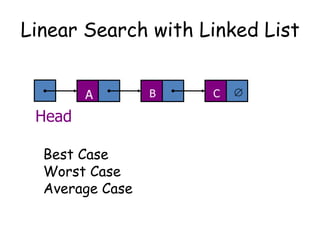
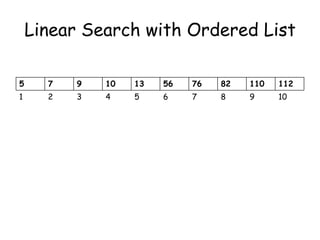
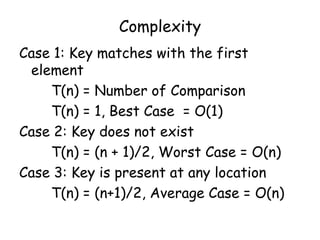
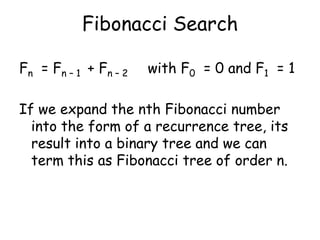
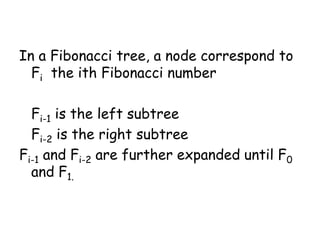
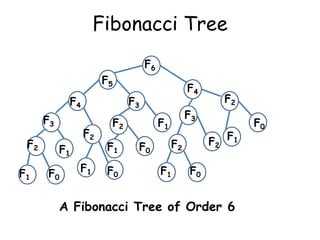
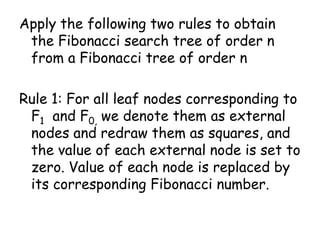
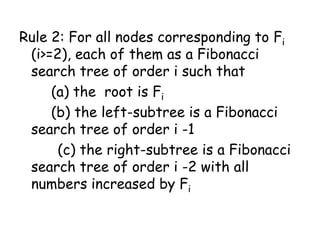
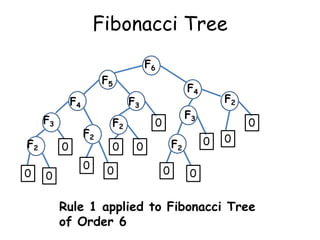
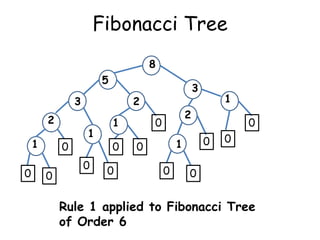
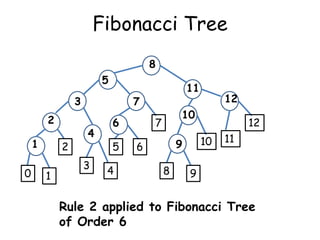
The document discusses different searching algorithms like linear search, binary search, and Fibonacci search. It explains the algorithms through pseudocode and examples. Linear search has worst case complexity of O(n) as it may need to search through the entire list. Binary search has worst case complexity of O(log n) as it divides the search space in half in each step. Fibonacci search generalizes binary search by dividing the search space in Fibonacci numbers ratios in each step.


