Data Structure and
Algorithm (CS-102)
Ashok K Turuk
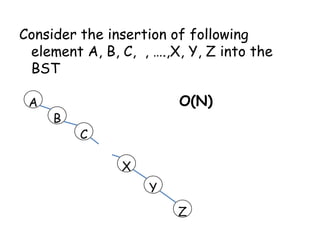
Consider the insertion of following
element A, B, C, , ….,X, Y, Z into the
BST
A

B

O(N)
C

X
Y

Z
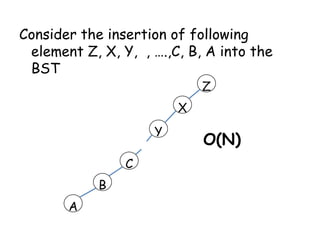
Consider the insertion of following
element Z, X, Y, , ….,C, B, A into the
BST
Z

X
Y

C
B
A

O(N)
Balanced binary tree
• The disadvantage of a binary search tree is that its
height can be as large as N-1
• This means that the time needed to perform insertion
and deletion and many other operations can be O(N)
in the worst case
• We want a tree with small height
• A binary tree with N node has height at least
(log
N)
• Thus, our goal is to keep the height of a binary search
tree O(log N)
• Such trees are called balanced binary search trees.
Examples are AVL tree, red-black tree.
AVL tree
Height of a node
• The height of a leaf is 1. The height of
a null pointer is zero.
• The height of an internal node is the
maximum height of its children plus 1
AVL tree
• An AVL tree is a binary search tree in
which
– for every node in the tree, the height of
the left and right subtrees differ by at
most 1.
– An empty binary tree is an AVL tree
AVL tree

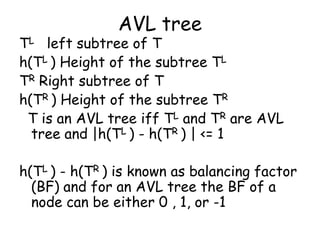
TL left subtree of T
h(TL ) Height of the subtree TL
TR Right subtree of T
h(TR ) Height of the subtree TR
T is an AVL tree iff TL and TR are AVL
tree and |h(TL ) - h(TR ) | <= 1
h(TL ) - h(TR ) is known as balancing factor
(BF) and for an AVL tree the BF of a
node can be either 0 , 1, or -1
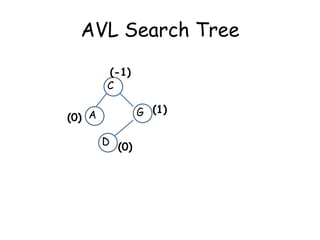
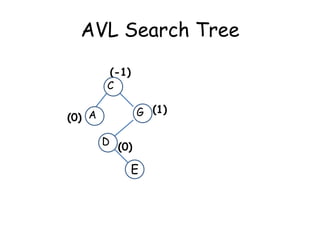
AVL Search Tree
(-1)
C
G (1)

(0) A
D (0)
Insertion in AVL search Tree
Insertion into an AVL search tree may
affect the BF of a node, resulting the
BST unbalanced.

A technique called Rotation is used to
restore he balance of the search tree
AVL Search Tree
(-1)
C
G (1)

(0) A
D (0)

E
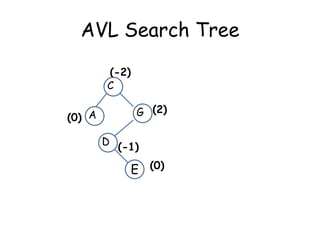
AVL Search Tree
(-2)
C
(0) A

G (2)
D (-1)

E (0)
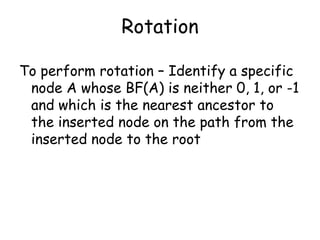
Rotation
To perform rotation – Identify a specific
node A whose BF(A) is neither 0, 1, or -1
and which is the nearest ancestor to
the inserted node on the path from the
inserted node to the root
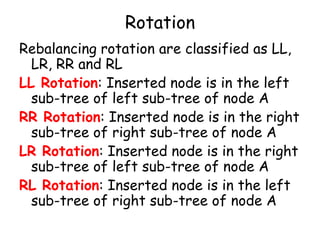
Rotation
Rebalancing rotation are classified as LL,
LR, RR and RL
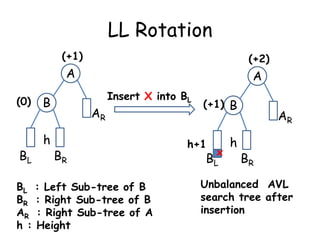
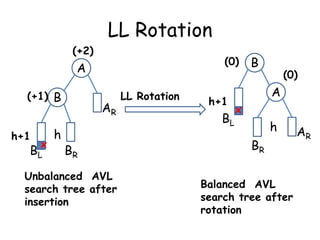
LL Rotation: Inserted node is in the left
sub-tree of left sub-tree of node A
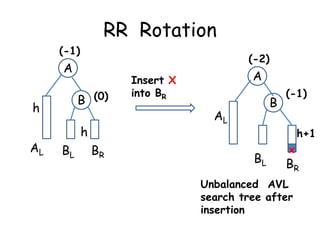
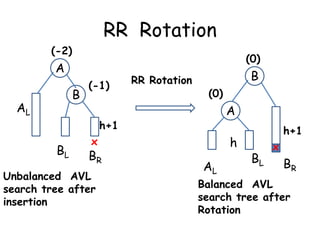
RR Rotation: Inserted node is in the right
sub-tree of right sub-tree of node A
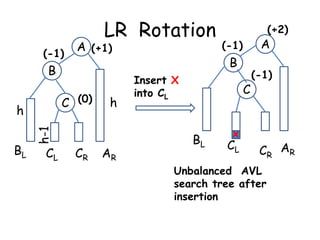
LR Rotation: Inserted node is in the right
sub-tree of left sub-tree of node A
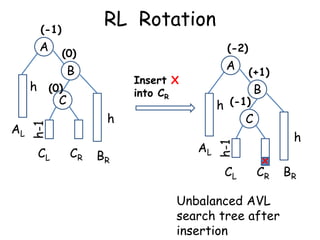
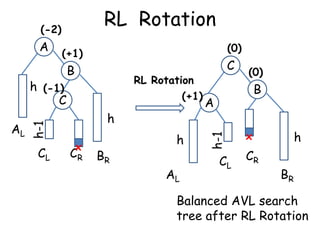
RL Rotation: Inserted node is in the left
sub-tree of right sub-tree of node A
LL Rotation
(+1)

(+2)

A
(0)

BL

B

h

A
AR

Insert X into BL

c

BR

BL : Left Sub-tree of B
BR : Right Sub-tree of B
AR : Right Sub-tree of A
h : Height

(+1) B

h+1

x

BL

h

AR
c

BR

Unbalanced AVL
search tree after
insertion
LL Rotation
(+2)

(0)

A
(+1) B

h+1

x

BL

h

AR
c

BR

Unbalanced AVL
search tree after
insertion

LL Rotation

h+1

BL

B

(0)

A
x
c

h

BR
Balanced AVL
search tree after
rotation

AR
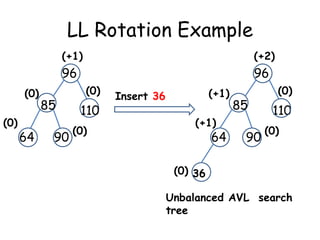
LL Rotation Example
(+1)

96
(0)
(0)

64

(+2)

96

85

90

(0)

110
(0)

(+1)

Insert 36

(+1)

64

85

90

(0)

110
(0)

(0) 36
Unbalanced AVL search
tree
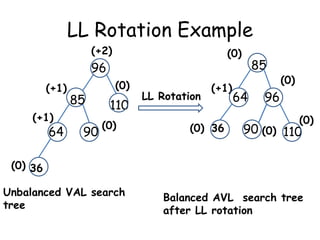
LL Rotation Example
(+2)

(0)

96
(+1)
(+1)

64

85

90

(0)

110
(0)

LL Rotation

(+1)

(0) 36

85

64

(0)

96
(0)

90 (0) 110

(0) 36

Unbalanced VAL search
tree

Balanced AVL search tree
after LL rotation
RR Rotation
(-1)

(-2)

A
B (0)

h
AL

h
BL

c

BR

A

Insert X
into BR

B

AL

(-1)

c

BL

x

h+1

BR

Unbalanced AVL
search tree after
insertion
RR Rotation
(-2)

(0)

A
B

AL

(-1)

c

BL

RR Rotation

B
(0)

A

h+1

c

h

x

BR

Unbalanced AVL
search tree after
insertion

AL

BL

h+1

x

BR

Balanced AVL
search tree after
Rotation
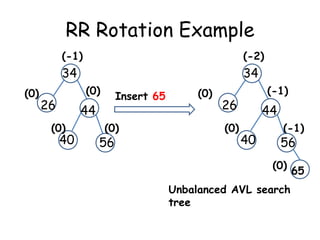
RR Rotation Example
(-1)

34
(0)

(-2)

34
(0)

26

Insert 65

44

(0)

40

(0)

56

(0)

(-1)

26
(0)

44

40

(-1)

56

(0) 65

Unbalanced AVL search
tree
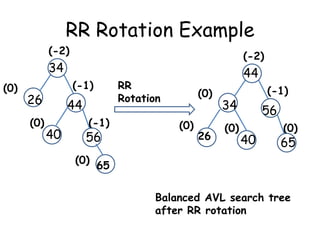
RR Rotation Example
(-2)

(-2)

34
(0)

(-1)

26
(0)

44

40

(-1)

56

44

RR
Rotation

(0)
(0)

26

(-1)

34
(0)

56

40

(0)

65

(0) 65
Balanced AVL search tree
after RR rotation
LR Rotation

(-1)

A (+1)

B
C (0)

h

h

c

BL

CL

CR

AR

(+2)

A

(-1)

B
Insert X
into CL

C

BL

x

CL

(-1)

c

CR AR

Unbalanced AVL
search tree after
insertion
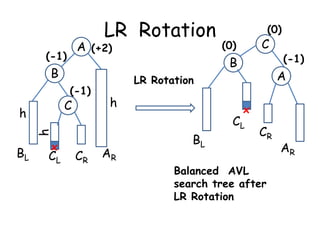
LR Rotation

A (+2)

(-1)

B
(-1)

C

h
BL

x

CL

C

(0)

B

h

AR

x

BL

(-1)

A

LR Rotation

c

CR

(0)

CL

c

CR

Balanced AVL
search tree after
LR Rotation

AR
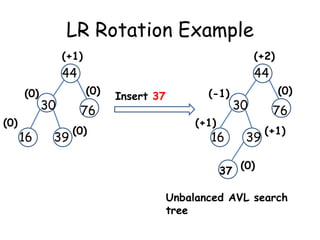
LR Rotation Example
(+1)

44
(0)
(0)

16

(+2)

44

30

39

(0)

76
(0)

Insert 37

(-1)
(+1)

16

30

39

(0)

76
(+1)

37 (0)
Unbalanced AVL search
tree
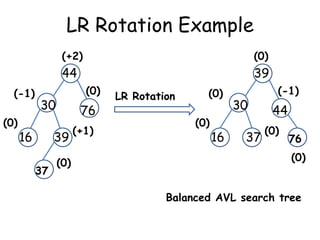
LR Rotation Example
(+2)

44
(-1)
(0)

(0)

39
(0)

30

16

76

39
37

(0)

(+1)

LR Rotation

(0)
(0)

16

30

37

(-1)

44
(0)

76
(0)

Balanced AVL search tree
RL Rotation

(-1)

A

h (0)
C
AL

(-2)

(0)

B

Insert X
into CR
c

CL

A

CR

h (-1)
C

h
BR

(+1)

AL

B

c

CL

x

CR

Unbalanced AVL
search tree after
insertion

h
BR
RL Rotation

(-2)

A

h (-1)
C
AL

B

RL Rotation
(+1)
c

CL

(0)

(+1)

x

CR

h
BR

C

(0)

B

A
c

AL

h

x

h
CL

CR

BR

Balanced AVL search
tree after RL Rotation
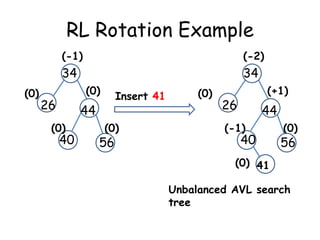
RL Rotation Example
(-1)

34
(0)

(-2)

34
(0)

26

Insert 41

44

(0)

40

(0)

56

(0)

(+1)

26

44

(-1)

40

(0)

56

(0) 41

Unbalanced AVL search
tree
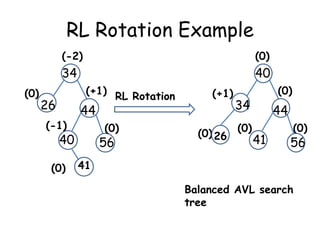
RL Rotation Example
(-2)

34
(0)

(0)

40
(+1) RL Rotation

26
(-1)

44

(0)

40

(0)

56

(+1)

(0)

34

(0) 26 (0)

44

41

(0)

56

41

Balanced AVL search
tree
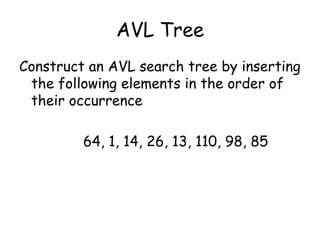
AVL Tree
Construct an AVL search tree by inserting
the following elements in the order of
their occurrence

64, 1, 14, 26, 13, 110, 98, 85
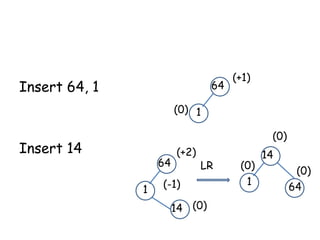
Insert 64, 1

64

(+1)

(0) 1

(0)

Insert 14

64

1

(+2)

LR

(-1)
14 (0)

(0)
1

14
(0)
64
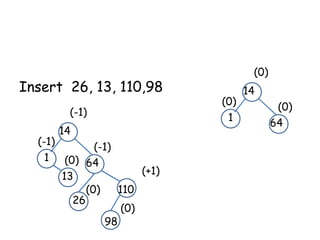
Insert 26, 13, 110,98
(-1)

14

(-1)
(-1)
1 (0) 64
(+1)
13
(0)
110
26
(0)
98

(0)
(0)
1

14
(0)
64
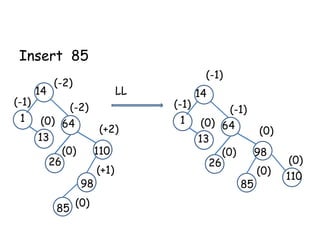
Insert 85
(-1)
1

14

(-1)

(-2)

LL

(-2)

(0) 64
13
(0)
26

(+2)

110
98

85 (0)

(+1)

14

(-1)
(-1)
1 (0) 64
(0)
13
(0)
98
26
(0)
85

(0)
110
Deletion in AVL search Tree
Deletion in AVL search tree proceed the
same way as the deletion in binary
search tree
However, in the event of imbalance due to
deletion, one or more rotation need to
be applied to balance the AVL tree.
AVL deletion
Let A be the closest ancestor node on the
path from X (deleted node) to the root
with a balancing factor +2 or -2
Classify the rotation as L or R depending
on whether the deletion occurred on the
left or right subtree of A
AVL Deletion
Depending on the value of BF(B) where B
is the root of the left or right subtree
of A, the R or L imbalance is further
classified as R0, R1 and R -1 or L0, L1
and L-1.
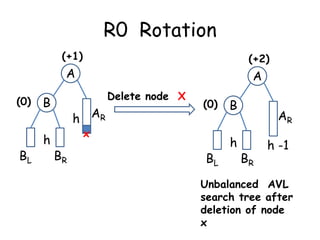
R0 Rotation
(+1)

(+2)

A
(0)

BL

Delete node X

B

h

A

h AR
c

BR

(0)

x

BL

B
h

AR
c

BR

h -1

Unbalanced AVL
search tree after
deletion of node
x
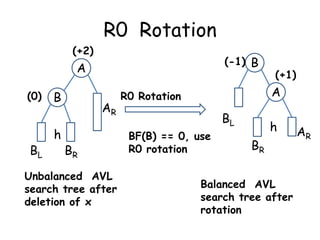
R0 Rotation
(+2)

(-1) B

A
(0)

BL

B

h

AR
c

BR

Unbalanced AVL
search tree after
deletion of x

(+1)

A

R0 Rotation

BF(B) == 0, use
R0 rotation

BL

c

h

BR

Balanced AVL
search tree after
rotation

AR
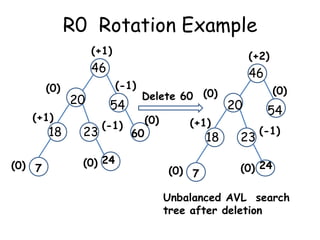
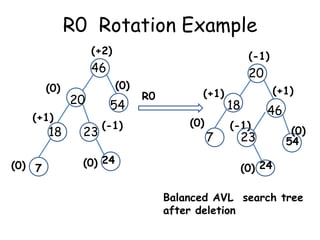
R0 Rotation Example
(+1)

(+2)

46
(0)
(+1)

18

(0) 7

20

23

(-1)

54
(-1)

(0) 24

46
Delete 60 (0)

60

(0)

(+1)

18

(0) 7

20

23

(0)

54
(-1)

(0) 24

Unbalanced AVL search
tree after deletion
R0 Rotation Example
(+2)

(-1)

46
(0)
(+1)

18

(0) 7

20

23

(0)

54
(-1)

(0) 24

20
R0

(+1)
(0)

7

(+1)

18
(-1)

46

23

(0)
54

(0) 24
Balanced AVL search tree
after deletion
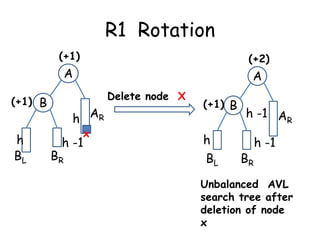
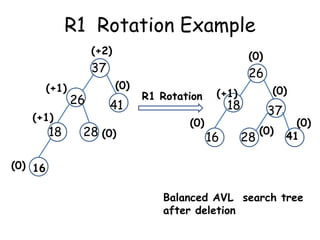
R1 Rotation
(+1)

(+2)

A
Delete node X

(+1) B

h
BL

A

h AR
c

x

h -1

BR

(+1) B

h
BL

h -1 AR
c

BR

h -1

Unbalanced AVL
search tree after
deletion of node
x
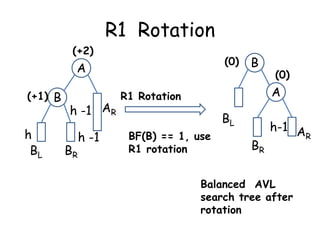
R1 Rotation
(+2)

(0)

A
(+1) B

h
BL

h -1 AR
c

BR

h -1

B

(0)

A

R1 Rotation

BF(B) == 1, use
R1 rotation

BL

c

BR

h-1 A
R

Balanced AVL
search tree after
rotation
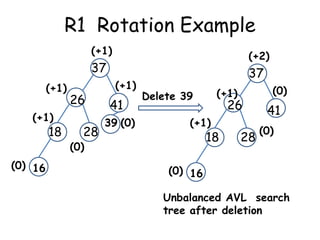
R1 Rotation Example
(+1)

(+2)

37
(+1)
(+1)

18

(0) 16

26

28

(+1)

41
39 (0)

37
(+1)

Delete 39

26

(+1)

18

(0)

28

(0)

41
(0)

(0) 16
Unbalanced AVL search
tree after deletion
R1 Rotation Example
(+2)

(0)

37
(+1)
(+1)

18

26

(0)

41

28 (0)

26
R1 Rotation
(0)

(0)

(+1)

18

16

37

28

(0)

(0)
41

(0) 16
Balanced AVL search tree
after deletion
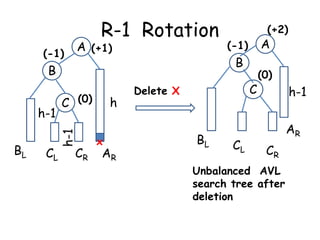
R-1 Rotation

(-1)

A (+1)

h-1

c

BL

CL

CR

h

A

(-1)

B

B
C (0)

(+2)

C

Delete X

(0)

h-1
c

x

AR

BL

CL

CR

Unbalanced AVL
search tree after
deletion

AR
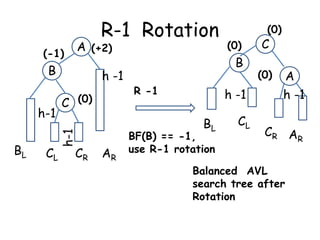
R-1 Rotation

(-1)

A (+2)

B
h-1

h -1
C (0)

BL

CL

CR

AR

(0)

B
R -1

h -1
BL

c

(0)

BF(B) == -1,
use R-1 rotation

CL

C

(0)
c

A
h -1

CR AR

Balanced AVL
search tree after
Rotation
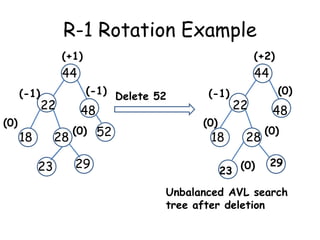
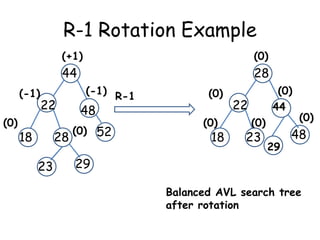
R-1 Rotation Example
(+1)

44
(-1)
(0)

22

(+2)

44
(-1) Delete 52

48

(0) 52
28

18
23

29

(-1)
(0)

18

22

28

23 (0)

(0)

48
(0)
29

Unbalanced AVL search
tree after deletion
R-1 Rotation Example
(+1)

44
(-1)
(0)

22

(0)

28
(-1) R-1

48

(0) 52
28

18
23

(0)
(0)

18

(0)
44

22
(0)

23

29

(0)

48

29
Balanced AVL search tree
after rotation
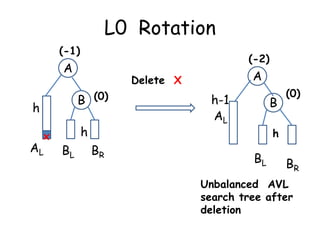
L0 Rotation
(-1)

(-2)

A
B (0)

h
x

AL

h
BL

A

Delete X

c

BR

h-1
AL

B
h

BL

(0)

c

BR

Unbalanced AVL
search tree after
deletion
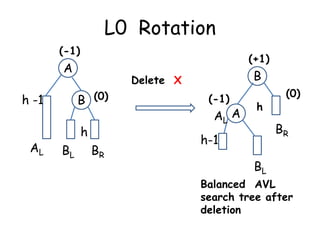
L0 Rotation
(-1)

(+1)

A
B (0)

h -1
AL

h
BL

B

Delete X

c

BR

(-1)

AL A

h

c

(0)

BR

h-1
BL

Balanced AVL
search tree after
deletion
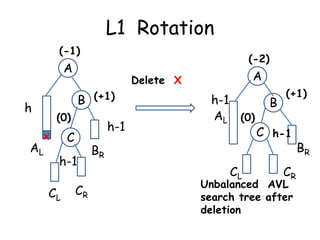
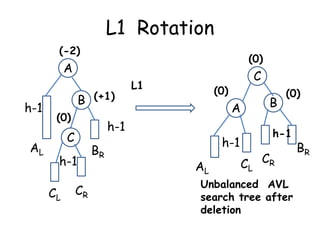
L1 Rotation
(-1)

(-2)

A
B (+1)

h

(0)

AL

c

C

x

h-1

CL

A

Delete X

CR

h-1

h-1
AL (0)

B

(+1)

C h-1c

BR
CL

CR

Unbalanced AVL
search tree after
deletion

BR
L1 Rotation
(-2)

(0)

A
h-1
AL

B (+1)
(0)

c

C
h-1

CL

CR

BR

L1

C

(0)

A

h-1

h-1
AL

B

(0)

h-1c

CL CR

Unbalanced AVL
search tree after
deletion

BR
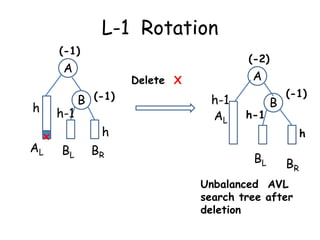
L-1 Rotation
(-1)

(-2)

A
h

h-1
x

AL

B (-1)
c

BL

A

Delete X

h

BR

h-1
AL

h-1

B

(-1)

c

BL

BR

Unbalanced AVL
search tree after
deletion

h
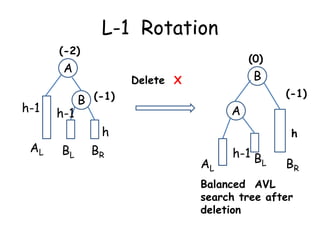
L-1 Rotation
(-2)

(0)

A
h-1

h-1
BL

(-1)

B (-1)
c

AL

B

Delete X

A

h

BR

c

AL

h-1 B

L

h

BR

Balanced AVL
search tree after
deletion

Lecture 10 data structures and algorithms