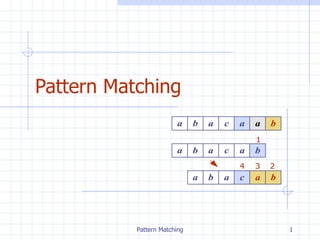
The document discusses several algorithms for pattern matching in strings:
1) Brute-force algorithm compares the pattern to every substring of the text, running in O(nm) time where n and m are the lengths of the text and pattern.
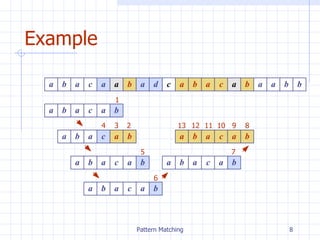
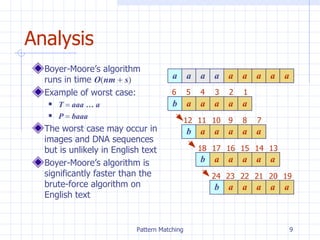
2) Boyer-Moore algorithm uses heuristics like the last occurrence function to skip comparisons, running faster in O(nm+s) time where s is the alphabet size.
3) Knuth-Morris-Pratt algorithm builds a failure function to determine the maximum shift of the pattern after a mismatch, running optimally in O(n+m) time.
![Strings A string is a sequence of characters Examples of strings: Java program HTML document DNA sequence Digitized image An alphabet is the set of possible characters for a family of strings Example of alphabets: ASCII Unicode {0, 1} {A, C, G, T} Let P be a string of size m A substring P [ i .. j ] of P is the subsequence of P consisting of the characters with ranks between i and j A prefix of P is a substring of the type P [0 .. i ] A suffix of P is a substring of the type P [ i ..m 1] Given strings T (text) and P (pattern), the pattern matching problem consists of finding a substring of T equal to P Applications: Text editors Search engines Biological research](https://image.slidesharecdn.com/chpt9patternmatching-111114002620-phpapp02/85/Chpt9-patternmatching-3-320.jpg)
![Brute-Force Algorithm The brute-force pattern matching algorithm compares the pattern P with the text T for each possible shift of P relative to T , until either a match is found, or all placements of the pattern have been tried Brute-force pattern matching runs in time O ( nm ) Example of worst case: T aaa … ah P aaah may occur in images and DNA sequences unlikely in English text Algorithm BruteForceMatch ( T, P ) Input text T of size n and pattern P of size m Output starting index of a substring of T equal to P or 1 if no such substring exists for i 0 to n m { test shift i of the pattern } j 0 while j m T [ i j ] P [ j ] j j 1 if j m return i {match at i } else break while loop {mismatch} return -1 {no match anywhere}](https://image.slidesharecdn.com/chpt9patternmatching-111114002620-phpapp02/85/Chpt9-patternmatching-4-320.jpg)
![Boyer-Moore Heuristics The Boyer-Moore’s pattern matching algorithm is based on two heuristics Looking-glass heuristic: Compare P with a subsequence of T moving backwards Character-jump heuristic: When a mismatch occurs at T [ i ] c If P contains c , shift P to align the last occurrence of c in P with T [ i ] Else, shift P to align P [0] with T [ i 1] Example](https://image.slidesharecdn.com/chpt9patternmatching-111114002620-phpapp02/85/Chpt9-patternmatching-5-320.jpg)
![Last-Occurrence Function Boyer-Moore’s algorithm preprocesses the pattern P and the alphabet to build the last-occurrence function L mapping to integers, where L ( c ) is defined as the largest index i such that P [ i ] c or 1 if no such index exists Example: { a, b, c, d } P abacab The last-occurrence function can be represented by an array indexed by the numeric codes of the characters The last-occurrence function can be computed in time O ( m s ) , where m is the size of P and s is the size of 1 3 5 4 L ( c ) d c b a c](https://image.slidesharecdn.com/chpt9patternmatching-111114002620-phpapp02/85/Chpt9-patternmatching-6-320.jpg)
![The Boyer-Moore Algorithm Algorithm BoyerMooreMatch ( T, P, ) L lastOccurenceFunction ( P, ) i m 1 j m 1 repeat if T [ i ] P [ j ] if j 0 return i { match at i } else i i 1 j j 1 else { character-jump } l L [ T [ i ]] i i m – min( j , 1 l ) j m 1 until i n 1 return 1 { no match } Case 1: j 1 l Case 2: 1 l j](https://image.slidesharecdn.com/chpt9patternmatching-111114002620-phpapp02/85/Chpt9-patternmatching-7-320.jpg)
![The KMP Algorithm - Motivation Knuth-Morris-Pratt’s algorithm compares the pattern to the text in left-to-right , but shifts the pattern more intelligently than the brute-force algorithm. When a mismatch occurs, what is the most we can shift the pattern so as to avoid redundant comparisons? Answer: the largest prefix of P [0.. j ] that is a suffix of P [1.. j ] x j . . a b a a b . . . . . a b a a b a a b a a b a No need to repeat these comparisons Resume comparing here](https://image.slidesharecdn.com/chpt9patternmatching-111114002620-phpapp02/85/Chpt9-patternmatching-10-320.jpg)
![KMP Failure Function Knuth-Morris-Pratt’s algorithm preprocesses the pattern to find matches of prefixes of the pattern with the pattern itself The failure function F ( j ) is defined as the size of the largest prefix of P [0.. j ] that is also a suffix of P [1.. j ] Knuth-Morris-Pratt’s algorithm modifies the brute-force algorithm so that if a mismatch occurs at P [ j ] T [ i ] we set j F ( j 1) 1 a 3 2 b 4 2 1 0 j 1 0 0 F ( j ) a a b a P [ j ]](https://image.slidesharecdn.com/chpt9patternmatching-111114002620-phpapp02/85/Chpt9-patternmatching-11-320.jpg)
![The KMP Algorithm The failure function can be represented by an array and can be computed in O ( m ) time At each iteration of the while-loop, either i increases by one, or the shift amount i j increases by at least one (observe that F ( j 1) < j ) Hence, there are no more than 2 n iterations of the while-loop Thus, KMP’s algorithm runs in optimal time O ( m n ) Algorithm KMPMatch ( T, P ) F failureFunction ( P ) i 0 j 0 while i n if T [ i ] P [ j ] if j m 1 return i j { match } else i i 1 j j 1 else if j 0 j F [ j 1 ] else i i 1 return 1 { no match }](https://image.slidesharecdn.com/chpt9patternmatching-111114002620-phpapp02/85/Chpt9-patternmatching-12-320.jpg)
![Computing the Failure Function The failure function can be represented by an array and can be computed in O ( m ) time The construction is similar to the KMP algorithm itself At each iteration of the while-loop, either i increases by one, or the shift amount i j increases by at least one (observe that F ( j 1) < j ) Hence, there are no more than 2 m iterations of the while-loop Algorithm failureFunction ( P ) F [ 0 ] 0 i 1 j 0 while i m if P [ i ] P [ j ] {we have matched j + 1 chars} F [ i ] j + 1 i i 1 j j 1 else if j 0 then {use failure function to shift P } j F [ j 1 ] else F [ i ] 0 { no match } i i 1](https://image.slidesharecdn.com/chpt9patternmatching-111114002620-phpapp02/85/Chpt9-patternmatching-13-320.jpg)
![Example 0 c 3 1 a 4 2 1 0 j 1 0 0 F ( j ) b a b a P [ j ]](https://image.slidesharecdn.com/chpt9patternmatching-111114002620-phpapp02/85/Chpt9-patternmatching-14-320.jpg)


![Gp 27[string matching].pptx](https://cdn.slidesharecdn.com/ss_thumbnails/gp27stringmatching-230422183348-6f0879e9-thumbnail.jpg?width=640&height=640&fit=bounds)


