Chapter 1
INTRODUCTION TO ROBOTICS
Introduction
Basic Definitions:
•Robot
• Any automated machine programmed to perform specific mechanical
functions in the manner of a man
• An electro-mechanical machine with sensors, electronics and guided by
computers.
• A re-programmable, multi-functional manipulator designed to move
materials, parts, tools or specialized devices through various
programmed motions for the performance of a variety of tasks.
•Robotics – the science dealing with design, construction and operation
of robots
Robot applications
Industrial automation
Medical Services
Transport
Underwater
Entertainment
And other Hazardous environment where human presence is not
needed or not possible.
Robot types
Manipulators
oUsed for industrial automation
oMost of the robots (90%)
oHave two parts (end effector + articulated mechanical structure)
oMostly used for automobile industry
Walking robots
oImitate walking pattern of man and animals
oResearch and entertainment
Mobile robots
oWheeled robots
oUsed for military, rescue operation and so on
Robot parts
Mechanism
Perception capability
Controller
Communication interface
Work cell and peripheral devices
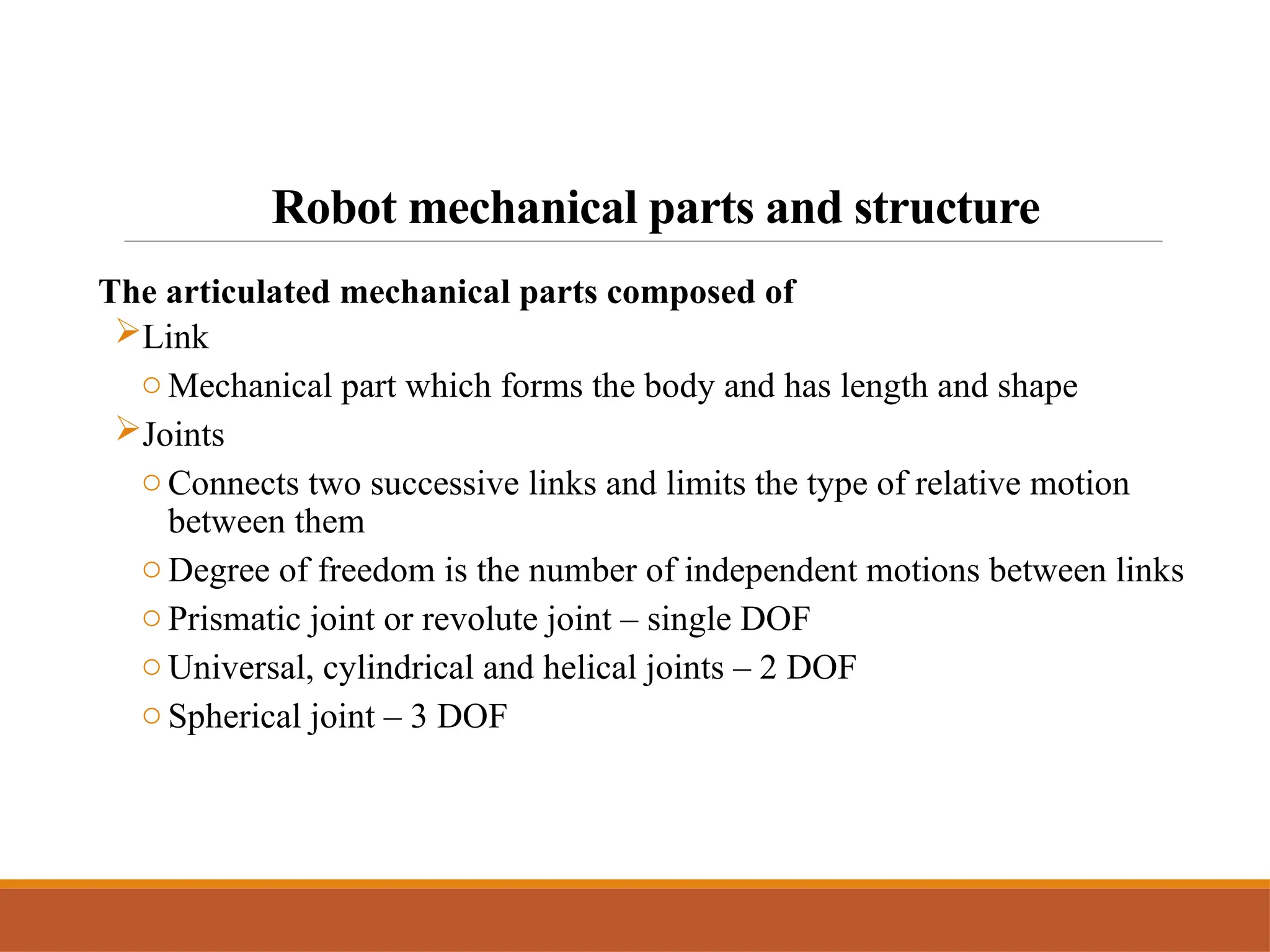
Robot mechanical parts and structure
The articulated mechanical parts composed of
Link
o Mechanical part which forms the body and has length and shape
Joints
o Connects two successive links and limits the type of relative motion
between them
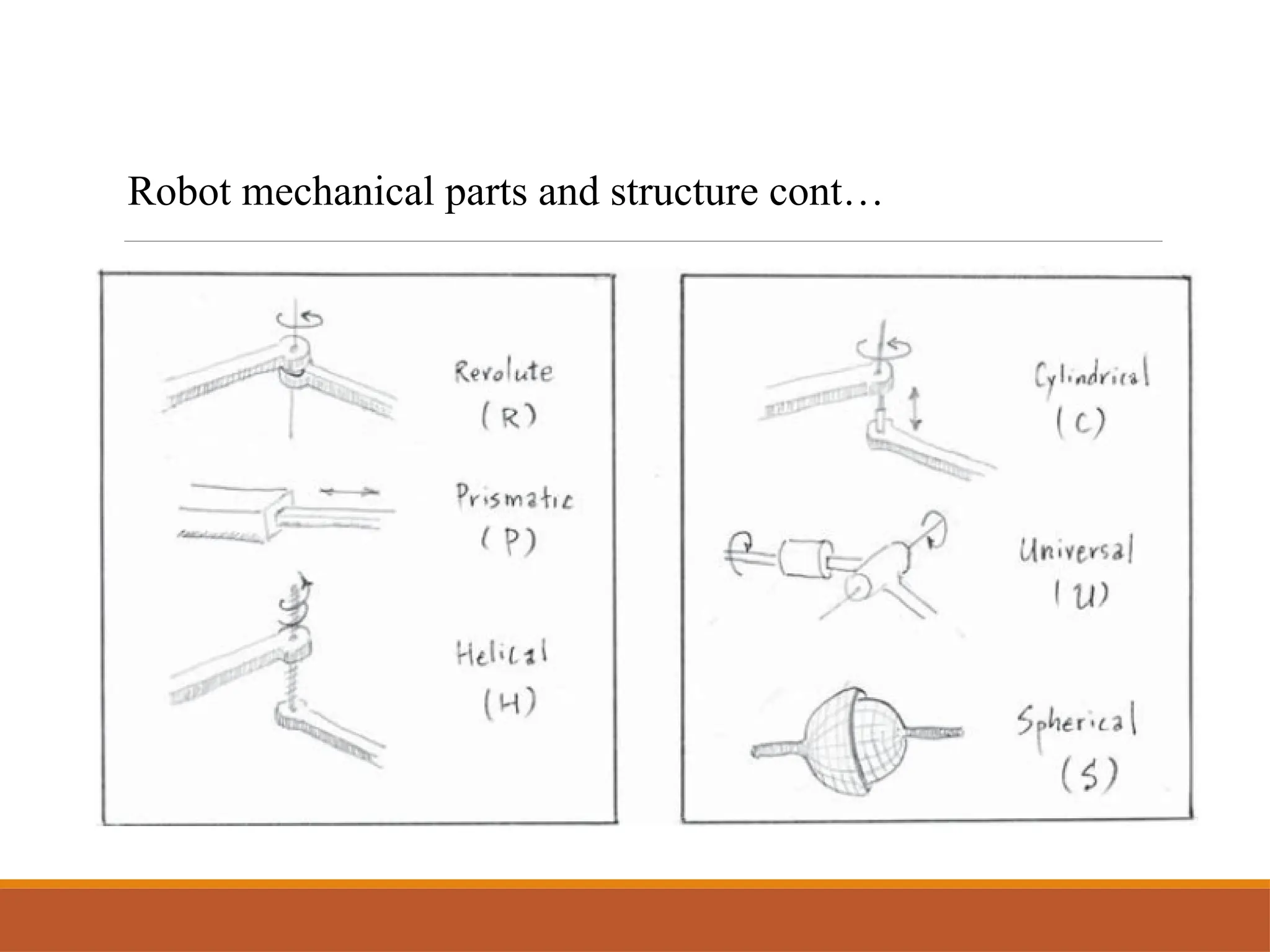
o Degree of freedom is the number of independent motions between links
o Prismatic joint or revolute joint – single DOF
o Universal, cylindrical and helical joints – 2 DOF
o Spherical joint – 3 DOF
Robot mechanical parts and structure cont…
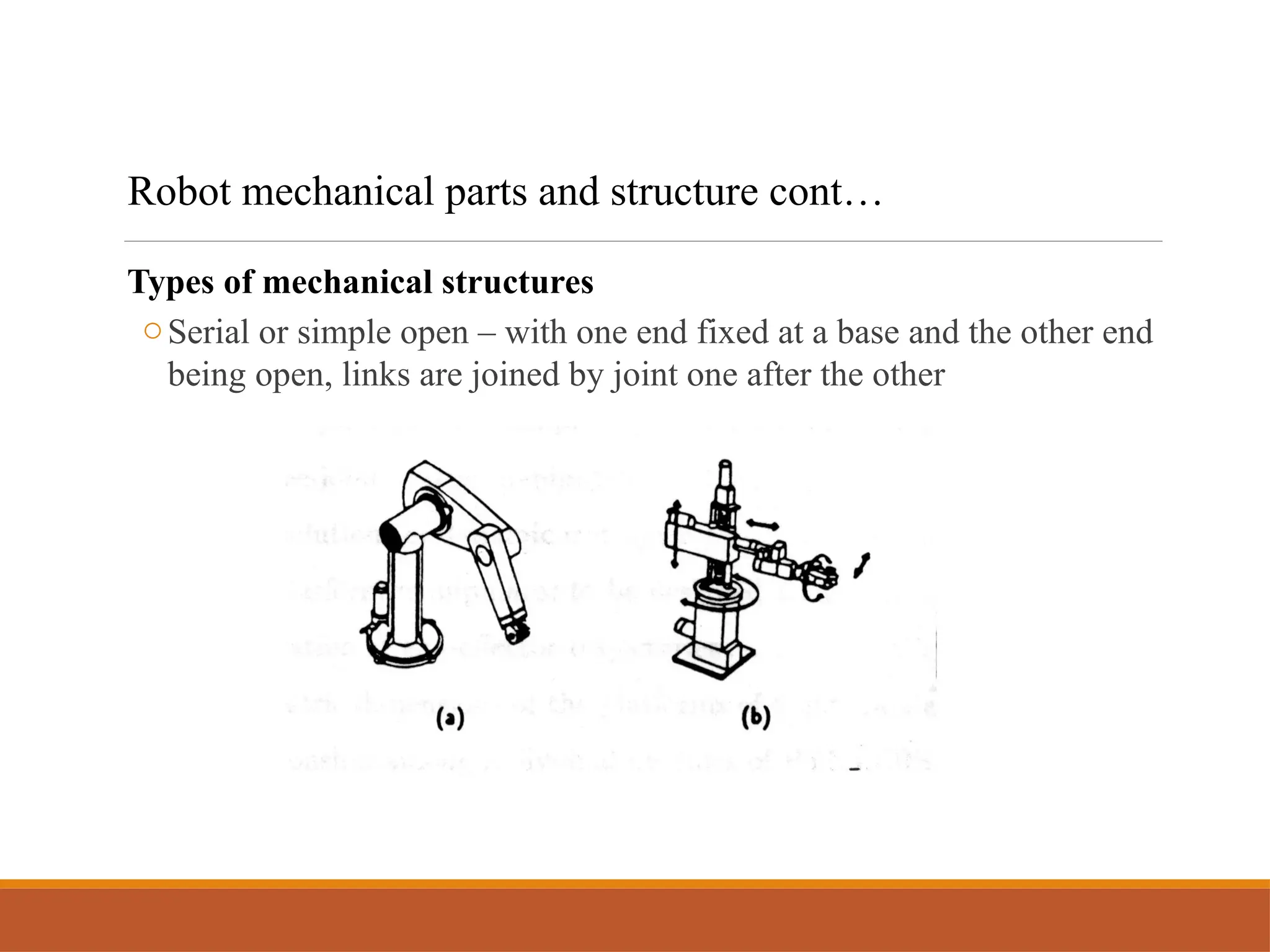
Types of mechanical structures
oSerial or simple open – with one end fixed at a base and the other end
being open, links are joined by joint one after the other
Robot mechanical parts and structure cont…
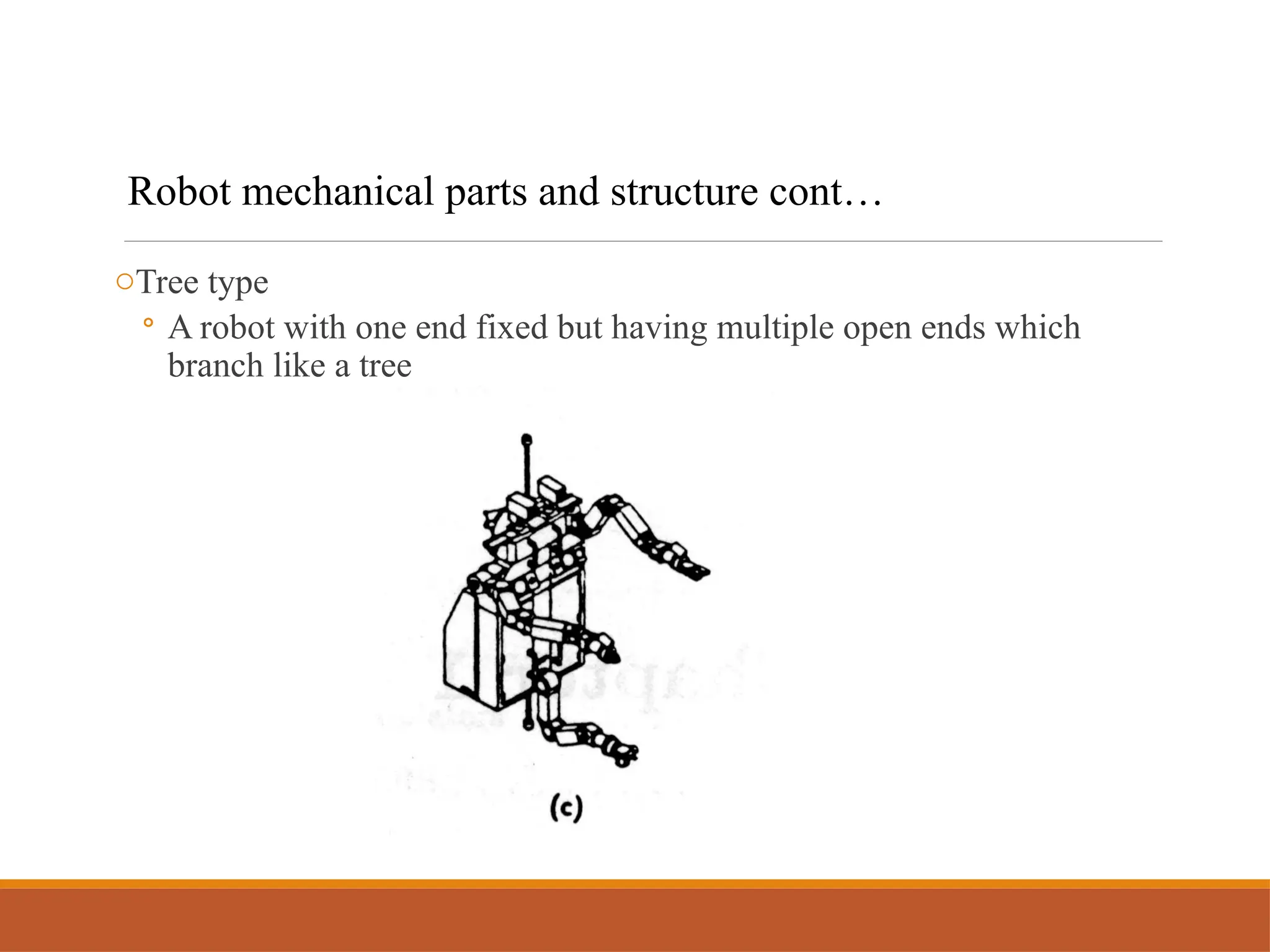
oTree type
◦ A robot with one end fixed but having multiple open ends which
branch like a tree
Robot mechanical parts and structure cont…
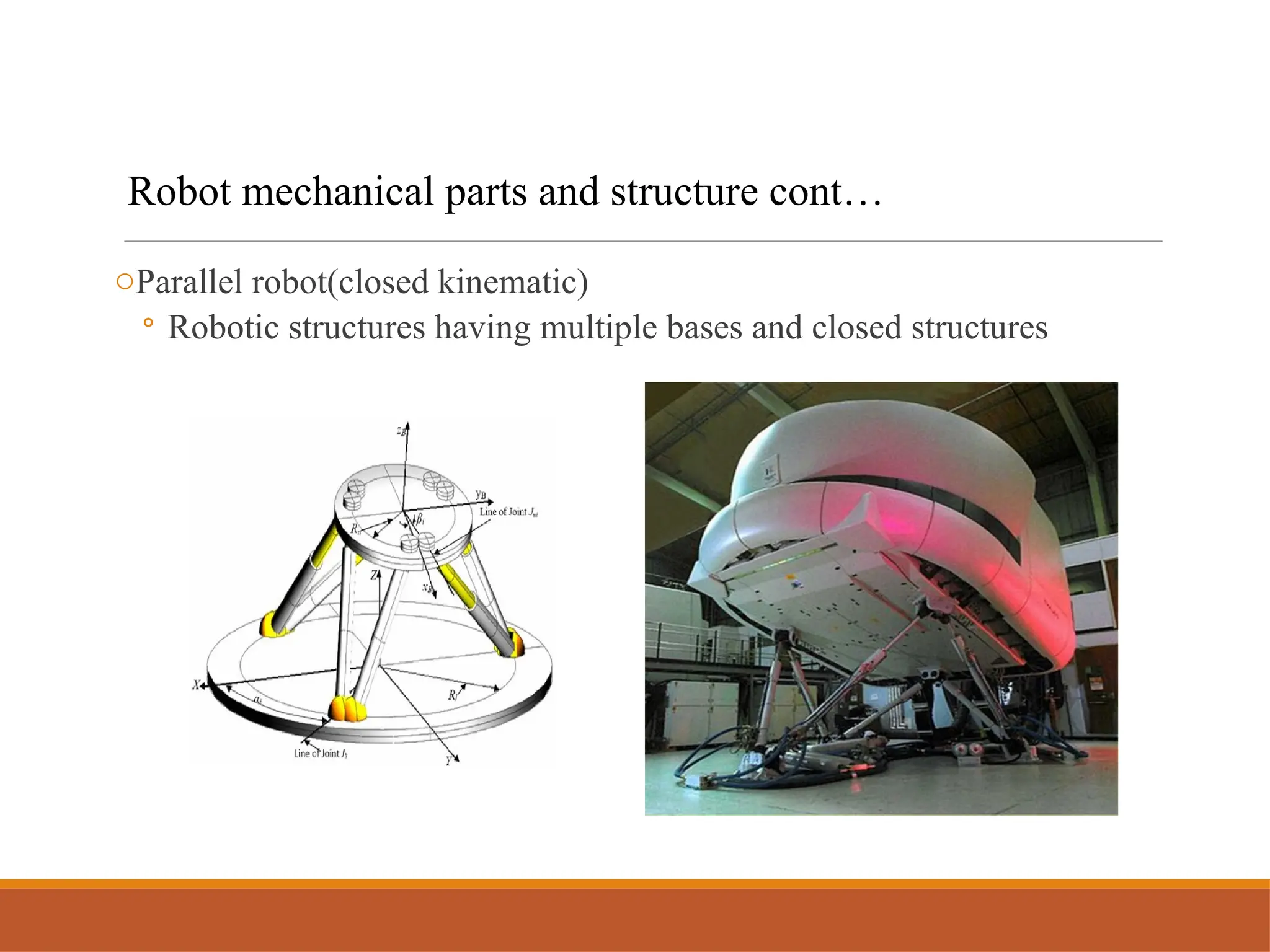
oParallel robot(closed kinematic)
◦ Robotic structures having multiple bases and closed structures
Robot mechanical parts and structure cont…
Robot specification
Work space – the space that a robot can reach from a given base.
Payload – the maximum load that a robot manipulator can carry.
Accuracy- is a measure of how close the manipulator can come to a given
point within its workspace. Or it is the distance between final actual
position and desired position.
Repeatability- is a measure of ‘how precisely a manipulator can return to
a desired point’.
Wrists: are joints in the kinematic chain between the arm and end effector.
The wrist joints are nearly always all revolute.
Types of manipulators
Depending up on the workspace ( type of joints used and their DOF)
manipulators can be divided into
◦ Rectangular manipulator
◦ Has prismatic joints at all joints
◦ The workspace is rectangular
◦ Cylindrical manipulator
◦ Has one revolute and two prismatic joints
◦ Spherical manipulator
◦ Has two revolute and one prismatic joints
◦ Articulated (Revolute) manipulator
◦ Has all joints revolute
Ex: explain the workspace of each
manipulator Types by using diagram?
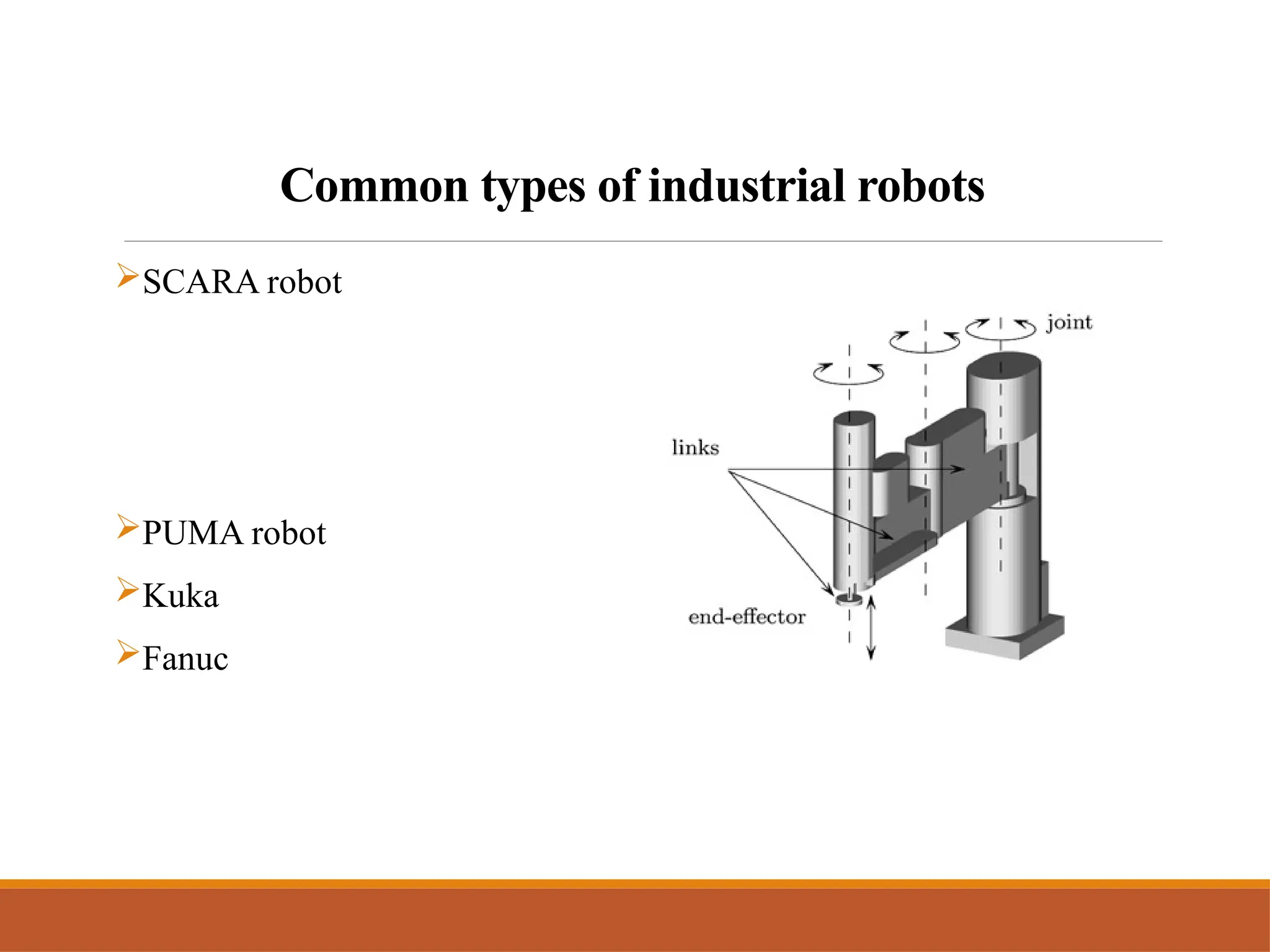
Common types of industrial robots
SCARA robot
PUMA robot
Kuka
Fanuc
Actuators and sensors
Actuators in robotic systems are used to move the joints
Joint actuators can be
Hydraulic actuators
Pneumatic actuators
Electric actuators
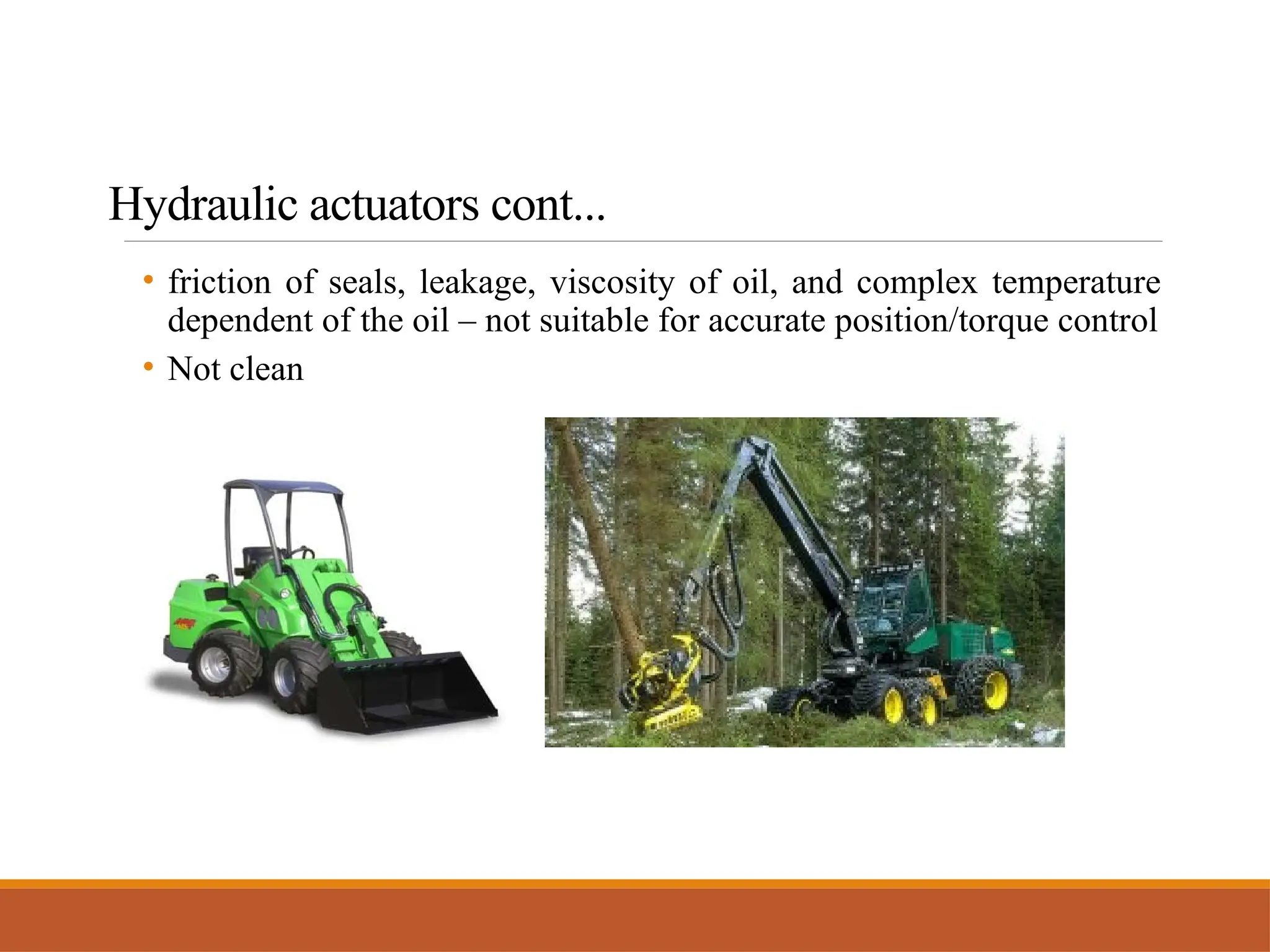
Hydraulic actuators
Are actuators which use oil pressure
Their advantages are
• Can produce large force/torque to drive manipulator joints without
used of reduction gearing – large power-to-weight ration
• actuators are simple
• linear movement
• Are easily applied for position control
Their disadvantages are
• Are cumbersome and messy
• Require a great deal of equipments such as pumps, actuators, hoses,
and servo valves
• friction of seals, leakage, viscosity of oil, and complex temperature
dependent of the oil – not suitable for accurate position/torque control
• Not clean
Hydraulic actuators cont...
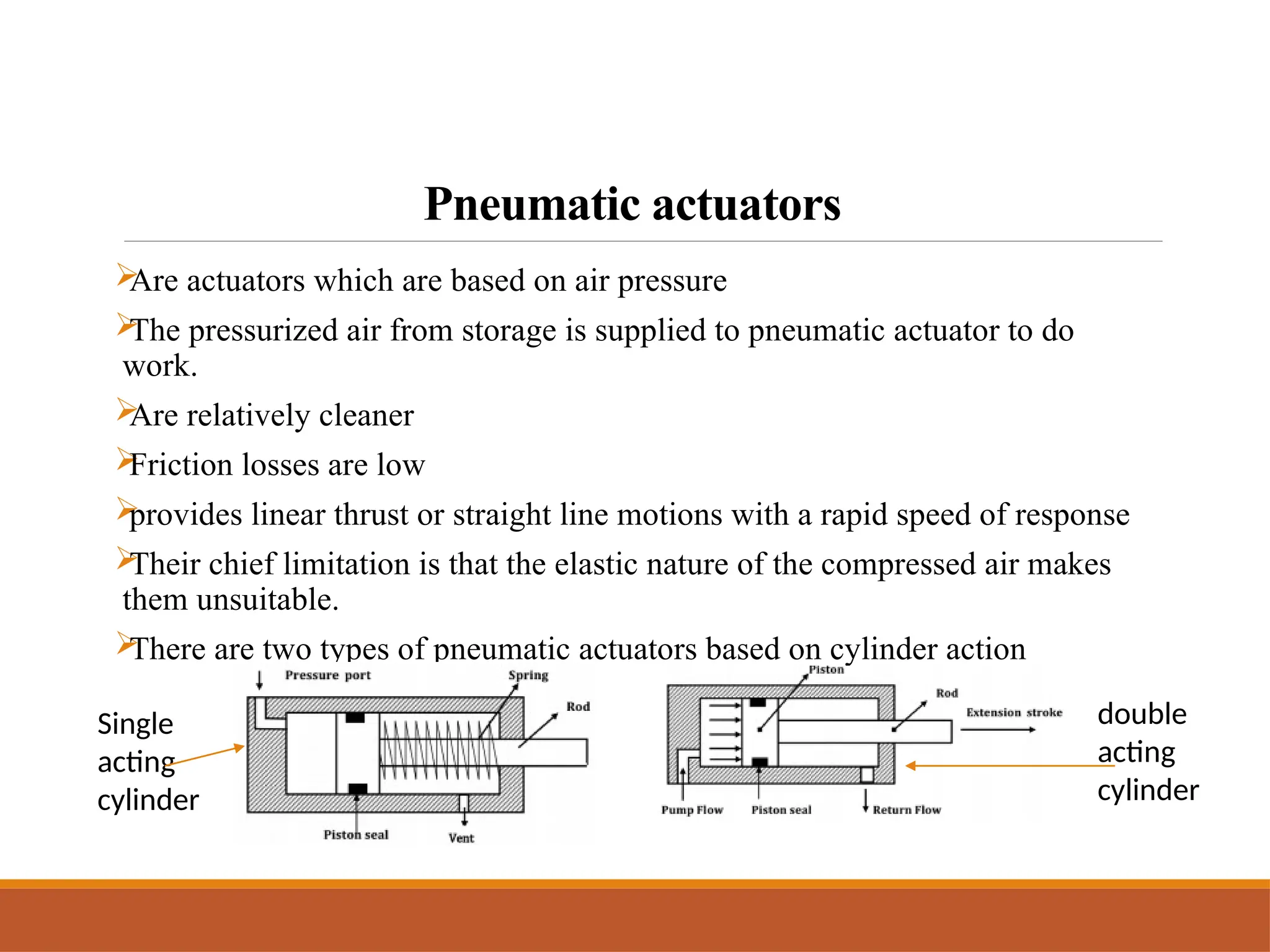
Pneumatic actuators

Are actuators which are based on air pressure

The pressurized air from storage is supplied to pneumatic actuator to do
work.

Are relatively cleaner

Friction losses are low

provides linear thrust or straight line motions with a rapid speed of response

Their chief limitation is that the elastic nature of the compressed air makes
them unsuitable.

There are two types of pneumatic actuators based on cylinder action
Single
acting
cylinder
double
acting
cylinder
Electric actuators
Most popular choice
Easy to control and are clean
Used for small to medium sized robotic manipulators
Need reduction gears of high ratio
◦ Linearizes the dynamics
◦ Increases the friction, elasticity and backlash
 Most commonly use electric actuators are electric motors such as; AC
motor, DC motor, stepper motor and other devices such as solenoid.
Sensors and detectors
Sensors are used to supply information to the robotic control system.
They make measurement of physical variable of interest and convert it
in to electrical signal
Sensors
• Provide information about the status of links and joints
• Provide information about the environment
In robotic system sensors are classified into two:
• Internal state sensors
• External state sensors
Internal State sensors
They are basic elements in the internal closed loop control of the robot
Sense
◦ Position
◦ Velocity
◦ Acceleration
◦ Torque/force in joints
Degree of resolution and accuracy of internal state sensors determine
the accuracy of the robot
Types of internal state sensors
Position sensors:
◦ Potentiometers
◦ Incremental and absolute encoders->optical, magnetic or capacitive
◦ Linear analog resistive or digital encoders
Velocity sensors:
◦ Tachometers
◦ Optical encoders
Force/torque sensors:
◦ Strain gauge
◦ Micro switch
Position sensors
Potentiometers
◦ Are variable resistance devices
◦ Change in length(linear or angular) varies the effective length of the
conductor and hence resistance of the device
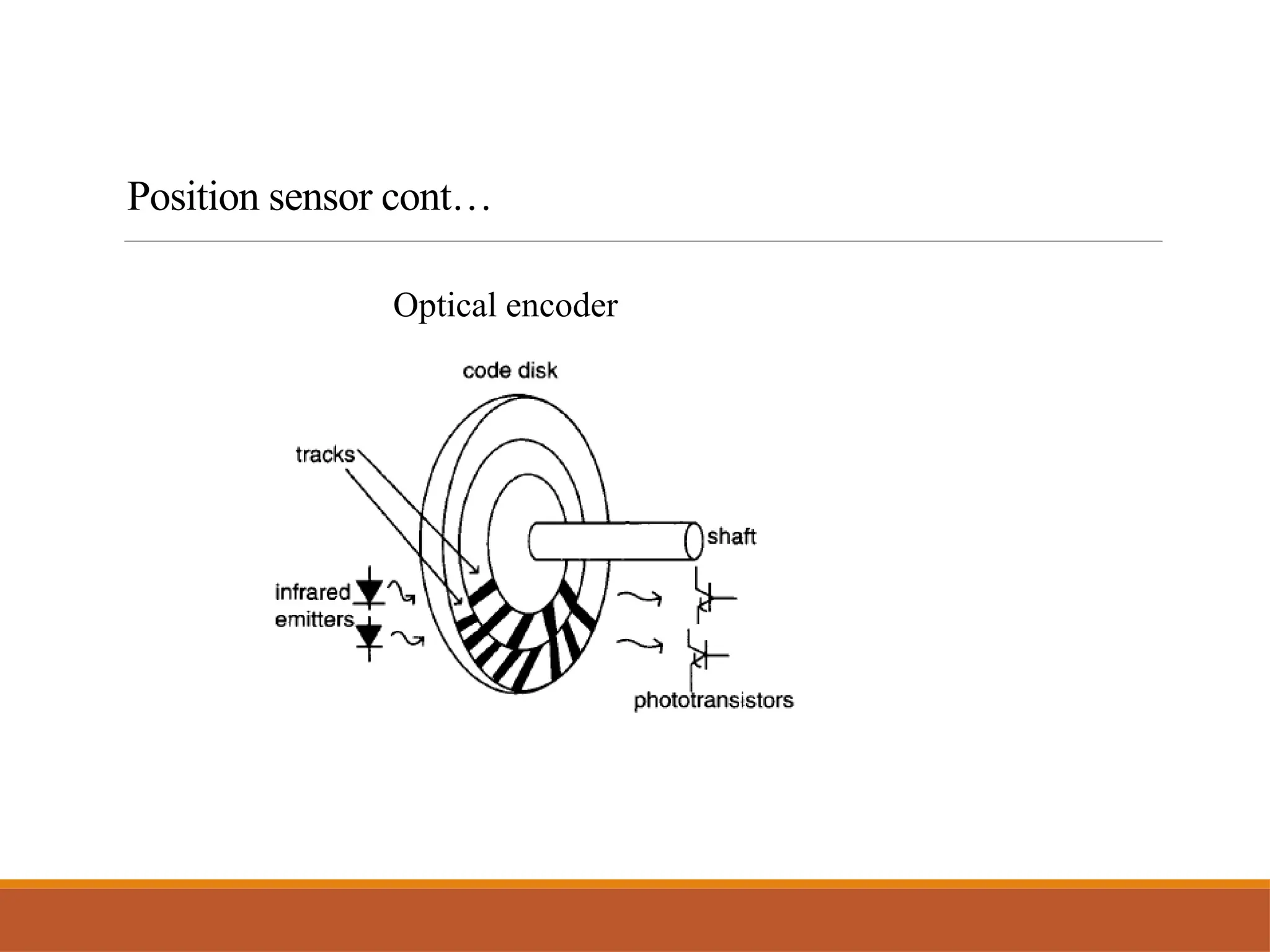
 optical encoder
◦ Converts motion into a sequence of digital pulses
◦ By counting a single bit or decoding a set of bits, the pulses can be
converted to absolute or relative position
Position sensor cont…
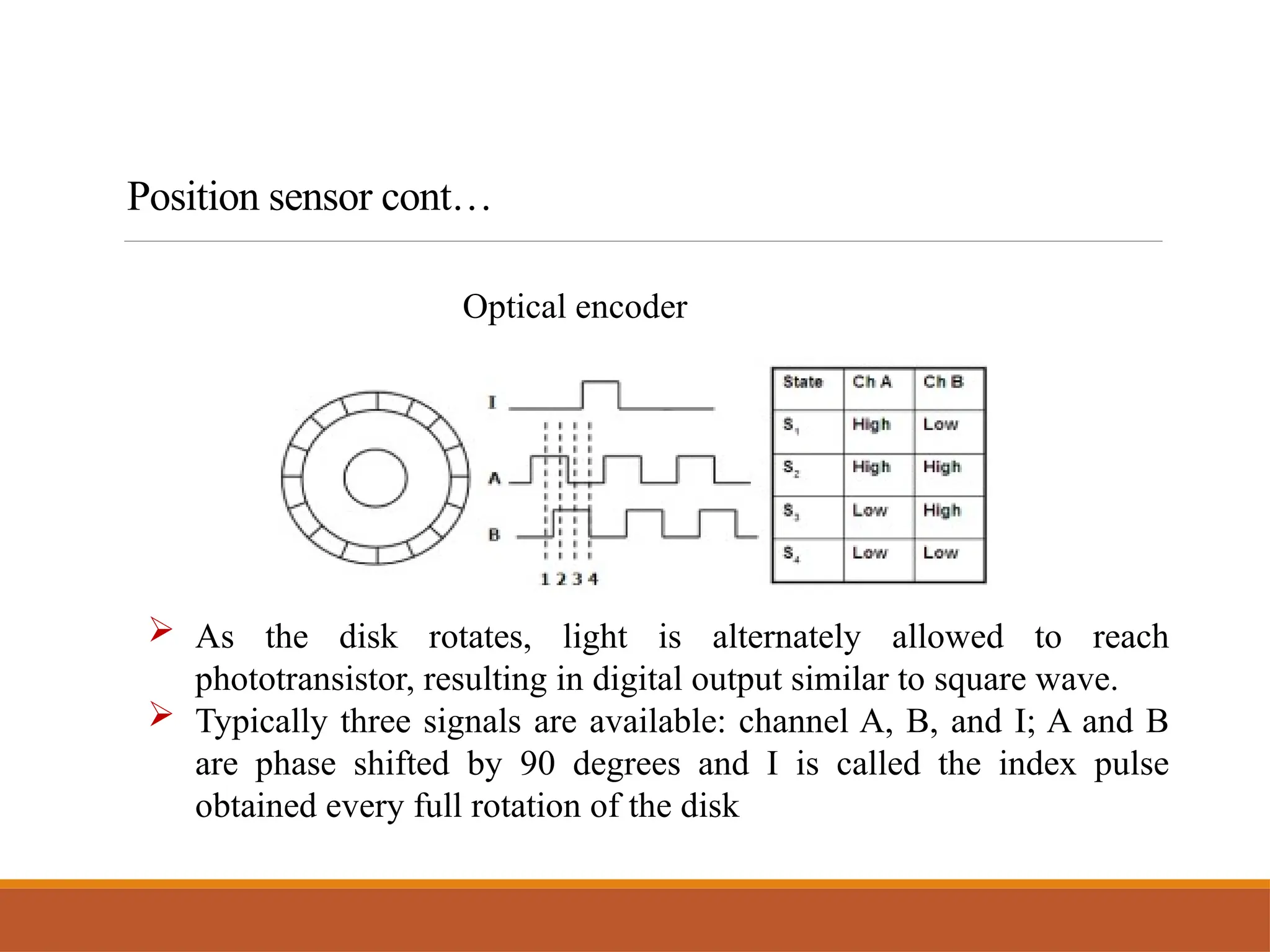
Optical encoder
 As the disk rotates, light is alternately allowed to reach
phototransistor, resulting in digital output similar to square wave.
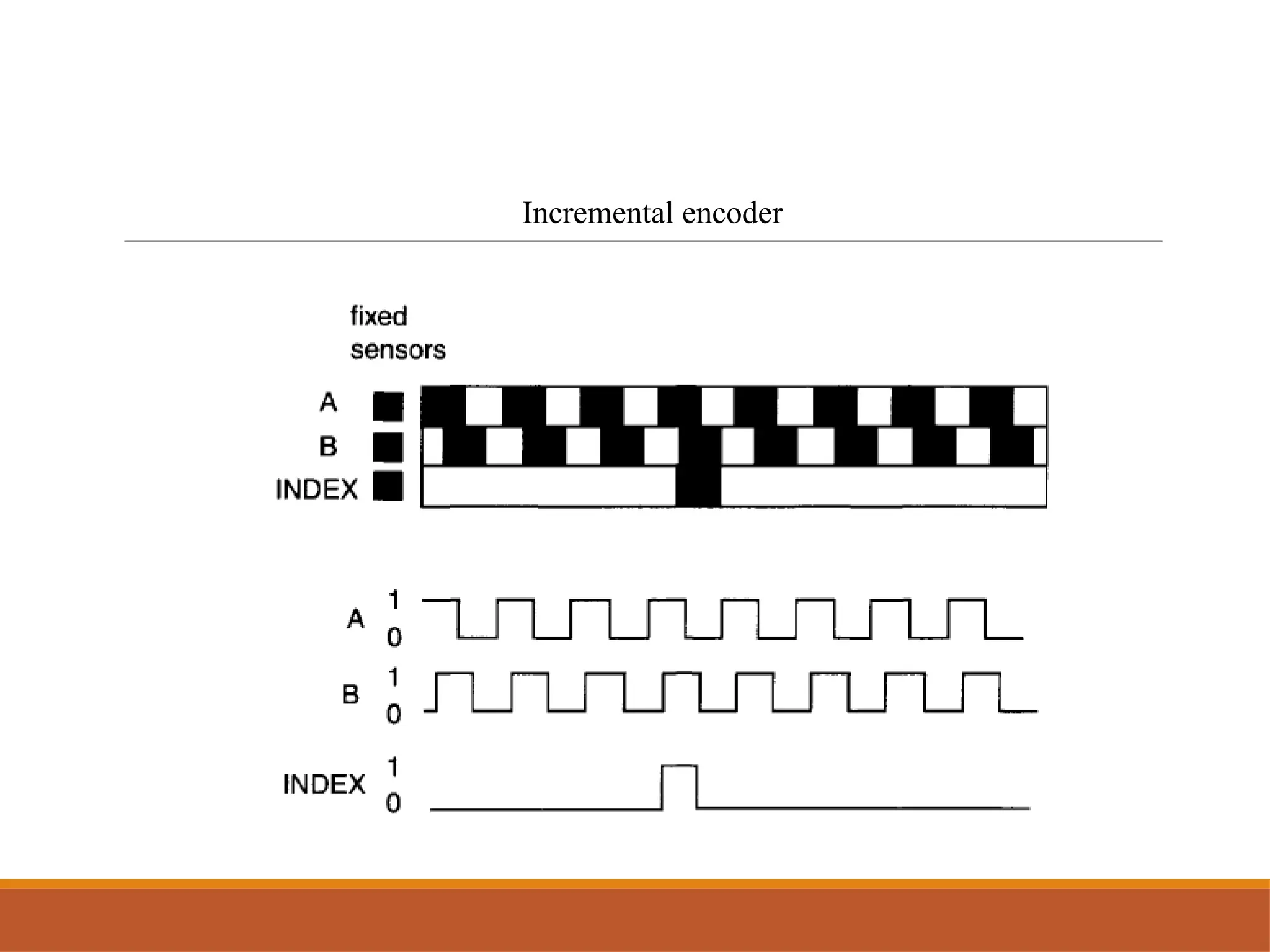
 Typically three signals are available: channel A, B, and I; A and B
are phase shifted by 90 degrees and I is called the index pulse
obtained every full rotation of the disk
Position sensor cont…
Optical encoder
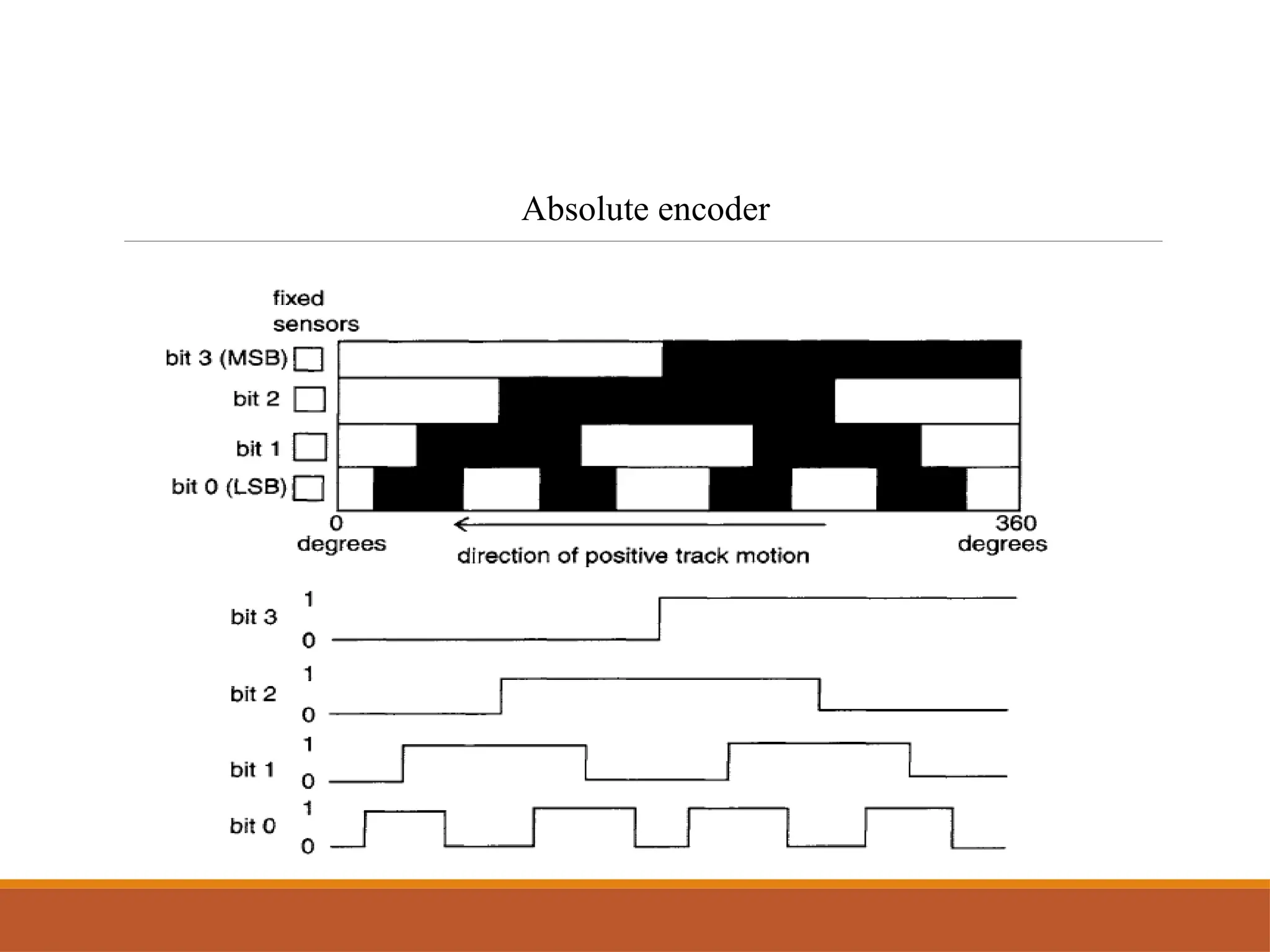
Two types of encoders: absolute and incremental (relative) encoders
Absolute
◦ A single bit corresponds to a unique position
◦ The same shaft angle will always produce the same reading
◦ Has two rings, the outer ring is the most significant digit and the inner ring
is the least significant digit of the encoder.
◦ To add accuracy more rings must be added to the disk, and more emitters
and detectors
◦ A position from a single rotation is measured directly, if the encoder rotates
multiple times the total number of rotations must be counted separately.
◦ The number of tracks determine the bit width and hence the resolution
◦ Example: 8 track encoder, degree to be sensed is 360/256
Position sensor cont…
Incremental encoder
◦ Produce two digital pulses as the shaft rotates
◦ Has two rings, with one ring rotated a few degrees a head of the other, but
otherwise the same.
◦ To add accuracy we only need to add more windows to the existing rings.
◦ Has two tracks in opposite directions
◦ The distance of rotation is determined by only counting pulses on one of the
rings, if the encoder rotates only in one direction, otherwise a second ring
must be used to determine when to subtract the pulses.
◦ The phase sequence between the channels determine the direction of
rotation
Position sensor cont…
Absolute encoder
Incremental encoder
Velocity and acceleration sensors
Tacho generators
◦ The common technique is hooking a simple permanent magnet DC
generator to the rotating shaft.
◦ The rotation of a shaft will induce a voltage proportional to speed of
rotation of a shaft
◦ Used with dc motors to sense speed of rotation
◦ Have very big voltage outputs
◦ Used for feedback control of DC motors
Accelerometer
◦ measure acceleration
◦ Use force sensor and mass and then apply Newton’s second law
◦ Not common in robotics because of noise effect
Force/Torque sensors
Can be achieved by joint and wrist sensing
Force/Torque joint sensors
◦ Direct measuring of Force/Torque in a compliant shaft attached to a
motor by means of strain gages
Force/Torque wrist sensor
◦ mounted between end of the robot arm and end-effector
◦ Can measure all six components of force/torque using strain gages.
External state sensors
Provide information about the objects in the surrounding
◦ Detect presence of work piece
◦ Determine position and orientation of work piece
◦ Provide information about environmental variables such as
temperature, humidity
Information is used by the control computer to adapt trajectory
Types of external state sensors
Contact type sensors: respond to physical contact
◦ Pressure
◦ Force
◦ Slip
◦ Torque
E.g: touch, slip, tactile sensors
Non contact type sensors: detect variations in optical, acoustic or
electromagnetic radiations or change in positions and orientations
◦ IR and proximity switches
◦ temperature and chemical sensors
◦ Color sensors
◦ Gyroscope
Contact type sensors
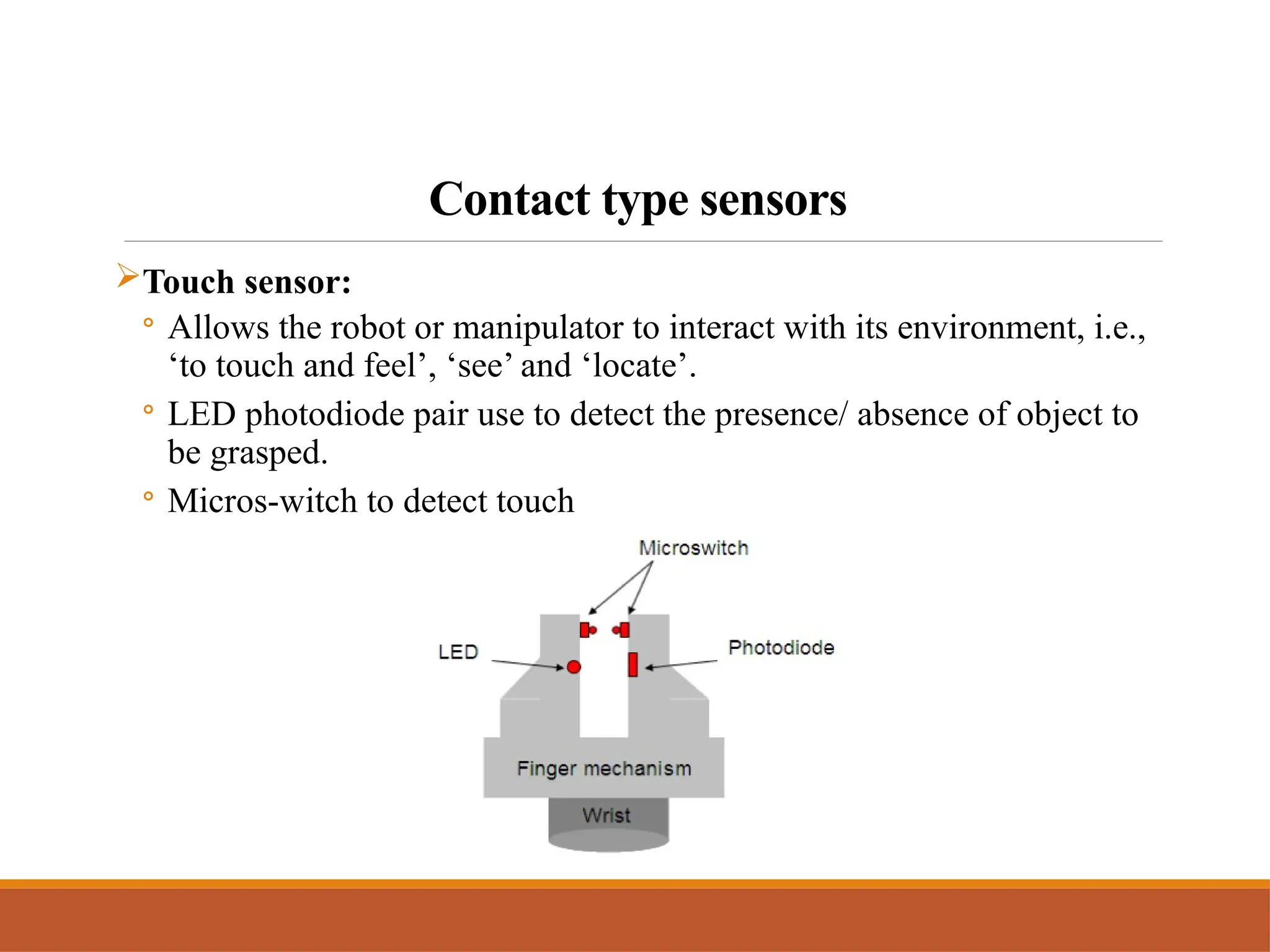
Touch sensor:
◦ Allows the robot or manipulator to interact with its environment, i.e.,
‘to touch and feel’, ‘see’ and ‘locate’.
◦ LED photodiode pair use to detect the presence/ absence of object to
be grasped.
◦ Micros-witch to detect touch
Contact type sensors cont…
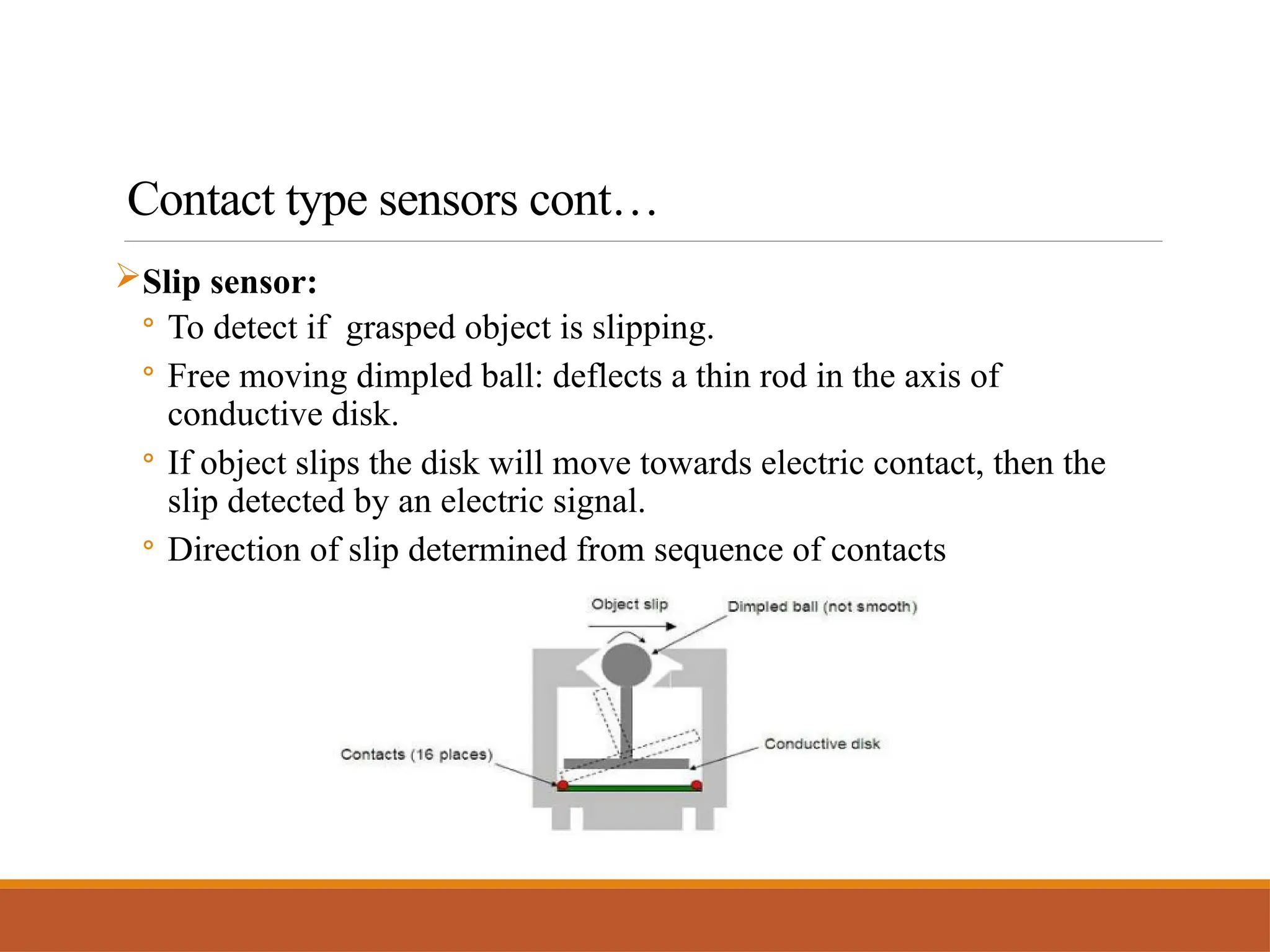
Slip sensor:
◦ To detect if grasped object is slipping.
◦ Free moving dimpled ball: deflects a thin rod in the axis of
conductive disk.
◦ If object slips the disk will move towards electric contact, then the
slip detected by an electric signal.
◦ Direction of slip determined from sequence of contacts
Contact type sensors cont…
Tactile sensor:
◦ Skin like membrane to feel the shape of the grasped object.
◦ Also measure the force/torque required to grasp the object
◦ Resistance/capacitance will change due to the local deformation from
the applied force.
Non contact type sensors
Proximity sensors:
Are very common and useful in robotics and automated machinery
applications
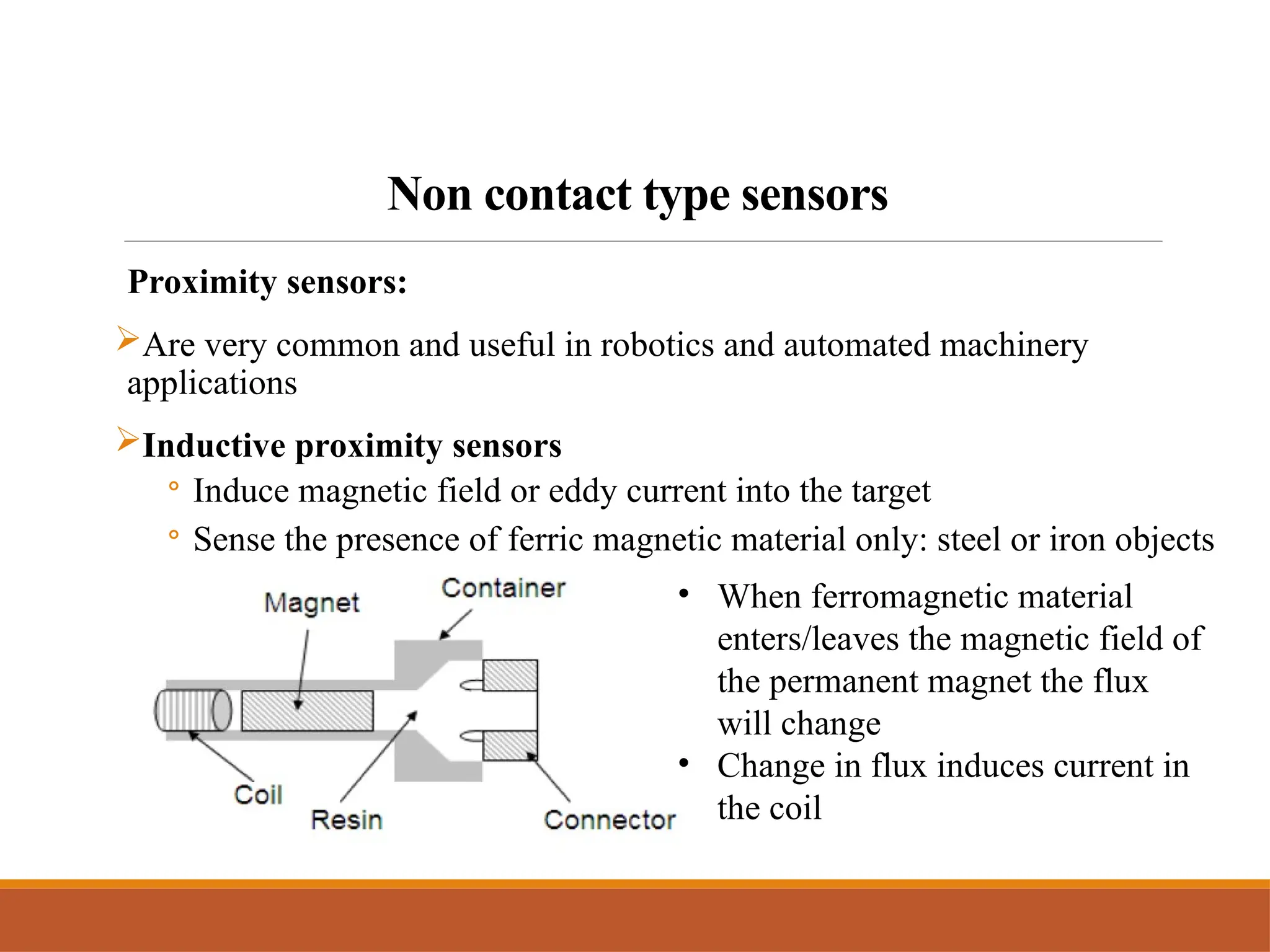
Inductive proximity sensors
◦ Induce magnetic field or eddy current into the target
◦ Sense the presence of ferric magnetic material only: steel or iron objects
• When ferromagnetic material
enters/leaves the magnetic field of
the permanent magnet the flux
will change
• Change in flux induces current in
the coil
Non contact type sensors cont…
Capacitive proximity sensors
◦ Similar to inductive, but uses electrostatic field.
◦ Sense presence of any material (metallic or non-metallic)
◦ Object enters in the electrostatic field of electrodes- capacitance
change
Non contact type sensors cont…
ultrasonic proximity sensors
◦ Electro-acoustic transducer to send and receive high frequency
sound waves.
◦ Emitted sonic waves are reflected by an object back to the transduce
which switches to receiver mode.
Optical proximity sensors
◦ Also known as light beam sensors: solid state LED acting as
transmitter by generating a light beam and solid state photo-diode
acts as receiver.
◦ Any reflective surface that intersects the light beam gets illuminated
by the source and is seen by the receiver
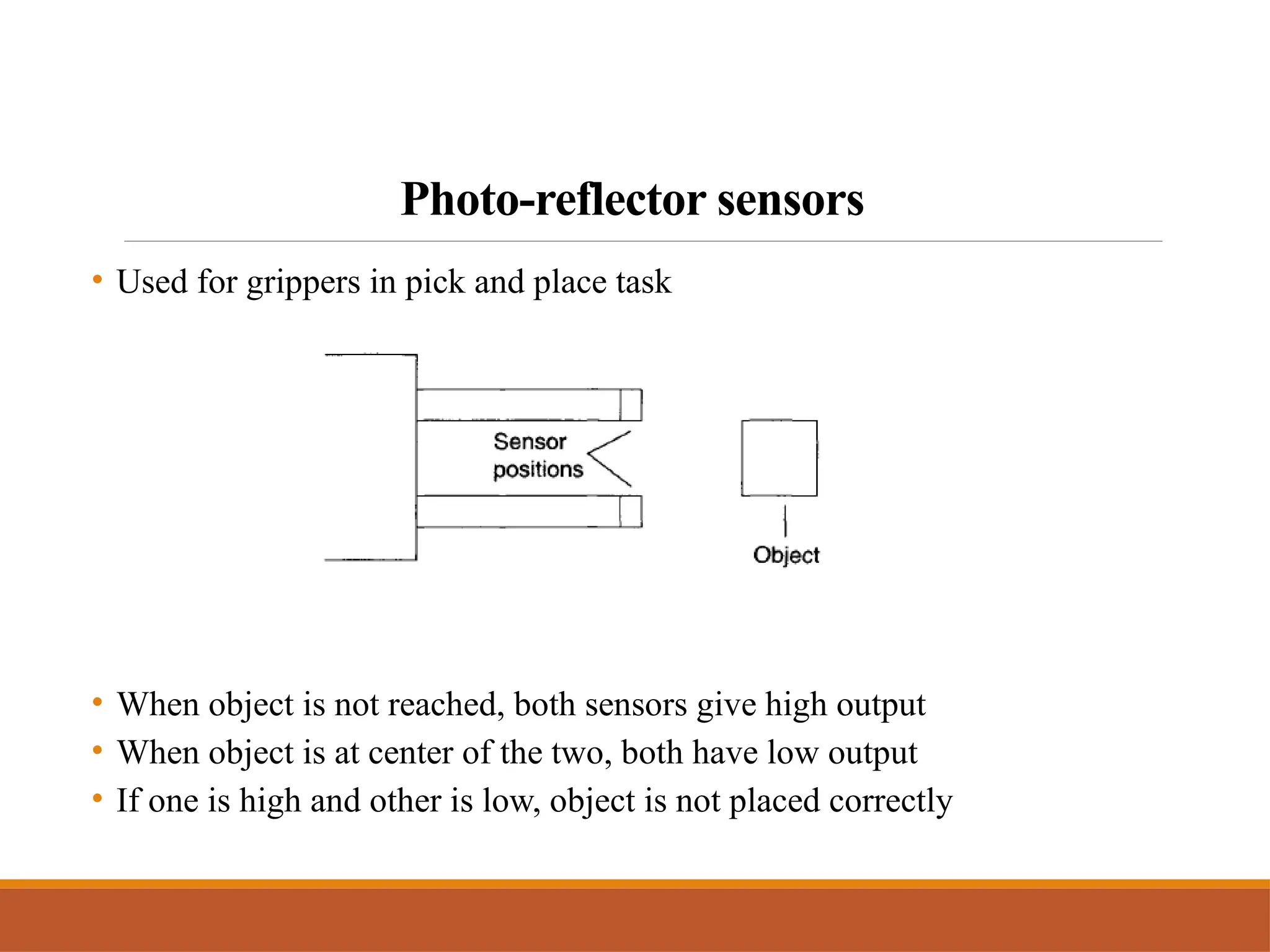
Photo-reflector sensors
• Used for grippers in pick and place task
• When object is not reached, both sensors give high output
• When object is at center of the two, both have low output
• If one is high and other is low, object is not placed correctly
Vision sensors
Most powerful and complex form of sensing, comprising of one or more
video cameras with integrated signal processing and imaging electronics.
Also referred to us a machine or computer vision.
Computer vision can be subdivided in to six main areas: sensing, pre-
processing, segmentation, description, recognition and interpretation.
Three levels of processing:
Low level vision:
• Primitive in nature and required no intelligence on the part of the vision
functions
• Sensing and pre-processing can be considered as low level vision functions
Vision sensors cont…
Medium level vision:
• Processes that extracts, characterize and label components in an image
resulting from a low level vision.
• Segmentation, description, and recognition of the individual objects
refers to the medium level function.
High level vision:
• Processes that attempts to emulate cognition.
Vision system can determine distances of objects, the geometrical shape
and size of objects and optical (color, brightness) properties of objects
It can be used for navigation (map making), obstacle avoidance, Cartesian
position and velocity feedback, locating parts and many other uses.
Robotic vision application
◦ Find the presence of an object in a conveyer belt of a bin
◦ Object location – obstacle or an object to be manipulated is correctly
identified in its location and orientation
◦ Pick and place motion- guided manipulation to pick and place objects,
gripper orientation
◦ Visual inspection – used for automated quality control, extracting
specific quantitative measurement of desired parameters from an image
◦ Visual guidance – is most advanced, assembly operation , one part is
fixed and the other is moved or guided by a robot using vision

ch1 robotics (1).pptxjgfhhfhfhhgegf)43!654557

  • 1.
  • 2.
    Introduction Basic Definitions: •Robot • Anyautomated machine programmed to perform specific mechanical functions in the manner of a man • An electro-mechanical machine with sensors, electronics and guided by computers. • A re-programmable, multi-functional manipulator designed to move materials, parts, tools or specialized devices through various programmed motions for the performance of a variety of tasks. •Robotics – the science dealing with design, construction and operation of robots
  • 3.
    Robot applications Industrial automation MedicalServices Transport Underwater Entertainment And other Hazardous environment where human presence is not needed or not possible.
  • 4.
    Robot types Manipulators oUsed forindustrial automation oMost of the robots (90%) oHave two parts (end effector + articulated mechanical structure) oMostly used for automobile industry Walking robots oImitate walking pattern of man and animals oResearch and entertainment Mobile robots oWheeled robots oUsed for military, rescue operation and so on
  • 5.
  • 6.
    Robot mechanical partsand structure The articulated mechanical parts composed of Link o Mechanical part which forms the body and has length and shape Joints o Connects two successive links and limits the type of relative motion between them o Degree of freedom is the number of independent motions between links o Prismatic joint or revolute joint – single DOF o Universal, cylindrical and helical joints – 2 DOF o Spherical joint – 3 DOF
  • 7.
    Robot mechanical partsand structure cont…
  • 8.
    Types of mechanicalstructures oSerial or simple open – with one end fixed at a base and the other end being open, links are joined by joint one after the other Robot mechanical parts and structure cont…
  • 9.
    oTree type ◦ Arobot with one end fixed but having multiple open ends which branch like a tree Robot mechanical parts and structure cont…
  • 10.
    oParallel robot(closed kinematic) ◦Robotic structures having multiple bases and closed structures Robot mechanical parts and structure cont…
  • 11.
    Robot specification Work space– the space that a robot can reach from a given base. Payload – the maximum load that a robot manipulator can carry. Accuracy- is a measure of how close the manipulator can come to a given point within its workspace. Or it is the distance between final actual position and desired position. Repeatability- is a measure of ‘how precisely a manipulator can return to a desired point’. Wrists: are joints in the kinematic chain between the arm and end effector. The wrist joints are nearly always all revolute.
  • 12.
    Types of manipulators Dependingup on the workspace ( type of joints used and their DOF) manipulators can be divided into ◦ Rectangular manipulator ◦ Has prismatic joints at all joints ◦ The workspace is rectangular ◦ Cylindrical manipulator ◦ Has one revolute and two prismatic joints ◦ Spherical manipulator ◦ Has two revolute and one prismatic joints ◦ Articulated (Revolute) manipulator ◦ Has all joints revolute Ex: explain the workspace of each manipulator Types by using diagram?
  • 13.
    Common types ofindustrial robots SCARA robot PUMA robot Kuka Fanuc
  • 14.
    Actuators and sensors Actuatorsin robotic systems are used to move the joints Joint actuators can be Hydraulic actuators Pneumatic actuators Electric actuators
  • 15.
    Hydraulic actuators Are actuatorswhich use oil pressure Their advantages are • Can produce large force/torque to drive manipulator joints without used of reduction gearing – large power-to-weight ration • actuators are simple • linear movement • Are easily applied for position control Their disadvantages are • Are cumbersome and messy • Require a great deal of equipments such as pumps, actuators, hoses, and servo valves
  • 16.
    • friction ofseals, leakage, viscosity of oil, and complex temperature dependent of the oil – not suitable for accurate position/torque control • Not clean Hydraulic actuators cont...
  • 17.
    Pneumatic actuators  Are actuatorswhich are based on air pressure  The pressurized air from storage is supplied to pneumatic actuator to do work.  Are relatively cleaner  Friction losses are low  provides linear thrust or straight line motions with a rapid speed of response  Their chief limitation is that the elastic nature of the compressed air makes them unsuitable.  There are two types of pneumatic actuators based on cylinder action Single acting cylinder double acting cylinder
  • 18.
    Electric actuators Most popularchoice Easy to control and are clean Used for small to medium sized robotic manipulators Need reduction gears of high ratio ◦ Linearizes the dynamics ◦ Increases the friction, elasticity and backlash  Most commonly use electric actuators are electric motors such as; AC motor, DC motor, stepper motor and other devices such as solenoid.
  • 19.
    Sensors and detectors Sensorsare used to supply information to the robotic control system. They make measurement of physical variable of interest and convert it in to electrical signal Sensors • Provide information about the status of links and joints • Provide information about the environment In robotic system sensors are classified into two: • Internal state sensors • External state sensors
  • 20.
    Internal State sensors Theyare basic elements in the internal closed loop control of the robot Sense ◦ Position ◦ Velocity ◦ Acceleration ◦ Torque/force in joints Degree of resolution and accuracy of internal state sensors determine the accuracy of the robot
  • 21.
    Types of internalstate sensors Position sensors: ◦ Potentiometers ◦ Incremental and absolute encoders->optical, magnetic or capacitive ◦ Linear analog resistive or digital encoders Velocity sensors: ◦ Tachometers ◦ Optical encoders Force/torque sensors: ◦ Strain gauge ◦ Micro switch
  • 22.
    Position sensors Potentiometers ◦ Arevariable resistance devices ◦ Change in length(linear or angular) varies the effective length of the conductor and hence resistance of the device  optical encoder ◦ Converts motion into a sequence of digital pulses ◦ By counting a single bit or decoding a set of bits, the pulses can be converted to absolute or relative position
  • 23.
  • 24.
     As thedisk rotates, light is alternately allowed to reach phototransistor, resulting in digital output similar to square wave.  Typically three signals are available: channel A, B, and I; A and B are phase shifted by 90 degrees and I is called the index pulse obtained every full rotation of the disk Position sensor cont… Optical encoder
  • 25.
    Two types ofencoders: absolute and incremental (relative) encoders Absolute ◦ A single bit corresponds to a unique position ◦ The same shaft angle will always produce the same reading ◦ Has two rings, the outer ring is the most significant digit and the inner ring is the least significant digit of the encoder. ◦ To add accuracy more rings must be added to the disk, and more emitters and detectors ◦ A position from a single rotation is measured directly, if the encoder rotates multiple times the total number of rotations must be counted separately. ◦ The number of tracks determine the bit width and hence the resolution ◦ Example: 8 track encoder, degree to be sensed is 360/256 Position sensor cont…
  • 26.
    Incremental encoder ◦ Producetwo digital pulses as the shaft rotates ◦ Has two rings, with one ring rotated a few degrees a head of the other, but otherwise the same. ◦ To add accuracy we only need to add more windows to the existing rings. ◦ Has two tracks in opposite directions ◦ The distance of rotation is determined by only counting pulses on one of the rings, if the encoder rotates only in one direction, otherwise a second ring must be used to determine when to subtract the pulses. ◦ The phase sequence between the channels determine the direction of rotation Position sensor cont…
  • 27.
  • 28.
  • 29.
    Velocity and accelerationsensors Tacho generators ◦ The common technique is hooking a simple permanent magnet DC generator to the rotating shaft. ◦ The rotation of a shaft will induce a voltage proportional to speed of rotation of a shaft ◦ Used with dc motors to sense speed of rotation ◦ Have very big voltage outputs ◦ Used for feedback control of DC motors Accelerometer ◦ measure acceleration ◦ Use force sensor and mass and then apply Newton’s second law ◦ Not common in robotics because of noise effect
  • 30.
    Force/Torque sensors Can beachieved by joint and wrist sensing Force/Torque joint sensors ◦ Direct measuring of Force/Torque in a compliant shaft attached to a motor by means of strain gages Force/Torque wrist sensor ◦ mounted between end of the robot arm and end-effector ◦ Can measure all six components of force/torque using strain gages.
  • 31.
    External state sensors Provideinformation about the objects in the surrounding ◦ Detect presence of work piece ◦ Determine position and orientation of work piece ◦ Provide information about environmental variables such as temperature, humidity Information is used by the control computer to adapt trajectory
  • 32.
    Types of externalstate sensors Contact type sensors: respond to physical contact ◦ Pressure ◦ Force ◦ Slip ◦ Torque E.g: touch, slip, tactile sensors Non contact type sensors: detect variations in optical, acoustic or electromagnetic radiations or change in positions and orientations ◦ IR and proximity switches ◦ temperature and chemical sensors ◦ Color sensors ◦ Gyroscope
  • 33.
    Contact type sensors Touchsensor: ◦ Allows the robot or manipulator to interact with its environment, i.e., ‘to touch and feel’, ‘see’ and ‘locate’. ◦ LED photodiode pair use to detect the presence/ absence of object to be grasped. ◦ Micros-witch to detect touch
  • 34.
    Contact type sensorscont… Slip sensor: ◦ To detect if grasped object is slipping. ◦ Free moving dimpled ball: deflects a thin rod in the axis of conductive disk. ◦ If object slips the disk will move towards electric contact, then the slip detected by an electric signal. ◦ Direction of slip determined from sequence of contacts
  • 35.
    Contact type sensorscont… Tactile sensor: ◦ Skin like membrane to feel the shape of the grasped object. ◦ Also measure the force/torque required to grasp the object ◦ Resistance/capacitance will change due to the local deformation from the applied force.
  • 36.
    Non contact typesensors Proximity sensors: Are very common and useful in robotics and automated machinery applications Inductive proximity sensors ◦ Induce magnetic field or eddy current into the target ◦ Sense the presence of ferric magnetic material only: steel or iron objects • When ferromagnetic material enters/leaves the magnetic field of the permanent magnet the flux will change • Change in flux induces current in the coil
  • 37.
    Non contact typesensors cont… Capacitive proximity sensors ◦ Similar to inductive, but uses electrostatic field. ◦ Sense presence of any material (metallic or non-metallic) ◦ Object enters in the electrostatic field of electrodes- capacitance change
  • 38.
    Non contact typesensors cont… ultrasonic proximity sensors ◦ Electro-acoustic transducer to send and receive high frequency sound waves. ◦ Emitted sonic waves are reflected by an object back to the transduce which switches to receiver mode. Optical proximity sensors ◦ Also known as light beam sensors: solid state LED acting as transmitter by generating a light beam and solid state photo-diode acts as receiver. ◦ Any reflective surface that intersects the light beam gets illuminated by the source and is seen by the receiver
  • 39.
    Photo-reflector sensors • Usedfor grippers in pick and place task • When object is not reached, both sensors give high output • When object is at center of the two, both have low output • If one is high and other is low, object is not placed correctly
  • 40.
    Vision sensors Most powerfuland complex form of sensing, comprising of one or more video cameras with integrated signal processing and imaging electronics. Also referred to us a machine or computer vision. Computer vision can be subdivided in to six main areas: sensing, pre- processing, segmentation, description, recognition and interpretation. Three levels of processing: Low level vision: • Primitive in nature and required no intelligence on the part of the vision functions • Sensing and pre-processing can be considered as low level vision functions
  • 41.
    Vision sensors cont… Mediumlevel vision: • Processes that extracts, characterize and label components in an image resulting from a low level vision. • Segmentation, description, and recognition of the individual objects refers to the medium level function. High level vision: • Processes that attempts to emulate cognition. Vision system can determine distances of objects, the geometrical shape and size of objects and optical (color, brightness) properties of objects It can be used for navigation (map making), obstacle avoidance, Cartesian position and velocity feedback, locating parts and many other uses.
  • 42.
    Robotic vision application ◦Find the presence of an object in a conveyer belt of a bin ◦ Object location – obstacle or an object to be manipulated is correctly identified in its location and orientation ◦ Pick and place motion- guided manipulation to pick and place objects, gripper orientation ◦ Visual inspection – used for automated quality control, extracting specific quantitative measurement of desired parameters from an image ◦ Visual guidance – is most advanced, assembly operation , one part is fixed and the other is moved or guided by a robot using vision