Submitted by
1. Sojal, Md. Jahidul Hasan 12-22626-3
2. Taufiquzzaman, Md. 14-25506-1
3. Islam, M. Jamiul 14-26006-1
4. Rahman, Md. Mustafizur 14-27279-2
5. Khan, Md. Tasdikul Islam 15-29210-1
Submitted to
Rethwan Faiz
Assistant Professor,
Department of EEE.
American International University-Bangladesh
Real-time Obstacle Avoidance
Algorithm for Mobile Robots
ROBOTICS ALGORITHM
Welcome
to the
Presentation !!!
•Introduction
•Flow Chart
•Algorithm Overview
•Diagrams
•Implementation
•References
OVERVIEW
INTRODUCTION
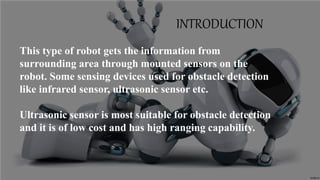
This type of robot gets the information from
surrounding area through mounted sensors on the
robot. Some sensing devices used for obstacle detection
like infrared sensor, ultrasonic sensor etc.
Ultrasonic sensor is most suitable for obstacle detection
and it is of low cost and has high ranging capability.
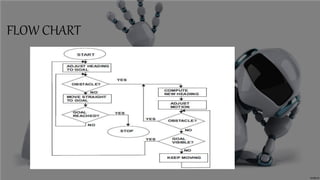
FLOW CHART
ALGORITHMS
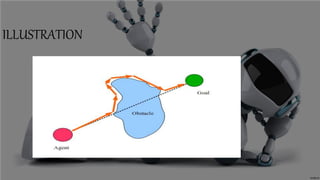
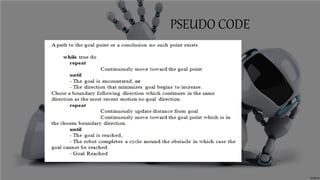
The BUG Algorithms
The simplest obstacle avoidance algorithm ever described is
called “the bug algorithm”. According to it, when an obstacle is
encountered, the robot fully circles the object in order to find the
point with the shortest distance to the goal.
ILLUSTRATION
• Very Easy to Implement
• Costs lower in terms of implementation then other
algorithms
• Works very good in simple scenario
ADVANTAGES
DISADVANTAGES
• It considers only the most recent sensor readings, and
therefore sensor noise seriously affects the overall
performance of the robot
• It works very slow
• Result is complex scenario is very poor
PSEUDO CODE
CODE
BUG 2 ALGORITHM
• More improvised
• Follow greedy search technique
• Faster then BUG 1 Algorithm
• More time efficient
• But not as predictable as BUG 1 Algorithm
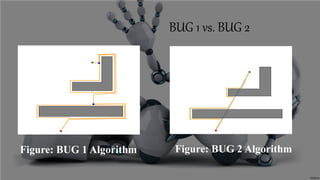
BUG 1 vs. BUG 2
Figure: BUG 1 Algorithm Figure: BUG 2 Algorithm
BUG 1 vs. BUG 2
• BUG 1 is an exhaustive search algorithm, it
looks at all choices before committing
• BUG 2 is a greedy algorithm, it takes the first
thing that looks better
• In many cases, BUG 2 will outperform BUG 1,
but BUG 1 has a more predictable performance
overall
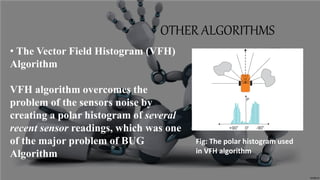
• The Vector Field Histogram (VFH)
Algorithm
VFH algorithm overcomes the
problem of the sensors noise by
creating a polar histogram of several
recent sensor readings, which was one
of the major problem of BUG
Algorithm
Fig: The polar histogram used
in VFH algorithm
OTHER ALGORITHMS
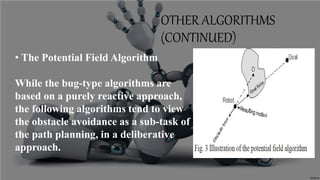
• The Potential Field Algorithm
While the bug-type algorithms are
based on a purely reactive approach,
the following algorithms tend to view
the obstacle avoidance as a sub-task of
the path planning, in a deliberative
approach.
OTHER ALGORITHMS
(CONTINUED)
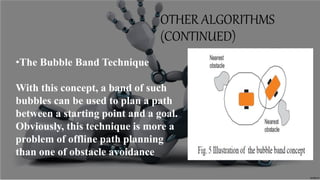
•The Bubble Band Technique
With this concept, a band of such
bubbles can be used to plan a path
between a starting point and a goal.
Obviously, this technique is more a
problem of offline path planning
than one of obstacle avoidance
OTHER ALGORITHMS
(CONTINUED)
• As a Mining Vehicle
Reliable obstacle detection is an essential element of an autonomous mining vehicle
system. An autonomous vehicle must be capable of detecting potentially dangerous
obstacles that would endanger the vehicle itself.
• Smart Motor Vehicle
Already few smart vehicle projects have been developed and under monetization. They are
using lots of advanced methods and Artificial Intelligence where obstacle detection is a
vital part.
• Autonomous cleaning robot
There is a long felt need for autonomous robotic cleaning devices for dusting, mopping,
vacuuming, and sweeping operations. Although technology exists for complex robots
which can, to some extent, "see" and "feel" their surroundings, the complexity, expense
and power requirements associated with these types of robotic subsystems render them
unsuitable for the consumer marketplace.
USES
REFERENCES
•https://www.livescience.com/topics/robots
•https://www.robotictechnologyinc.com/
•http://www.popularmechanics.com/technology/robots/
•https://www.mouser.com/applications/robotics-technology/
•http://study.com/directory/category/Engineering/Electrical_Engin
eering_and_Electronics/Robotics_Technologies.html
Real-time Obstacle Avoidance  Algorithm for Mobile Robots

Real-time Obstacle Avoidance Algorithm for Mobile Robots

  • 1.
    Submitted by 1. Sojal,Md. Jahidul Hasan 12-22626-3 2. Taufiquzzaman, Md. 14-25506-1 3. Islam, M. Jamiul 14-26006-1 4. Rahman, Md. Mustafizur 14-27279-2 5. Khan, Md. Tasdikul Islam 15-29210-1 Submitted to Rethwan Faiz Assistant Professor, Department of EEE. American International University-Bangladesh Real-time Obstacle Avoidance Algorithm for Mobile Robots
  • 2.
  • 3.
  • 4.
    INTRODUCTION This type ofrobot gets the information from surrounding area through mounted sensors on the robot. Some sensing devices used for obstacle detection like infrared sensor, ultrasonic sensor etc. Ultrasonic sensor is most suitable for obstacle detection and it is of low cost and has high ranging capability.
  • 5.
  • 6.
    ALGORITHMS The BUG Algorithms Thesimplest obstacle avoidance algorithm ever described is called “the bug algorithm”. According to it, when an obstacle is encountered, the robot fully circles the object in order to find the point with the shortest distance to the goal.
  • 7.
  • 8.
    • Very Easyto Implement • Costs lower in terms of implementation then other algorithms • Works very good in simple scenario ADVANTAGES
  • 9.
    DISADVANTAGES • It considersonly the most recent sensor readings, and therefore sensor noise seriously affects the overall performance of the robot • It works very slow • Result is complex scenario is very poor
  • 10.
  • 11.
  • 12.
    BUG 2 ALGORITHM •More improvised • Follow greedy search technique • Faster then BUG 1 Algorithm • More time efficient • But not as predictable as BUG 1 Algorithm
  • 13.
    BUG 1 vs.BUG 2 Figure: BUG 1 Algorithm Figure: BUG 2 Algorithm
  • 14.
    BUG 1 vs.BUG 2 • BUG 1 is an exhaustive search algorithm, it looks at all choices before committing • BUG 2 is a greedy algorithm, it takes the first thing that looks better • In many cases, BUG 2 will outperform BUG 1, but BUG 1 has a more predictable performance overall
  • 15.
    • The VectorField Histogram (VFH) Algorithm VFH algorithm overcomes the problem of the sensors noise by creating a polar histogram of several recent sensor readings, which was one of the major problem of BUG Algorithm Fig: The polar histogram used in VFH algorithm OTHER ALGORITHMS
  • 16.
    • The PotentialField Algorithm While the bug-type algorithms are based on a purely reactive approach, the following algorithms tend to view the obstacle avoidance as a sub-task of the path planning, in a deliberative approach. OTHER ALGORITHMS (CONTINUED)
  • 17.
    •The Bubble BandTechnique With this concept, a band of such bubbles can be used to plan a path between a starting point and a goal. Obviously, this technique is more a problem of offline path planning than one of obstacle avoidance OTHER ALGORITHMS (CONTINUED)
  • 18.
    • As aMining Vehicle Reliable obstacle detection is an essential element of an autonomous mining vehicle system. An autonomous vehicle must be capable of detecting potentially dangerous obstacles that would endanger the vehicle itself. • Smart Motor Vehicle Already few smart vehicle projects have been developed and under monetization. They are using lots of advanced methods and Artificial Intelligence where obstacle detection is a vital part. • Autonomous cleaning robot There is a long felt need for autonomous robotic cleaning devices for dusting, mopping, vacuuming, and sweeping operations. Although technology exists for complex robots which can, to some extent, "see" and "feel" their surroundings, the complexity, expense and power requirements associated with these types of robotic subsystems render them unsuitable for the consumer marketplace. USES
  • 19.