Vector vs. Scalar
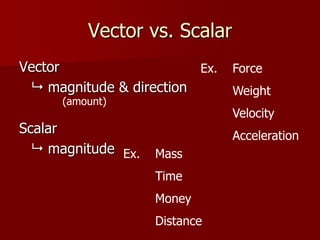
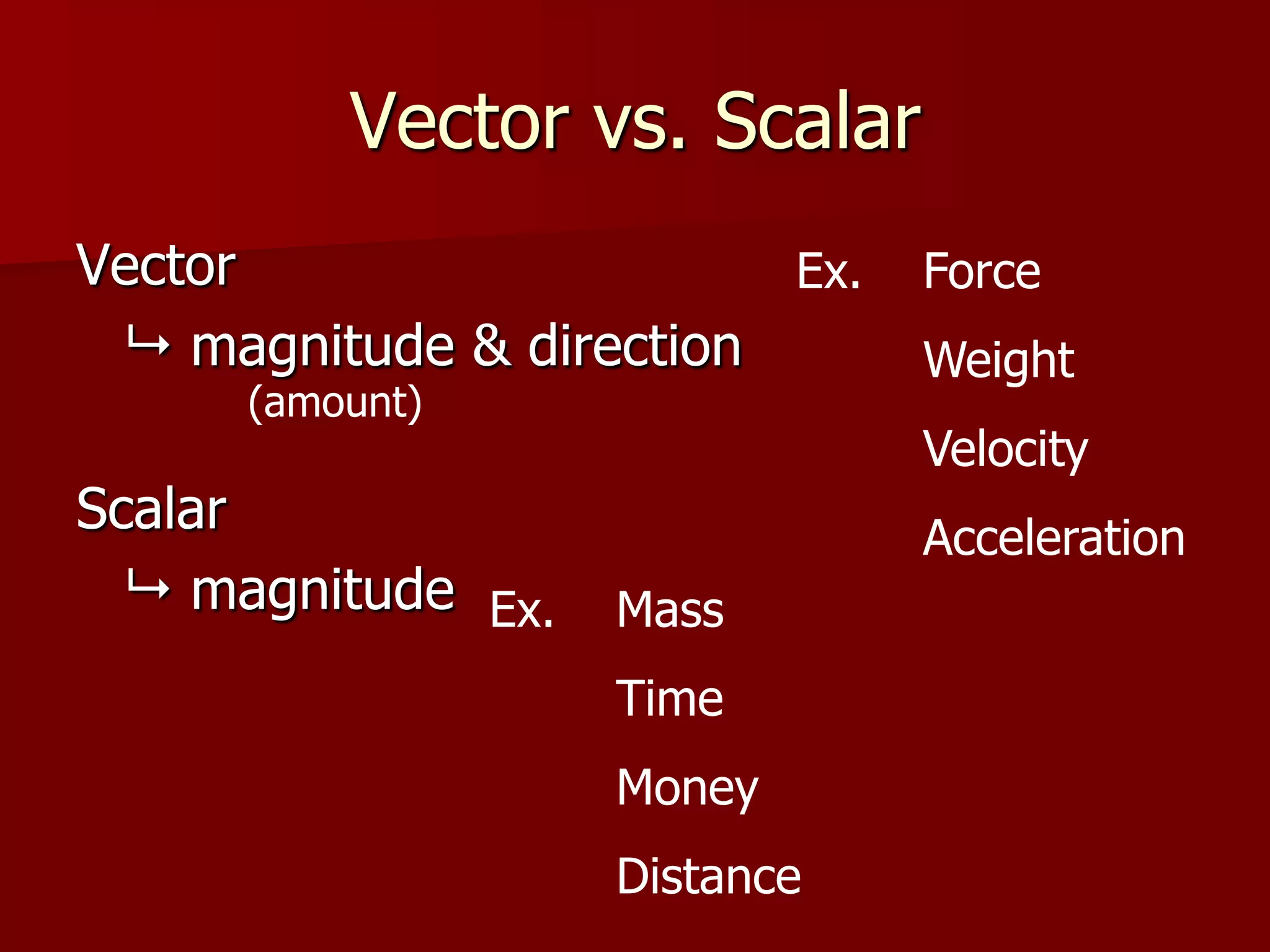
Vector                   Ex.   Force
  magnitude & direction       Weight
      (amount)
                               Velocity
Scalar                         Acceleration
   magnitude Ex.   Mass
                    Time
                    Money
                    Distance
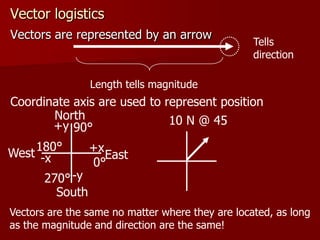
Vector logistics
Vectors are represented by an arrow
                                                  Tells
                                                  direction

                 Length tells magnitude
Coordinate axis are used to represent position
       North                 10 N @ 45
       +y 90°
    180°         +x
West -x             East
                 0°
       270° -y
         South
Vectors are the same no matter where they are located, as long
as the magnitude and direction are the same!
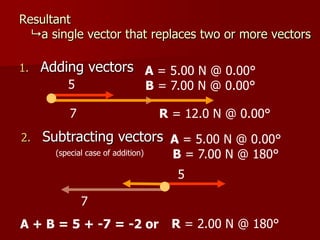
Resultant
   a single vector that replaces two or more vectors

1.   Adding vectors A = 5.00 N @ 0.00°
          5                         B = 7.00 N @ 0.00°

           7                          R = 12.0 N @ 0.00°
2.   Subtracting vectors A = 5.00 N @ 0.00°
       (special case of addition)       B = 7.00 N @ 180°
                                         5

               7
A + B = 5 + -7 = -2 or                  R = 2.00 N @ 180°
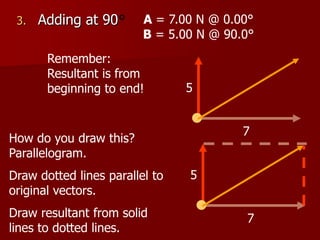
3.   Adding at 90       A = 7.00 N @ 0.00°
                         B = 5.00 N @ 90.0°
       Remember:
       Resultant is from
       beginning to end!        5


                                         7
How do you draw this?
Parallelogram.
Draw dotted lines parallel to   5
original vectors.
Draw resultant from solid                7
lines to dotted lines.
How do you calculate the resultant?

Magnitude 
  Pythagorean theorem
                                  5
Direction 
  SOHCAHTOA

        2       2                       opp     7
R     5     7       8.60N   tan
                                        adj
                                                    theta
Is the angle in                                       first
                                            5
reference to the                  tan   1
                                                    inside
origin? If not, add                         7       angle you
back to 0.                        35.5              come to
                                                    from 0
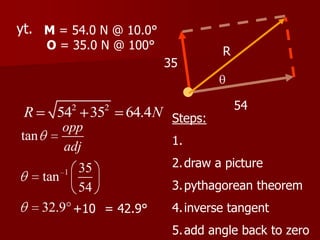
yt. M = 54.0 N @ 10.0°
      O = 35.0 N @ 100°                     R
                                  35


                2        2                      54
 R      54           35      64.4N Steps:
            opp
tan                                1.
            adj
                    35             2. draw a picture
            1
      tan
                    54             3. pythagorean theorem
      32.9 +10 = 42.9°             4. inverse tangent
                                   5. add angle back to zero
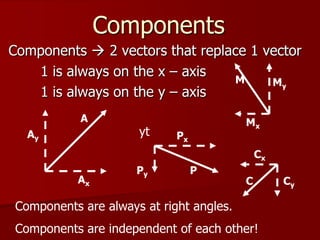
Components
Components  2 vectors that replace 1 vector
   1 is always on the x – axis   M     My
   1 is always on the y – axis
            A                             Mx
   Ay                 yt     Px
                                              Cx
                      Py          P
           Ax                             C        Cy

 Components are always at right angles.
 Components are independent of each other!
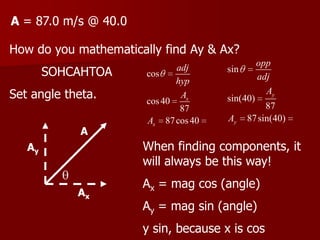
A = 87.0 m/s @ 40.0

How do you mathematically find Ay & Ax?
                                                opp
        SOHCAHTOA      cos
                              adj     sin
                                                adj
                              hyp
Set angle theta.       cos 40
                               Ax     sin(40)
                                                  Ay
                               87                87
                       Ax 87 cos 40   Ay    87 sin(40)
             A
   Ay                 When finding components, it
                      will always be this way!
                      Ax = mag cos (angle)
            Ax
                      Ay = mag sin (angle)
                      y sin, because x is cos
Vectors:                 90°
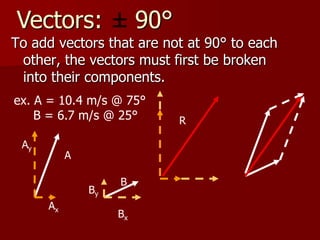
To add vectors that are not at 90° to each
 other, the vectors must first be broken
 into their components.
ex. A = 10.4 m/s @ 75°
    B = 6.7 m/s @ 25°          R

 Ay
           A

                    B
               By
      Ax
                    Bx
Steps:
1. components  find xtot & ytot
2. draw a picture
3. pythagorean theorem
4. inverse tangent
5. add angle back to zero
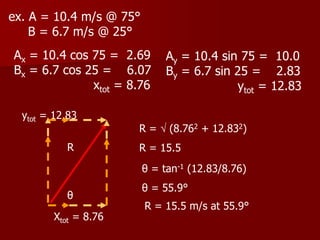
ex. A = 10.4 m/s @ 75°
    B = 6.7 m/s @ 25°
Ax = 10.4 cos 75 = 2.69       Ay = 10.4 sin 75 = 10.0
Bx = 6.7 cos 25 = 6.07        By = 6.7 sin 25 = 2.83
              xtot = 8.76                  ytot = 12.83

  ytot = 12.83
                      R=      (8.762 + 12.832)
           R          R = 15.5
                         θ = tan-1 (12.83/8.76)
                         θ = 55.9°
           θ
                         R = 15.5 m/s at 55.9°
        Xtot = 8.76
1  - vectors notes
1  - vectors notes

1 - vectors notes

  • 1.
    Vector vs. Scalar Vector Ex. Force  magnitude & direction Weight (amount) Velocity Scalar Acceleration  magnitude Ex. Mass Time Money Distance
  • 2.
    Vector logistics Vectors arerepresented by an arrow Tells direction Length tells magnitude Coordinate axis are used to represent position North 10 N @ 45 +y 90° 180° +x West -x East 0° 270° -y South Vectors are the same no matter where they are located, as long as the magnitude and direction are the same!
  • 3.
    Resultant a single vector that replaces two or more vectors 1. Adding vectors A = 5.00 N @ 0.00° 5 B = 7.00 N @ 0.00° 7 R = 12.0 N @ 0.00° 2. Subtracting vectors A = 5.00 N @ 0.00° (special case of addition) B = 7.00 N @ 180° 5 7 A + B = 5 + -7 = -2 or R = 2.00 N @ 180°
  • 5.
    3. Adding at 90 A = 7.00 N @ 0.00° B = 5.00 N @ 90.0° Remember: Resultant is from beginning to end! 5 7 How do you draw this? Parallelogram. Draw dotted lines parallel to 5 original vectors. Draw resultant from solid 7 lines to dotted lines.
  • 6.
    How do youcalculate the resultant? Magnitude  Pythagorean theorem 5 Direction  SOHCAHTOA 2 2 opp 7 R 5 7 8.60N tan adj theta Is the angle in  first 5 reference to the tan 1 inside origin? If not, add 7 angle you back to 0. 35.5 come to from 0
  • 7.
    yt. M =54.0 N @ 10.0° O = 35.0 N @ 100° R 35 2 2 54 R 54 35 64.4N Steps: opp tan 1. adj 35 2. draw a picture 1 tan 54 3. pythagorean theorem 32.9 +10 = 42.9° 4. inverse tangent 5. add angle back to zero
  • 8.
    Components Components  2vectors that replace 1 vector 1 is always on the x – axis M My 1 is always on the y – axis A Mx Ay yt Px Cx Py P Ax C Cy Components are always at right angles. Components are independent of each other!
  • 9.
    A = 87.0m/s @ 40.0 How do you mathematically find Ay & Ax? opp SOHCAHTOA cos adj sin adj hyp Set angle theta. cos 40 Ax sin(40) Ay 87 87 Ax 87 cos 40 Ay 87 sin(40) A Ay When finding components, it will always be this way! Ax = mag cos (angle) Ax Ay = mag sin (angle) y sin, because x is cos
  • 11.
    Vectors: 90° To add vectors that are not at 90° to each other, the vectors must first be broken into their components. ex. A = 10.4 m/s @ 75° B = 6.7 m/s @ 25° R Ay A B By Ax Bx
  • 12.
    Steps: 1. components find xtot & ytot 2. draw a picture 3. pythagorean theorem 4. inverse tangent 5. add angle back to zero
  • 13.
    ex. A =10.4 m/s @ 75° B = 6.7 m/s @ 25° Ax = 10.4 cos 75 = 2.69 Ay = 10.4 sin 75 = 10.0 Bx = 6.7 cos 25 = 6.07 By = 6.7 sin 25 = 2.83 xtot = 8.76 ytot = 12.83 ytot = 12.83 R= (8.762 + 12.832) R R = 15.5 θ = tan-1 (12.83/8.76) θ = 55.9° θ R = 15.5 m/s at 55.9° Xtot = 8.76