Engr. Mexieca M. Fidel
THE REAL NUMBER 
SYSTEM
WRITE SETS USING SET NOTATION 
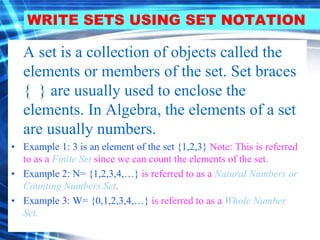
A set is a collection of objects called the 
elements or members of the set. Set braces 
{ } are usually used to enclose the 
elements. In Algebra, the elements of a set 
are usually numbers. 
• Example 1: 3 is an element of the set {1,2,3} Note: This is referred 
to as a Finite Set since we can count the elements of the set. 
• Example 2: N= {1,2,3,4,…} is referred to as a Natural Numbers or 
Counting Numbers Set. 
• Example 3: W= {0,1,2,3,4,…} is referred to as a Whole Number 
Set.
WRITE SETS USING SET NOTATION 
A set is a collection of objects called the 
elements or members of the set. Set braces 
{ } are usually used to enclose the 
elements. 
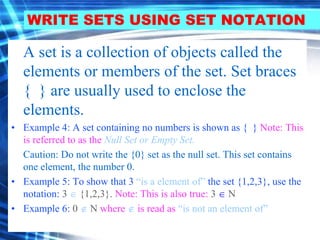
• Example 4: A set containing no numbers is shown as { } Note: This 
is referred to as the Null Set or Empty Set. 
Caution: Do not write the {0} set as the null set. This set contains 
one element, the number 0. 
• Example 5: To show that 3 “is a element of” the set {1,2,3}, use the 
notation: 3  {1,2,3}. Note: This is also true: 3  N 
• Example 6: 0  N where  is read as “is not an element of”
WRITE SETS USING SET NOTATION 
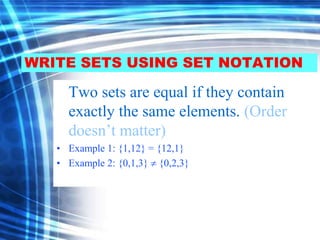
Two sets are equal if they contain 
exactly the same elements. (Order 
doesn’t matter) 
• Example 1: {1,12} = {12,1} 
• Example 2: {0,1,3}  {0,2,3}
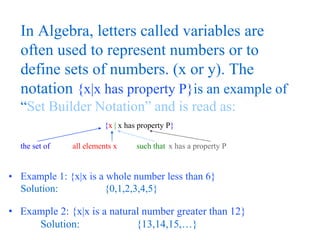
In Algebra, letters called variables are 
often used to represent numbers or to 
define sets of numbers. (x or y). The 
notation {x|x has property P}is an example of 
“Set Builder Notation” and is read as: 
{x  x has property P} 
the set of all elements x such that x has a property P 
• Example 1: {x|x is a whole number less than 6} 
Solution: {0,1,2,3,4,5} 
• Example 2: {x|x is a natural number greater than 12} 
Solution: {13,14,15,…}
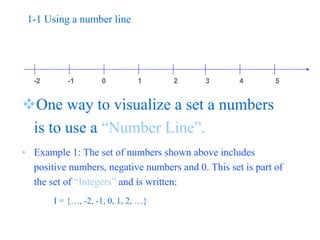
1-1 Using a number line 
-2 -1 0 1 2 3 4 5 
One way to visualize a set a numbers 
is to use a “Number Line”. 
• Example 1: The set of numbers shown above includes 
positive numbers, negative numbers and 0. This set is part of 
the set of “Integers” and is written: 
I = {…, -2, -1, 0, 1, 2, …}
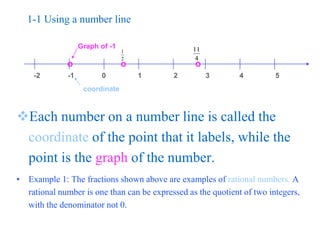
1-1 Using a number line 
Graph of -1 
o 
1 
2 
11 
4 
o o 
-2 -1 0 1 2 3 4 5 
coordinate 
Each number on a number line is called the 
coordinate of the point that it labels, while the 
point is the graph of the number. 
• Example 1: The fractions shown above are examples of rational numbers. A 
rational number is one than can be expressed as the quotient of two integers, 
with the denominator not 0.
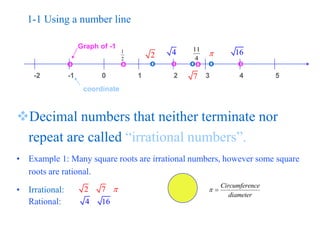
1-1 Using a number line 
Graph of -1 
4 16 
2  
o o o o o 
-2 -1 0 1 2 3 4 5 
coordinate 
Decimal numbers that neither terminate nor 
repeat are called “irrational numbers”. 
• Example 1: Many square roots are irrational numbers, however some square 
roots are rational. 
• Irrational: 
Rational: 
2 7  
4 16 
o 
1 
2 
11 
4 
o o 
7 
Circumference 
diameter 
 
OPERATIONS INVOLVING SETS
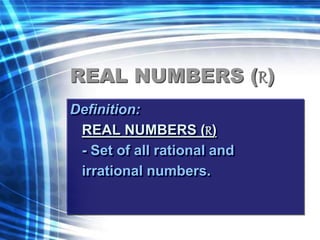
REAL NUMBERS (R) 
Definition: 
REAL NUMBERS (R) 
- Set of all rational and 
irrational numbers.
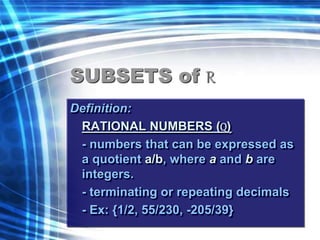
SUBSETS of R 
Definition: 
RATIONAL NUMBERS (Q) 
- numbers that can be expressed as 
a quotient a/b, where a and b are 
integers. 
- terminating or repeating decimals 
- Ex: {1/2, 55/230, -205/39}
SUBSETS of R 
Definition: 
INTEGERS (Z) 
- numbers that consist of 
positive integers, negative 
integers, and zero, 
- {…, -2, -1, 0, 1, 2 ,…}
SUBSETS of R 
Definition: 
NATURAL NUMBERS (N) 
- counting numbers 
- positive integers 
- {1, 2, 3, 4, ….}
SUBSETS of R 
Definition: 
WHOLE NUMBERS (W) 
- nonnegative integers 
- { 0 }  {1, 2, 3, 4, ….} 
- {0, 1, 2, 3, 4, …}
SUBSETS of R 
Definition: 
IRRATIONAL NUMBERS (Q´) 
- non-terminating and non-repeating 
decimals 
- transcendental numbers 
- Ex: {pi, sqrt 2, -1.436512…..}
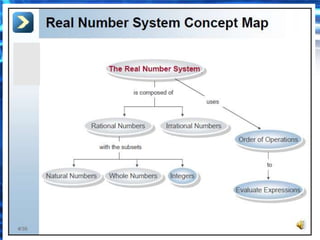
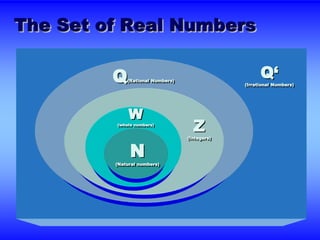
The Set of Real Numbers 
Q 
Q‘ 
(Irrational Numbers) 
Q 
(Rational Numbers) 
Z 
(Integers) 
W 
(whole numbers) 
N 
(Natural numbers)
PROPERTIES of R 
Definition: 
CLOSURE PROPERTY 
Given real numbers a and b, 
Then, a + b is a real number (+), 
or a x b is a real number (x).
PROPERTIES of R 
Example 1: 
12 + 3 is a real number. 
Therefore, the set of reals is 
CLOSED with respect to 
addition.
PROPERTIES of R 
Example 2: 
12 x 4.2 is a real number. 
Therefore, the set of reals is 
CLOSED with respect to 
multiplication.
PROPERTIES of R 
Definition: 
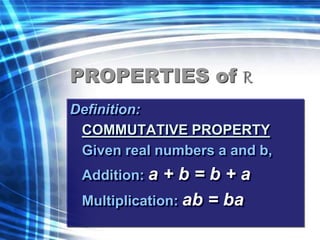
COMMUTATIVE PROPERTY 
Given real numbers a and b, 
Addition: a + b = b + a 
Multiplication: ab = ba
PROPERTIES of R 
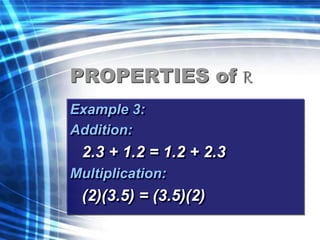
Example 3: 
Addition: 
2.3 + 1.2 = 1.2 + 2.3 
Multiplication: 
(2)(3.5) = (3.5)(2)
PROPERTIES of R 
Definition: 
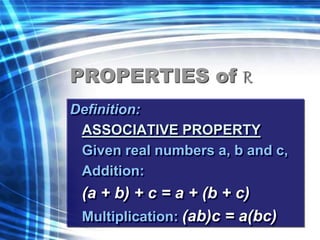
ASSOCIATIVE PROPERTY 
Given real numbers a, b and c, 
Addition: 
(a + b) + c = a + (b + c) 
Multiplication: (ab)c = a(bc)
PROPERTIES of R 
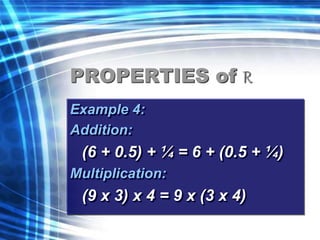
Example 4: 
Addition: 
(6 + 0.5) + ¼ = 6 + (0.5 + ¼) 
Multiplication: 
(9 x 3) x 4 = 9 x (3 x 4)
PROPERTIES of R 
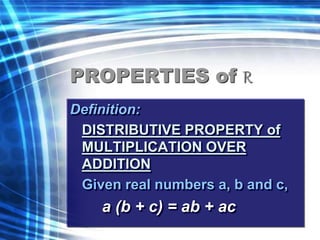
Definition: 
DISTRIBUTIVE PROPERTY of 
MULTIPLICATION OVER 
ADDITION 
Given real numbers a, b and c, 
a (b + c) = ab + ac
PROPERTIES of R 
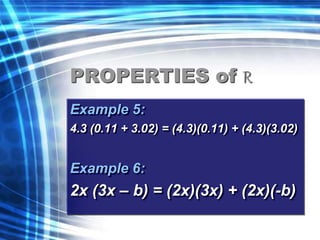
Example 5: 
4.3 (0.11 + 3.02) = (4.3)(0.11) + (4.3)(3.02) 
Example 6: 
2x (3x – b) = (2x)(3x) + (2x)(-b)
PROPERTIES of R 
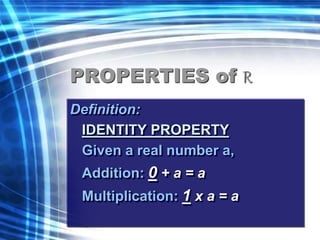
Definition: 
IDENTITY PROPERTY 
Given a real number a, 
Addition: 0 + a = a 
Multiplication: 1 x a = a
PROPERTIES of R 
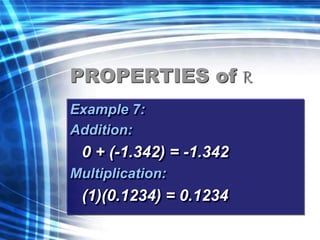
Example 7: 
Addition: 
0 + (-1.342) = -1.342 
Multiplication: 
(1)(0.1234) = 0.1234
PROPERTIES of R 
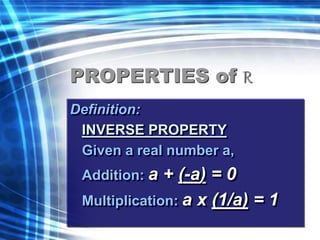
Definition: 
INVERSE PROPERTY 
Given a real number a, 
Addition: a + (-a) = 0 
Multiplication: a x (1/a) = 1
PROPERTIES of R 
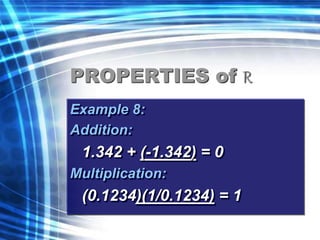
Example 8: 
Addition: 
1.342 + (-1.342) = 0 
Multiplication: 
(0.1234)(1/0.1234) = 1
EXERCISES 
Tell which of the properties of real 
numbers justifies each of the following 
statements. 
1. (2)(3) + (2)(5) = 2 (3 + 5) 
2. (10 + 5) + 3 = 10 + (5 + 3) 
3. (2)(10) + (3)(10) = (2 + 3)(10) 
4. (10)(4)(10) = (4)(10)(10) 
5. 10 + (4 + 10) = 10 + (10 + 4) 
6. 10[(4)(10)] = [(4)(10)]10 
7. [(4)(10)]10 = 4[(10)(10)] 
8. 3 + 0.33 is a real number
TRUE OR FALSE 
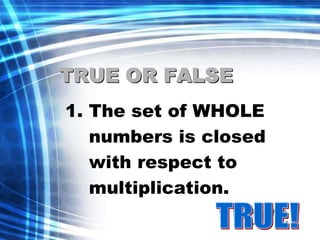
1. The set of WHOLE 
numbers is closed 
with respect to 
multiplication.
TRUE OR FALSE 
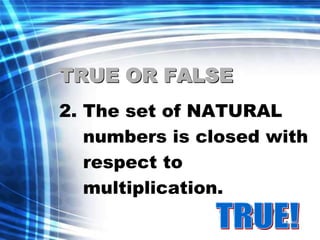
2. The set of NATURAL 
numbers is closed with 
respect to 
multiplication.
TRUE OR FALSE 
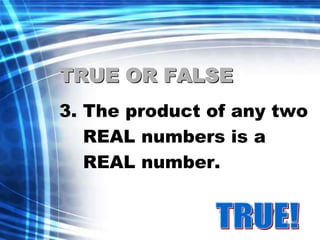
3. The product of any two 
REAL numbers is a 
REAL number.
TRUE OR FALSE 
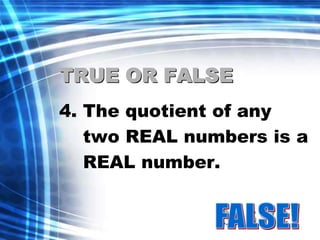
4. The quotient of any 
two REAL numbers is a 
REAL number.
TRUE OR FALSE 
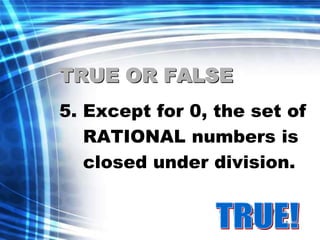
5. Except for 0, the set of 
RATIONAL numbers is 
closed under division.
TRUE OR FALSE 
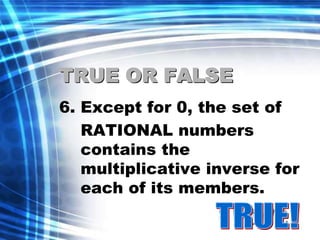
6. Except for 0, the set of 
RATIONAL numbers 
contains the 
multiplicative inverse for 
each of its members.
TRUE OR FALSE 
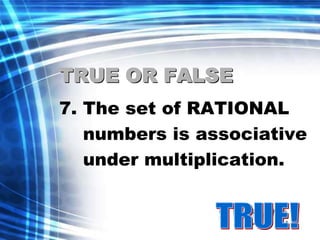
7. The set of RATIONAL 
numbers is associative 
under multiplication.
TRUE OR FALSE 
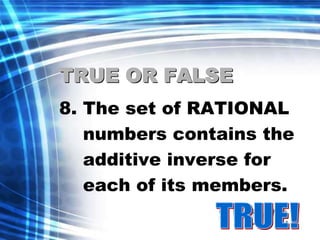
8. The set of RATIONAL 
numbers contains the 
additive inverse for 
each of its members.
TRUE OR FALSE 
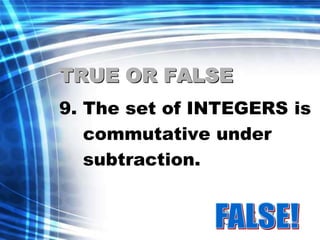
9. The set of INTEGERS is 
commutative under 
subtraction.
TRUE OR FALSE 
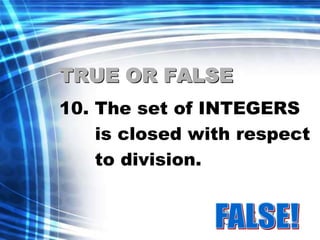
10. The set of INTEGERS 
is closed with respect 
to division.

Lecture 01 reals number system

  • 1.
  • 2.
  • 3.
    WRITE SETS USINGSET NOTATION A set is a collection of objects called the elements or members of the set. Set braces { } are usually used to enclose the elements. In Algebra, the elements of a set are usually numbers. • Example 1: 3 is an element of the set {1,2,3} Note: This is referred to as a Finite Set since we can count the elements of the set. • Example 2: N= {1,2,3,4,…} is referred to as a Natural Numbers or Counting Numbers Set. • Example 3: W= {0,1,2,3,4,…} is referred to as a Whole Number Set.
  • 4.
    WRITE SETS USINGSET NOTATION A set is a collection of objects called the elements or members of the set. Set braces { } are usually used to enclose the elements. • Example 4: A set containing no numbers is shown as { } Note: This is referred to as the Null Set or Empty Set. Caution: Do not write the {0} set as the null set. This set contains one element, the number 0. • Example 5: To show that 3 “is a element of” the set {1,2,3}, use the notation: 3  {1,2,3}. Note: This is also true: 3  N • Example 6: 0  N where  is read as “is not an element of”
  • 5.
    WRITE SETS USINGSET NOTATION Two sets are equal if they contain exactly the same elements. (Order doesn’t matter) • Example 1: {1,12} = {12,1} • Example 2: {0,1,3}  {0,2,3}
  • 6.
    In Algebra, letterscalled variables are often used to represent numbers or to define sets of numbers. (x or y). The notation {x|x has property P}is an example of “Set Builder Notation” and is read as: {x  x has property P} the set of all elements x such that x has a property P • Example 1: {x|x is a whole number less than 6} Solution: {0,1,2,3,4,5} • Example 2: {x|x is a natural number greater than 12} Solution: {13,14,15,…}
  • 7.
    1-1 Using anumber line -2 -1 0 1 2 3 4 5 One way to visualize a set a numbers is to use a “Number Line”. • Example 1: The set of numbers shown above includes positive numbers, negative numbers and 0. This set is part of the set of “Integers” and is written: I = {…, -2, -1, 0, 1, 2, …}
  • 8.
    1-1 Using anumber line Graph of -1 o 1 2 11 4 o o -2 -1 0 1 2 3 4 5 coordinate Each number on a number line is called the coordinate of the point that it labels, while the point is the graph of the number. • Example 1: The fractions shown above are examples of rational numbers. A rational number is one than can be expressed as the quotient of two integers, with the denominator not 0.
  • 9.
    1-1 Using anumber line Graph of -1 4 16 2  o o o o o -2 -1 0 1 2 3 4 5 coordinate Decimal numbers that neither terminate nor repeat are called “irrational numbers”. • Example 1: Many square roots are irrational numbers, however some square roots are rational. • Irrational: Rational: 2 7  4 16 o 1 2 11 4 o o 7 Circumference diameter  
  • 10.
  • 20.
    REAL NUMBERS (R) Definition: REAL NUMBERS (R) - Set of all rational and irrational numbers.
  • 21.
    SUBSETS of R Definition: RATIONAL NUMBERS (Q) - numbers that can be expressed as a quotient a/b, where a and b are integers. - terminating or repeating decimals - Ex: {1/2, 55/230, -205/39}
  • 22.
    SUBSETS of R Definition: INTEGERS (Z) - numbers that consist of positive integers, negative integers, and zero, - {…, -2, -1, 0, 1, 2 ,…}
  • 23.
    SUBSETS of R Definition: NATURAL NUMBERS (N) - counting numbers - positive integers - {1, 2, 3, 4, ….}
  • 24.
    SUBSETS of R Definition: WHOLE NUMBERS (W) - nonnegative integers - { 0 }  {1, 2, 3, 4, ….} - {0, 1, 2, 3, 4, …}
  • 25.
    SUBSETS of R Definition: IRRATIONAL NUMBERS (Q´) - non-terminating and non-repeating decimals - transcendental numbers - Ex: {pi, sqrt 2, -1.436512…..}
  • 26.
    The Set ofReal Numbers Q Q‘ (Irrational Numbers) Q (Rational Numbers) Z (Integers) W (whole numbers) N (Natural numbers)
  • 27.
    PROPERTIES of R Definition: CLOSURE PROPERTY Given real numbers a and b, Then, a + b is a real number (+), or a x b is a real number (x).
  • 28.
    PROPERTIES of R Example 1: 12 + 3 is a real number. Therefore, the set of reals is CLOSED with respect to addition.
  • 29.
    PROPERTIES of R Example 2: 12 x 4.2 is a real number. Therefore, the set of reals is CLOSED with respect to multiplication.
  • 30.
    PROPERTIES of R Definition: COMMUTATIVE PROPERTY Given real numbers a and b, Addition: a + b = b + a Multiplication: ab = ba
  • 31.
    PROPERTIES of R Example 3: Addition: 2.3 + 1.2 = 1.2 + 2.3 Multiplication: (2)(3.5) = (3.5)(2)
  • 32.
    PROPERTIES of R Definition: ASSOCIATIVE PROPERTY Given real numbers a, b and c, Addition: (a + b) + c = a + (b + c) Multiplication: (ab)c = a(bc)
  • 33.
    PROPERTIES of R Example 4: Addition: (6 + 0.5) + ¼ = 6 + (0.5 + ¼) Multiplication: (9 x 3) x 4 = 9 x (3 x 4)
  • 34.
    PROPERTIES of R Definition: DISTRIBUTIVE PROPERTY of MULTIPLICATION OVER ADDITION Given real numbers a, b and c, a (b + c) = ab + ac
  • 35.
    PROPERTIES of R Example 5: 4.3 (0.11 + 3.02) = (4.3)(0.11) + (4.3)(3.02) Example 6: 2x (3x – b) = (2x)(3x) + (2x)(-b)
  • 36.
    PROPERTIES of R Definition: IDENTITY PROPERTY Given a real number a, Addition: 0 + a = a Multiplication: 1 x a = a
  • 37.
    PROPERTIES of R Example 7: Addition: 0 + (-1.342) = -1.342 Multiplication: (1)(0.1234) = 0.1234
  • 38.
    PROPERTIES of R Definition: INVERSE PROPERTY Given a real number a, Addition: a + (-a) = 0 Multiplication: a x (1/a) = 1
  • 39.
    PROPERTIES of R Example 8: Addition: 1.342 + (-1.342) = 0 Multiplication: (0.1234)(1/0.1234) = 1
  • 40.
    EXERCISES Tell whichof the properties of real numbers justifies each of the following statements. 1. (2)(3) + (2)(5) = 2 (3 + 5) 2. (10 + 5) + 3 = 10 + (5 + 3) 3. (2)(10) + (3)(10) = (2 + 3)(10) 4. (10)(4)(10) = (4)(10)(10) 5. 10 + (4 + 10) = 10 + (10 + 4) 6. 10[(4)(10)] = [(4)(10)]10 7. [(4)(10)]10 = 4[(10)(10)] 8. 3 + 0.33 is a real number
  • 41.
    TRUE OR FALSE 1. The set of WHOLE numbers is closed with respect to multiplication.
  • 42.
    TRUE OR FALSE 2. The set of NATURAL numbers is closed with respect to multiplication.
  • 43.
    TRUE OR FALSE 3. The product of any two REAL numbers is a REAL number.
  • 44.
    TRUE OR FALSE 4. The quotient of any two REAL numbers is a REAL number.
  • 45.
    TRUE OR FALSE 5. Except for 0, the set of RATIONAL numbers is closed under division.
  • 46.
    TRUE OR FALSE 6. Except for 0, the set of RATIONAL numbers contains the multiplicative inverse for each of its members.
  • 47.
    TRUE OR FALSE 7. The set of RATIONAL numbers is associative under multiplication.
  • 48.
    TRUE OR FALSE 8. The set of RATIONAL numbers contains the additive inverse for each of its members.
  • 49.
    TRUE OR FALSE 9. The set of INTEGERS is commutative under subtraction.
  • 50.
    TRUE OR FALSE 10. The set of INTEGERS is closed with respect to division.