Real Number
System
Presentation on
Real number system:
The natural number:
 a number that occurs commonly and obviously in
nature
 non-negative number
 The set of natural numbers, denoted N
N = {0, 1, 2, 3, ...}
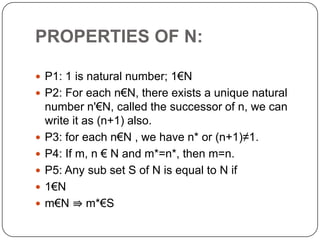
PROPERTIES OF N:
 P1: 1 is natural number; 1€N
 P2: For each n€N, there exists a unique natural
number n'€N, called the successor of n, we can
write it as (n+1) also.
 P3: for each n€N , we have n* or (n+1)≠1.
 P4: If m, n € N and m*=n*, then m=n.
 P5: Any sub set S of N is equal to N if
 1€N
 m€N ⇛ m*€S
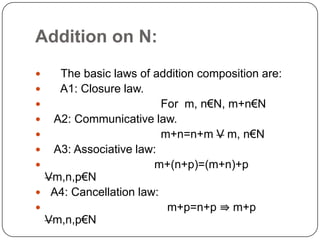
Addition on N:
 The basic laws of addition composition are:
 A1: Closure law.
 For m, n€N, m+n€N
 A2: Communicative law.
 m+n=n+m V m, n€N
 A3: Associative law:
 m+(n+p)=(m+n)+p
Vm,n,p€N
 A4: Cancellation law:
 m+p=n+p ⇛ m+p
Vm,n,p€N
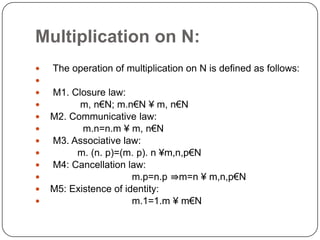
Multiplication on N:
 The operation of multiplication on N is defined as follows:

 M1. Closure law:
 m, n€N; m.n€N ¥ m, n€N
 M2. Communicative law:
 m.n=n.m ¥ m, n€N
 M3. Associative law:
 m. (n. p)=(m. p). n ¥m,n,p€N
 M4: Cancellation law:
 m.p=n.p ⇛m=n ¥ m,n,p€N
 M5: Existence of identity:
 m.1=1.m ¥ m€N
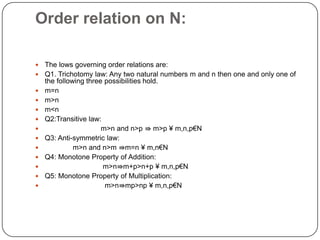
Order relation on N:
 The lows governing order relations are:
 Q1. Trichotomy law: Any two natural numbers m and n then one and only one of
the following three possibilities hold.
 m=n
 m>n
 m<n
 Q2:Transitive law:
 m>n and n>p ⇛ m>p ¥ m,n,p€N
 Q3: Anti-symmetric law:
 m>n and n>m ⇛m=n ¥ m,n€N
 Q4: Monotone Property of Addition:
 m>n⇛m+p>n+p ¥ m,n,p€N
 Q5: Monotone Property of Multiplication:
 m>n⇛mp>np ¥ m,n,p€N
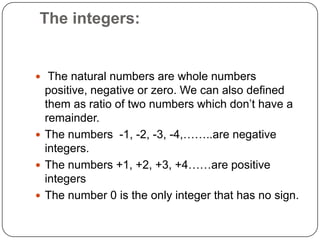
The integers:
 The natural numbers are whole numbers
positive, negative or zero. We can also defined
them as ratio of two numbers which don’t have a
remainder.
 The numbers -1, -2, -3, -4,……..are negative
integers.
 The numbers +1, +2, +3, +4……are positive
integers
 The number 0 is the only integer that has no sign.
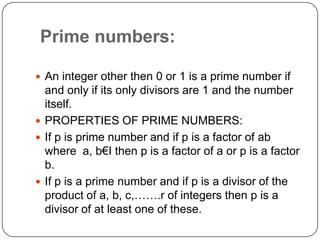
Prime numbers:
 An integer other then 0 or 1 is a prime number if
and only if its only divisors are 1 and the number
itself.
 PROPERTIES OF PRIME NUMBERS:
 If p is prime number and if p is a factor of ab
where a, b€I then p is a factor of a or p is a factor
b.
 If p is a prime number and if p is a divisor of the
product of a, b, c,…….r of integers then p is a
divisor of at least one of these.
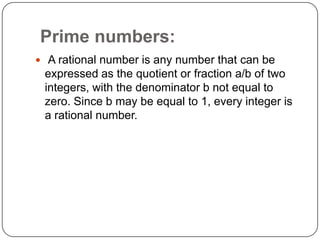
Prime numbers:
 A rational number is any number that can be
expressed as the quotient or fraction a/b of two
integers, with the denominator b not equal to
zero. Since b may be equal to 1, every integer is
a rational number.
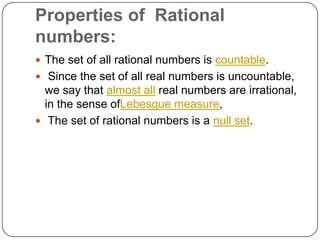
Properties of Rational
numbers:
 The set of all rational numbers is countable.
 Since the set of all real numbers is uncountable,
we say that almost all real numbers are irrational,
in the sense ofLebesgue measure,
 The set of rational numbers is a null set.
Irrational numbers:
 An irrational number is any real number that
cannot be expressed as a fraction a/b, where and
b are integers, with b non-zero, and is therefore
not a a rational number.
 An irrational number cannot be represented as a
simple fraction.
The real numbers:
 In mathematics, a real number is a value that
represents a quantity along a continuum, such as
–
 5 (an integer),
 4/3 (a rational number that is not an integer),
 8.6 (a rational number given by a finite decimal
representation),
 √2 (the square root of two, an irrational number)
and
 π (3.1415926535..., a transcendental number).
Properties of real numbers:
 a.Addition:
 1: Closure law:If a and b are any two real numbers, their sum (a+b) is also a real
number.
 2. Communicative law: If a and b are two real numbers,then
 a+b=b+a, V a,b∈R
 3. Associative law:(a+b)+c=a+(b+c) V a,b, c∈R
 b.Multiplication:
 1: Closure law:If a and b are any two real numbers, their product ab is also real
number.
 2. Communicative law:
 a, b= b, a V a, b ∈ R
 3. Associative law:
 (a,b) ,c=a, (b,c) V a, b, c ∈ R
 c.Relation between the two Algebric operation:
 a, (b,c)=a, b+a , c
 (b+c) , a= b , a+c ,a
 Modulus of real numbers: The absolute value has the
following four fundamental properties:
 Non-negativity
 Positive-definiteness
 Multiplicativeness
 Subadditivity
 Imaginary numbers: An imaginary number is defined as
any number that, when squared, results in a real number
less than zero.
Complex numbers:
A complex number is a number consisting of a
real part and an imaginary part. Complex
numbers extend the idea of the one-dimensional
number line to the two-dimensional complex
plane by using the number line for the real part
and adding a vertical axis to plot the imaginary
part.

Real number system

  • 1.
  • 2.
  • 3.
    The natural number: a number that occurs commonly and obviously in nature  non-negative number  The set of natural numbers, denoted N N = {0, 1, 2, 3, ...}
  • 4.
    PROPERTIES OF N: P1: 1 is natural number; 1€N  P2: For each n€N, there exists a unique natural number n'€N, called the successor of n, we can write it as (n+1) also.  P3: for each n€N , we have n* or (n+1)≠1.  P4: If m, n € N and m*=n*, then m=n.  P5: Any sub set S of N is equal to N if  1€N  m€N ⇛ m*€S
  • 5.
    Addition on N: The basic laws of addition composition are:  A1: Closure law.  For m, n€N, m+n€N  A2: Communicative law.  m+n=n+m V m, n€N  A3: Associative law:  m+(n+p)=(m+n)+p Vm,n,p€N  A4: Cancellation law:  m+p=n+p ⇛ m+p Vm,n,p€N
  • 6.
    Multiplication on N: The operation of multiplication on N is defined as follows:   M1. Closure law:  m, n€N; m.n€N ¥ m, n€N  M2. Communicative law:  m.n=n.m ¥ m, n€N  M3. Associative law:  m. (n. p)=(m. p). n ¥m,n,p€N  M4: Cancellation law:  m.p=n.p ⇛m=n ¥ m,n,p€N  M5: Existence of identity:  m.1=1.m ¥ m€N
  • 7.
    Order relation onN:  The lows governing order relations are:  Q1. Trichotomy law: Any two natural numbers m and n then one and only one of the following three possibilities hold.  m=n  m>n  m<n  Q2:Transitive law:  m>n and n>p ⇛ m>p ¥ m,n,p€N  Q3: Anti-symmetric law:  m>n and n>m ⇛m=n ¥ m,n€N  Q4: Monotone Property of Addition:  m>n⇛m+p>n+p ¥ m,n,p€N  Q5: Monotone Property of Multiplication:  m>n⇛mp>np ¥ m,n,p€N
  • 8.
    The integers:  Thenatural numbers are whole numbers positive, negative or zero. We can also defined them as ratio of two numbers which don’t have a remainder.  The numbers -1, -2, -3, -4,……..are negative integers.  The numbers +1, +2, +3, +4……are positive integers  The number 0 is the only integer that has no sign.
  • 9.
    Prime numbers:  Aninteger other then 0 or 1 is a prime number if and only if its only divisors are 1 and the number itself.  PROPERTIES OF PRIME NUMBERS:  If p is prime number and if p is a factor of ab where a, b€I then p is a factor of a or p is a factor b.  If p is a prime number and if p is a divisor of the product of a, b, c,…….r of integers then p is a divisor of at least one of these.
  • 10.
    Prime numbers:  Arational number is any number that can be expressed as the quotient or fraction a/b of two integers, with the denominator b not equal to zero. Since b may be equal to 1, every integer is a rational number.
  • 11.
    Properties of Rational numbers: The set of all rational numbers is countable.  Since the set of all real numbers is uncountable, we say that almost all real numbers are irrational, in the sense ofLebesgue measure,  The set of rational numbers is a null set.
  • 12.
    Irrational numbers:  Anirrational number is any real number that cannot be expressed as a fraction a/b, where and b are integers, with b non-zero, and is therefore not a a rational number.  An irrational number cannot be represented as a simple fraction.
  • 13.
    The real numbers: In mathematics, a real number is a value that represents a quantity along a continuum, such as –  5 (an integer),  4/3 (a rational number that is not an integer),  8.6 (a rational number given by a finite decimal representation),  √2 (the square root of two, an irrational number) and  π (3.1415926535..., a transcendental number).
  • 14.
    Properties of realnumbers:  a.Addition:  1: Closure law:If a and b are any two real numbers, their sum (a+b) is also a real number.  2. Communicative law: If a and b are two real numbers,then  a+b=b+a, V a,b∈R  3. Associative law:(a+b)+c=a+(b+c) V a,b, c∈R  b.Multiplication:  1: Closure law:If a and b are any two real numbers, their product ab is also real number.  2. Communicative law:  a, b= b, a V a, b ∈ R  3. Associative law:  (a,b) ,c=a, (b,c) V a, b, c ∈ R  c.Relation between the two Algebric operation:  a, (b,c)=a, b+a , c  (b+c) , a= b , a+c ,a
  • 15.
     Modulus ofreal numbers: The absolute value has the following four fundamental properties:  Non-negativity  Positive-definiteness  Multiplicativeness  Subadditivity  Imaginary numbers: An imaginary number is defined as any number that, when squared, results in a real number less than zero.
  • 16.
    Complex numbers: A complexnumber is a number consisting of a real part and an imaginary part. Complex numbers extend the idea of the one-dimensional number line to the two-dimensional complex plane by using the number line for the real part and adding a vertical axis to plot the imaginary part.