CHAPTER1: EXPRESSIONS,
EQUATIONS, AND INEQUALITIES
1.1 Patterns and Expressions
1.2 Properties of Real Numbers
DEFINITIONS
   A mathematical quantity is anything that can be
    measured or counted.
     Quantities whose value stay the same are constants
     Quantities whose values change or vary are called
      variable quantities
DEFINITIONS
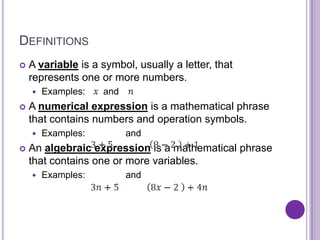
   A variable is a symbol, usually a letter, that
    represents one or more numbers.
       Examples:   and
   A numerical expression is a mathematical phrase
    that contains numbers and operation symbols.
       Examples:         and
   An algebraic expression is a mathematical phrase
    that contains one or more variables.
       Examples:         and
SETS OF NUMBERS
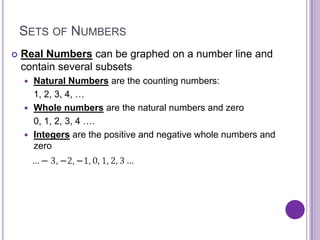
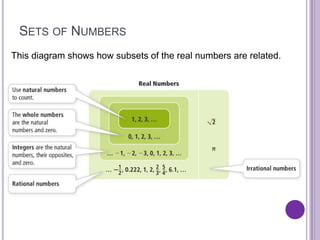
   Real Numbers can be graphed on a number line and
    contain several subsets
     Natural Numbers are the counting numbers:
      1, 2, 3, 4, …
     Whole numbers are the natural numbers and zero
      0, 1, 2, 3, 4 ….
     Integers are the positive and negative whole numbers and
      zero
SETS OF NUMBERS
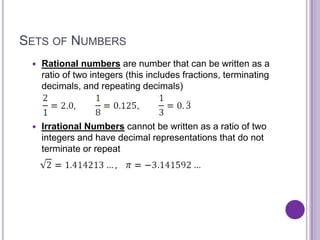
    Rational numbers are number that can be written as a
     ratio of two integers (this includes fractions, terminating
     decimals, and repeating decimals)


    Irrational Numbers cannot be written as a ratio of two
     integers and have decimal representations that do not
     terminate or repeat
SETS OF NUMBERS
This diagram shows how subsets of the real numbers are related.
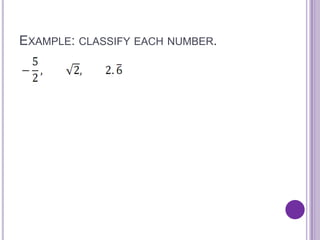
EXAMPLE: CLASSIFY EACH NUMBER.
PROPERTIES OF REAL NUMBERS
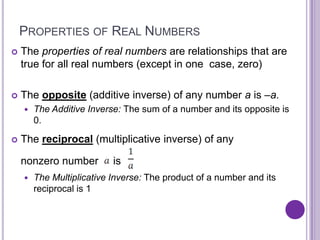
   The properties of real numbers are relationships that are
    true for all real numbers (except in one case, zero)

   The opposite (additive inverse) of any number a is –a.
       The Additive Inverse: The sum of a number and its opposite is
        0.

   The reciprocal (multiplicative inverse) of any

    nonzero number         is
       The Multiplicative Inverse: The product of a number and its
        reciprocal is 1
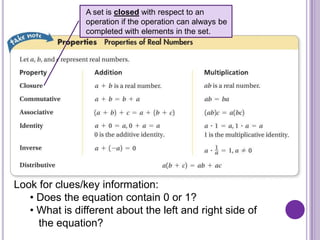
A set is closed with respect to an
                operation if the operation can always be
                completed with elements in the set.


Look for clues/key information:
   • Does the equation contain 0 or 1?
   • What is different about the left and right side of
     the equation?
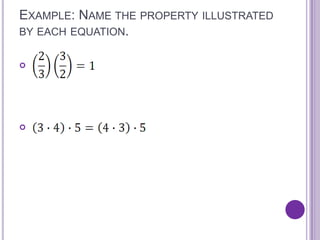
EXAMPLE: NAME THE PROPERTY ILLUSTRATED
BY EACH EQUATION.







1.1 and 1.2

  • 1.
    CHAPTER1: EXPRESSIONS, EQUATIONS, ANDINEQUALITIES 1.1 Patterns and Expressions 1.2 Properties of Real Numbers
  • 2.
    DEFINITIONS  A mathematical quantity is anything that can be measured or counted.  Quantities whose value stay the same are constants  Quantities whose values change or vary are called variable quantities
  • 3.
    DEFINITIONS  A variable is a symbol, usually a letter, that represents one or more numbers.  Examples: and  A numerical expression is a mathematical phrase that contains numbers and operation symbols.  Examples: and  An algebraic expression is a mathematical phrase that contains one or more variables.  Examples: and
  • 4.
    SETS OF NUMBERS  Real Numbers can be graphed on a number line and contain several subsets  Natural Numbers are the counting numbers: 1, 2, 3, 4, …  Whole numbers are the natural numbers and zero 0, 1, 2, 3, 4 ….  Integers are the positive and negative whole numbers and zero
  • 5.
    SETS OF NUMBERS  Rational numbers are number that can be written as a ratio of two integers (this includes fractions, terminating decimals, and repeating decimals)  Irrational Numbers cannot be written as a ratio of two integers and have decimal representations that do not terminate or repeat
  • 6.
    SETS OF NUMBERS Thisdiagram shows how subsets of the real numbers are related.
  • 7.
  • 8.
    PROPERTIES OF REALNUMBERS  The properties of real numbers are relationships that are true for all real numbers (except in one case, zero)  The opposite (additive inverse) of any number a is –a.  The Additive Inverse: The sum of a number and its opposite is 0.  The reciprocal (multiplicative inverse) of any nonzero number is  The Multiplicative Inverse: The product of a number and its reciprocal is 1
  • 9.
    A set isclosed with respect to an operation if the operation can always be completed with elements in the set. Look for clues/key information: • Does the equation contain 0 or 1? • What is different about the left and right side of the equation?
  • 10.
    EXAMPLE: NAME THEPROPERTY ILLUSTRATED BY EACH EQUATION.  