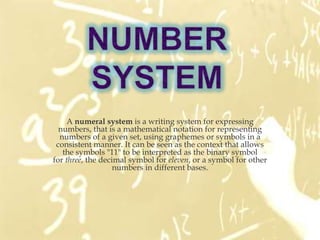
A numeral system is a writing system for expressing
  numbers, that is a mathematical notation for representing
  numbers of a given set, using graphemes or symbols in a
 consistent manner. It can be seen as the context that allows
   the symbols "11" to be interpreted as the binary symbol
for three, the decimal symbol for eleven, or a symbol for other
                   numbers in different bases.
   The most commonly used system of
    numerals is known as Arabic numerals
    or HinduTwo Indian mathematicians are
    credited with developing
    them. Aryabhata of Kusumapura develope
    d the place-value notation in the 5th
    century and a century
    later Brahmagupta introduced the symbol
    for zero.[1] The numeral system and the
    zero concept, developed by the Hindus in
    India slowly spread to other surrounding
    countries due to their commercial and
    military activities with India. The Arabs
    adopted it and modified them. Even
    today, the Arabs called the numerals they
    use 'Rakam Al-Hind' or the Hindu
    numeral system. The Arabs translated
    Hindu texts on numerology and spread it
    to the western world due to their trade
    links with them.
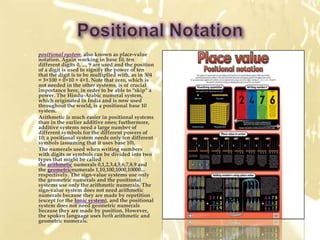
   positional system, also known as place-value
    notation. Again working in base 10, ten
    different digits 0, ..., 9 are used and the position
    of a digit is used to signify the power of ten
    that the digit is to be multiplied with, as in 304
    = 3×100 + 0×10 + 4×1. Note that zero, which is
    not needed in the other systems, is of crucial
    importance here, in order to be able to "skip" a
    power. The Hindu-Arabic numeral system,
    which originated in India and is now used
    throughout the world, is a positional base 10
    system.
   Arithmetic is much easier in positional systems
    than in the earlier additive ones; furthermore,
    additive systems need a large number of
    different symbols for the different powers of
    10; a positional system needs only ten different
    symbols (assuming that it uses base 10).
   The numerals used when writing numbers
    with digits or symbols can be divided into two
    types that might be called
    the arithmetic numerals 0,1,2,3,4,5,6,7,8,9 and
    the geometricnumerals 1,10,100,1000,10000...
    respectively. The sign-value systems use only
    the geometric numerals and the positional
    systems use only the arithmetic numerals. The
    sign-value system does not need arithmetic
    numerals because they are made by repetition
    (except for the Ionic system), and the positional
    system does not need geometric numerals
    because they are made by position. However,
    the spoken language uses both arithmetic and
    geometric numerals.
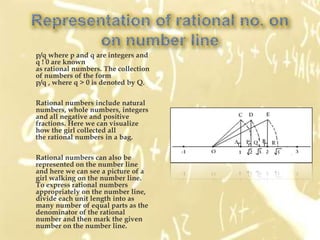
   p/q where p and q are integers and
    q ! 0 are known
    as rational numbers. The collection
    of numbers of the form
    p/q , where q > 0 is denoted by Q.

    Rational numbers include natural
    numbers, whole numbers, integers
    and all negative and positive
    fractions. Here we can visualize
    how the girl collected all
    the rational numbers in a bag.

    Rational numbers can also be
    represented on the number line
    and here we can see a picture of a
    girl walking on the number line.
    To express rational numbers
    appropriately on the number line,
    divide each unit length into as
    many number of equal parts as the
    denominator of the rational
    number and then mark the given
    number on the number line.
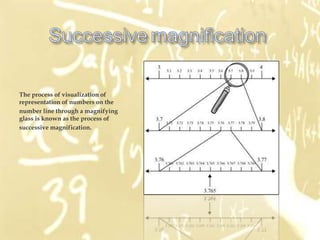
The process of visualization of
representation of numbers on the
number line through a magnifying
glass is known as the process of
successive magnification.
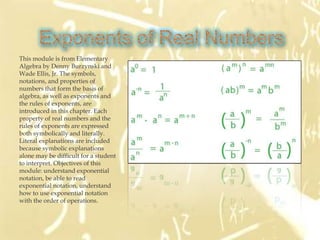
This module is from Elementary
Algebra by Denny Burzynski and
Wade Ellis, Jr. The symbols,
notations, and properties of
numbers that form the basis of
algebra, as well as exponents and
the rules of exponents, are
introduced in this chapter. Each
property of real numbers and the
rules of exponents are expressed
both symbolically and literally.
Literal explanations are included
because symbolic explanations
alone may be difficult for a student
to interpret. Objectives of this
module: understand exponential
notation, be able to read
exponential notation, understand
how to use exponential notation
with the order of operations.
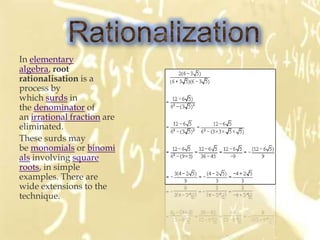
In elementary
algebra, root
rationalisation is a
process by
which surds in
the denominator of
an irrational fraction are
eliminated.
These surds may
be monomials or binomi
als involving square
roots, in simple
examples. There are
wide extensions to the
technique.
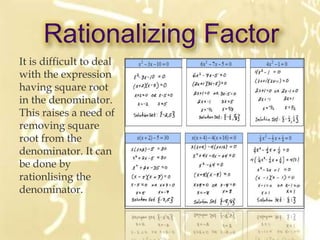
It is difficult to deal
with the expression
having square root
in the denominator.
This raises a need of
removing square
root from the
denominator. It can
be done by
rationlising the
denominator.
   1. Numbers 1, 2, 3…….∞, which are used for counting are called
    Natural                                                                        16. Real numbers satisfy the commutative, associate and distributive
   numbers and are denoted by N.                                                  law of addition and multiplication.
   2. 0 when included with the natural numbers form a new set of                  17. Commutative law of addition: If a and b are two real numbers then,
    numbers
                                                                                   a+b=b+a
   called Whole number denoted by W
                                                                                   18. Commutative law of multiplication: If a and b are two real
   3. -1,-2,-3……………..-∞ are the negative of natural numbers.
                                                                                   numbers then, a. b = b. a
   4. The negative of natural numbers, 0 and the natural number together
                                                                                   19. Associative law of addition: If a, b and c are real numbers then,
   constitutes integers denoted by Z.
                                                                                          a + (b + c) = (a + b) + c
   5. The numbers which can be represented in the form of p/q where
                                                                                   20. Associative law of multiplication: If a, b and c are real numbers
   q 0 ≠ and p and q are integers are called Rational numbers. Rational
                                                                                   then, a. (b. c) = (a. b). c
   numbers are denoted by Q. If p and q are co prime then the rational
                                                                                   21. Distributive of multiplication with respect to addition: If a, b and
   number is in its simplest form.
                                                                                   c are real numbers then, a. (b+ c) = a. b + a. c
   6. Irrational numbers are the numbers which are non-terminating and
                                                                                   22. Removing the radical sign from the denominator is called
   non-repeating.
                                                                                   rationalisation of denominator.
   7. Rational and irrational numbers together constitute Real numbers
                                                                                   23. The multiplication factor used for rationalizing the denominator is
   and it is denoted by R.
                                                                                   called the rationalizing factor.
   8. Equivalent rational numbers (or fractions) have same (equal)
                                                                                   24. The exponent is the number of times the base is multiplied by
   values when written in the simplest form.                                       itself.
   9. Terminating fractions are the fractions which leaves remainder 0 on         25. In the exponential representation
   division.                                                                      m
   10. Recurring fractions are the fractions which never leave a remainder        a , a is called the base and m is
   0 on division.                                                                 called the exponent or power.
   11. There are infinitely many rational numbers between any two                 26. If a number is to the left of the number on the number line, it is less
    rational
                                                                                   than the other number. If it is to the right, then it is greater than the
   numbers.
                                                                                   number.
   12. If Prime factors of the denominator are 2 or 5 or both only. Then the
                                                                                   27. There is one to one correspondence between the set of real
   number is terminating else repeating/recurring.
                                                                                   numbers and the set of point on the number line.
   13. Two numbers p & q are said to be co-prime if, numbers p & q have
    no
   common factors other than 1.
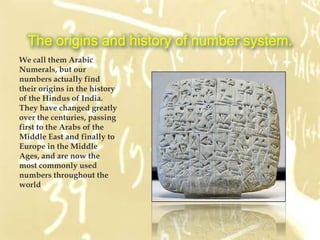
The origins and history of number system.
We call them Arabic
Numerals, but our
numbers actually find
their origins in the history
of the Hindus of India.
They have changed greatly
over the centuries, passing
first to the Arabs of the
Middle East and finally to
Europe in the Middle
Ages, and are now the
most commonly used
numbers throughout the
world.
Thanks
Name - Prajjwal Kushwaha
Class - flyers-1-b
Roll no -28


Special thanks to Mr.
pradeep Kumar lodha

Number system

  • 1.
    A numeral systemis a writing system for expressing numbers, that is a mathematical notation for representing numbers of a given set, using graphemes or symbols in a consistent manner. It can be seen as the context that allows the symbols "11" to be interpreted as the binary symbol for three, the decimal symbol for eleven, or a symbol for other numbers in different bases.
  • 3.
    The most commonly used system of numerals is known as Arabic numerals or HinduTwo Indian mathematicians are credited with developing them. Aryabhata of Kusumapura develope d the place-value notation in the 5th century and a century later Brahmagupta introduced the symbol for zero.[1] The numeral system and the zero concept, developed by the Hindus in India slowly spread to other surrounding countries due to their commercial and military activities with India. The Arabs adopted it and modified them. Even today, the Arabs called the numerals they use 'Rakam Al-Hind' or the Hindu numeral system. The Arabs translated Hindu texts on numerology and spread it to the western world due to their trade links with them.
  • 4.
    positional system, also known as place-value notation. Again working in base 10, ten different digits 0, ..., 9 are used and the position of a digit is used to signify the power of ten that the digit is to be multiplied with, as in 304 = 3×100 + 0×10 + 4×1. Note that zero, which is not needed in the other systems, is of crucial importance here, in order to be able to "skip" a power. The Hindu-Arabic numeral system, which originated in India and is now used throughout the world, is a positional base 10 system.  Arithmetic is much easier in positional systems than in the earlier additive ones; furthermore, additive systems need a large number of different symbols for the different powers of 10; a positional system needs only ten different symbols (assuming that it uses base 10).  The numerals used when writing numbers with digits or symbols can be divided into two types that might be called the arithmetic numerals 0,1,2,3,4,5,6,7,8,9 and the geometricnumerals 1,10,100,1000,10000... respectively. The sign-value systems use only the geometric numerals and the positional systems use only the arithmetic numerals. The sign-value system does not need arithmetic numerals because they are made by repetition (except for the Ionic system), and the positional system does not need geometric numerals because they are made by position. However, the spoken language uses both arithmetic and geometric numerals.
  • 5.
    p/q where p and q are integers and q ! 0 are known as rational numbers. The collection of numbers of the form p/q , where q > 0 is denoted by Q. Rational numbers include natural numbers, whole numbers, integers and all negative and positive fractions. Here we can visualize how the girl collected all the rational numbers in a bag. Rational numbers can also be represented on the number line and here we can see a picture of a girl walking on the number line. To express rational numbers appropriately on the number line, divide each unit length into as many number of equal parts as the denominator of the rational number and then mark the given number on the number line.
  • 6.
    The process ofvisualization of representation of numbers on the number line through a magnifying glass is known as the process of successive magnification.
  • 7.
    This module isfrom Elementary Algebra by Denny Burzynski and Wade Ellis, Jr. The symbols, notations, and properties of numbers that form the basis of algebra, as well as exponents and the rules of exponents, are introduced in this chapter. Each property of real numbers and the rules of exponents are expressed both symbolically and literally. Literal explanations are included because symbolic explanations alone may be difficult for a student to interpret. Objectives of this module: understand exponential notation, be able to read exponential notation, understand how to use exponential notation with the order of operations.
  • 8.
    In elementary algebra, root rationalisationis a process by which surds in the denominator of an irrational fraction are eliminated. These surds may be monomials or binomi als involving square roots, in simple examples. There are wide extensions to the technique.
  • 9.
    It is difficultto deal with the expression having square root in the denominator. This raises a need of removing square root from the denominator. It can be done by rationlising the denominator.
  • 10.
    1. Numbers 1, 2, 3…….∞, which are used for counting are called Natural  16. Real numbers satisfy the commutative, associate and distributive  numbers and are denoted by N.  law of addition and multiplication.  2. 0 when included with the natural numbers form a new set of  17. Commutative law of addition: If a and b are two real numbers then, numbers  a+b=b+a  called Whole number denoted by W  18. Commutative law of multiplication: If a and b are two real  3. -1,-2,-3……………..-∞ are the negative of natural numbers.  numbers then, a. b = b. a  4. The negative of natural numbers, 0 and the natural number together  19. Associative law of addition: If a, b and c are real numbers then,  constitutes integers denoted by Z.  a + (b + c) = (a + b) + c  5. The numbers which can be represented in the form of p/q where  20. Associative law of multiplication: If a, b and c are real numbers  q 0 ≠ and p and q are integers are called Rational numbers. Rational  then, a. (b. c) = (a. b). c  numbers are denoted by Q. If p and q are co prime then the rational  21. Distributive of multiplication with respect to addition: If a, b and  number is in its simplest form.  c are real numbers then, a. (b+ c) = a. b + a. c  6. Irrational numbers are the numbers which are non-terminating and  22. Removing the radical sign from the denominator is called  non-repeating.  rationalisation of denominator.  7. Rational and irrational numbers together constitute Real numbers  23. The multiplication factor used for rationalizing the denominator is  and it is denoted by R.  called the rationalizing factor.  8. Equivalent rational numbers (or fractions) have same (equal)  24. The exponent is the number of times the base is multiplied by  values when written in the simplest form. itself.  9. Terminating fractions are the fractions which leaves remainder 0 on  25. In the exponential representation  division.  m  10. Recurring fractions are the fractions which never leave a remainder  a , a is called the base and m is  0 on division.  called the exponent or power.  11. There are infinitely many rational numbers between any two  26. If a number is to the left of the number on the number line, it is less rational  than the other number. If it is to the right, then it is greater than the  numbers.  number.  12. If Prime factors of the denominator are 2 or 5 or both only. Then the  27. There is one to one correspondence between the set of real  number is terminating else repeating/recurring.  numbers and the set of point on the number line.  13. Two numbers p & q are said to be co-prime if, numbers p & q have no  common factors other than 1.
  • 11.
    The origins andhistory of number system. We call them Arabic Numerals, but our numbers actually find their origins in the history of the Hindus of India. They have changed greatly over the centuries, passing first to the Arabs of the Middle East and finally to Europe in the Middle Ages, and are now the most commonly used numbers throughout the world.
  • 12.
    Thanks Name - PrajjwalKushwaha Class - flyers-1-b Roll no -28 Special thanks to Mr. pradeep Kumar lodha