A. Sets andNotation
A set is a well-defined collection of distinct objects called elements.
For example, if A is a set of vowels, then we write
A = {a, e, i, o, u}
Sets and sets operations
4.
A.1. Relations onSets
A.1.1. Relations and Their Properties
1. Binary Relation
Definition: Let A, B be any sets. A binary relation R from A to B, written R:
A x B, is a subset of the set A x B.
Sets and sets operations
5.
A.1. Relations onSets
A.1.1. Relations and Their Properties
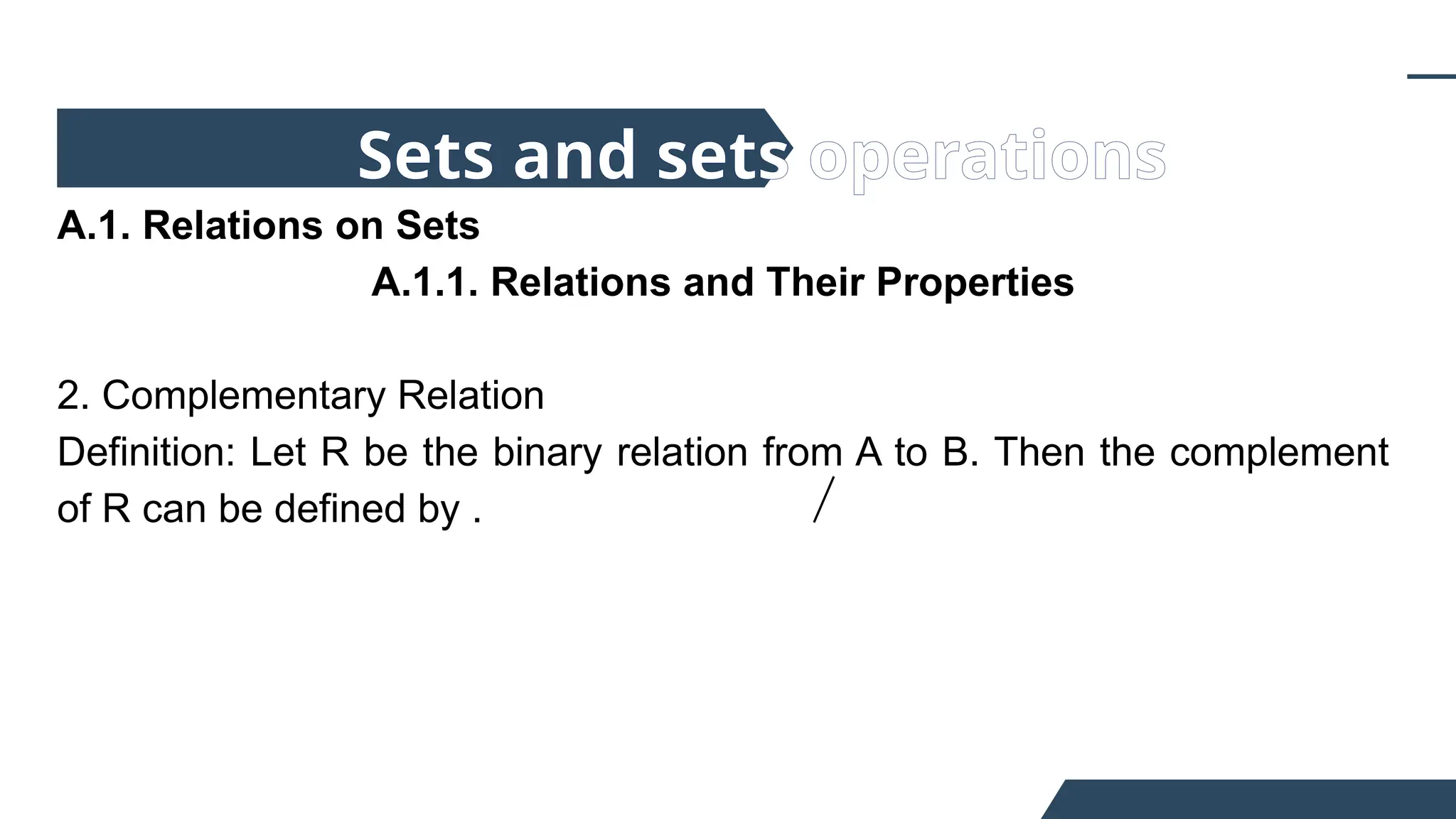
2. Complementary Relation
Definition: Let R be the binary relation from A to B. Then the complement
of R can be defined by .
Sets and sets operations
6.
A.1. Relations onSets
A.1.1. Relations and Their Properties
3. Inverse Relation
Definition: Let R be the binary relation from A to B. Then the inverse of R
can be defined by
Sets and sets operations
7.
A.1. Relations onSets
A.1.2. Relations on a Set
Definition: A relation on a set A is a relation from A to A. In other words, a
relation on a set A is a
subset of A x A.
• Digraph
Definition: A directed graph, or digraph, consists of a set V of vertices (or
nodes) together with a set E of ordered pairs of element of V called edges
(or arcs). The vertex a is called the initial vertex of the edge (a, b), and the
vertex b is called the terminal vertex of this edge.
Sets and sets operations
8.
A.1. Relations onSets
A.1.3. Properties
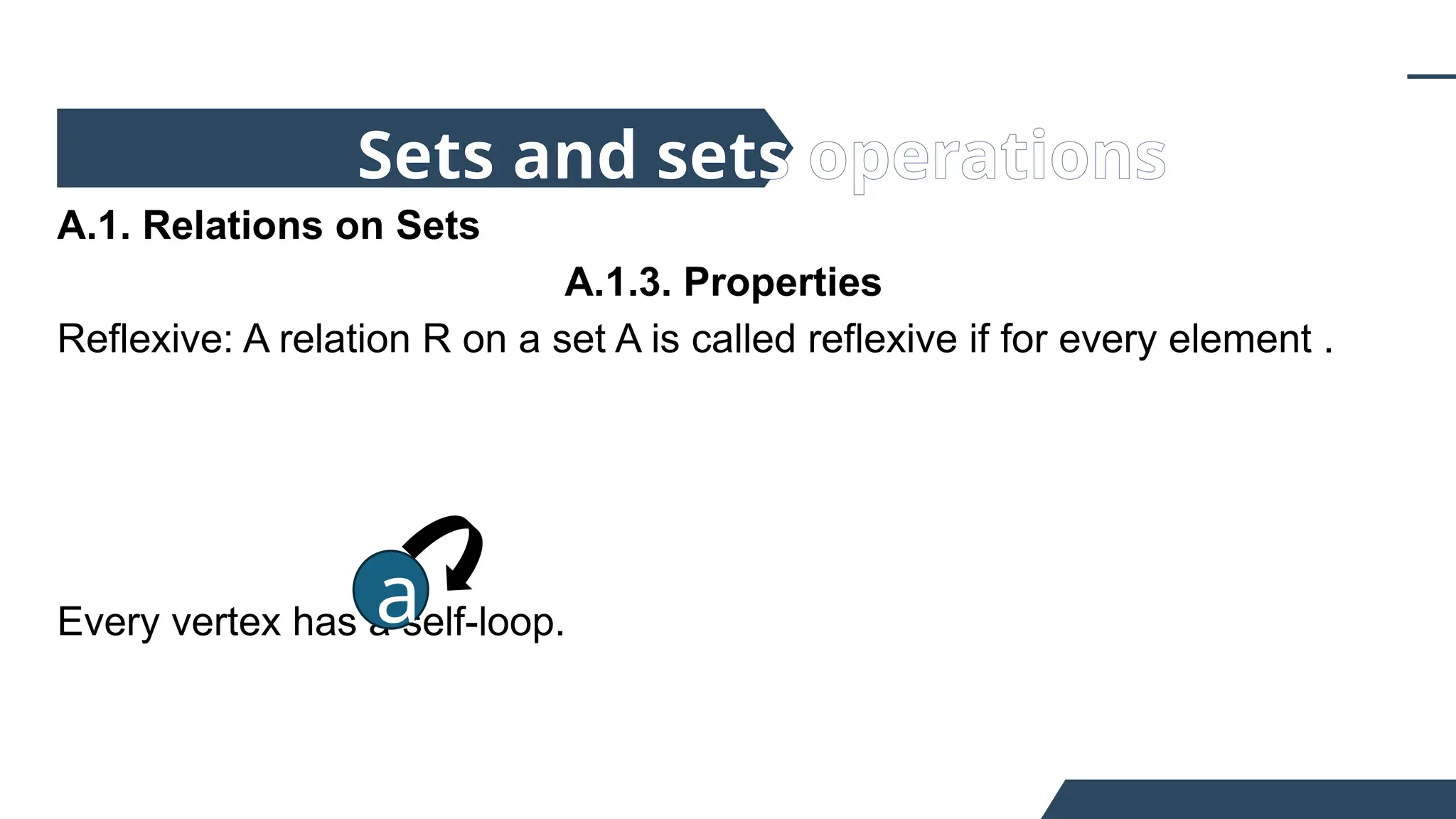
Reflexive: A relation R on a set A is called reflexive if for every element .
Every vertex has a self-loop.
Sets and sets operations
a
9.
A.1. Relations onSets
A.1.3. Properties
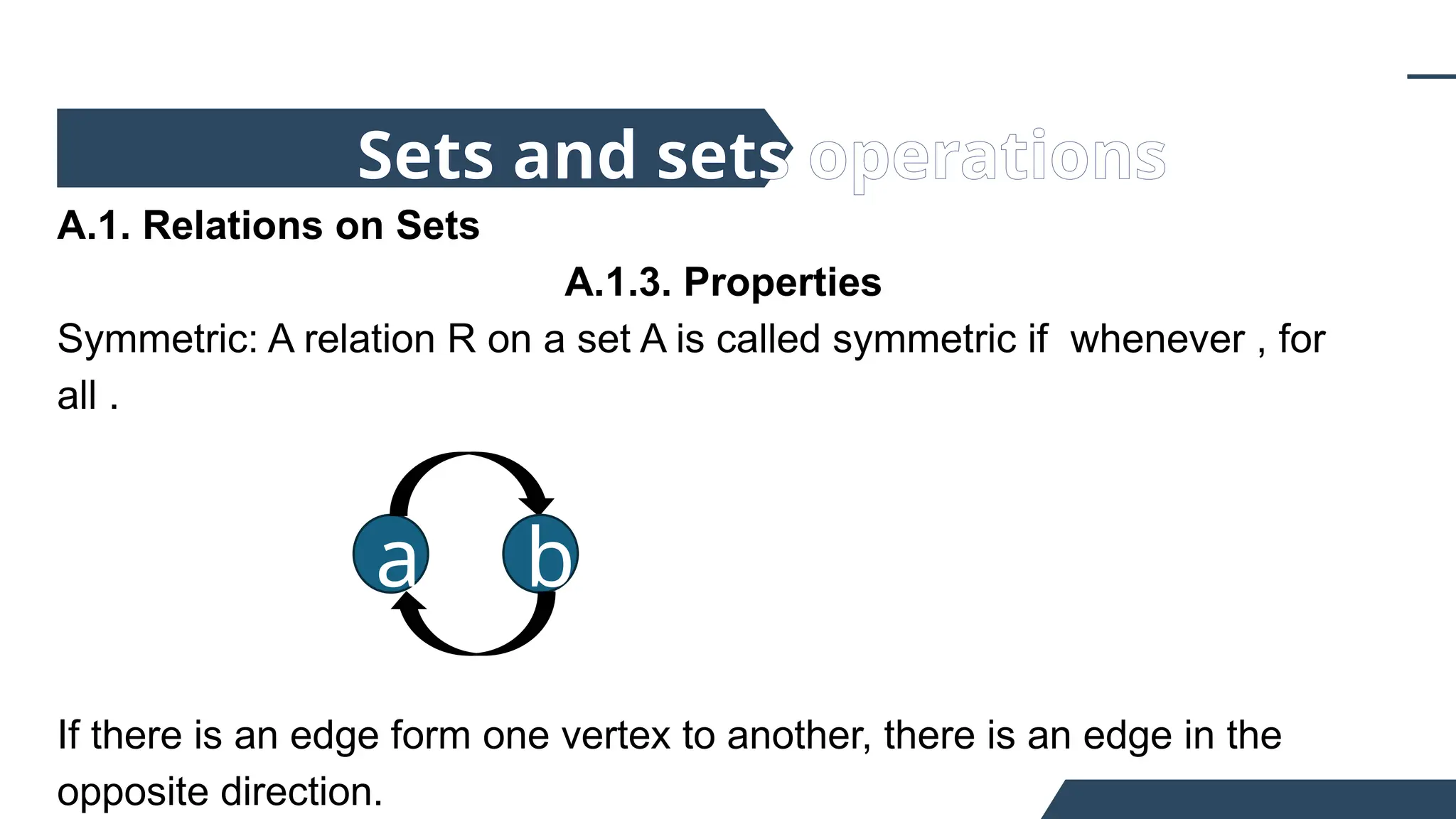
Symmetric: A relation R on a set A is called symmetric if whenever , for
all .
If there is an edge form one vertex to another, there is an edge in the
opposite direction.
Sets and sets operations
a b
10.
A.1. Relations onSets
A.1.3. Properties
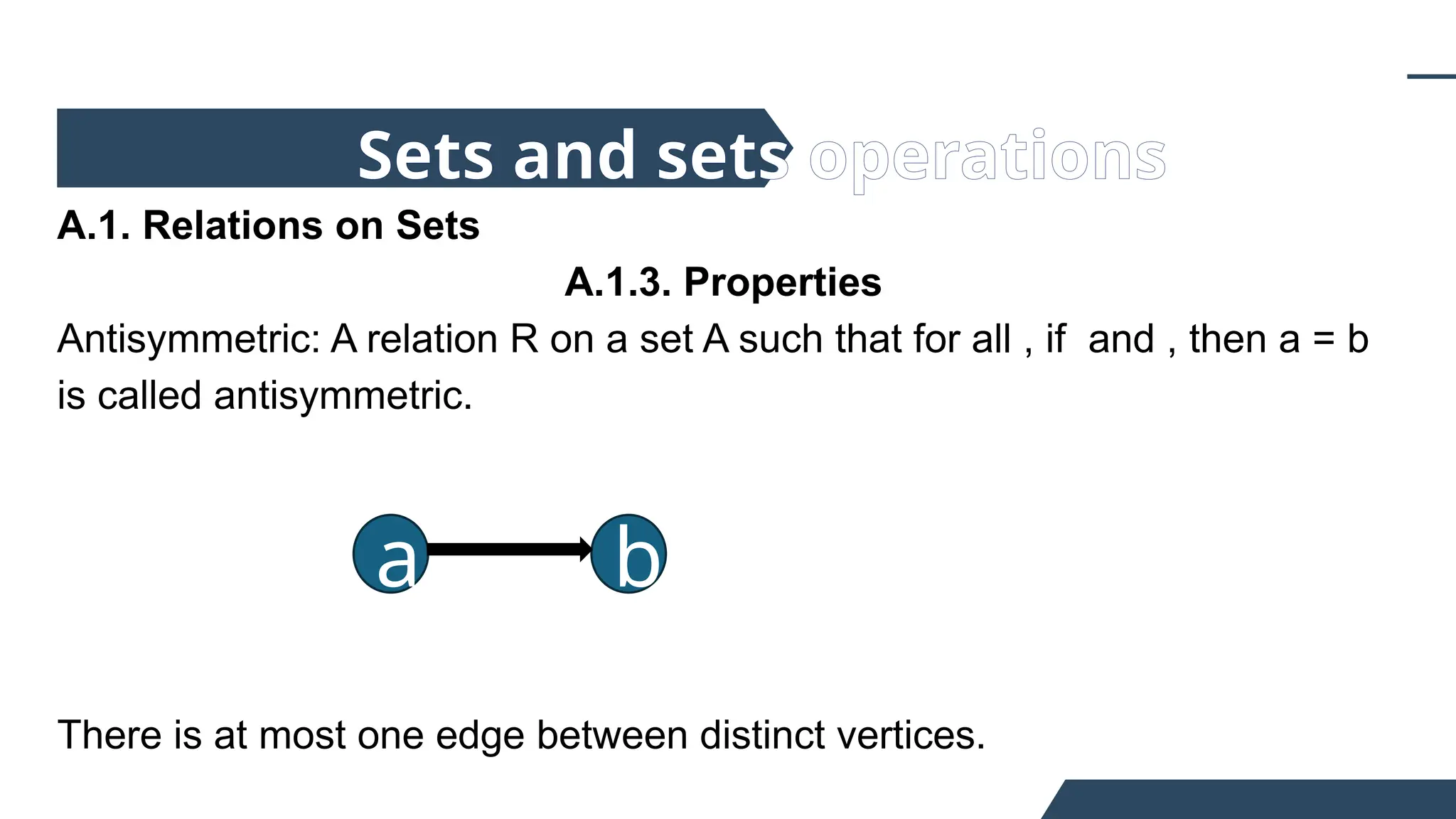
Antisymmetric: A relation R on a set A such that for all , if and , then a = b
is called antisymmetric.
There is at most one edge between distinct vertices.
Sets and sets operations
a b
11.
A.1. Relations onSets
A.1.3. Properties
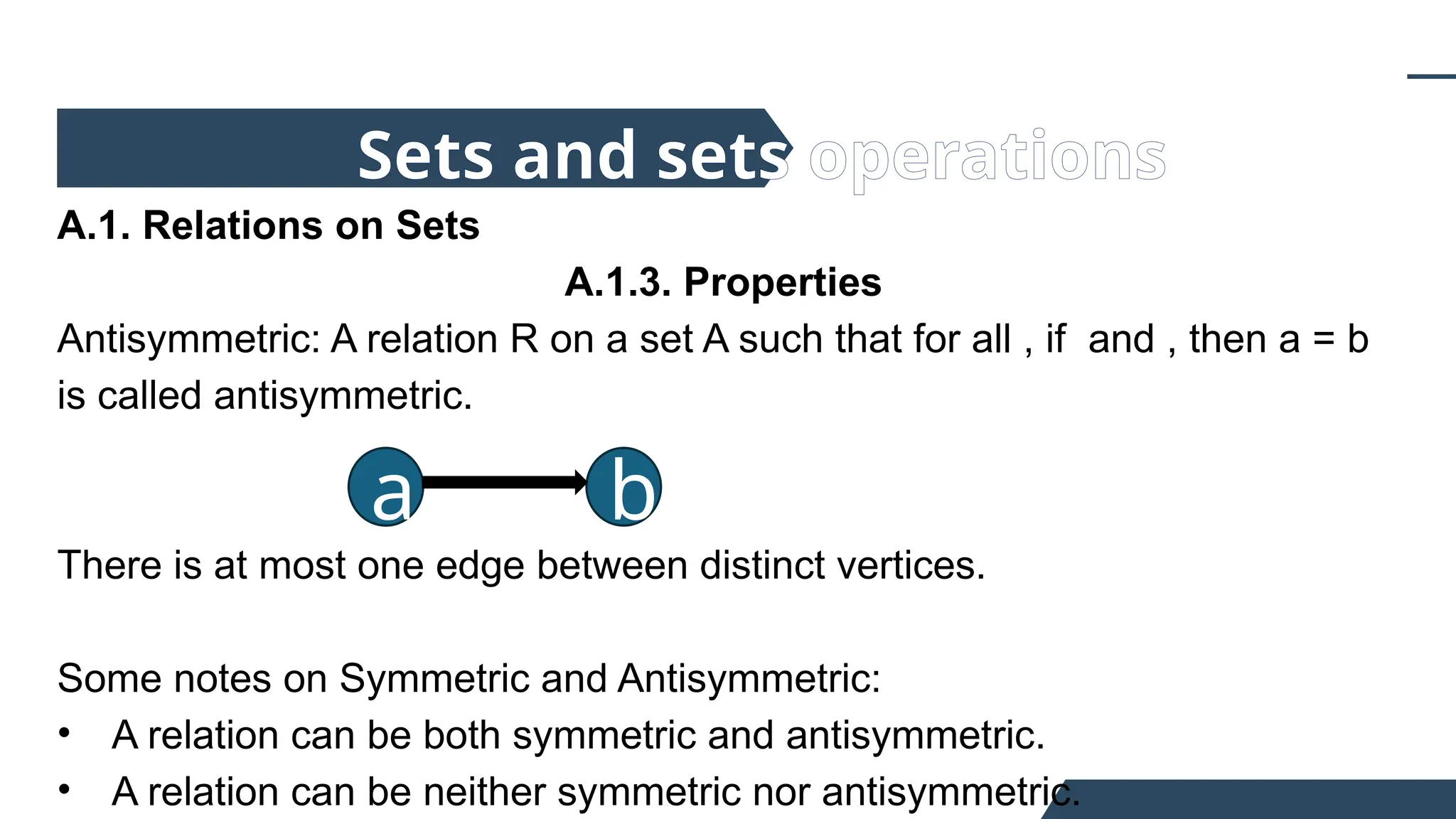
Antisymmetric: A relation R on a set A such that for all , if and , then a = b
is called antisymmetric.
There is at most one edge between distinct vertices.
Some notes on Symmetric and Antisymmetric:
• A relation can be both symmetric and antisymmetric.
• A relation can be neither symmetric nor antisymmetric.
Sets and sets operations
a b
12.
A.1. Relations onSets
A.1.3. Properties
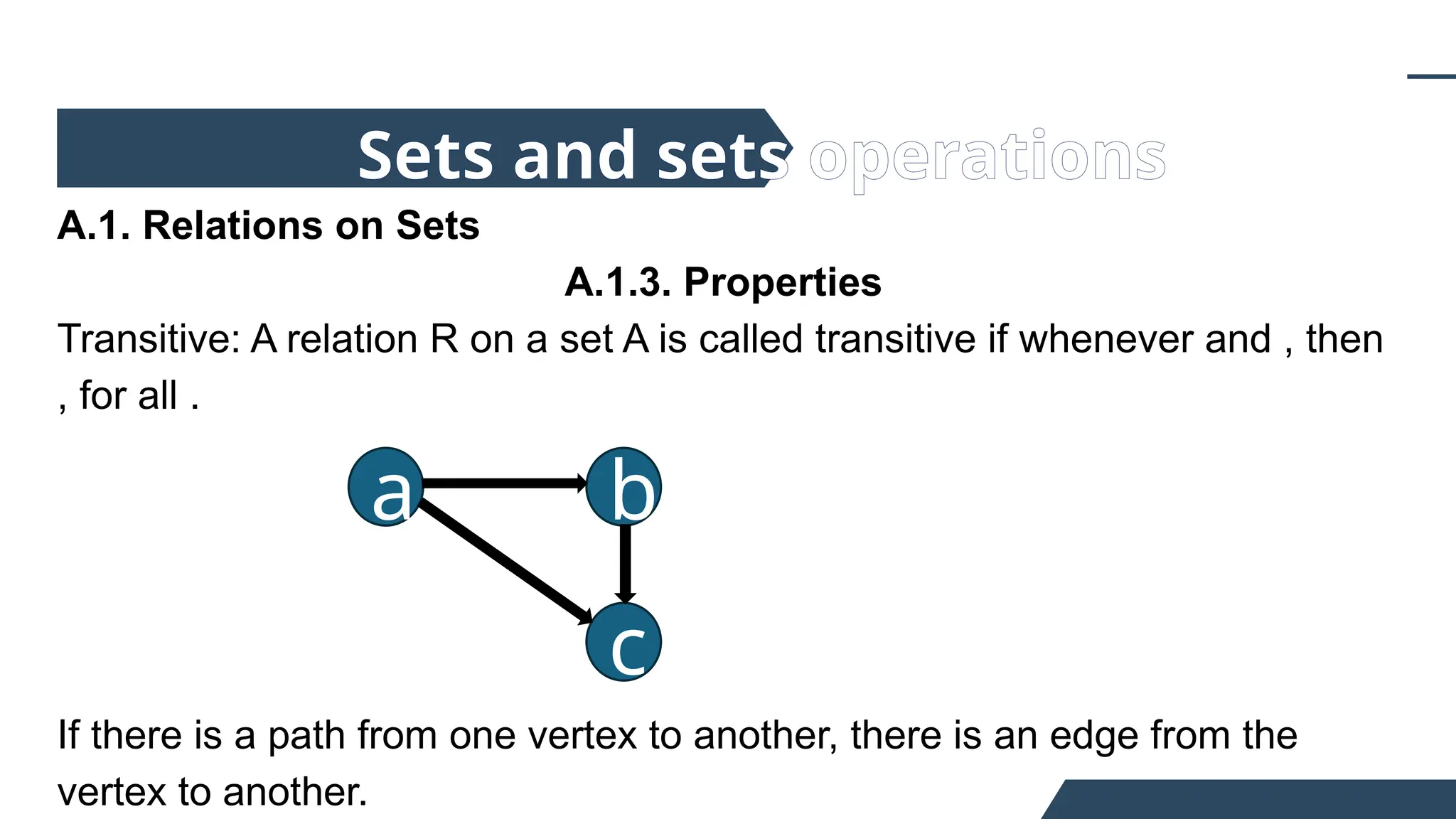
Transitive: A relation R on a set A is called transitive if whenever and , then
, for all .
If there is a path from one vertex to another, there is an edge from the
vertex to another.
Sets and sets operations
a b
c
13.
B. Operations onSets
1. Complement of the Set
-The complement of a set A is the set of all elements in the universal set
U, but not in A.
Sets and sets operations
“the complement of A” or “ A
complement”
14.
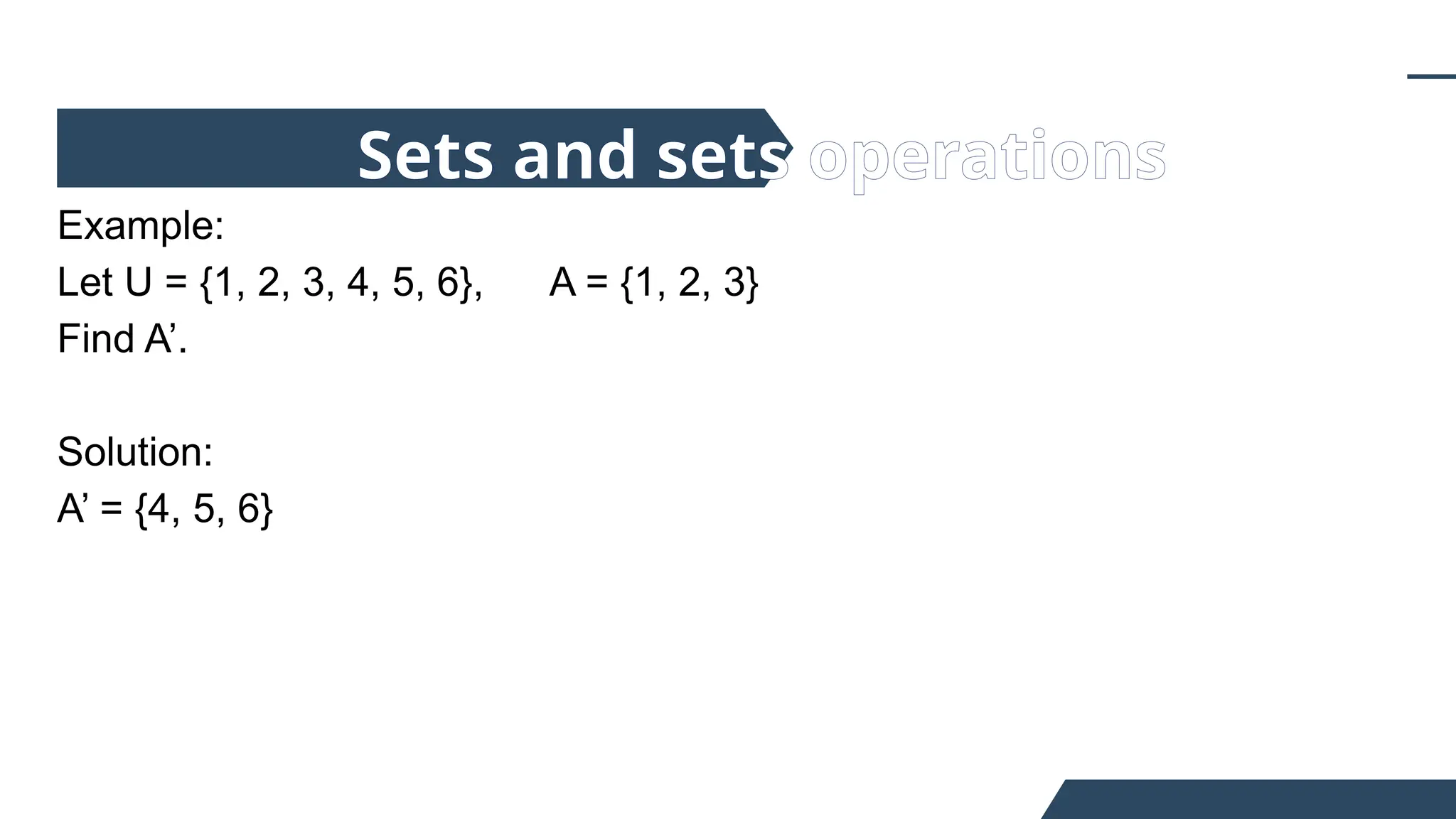
Example:
Let U ={1, 2, 3, 4, 5, 6}, A = {1, 2, 3}
Find A’.
Solution:
A’ = {4, 5, 6}
Sets and sets operations
15.
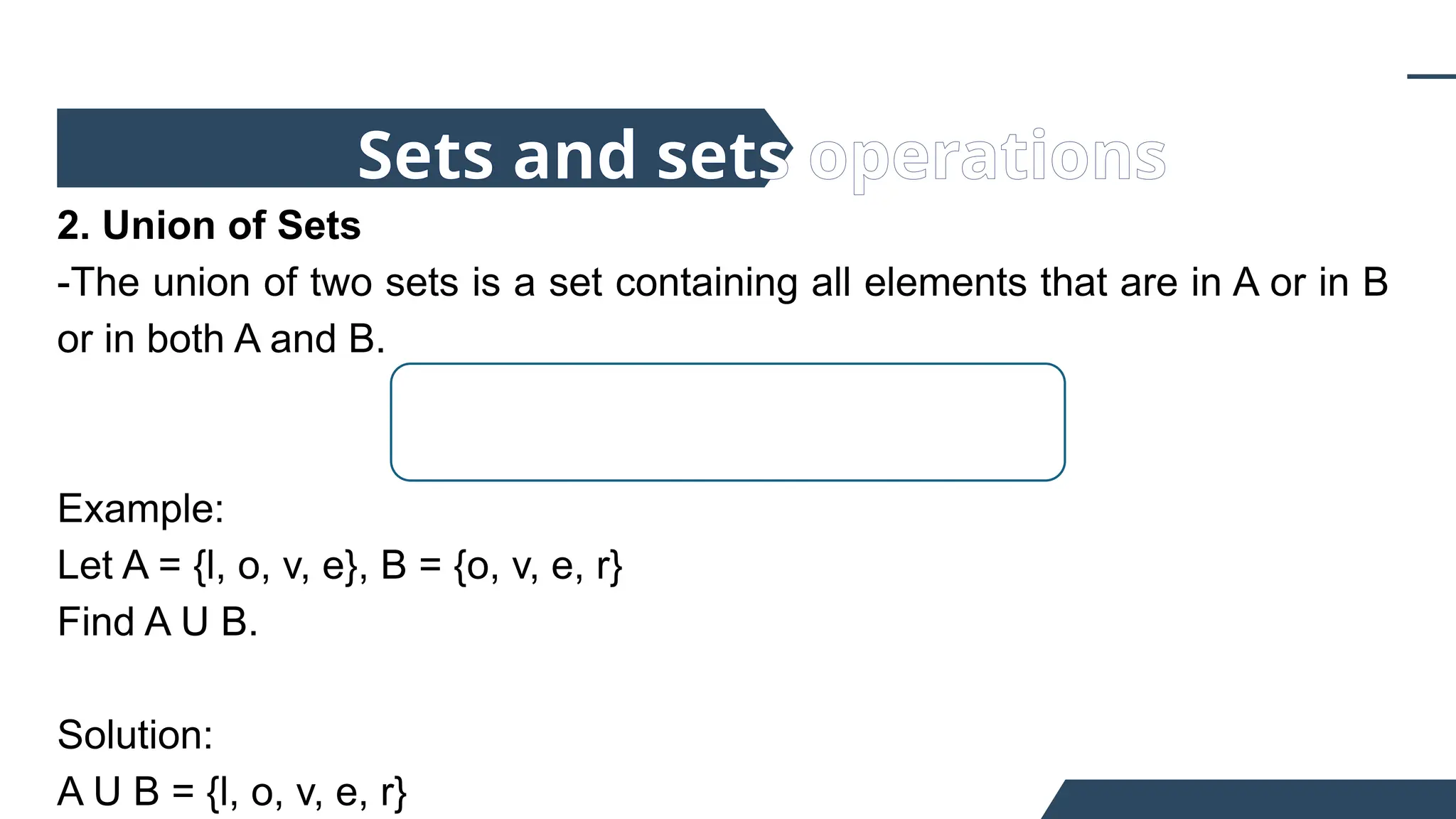
2. Union ofSets
-The union of two sets is a set containing all elements that are in A or in B
or in both A and B.
Example:
Let A = {l, o, v, e}, B = {o, v, e, r}
Find A U B.
Solution:
A U B = {l, o, v, e, r}
Sets and sets operations
16.
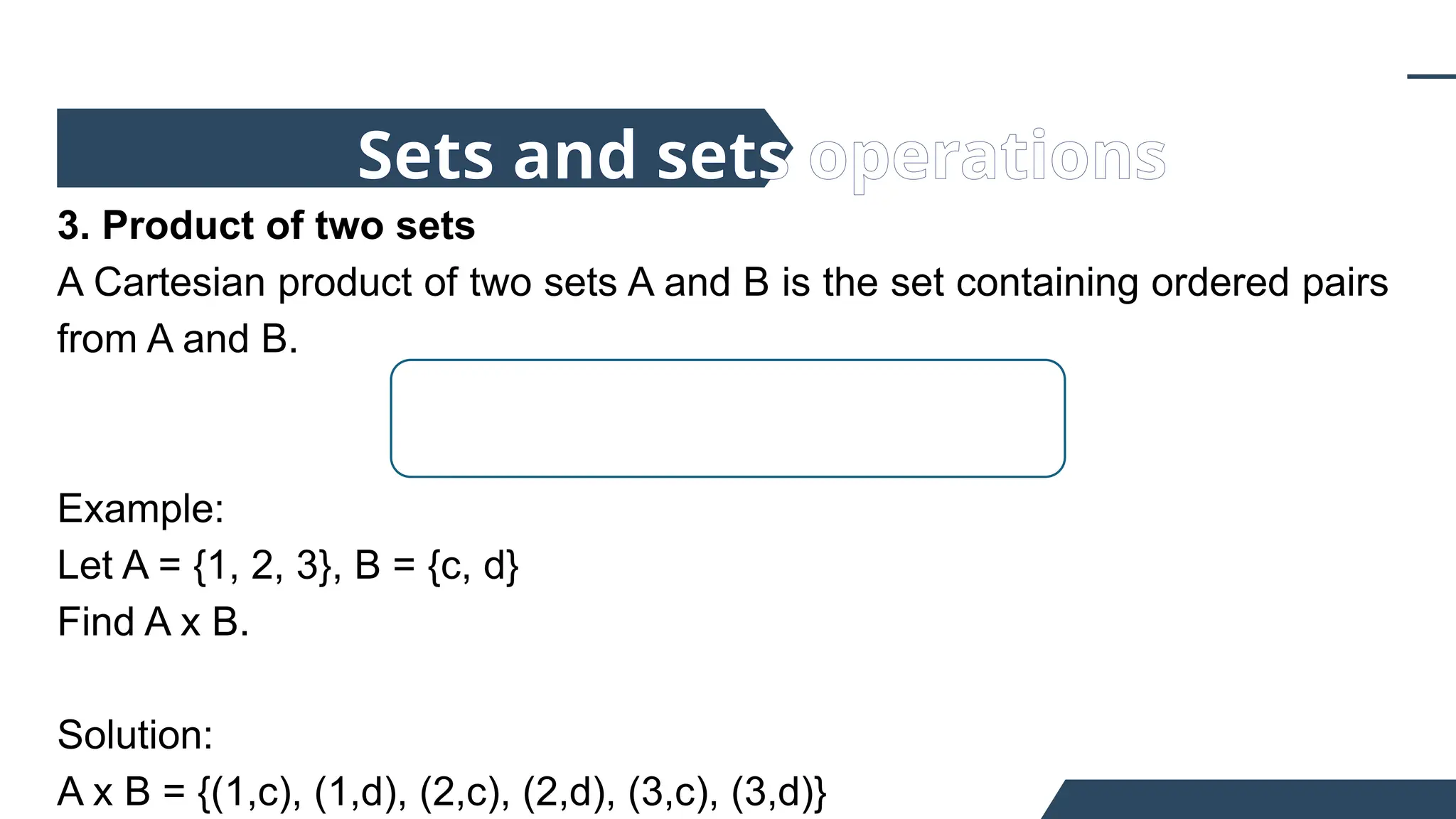
3. Product oftwo sets
A Cartesian product of two sets A and B is the set containing ordered pairs
from A and B.
Example:
Let A = {1, 2, 3}, B = {c, d}
Find A x B.
Solution:
A x B = {(1,c), (1,d), (2,c), (2,d), (3,c), (3,d)}
Sets and sets operations
17.
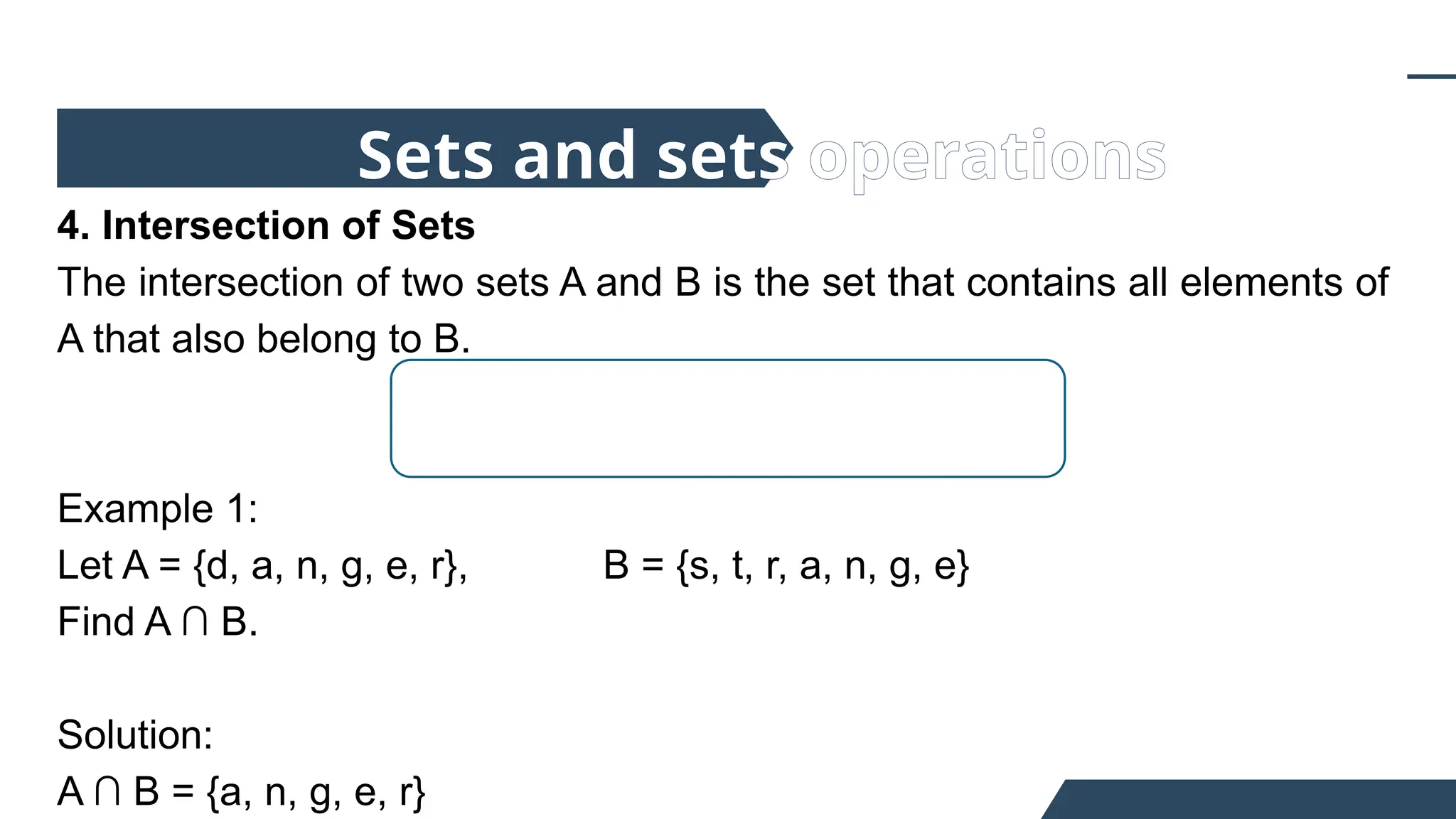
4. Intersection ofSets
The intersection of two sets A and B is the set that contains all elements of
A that also belong to B.
Example 1:
Let A = {d, a, n, g, e, r}, B = {s, t, r, a, n, g, e}
Find A ∩ B.
Solution:
A ∩ B = {a, n, g, e, r}
Sets and sets operations
18.
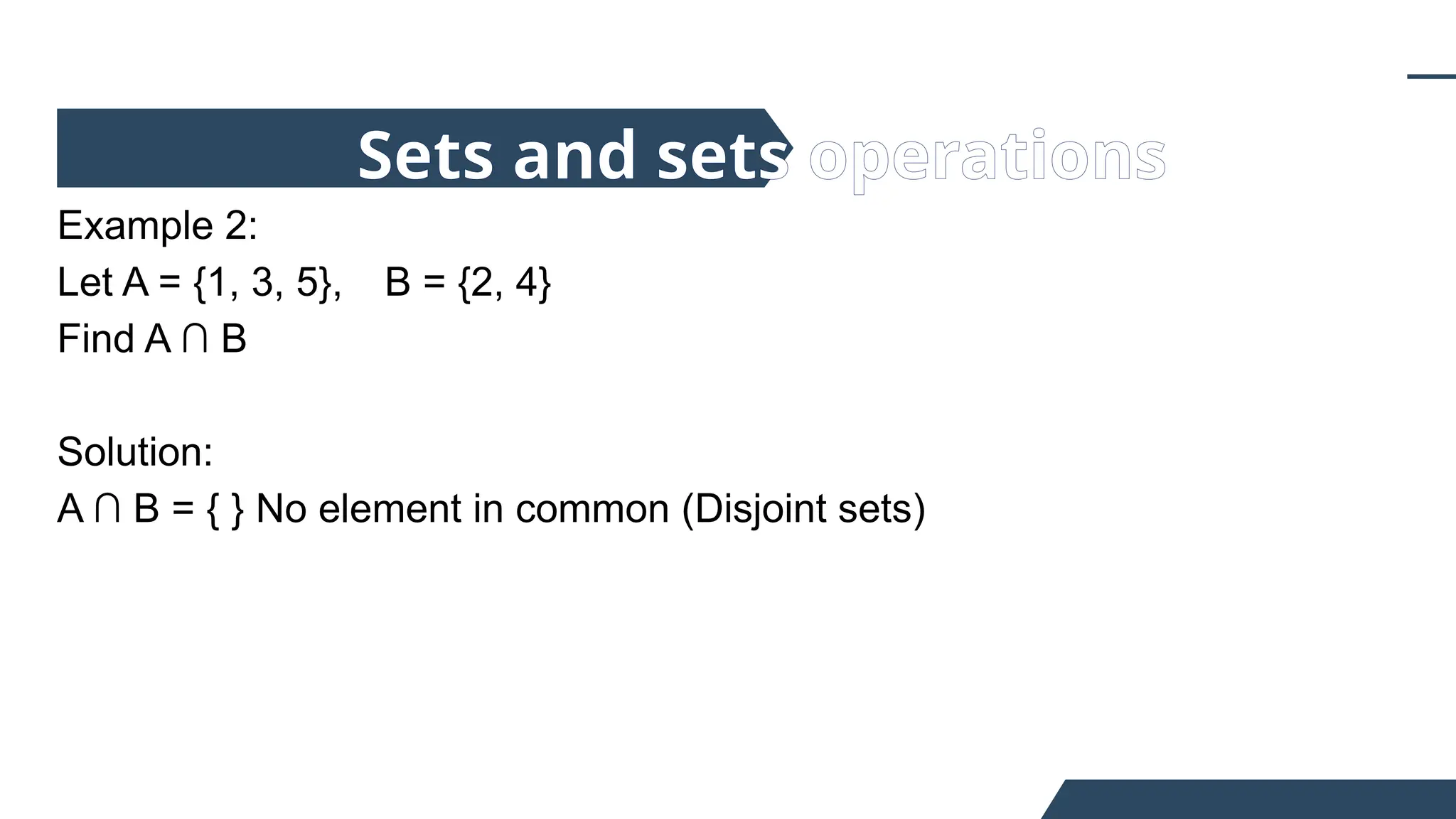
Example 2:
Let A= {1, 3, 5}, B = {2, 4}
Find A ∩ B
Solution:
A ∩ B = { } No element in common (Disjoint sets)
Sets and sets operations
19.
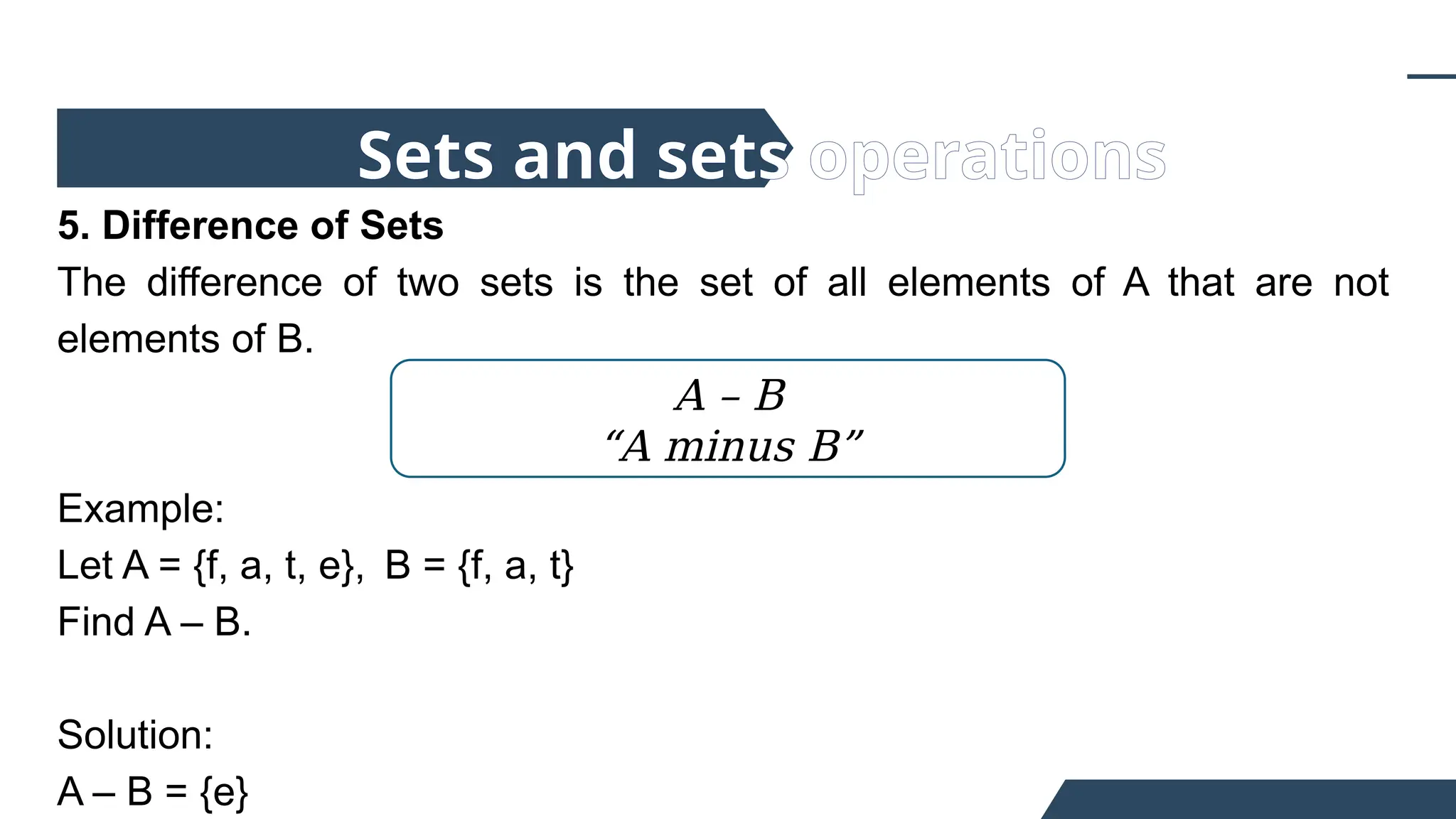
5. Difference ofSets
The difference of two sets is the set of all elements of A that are not
elements of B.
Example:
Let A = {f, a, t, e}, B = {f, a, t}
Find A – B.
Solution:
A – B = {e}
Sets and sets operations
A – B
“A minus B”
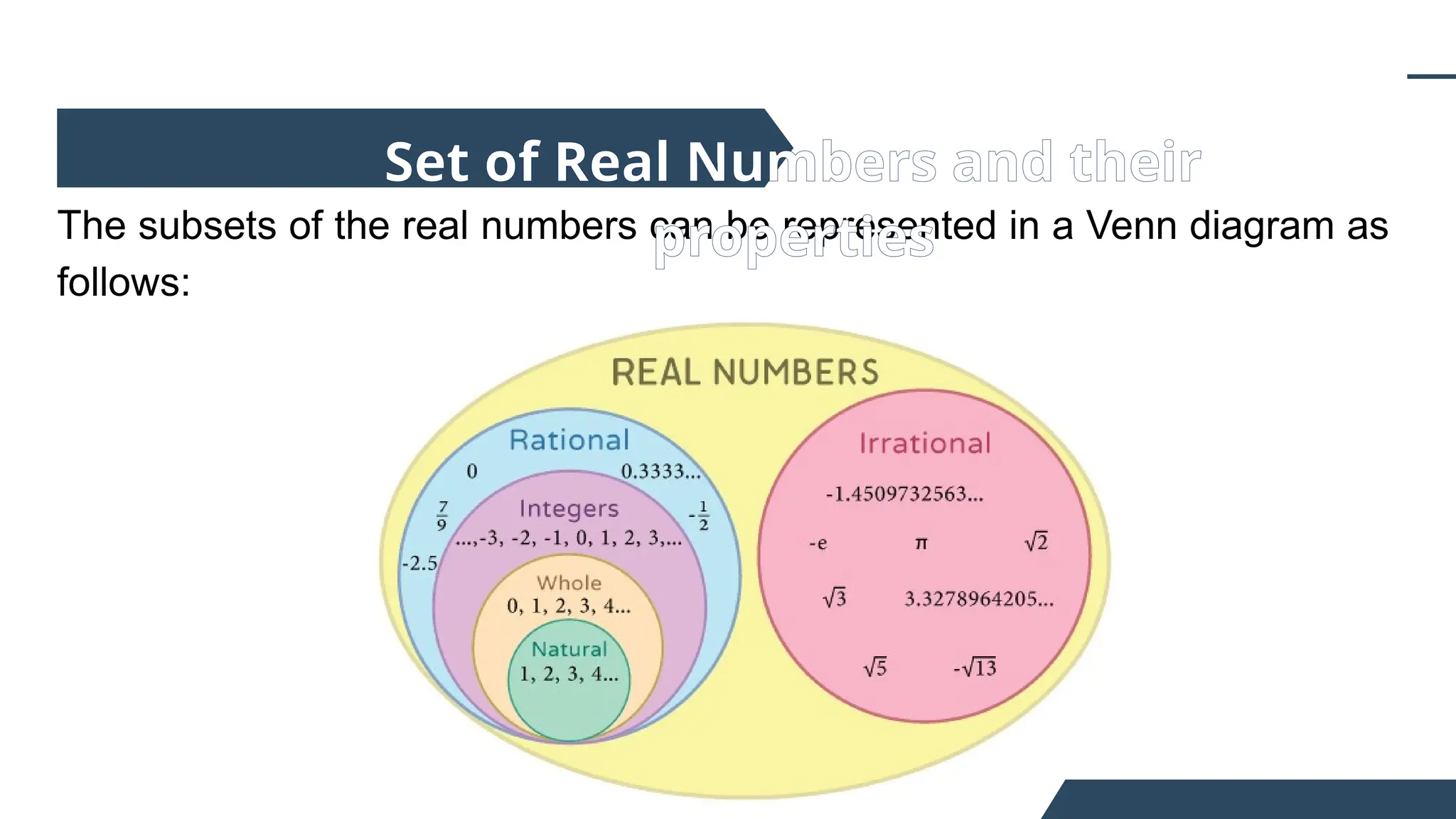
The subsets ofthe real numbers can be represented in a Venn diagram as
follows:
Set of Real Numbers and their
properties
24.
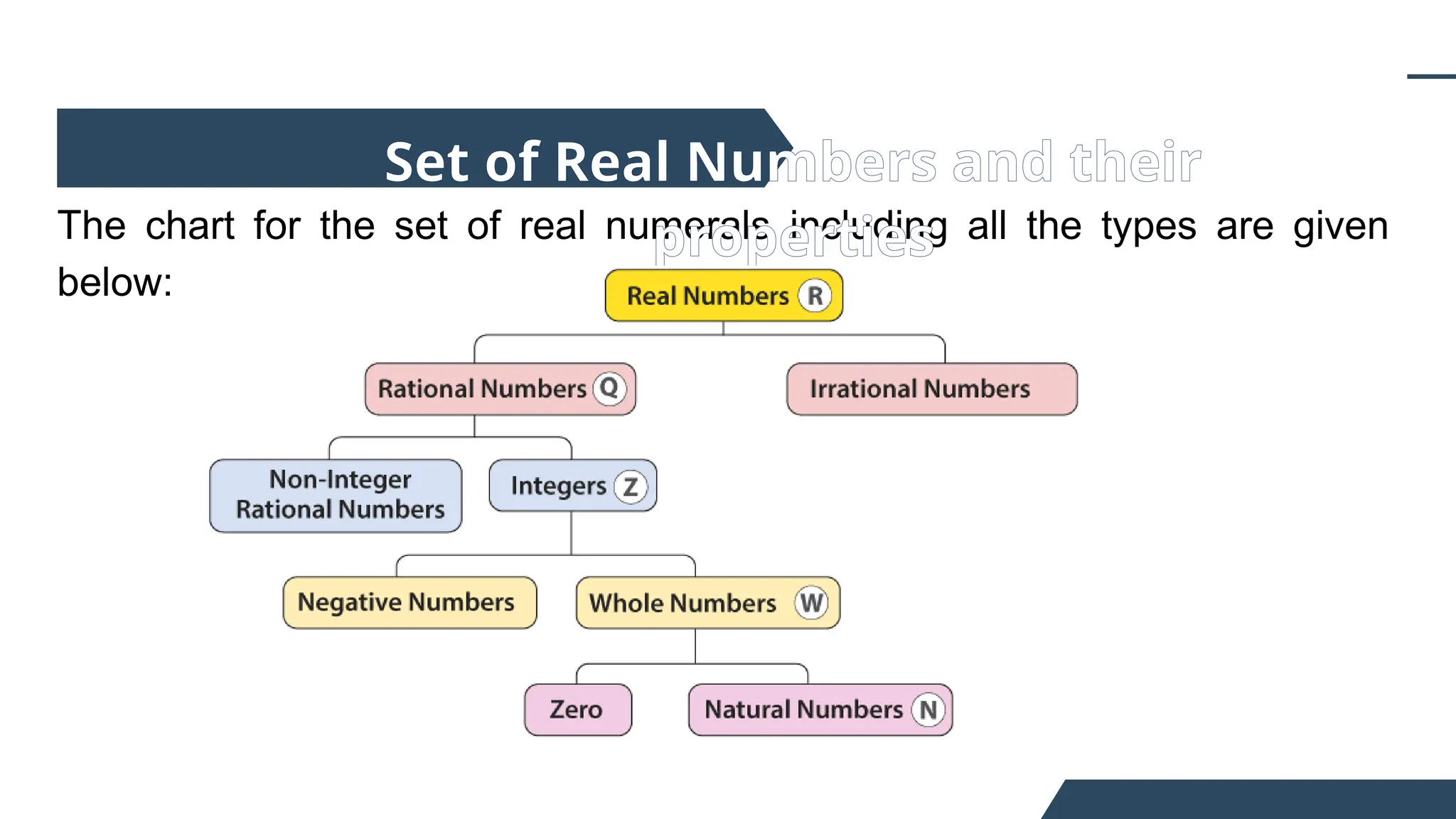
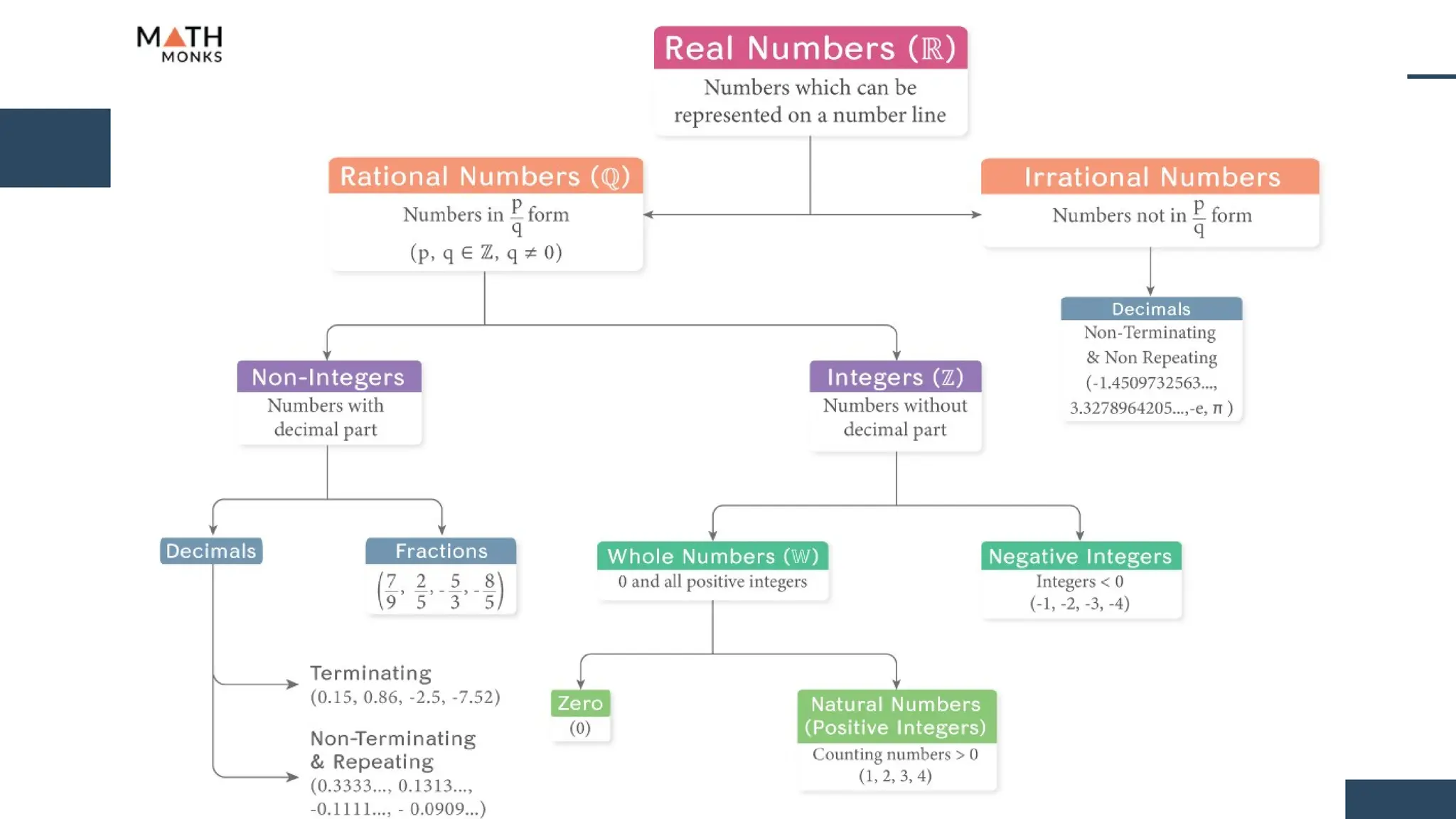
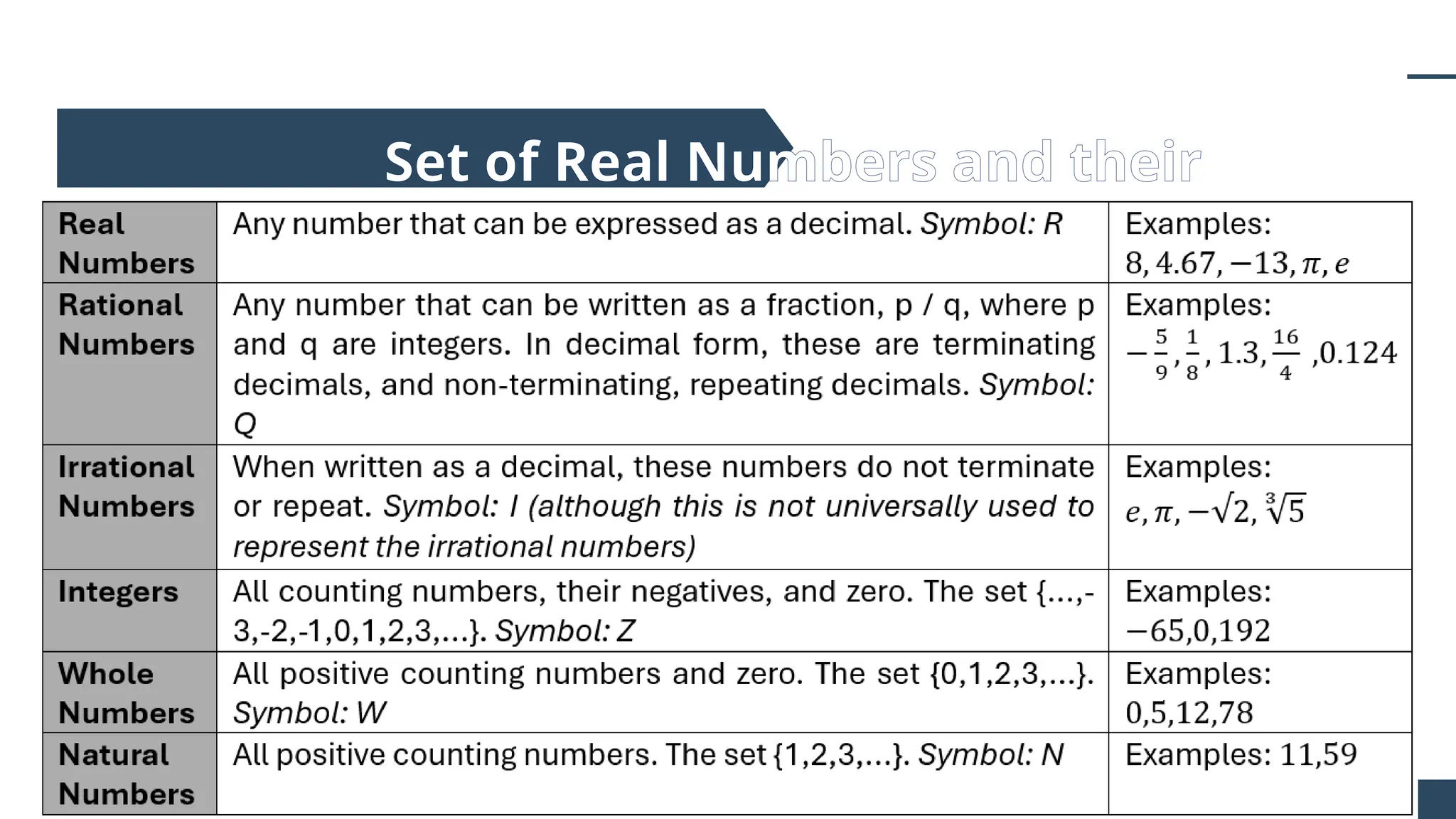
The chart forthe set of real numerals including all the types are given
below:
Set of Real Numbers and their
properties
25.
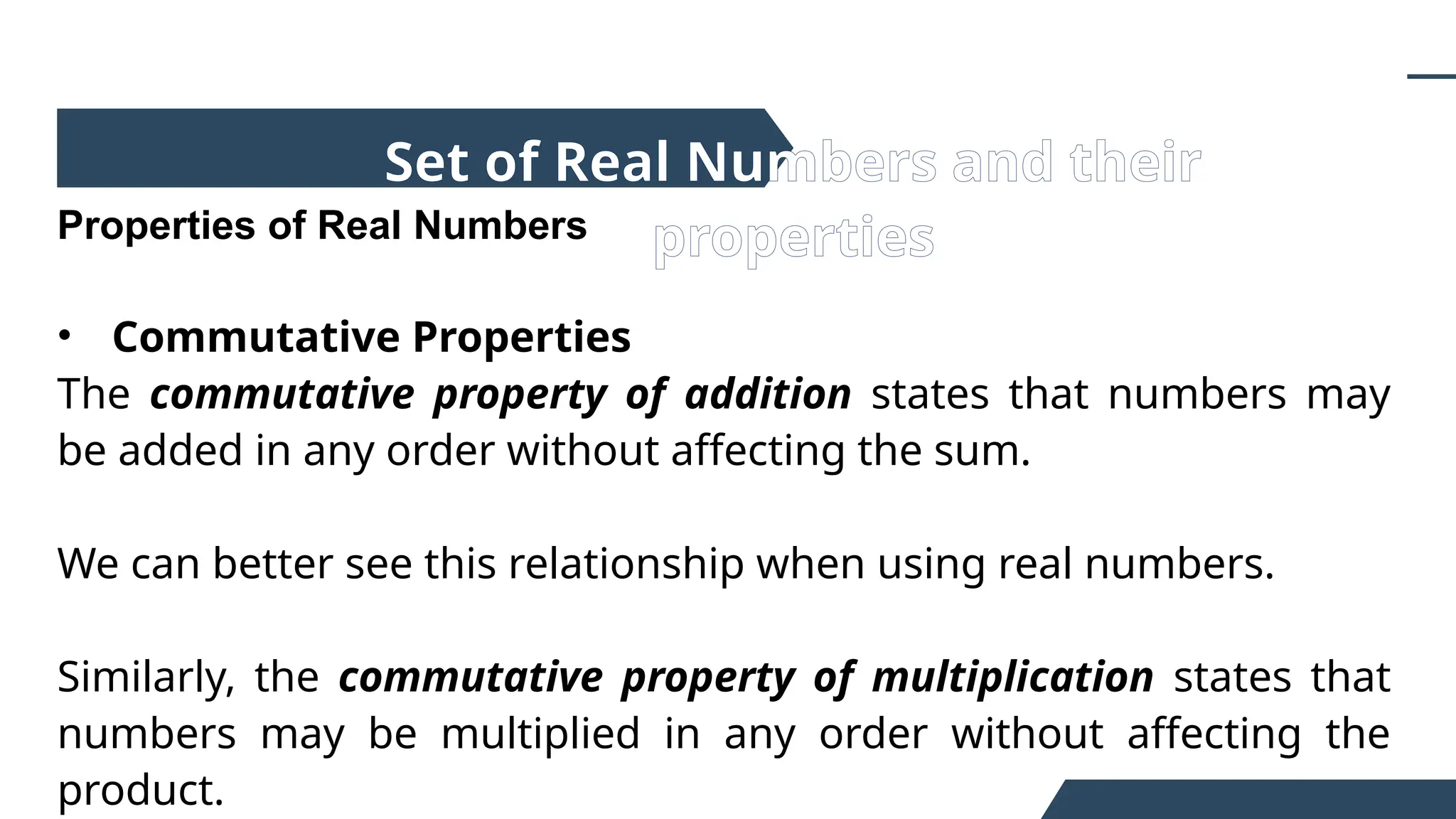
Properties of RealNumbers
• Commutative Properties
The commutative property of addition states that numbers may
be added in any order without affecting the sum.
We can better see this relationship when using real numbers.
Similarly, the commutative property of multiplication states that
numbers may be multiplied in any order without affecting the
product.
Set of Real Numbers and their
properties
26.
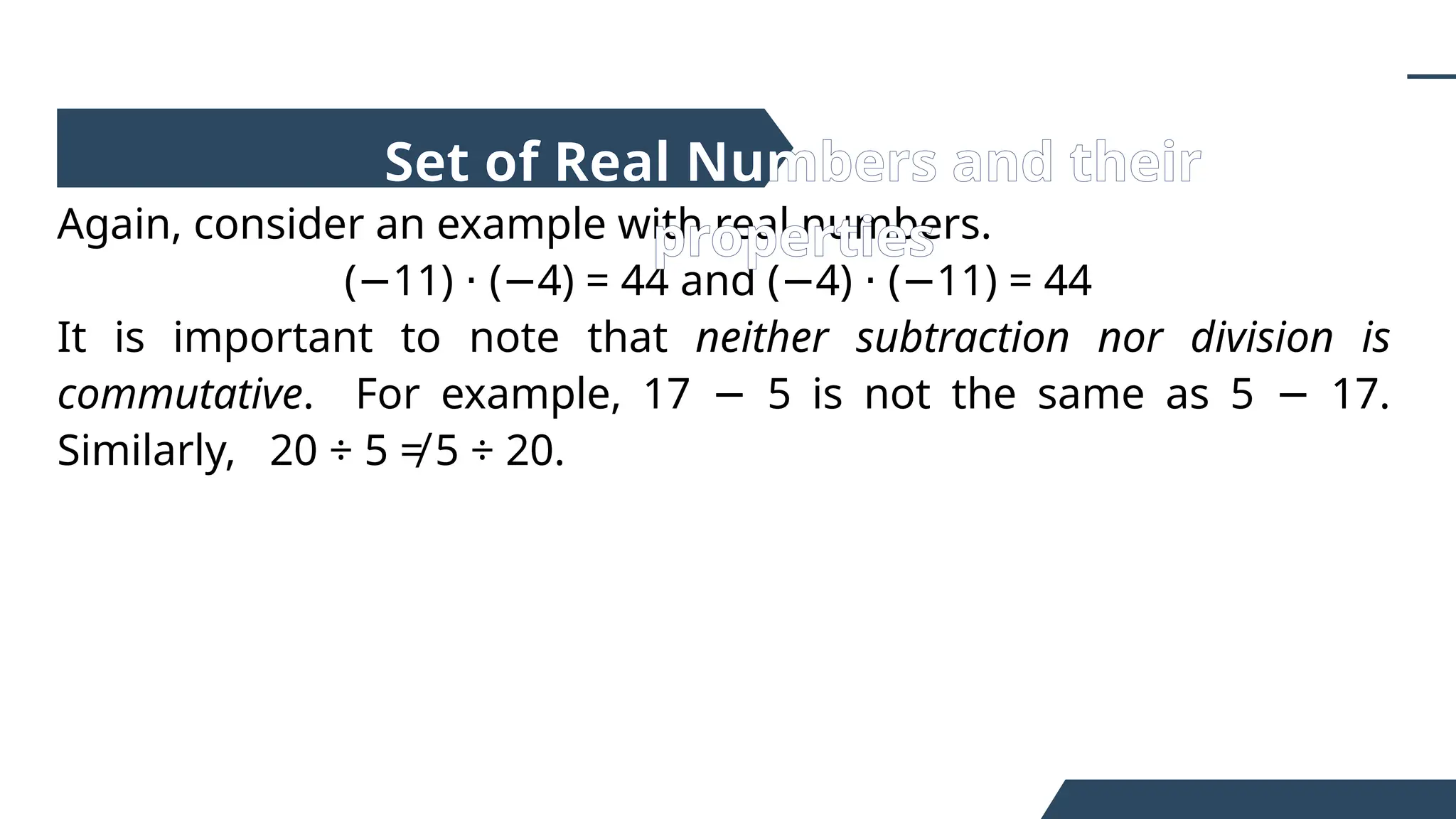
Again, consider anexample with real numbers.
( 11) ( 4) = 44 and ( 4) ( 11) = 44
− ⋅ − − ⋅ −
It is important to note that neither subtraction nor division is
commutative. For example, 17 5 is not the same as 5 17.
− −
Similarly, 20 ÷ 5 ≠ 5 ÷ 20.
Set of Real Numbers and their
properties
27.
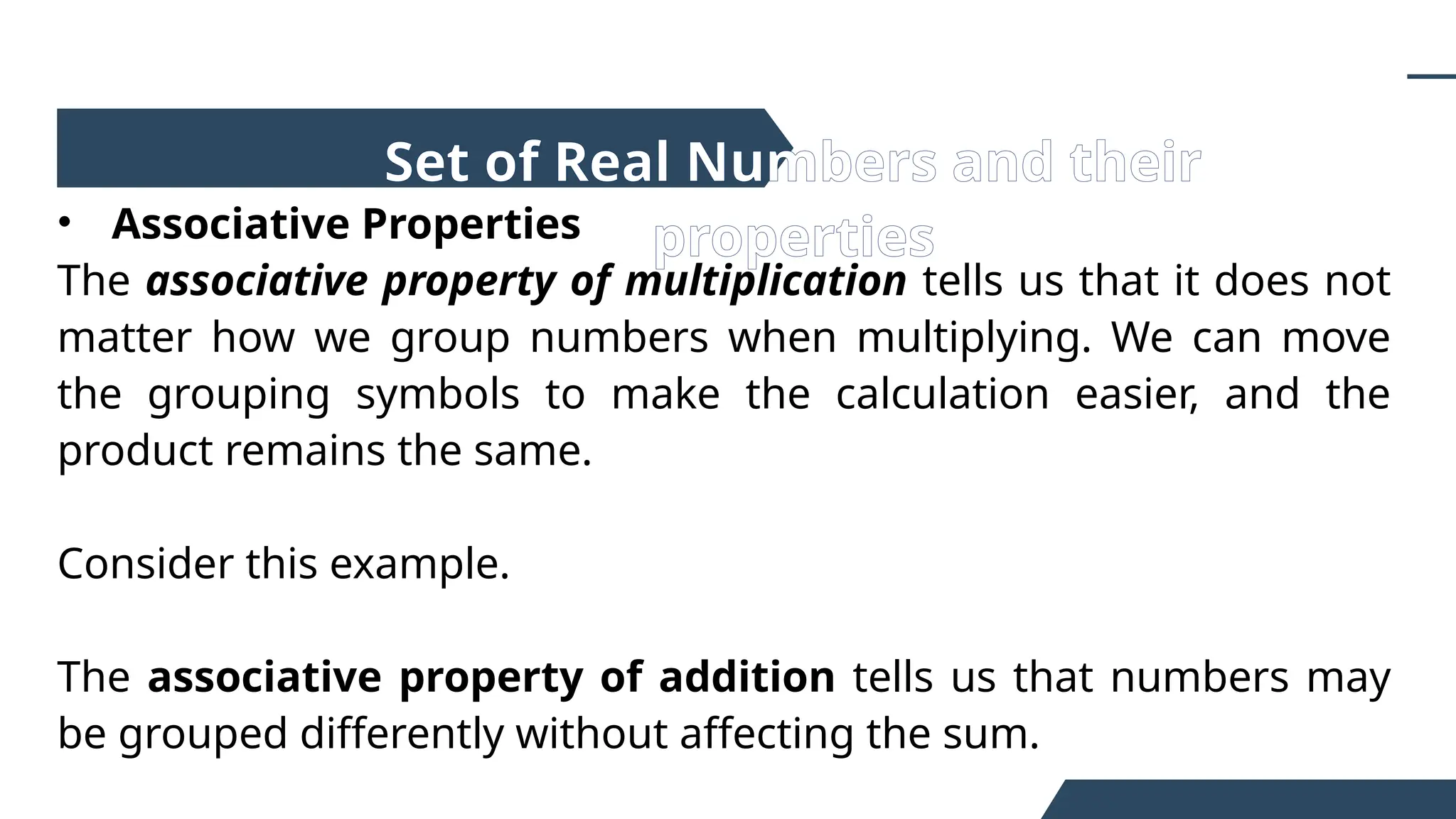
• Associative Properties
Theassociative property of multiplication tells us that it does not
matter how we group numbers when multiplying. We can move
the grouping symbols to make the calculation easier, and the
product remains the same.
Consider this example.
The associative property of addition tells us that numbers may
be grouped differently without affecting the sum.
Set of Real Numbers and their
properties
28.
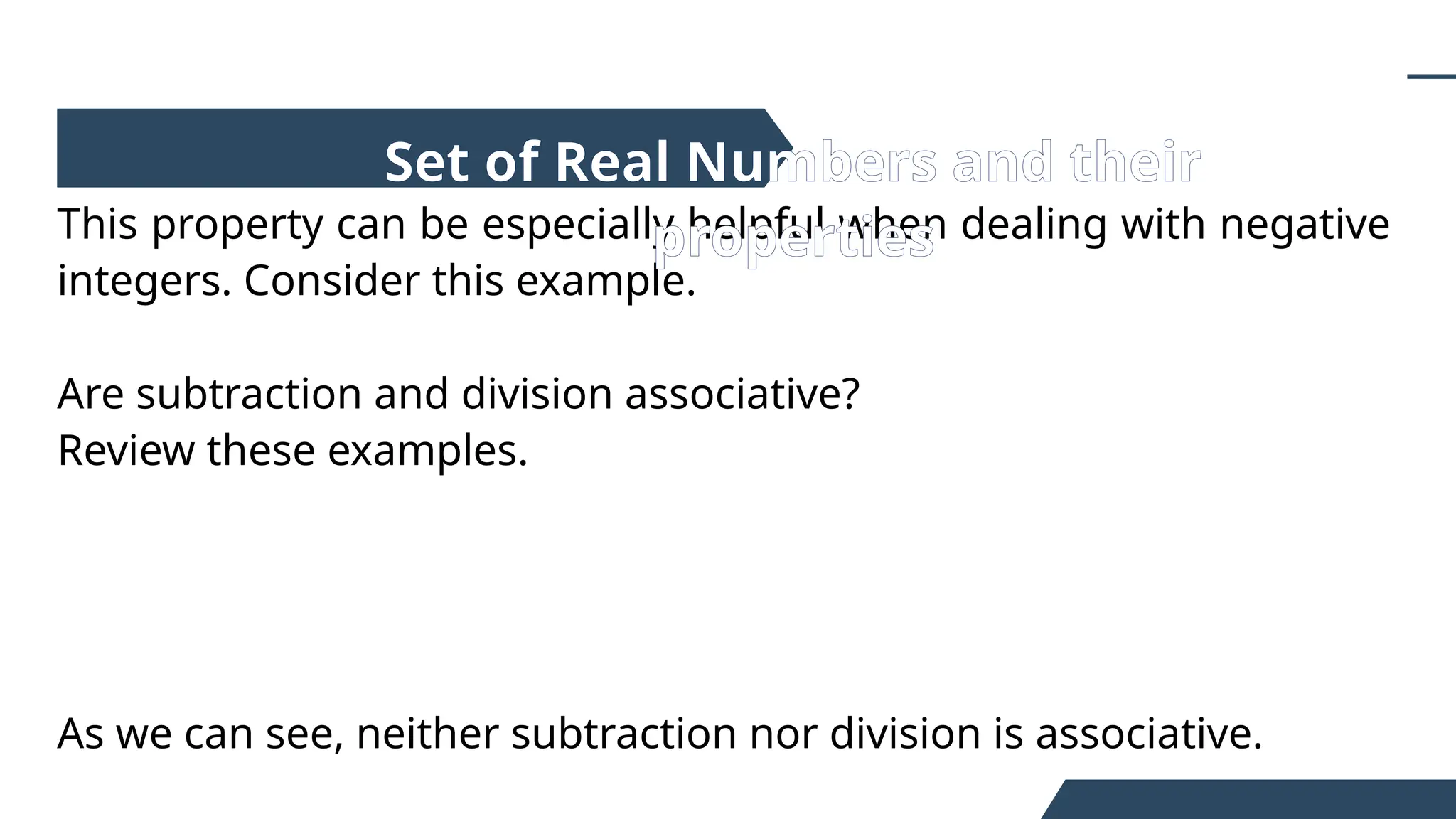
This property canbe especially helpful when dealing with negative
integers. Consider this example.
Are subtraction and division associative?
Review these examples.
As we can see, neither subtraction nor division is associative.
Set of Real Numbers and their
properties
29.
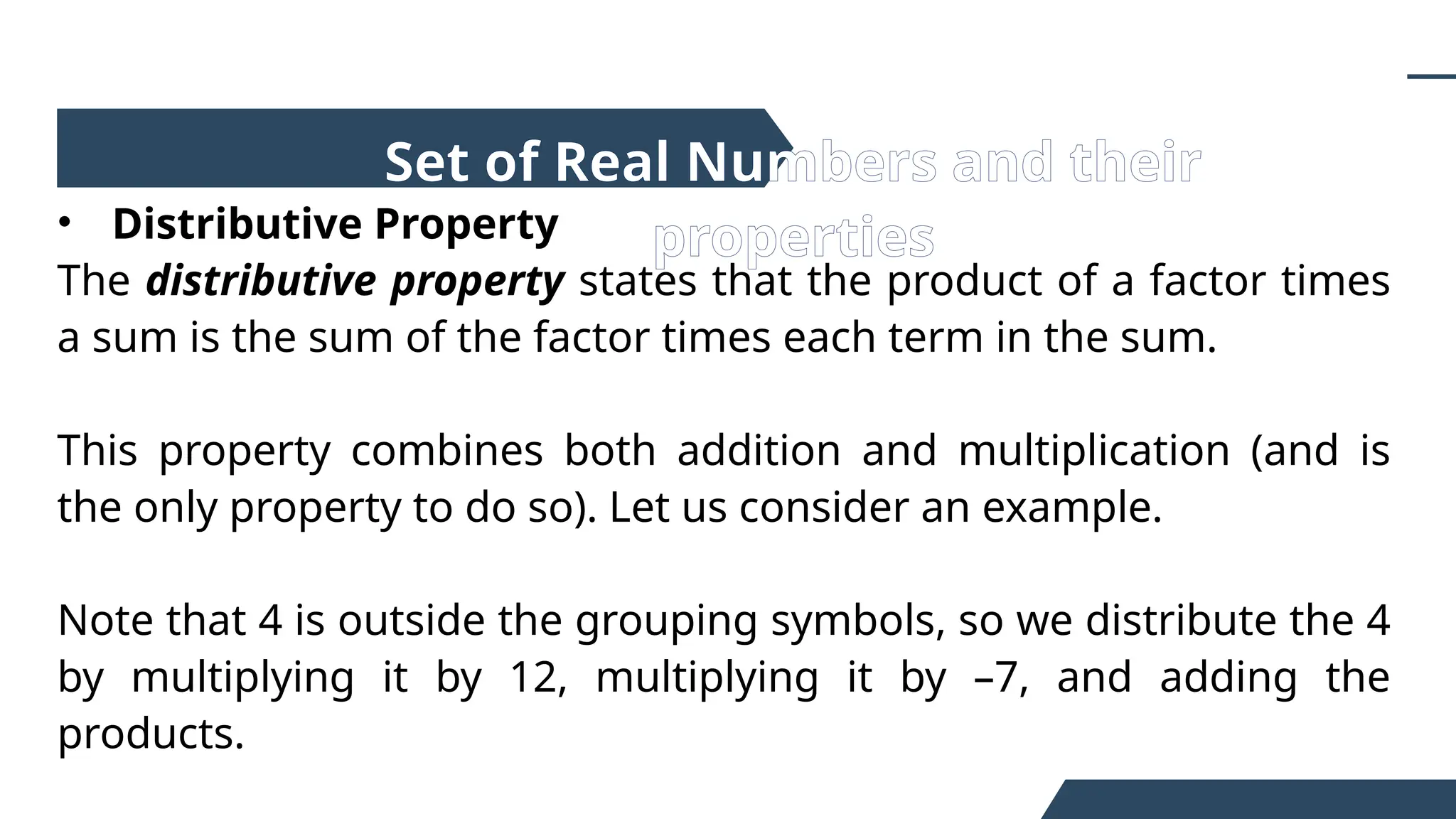
• Distributive Property
Thedistributive property states that the product of a factor times
a sum is the sum of the factor times each term in the sum.
This property combines both addition and multiplication (and is
the only property to do so). Let us consider an example.
Note that 4 is outside the grouping symbols, so we distribute the 4
by multiplying it by 12, multiplying it by –7, and adding the
products.
Set of Real Numbers and their
properties
30.
• Identity Properties
Theidentity property of addition states that there is a unique
number, called the additive identity (0) that, when added to a
number, results in the original number.
The identity property of multiplication states that there is a
unique number, called the multiplicative identity (1) that, when
multiplied by a number, results in the original number.
Set of Real Numbers and their
properties
31.
• Inverse Properties
Theinverse property of addition states that, for every real number
a, there is a unique number, called the additive inverse (or
opposite), denoted a, that, when added to the original number,
−
results in the additive identity, 0.
For example, if a = 8, the additive inverse is 8, since ( 8) + 8 = 0.
− −
Set of Real Numbers and their
properties
32.
The inverse propertyof multiplication holds for all real numbers
except 0 because the reciprocal of 0 is not defined. The property
states that, for every real number a, there is a unique number,
called the multiplicative inverse (or reciprocal), denoted , that,
when multiplied by the original number, results in the
multiplicative identity, 1.
For example, if , the reciprocal, denoted , is because
Set of Real Numbers and their
properties
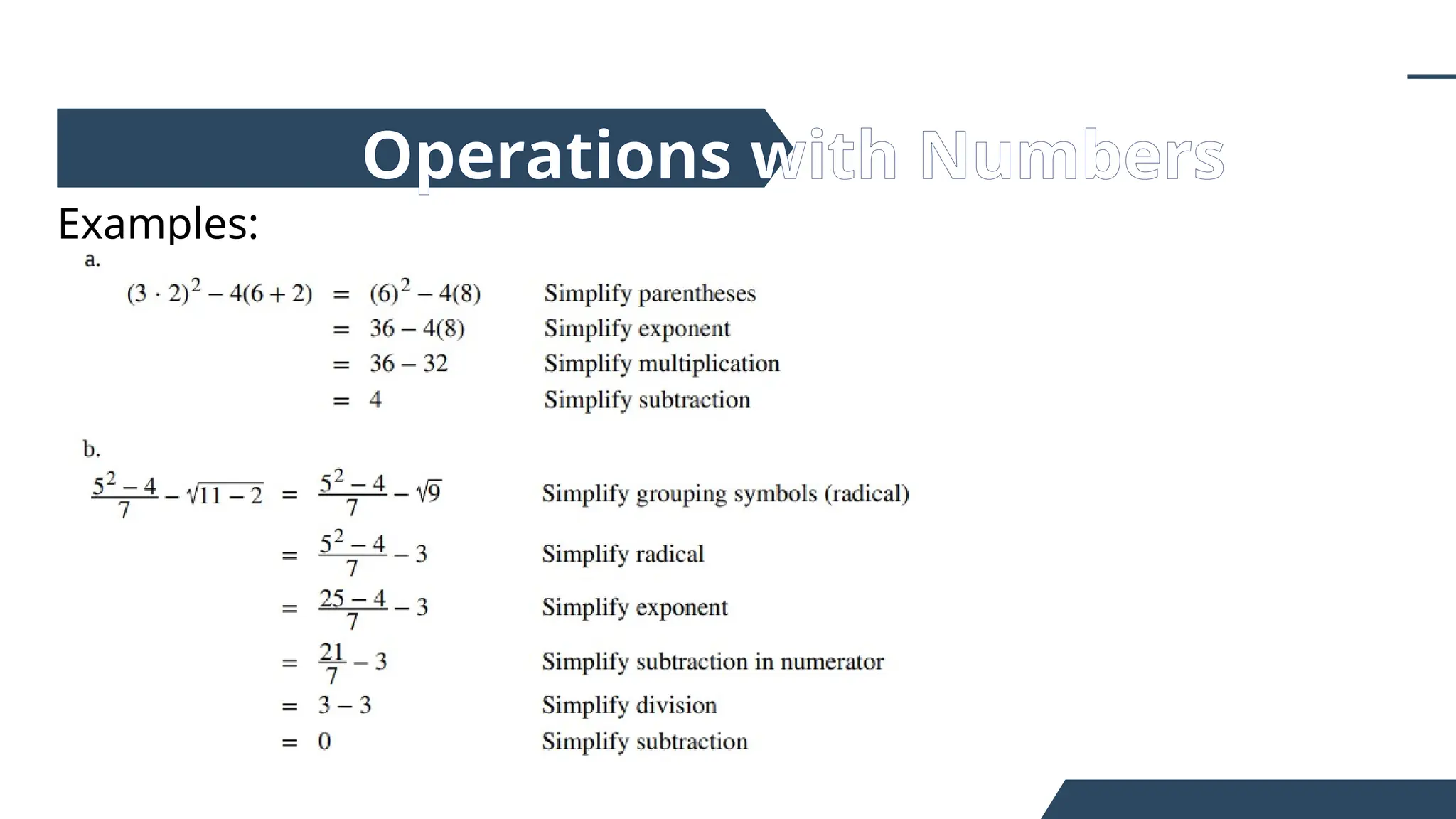
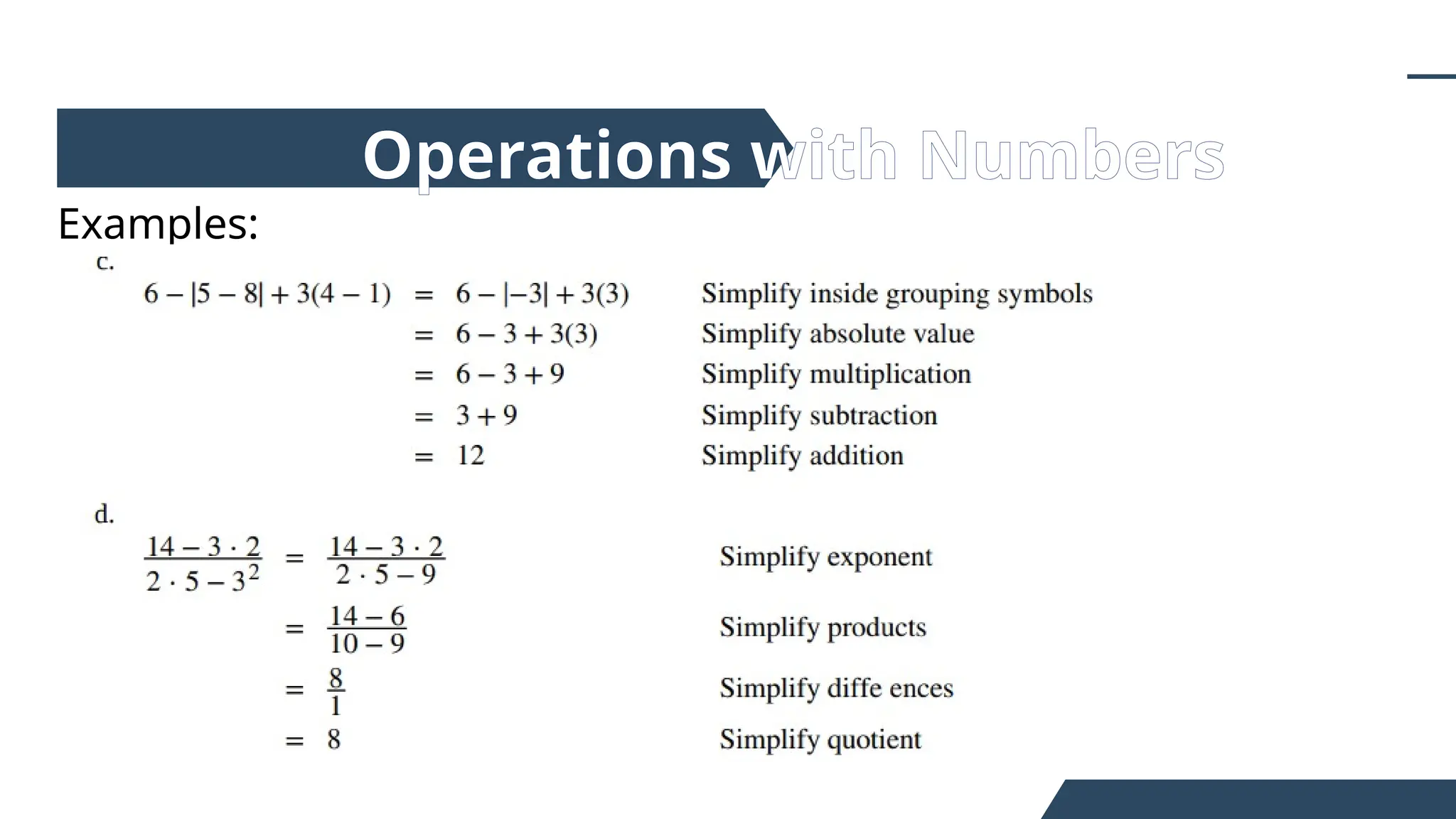
To evaluate amathematical expression, we perform the various
operations. However, we do not perform them in any random order. We
use the order of operations. This is a sequence of rules for evaluating
such expressions.
Recall that in mathematics we use parentheses ( ), brackets [ ], and
braces { } to group numbers and expressions so that anything appearing
within the symbols is treated as a unit. Additionally, fraction bars, radicals,
and absolute value bars are treated as grouping symbols. When
evaluating a mathematical expression, begin by simplifying expressions
within grouping symbols.
Operations with Numbers
35.
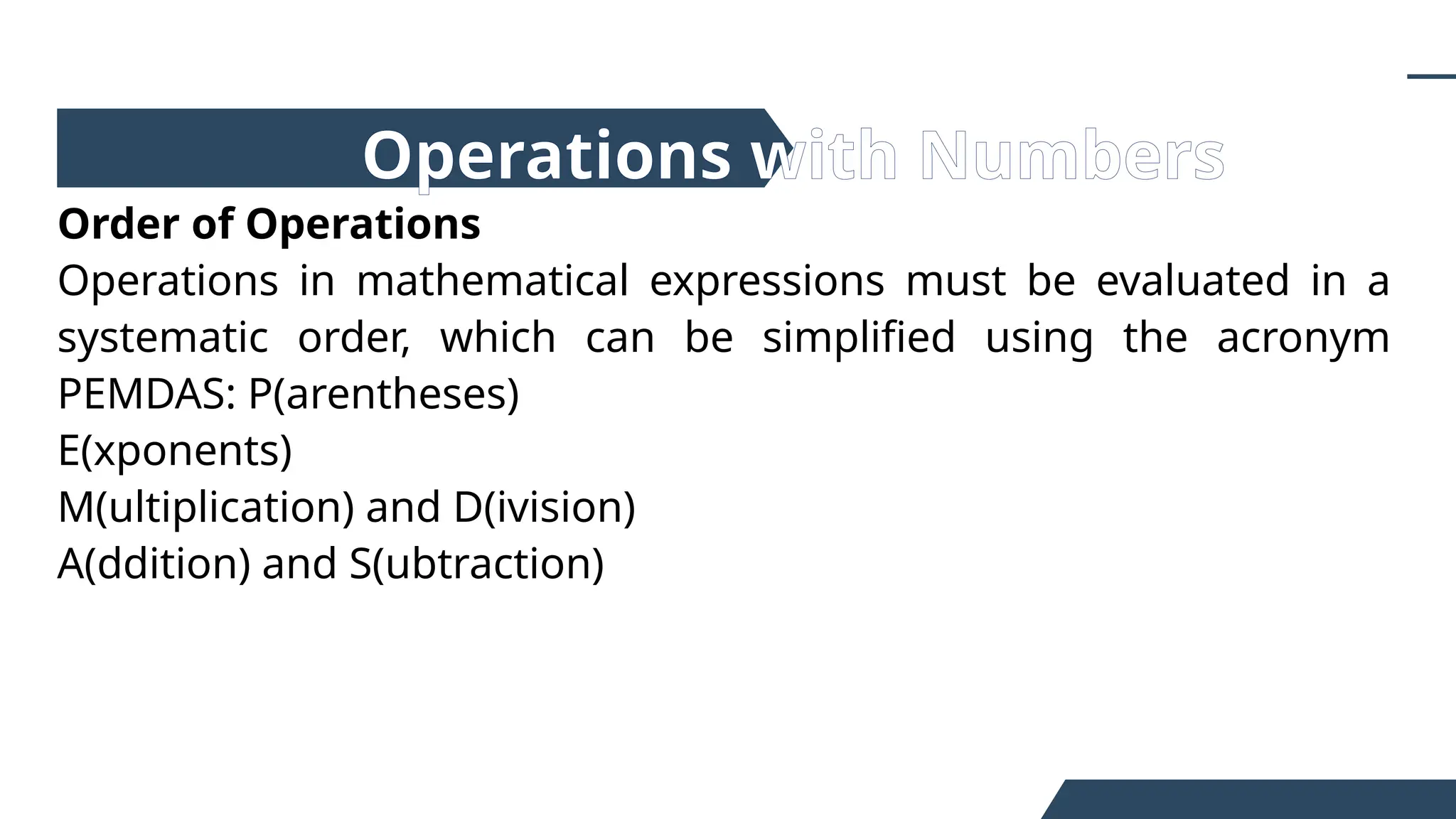
Order of Operations
Operationsin mathematical expressions must be evaluated in a
systematic order, which can be simplified using the acronym
PEMDAS: P(arentheses)
E(xponents)
M(ultiplication) and D(ivision)
A(ddition) and S(ubtraction)
Operations with Numbers
36.
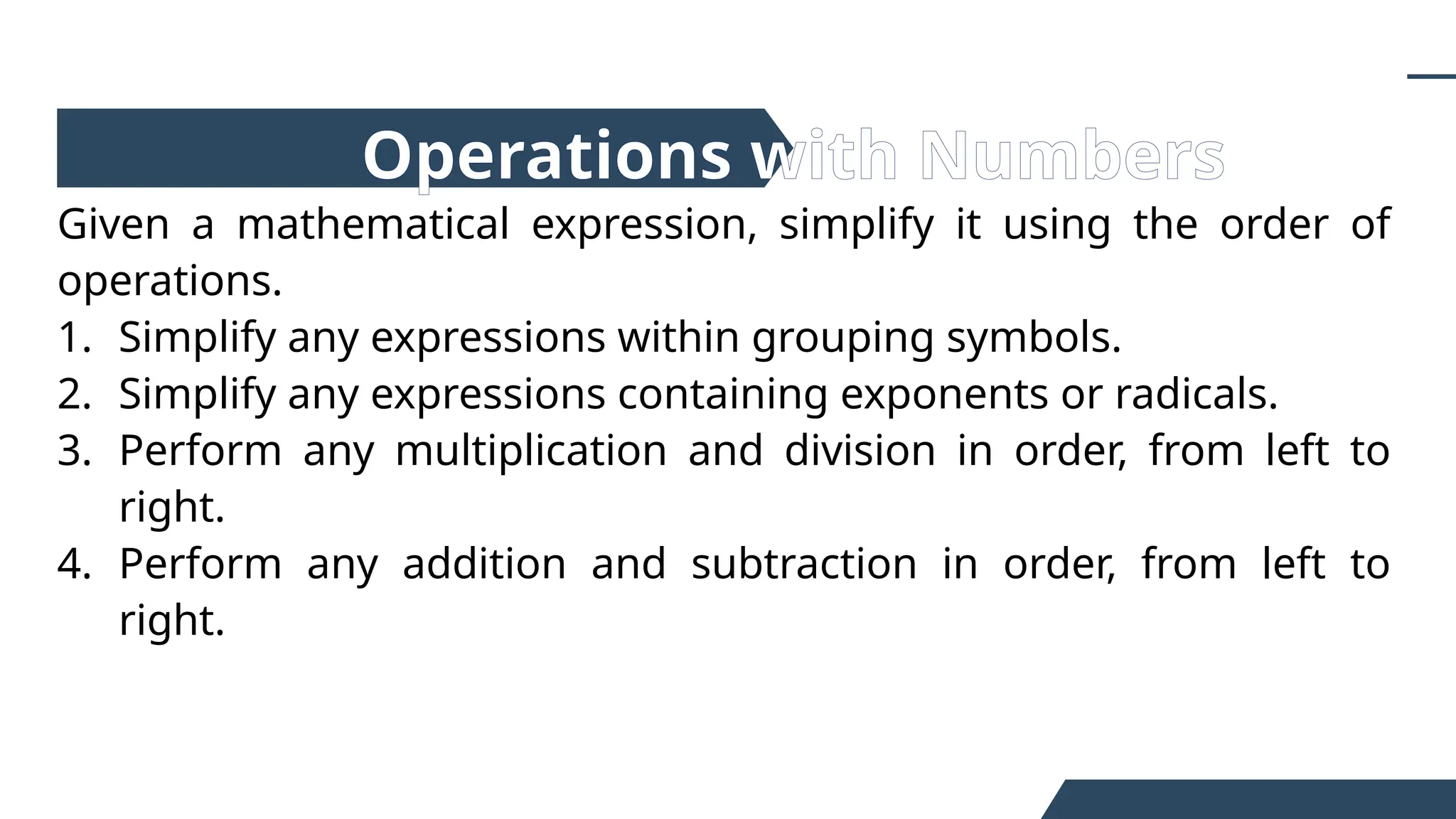
Given a mathematicalexpression, simplify it using the order of
operations.
1. Simplify any expressions within grouping symbols.
2. Simplify any expressions containing exponents or radicals.
3. Perform any multiplication and division in order, from left to
right.
4. Perform any addition and subtraction in order, from left to
right.
Operations with Numbers
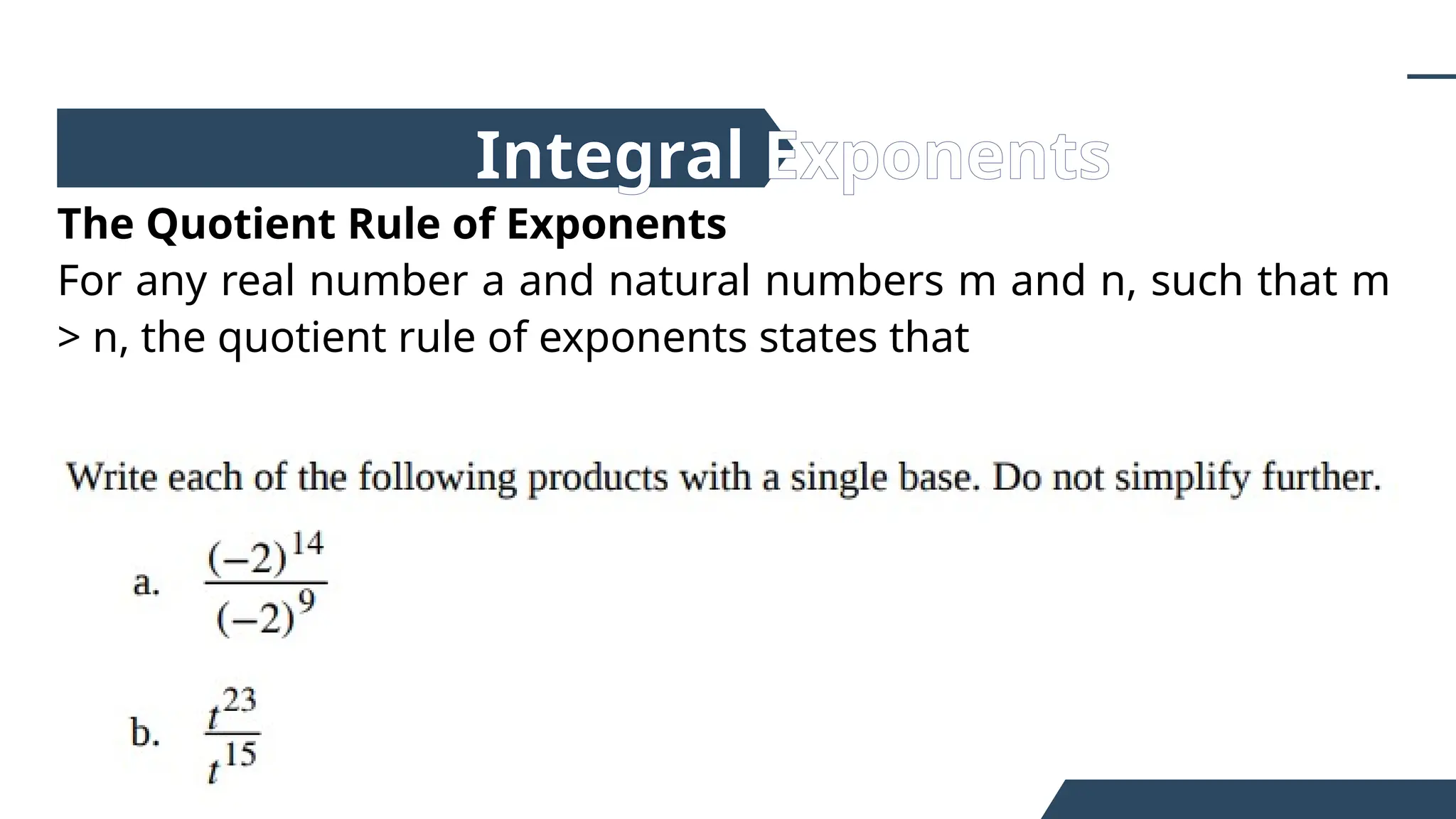
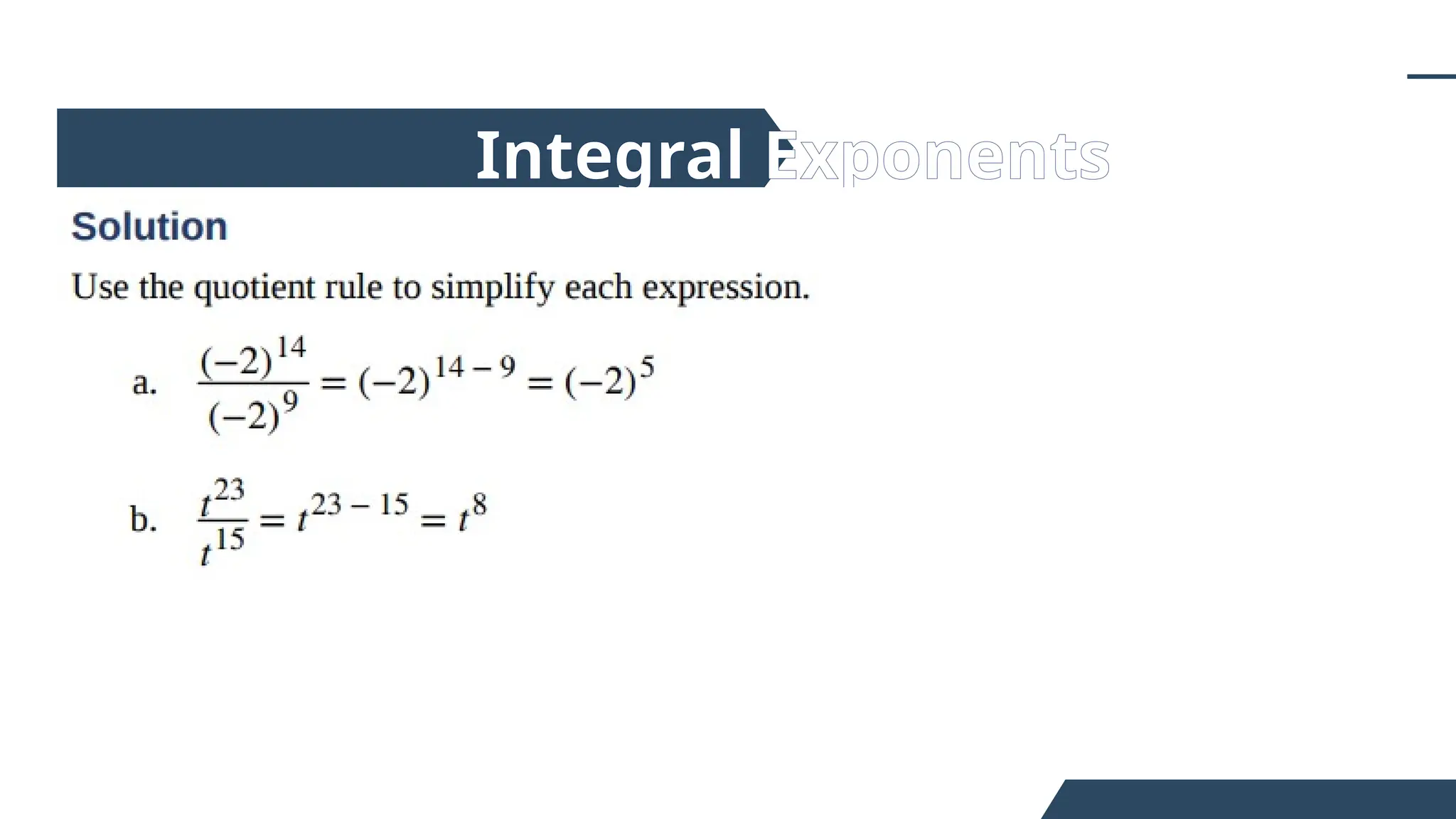
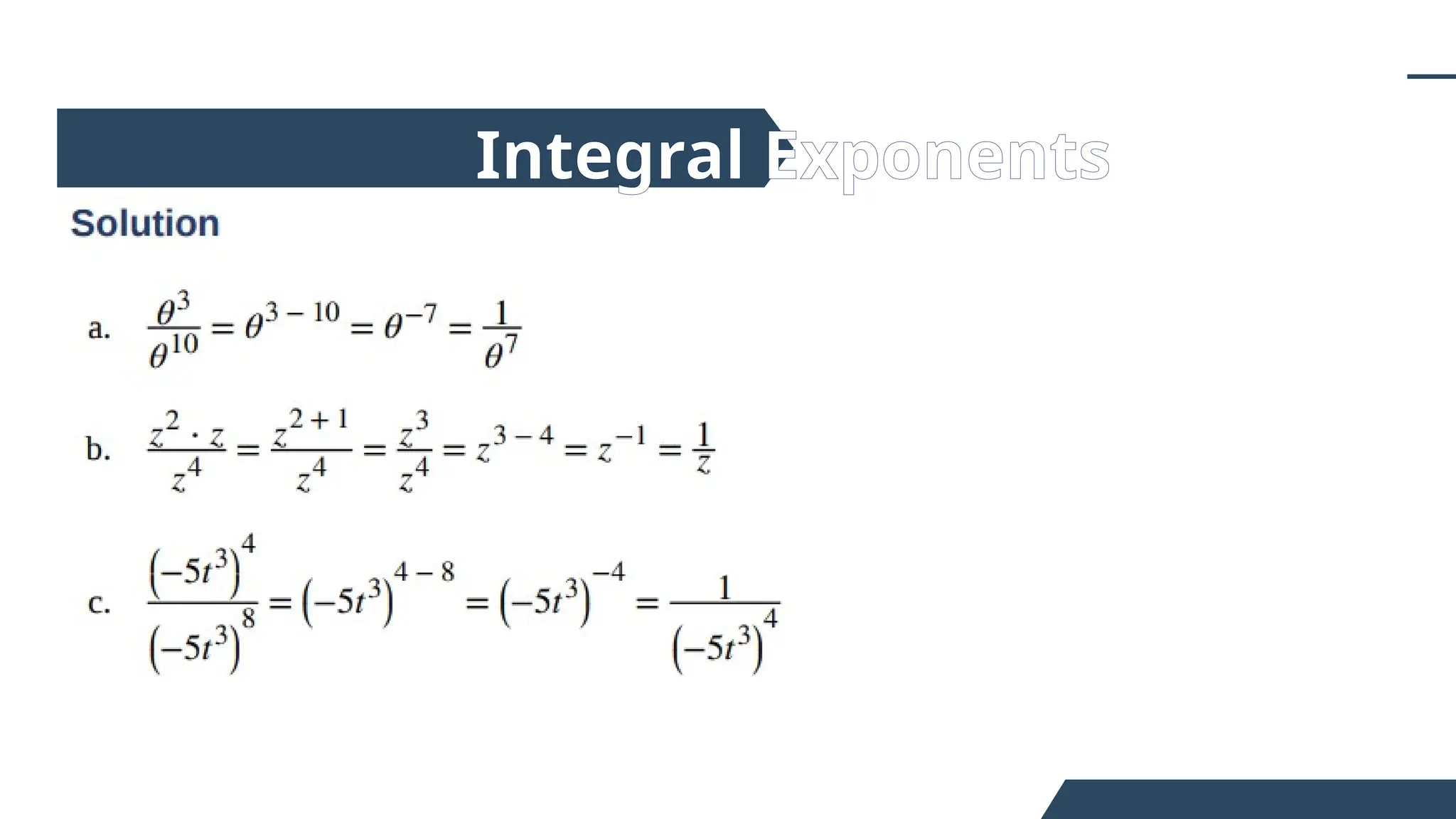
The Quotient Ruleof Exponents
For any real number a and natural numbers m and n, such that m
> n, the quotient rule of exponents states that
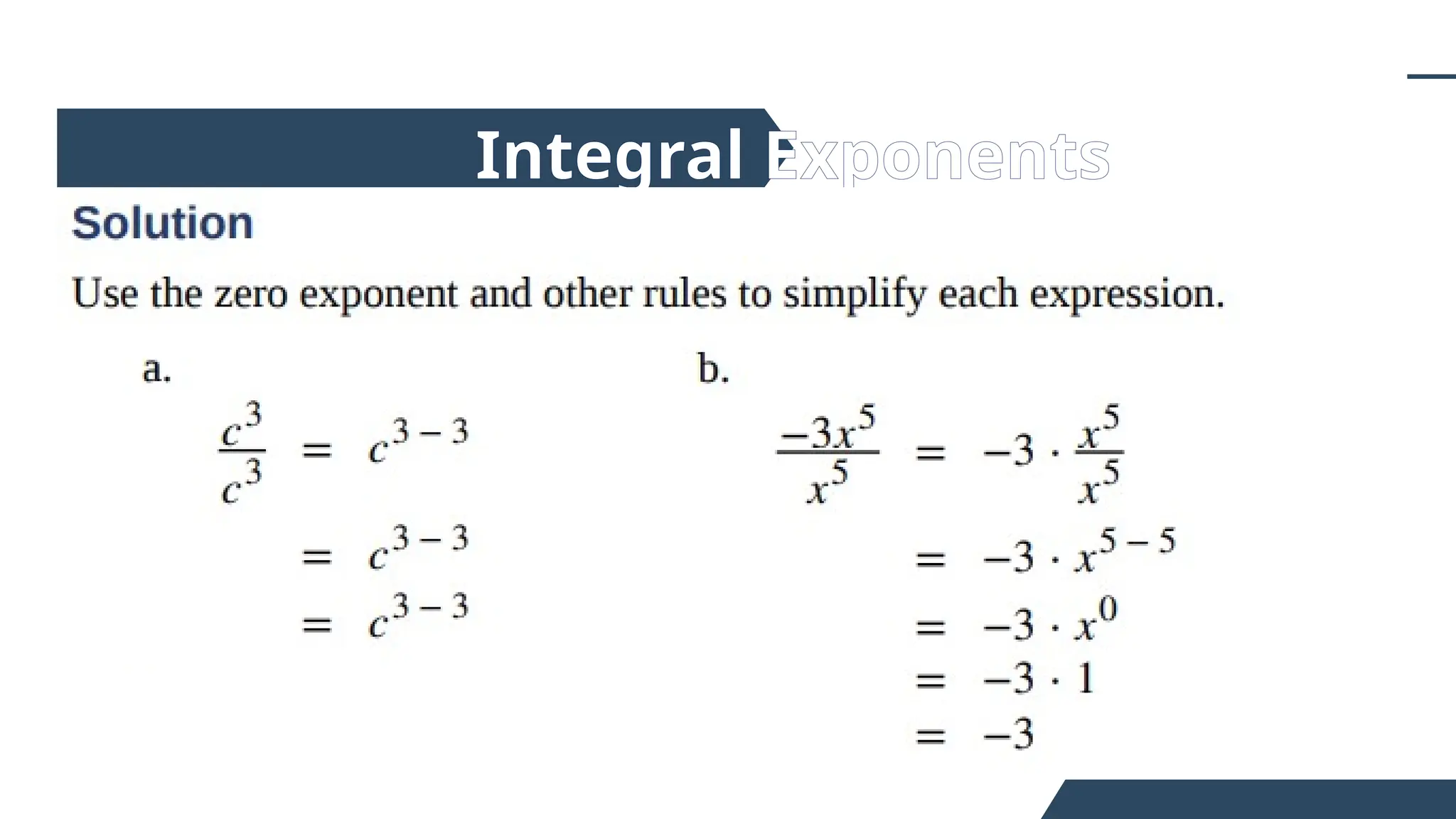
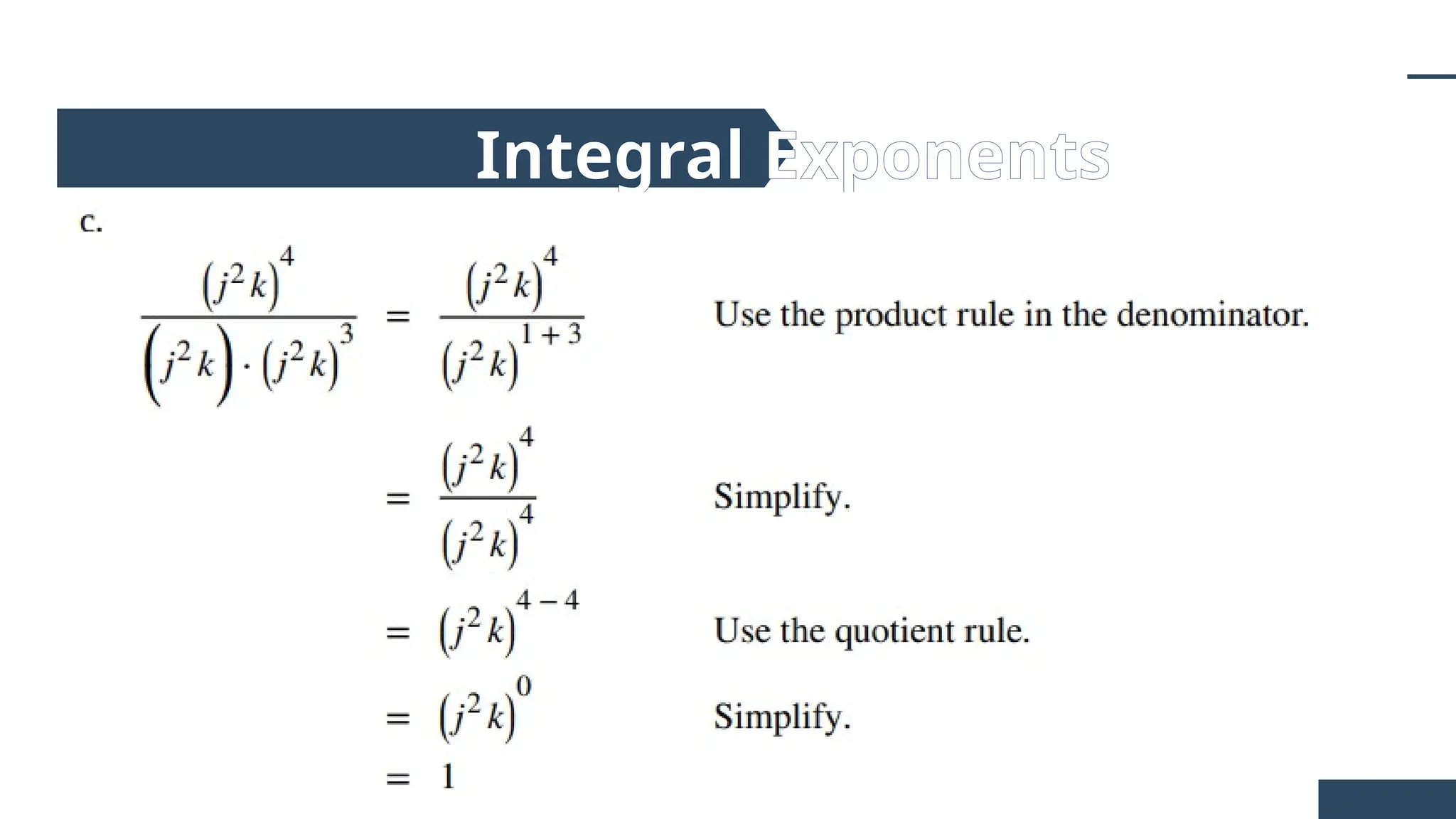
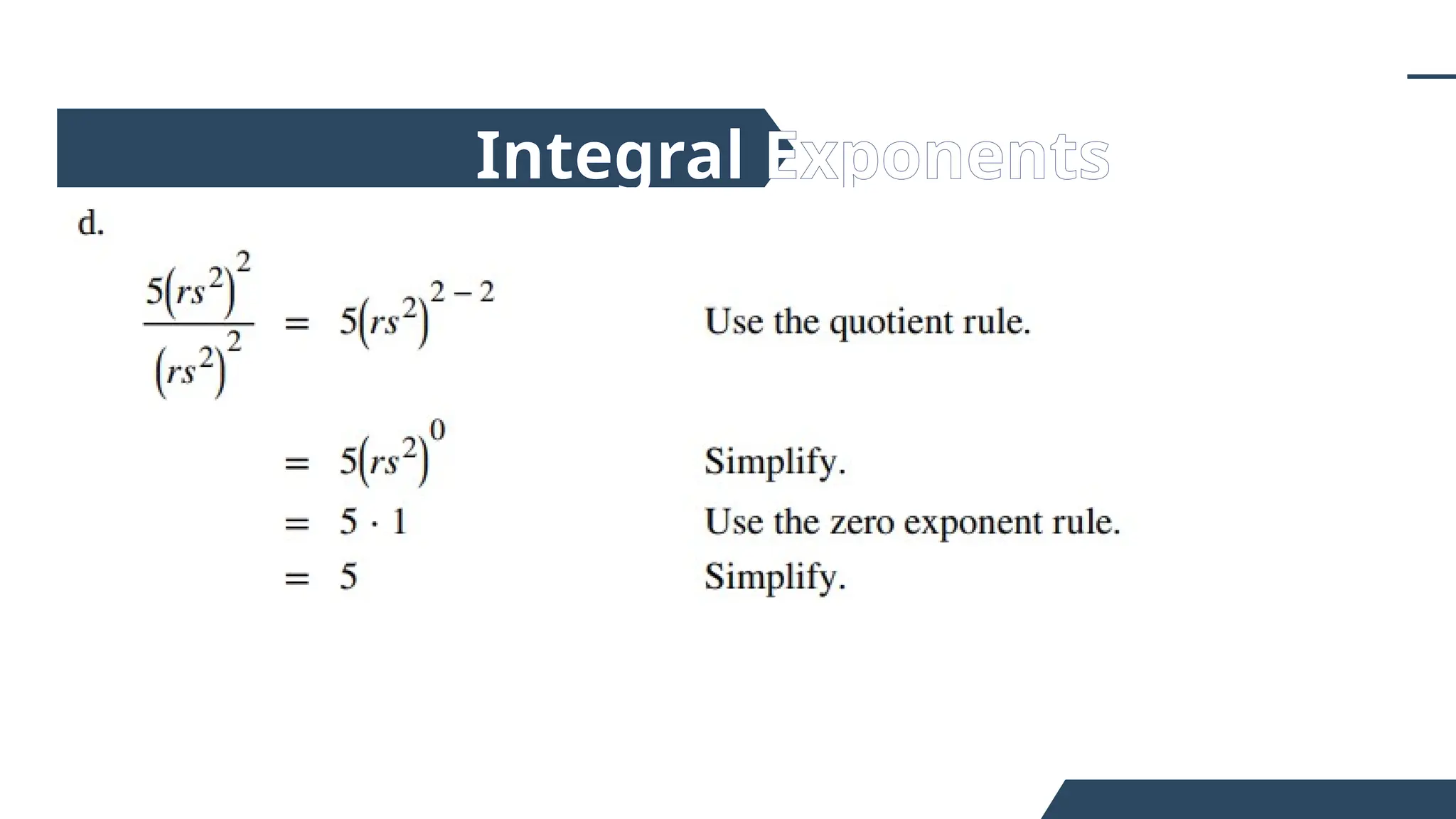
Integral Exponents
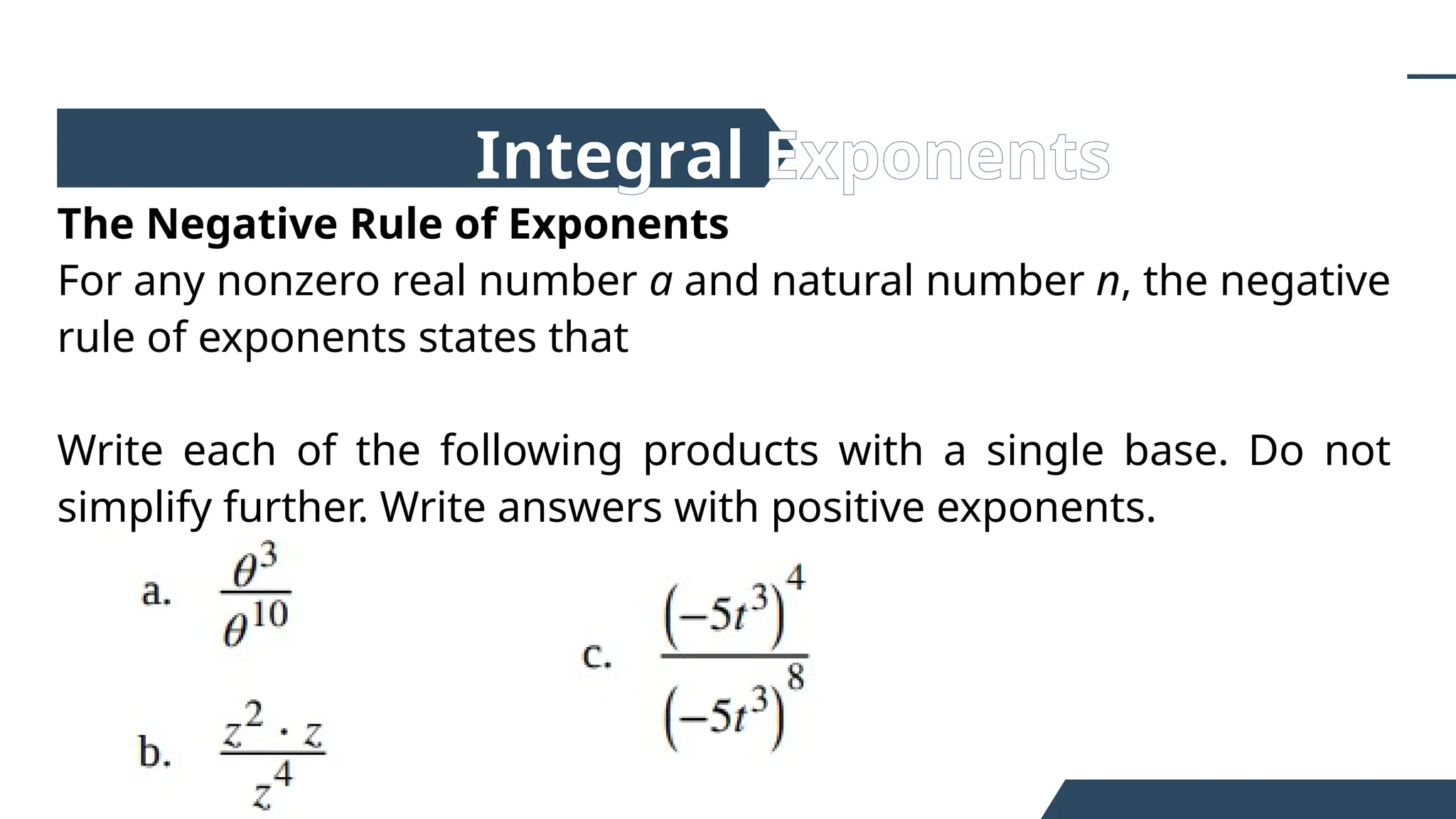
The Negative Ruleof Exponents
For any nonzero real number a and natural number n, the negative
rule of exponents states that
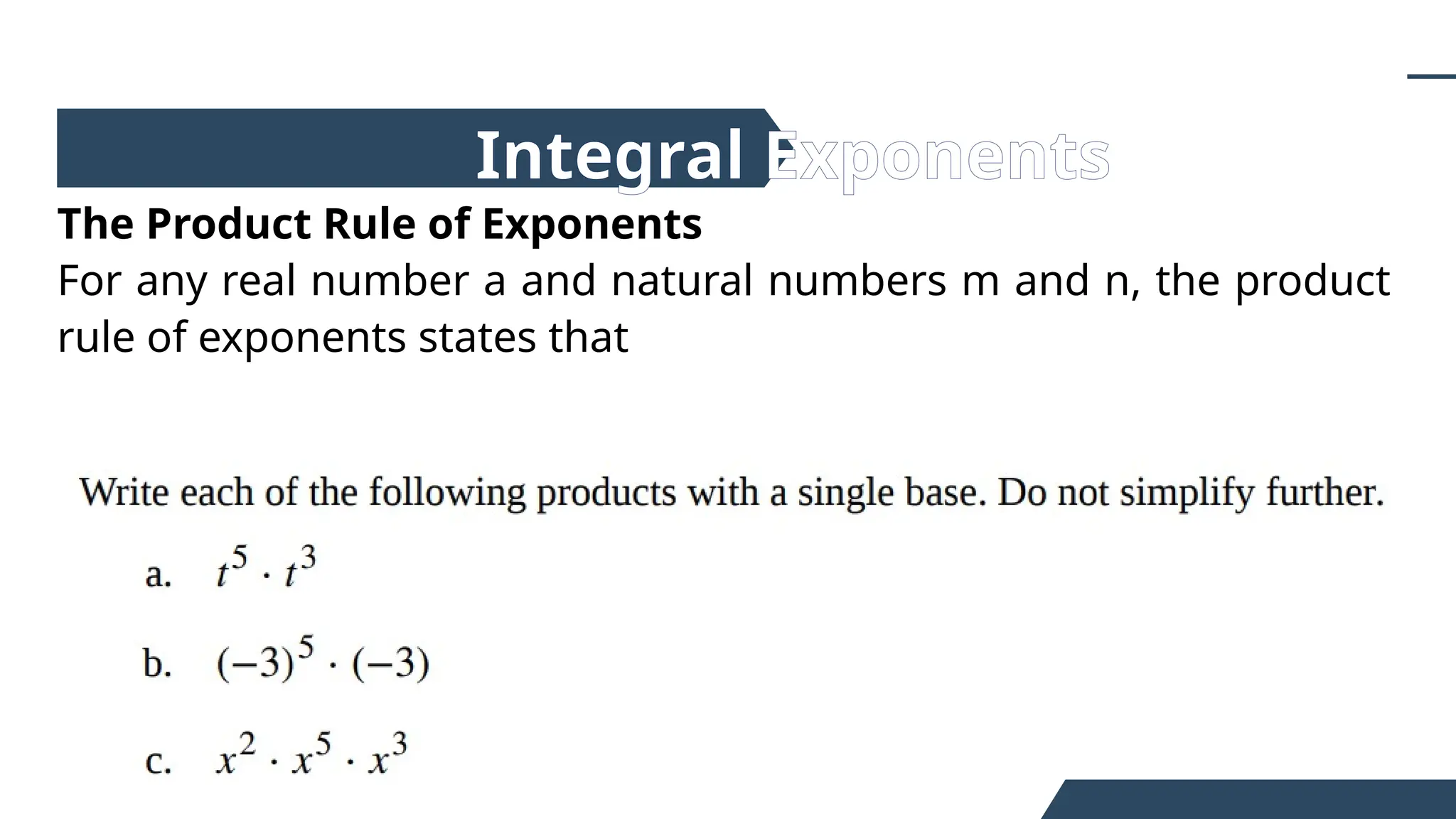
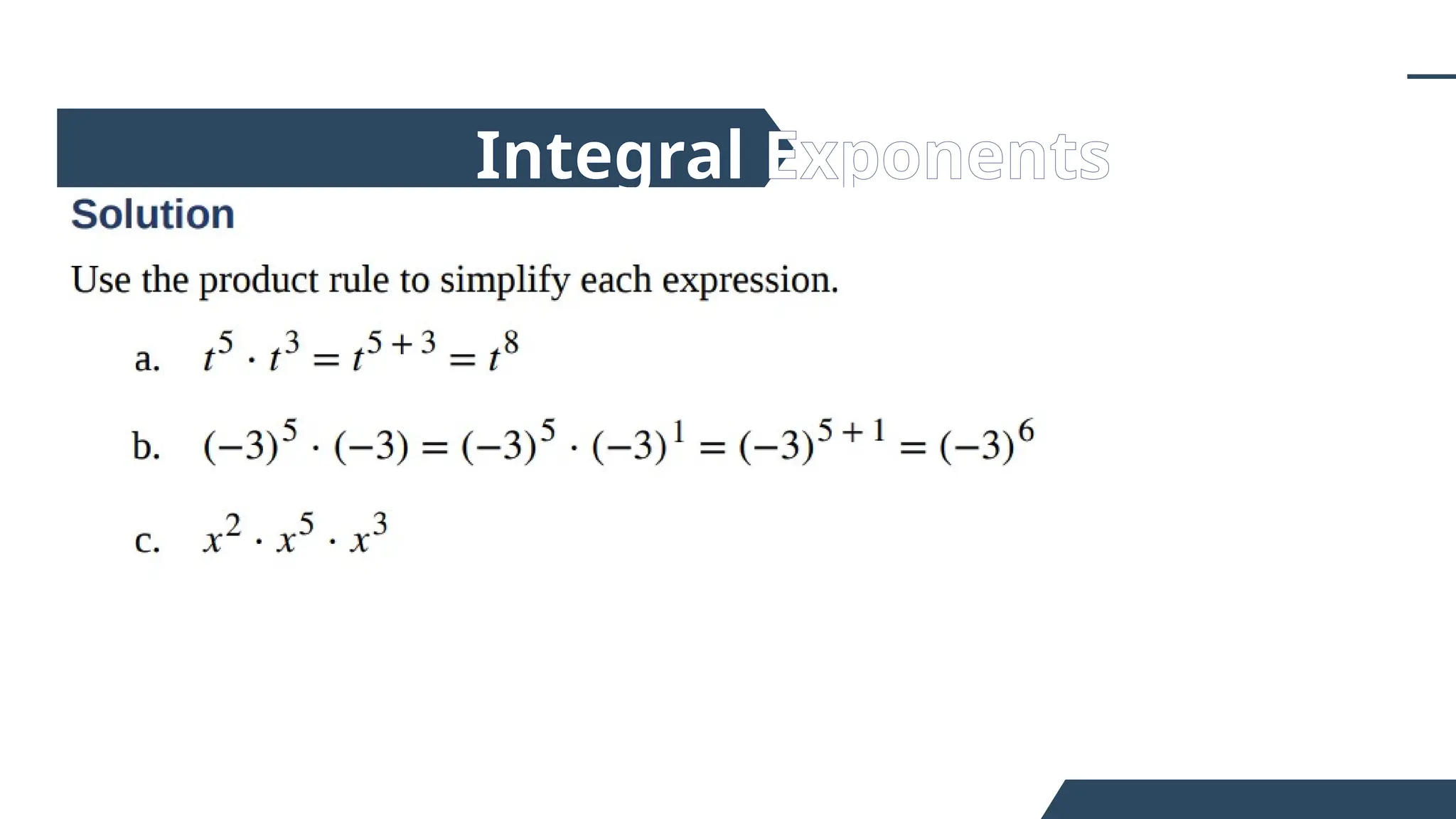
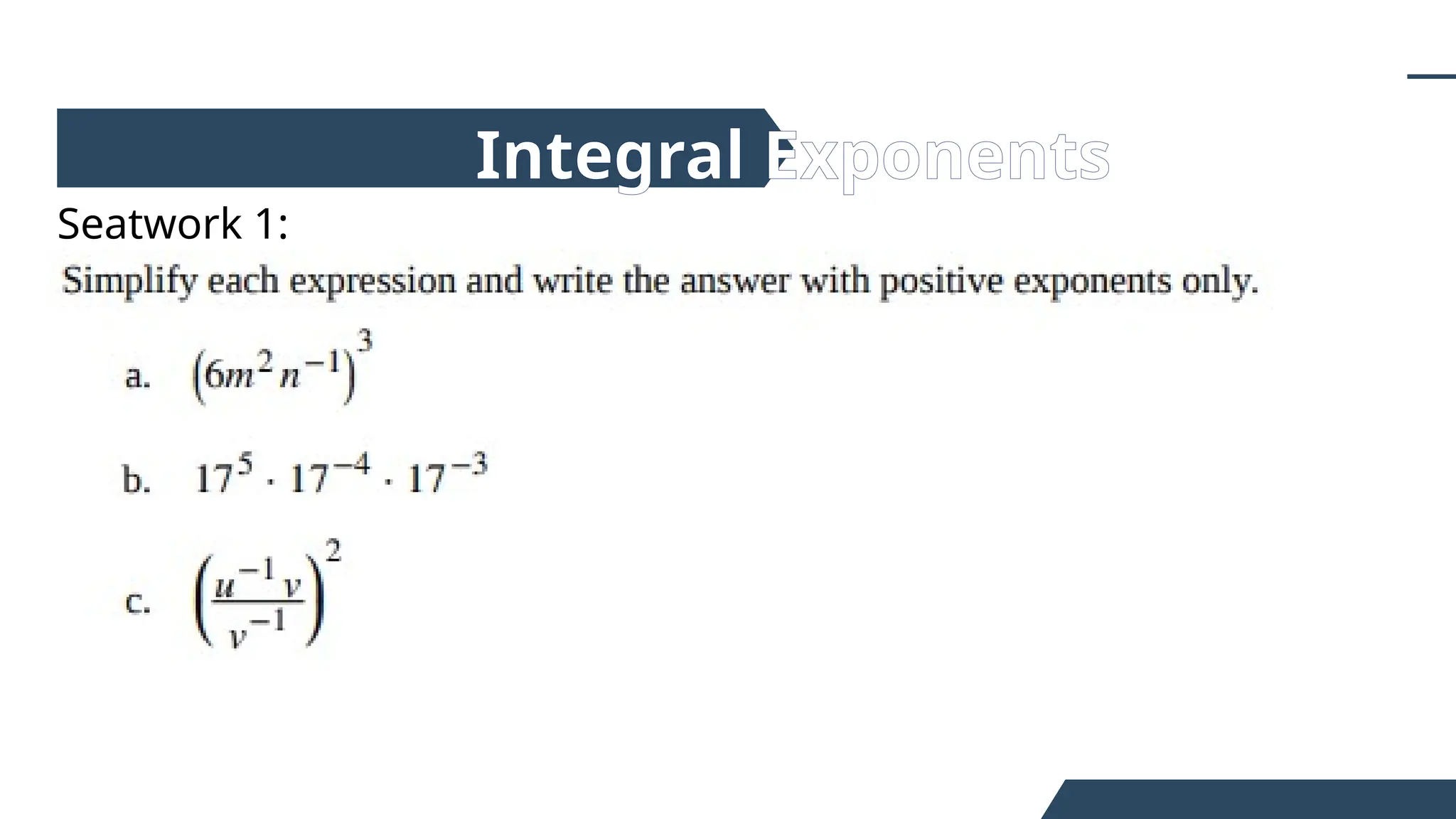
Write each of the following products with a single base. Do not
simplify further. Write answers with positive exponents.
Integral Exponents
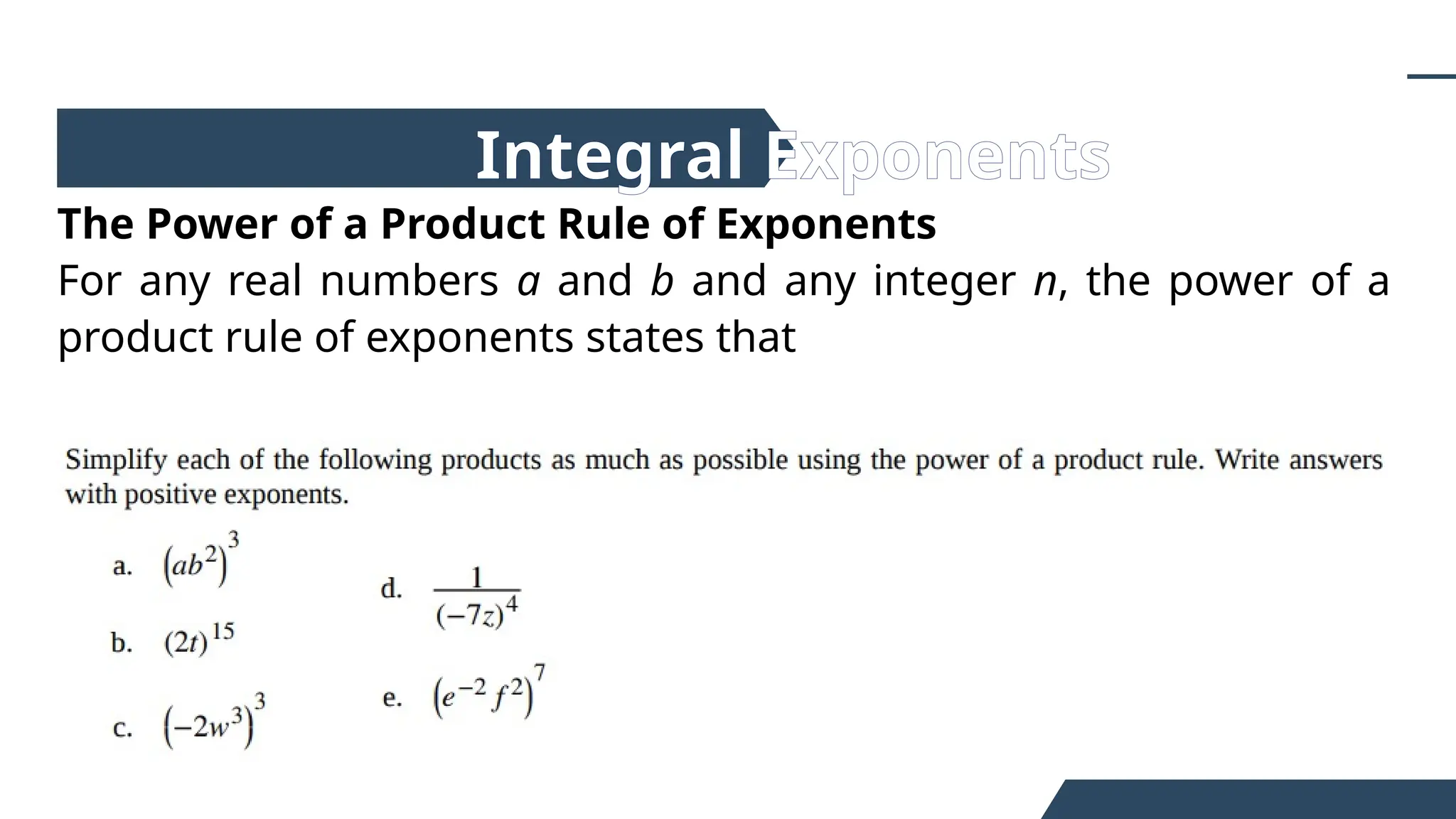
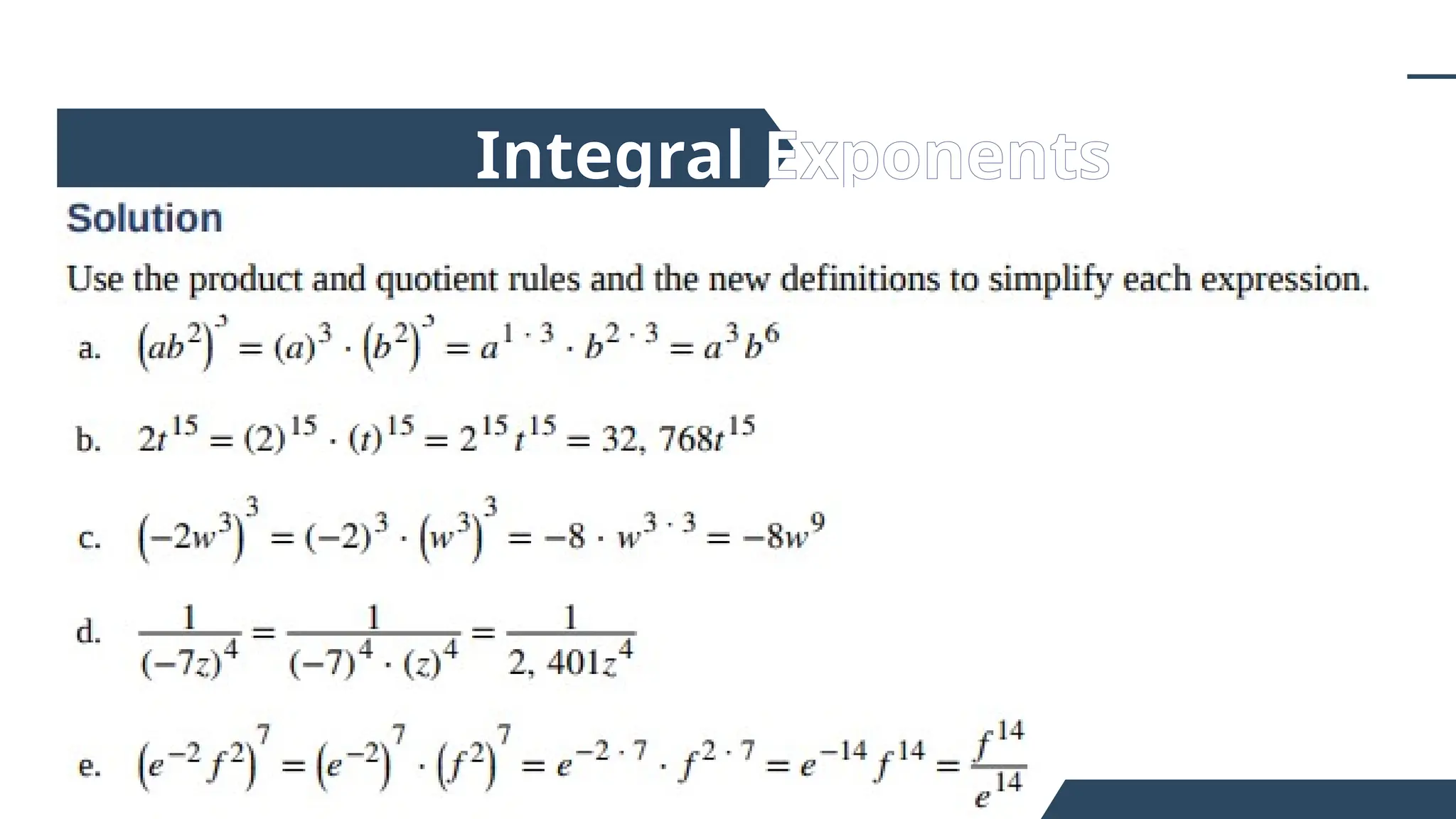
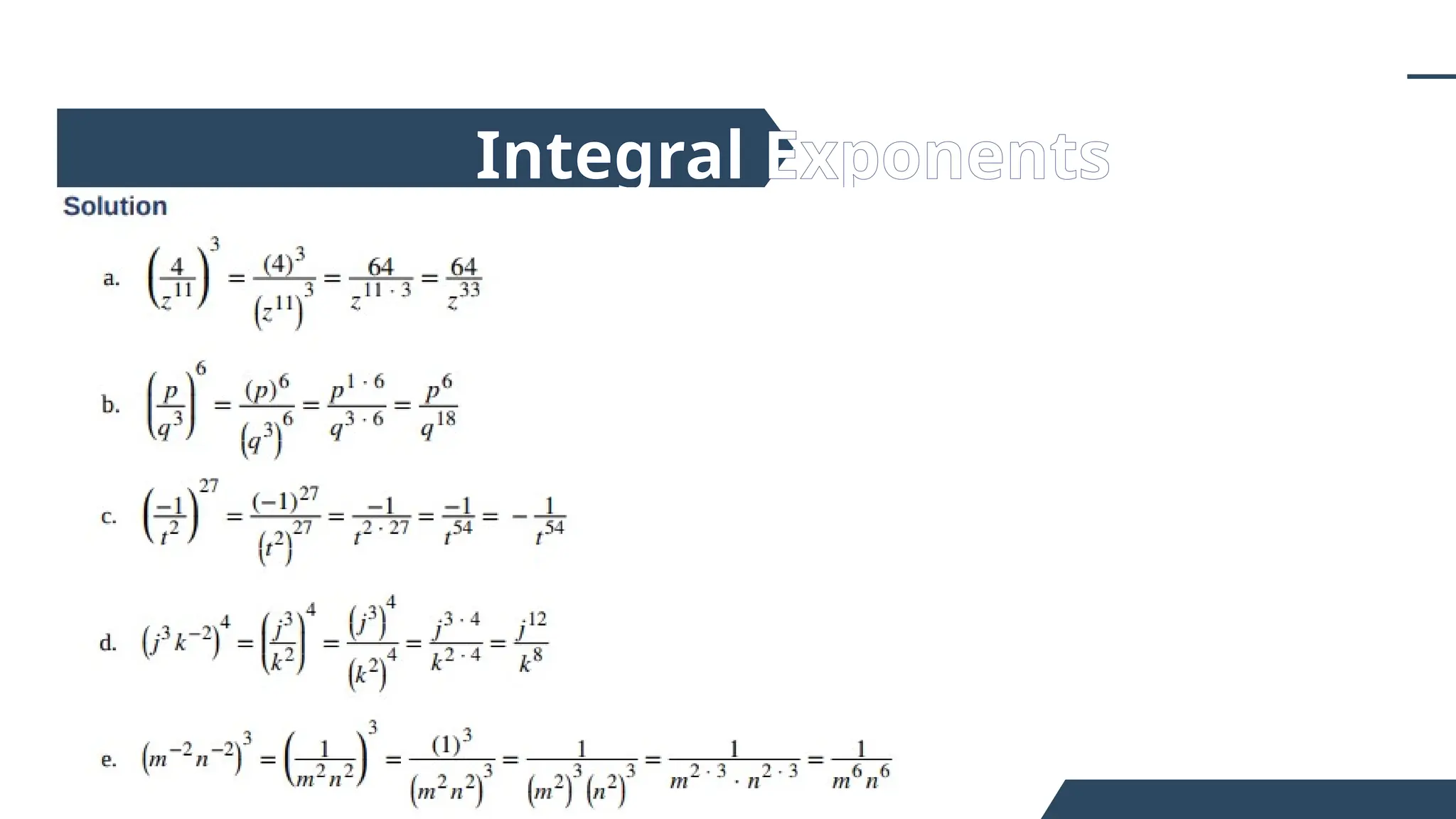
The Power ofa Product Rule of Exponents
For any real numbers a and b and any integer n, the power of a
product rule of exponents states that
Integral Exponents
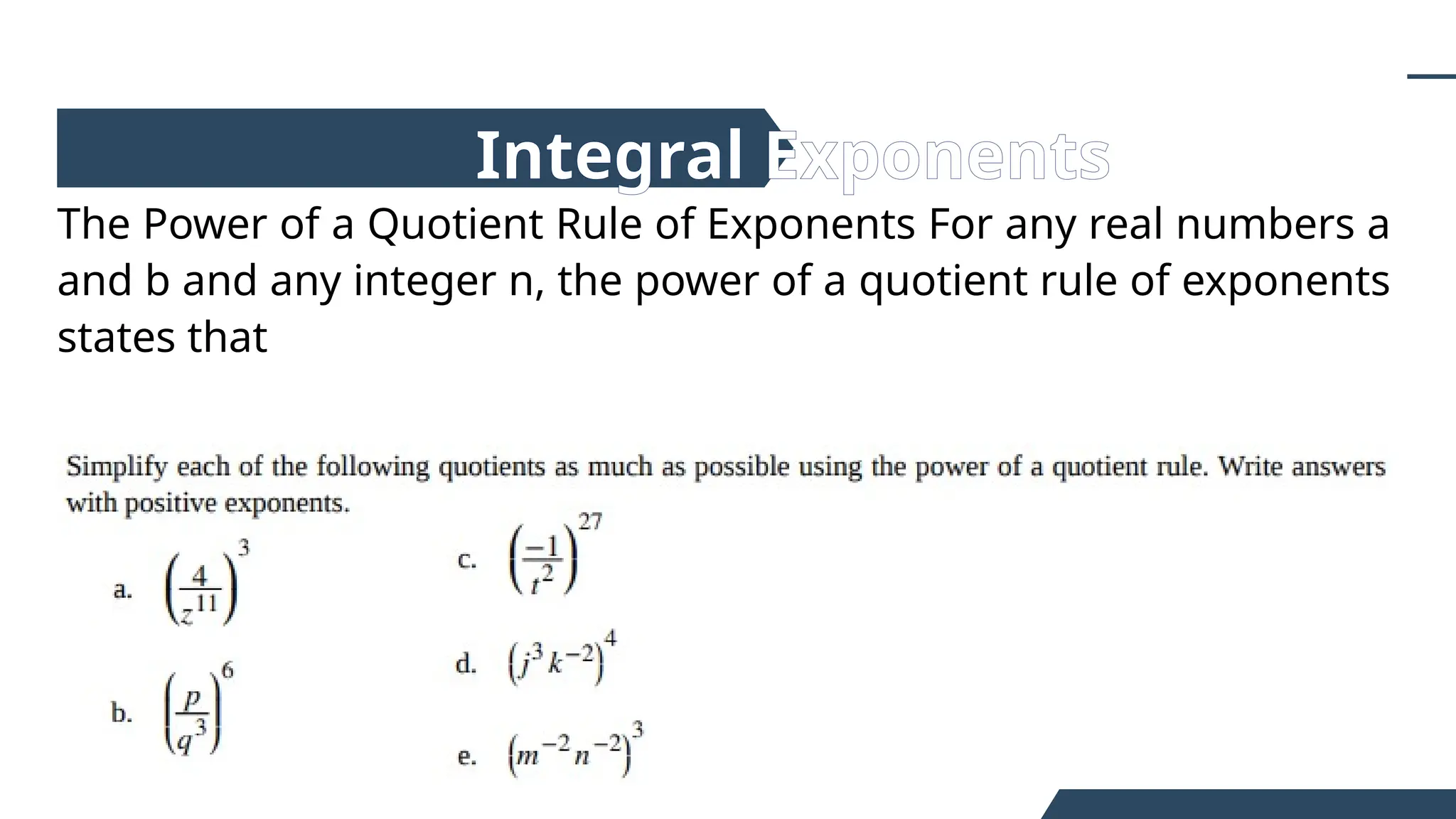
The Power ofa Quotient Rule of Exponents For any real numbers a
and b and any integer n, the power of a quotient rule of exponents
states that
Integral Exponents
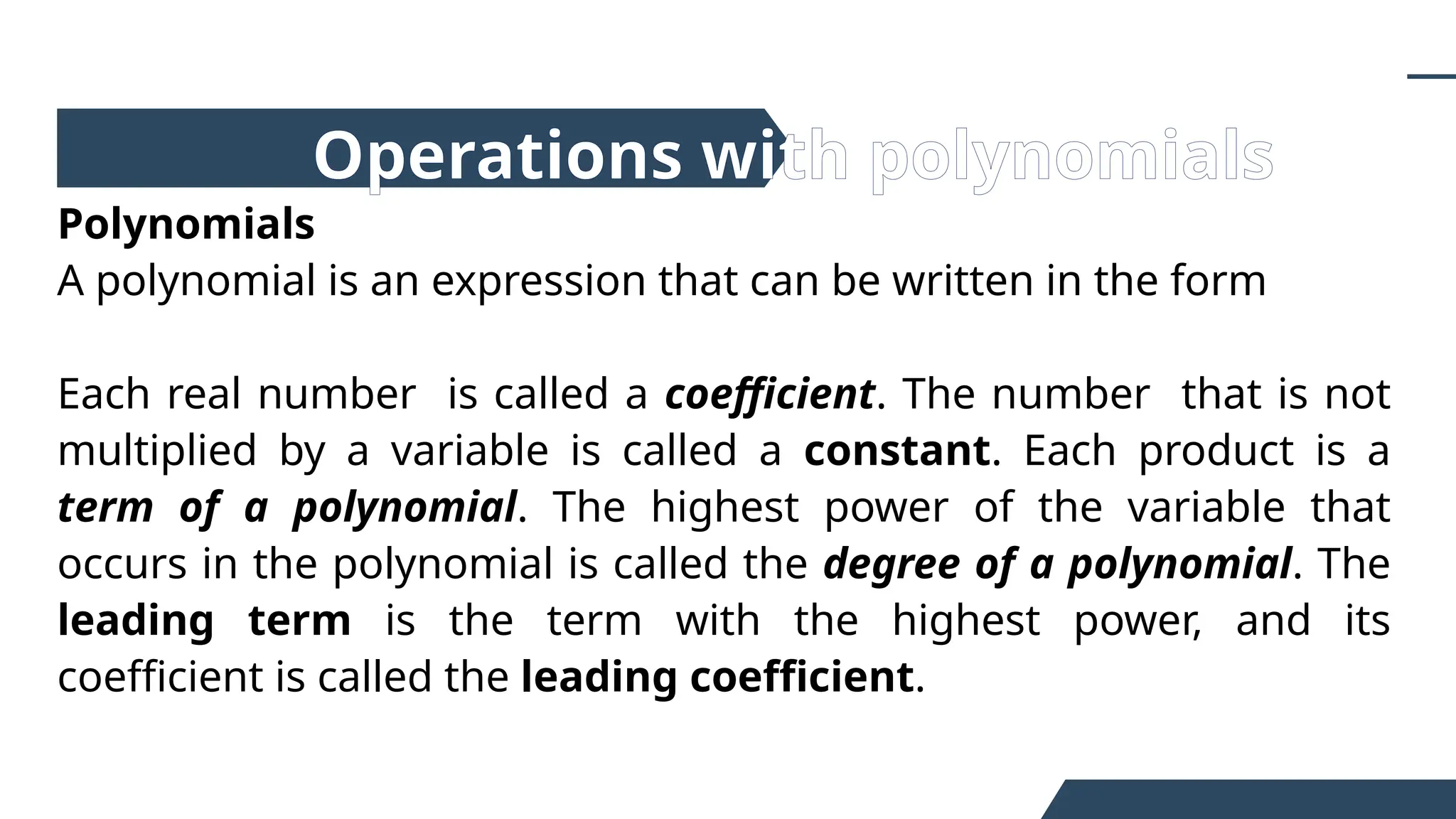
Polynomials
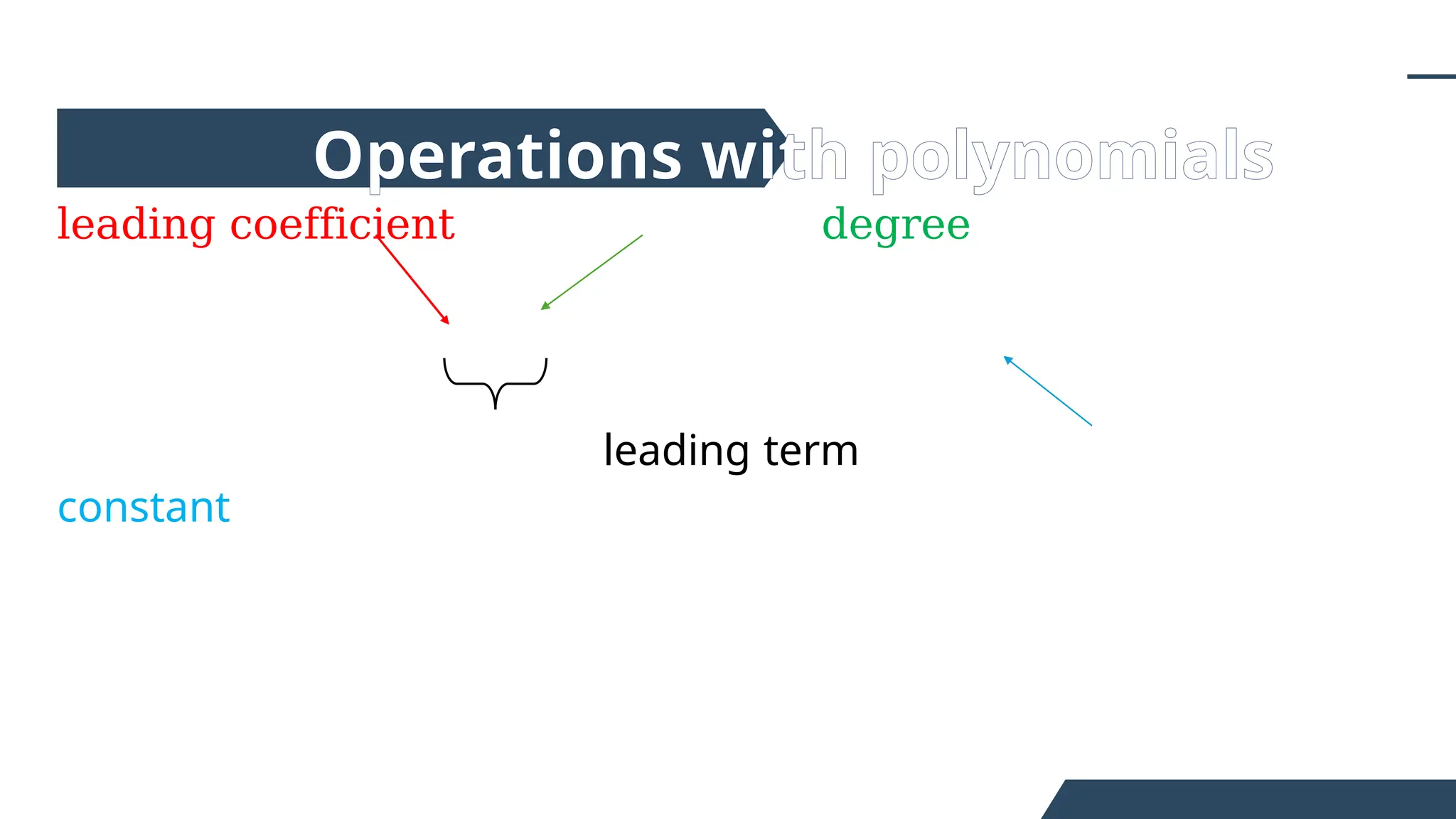
A polynomial isan expression that can be written in the form
Each real number is called a coefficient. The number that is not
multiplied by a variable is called a constant. Each product is a
term of a polynomial. The highest power of the variable that
occurs in the polynomial is called the degree of a polynomial. The
leading term is the term with the highest power, and its
coefficient is called the leading coefficient.
Operations with polynomials
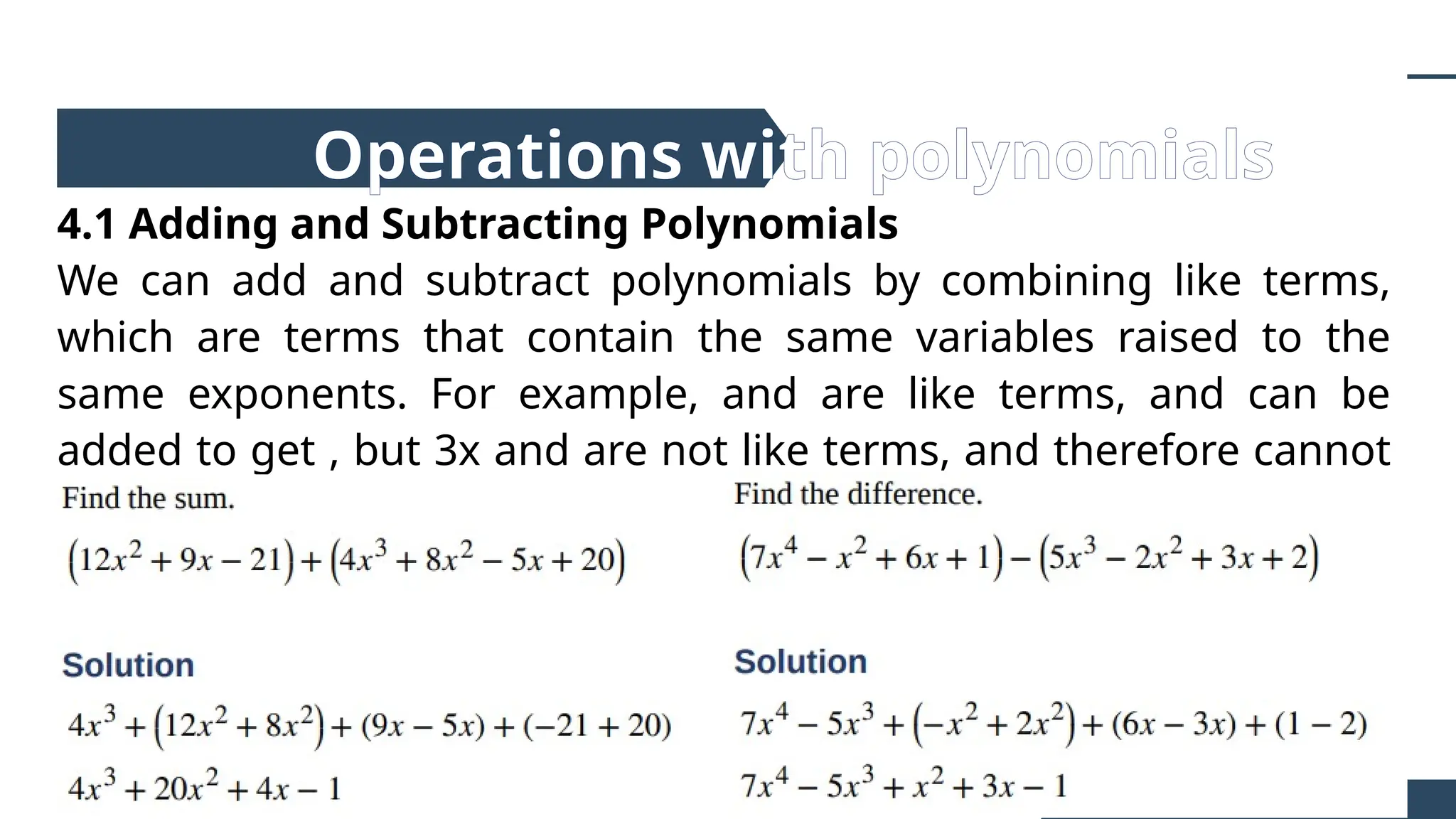
4.1 Adding andSubtracting Polynomials
We can add and subtract polynomials by combining like terms,
which are terms that contain the same variables raised to the
same exponents. For example, and are like terms, and can be
added to get , but 3x and are not like terms, and therefore cannot
be added.
Operations with polynomials
62.
4.2 Multiplying Polynomials
Multiplyingpolynomials is a bit more challenging than adding and
subtracting polynomials. We must use the distributive property to
multiply each term in the first polynomial by each term in the
second polynomial. We then combine like terms. We can also use a
shortcut called the FOIL method when multiplying binomials.
Operations with polynomials
63.
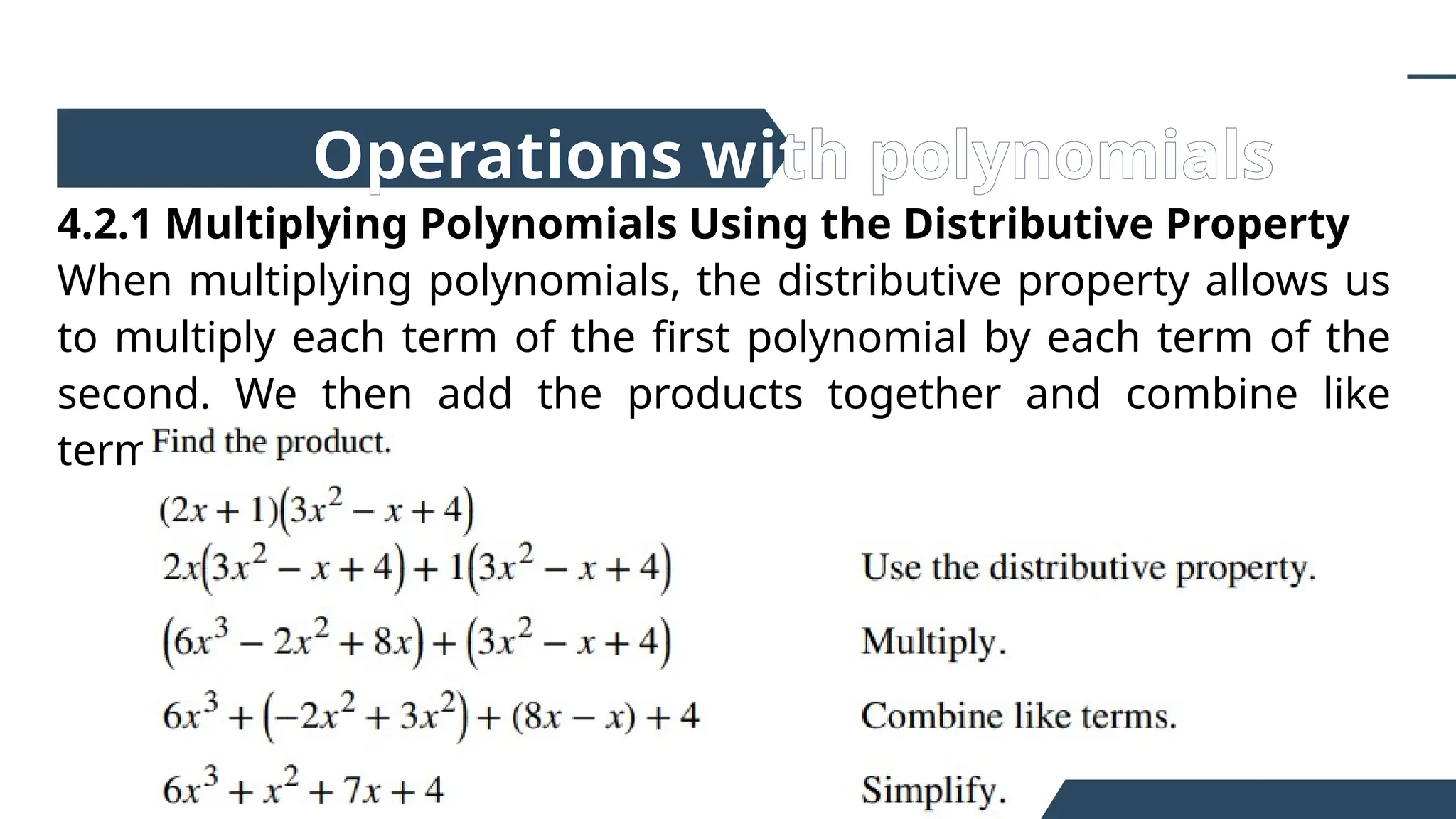
4.2.1 Multiplying PolynomialsUsing the Distributive Property
When multiplying polynomials, the distributive property allows us
to multiply each term of the first polynomial by each term of the
second. We then add the products together and combine like
terms to simplify.
Operations with polynomials
64.
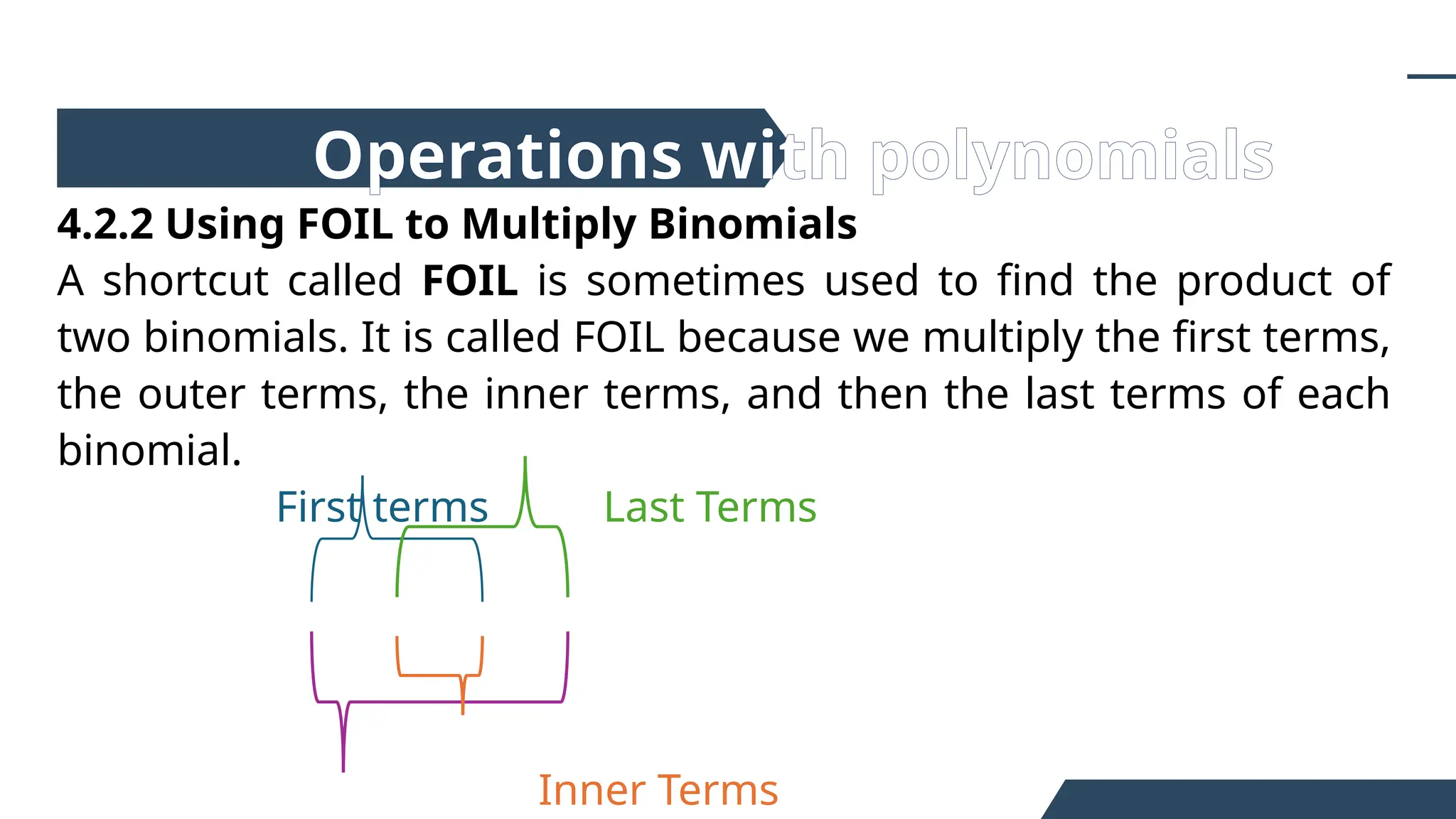
4.2.2 Using FOILto Multiply Binomials
A shortcut called FOIL is sometimes used to find the product of
two binomials. It is called FOIL because we multiply the first terms,
the outer terms, the inner terms, and then the last terms of each
binomial.
First terms Last Terms
Inner Terms
Operations with polynomials
65.
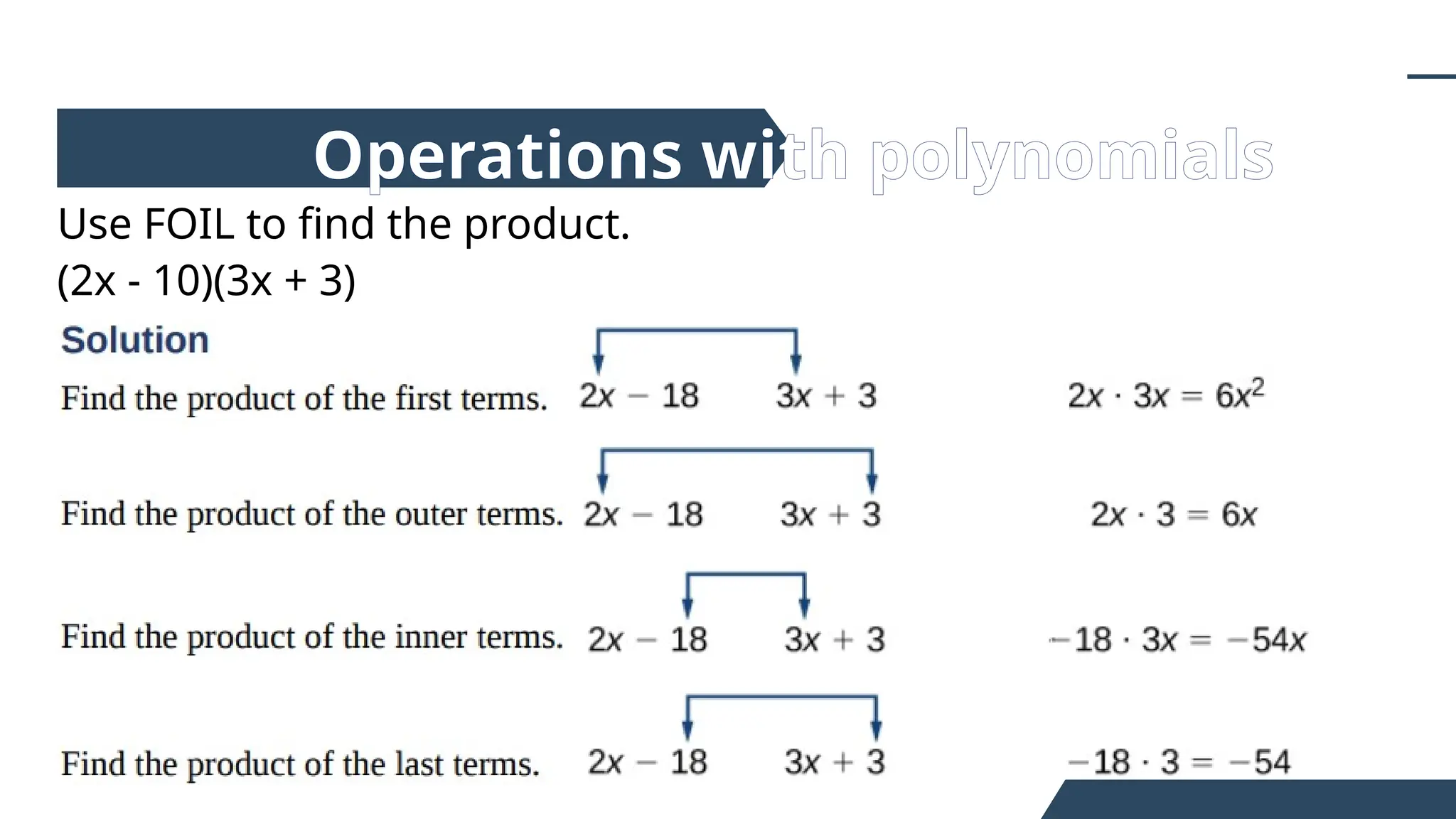
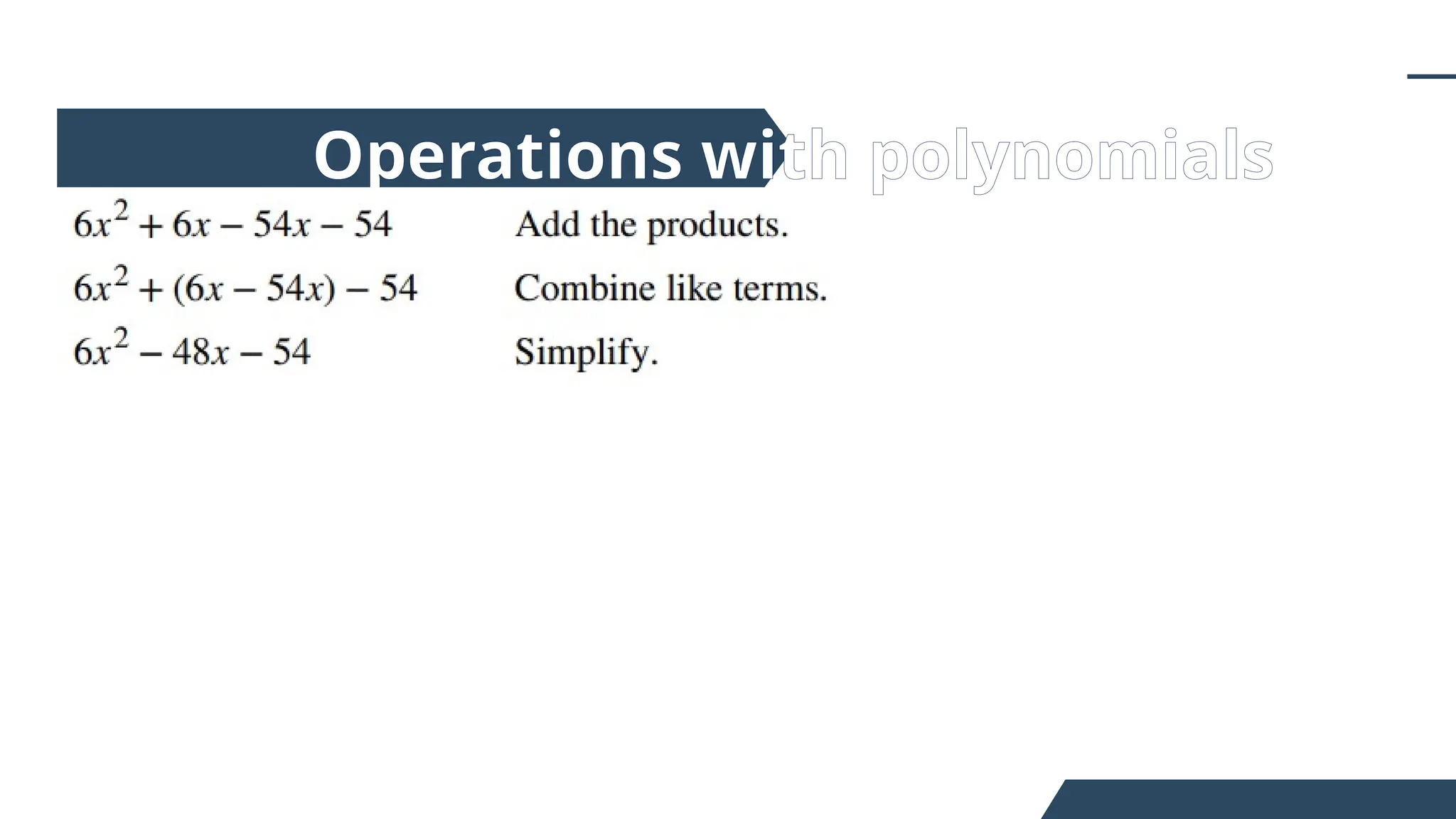
Use FOIL tofind the product.
(2x - 10)(3x + 3)
Operations with polynomials
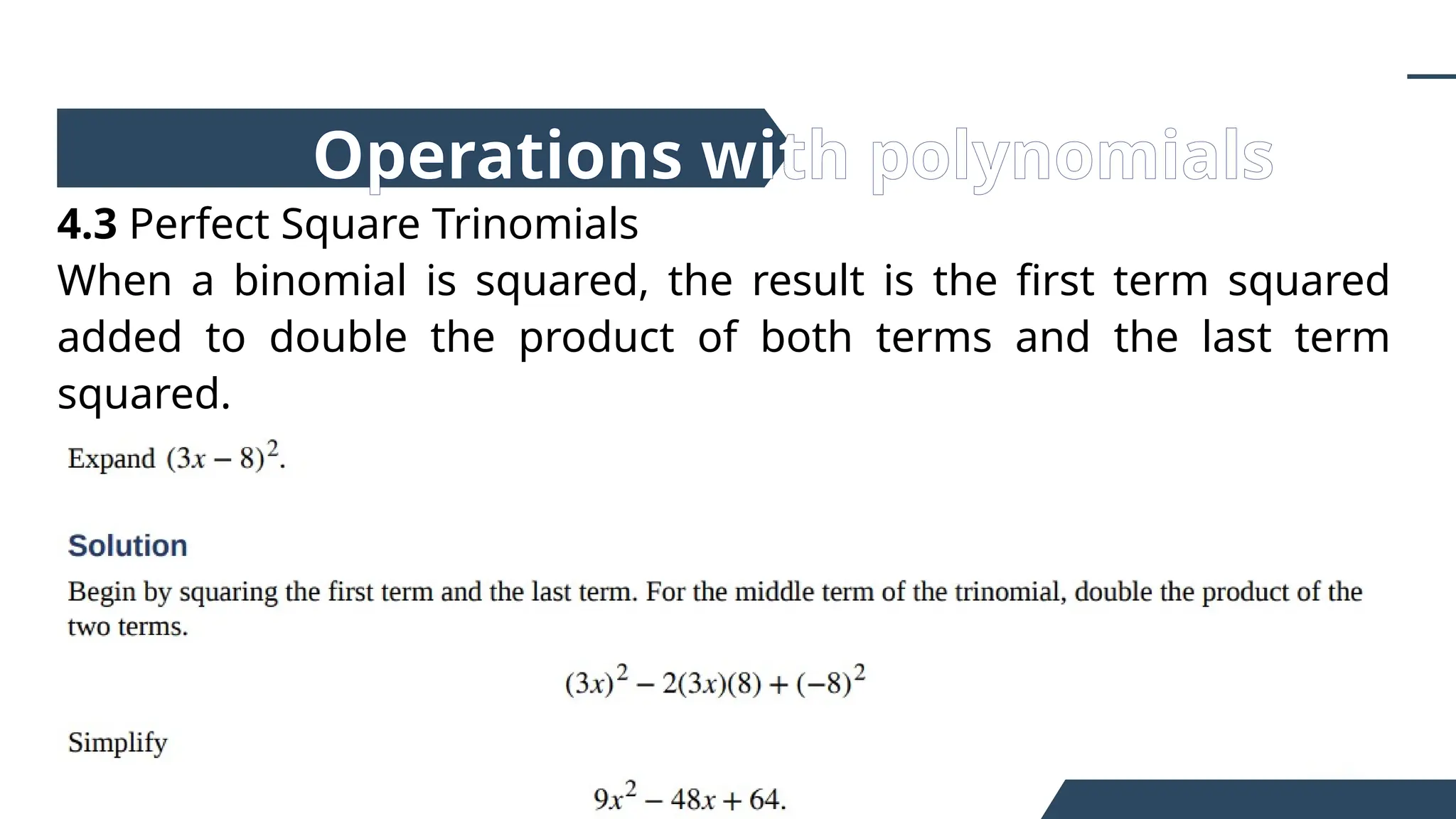
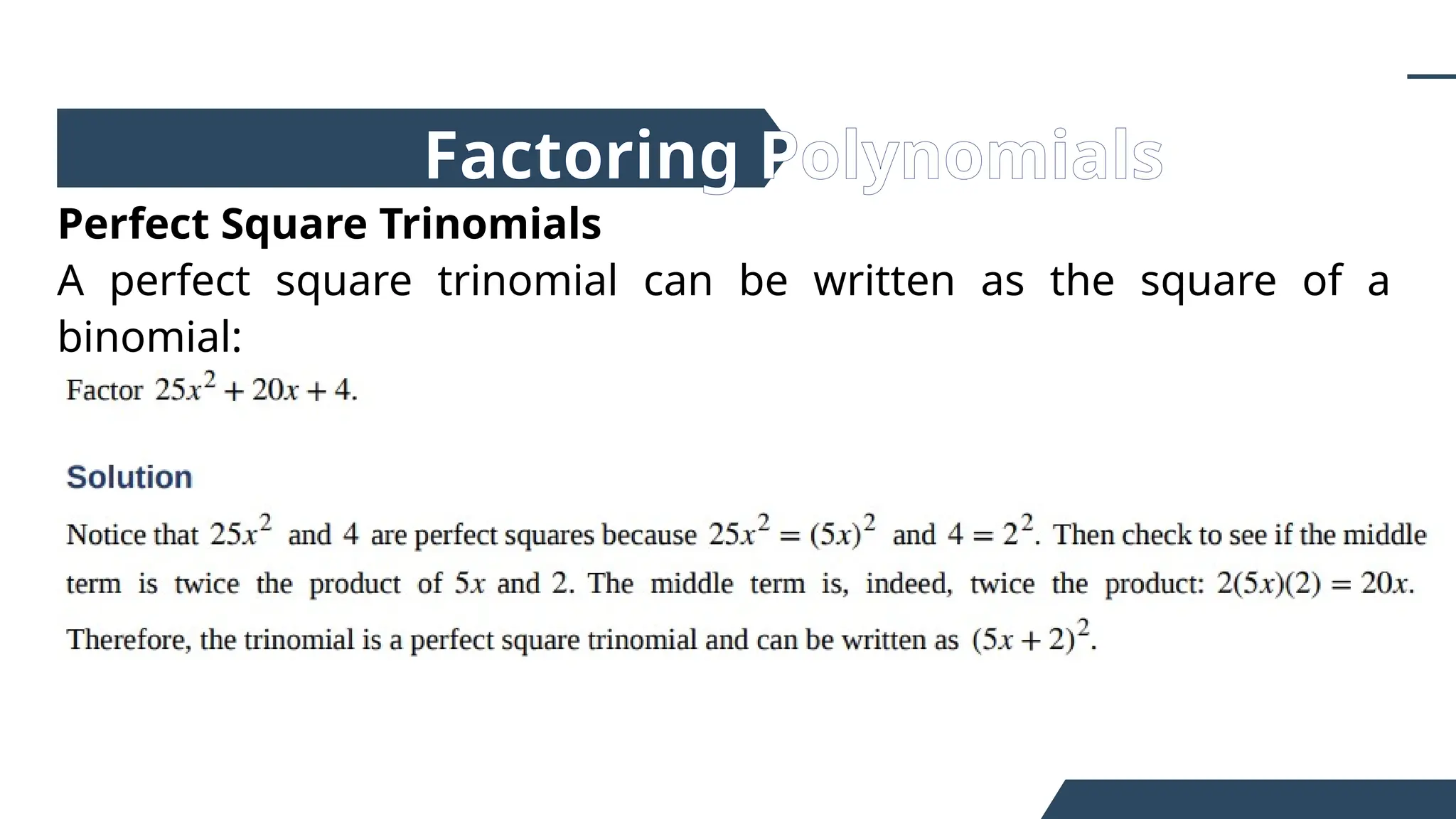
4.3 Perfect SquareTrinomials
When a binomial is squared, the result is the first term squared
added to double the product of both terms and the last term
squared.
Operations with polynomials
68.
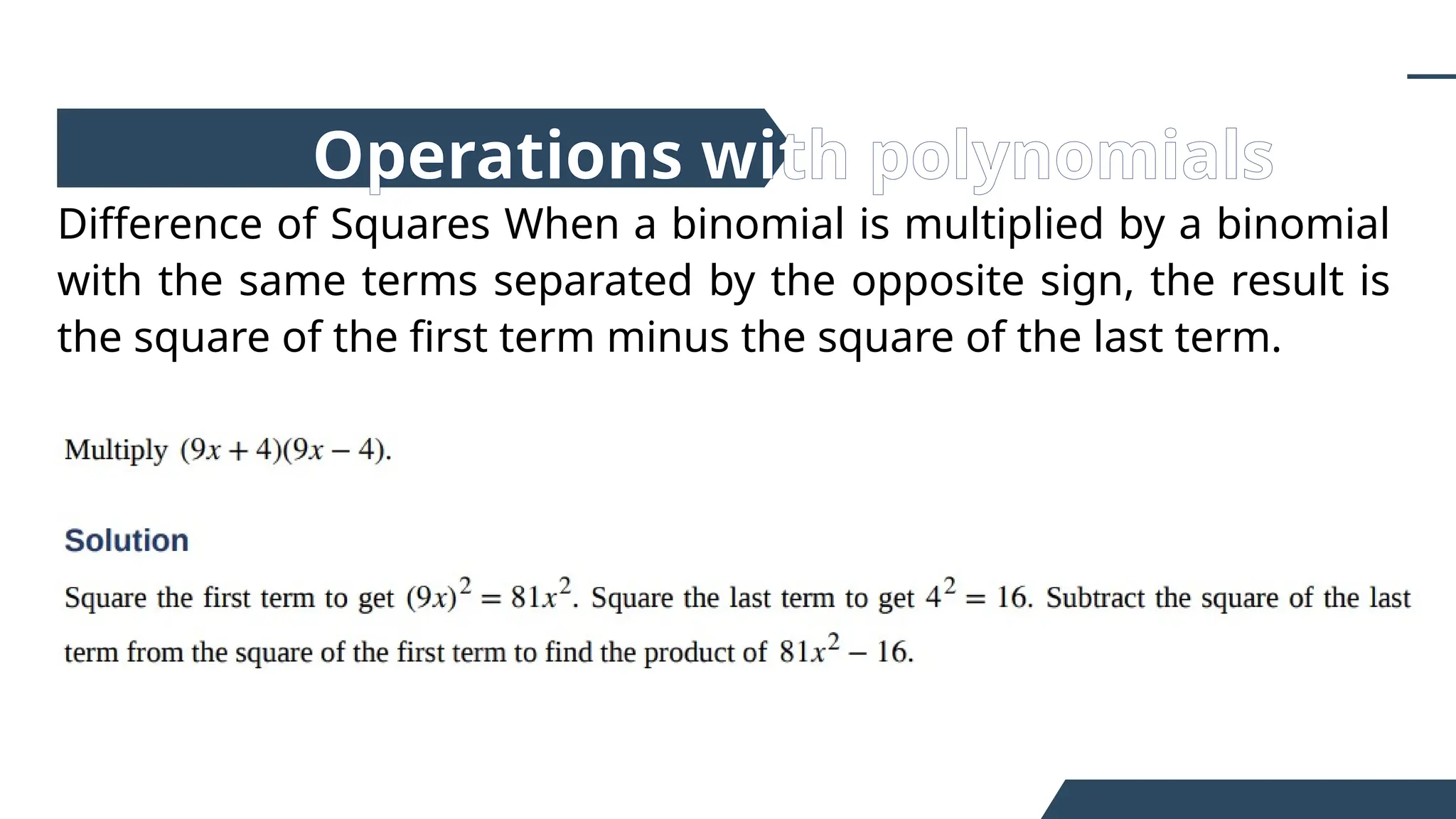
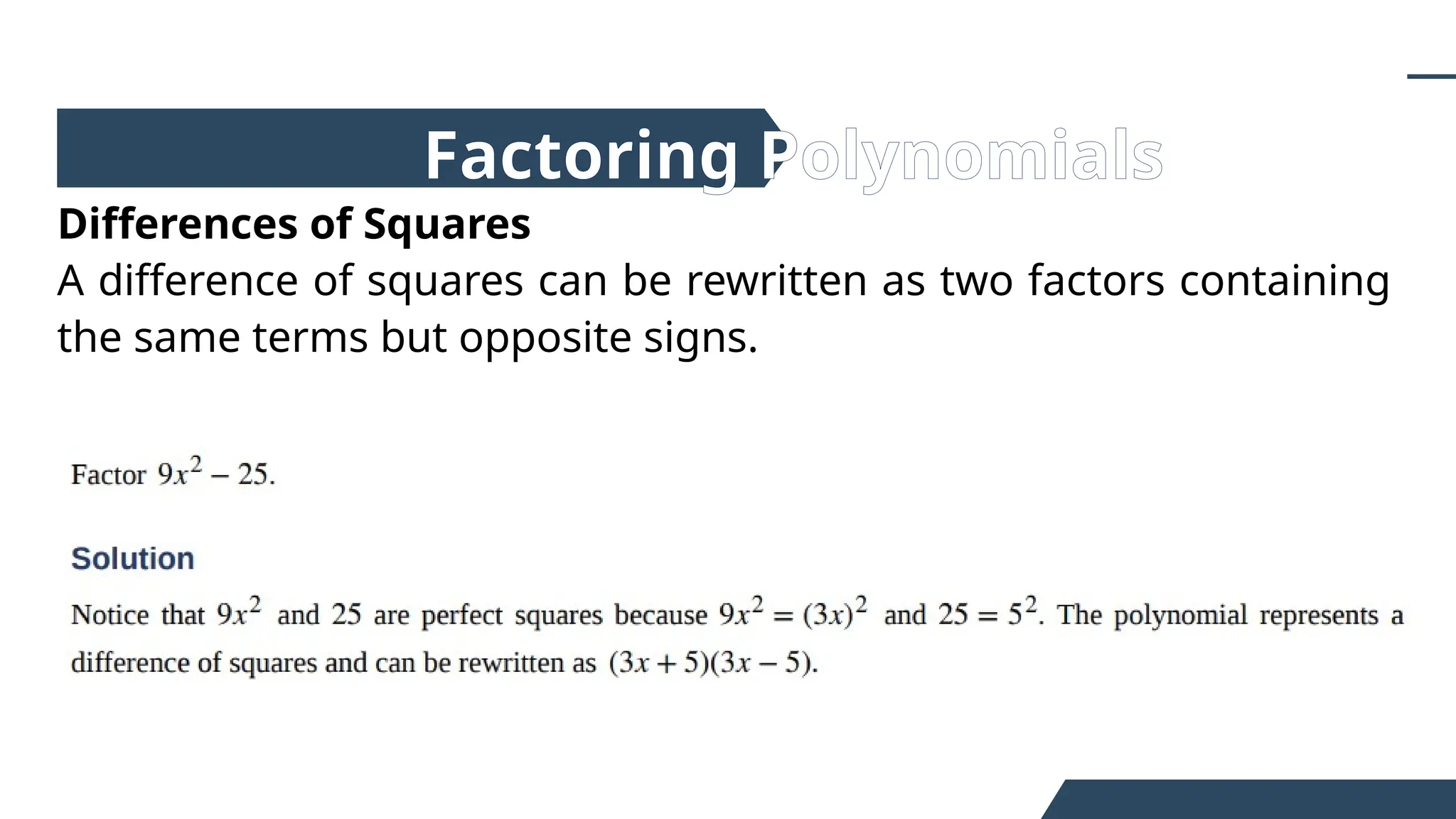
Difference of SquaresWhen a binomial is multiplied by a binomial
with the same terms separated by the opposite sign, the result is
the square of the first term minus the square of the last term.
Operations with polynomials
69.
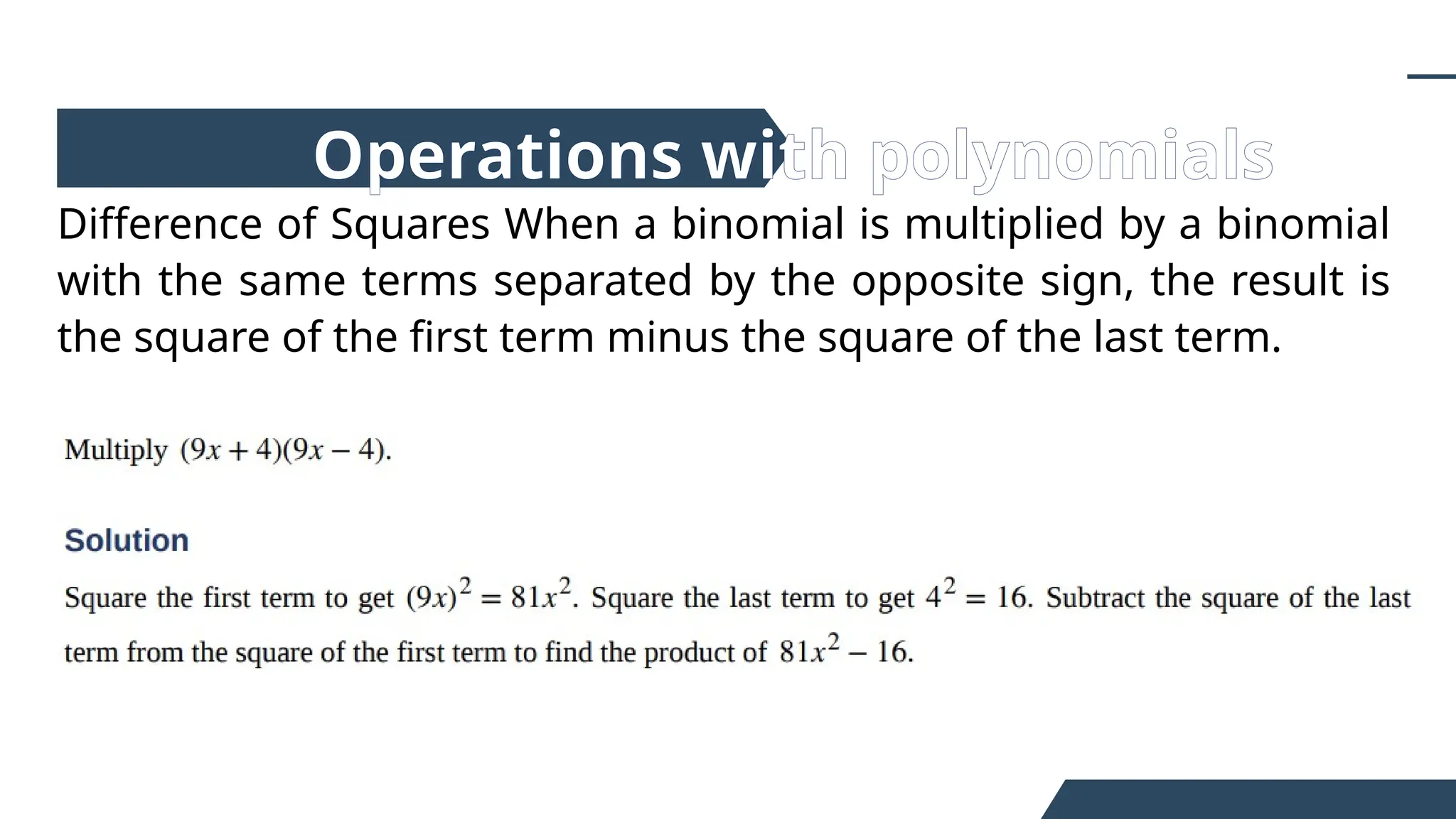
Difference of SquaresWhen a binomial is multiplied by a binomial
with the same terms separated by the opposite sign, the result is
the square of the first term minus the square of the last term.
Operations with polynomials
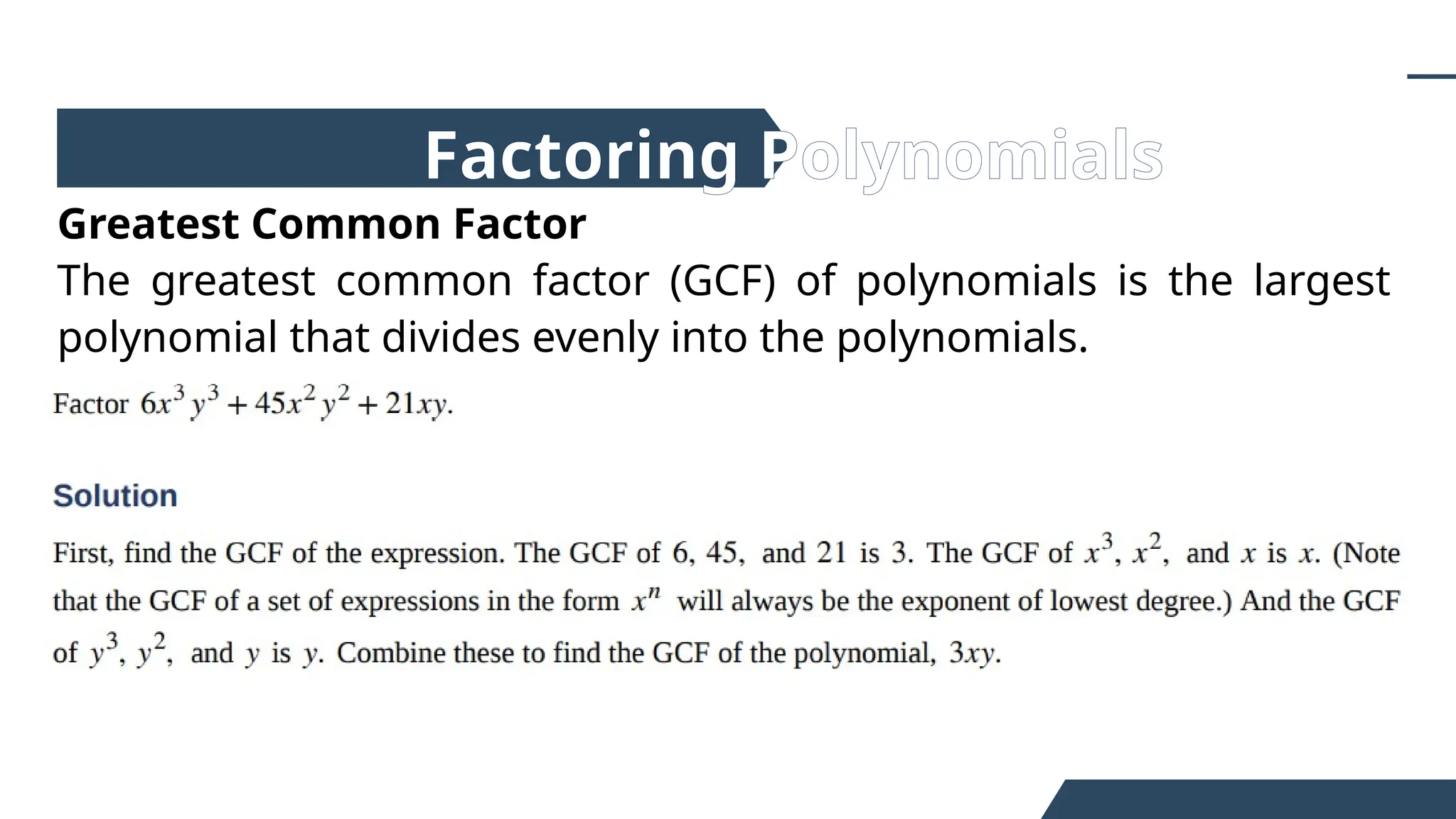
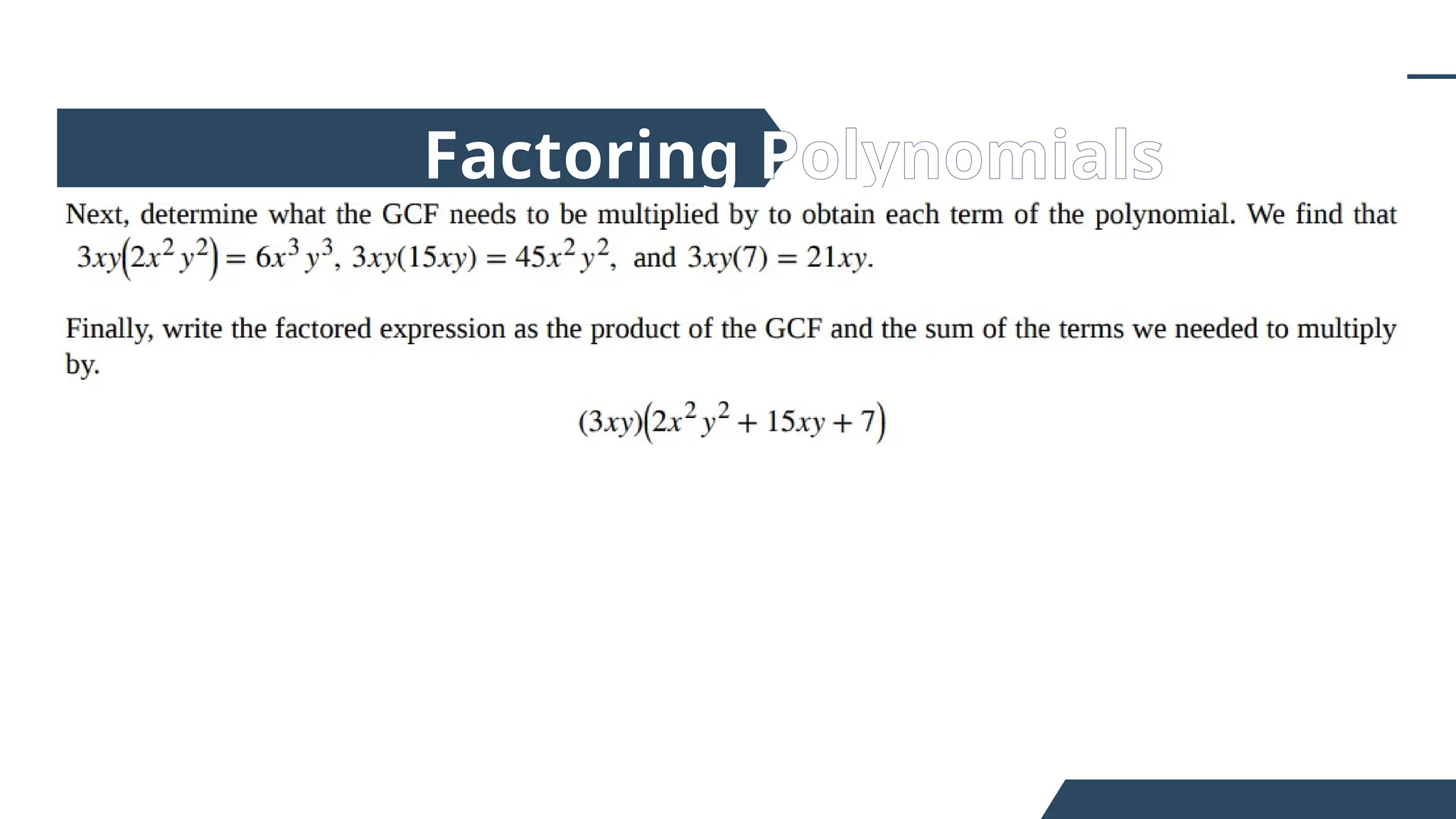
Greatest Common Factor
Thegreatest common factor (GCF) of polynomials is the largest
polynomial that divides evenly into the polynomials.
Factoring Polynomials
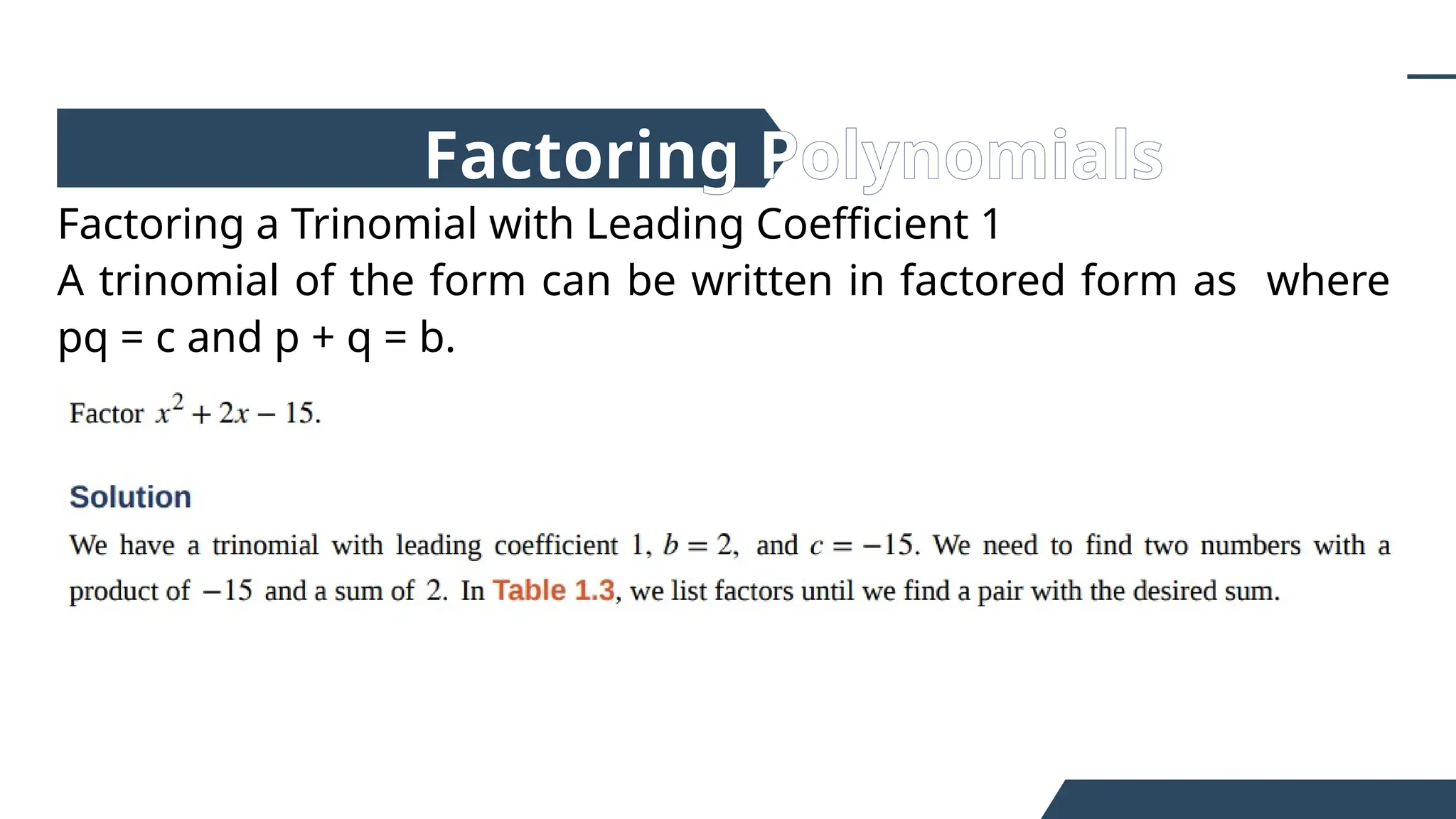
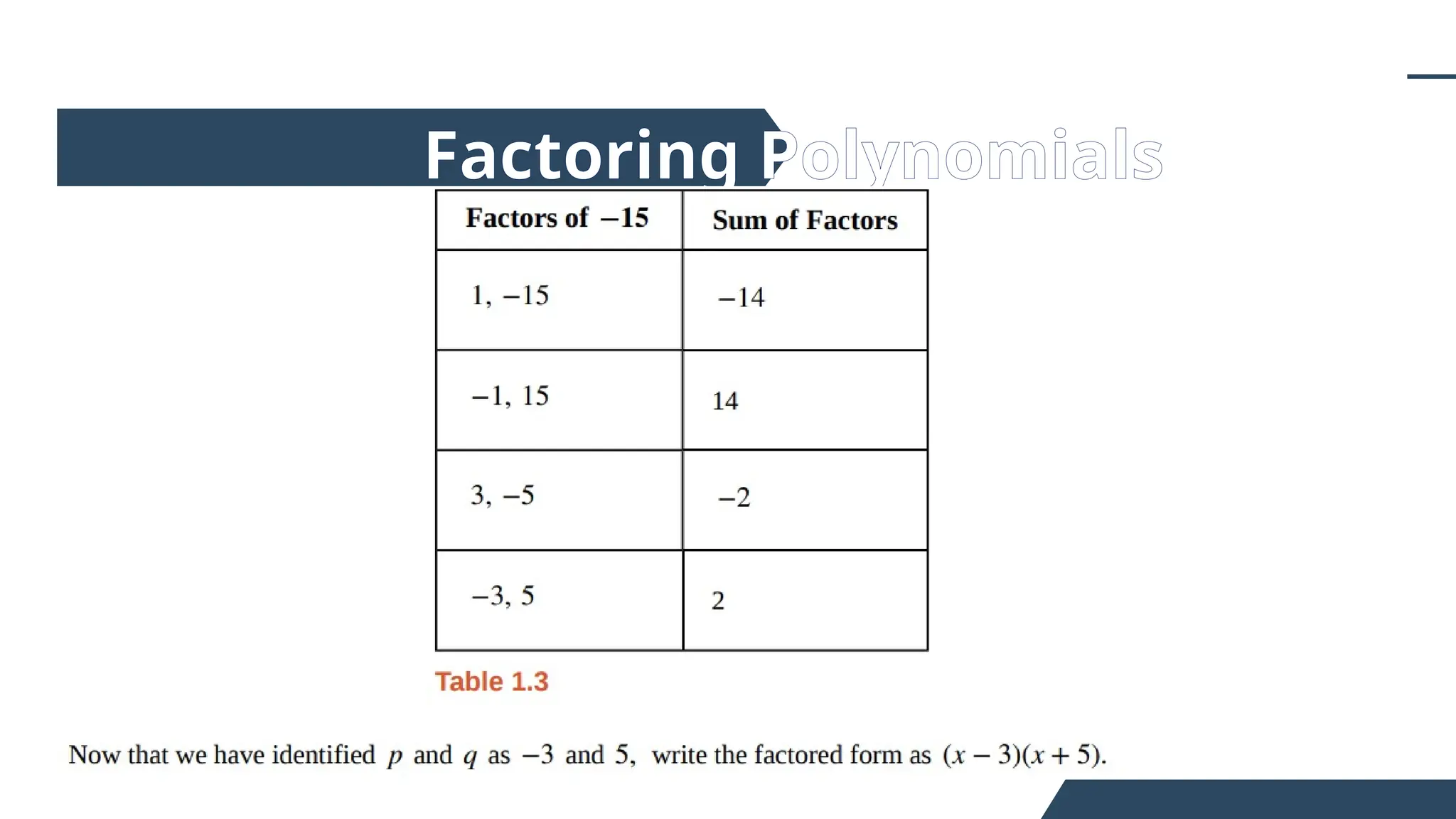
Factoring a Trinomialwith Leading Coefficient 1
A trinomial of the form can be written in factored form as where
pq = c and p + q = b.
Factoring Polynomials
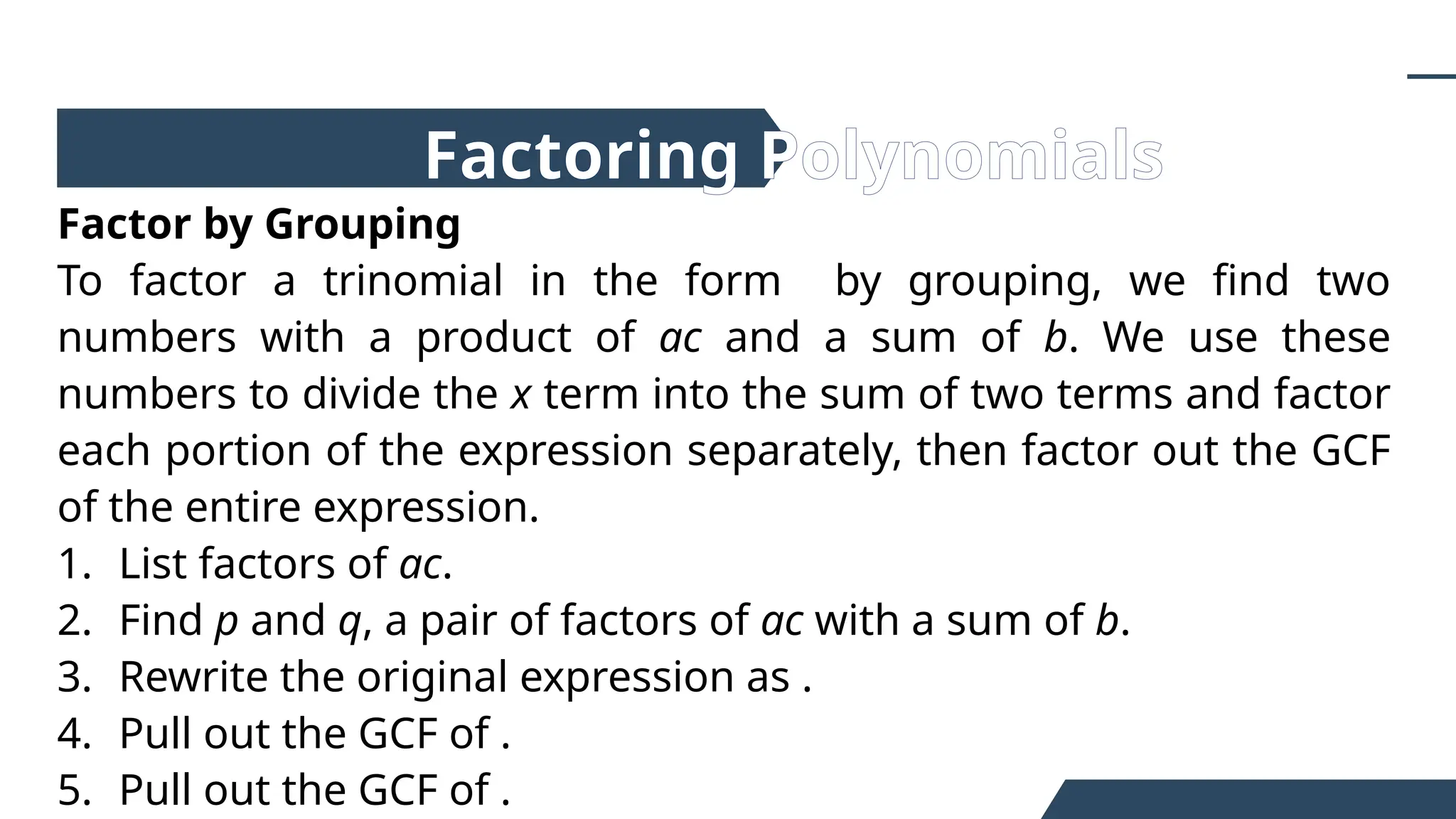
Factor by Grouping
Tofactor a trinomial in the form by grouping, we find two
numbers with a product of ac and a sum of b. We use these
numbers to divide the x term into the sum of two terms and factor
each portion of the expression separately, then factor out the GCF
of the entire expression.
1. List factors of ac.
2. Find p and q, a pair of factors of ac with a sum of b.
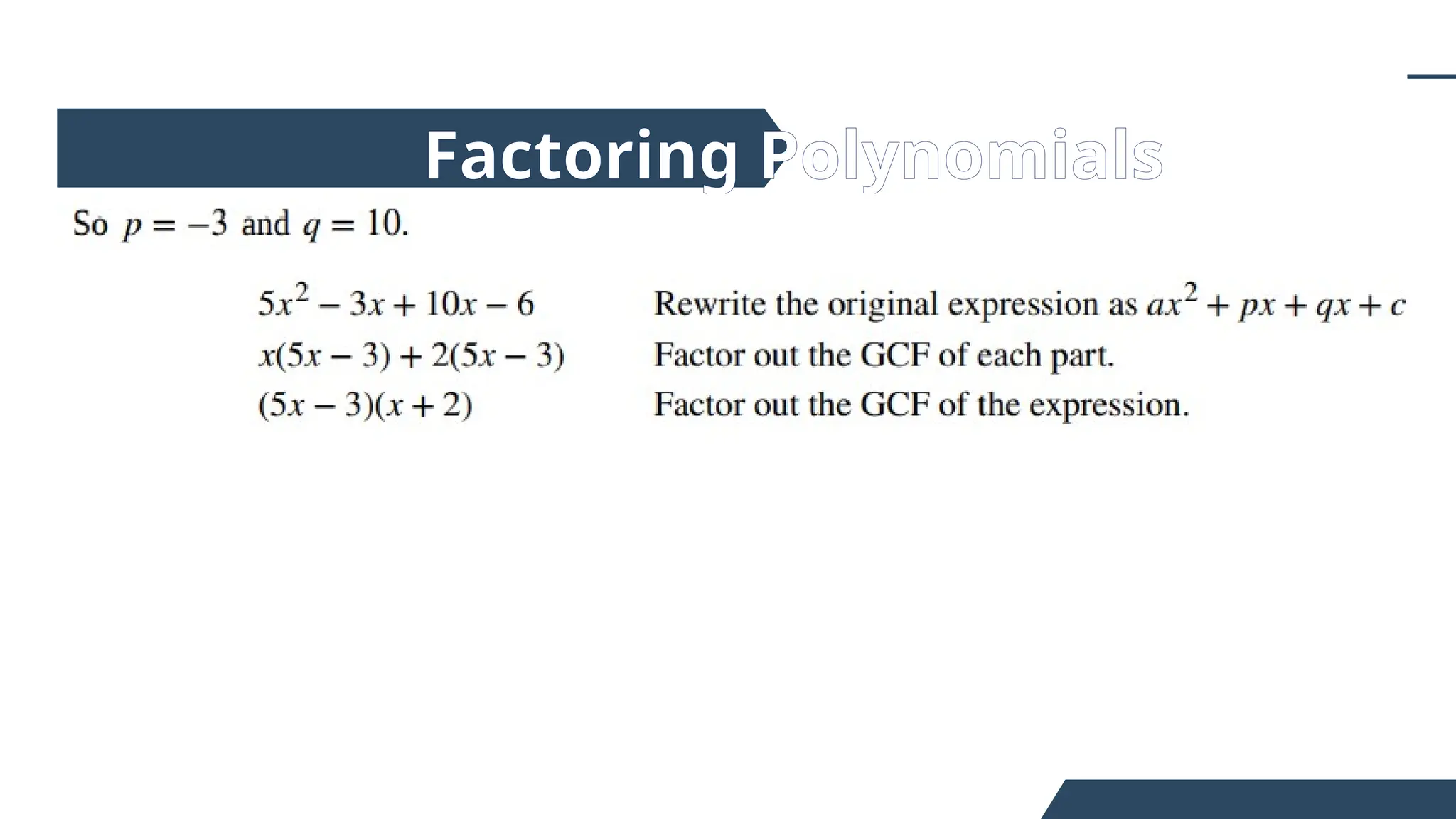
3. Rewrite the original expression as .
4. Pull out the GCF of .
5. Pull out the GCF of .
Factoring Polynomials
76.
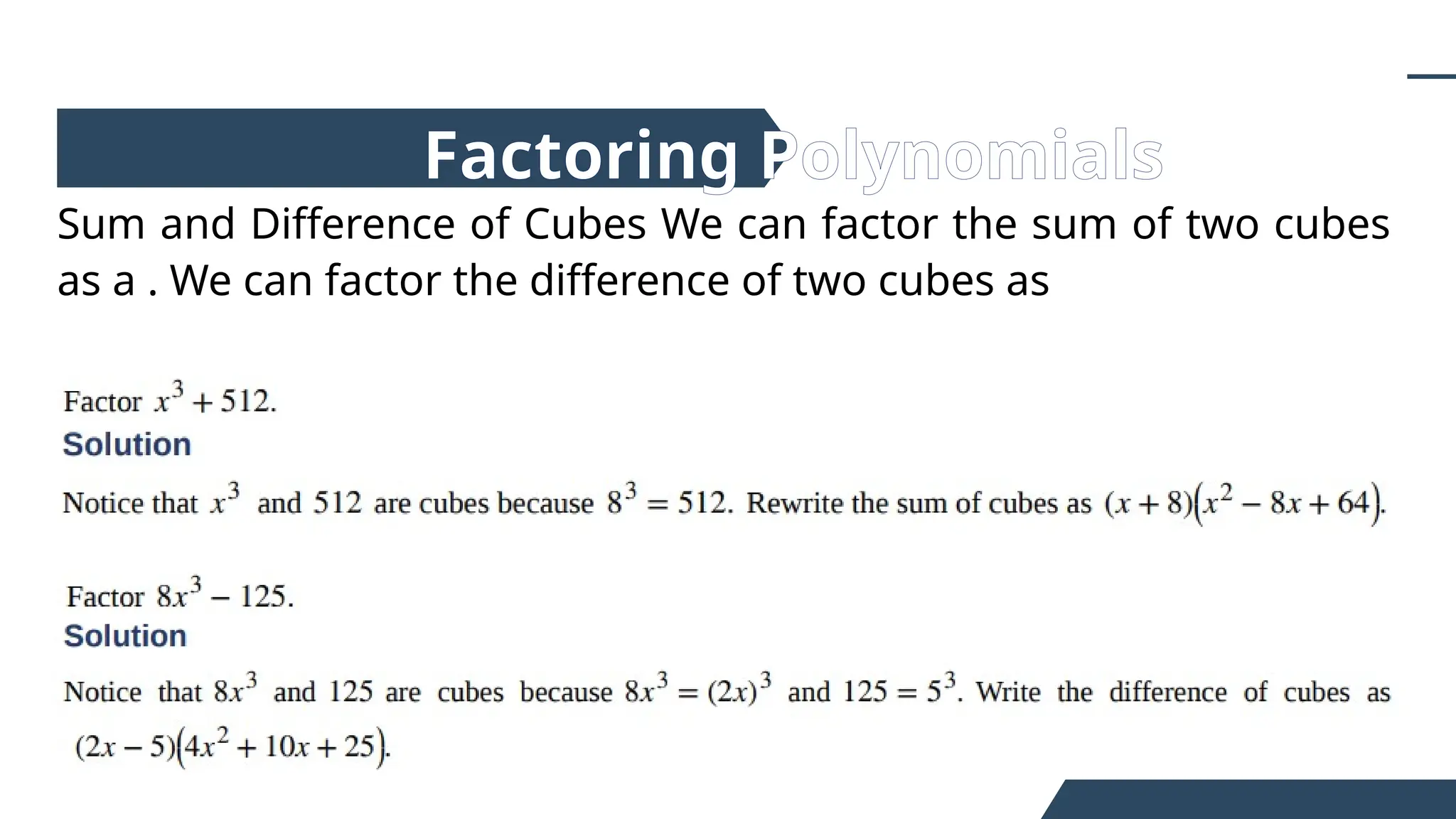
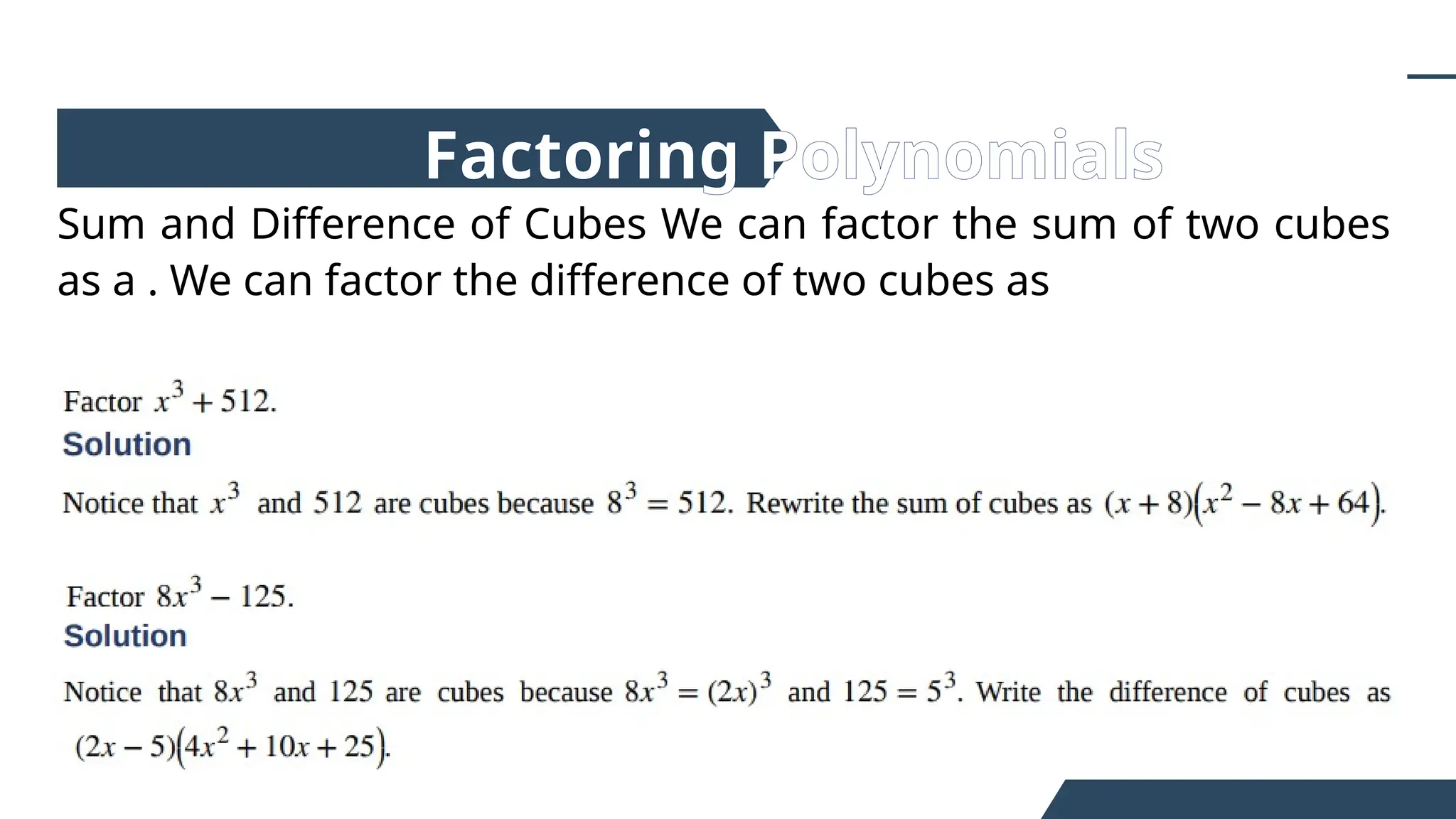
Factoring Polynomials
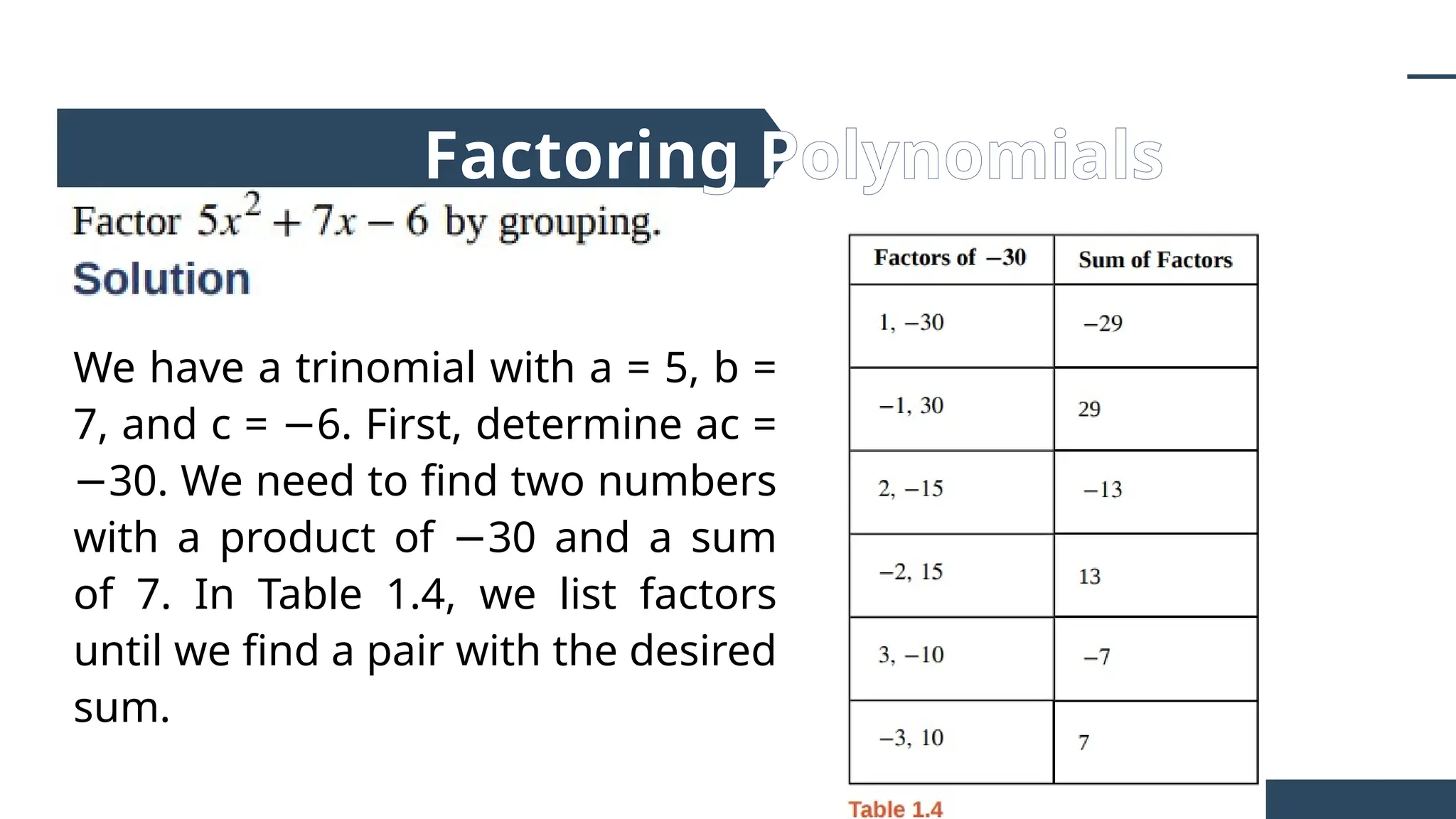
We havea trinomial with a = 5, b =
7, and c = 6. First, determine ac =
−
30. We need to find two numbers
−
with a product of 30 and a sum
−
of 7. In Table 1.4, we list factors
until we find a pair with the desired
sum.

![To evaluate a mathematical expression, we perform the various
operations. However, we do not perform them in any random order. We
use the order of operations. This is a sequence of rules for evaluating
such expressions.
Recall that in mathematics we use parentheses ( ), brackets [ ], and
braces { } to group numbers and expressions so that anything appearing
within the symbols is treated as a unit. Additionally, fraction bars, radicals,
and absolute value bars are treated as grouping symbols. When
evaluating a mathematical expression, begin by simplifying expressions
within grouping symbols.
Operations with Numbers](https://image.slidesharecdn.com/mfal1part11-251206063607-e5292258/75/MFA_L1_Part_1-1-pptx-bbbbbbbbbbbbbbbbbbbbbbbbbbbb-34-2048.jpg)




![Reading Techniques [Autosaved].pptxReading Techniques [Autosaved].pptx](https://cdn.slidesharecdn.com/ss_thumbnails/readingtechniquesautosaved-251211193055-b8821f9d-thumbnail.jpg?width=640&height=640&fit=bounds)


