ALGEB-X: REAL NUMBER SYSTEM 
MATH 101 
REAL NUMBERS 
Lecture by: Ms. Cherry Rose R. Estabillo 
MATH101 C. ESTABILLO
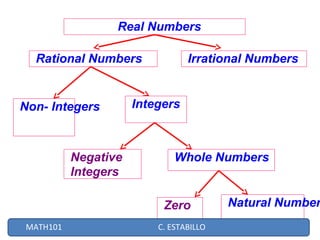
Real Numbers 
Rational Numbers 
Irrational Numbers 
Non- Integers 
Integers 
Negative 
Integers 
Whole Numbers 
Zero 
Natural Numbers 
MATH101 C. ESTABILLO
Real Numbers 
Rational Numbers 
Irrational Numbers 
Non- Integers 
Integers 
Negative 
Integers 
Whole Numbers 
Zero 
Natural Numbers 
MATH101 C. ESTABILLO
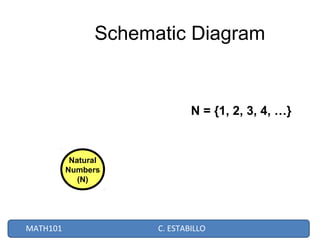
Schematic Diagram 
Natural 
Numbers 
(N) 
N = {1, 2, 3, 4, …} 
MATH101 C. ESTABILLO
Schematic Diagram 
Whole 
Numbers (W) 
Natural 
Numbers 
(N) 
W = {0, 1, 2, 3, 4, …} 
MATH101 C. ESTABILLO
Schematic Diagram 
Integers (Z) 
Whole 
Numbers (W) 
Natural 
Numbers 
(N) 
Z = {… -2, -1, 0, 1, 2, …} 
MATH101 C. ESTABILLO
Schematic Diagram 
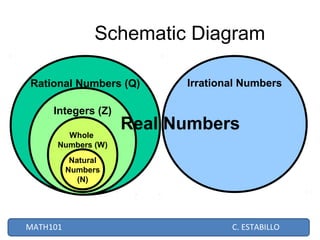
Rational Numbers (Q) 
Integers (Z) 
Whole 
Numbers (W) 
Natural 
Numbers 
(N) 
A rational number can be expressed 
as a quotient of two integers, a/b 
where b is not equal to 0. The set of 
rational numbers includes terminating 
and repeating decimals. 
Q = { … -3, … 0, … 3, … } 
-3.75 
5/7 
-2 
4.21 
MATH101 C. ESTABILLO
Schematic Diagram 
- 2 
Irrational Numbers 
3 3 
(Q’) Q’ = { … -3, … 0, … 3, … } 
-1.1234567890023… p 
An irrational number is a non-repeating, 
non-terminating decimal. 
MATH101 C. ESTABILLO
Schematic Diagram 
Rational Numbers (Q) 
Integers (Z) 
Whole 
Numbers (W) 
Natural 
Numbers 
(N) 
Irrational Numbers 
Real Numbers 
MATH101 C. ESTABILLO
Example 
Given: 
30, 3.14, 8 p i 
, 3,,2.71253...,0, 1 
2 
Name the set of non-integer, rational numbers. 
Name the set of irrational numbers. 
Name the set of integers. 
Name the set of whole numbers. 
Name the set of natural numbers. 
þ ý ü 
î í ì 
- - - ,25,9.253253...,2 ,- 81 
2 
, 
11 
MATH101 C. ESTABILLO
Properties of Real Numbers 
• Closure Property 
• Commutative Property 
• Associative Property 
• Distributive Property of Multiplication over 
Addition 
• Identity Property 
• Inverse Property 
• Zero Property 
MATH101 C. ESTABILLO
Name the axiom that justifies the ff. statement 
(30 ×5) × 20 = 20 × (30 ×5) 
(4 + x) ×(2 + x) = 4×(2 + x) + x ×(2 + x) 
x + (5 +13) = ( x + 5) +13 
0 + (50 + 40) = 50 + 40 
7 + 3ÎÂ 
MATH101 C. ESTABILLO
Application 
• Is the action of undressing and taking a bath 
commutative? 
• Is the action of tying your left shoe and tying 
your right shoe commutative? 
MATH101 C. ESTABILLO
ORDER OF OPERATIONS 
P E M D A S 
MATH101 C. ESTABILLO
EXAMPLES 
1.) 56 ÷ 23 x 7 –1 + 3 x 8 
2.) 
( ) 
¸ × + × 
40 2 3 4 2 
- × ¸ + - 
( 3) 8 4 (1 3) 
MATH101 C. ESTABILLO

Real Numbers

  • 1.
    ALGEB-X: REAL NUMBERSYSTEM MATH 101 REAL NUMBERS Lecture by: Ms. Cherry Rose R. Estabillo MATH101 C. ESTABILLO
  • 2.
    Real Numbers RationalNumbers Irrational Numbers Non- Integers Integers Negative Integers Whole Numbers Zero Natural Numbers MATH101 C. ESTABILLO
  • 3.
    Real Numbers RationalNumbers Irrational Numbers Non- Integers Integers Negative Integers Whole Numbers Zero Natural Numbers MATH101 C. ESTABILLO
  • 4.
    Schematic Diagram Natural Numbers (N) N = {1, 2, 3, 4, …} MATH101 C. ESTABILLO
  • 5.
    Schematic Diagram Whole Numbers (W) Natural Numbers (N) W = {0, 1, 2, 3, 4, …} MATH101 C. ESTABILLO
  • 6.
    Schematic Diagram Integers(Z) Whole Numbers (W) Natural Numbers (N) Z = {… -2, -1, 0, 1, 2, …} MATH101 C. ESTABILLO
  • 7.
    Schematic Diagram RationalNumbers (Q) Integers (Z) Whole Numbers (W) Natural Numbers (N) A rational number can be expressed as a quotient of two integers, a/b where b is not equal to 0. The set of rational numbers includes terminating and repeating decimals. Q = { … -3, … 0, … 3, … } -3.75 5/7 -2 4.21 MATH101 C. ESTABILLO
  • 8.
    Schematic Diagram -2 Irrational Numbers 3 3 (Q’) Q’ = { … -3, … 0, … 3, … } -1.1234567890023… p An irrational number is a non-repeating, non-terminating decimal. MATH101 C. ESTABILLO
  • 9.
    Schematic Diagram RationalNumbers (Q) Integers (Z) Whole Numbers (W) Natural Numbers (N) Irrational Numbers Real Numbers MATH101 C. ESTABILLO
  • 10.
    Example Given: 30,3.14, 8 p i , 3,,2.71253...,0, 1 2 Name the set of non-integer, rational numbers. Name the set of irrational numbers. Name the set of integers. Name the set of whole numbers. Name the set of natural numbers. þ ý ü î í ì - - - ,25,9.253253...,2 ,- 81 2 , 11 MATH101 C. ESTABILLO
  • 11.
    Properties of RealNumbers • Closure Property • Commutative Property • Associative Property • Distributive Property of Multiplication over Addition • Identity Property • Inverse Property • Zero Property MATH101 C. ESTABILLO
  • 12.
    Name the axiomthat justifies the ff. statement (30 ×5) × 20 = 20 × (30 ×5) (4 + x) ×(2 + x) = 4×(2 + x) + x ×(2 + x) x + (5 +13) = ( x + 5) +13 0 + (50 + 40) = 50 + 40 7 + 3ÎÂ MATH101 C. ESTABILLO
  • 13.
    Application • Isthe action of undressing and taking a bath commutative? • Is the action of tying your left shoe and tying your right shoe commutative? MATH101 C. ESTABILLO
  • 14.
    ORDER OF OPERATIONS P E M D A S MATH101 C. ESTABILLO
  • 15.
    EXAMPLES 1.) 56÷ 23 x 7 –1 + 3 x 8 2.) ( ) ¸ × + × 40 2 3 4 2 - × ¸ + - ( 3) 8 4 (1 3) MATH101 C. ESTABILLO

Editor's Notes

  • #9 All sample numbers should be in magenta
  • #19 Place link pointing to property, definition and example
  • #20 Place link pointing to property, definition and example
  • #21 Place link pointing to property, definition and example
  • #22 Place link pointing to property, definition and example
  • #23 Place link pointing to property, definition and example
  • #24 Place link pointing to property, definition and example
  • #25 Change 1/a to horizontal form using Equation editor
  • #26 Place link pointing to property, definition and example