A NUMBER ANDA NUMERAL
A number is a concept for a value.
A numeral is a representation of that concept.
Example:
If you hear someone say the number 3, you
conceive the number in your mind, which
makes you understand ‘how many’. When this
same number is written down on paper – like
“3” – then it becomes a representation of that
concept.
3.
A NUMBER ANDA NUMERAL
Question: Should this number be written
in figures or in words?
Answer: In general parlance, a numeral is one
that is written in figures, and a
number is one that is spelled out.
4.
A NUMBER ANDA NUMERAL
Question: When should a number be written
figures, and when should it be spelled out?
Answer: It all depends on the situation, but
there are some basic rules. These are:
1. Small numbers are spelled out,
and big numbers are written in figures.
2. Never begin a sentence with a numeral.
5.
A NUMBER ANDA NUMERAL
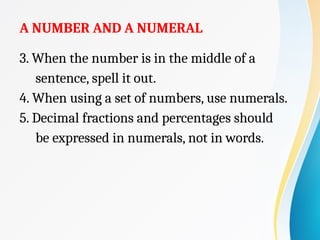
3. When the number is in the middle of a
sentence, spell it out.
4. When using a set of numbers, use numerals.
5. Decimal fractions and percentages should
be expressed in numerals, not in words.
6.
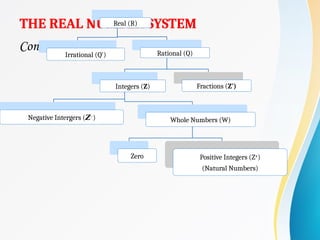
THE REAL NUMBERSYSTEM
Concept Map
Real (R)
Irrational (Q') Rational (Q)
Integers (Z)
Negative Intergers (𝒁−
) Whole Numbers (W)
Zero Positive Integers (Z+
)
(Natural Numbers)
Fractions (Z')
7.
THE SET ofNATURAL NUMBERS
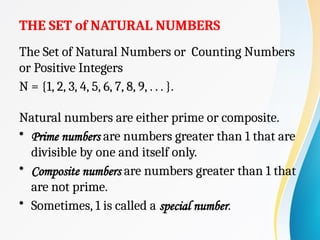
The Set of Natural Numbers or Counting Numbers
or Positive Integers
N = {1, 2, 3, 4, 5, 6, 7, 8, 9, . . . }.
Natural numbers are either prime or composite.
• Prime numbers are numbers greater than 1 that are
divisible by one and itself only.
• Composite numbers are numbers greater than 1 that
are not prime.
• Sometimes, 1 is called a special number.
8.
THE SET ofNATURAL NUMBERS
Fundamental Theorem of Arithmetic.
• Every composite number can be uniquely
expressed as a product of prime factors, except
for the order in which they are written as
factors.
Example:
9.
THE SET ofNATURAL NUMBERS
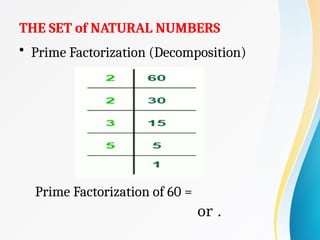
• Prime Factorization (Decomposition)
Prime Factorization of 60 =
or .
10.
THE SET ofNATURAL NUMBERS
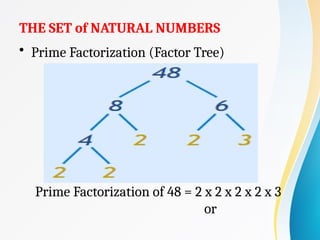
• Prime Factorization (Factor Tree)
Prime Factorization of 48 = 2 x 2 x 2 x 2 x 3
or
11.
THE SET ofWHOLE NUMBERS
W = the set of natural numbers together with
zero = {0, 1, 2, 3, . . . }.
• Even numbers are numbers that are divisible by
2 or when their last digit is o, 2, 4, 6, or 8.
• Odd numbers are numbers that is not a multiple
of two. If it is divided by 2 the result is a
fraction.
12.
OPERATIONS ON WHOLENUMBERS
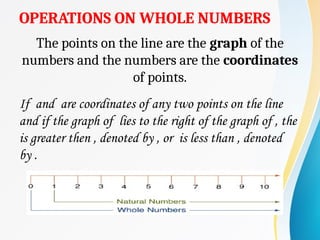
The points on the line are the graph of the
numbers and the numbers are the coordinates
of points.
If and are coordinates of any two points on the line
and if the graph of lies to the right of the graph of , the
is greater then , denoted by , or is less than , denoted
by .
13.
OPERATIONS ON WHOLENUMBERS
Addition of Whole Numbers
For any two whole numbers a and b there exists
a unique whole number called their sum. The
sum of two numbers a and b is denoted by a +
b. These two numbers a and b are called
addends or terms of the sum.
14.
OPERATIONS ON WHOLENUMBERS
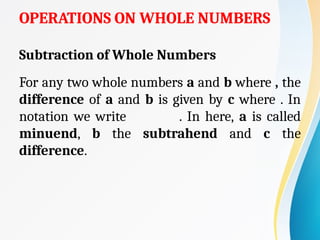
Subtraction of Whole Numbers
For any two whole numbers a and b where , the
difference of a and b is given by c where . In
notation we write . In here, a is called
minuend, b the subtrahend and c the
difference.
15.
OPERATIONS ON WHOLENUMBERS
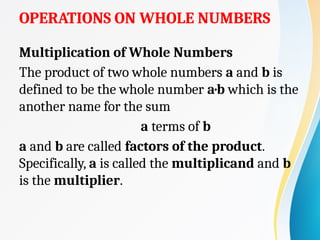
Multiplication of Whole Numbers
The product of two whole numbers a and b is
defined to be the whole number a·b which is the
another name for the sum
a terms of b
a and b are called factors of the product.
Specifically, a is called the multiplicand and b
is the multiplier.
16.
OPERATIONS ON WHOLENUMBERS
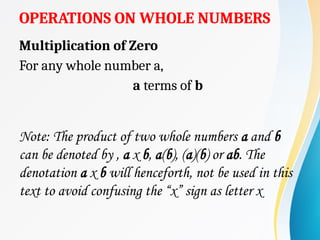
Multiplication of Zero
For any whole number a,
a terms of b
Note: The product of two whole numbers a and b
can be denoted by , a x b, a(b), (a)(b) or ab. The
denotation a x b will henceforth, not be used in this
text to avoid confusing the “x” sign as letter x
17.
OPERATIONS ON WHOLENUMBERS
Division of Whole Numbers
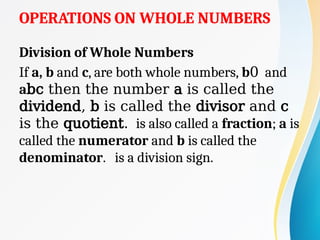
If a, b and c, are both whole numbers, b0 and
abc then the number a is called the
dividend, b is called the divisor and c
is the quotient. is also called a fraction; a is
called the numerator and b is called the
denominator. is a division sign.
18.
THE SET ofINTEGERS
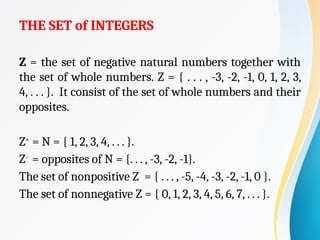
Z = the set of negative natural numbers together with
the set of whole numbers. Z = { . . . , -3, -2, -1, 0, 1, 2, 3,
4, . . . }. It consist of the set of whole numbers and their
opposites.
Z+
= N = { 1, 2, 3, 4, . . . }.
Z-
= opposites of N = {. . . , -3, -2, -1}.
The set of nonpositive Z = { . . . , -5, -4, -3, -2, -1, 0 }.
The set of nonnegative Z = { 0, 1, 2, 3, 4, 5, 6, 7, . . . }.
19.
THE SET ofINTEGERS
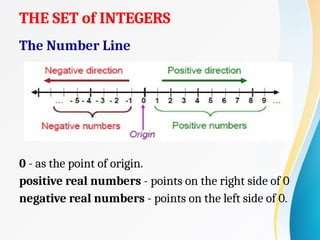
The Number Line
0 - as the point of origin.
positive real numbers - points on the right side of 0
negative real numbers - points on the left side of 0.
20.
THE SET ofINTEGERS
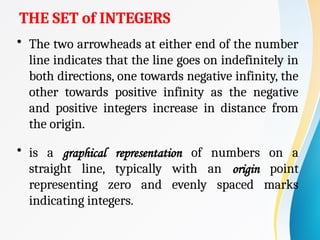
• The two arrowheads at either end of the number
line indicates that the line goes on indefinitely in
both directions, one towards negative infinity, the
other towards positive infinity as the negative
and positive integers increase in distance from
the origin.
• is a graphical representation of numbers on a
straight line, typically with an origin point
representing zero and evenly spaced marks
indicating integers.
21.
THE SET ofINTEGERS
A number preceded by a plus sign (+) is called a positive
number while a number preceded by a negative sign (–)
is called a negative number. However, if the sign of the
number is not indicated, it is considered positive.
Note:
• numbers are arranged sequentially at equal distances .
• numbers to the left are less than those to the right.
• a number line can extend infinitely in both
directions.
22.
THE SET ofINTEGERS
• There is no smallest and largest integer.
• The largest negative integer is -1.
• Every negative integer is smaller than zero.
• Every positive integers is bigger than zero.
• Along the real number line, the infinite set of
integers increases from left to right.
• Zero is neither positive nor negative integer.
23.
THE SET ofINTEGERS
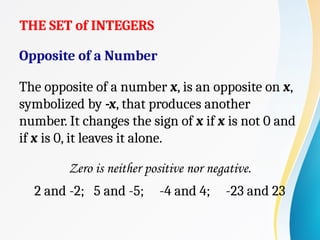
Opposite of a Number
The opposite of a number x, is an opposite on x,
symbolized by -x, that produces another
number. It changes the sign of x if x is not 0 and
if x is 0, it leaves it alone.
Zero is neither positive nor negative.
2 and -2; 5 and -5; -4 and 4; -23 and 23
24.
THE SET ofINTEGERS
Comparing and Ordering Integers
A number line is used to order numbers. As we
move to the right along the number line, the
numbers increases in value and as we move to
the left, the numbers decrease in value.
25.
THE SET ofINTEGERS
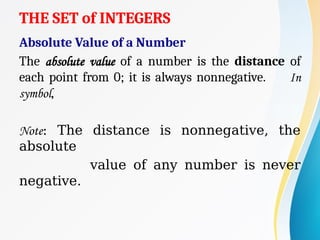
Absolute Value of a Number
The absolute value of a number is the distance of
each point from 0; it is always nonnegative. In
symbol,
Note: The distance is nonnegative, the
absolute
value of any number is never
negative.
26.
THE SET OFINTEGERS
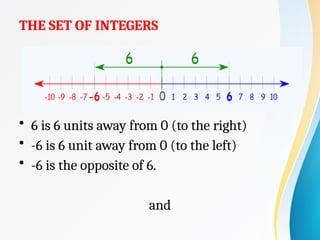
• 6 is 6 units away from 0 (to the right)
• -6 is 6 unit away from 0 (to the left)
• -6 is the opposite of 6.
and
27.
ABSOLUTE VALUE OFA NUMBER
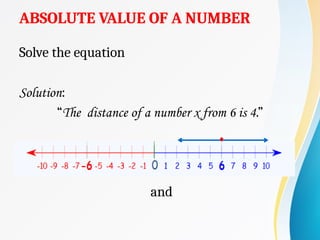
Solve the equation
Solution:
“The distance of a number x from 6 is 4.”
and
28.
ABSOLUTE VALUE OFA NUMBER
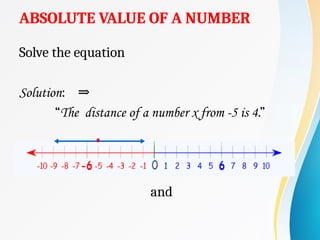
Solve the equation
Solution: ⇒
“The distance of a number x from -5 is 4.”
and
29.
PROPERTIES OF REALNUMBERS
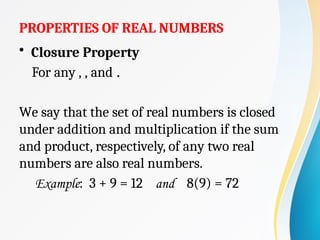
• Closure Property
For any , , and .
We say that the set of real numbers is closed
under addition and multiplication if the sum
and product, respectively, of any two real
numbers are also real numbers.
Example: 3 + 9 = 12 and 8(9) = 72
30.
PROPERTIES OF REALNUMBERS
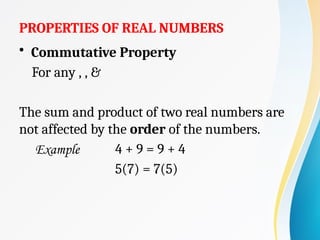
• Commutative Property
For any , , &
The sum and product of two real numbers are
not affected by the order of the numbers.
Example 4 + 9 = 9 + 4
5(7) = 7(5)
31.
PROPERTIES OF REALNUMBERS
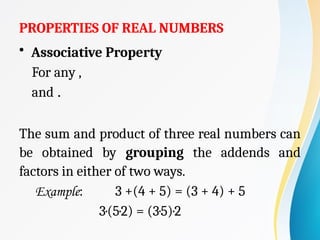
• Associative Property
For any ,
and .
The sum and product of three real numbers can
be obtained by grouping the addends and
factors in either of two ways.
Example: 3 +(4 + 5) = (3 + 4) + 5
3·(5·2) = (3·5)·2
32.
PROPERTIES OF REALNUMBERS
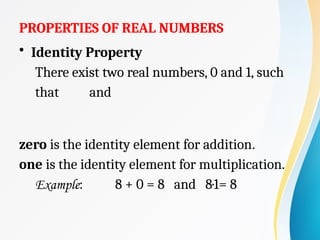
• Identity Property
There exist two real numbers, 0 and 1, such
that and
zero is the identity element for addition.
one is the identity element for multiplication.
Example: 8 + 0 = 8 and 8·1= 8
33.
PROPERTIES OF REALNUMBERS
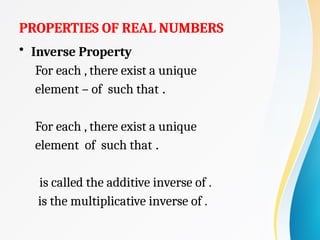
• Inverse Property
For each , there exist a unique
element – of such that .
For each , there exist a unique
element of such that .
is called the additive inverse of .
is the multiplicative inverse of .
34.
PROPERTIES OF REALNUMBERS
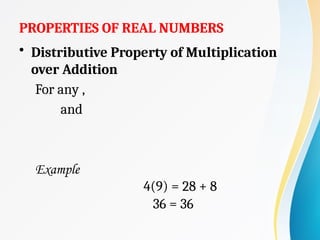
• Distributive Property of Multiplication
over Addition
For any ,
and
Example
4(9) = 28 + 8
36 = 36
35.
ADDITION OF INTEGERS
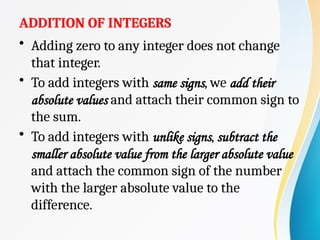
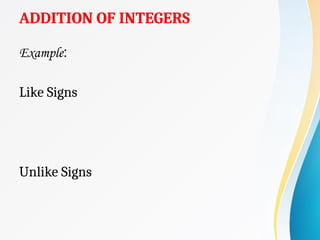
•Adding zero to any integer does not change
that integer.
• To add integers with same signs, we add their
absolute values and attach their common sign to
the sum.
• To add integers with unlike signs, subtract the
smaller absolute value from the larger absolute value
and attach the common sign of the number
with the larger absolute value to the
difference.
SUBTRACTION OF INTEGERS
•the process of adding the negative of
the subtrahend to the minuend.
• change the sign of the subtrahend
and proceed as in addition of signed
numbers.
Example:
38.
MULTIPLICATION OF INTEGERS
•Multiplying any integer by 0
produces 0.
• The product of two numbers with
like signs is positive, while the
product of two numbers with unlike
signs is negative.
• The indicated product of an even
number of negative factors is
positive, while the indicated
product of an odd number of
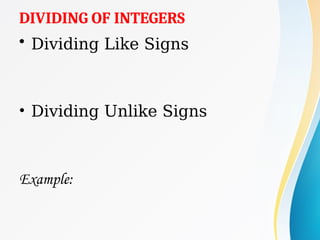
DIVISION OF INTEGERS
•Dividing 0 by any nonzero integers is 0.
Dividing any integer by 0 is not defined.
• Dividing two integers with like signs,
divide the absolute values of the two
integers.
• Dividing two integers with unlike signs,
take the quotient of the absolute values
of the two integers and get the opposite
of this quotient.
41.
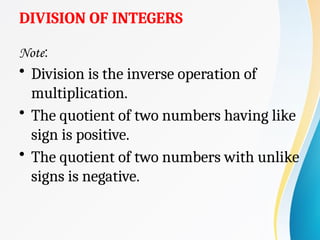
DIVISION OF INTEGERS
Note:
•Division is the inverse operation of
multiplication.
• The quotient of two numbers having like
sign is positive.
• The quotient of two numbers with unlike
signs is negative.
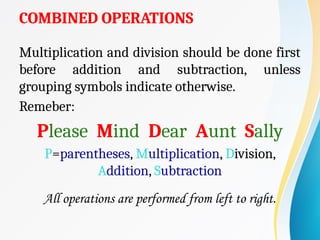
COMBINED OPERATIONS
Multiplication anddivision should be done first
before addition and subtraction, unless
grouping symbols indicate otherwise.
Remeber:
Please Mind Dear Aunt Sally
P=parentheses, Multiplication, Division,
Addition, Subtraction
All operations are performed from left to right.
44.
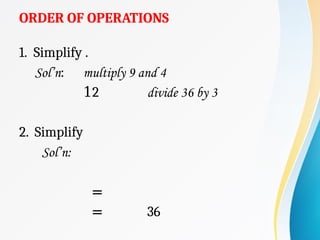
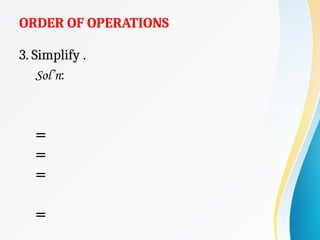
ORDER OF OPERATIONS
1.Simplify .
Sol’n: multiply 9 and 4
12 divide 36 by 3
2. Simplify
Sol’n:
=
= 36