


Comparison of Matrix Completion Algorithms
for Background Initialization in Videos
Andrews Sobral, Thierry Bouwmans and El-hadi ZahZah
Ph.D. Student, Computer Vision
Lab. L3I/MIA – University of La Rochelle, France
Summary
▪ Context
▪ Understanding an Intelligent Video Surveillance Framework
▪ Introduction to Background Subtraction
▪ Background Model Initialization Problem
▪ Matrix Completion
▪ Proposed Approach
▪ Experimental results
▪ Conclusions
!
Video Content Analysis
(VCA) or Video Analytics
Behavior
Analysis
Image
acquisition and
preprocessing
Object
Detection
Object
Tracking
event location
Intrusion
detection
Collision
prevention
Target detection
and tracking
Anomaly
detection
Target behavior
analysis
Traffic data
collection and
analysis
activity report
Understanding an Intelligent Video Surveillance Framework
supervisor
Behind the Scenes of an Intelligent Video Surveillance
Framework
!
Example of automatic
incident detection
our focus
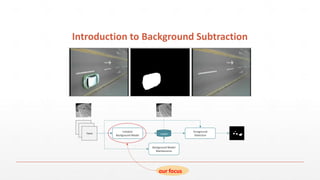
Introduction to Background Subtraction
Initialize
Background Model
frame model
Foreground
Detection
Background Model
Maintenance
our focus
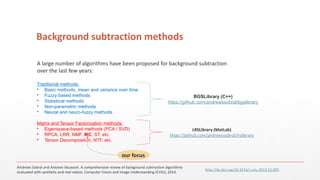
Background subtraction methods
Traditional methods:
• Basic methods, mean and variance over time
• Fuzzy based methods
• Statistical methods
• Non-parametric methods
• Neural and neuro-fuzzy methods
Matrix and Tensor Factorization methods:
• Eigenspace-based methods (PCA / SVD)
• RPCA, LRR, NMF, MC, ST, etc.
• Tensor Decomposition, NTF, etc.
BGSLibrary (C++)
https://github.com/andrewssobral/bgslibrary
A large number of algorithms have been proposed for background subtraction
over the last few years:
LRSLibrary (MatLab)
https://github.com/andrewssobral/lrslibrary
our focus
Andrews Sobral and Antoine Vacavant. A comprehensive review of background subtraction algorithms
evaluated with synthetic and real videos. Computer Vision and Image Understanding (CVIU), 2014.
http://dx.doi.org/10.1016/j.cviu.2013.12.005
Introduction to Matrix Completion (MC)
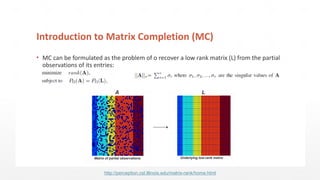
▪ MC can be formulated as the problem of o recover a low rank matrix (L) from the partial
observations of its entries:
L
Underlying low-rank matrix
A
Matrix of partial observations
http://perception.csl.illinois.edu/matrix-rank/home.html
Applying MC for Background Model Initialization
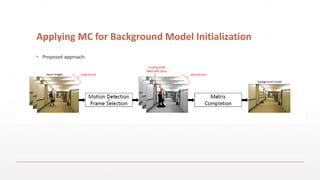
▪ Proposed approach:
Motion Detection and Frame Selection
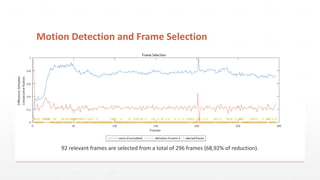
92 relevant frames are selected from a total of 296 frames (68,92% of reduction).
Matrix Completion Process
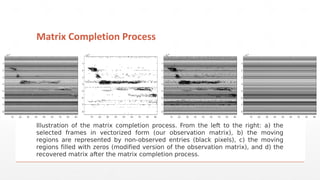
Illustration of the matrix completion process. From the left to the right: a) the
selected frames in vectorized form (our observation matrix), b) the moving
regions are represented by non-observed entries (black pixels), c) the moving
regions filled with zeros (modified version of the observation matrix), and d) the
recovered matrix after the matrix completion process.
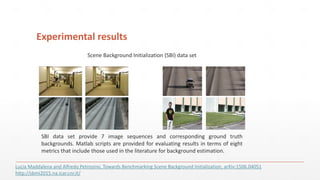
Experimental results
Scene Background Initialization (SBI) data set
SBI data set provide 7 image sequences and corresponding ground truth
backgrounds. Matlab scripts are provided for evaluating results in terms of eight
metrics that include those used in the literature for background estimation.
Lucia Maddalena and Alfredo Petrosino, Towards Benchmarking Scene Background Initialization, arXiv:1506.04051
http://sbmi2015.na.icar.cnr.it/
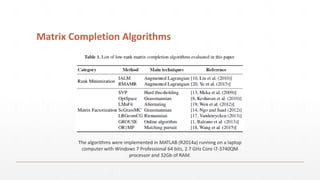
Matrix Completion Algorithms
The algorithms were implemented in MATLAB (R2014a) running on a laptop
computer with Windows 7 Professional 64 bits, 2.7 GHz Core i7-3740QM
processor and 32Gb of RAM.
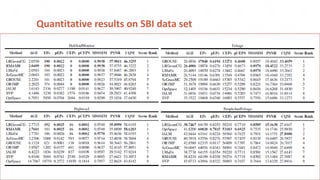
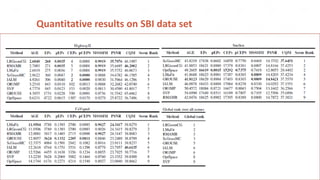
Quantitative results on SBI data set
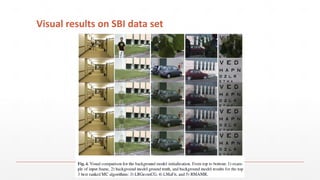
Visual results on SBI data set
Conclusions
▪ The key idea is to eliminate the redundant frames, and consider its moving regions as
non-observed values. This approach results in a matrix completion problem, and the
background model can be recovered even with the presence of missing entries.
▪ The experimental results on the SBI data set shows the comparative evaluation of these
recent methods, and highlights the good performance of LRGeomCG method over its
direct competitors.
▪ Future research may concern to evaluate incremental and real-time approaches of
matrix completion algorithm applied in streaming videos.
▪ MATLAB codes available: https://sites.google.com/site/mc4bmi/
Comparison of Matrix Completion Algorithms for Background Initialization in Videos

Comparison of Matrix Completion Algorithms for Background Initialization in Videos

  • 1.
    Comparison of MatrixCompletion Algorithms for Background Initialization in Videos Andrews Sobral, Thierry Bouwmans and El-hadi ZahZah Ph.D. Student, Computer Vision Lab. L3I/MIA – University of La Rochelle, France
  • 2.
    Summary ▪ Context ▪ Understandingan Intelligent Video Surveillance Framework ▪ Introduction to Background Subtraction ▪ Background Model Initialization Problem ▪ Matrix Completion ▪ Proposed Approach ▪ Experimental results ▪ Conclusions
  • 3.
    ! Video Content Analysis (VCA)or Video Analytics Behavior Analysis Image acquisition and preprocessing Object Detection Object Tracking event location Intrusion detection Collision prevention Target detection and tracking Anomaly detection Target behavior analysis Traffic data collection and analysis activity report Understanding an Intelligent Video Surveillance Framework supervisor Behind the Scenes of an Intelligent Video Surveillance Framework ! Example of automatic incident detection our focus
  • 4.
    Introduction to BackgroundSubtraction Initialize Background Model frame model Foreground Detection Background Model Maintenance our focus
  • 5.
    Background subtraction methods Traditionalmethods: • Basic methods, mean and variance over time • Fuzzy based methods • Statistical methods • Non-parametric methods • Neural and neuro-fuzzy methods Matrix and Tensor Factorization methods: • Eigenspace-based methods (PCA / SVD) • RPCA, LRR, NMF, MC, ST, etc. • Tensor Decomposition, NTF, etc. BGSLibrary (C++) https://github.com/andrewssobral/bgslibrary A large number of algorithms have been proposed for background subtraction over the last few years: LRSLibrary (MatLab) https://github.com/andrewssobral/lrslibrary our focus Andrews Sobral and Antoine Vacavant. A comprehensive review of background subtraction algorithms evaluated with synthetic and real videos. Computer Vision and Image Understanding (CVIU), 2014. http://dx.doi.org/10.1016/j.cviu.2013.12.005
  • 6.
    Introduction to MatrixCompletion (MC) ▪ MC can be formulated as the problem of o recover a low rank matrix (L) from the partial observations of its entries: L Underlying low-rank matrix A Matrix of partial observations http://perception.csl.illinois.edu/matrix-rank/home.html
  • 7.
    Applying MC forBackground Model Initialization ▪ Proposed approach:
  • 8.
    Motion Detection andFrame Selection 92 relevant frames are selected from a total of 296 frames (68,92% of reduction).
  • 9.
    Matrix Completion Process Illustrationof the matrix completion process. From the left to the right: a) the selected frames in vectorized form (our observation matrix), b) the moving regions are represented by non-observed entries (black pixels), c) the moving regions filled with zeros (modified version of the observation matrix), and d) the recovered matrix after the matrix completion process.
  • 10.
    Experimental results Scene BackgroundInitialization (SBI) data set SBI data set provide 7 image sequences and corresponding ground truth backgrounds. Matlab scripts are provided for evaluating results in terms of eight metrics that include those used in the literature for background estimation. Lucia Maddalena and Alfredo Petrosino, Towards Benchmarking Scene Background Initialization, arXiv:1506.04051 http://sbmi2015.na.icar.cnr.it/
  • 11.
    Matrix Completion Algorithms Thealgorithms were implemented in MATLAB (R2014a) running on a laptop computer with Windows 7 Professional 64 bits, 2.7 GHz Core i7-3740QM processor and 32Gb of RAM.
  • 12.
  • 13.
  • 14.
    Visual results onSBI data set
  • 15.
    Conclusions ▪ The keyidea is to eliminate the redundant frames, and consider its moving regions as non-observed values. This approach results in a matrix completion problem, and the background model can be recovered even with the presence of missing entries. ▪ The experimental results on the SBI data set shows the comparative evaluation of these recent methods, and highlights the good performance of LRGeomCG method over its direct competitors. ▪ Future research may concern to evaluate incremental and real-time approaches of matrix completion algorithm applied in streaming videos. ▪ MATLAB codes available: https://sites.google.com/site/mc4bmi/