Recommender Systems with Implicit Feedback:
Challenges, Techniques, and Applications
Yeon-Chang Lee
Advisor: Sang-Wook Kim
Big Data Science Lab.
Hanyang University
2018-02-21
Contents
 gOCCF: Graph-Theoretic One-Class Collaborative Filtering Based
on Uninteresting Items (AAAI 18)
 Background
 Motivation
 Proposed Approach
 Evaluation
 Conclusions
 Applications of OCCF
 Job Recommendation (ACM SAC 16, IEEE SMC 17)
 Paper Recommendation (IEEE SMC 16)
 TV Show Recommendation (Submitted to IJCAI 18)
2
3
gOCCF: Graph-Theoretic One-Class
Collaborative Filtering Based on
Uninteresting Items
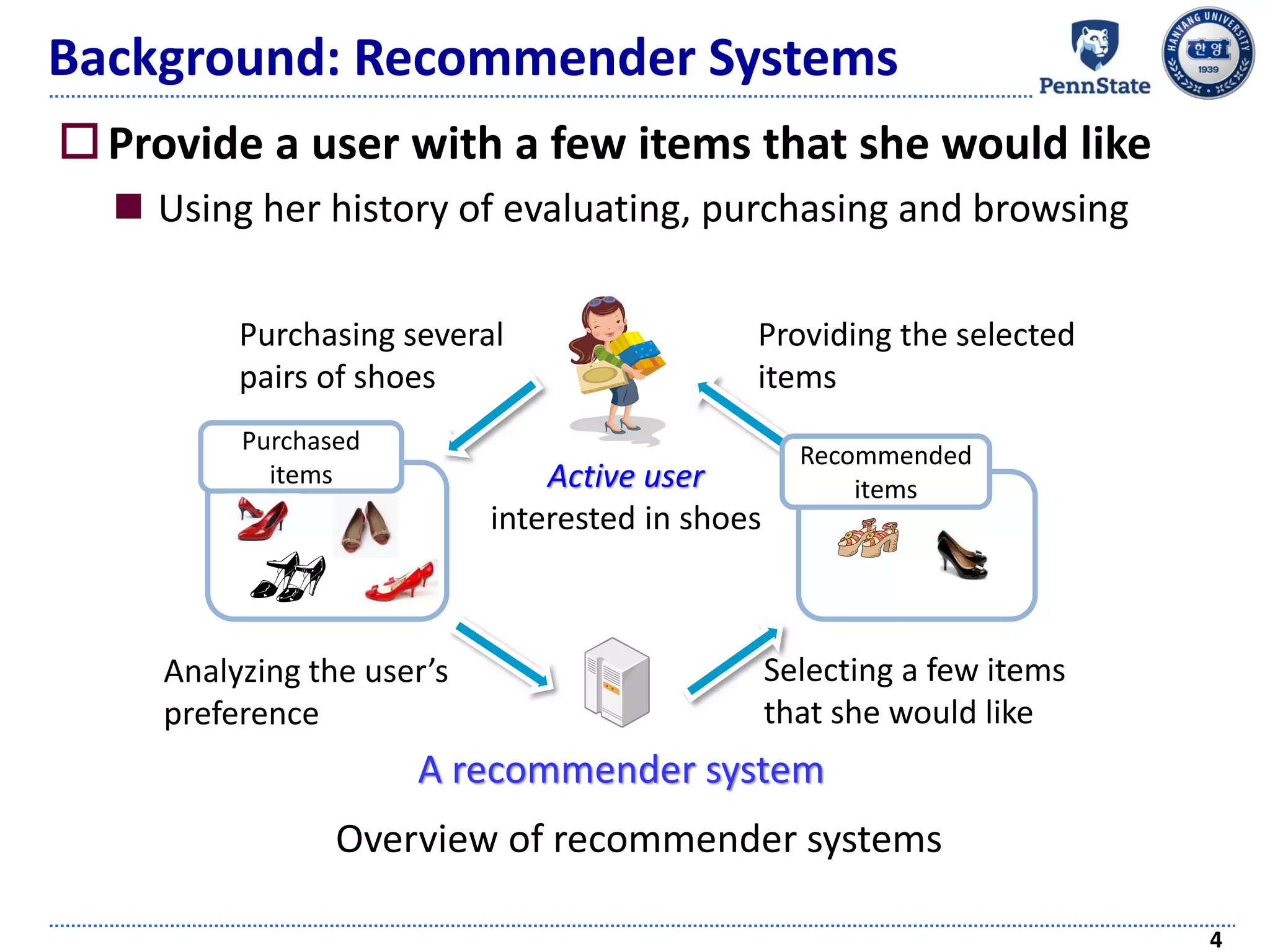
Background: Recommender Systems
Provide a user with a few items that she would like
 Using her history of evaluating, purchasing and browsing
4
Active user
interested in shoes
Purchased
items
A recommender system
Recommended
items
Purchasing several
pairs of shoes
Analyzing the user’s
preference
Selecting a few items
that she would like
Providing the selected
items
Overview of recommender systems
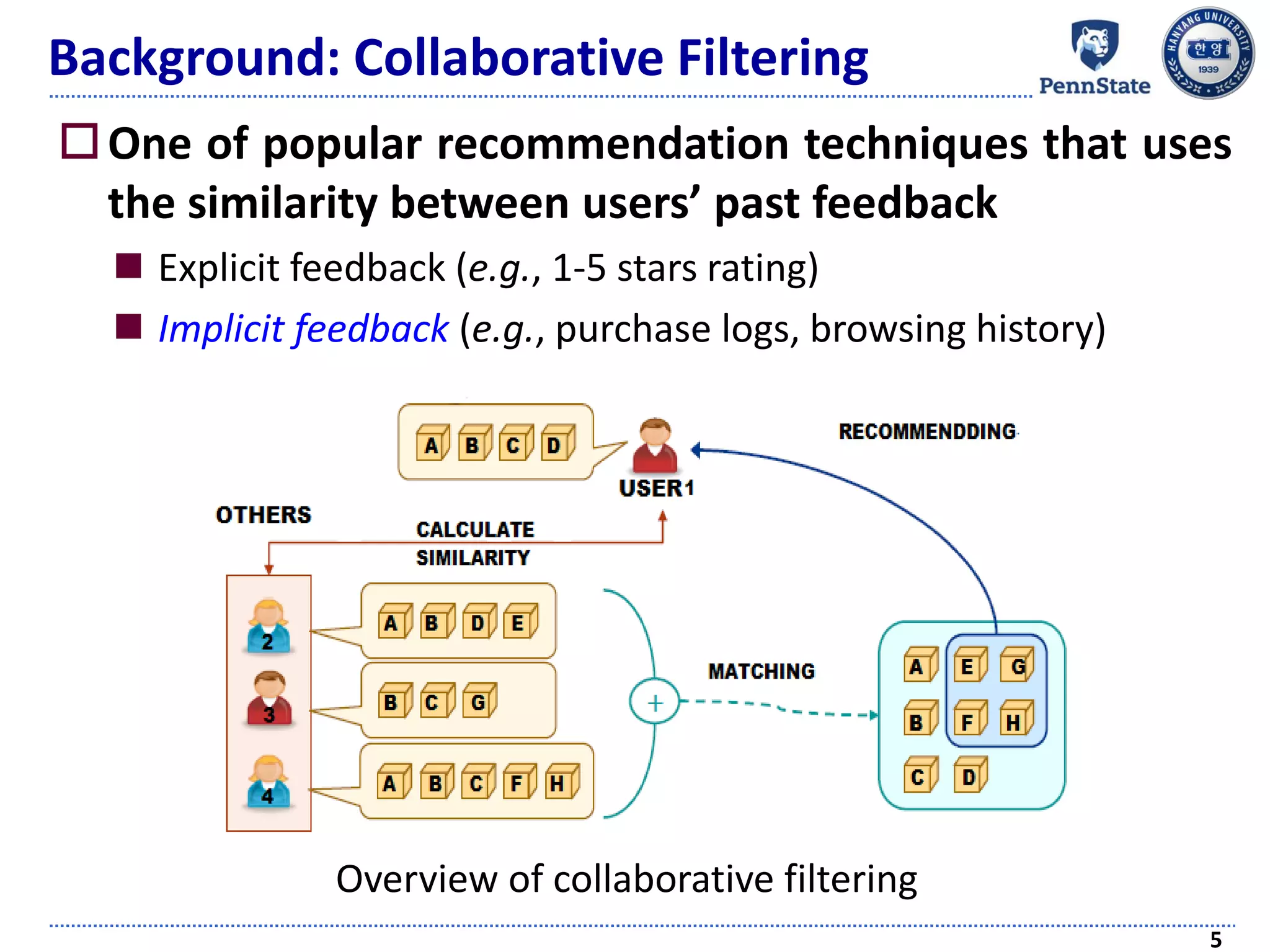
Background: Collaborative Filtering
One of popular recommendation techniques that uses
the similarity between users’ past feedback
 Explicit feedback (e.g., 1-5 stars rating)
 Implicit feedback (e.g., purchase logs, browsing history)
5
Overview of collaborative filtering
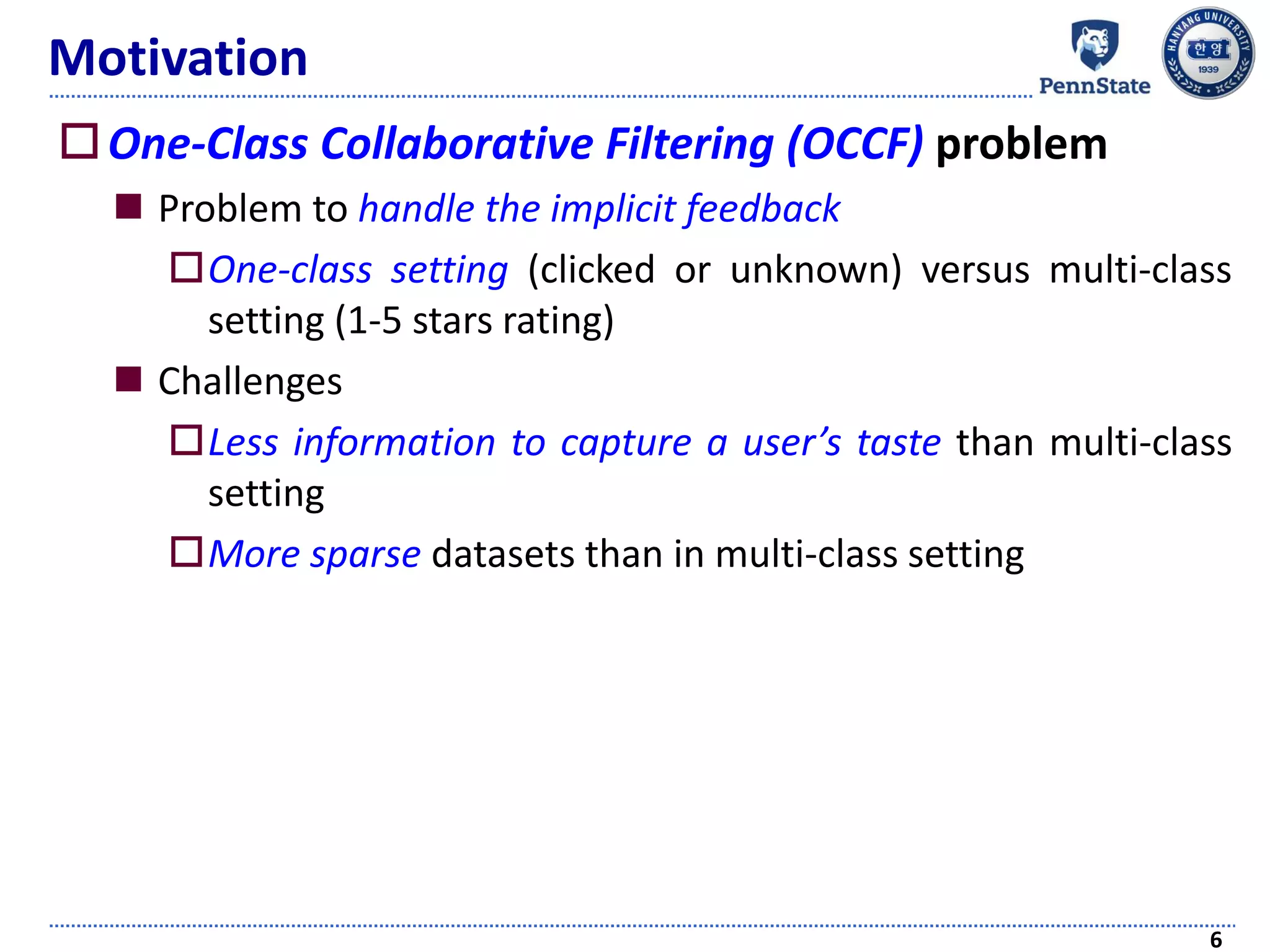
Motivation
One-Class Collaborative Filtering (OCCF) problem
 Problem to handle the implicit feedback
One-class setting (clicked or unknown) versus multi-class
setting (1-5 stars rating)
 Challenges
Less information to capture a user’s taste than multi-class
setting
More sparse datasets than in multi-class setting
6
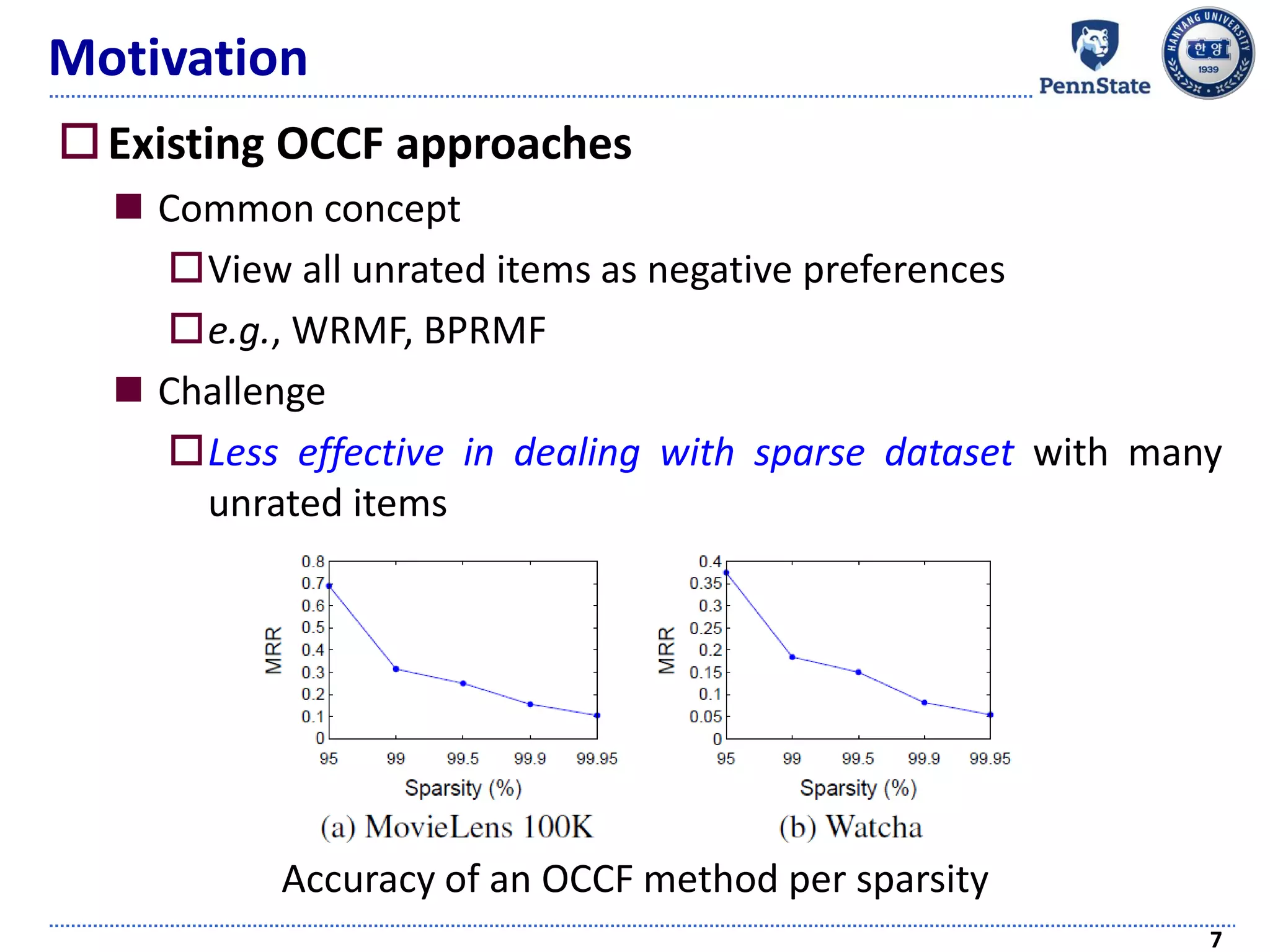
Motivation
Existing OCCF approaches
 Common concept
View all unrated items as negative preferences
e.g., WRMF, BPRMF
 Challenge
Less effective in dealing with sparse dataset with many
unrated items
7
Accuracy of an OCCF method per sparsity
Motivation
Zero-injection [Hwang et al., ICDE 16]
 Address the sparsity problem successfully in multi-class
setting
 Define a novel notion of ‘uninteresting items’ (U-items, in
short) of a user
Items on which the user has “negative” preferences
8
Whole items (𝐼u)
Interesting items
(𝐼 𝑢
𝑖𝑛
)
Uninteresting items
(𝐼 𝑢
𝑢𝑛
= 𝐼 − 𝐼 𝑢
𝑖𝑛
)
Evaluated items
(𝐼 𝑢
𝑒𝑣𝑎𝑙
)
Preferred Items
(𝐼 𝑢
𝑝𝑟𝑒
)
Venn diagram for preferences of items
Motivation
Zero-injection [Hwang et al., ICDE 16]
9
Overview of zero-injection
Motivation
Zero-injection [Hwang et al., ICDE 16]
10
Accuracy of zero-injection
90 92 94 96 98 99.7
0
0.05
0.1
0.15
0.2
0.25
0 2 4 6 8 10
0
0.05
0.1
0.15
0.2
0.25
0 20 40 60 80 99.7
Precision
Parameter θ
Zero-injection + SVD
Zero-injection + ICF
<Recall>
<nDCG>
<MRR><Precision>
Motivation
Zero-injection [Hwang et al., ICDE 16]
 A naïve application of zero-injection in one-class setting
Lower accuracy than OCCF approaches
Sensitivity to the number of U-items
11
Accuracy in one-class setting: SVD and PMF with varying
degree of zero injection and WRMF without zero-injection
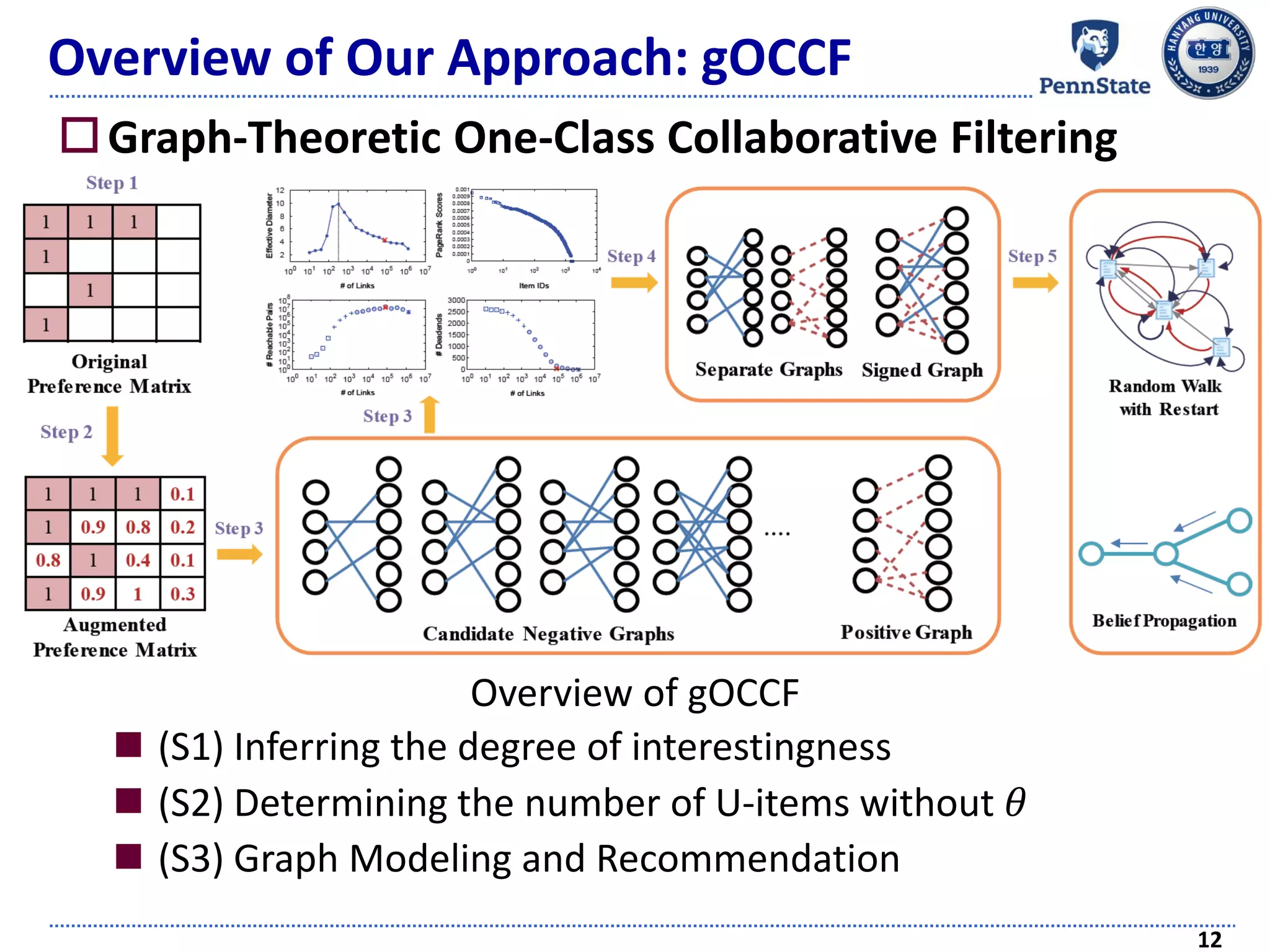
Overview of Our Approach: gOCCF
12
Graph-Theoretic One-Class Collaborative Filtering
 (S1) Inferring the degree of interestingness
 (S2) Determining the number of U-items without 𝜃
 (S3) Graph Modeling and Recommendation
Overview of gOCCF
Employ a popular OCCF method (WRMF) [Pan et al.,
ICDM 08]
Steps
 Treat all unrated items as negative preferences (i.e., value of 0)
 Assign different weights to quantify the relative contribution
 Predict the value of by matrix factorization
13
U
V
Feature of user u
Feature of item i
1 1 1 0
1 0 0 0
0 0 1 0
1 1 1 0.6
1 0.2 0.2 0.2
0.2 0.2 1 0.2
Binary rating matrixUnary rating matrix
Weight matrix
1 1 1
1
1
WRMF
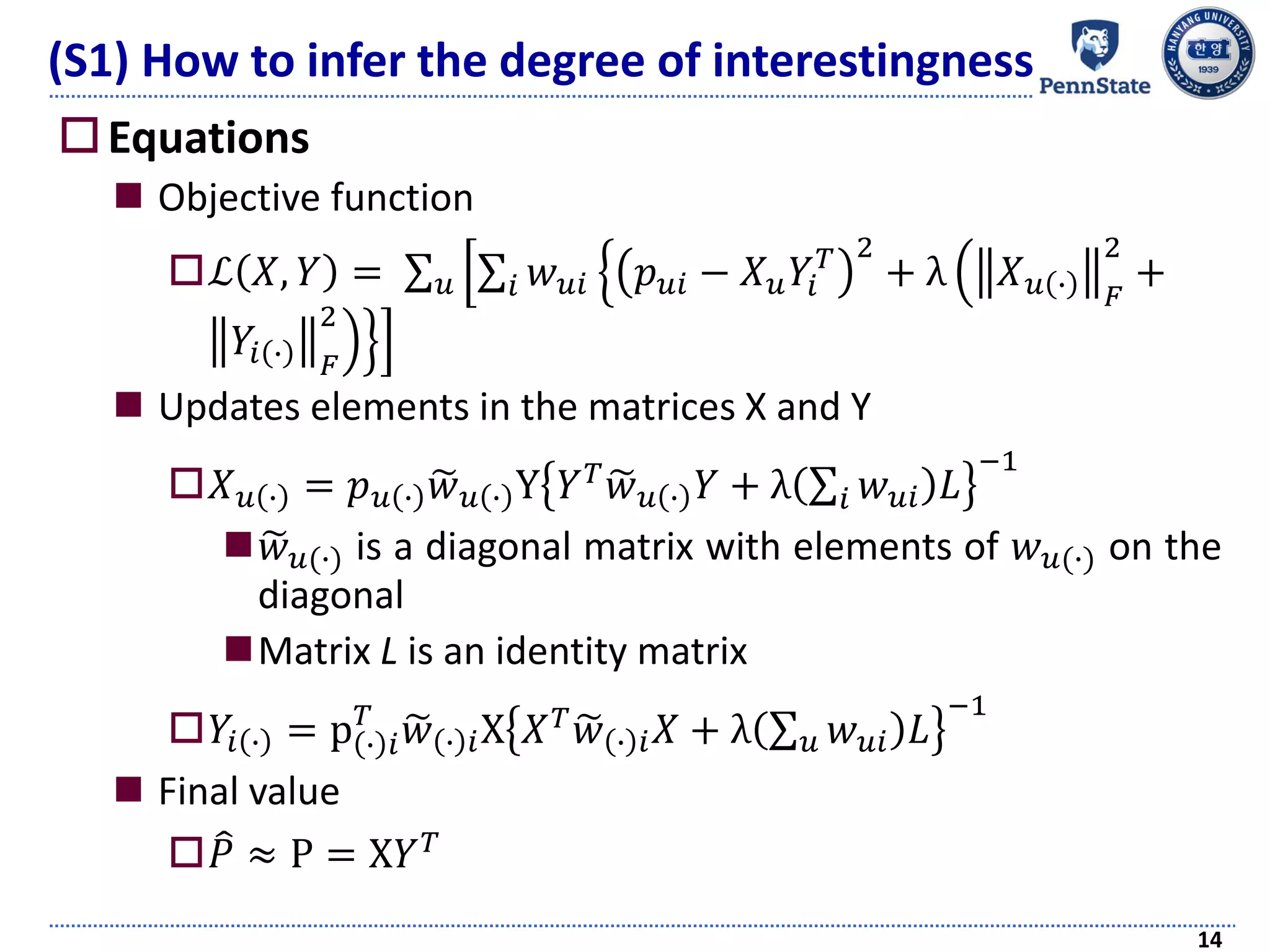
(S1) How to infer the degree of interestingness
Equations
 Objective function
ℒ 𝑋, 𝑌 = σ 𝑢 ቂ
ቃ
σ𝑖 𝑤 𝑢𝑖 ቄ
ቅ
𝑝 𝑢𝑖 − 𝑋 𝑢 𝑌𝑖
𝑇 2
+ λ ቀ
ቁ
𝑋 𝑢 ∙ 𝐹
2
+
𝑌𝑖 ∙ 𝐹
2
 Updates elements in the matrices X and Y
𝑋 𝑢 ∙ = 𝑝 𝑢 ∙ ෥𝑤 𝑢 ∙ Y 𝑌 𝑇 ෥𝑤 𝑢 ∙ 𝑌 + λ σ𝑖 𝑤 𝑢𝑖 𝐿
−1
 ෥𝑤 𝑢(∙) is a diagonal matrix with elements of 𝑤 𝑢(∙) on the
diagonal
Matrix L is an identity matrix
𝑌𝑖 ∙ = p ∙ 𝑖
𝑇
෥𝑤 ∙ 𝑖X 𝑋 𝑇 ෥𝑤 ∙ 𝑖 𝑋 + λ σ 𝑢 𝑤 𝑢𝑖 𝐿
−1
 Final value
 ෠𝑃 ≈ P = X𝑌 𝑇
14
(S1) How to infer the degree of interestingness
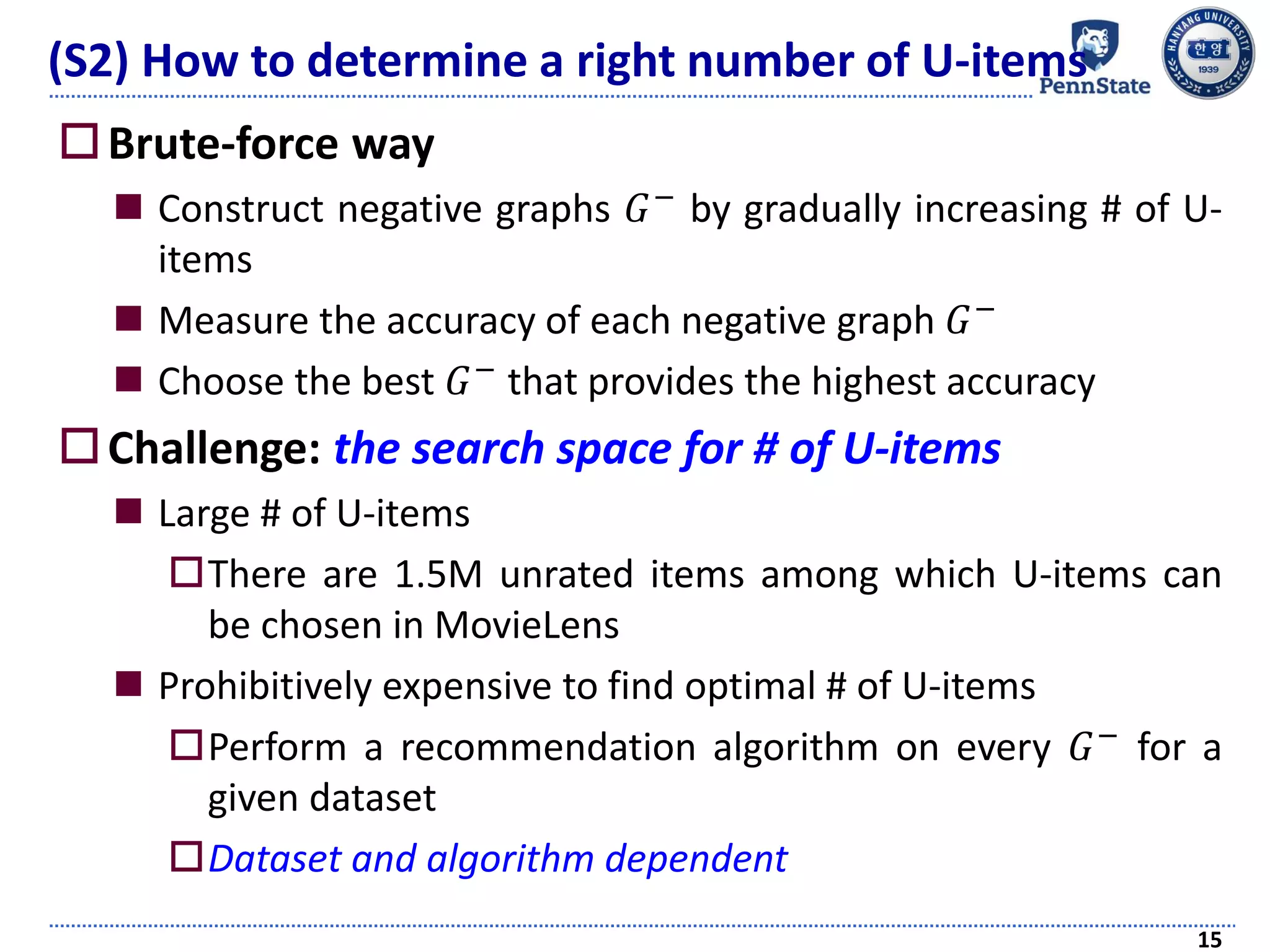
Brute-force way
 Construct negative graphs 𝐺− by gradually increasing # of U-
items
 Measure the accuracy of each negative graph 𝐺−
 Choose the best 𝐺− that provides the highest accuracy
Challenge: the search space for # of U-items
 Large # of U-items
There are 1.5M unrated items among which U-items can
be chosen in MovieLens
 Prohibitively expensive to find optimal # of U-items
Perform a recommendation algorithm on every 𝐺− for a
given dataset
Dataset and algorithm dependent
15
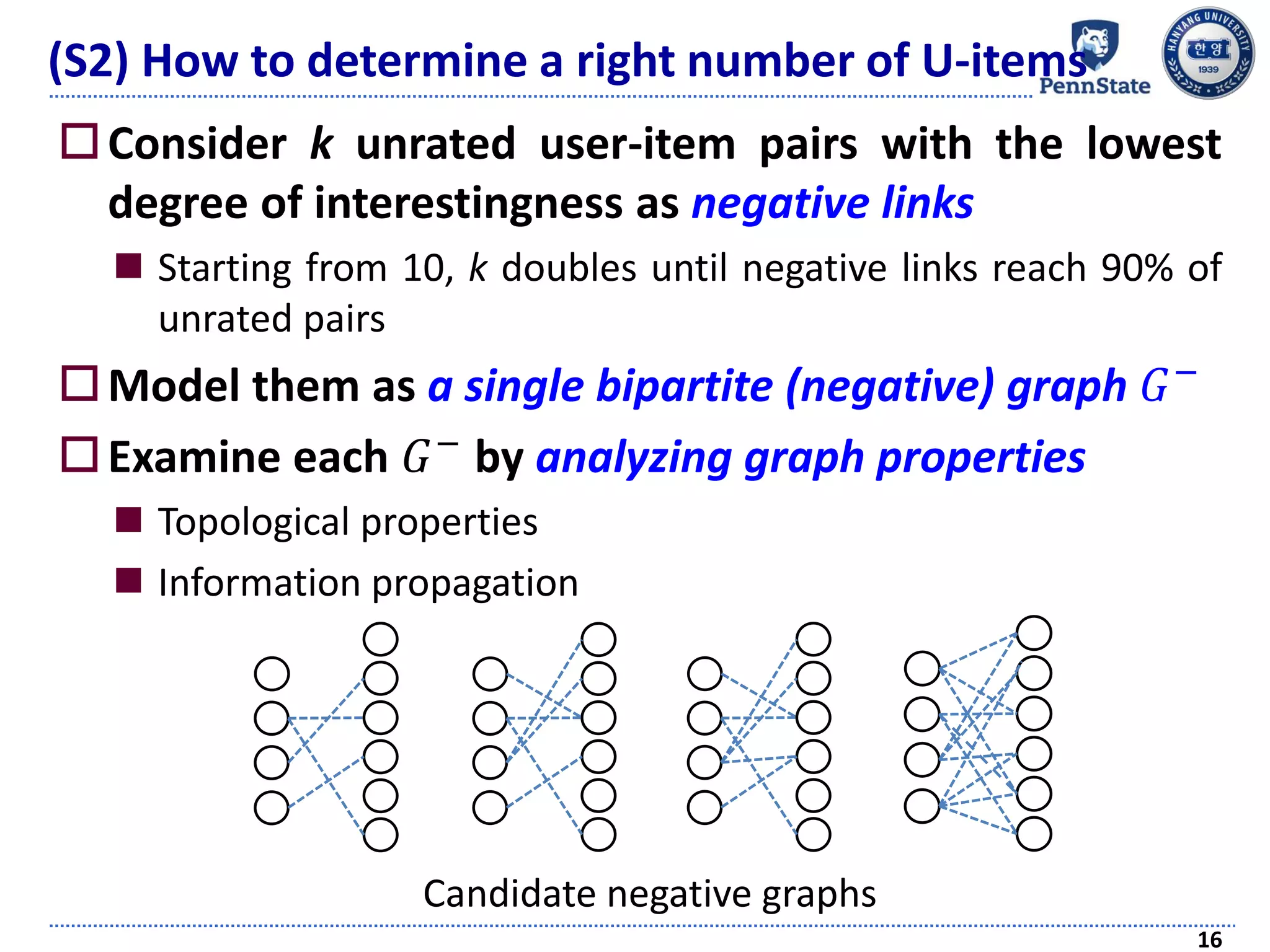
(S2) How to determine a right number of U-items
Consider k unrated user-item pairs with the lowest
degree of interestingness as negative links
 Starting from 10, k doubles until negative links reach 90% of
unrated pairs
Model them as a single bipartite (negative) graph 𝐺−
Examine each 𝐺− by analyzing graph properties
 Topological properties
 Information propagation
16
(S2) How to determine a right number of U-items
Candidate negative graphs
Topological property
Graph shattering theory [Appel et al., SDM 09]
 Introduces a “shattering point”
Connectivity of a graph becomes seriously collapsed
As links are continuously removed in a random way
 ShatterPlot: visualizing the process of generating the
shattering point
17
ShatterPlot for positive graph 𝐺+
of MovieLens 100K
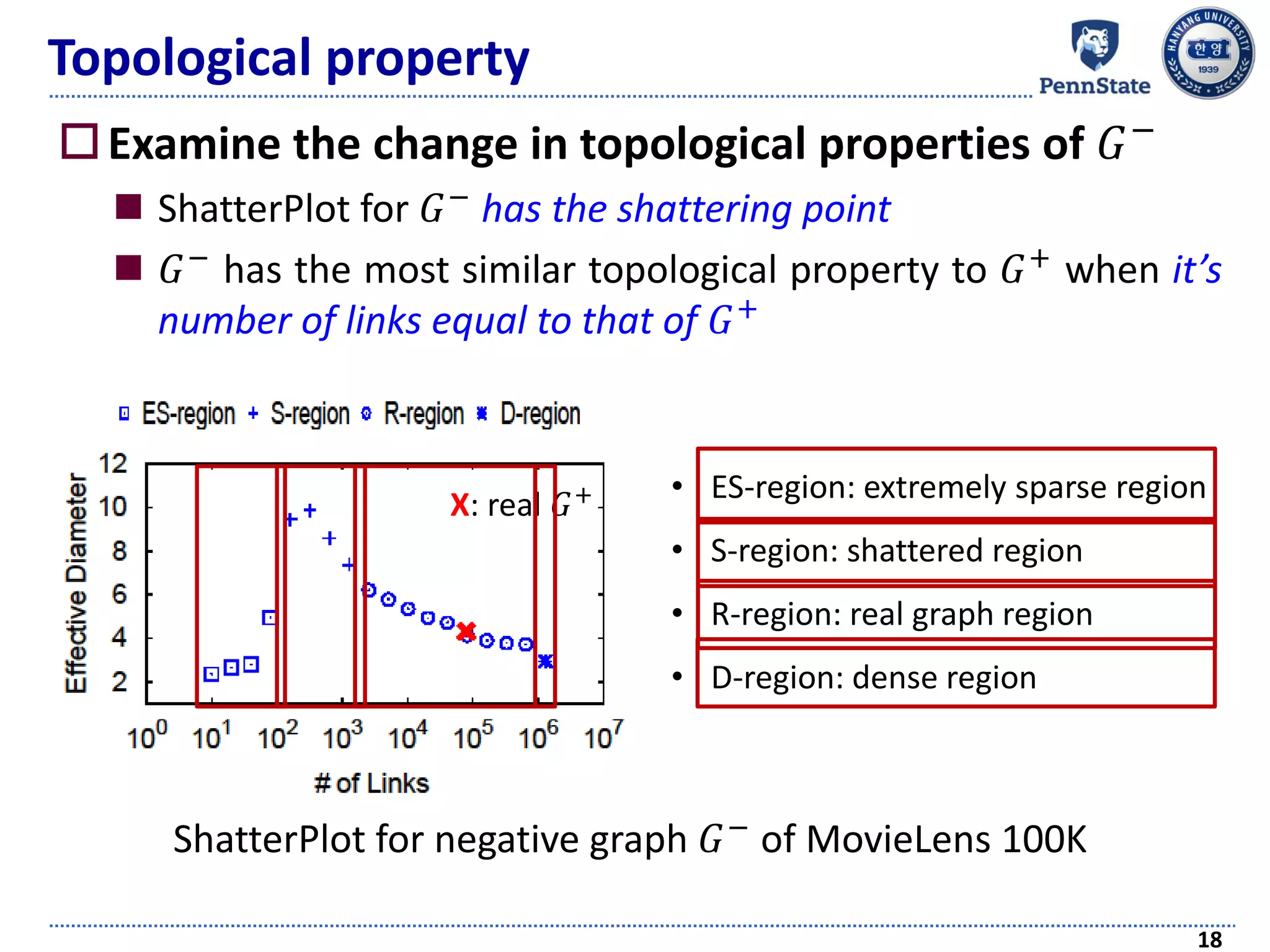
Examine the change in topological properties of 𝐺−
 ShatterPlot for 𝐺− has the shattering point
 𝐺−
has the most similar topological property to 𝐺+
when it’s
number of links equal to that of 𝐺+
Topological property
18
ShatterPlot for negative graph 𝐺− of MovieLens 100K
• ES-region: extremely sparse region
• S-region: shattered region
• R-region: real graph region
• D-region: dense region
X: real 𝐺+
Topological property
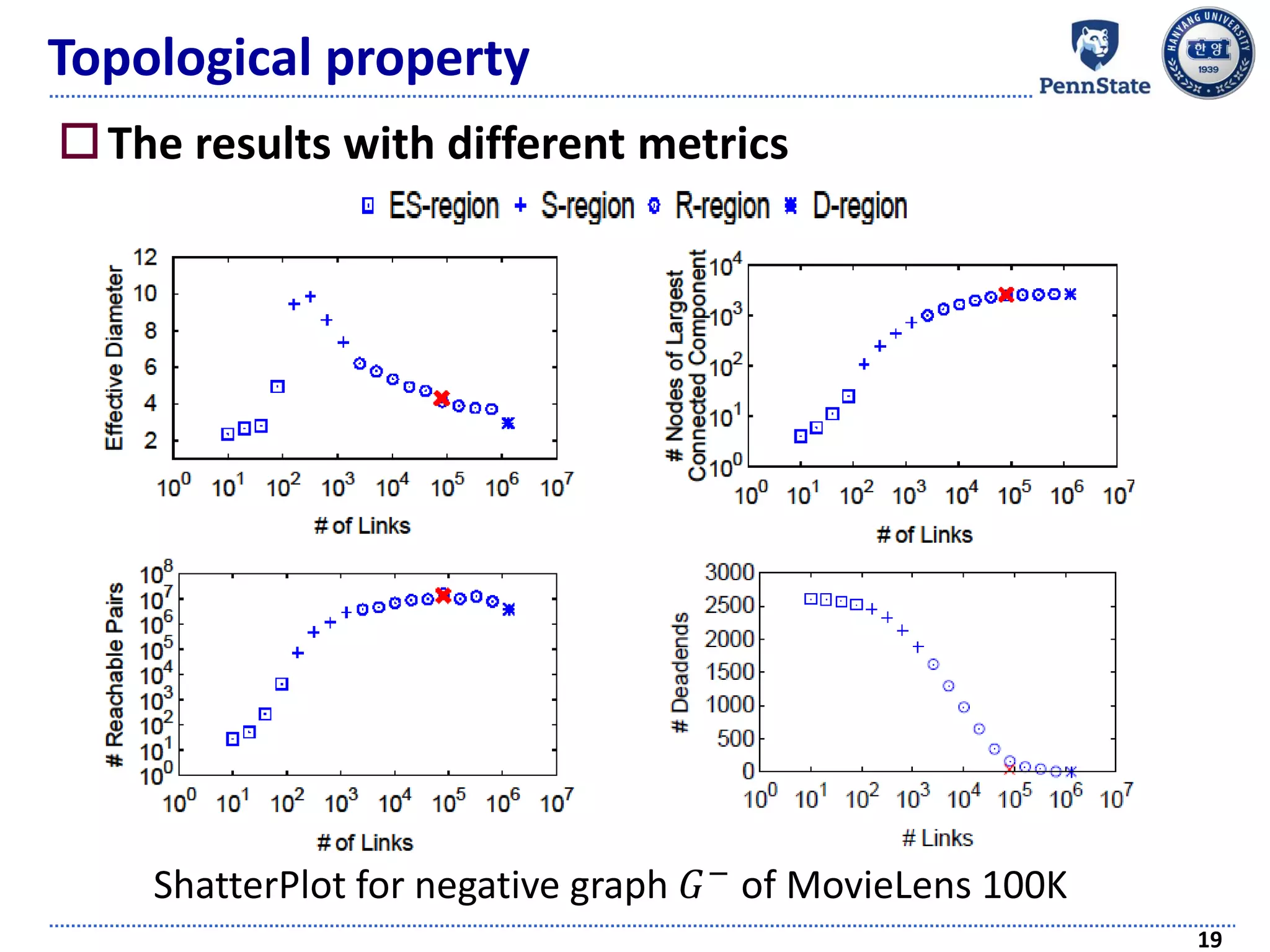
The results with different metrics
19
ShatterPlot for negative graph 𝐺− of MovieLens 100K
Topological property
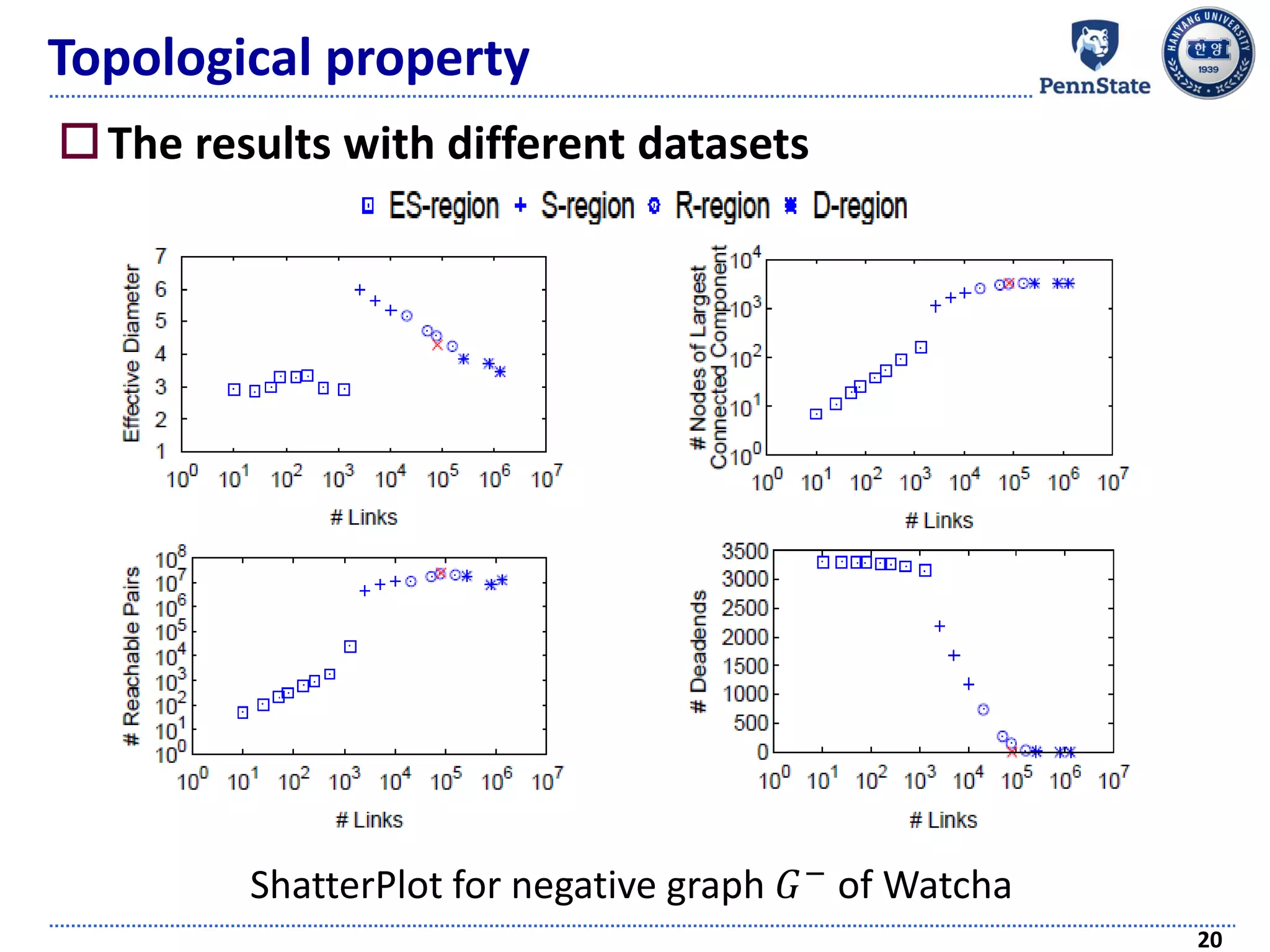
The results with different datasets
20
ShatterPlot for negative graph 𝐺− of Watcha
Topological property
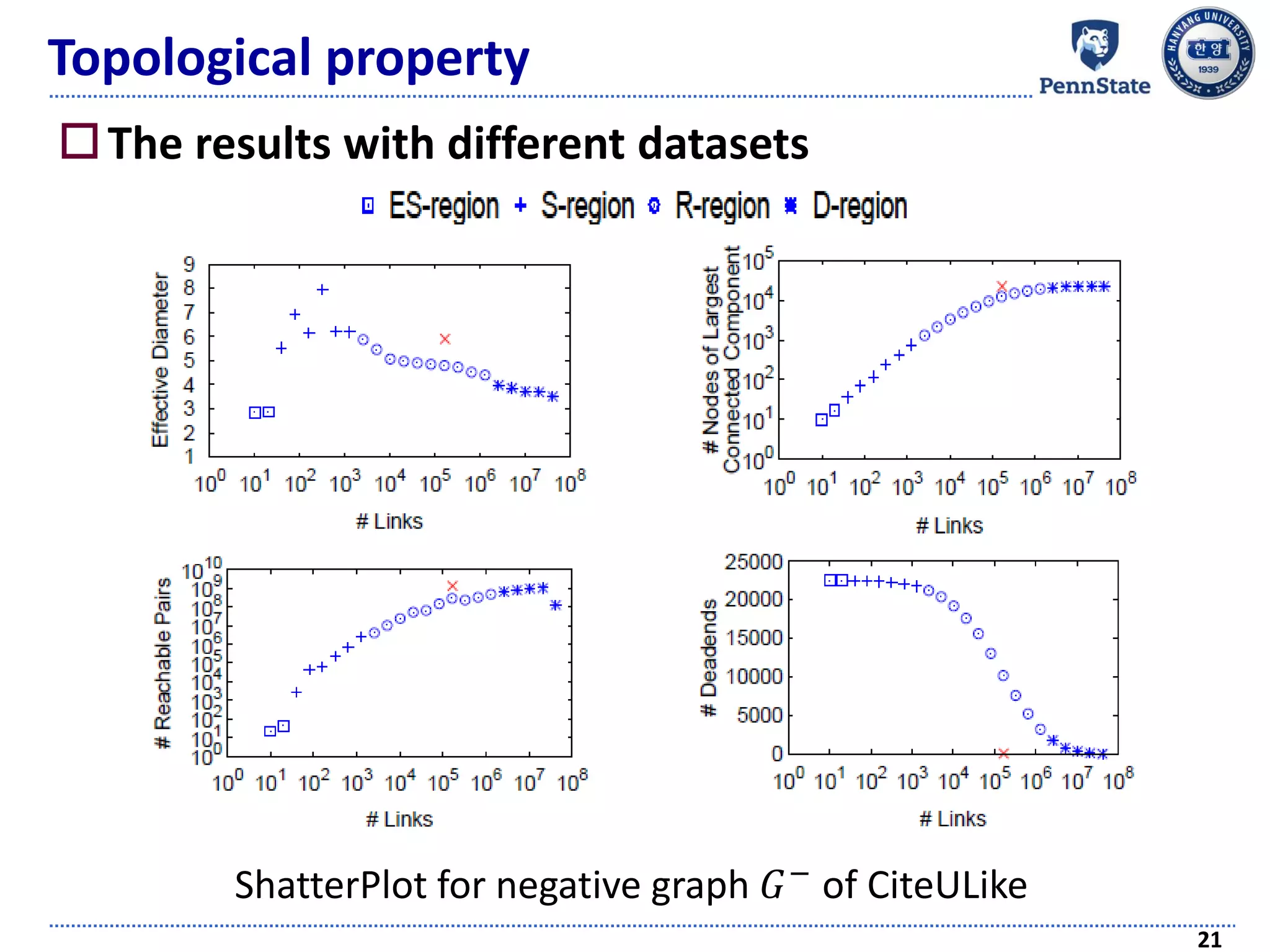
The results with different datasets
21
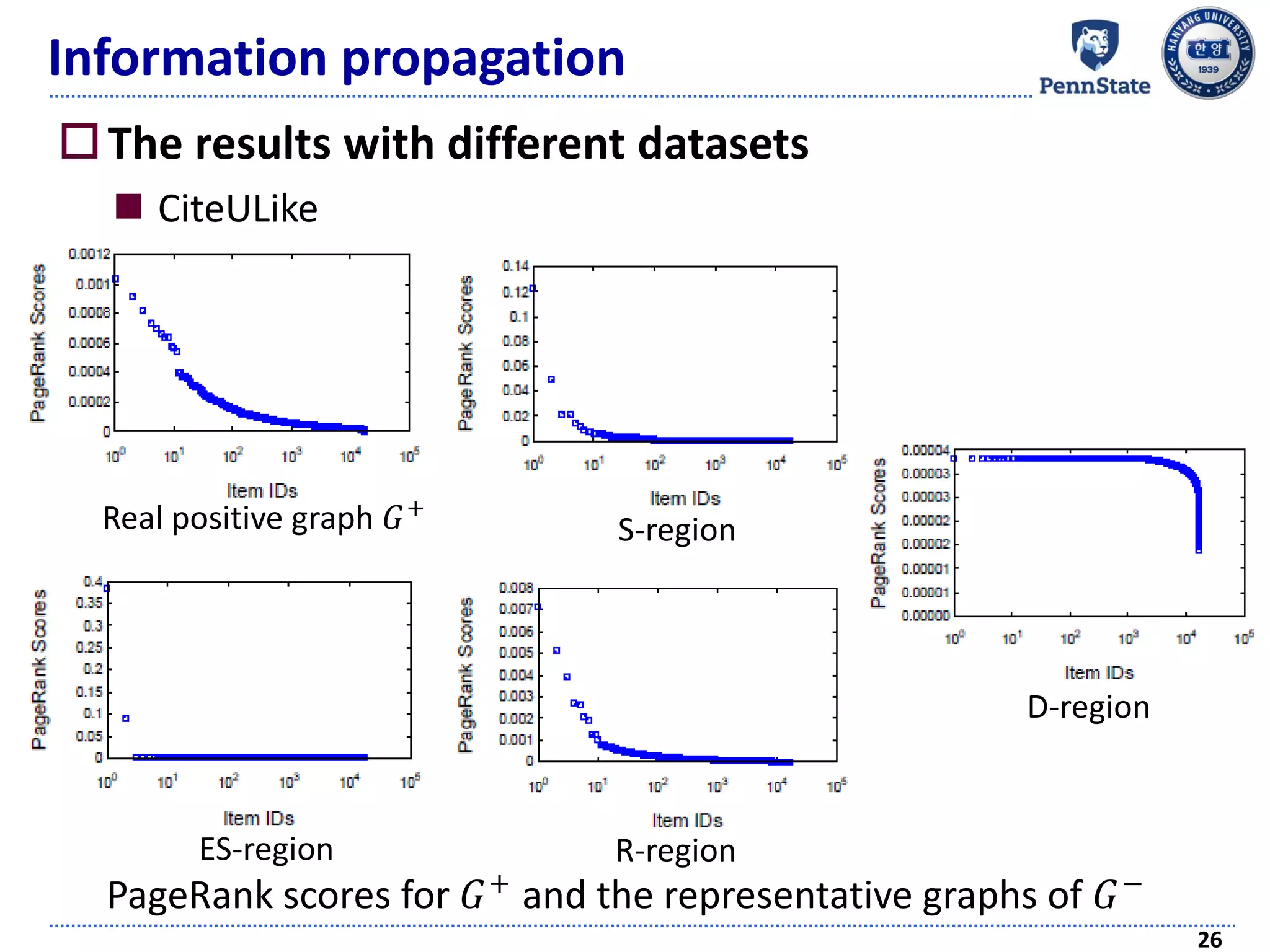
ShatterPlot for negative graph 𝐺− of CiteULike
Information propagation
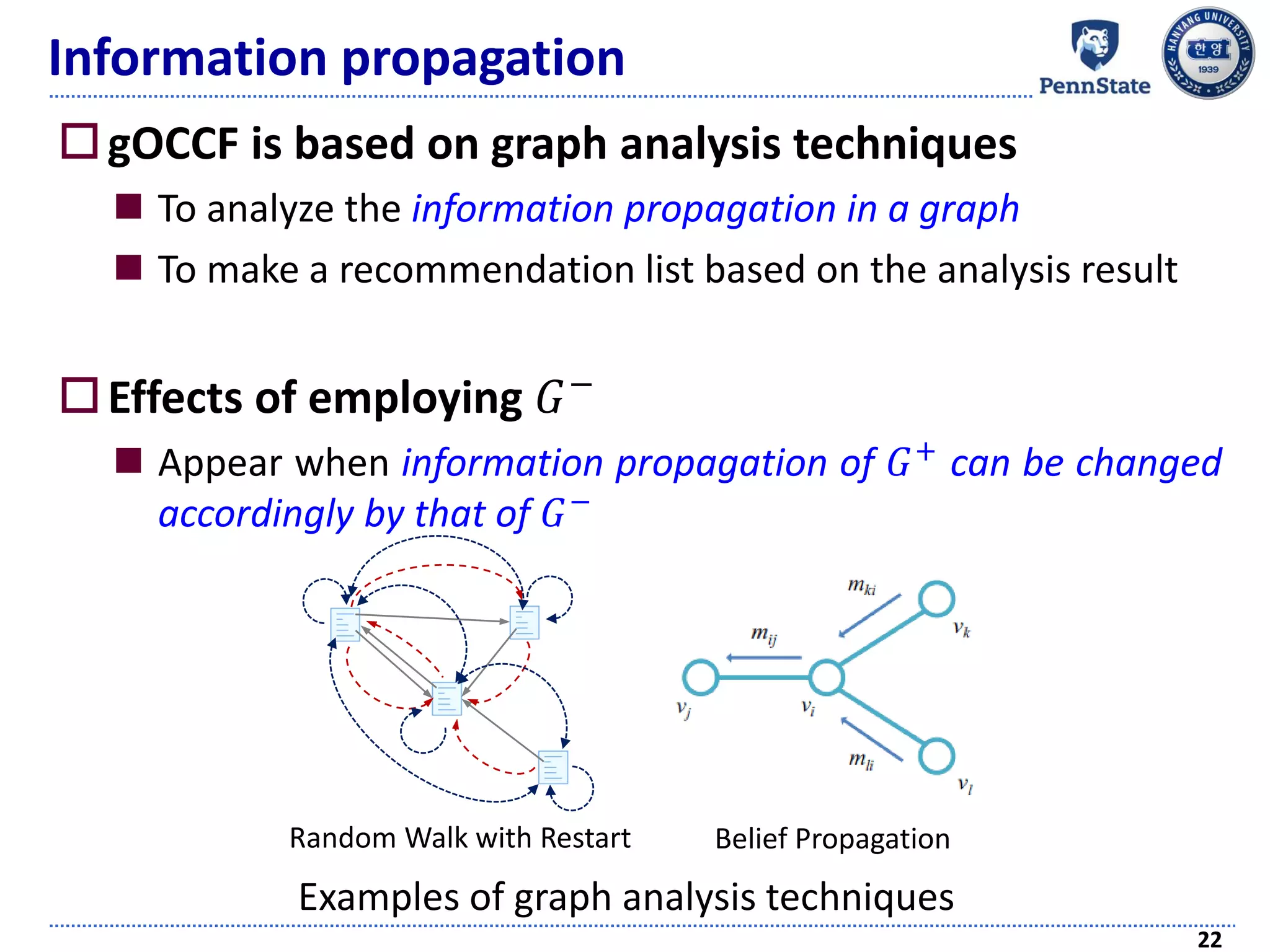
gOCCF is based on graph analysis techniques
 To analyze the information propagation in a graph
 To make a recommendation list based on the analysis result
Effects of employing 𝐺−
 Appear when information propagation of 𝐺+ can be changed
accordingly by that of 𝐺−
22
Random Walk with Restart Belief Propagation
Examples of graph analysis techniques
Information propagation
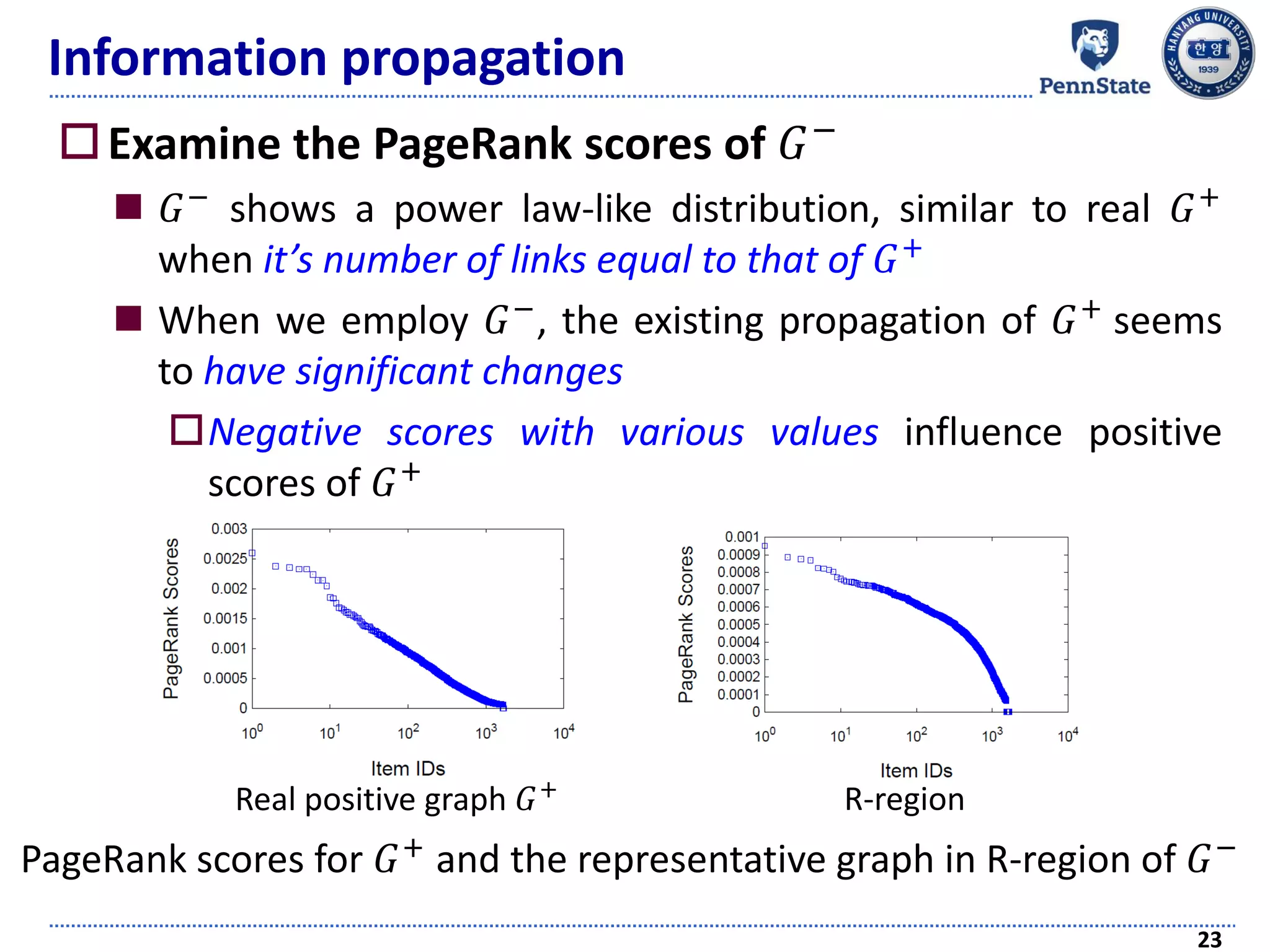
Examine the PageRank scores of 𝐺−
 𝐺− shows a power law-like distribution, similar to real 𝐺+
when it’s number of links equal to that of 𝐺+
 When we employ 𝐺−, the existing propagation of 𝐺+ seems
to have significant changes
Negative scores with various values influence positive
scores of 𝐺+
23
Real positive graph 𝐺+ R-region
PageRank scores for 𝐺+ and the representative graph in R-region of 𝐺−
Information propagation
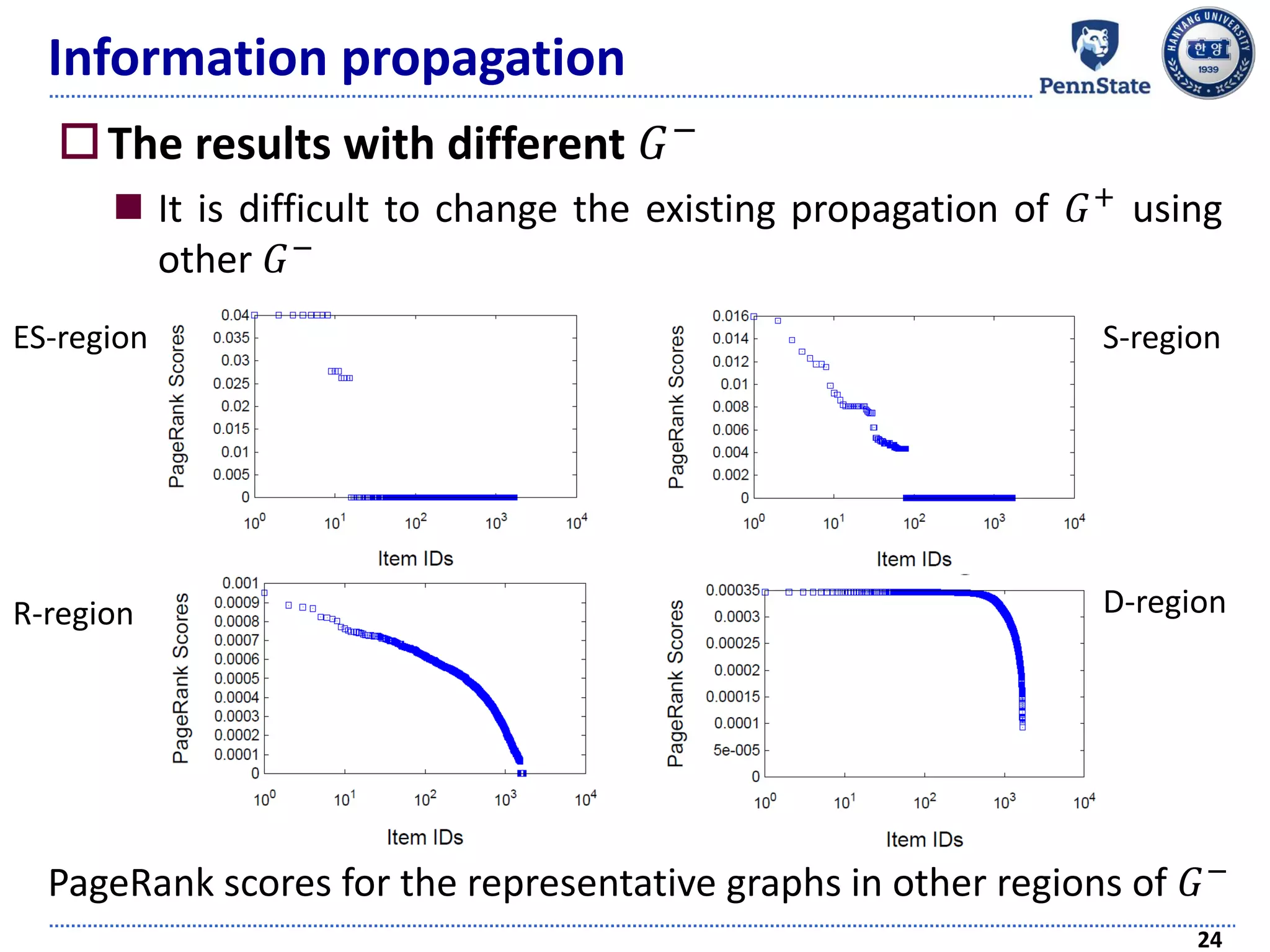
The results with different 𝐺−
 It is difficult to change the existing propagation of 𝐺+ using
other 𝐺−
24
PageRank scores for the representative graphs in other regions of 𝐺−
D-region
S-regionES-region
R-region
Information propagation
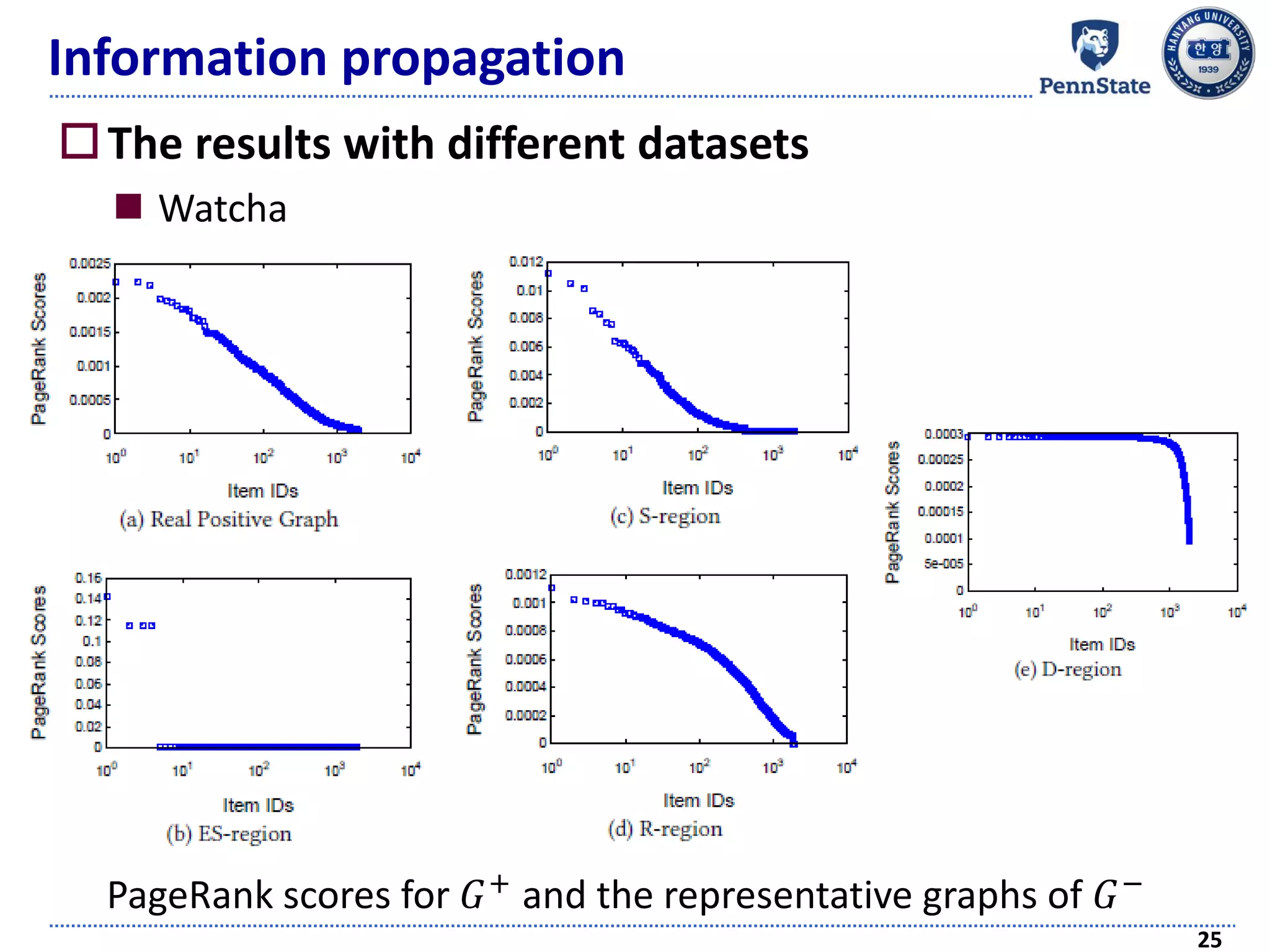
The results with different datasets
 Watcha
25
PageRank scores for 𝐺+ and the representative graphs of 𝐺−
Information propagation
The results with different datasets
 CiteULike
26
PageRank scores for 𝐺+ and the representative graphs of 𝐺−
Real positive graph 𝐺+
R-region
S-region
ES-region
D-region
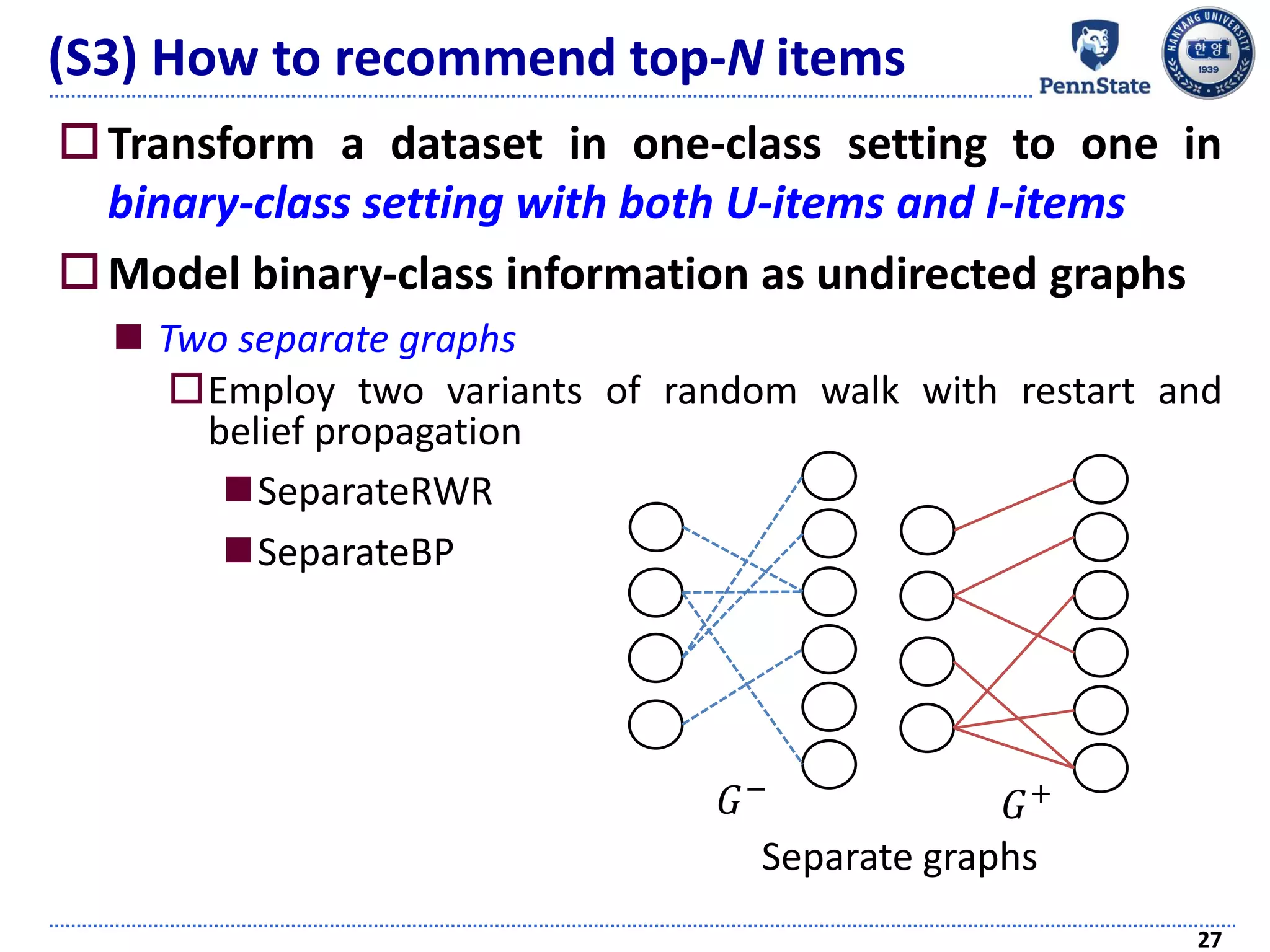
(S3) How to recommend top-N items
Transform a dataset in one-class setting to one in
binary-class setting with both U-items and I-items
Model binary-class information as undirected graphs
 Two separate graphs
Employ two variants of random walk with restart and
belief propagation
SeparateRWR
SeparateBP
27
Separate graphs
𝐺−
𝐺+
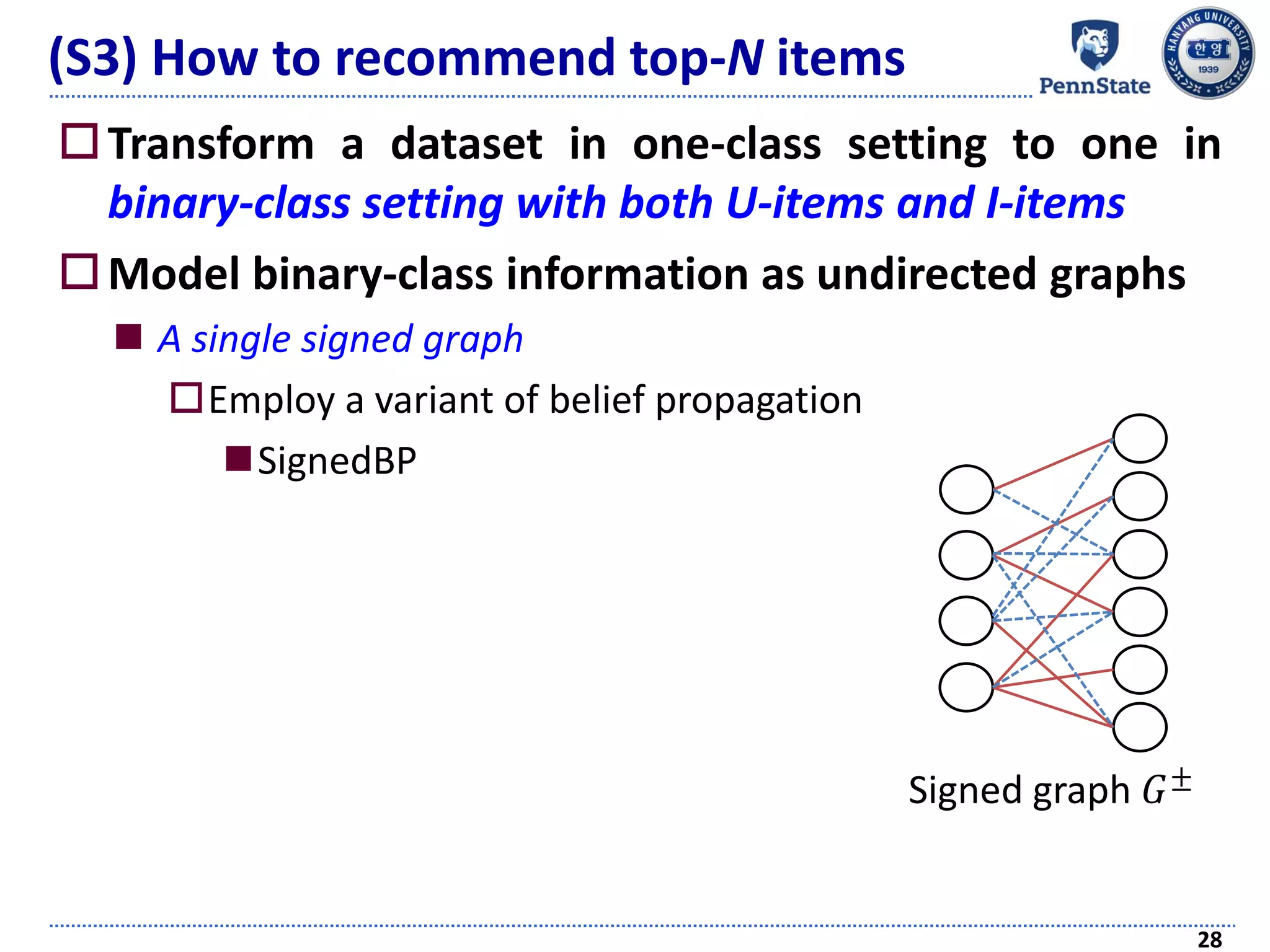
(S3) How to recommend top-N items
Transform a dataset in one-class setting to one in
binary-class setting with both U-items and I-items
Model binary-class information as undirected graphs
 A single signed graph
Employ a variant of belief propagation
SignedBP
28
Signed graph 𝐺±
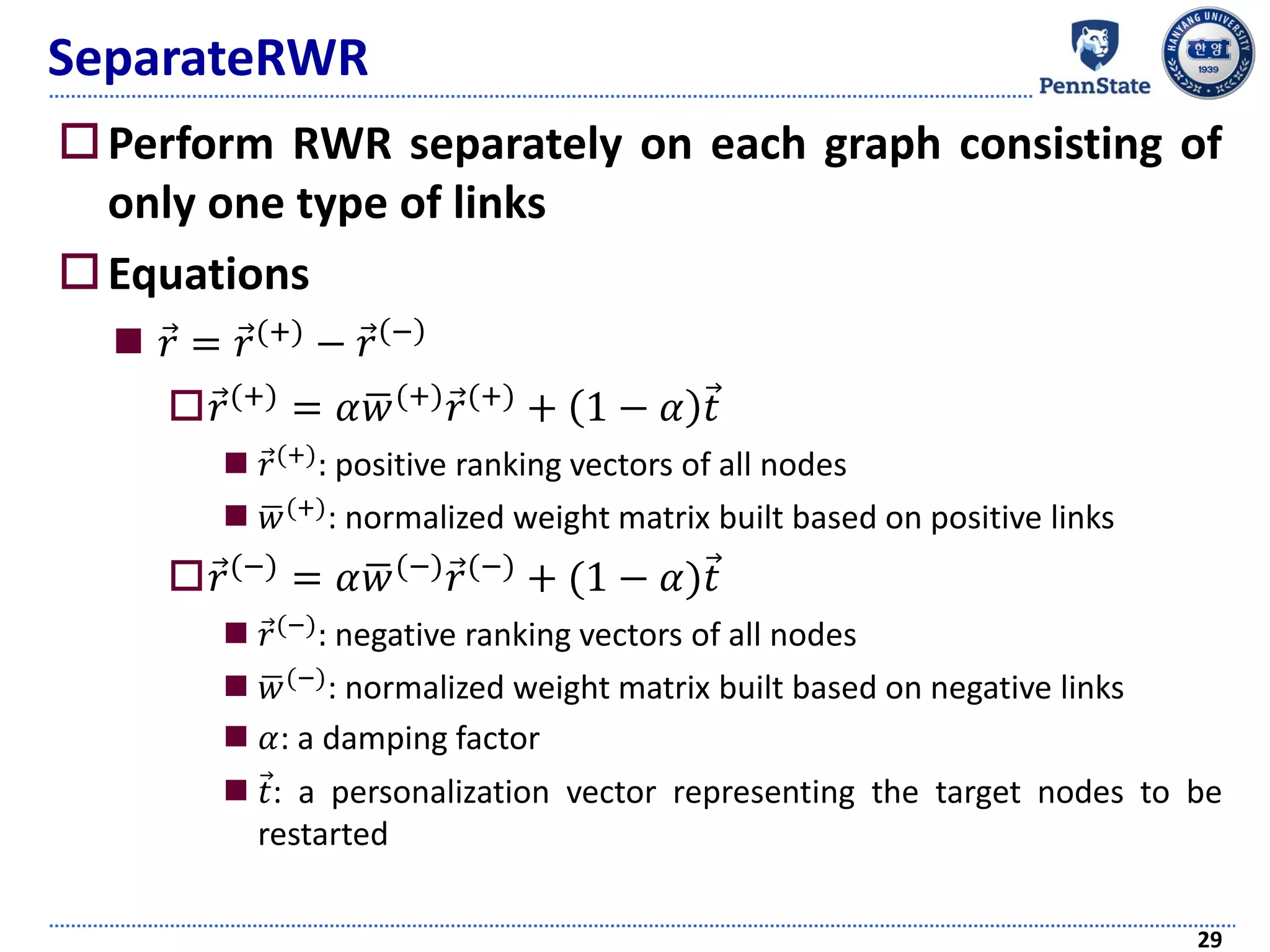
SeparateRWR
Perform RWR separately on each graph consisting of
only one type of links
Equations
 Ԧ𝑟 = Ԧ𝑟(+)
− Ԧ𝑟 −
 Ԧ𝑟(+)
= 𝛼ഥ𝑤(+)
Ԧ𝑟(+)
+ 1 − 𝛼 Ԧ𝑡
 Ԧ𝑟(+): positive ranking vectors of all nodes
 ഥ𝑤(+): normalized weight matrix built based on positive links
 Ԧ𝑟(−) = 𝛼ഥ𝑤(−) Ԧ𝑟(−) + (1 − 𝛼)Ԧ𝑡
 Ԧ𝑟(−): negative ranking vectors of all nodes
 ഥ𝑤(−): normalized weight matrix built based on negative links
 𝛼: a damping factor
 Ԧ𝑡: a personalization vector representing the target nodes to be
restarted
29
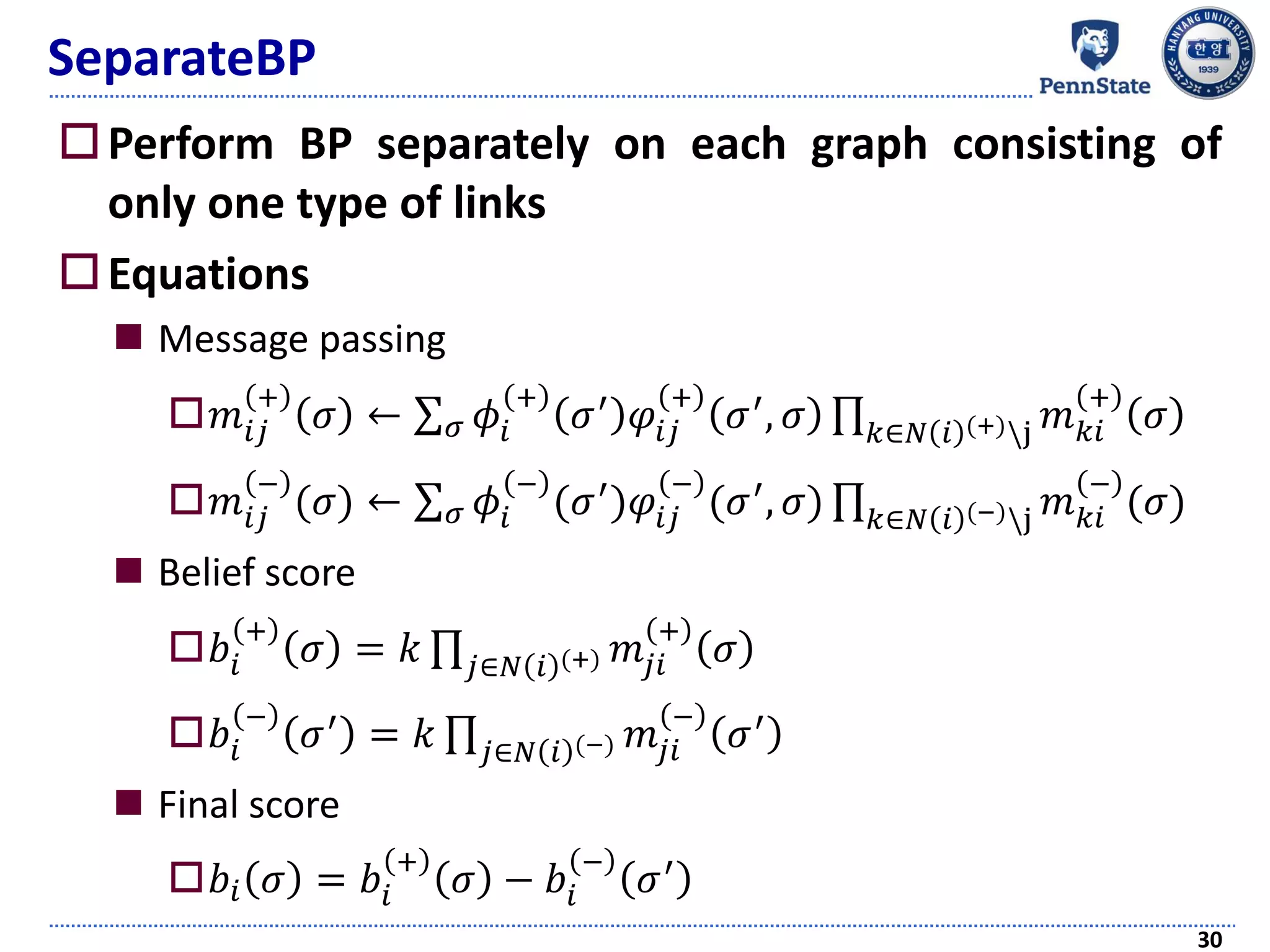
SeparateBP
Perform BP separately on each graph consisting of
only one type of links
Equations
 Message passing
𝑚𝑖𝑗
+
𝜎 ← σ 𝜎 𝜙𝑖
+
𝜎′ 𝜑𝑖𝑗
+
𝜎′, 𝜎 ς 𝑘∈𝑁 𝑖 (+)j 𝑚 𝑘𝑖
+
𝜎
𝑚𝑖𝑗
−
(𝜎) ← σ 𝜎 𝜙𝑖
−
(𝜎′)𝜑𝑖𝑗
−
(𝜎′, 𝜎) ς 𝑘∈𝑁 𝑖 (−)j 𝑚 𝑘𝑖
−
(𝜎)
 Belief score
𝑏𝑖
+
𝜎 = 𝑘 ς 𝑗∈𝑁 𝑖 (+) 𝑚𝑗𝑖
+
𝜎
𝑏𝑖
−
𝜎′ = 𝑘 ς 𝑗∈𝑁 𝑖 (−) 𝑚𝑗𝑖
−
𝜎′
 Final score
𝑏𝑖 𝜎 = 𝑏𝑖
+
𝜎 − 𝑏𝑖
−
𝜎′
30
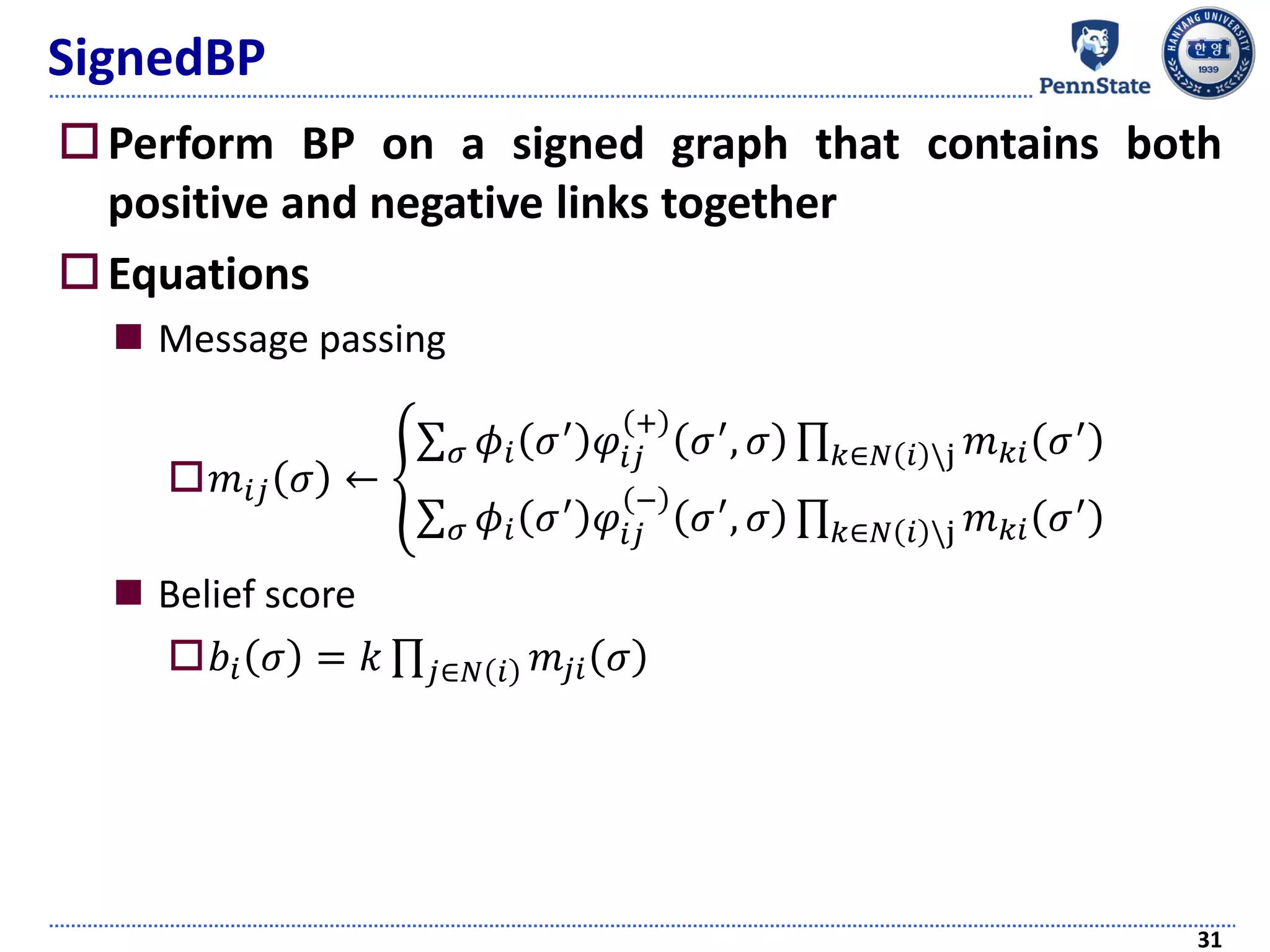
SignedBP
Perform BP on a signed graph that contains both
positive and negative links together
Equations
 Message passing
𝑚𝑖𝑗 𝜎 ← ቐ
σ 𝜎 𝜙𝑖 𝜎′
𝜑𝑖𝑗
+
𝜎′
, 𝜎 ς 𝑘∈𝑁 𝑖 j 𝑚 𝑘𝑖 𝜎′
σ 𝜎 𝜙𝑖 𝜎′ 𝜑𝑖𝑗
−
𝜎′, 𝜎 ς 𝑘∈𝑁 𝑖 j 𝑚 𝑘𝑖 𝜎′
 Belief score
𝑏𝑖 𝜎 = 𝑘 ς 𝑗∈𝑁 𝑖 𝑚𝑗𝑖 𝜎
31
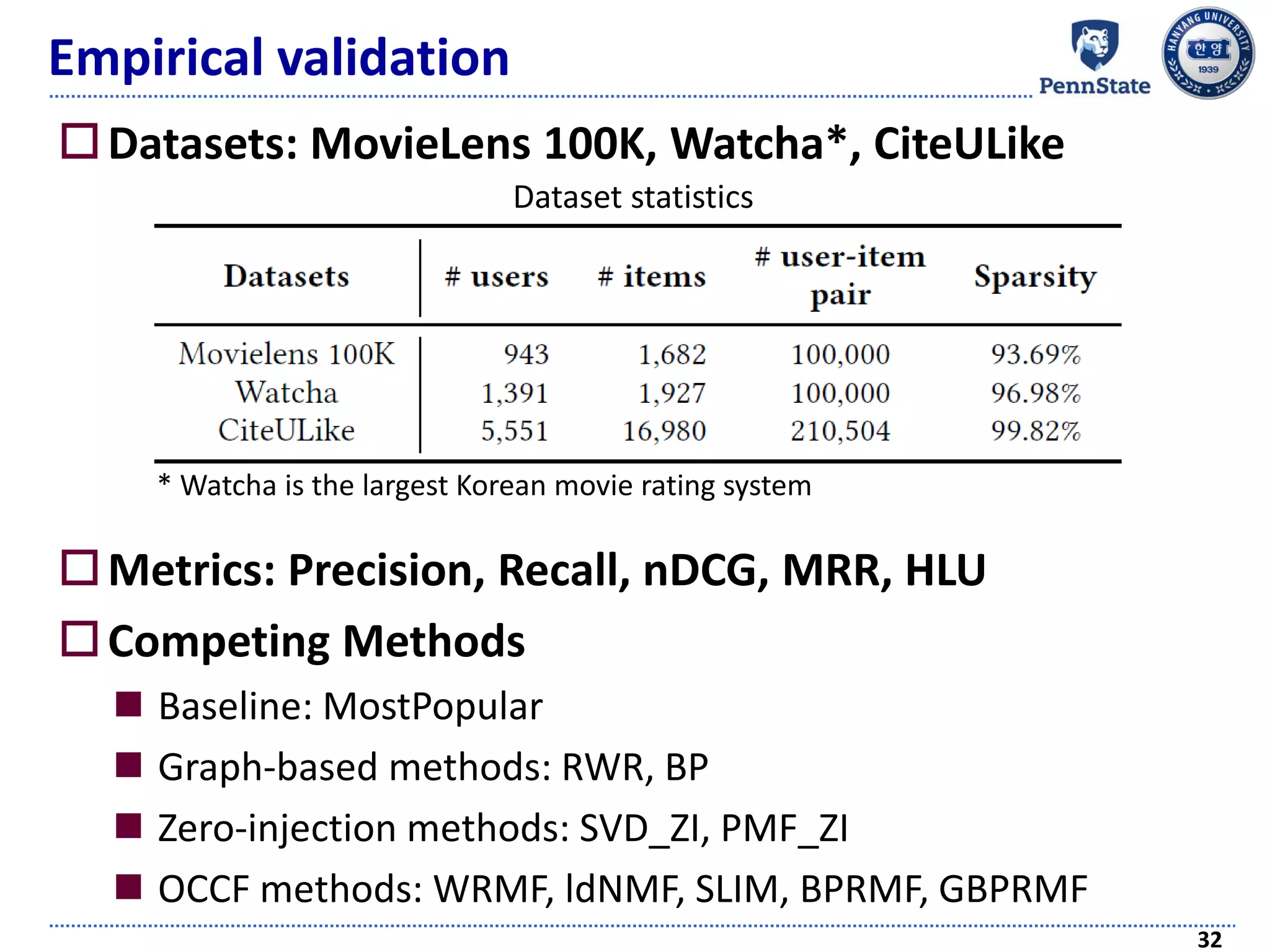
Empirical validation
Datasets: MovieLens 100K, Watcha*, CiteULike
Metrics: Precision, Recall, nDCG, MRR, HLU
Competing Methods
 Baseline: MostPopular
 Graph-based methods: RWR, BP
 Zero-injection methods: SVD_ZI, PMF_ZI
 OCCF methods: WRMF, ldNMF, SLIM, BPRMF, GBPRMF
32
Dataset statistics
* Watcha is the largest Korean movie rating system
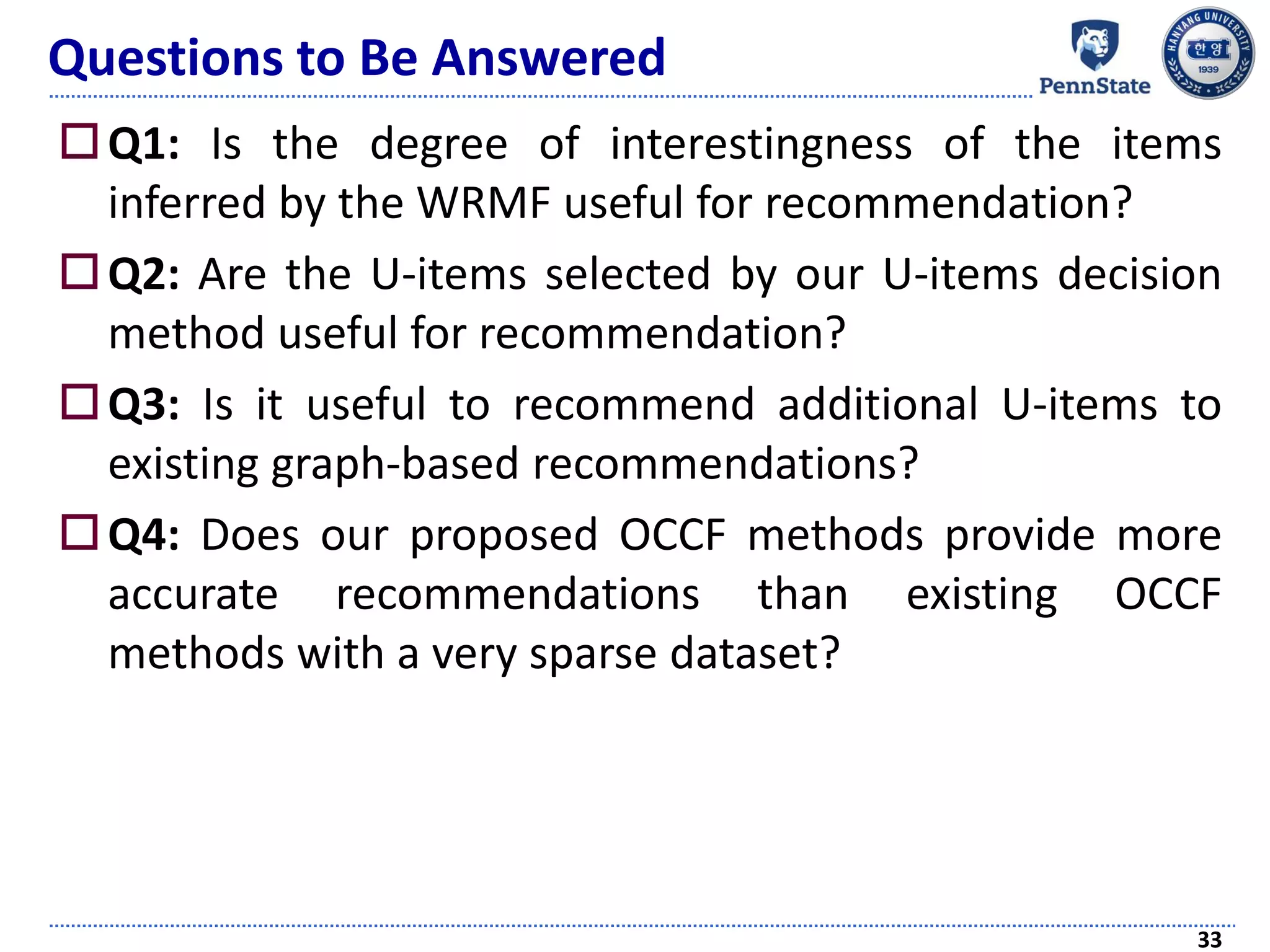
Questions to Be Answered
Q1: Is the degree of interestingness of the items
inferred by the WRMF useful for recommendation?
Q2: Are the U-items selected by our U-items decision
method useful for recommendation?
Q3: Is it useful to recommend additional U-items to
existing graph-based recommendations?
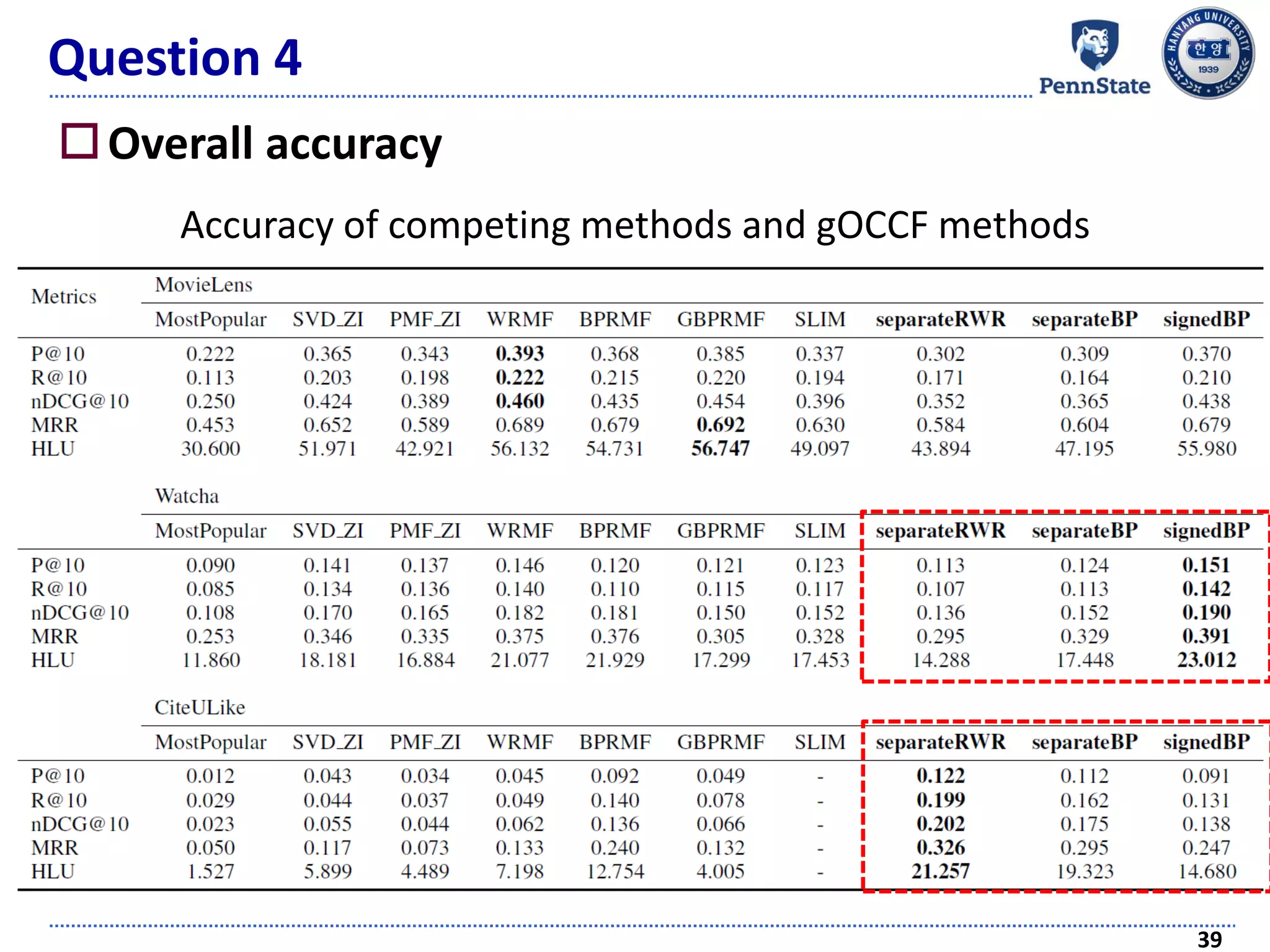
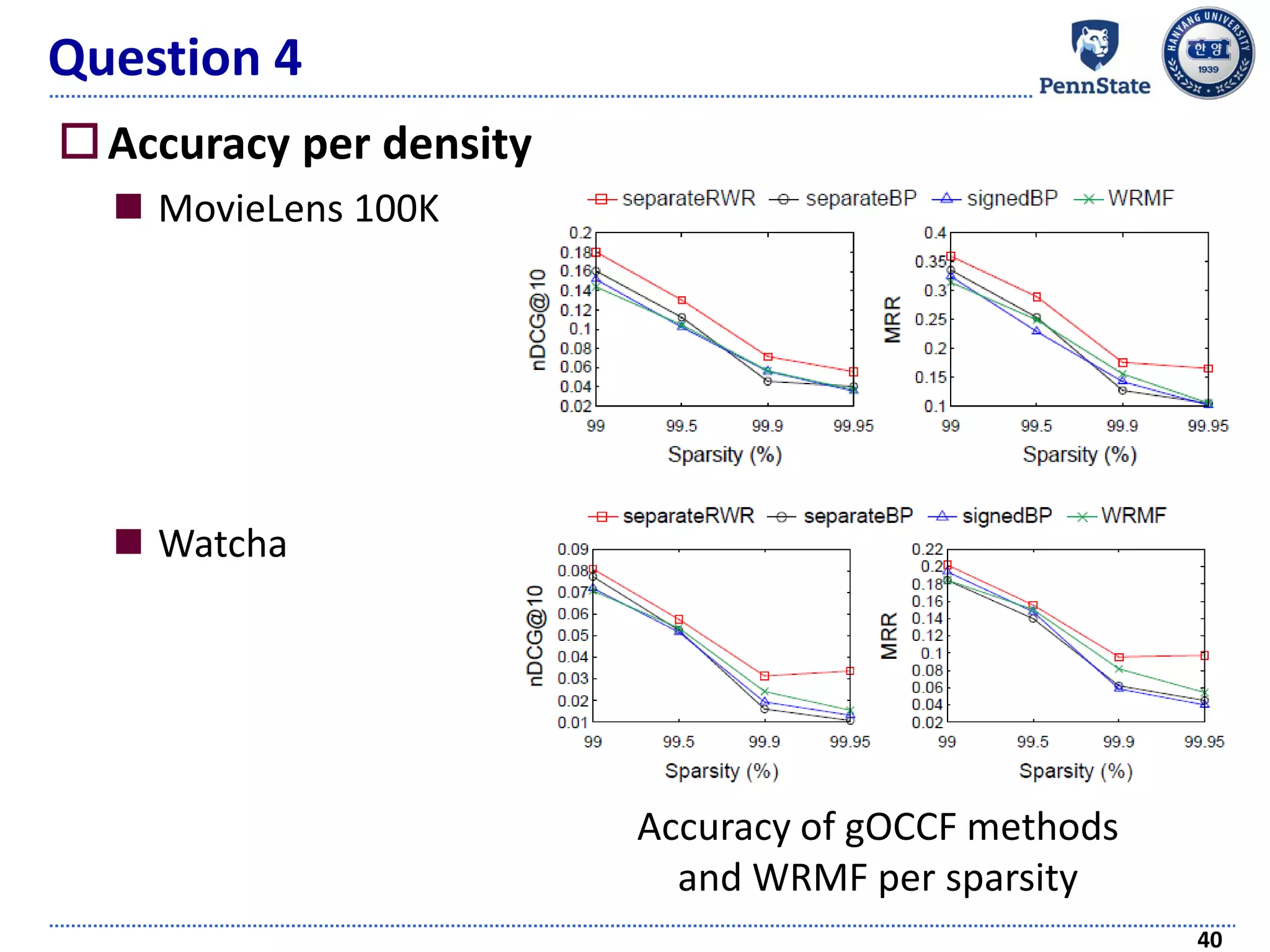
Q4: Does our proposed OCCF methods provide more
accurate recommendations than existing OCCF
methods with a very sparse dataset?
33
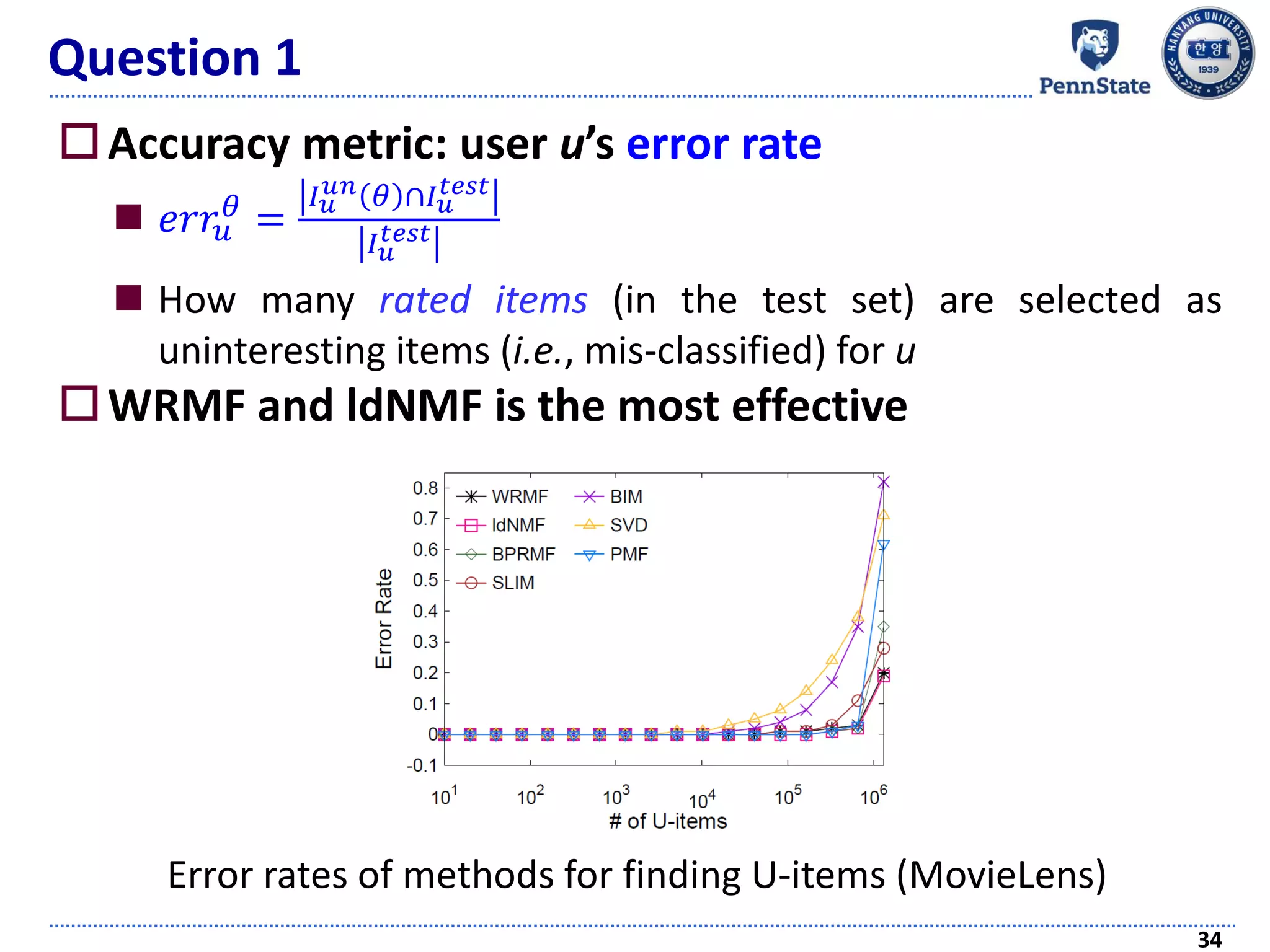
Question 1
Accuracy metric: user u’s error rate
 𝑒𝑟𝑟𝑢
𝜃
=
𝐼 𝑢
𝑢𝑛 𝜃 ∩𝐼 𝑢
𝑡𝑒𝑠𝑡
𝐼 𝑢
𝑡𝑒𝑠𝑡
 How many rated items (in the test set) are selected as
uninteresting items (i.e., mis-classified) for u
WRMF and ldNMF is the most effective
34
Error rates of methods for finding U-items (MovieLens)
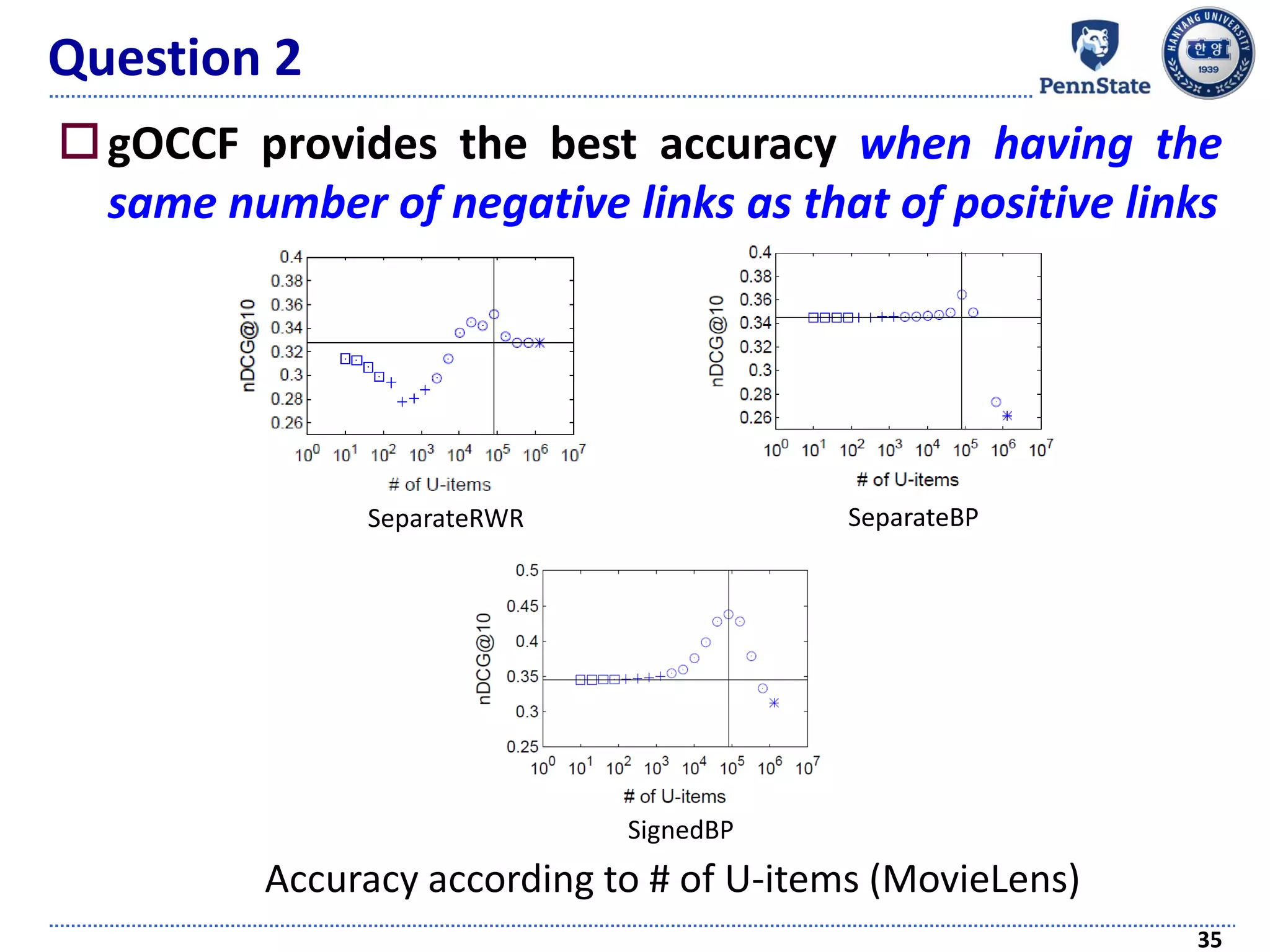
gOCCF provides the best accuracy when having the
same number of negative links as that of positive links
Question 2
35
Accuracy according to # of U-items (MovieLens)
SeparateRWR SeparateBP
SignedBP
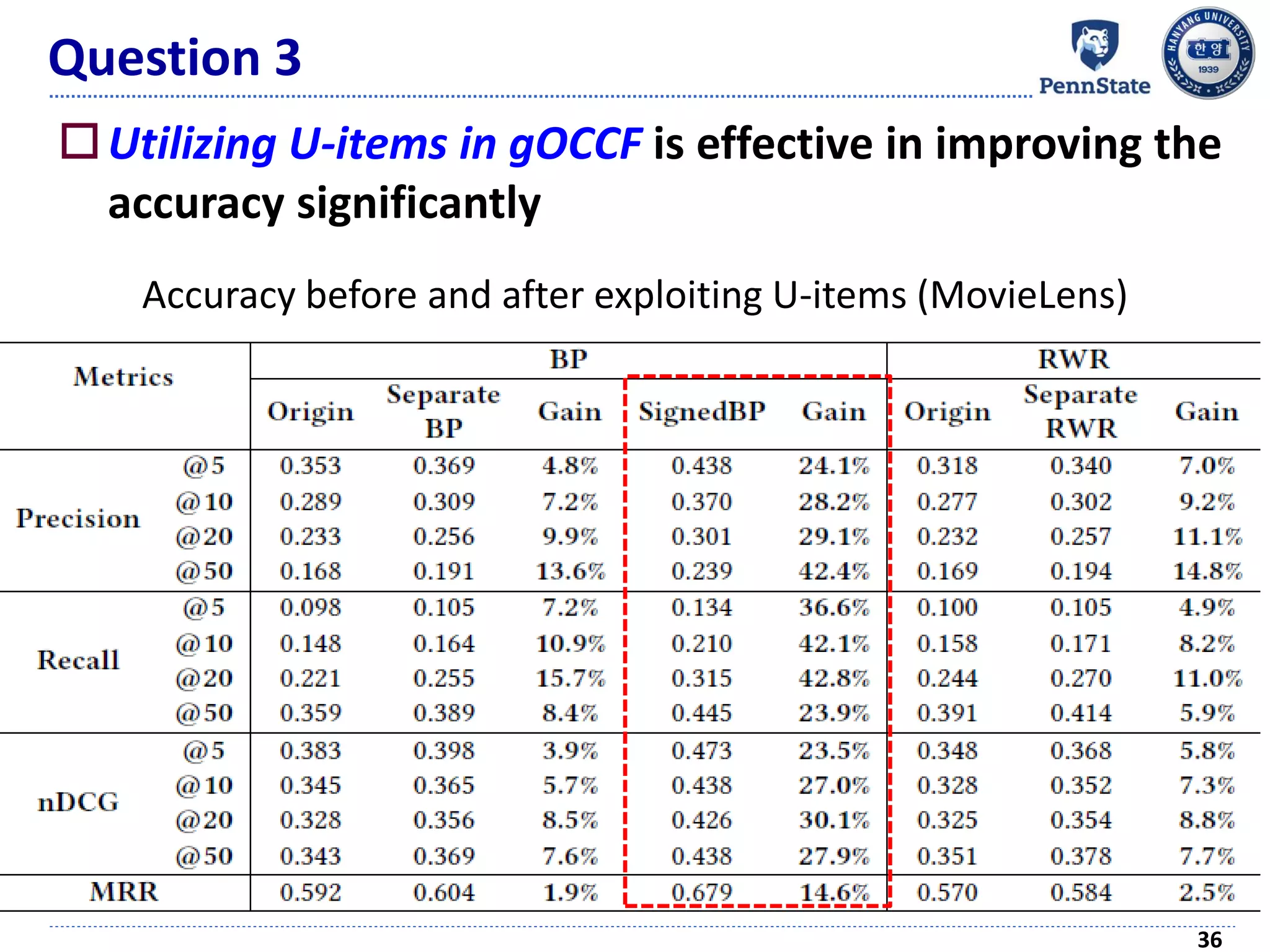
Question 3
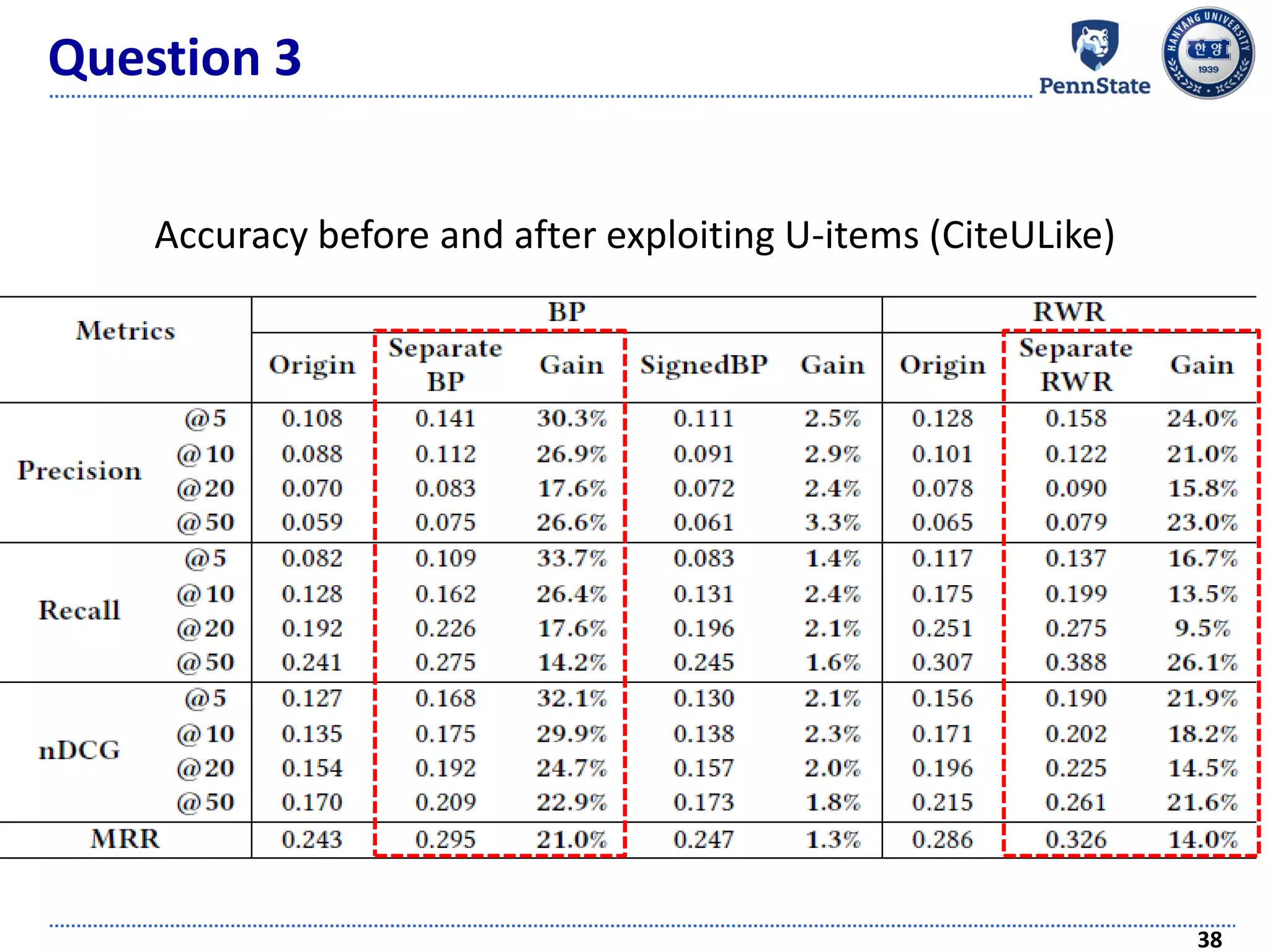
Utilizing U-items in gOCCF is effective in improving the
accuracy significantly
36
Accuracy before and after exploiting U-items (MovieLens)
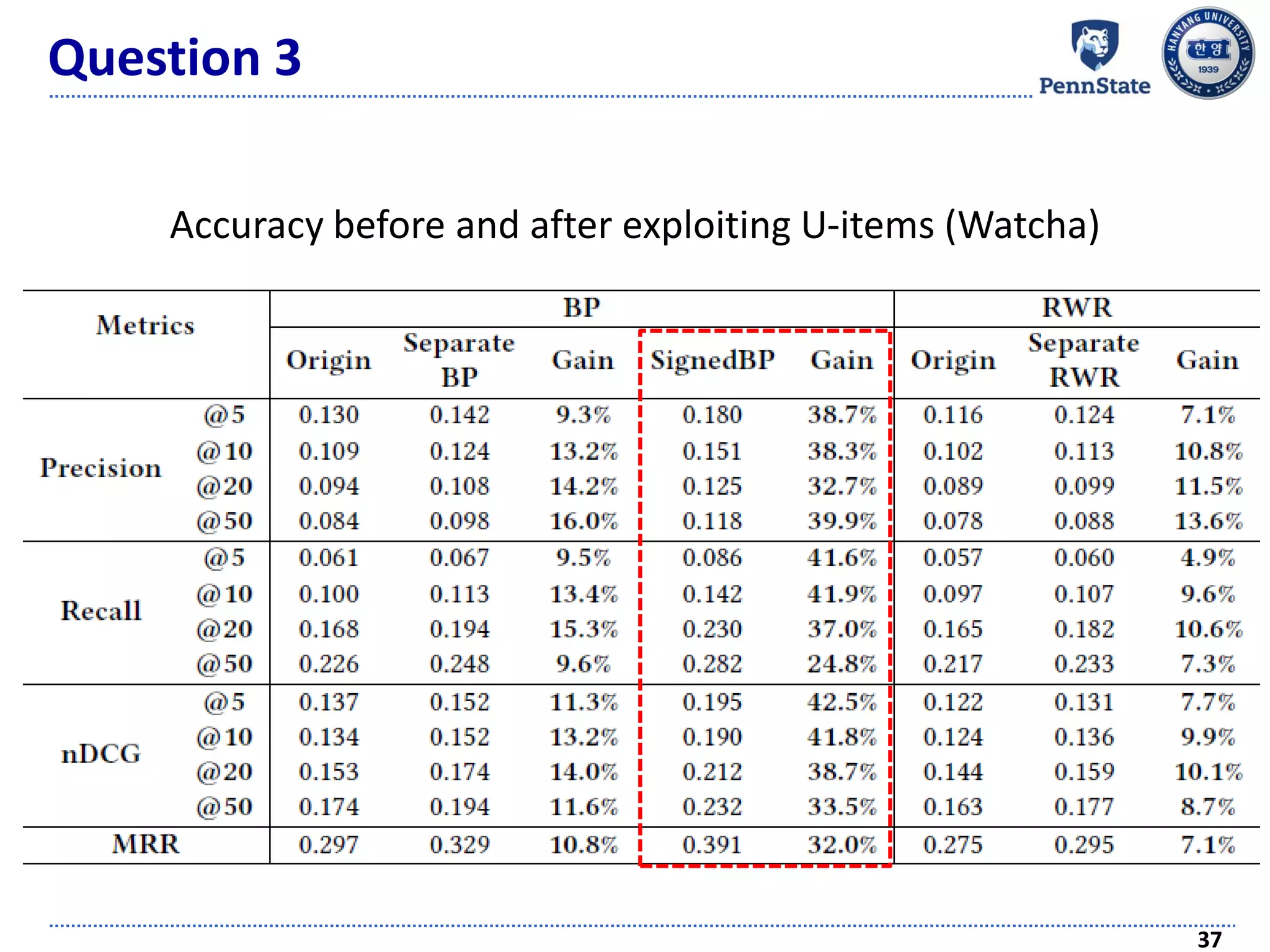
Question 3
37
Accuracy before and after exploiting U-items (Watcha)
Question 3
38
Accuracy before and after exploiting U-items (CiteULike)
Question 4
Overall accuracy
39
Accuracy of competing methods and gOCCF methods
Question 4
Accuracy per density
 MovieLens 100K
 Watcha
40
Accuracy of gOCCF methods
and WRMF per sparsity
Conclusions
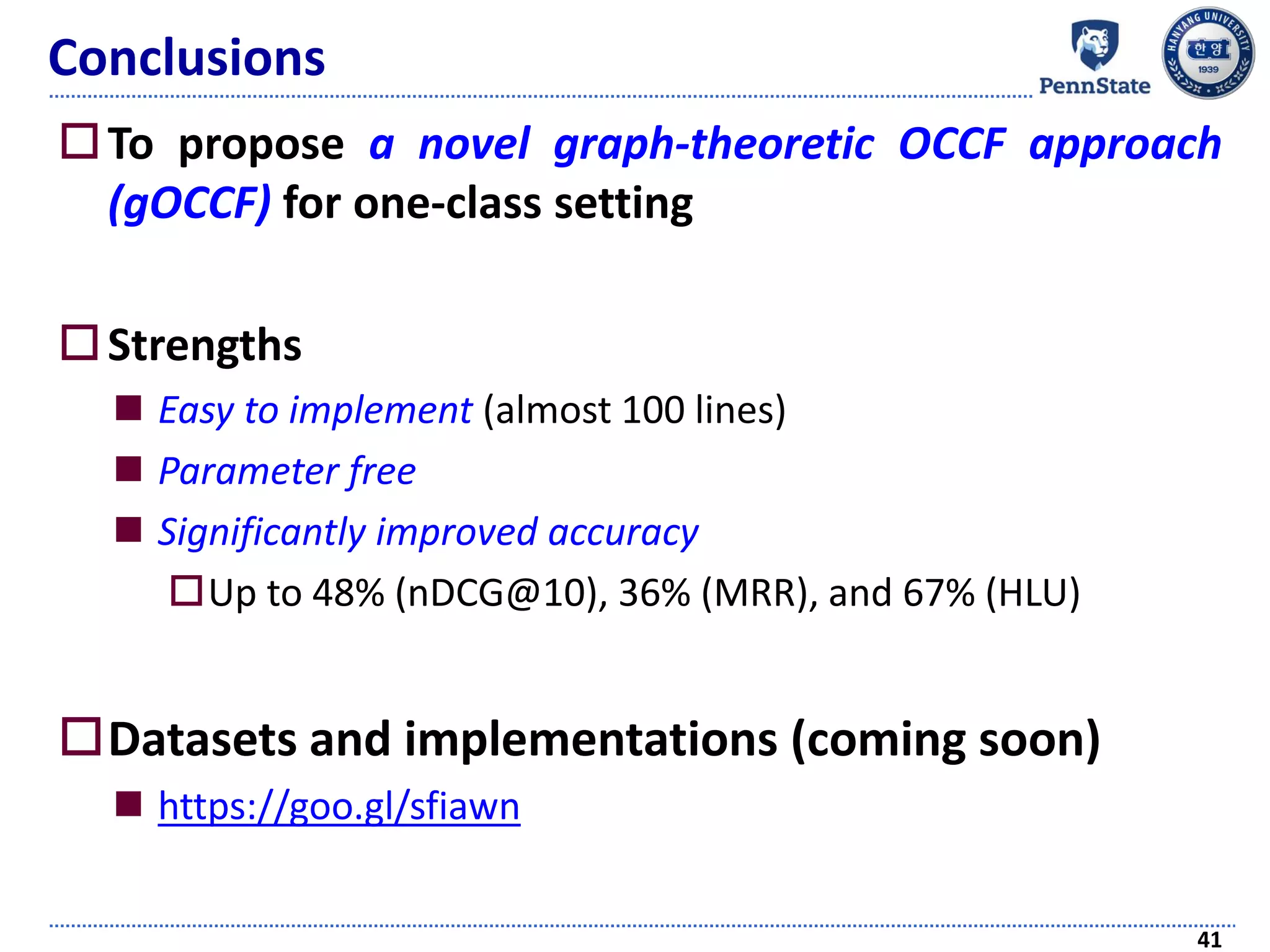
To propose a novel graph-theoretic OCCF approach
(gOCCF) for one-class setting
Strengths
 Easy to implement (almost 100 lines)
 Parameter free
 Significantly improved accuracy
Up to 48% (nDCG@10), 36% (MRR), and 67% (HLU)
Datasets and implementations (coming soon)
 https://goo.gl/sfiawn
41
42
Applications of OCCF
 Motivation
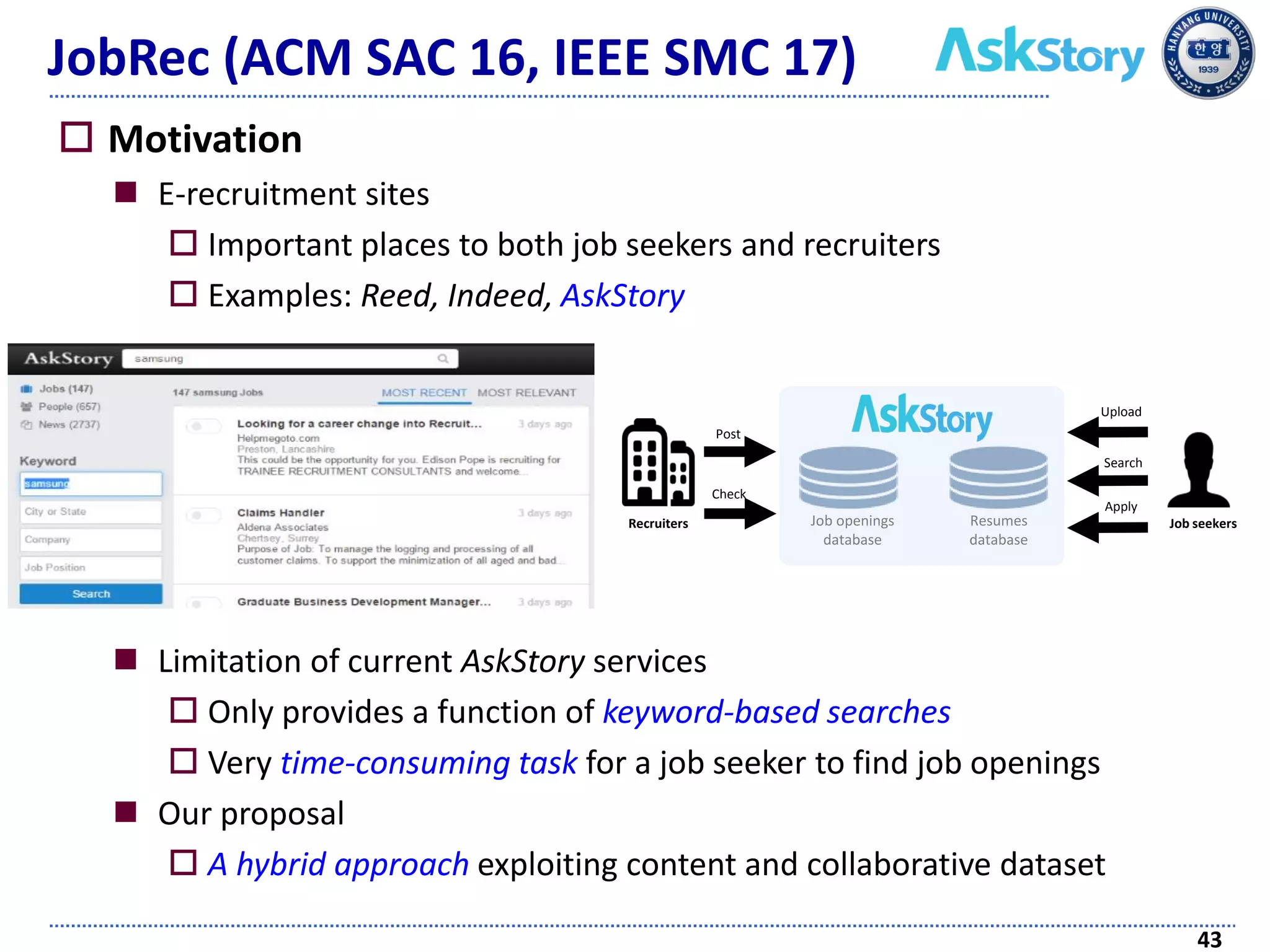
 E-recruitment sites
 Important places to both job seekers and recruiters
 Examples: Reed, Indeed, AskStory
 Limitation of current AskStory services
 Only provides a function of keyword-based searches
 Very time-consuming task for a job seeker to find job openings
 Our proposal
 A hybrid approach exploiting content and collaborative dataset
43
JobRec (ACM SAC 16, IEEE SMC 17)
Job seekersRecruiters Job openings
database
Resumes
database
Upload
Search
Apply
Post
Check
JobRec (ACM SAC 16, IEEE SMC 17)
 Our approach
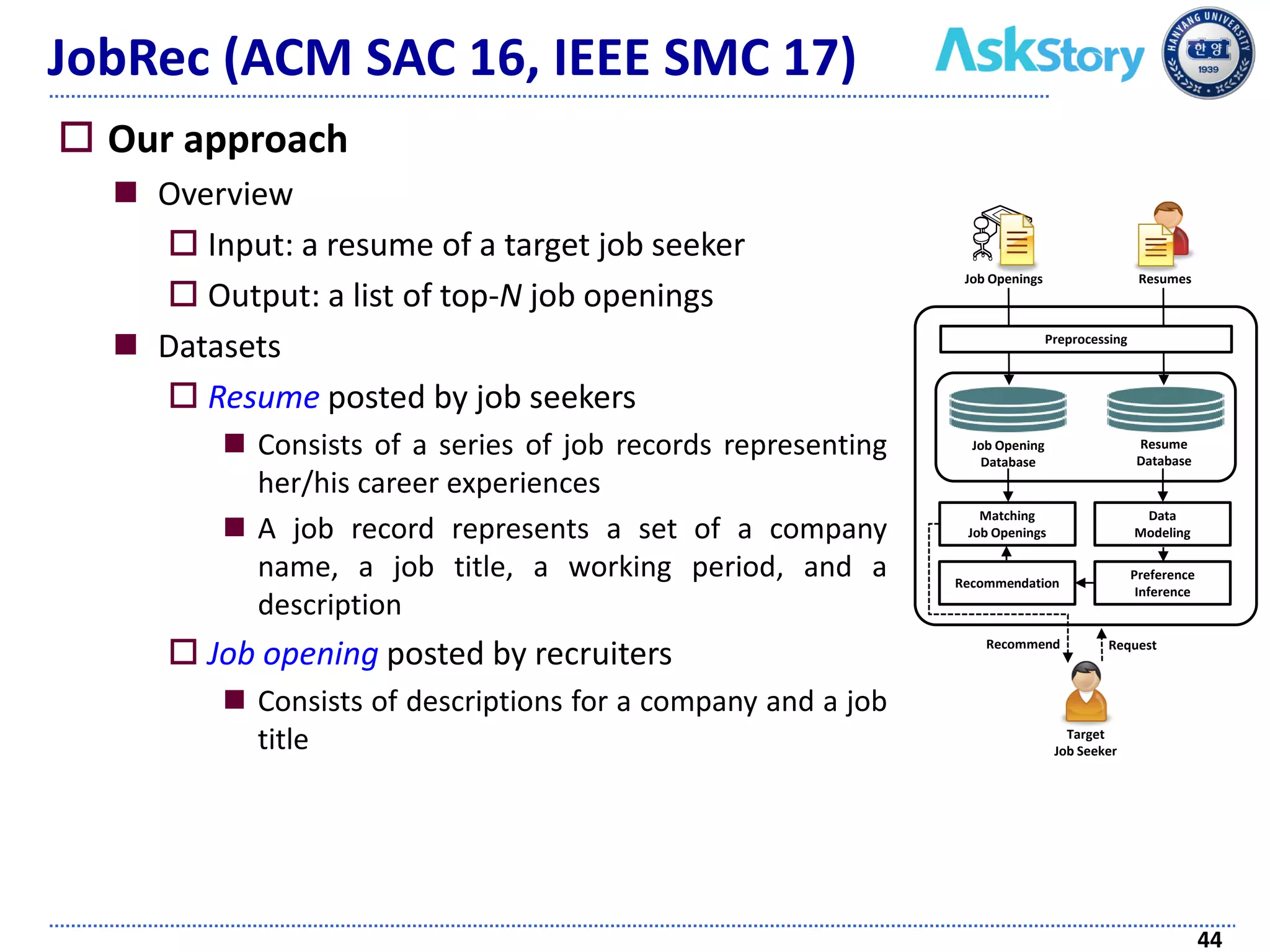
 Overview
 Input: a resume of a target job seeker
 Output: a list of top-N job openings
 Datasets
 Resume posted by job seekers
 Consists of a series of job records representing
her/his career experiences
 A job record represents a set of a company
name, a job title, a working period, and a
description
 Job opening posted by recruiters
 Consists of descriptions for a company and a job
title
44
Request
ResumesJob Openings
Resume
Database
Job Opening
Database
Data
Modeling
Preference
Inference
Matching
Job Openings
Target
Job Seeker
Recommendation
Recommend
Preprocessing
JobRec (ACM SAC 16, IEEE SMC 17)
 Our approach
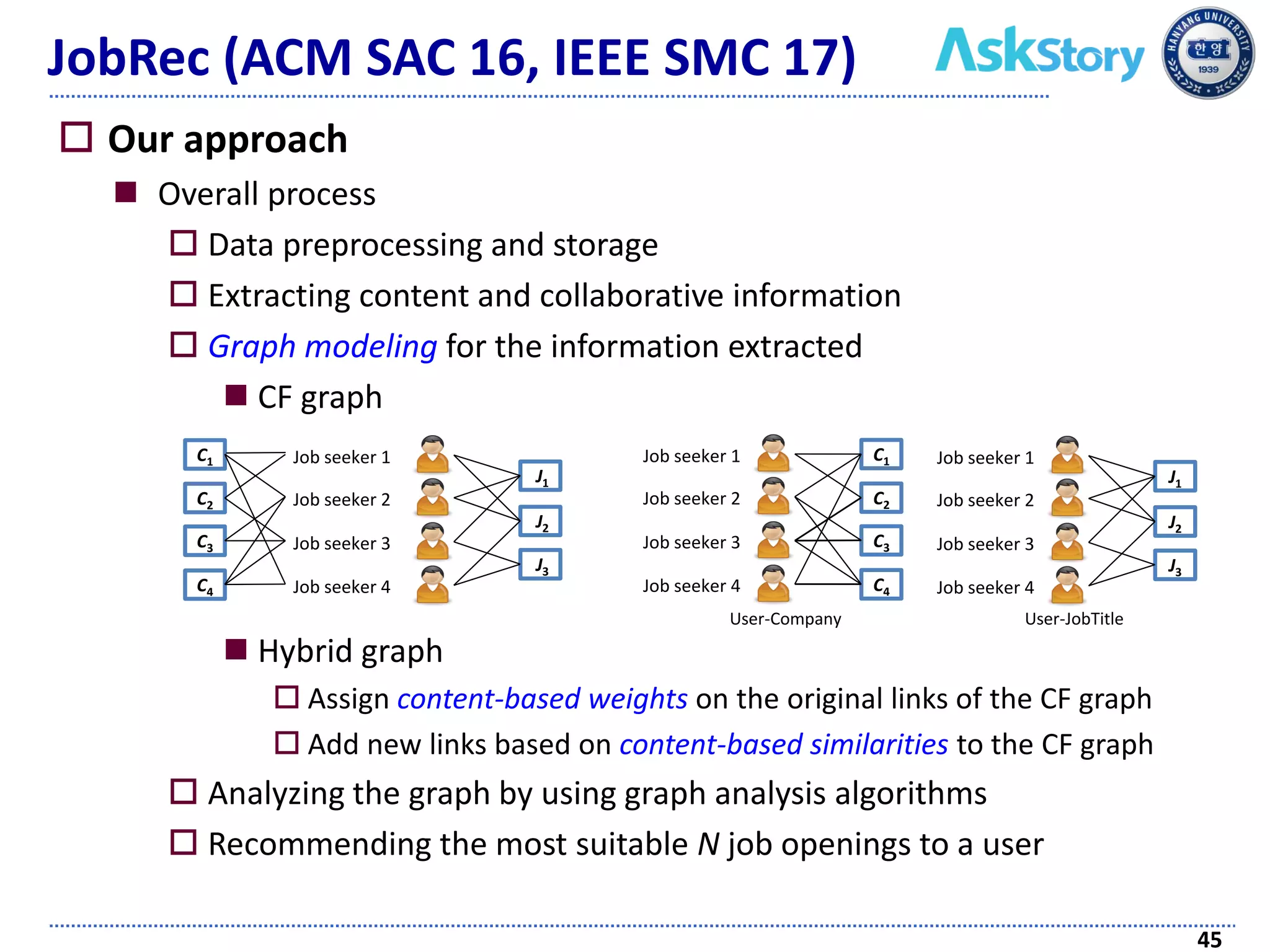
 Overall process
 Data preprocessing and storage
 Extracting content and collaborative information
 Graph modeling for the information extracted
 CF graph
 Hybrid graph
 Assign content-based weights on the original links of the CF graph
 Add new links based on content-based similarities to the CF graph
 Analyzing the graph by using graph analysis algorithms
 Recommending the most suitable N job openings to a user
45
User-Company
Job seeker 1
Job seeker 2
Job seeker 3
Job seeker 4
C1
C2
C3
C4
User-JobTitle
Job seeker 1
Job seeker 2
Job seeker 3
Job seeker 4
J1
J2
J3
Job seeker 1
Job seeker 2
Job seeker 3
Job seeker 4
J1
J2
J3
C1
C2
C3
C4
JobRec (ACM SAC 16, IEEE SMC 17)
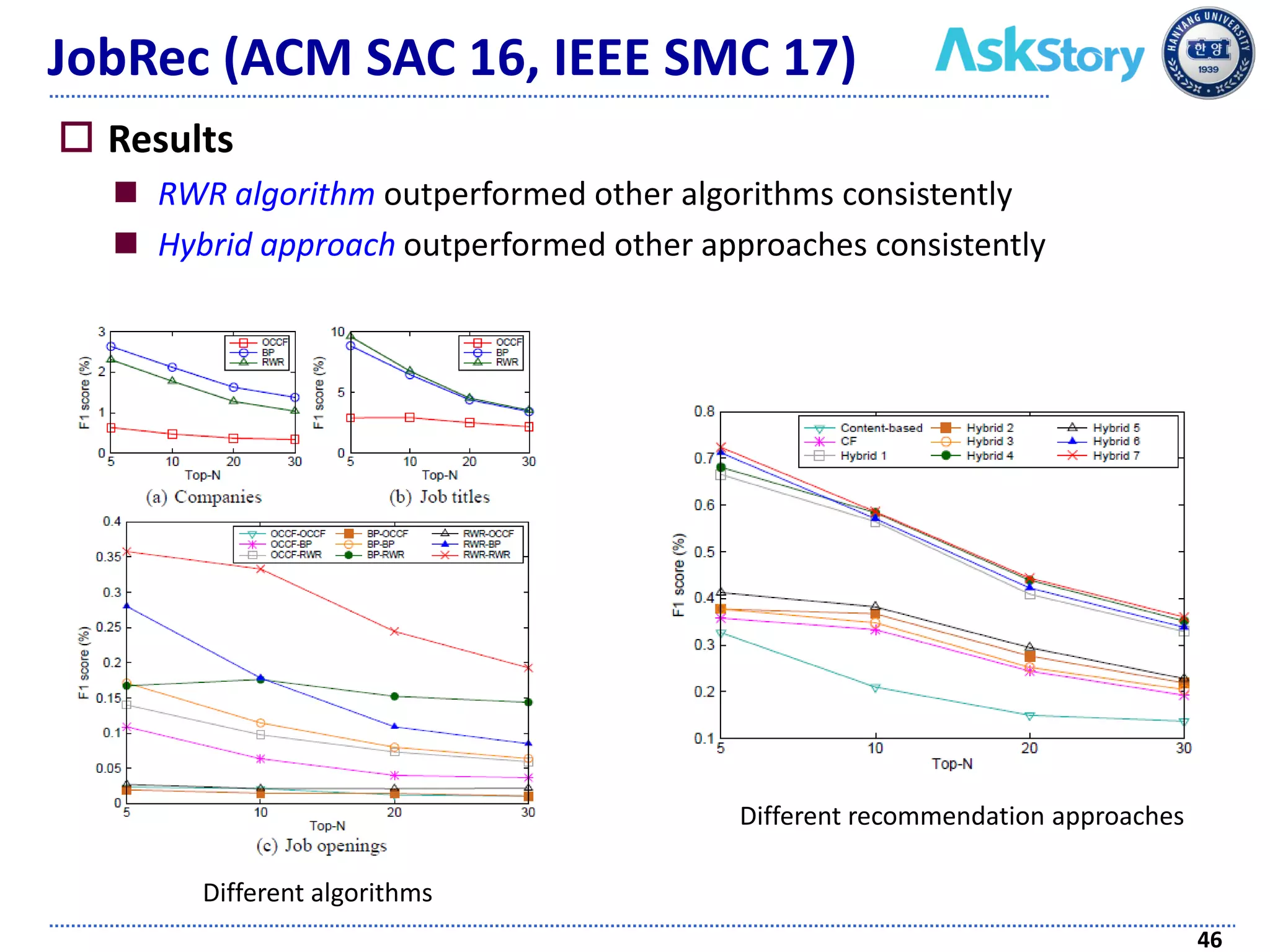
 Results
 RWR algorithm outperformed other algorithms consistently
 Hybrid approach outperformed other approaches consistently
46
Different algorithms
Different recommendation approaches
PaperRec (IEEE SMC 16)
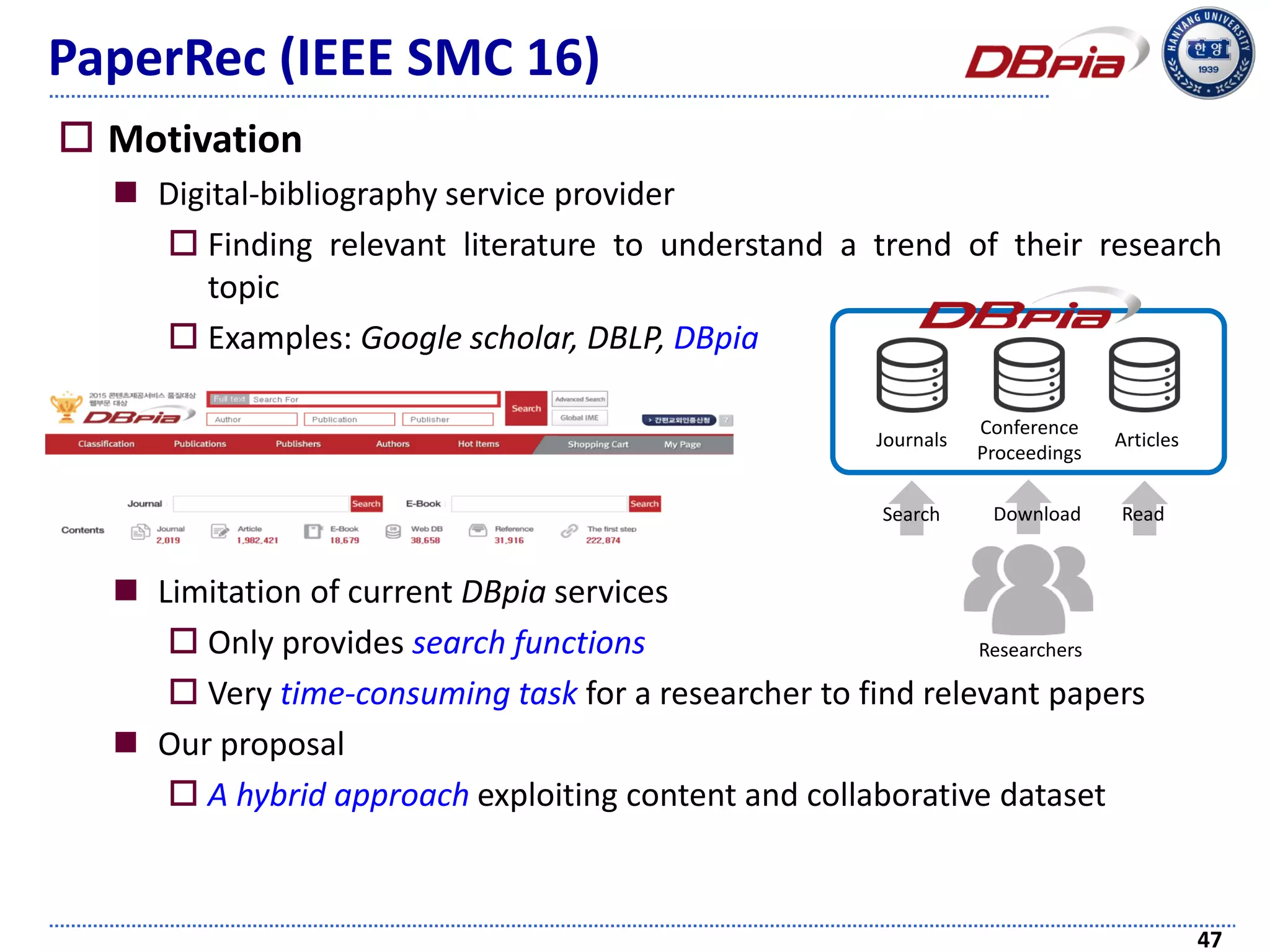
 Motivation
 Digital-bibliography service provider
 Finding relevant literature to understand a trend of their research
topic
 Examples: Google scholar, DBLP, DBpia
 Limitation of current DBpia services
 Only provides search functions
 Very time-consuming task for a researcher to find relevant papers
 Our proposal
 A hybrid approach exploiting content and collaborative dataset
47
Researchers
Journals
Conference
Proceedings
Articles
Search Download Read
PaperRec (IEEE SMC 16)
 Our approach
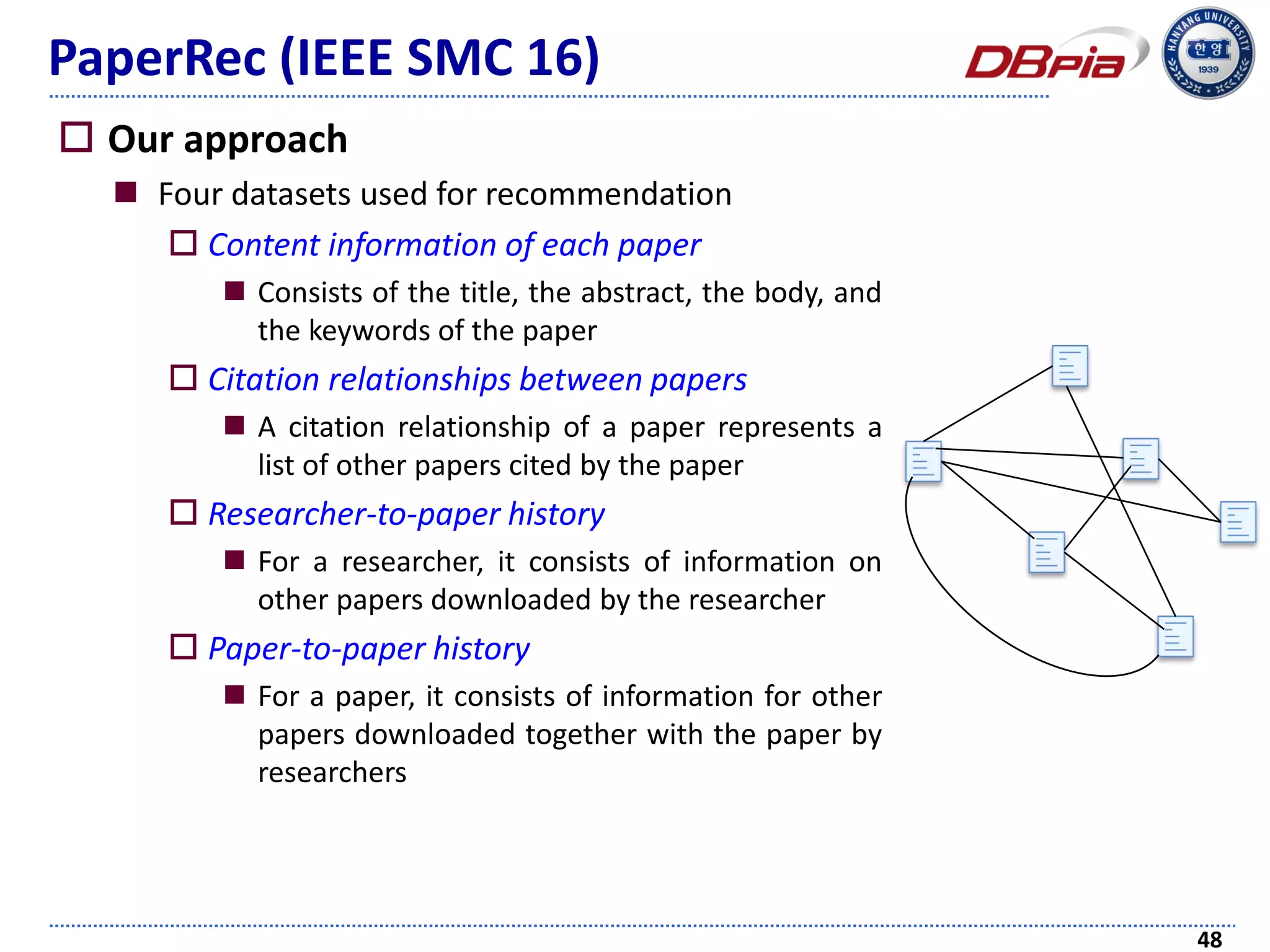
 Four datasets used for recommendation
 Content information of each paper
 Consists of the title, the abstract, the body, and
the keywords of the paper
 Citation relationships between papers
 A citation relationship of a paper represents a
list of other papers cited by the paper
 Researcher-to-paper history
 For a researcher, it consists of information on
other papers downloaded by the researcher
 Paper-to-paper history
 For a paper, it consists of information for other
papers downloaded together with the paper by
researchers
48
PaperRec (IEEE SMC 16)
 Our approach
 Idea
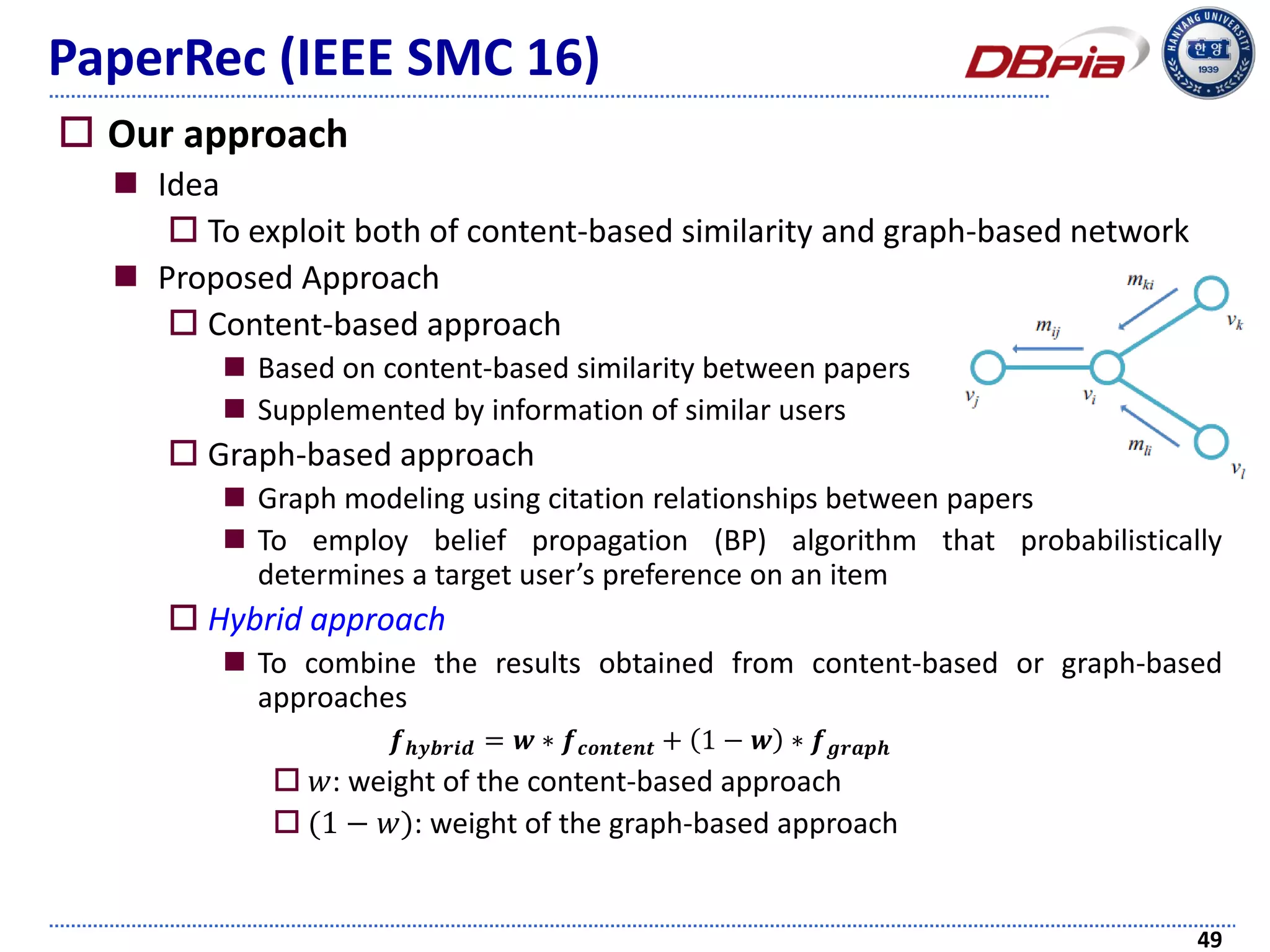
 To exploit both of content-based similarity and graph-based network
 Proposed Approach
 Content-based approach
 Based on content-based similarity between papers
 Supplemented by information of similar users
 Graph-based approach
 Graph modeling using citation relationships between papers
 To employ belief propagation (BP) algorithm that probabilistically
determines a target user’s preference on an item
 Hybrid approach
 To combine the results obtained from content-based or graph-based
approaches
 𝑤: weight of the content-based approach
 (1 − 𝑤): weight of the graph-based approach
49
𝒇 𝒉𝒚𝒃𝒓𝒊𝒅 = 𝒘 ∗ 𝒇 𝒄𝒐𝒏𝒕𝒆𝒏𝒕 + 1 − 𝒘 ∗ 𝒇 𝒈𝒓𝒂𝒑𝒉
PaperRec (IEEE SMC 16)
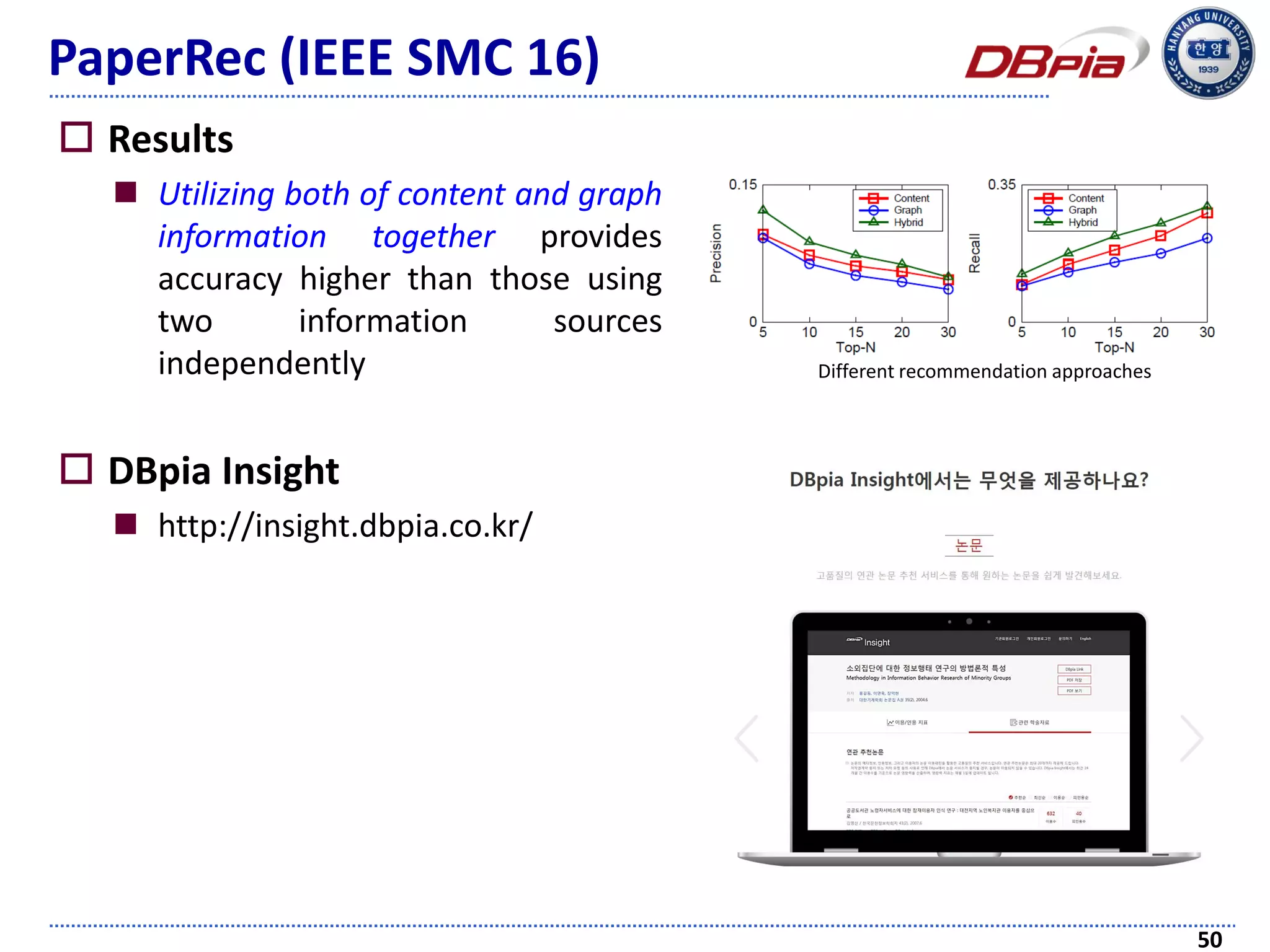
 Results
 Utilizing both of content and graph
information together provides
accuracy higher than those using
two information sources
independently
 DBpia Insight
 http://insight.dbpia.co.kr/
50
Different recommendation approaches
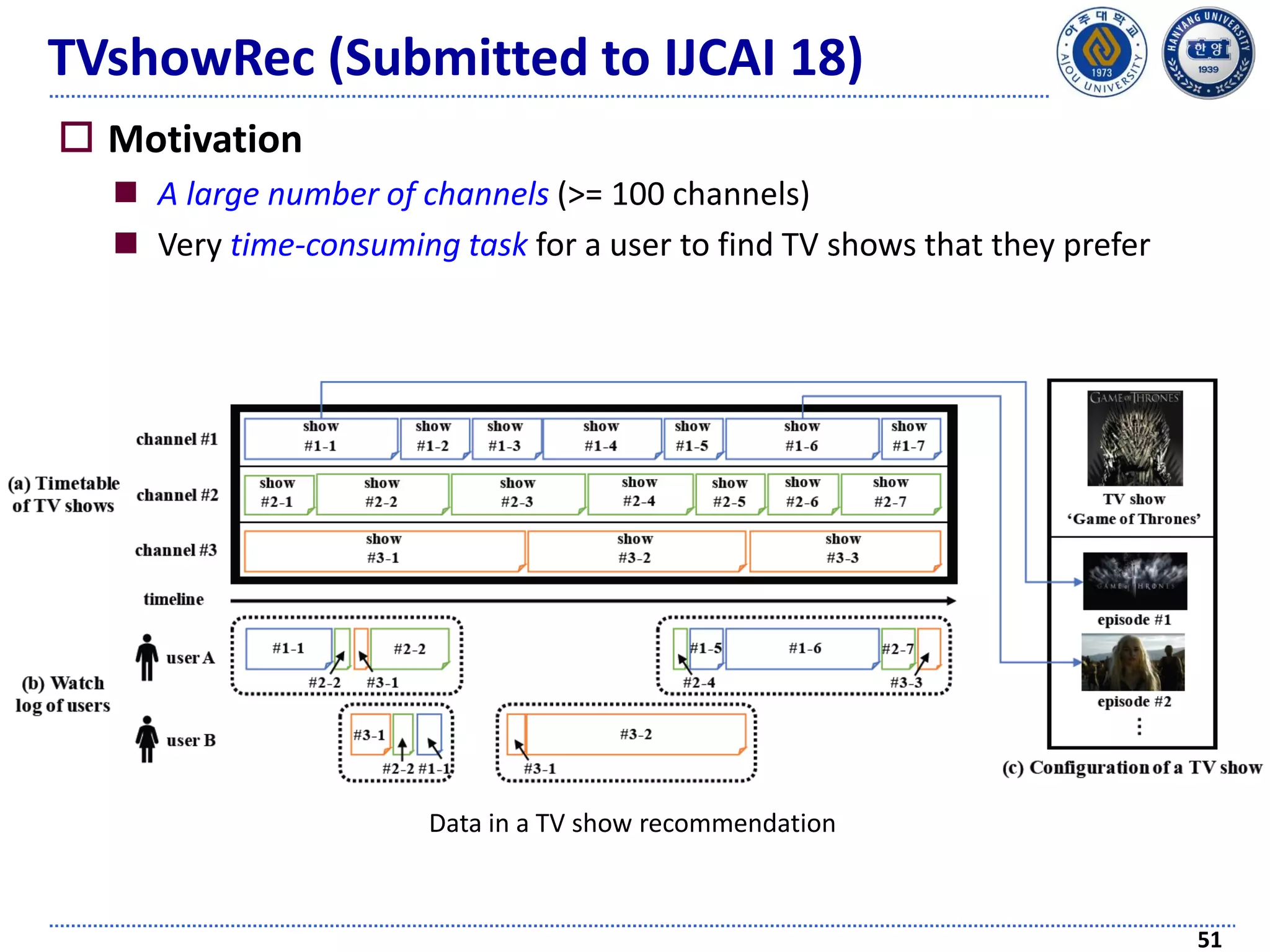
 Motivation
 A large number of channels (>= 100 channels)
 Very time-consuming task for a user to find TV shows that they prefer
51
TVshowRec (Submitted to IJCAI 18)
Data in a TV show recommendation
TVshowRec (Submitted to IJCAI 18)
 Our approach
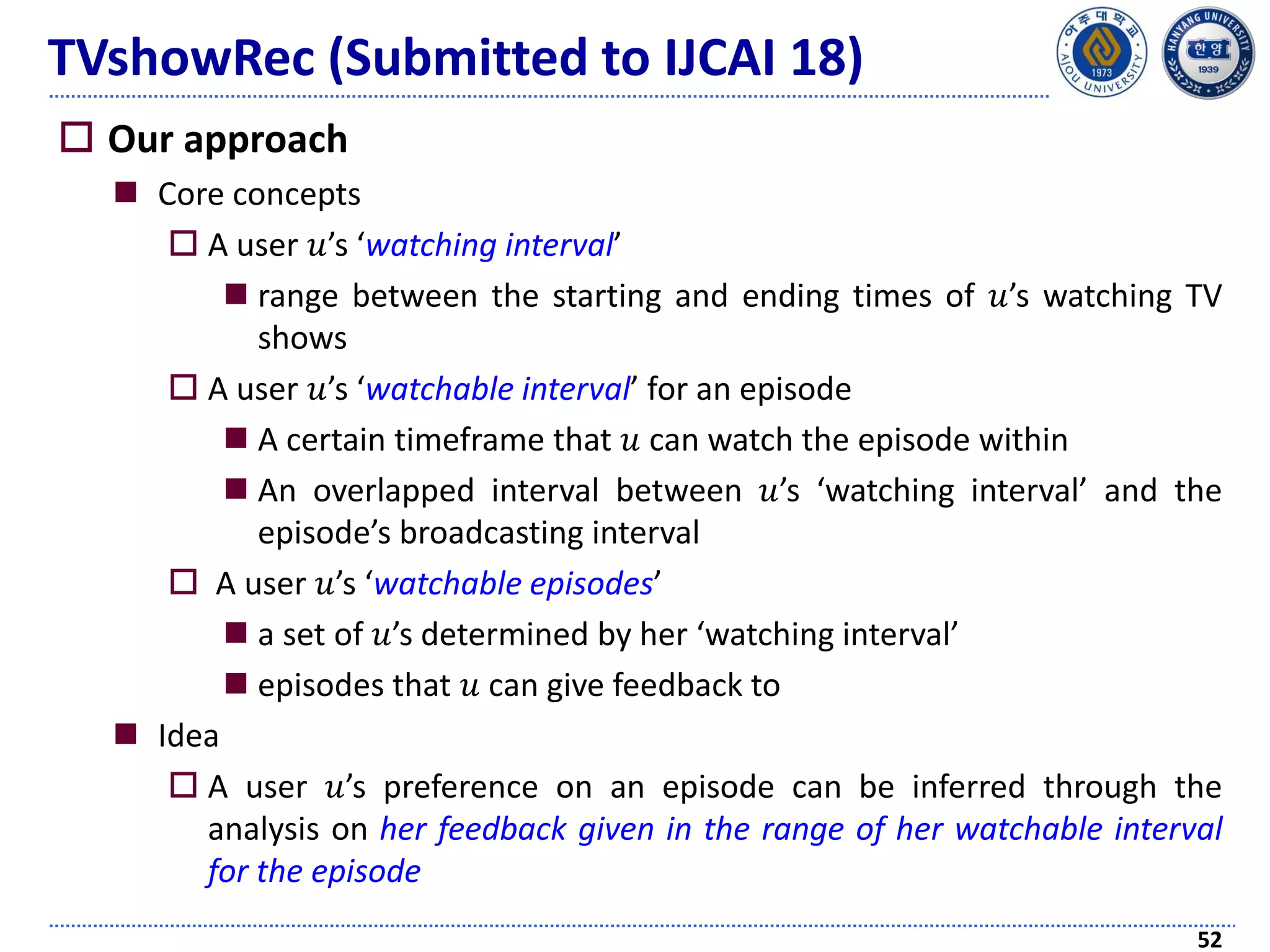
 Core concepts
 A user 𝑢’s ‘watching interval’
 range between the starting and ending times of 𝑢’s watching TV
shows
 A user 𝑢’s ‘watchable interval’ for an episode
 A certain timeframe that 𝑢 can watch the episode within
 An overlapped interval between 𝑢’s ‘watching interval’ and the
episode’s broadcasting interval
 A user 𝑢’s ‘watchable episodes’
 a set of 𝑢’s determined by her ‘watching interval’
 episodes that 𝑢 can give feedback to
 Idea
 A user 𝑢’s preference on an episode can be inferred through the
analysis on her feedback given in the range of her watchable interval
for the episode
52
TVshowRec (Submitted to IJCAI 18)
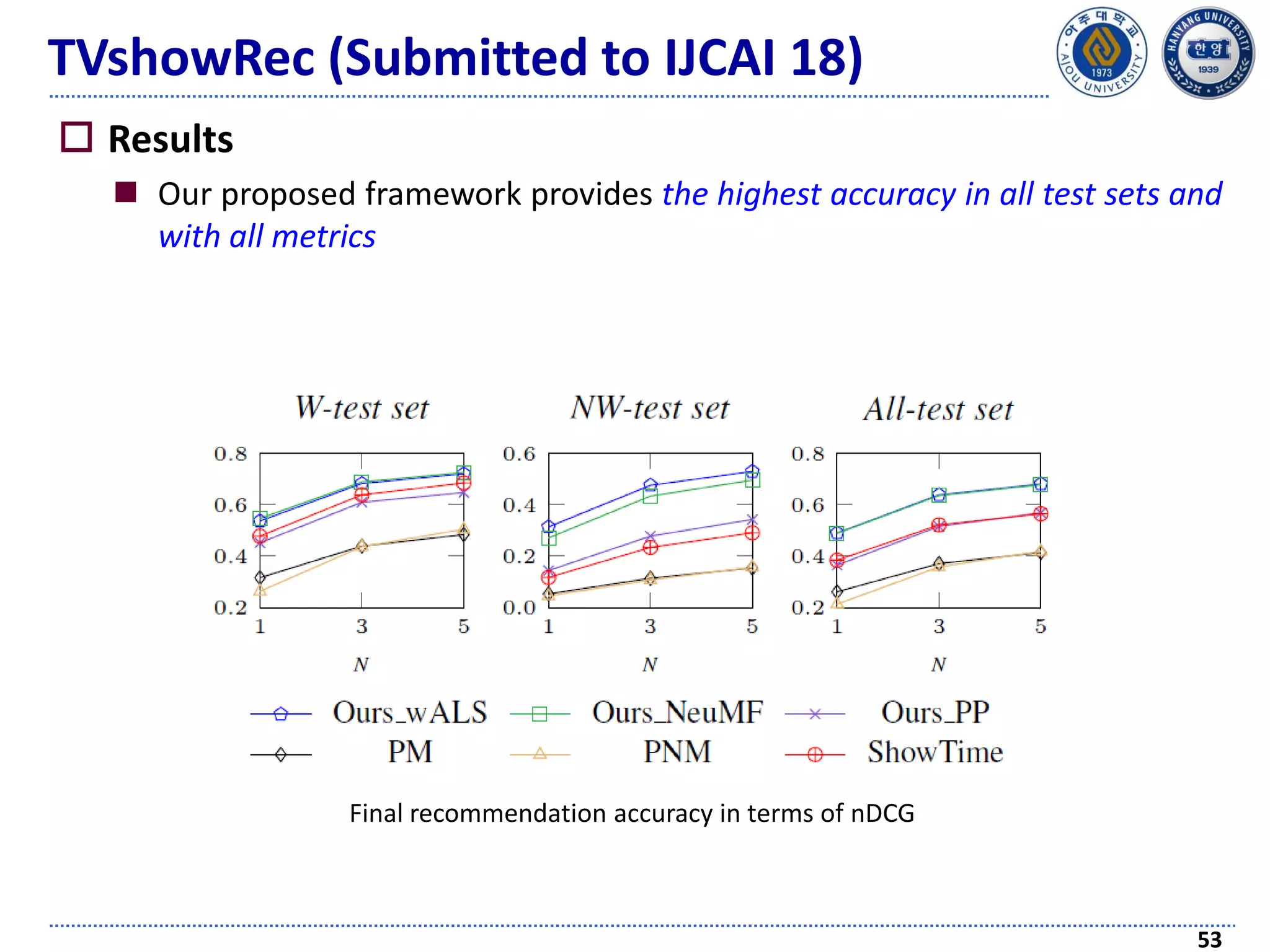
 Results
 Our proposed framework provides the highest accuracy in all test sets and
with all metrics
53
Final recommendation accuracy in terms of nDCG
References
 gOCCF
 Yeon-Chang Lee, Sang-Wook Kim, Dongwon Lee, “gOCCF: Graph-Theoretic One-Class
Collaborative Filtering Based on Uninteresting Items”, In AAAI 2018
 JobRec
 Yujin Lee*, Yeon-Chang Lee*, Jiwon Hong, Sang-Wook Kim, “Exploiting Job Transition
Patterns for Effective Job Recommendation”, In IEEE SMC 2017 (*co-first authors with equal
contribution)
 Yeon-Chang Lee, Jiwon Hong, and Sang-Wook Kim, “Job Recommendation in AskStory:
Experiences, Methods, and Evaluation,” In ACM SAC 2016
 Yeon-Chang Lee, Jiwon Hong, Sang-Wook Kim, Sheng Gao, and Ji-Yong Hwang, “On
Recommending Job Openings,” In ACM HT 2015
 PaperRec
 Yeon-Chang Lee, Jungwan Yeom, Kiburm Song, Jiwoon Ha, Kichun Lee, Jangho Yeo, and Sang-
Wook Kim, “Recommendation of Research Papers in DBpia: A Hybrid Approach Exploiting
Content and Collaborative Data,” In IEEE SMC 2016
 TVshowRec
 Kyung-Jae Cho, Yeon-Chang Lee, Kyungsik Han, Sang-Wook Kim, “TV Show Recommendation
using Watchable Episodes,” In IJCAI 2018 (Submitted)
54

Recommender Systems with Implicit Feedback Challenges, Techniques, and Applications

  • 1.
    Recommender Systems withImplicit Feedback: Challenges, Techniques, and Applications Yeon-Chang Lee Advisor: Sang-Wook Kim Big Data Science Lab. Hanyang University 2018-02-21
  • 2.
    Contents  gOCCF: Graph-TheoreticOne-Class Collaborative Filtering Based on Uninteresting Items (AAAI 18)  Background  Motivation  Proposed Approach  Evaluation  Conclusions  Applications of OCCF  Job Recommendation (ACM SAC 16, IEEE SMC 17)  Paper Recommendation (IEEE SMC 16)  TV Show Recommendation (Submitted to IJCAI 18) 2
  • 3.
    3 gOCCF: Graph-Theoretic One-Class CollaborativeFiltering Based on Uninteresting Items
  • 4.
    Background: Recommender Systems Providea user with a few items that she would like  Using her history of evaluating, purchasing and browsing 4 Active user interested in shoes Purchased items A recommender system Recommended items Purchasing several pairs of shoes Analyzing the user’s preference Selecting a few items that she would like Providing the selected items Overview of recommender systems
  • 5.
    Background: Collaborative Filtering Oneof popular recommendation techniques that uses the similarity between users’ past feedback  Explicit feedback (e.g., 1-5 stars rating)  Implicit feedback (e.g., purchase logs, browsing history) 5 Overview of collaborative filtering
  • 6.
    Motivation One-Class Collaborative Filtering(OCCF) problem  Problem to handle the implicit feedback One-class setting (clicked or unknown) versus multi-class setting (1-5 stars rating)  Challenges Less information to capture a user’s taste than multi-class setting More sparse datasets than in multi-class setting 6
  • 7.
    Motivation Existing OCCF approaches Common concept View all unrated items as negative preferences e.g., WRMF, BPRMF  Challenge Less effective in dealing with sparse dataset with many unrated items 7 Accuracy of an OCCF method per sparsity
  • 8.
    Motivation Zero-injection [Hwang etal., ICDE 16]  Address the sparsity problem successfully in multi-class setting  Define a novel notion of ‘uninteresting items’ (U-items, in short) of a user Items on which the user has “negative” preferences 8 Whole items (𝐼u) Interesting items (𝐼 𝑢 𝑖𝑛 ) Uninteresting items (𝐼 𝑢 𝑢𝑛 = 𝐼 − 𝐼 𝑢 𝑖𝑛 ) Evaluated items (𝐼 𝑢 𝑒𝑣𝑎𝑙 ) Preferred Items (𝐼 𝑢 𝑝𝑟𝑒 ) Venn diagram for preferences of items
  • 9.
    Motivation Zero-injection [Hwang etal., ICDE 16] 9 Overview of zero-injection
  • 10.
    Motivation Zero-injection [Hwang etal., ICDE 16] 10 Accuracy of zero-injection 90 92 94 96 98 99.7 0 0.05 0.1 0.15 0.2 0.25 0 2 4 6 8 10 0 0.05 0.1 0.15 0.2 0.25 0 20 40 60 80 99.7 Precision Parameter θ Zero-injection + SVD Zero-injection + ICF <Recall> <nDCG> <MRR><Precision>
  • 11.
    Motivation Zero-injection [Hwang etal., ICDE 16]  A naïve application of zero-injection in one-class setting Lower accuracy than OCCF approaches Sensitivity to the number of U-items 11 Accuracy in one-class setting: SVD and PMF with varying degree of zero injection and WRMF without zero-injection
  • 12.
    Overview of OurApproach: gOCCF 12 Graph-Theoretic One-Class Collaborative Filtering  (S1) Inferring the degree of interestingness  (S2) Determining the number of U-items without 𝜃  (S3) Graph Modeling and Recommendation Overview of gOCCF
  • 13.
    Employ a popularOCCF method (WRMF) [Pan et al., ICDM 08] Steps  Treat all unrated items as negative preferences (i.e., value of 0)  Assign different weights to quantify the relative contribution  Predict the value of by matrix factorization 13 U V Feature of user u Feature of item i 1 1 1 0 1 0 0 0 0 0 1 0 1 1 1 0.6 1 0.2 0.2 0.2 0.2 0.2 1 0.2 Binary rating matrixUnary rating matrix Weight matrix 1 1 1 1 1 WRMF (S1) How to infer the degree of interestingness
  • 14.
    Equations  Objective function ℒ𝑋, 𝑌 = σ 𝑢 ቂ ቃ σ𝑖 𝑤 𝑢𝑖 ቄ ቅ 𝑝 𝑢𝑖 − 𝑋 𝑢 𝑌𝑖 𝑇 2 + λ ቀ ቁ 𝑋 𝑢 ∙ 𝐹 2 + 𝑌𝑖 ∙ 𝐹 2  Updates elements in the matrices X and Y 𝑋 𝑢 ∙ = 𝑝 𝑢 ∙ ෥𝑤 𝑢 ∙ Y 𝑌 𝑇 ෥𝑤 𝑢 ∙ 𝑌 + λ σ𝑖 𝑤 𝑢𝑖 𝐿 −1  ෥𝑤 𝑢(∙) is a diagonal matrix with elements of 𝑤 𝑢(∙) on the diagonal Matrix L is an identity matrix 𝑌𝑖 ∙ = p ∙ 𝑖 𝑇 ෥𝑤 ∙ 𝑖X 𝑋 𝑇 ෥𝑤 ∙ 𝑖 𝑋 + λ σ 𝑢 𝑤 𝑢𝑖 𝐿 −1  Final value  ෠𝑃 ≈ P = X𝑌 𝑇 14 (S1) How to infer the degree of interestingness
  • 15.
    Brute-force way  Constructnegative graphs 𝐺− by gradually increasing # of U- items  Measure the accuracy of each negative graph 𝐺−  Choose the best 𝐺− that provides the highest accuracy Challenge: the search space for # of U-items  Large # of U-items There are 1.5M unrated items among which U-items can be chosen in MovieLens  Prohibitively expensive to find optimal # of U-items Perform a recommendation algorithm on every 𝐺− for a given dataset Dataset and algorithm dependent 15 (S2) How to determine a right number of U-items
  • 16.
    Consider k unrateduser-item pairs with the lowest degree of interestingness as negative links  Starting from 10, k doubles until negative links reach 90% of unrated pairs Model them as a single bipartite (negative) graph 𝐺− Examine each 𝐺− by analyzing graph properties  Topological properties  Information propagation 16 (S2) How to determine a right number of U-items Candidate negative graphs
  • 17.
    Topological property Graph shatteringtheory [Appel et al., SDM 09]  Introduces a “shattering point” Connectivity of a graph becomes seriously collapsed As links are continuously removed in a random way  ShatterPlot: visualizing the process of generating the shattering point 17 ShatterPlot for positive graph 𝐺+ of MovieLens 100K
  • 18.
    Examine the changein topological properties of 𝐺−  ShatterPlot for 𝐺− has the shattering point  𝐺− has the most similar topological property to 𝐺+ when it’s number of links equal to that of 𝐺+ Topological property 18 ShatterPlot for negative graph 𝐺− of MovieLens 100K • ES-region: extremely sparse region • S-region: shattered region • R-region: real graph region • D-region: dense region X: real 𝐺+
  • 19.
    Topological property The resultswith different metrics 19 ShatterPlot for negative graph 𝐺− of MovieLens 100K
  • 20.
    Topological property The resultswith different datasets 20 ShatterPlot for negative graph 𝐺− of Watcha
  • 21.
    Topological property The resultswith different datasets 21 ShatterPlot for negative graph 𝐺− of CiteULike
  • 22.
    Information propagation gOCCF isbased on graph analysis techniques  To analyze the information propagation in a graph  To make a recommendation list based on the analysis result Effects of employing 𝐺−  Appear when information propagation of 𝐺+ can be changed accordingly by that of 𝐺− 22 Random Walk with Restart Belief Propagation Examples of graph analysis techniques
  • 23.
    Information propagation Examine thePageRank scores of 𝐺−  𝐺− shows a power law-like distribution, similar to real 𝐺+ when it’s number of links equal to that of 𝐺+  When we employ 𝐺−, the existing propagation of 𝐺+ seems to have significant changes Negative scores with various values influence positive scores of 𝐺+ 23 Real positive graph 𝐺+ R-region PageRank scores for 𝐺+ and the representative graph in R-region of 𝐺−
  • 24.
    Information propagation The resultswith different 𝐺−  It is difficult to change the existing propagation of 𝐺+ using other 𝐺− 24 PageRank scores for the representative graphs in other regions of 𝐺− D-region S-regionES-region R-region
  • 25.
    Information propagation The resultswith different datasets  Watcha 25 PageRank scores for 𝐺+ and the representative graphs of 𝐺−
  • 26.
    Information propagation The resultswith different datasets  CiteULike 26 PageRank scores for 𝐺+ and the representative graphs of 𝐺− Real positive graph 𝐺+ R-region S-region ES-region D-region
  • 27.
    (S3) How torecommend top-N items Transform a dataset in one-class setting to one in binary-class setting with both U-items and I-items Model binary-class information as undirected graphs  Two separate graphs Employ two variants of random walk with restart and belief propagation SeparateRWR SeparateBP 27 Separate graphs 𝐺− 𝐺+
  • 28.
    (S3) How torecommend top-N items Transform a dataset in one-class setting to one in binary-class setting with both U-items and I-items Model binary-class information as undirected graphs  A single signed graph Employ a variant of belief propagation SignedBP 28 Signed graph 𝐺±
  • 29.
    SeparateRWR Perform RWR separatelyon each graph consisting of only one type of links Equations  Ԧ𝑟 = Ԧ𝑟(+) − Ԧ𝑟 −  Ԧ𝑟(+) = 𝛼ഥ𝑤(+) Ԧ𝑟(+) + 1 − 𝛼 Ԧ𝑡  Ԧ𝑟(+): positive ranking vectors of all nodes  ഥ𝑤(+): normalized weight matrix built based on positive links  Ԧ𝑟(−) = 𝛼ഥ𝑤(−) Ԧ𝑟(−) + (1 − 𝛼)Ԧ𝑡  Ԧ𝑟(−): negative ranking vectors of all nodes  ഥ𝑤(−): normalized weight matrix built based on negative links  𝛼: a damping factor  Ԧ𝑡: a personalization vector representing the target nodes to be restarted 29
  • 30.
    SeparateBP Perform BP separatelyon each graph consisting of only one type of links Equations  Message passing 𝑚𝑖𝑗 + 𝜎 ← σ 𝜎 𝜙𝑖 + 𝜎′ 𝜑𝑖𝑗 + 𝜎′, 𝜎 ς 𝑘∈𝑁 𝑖 (+)j 𝑚 𝑘𝑖 + 𝜎 𝑚𝑖𝑗 − (𝜎) ← σ 𝜎 𝜙𝑖 − (𝜎′)𝜑𝑖𝑗 − (𝜎′, 𝜎) ς 𝑘∈𝑁 𝑖 (−)j 𝑚 𝑘𝑖 − (𝜎)  Belief score 𝑏𝑖 + 𝜎 = 𝑘 ς 𝑗∈𝑁 𝑖 (+) 𝑚𝑗𝑖 + 𝜎 𝑏𝑖 − 𝜎′ = 𝑘 ς 𝑗∈𝑁 𝑖 (−) 𝑚𝑗𝑖 − 𝜎′  Final score 𝑏𝑖 𝜎 = 𝑏𝑖 + 𝜎 − 𝑏𝑖 − 𝜎′ 30
  • 31.
    SignedBP Perform BP ona signed graph that contains both positive and negative links together Equations  Message passing 𝑚𝑖𝑗 𝜎 ← ቐ σ 𝜎 𝜙𝑖 𝜎′ 𝜑𝑖𝑗 + 𝜎′ , 𝜎 ς 𝑘∈𝑁 𝑖 j 𝑚 𝑘𝑖 𝜎′ σ 𝜎 𝜙𝑖 𝜎′ 𝜑𝑖𝑗 − 𝜎′, 𝜎 ς 𝑘∈𝑁 𝑖 j 𝑚 𝑘𝑖 𝜎′  Belief score 𝑏𝑖 𝜎 = 𝑘 ς 𝑗∈𝑁 𝑖 𝑚𝑗𝑖 𝜎 31
  • 32.
    Empirical validation Datasets: MovieLens100K, Watcha*, CiteULike Metrics: Precision, Recall, nDCG, MRR, HLU Competing Methods  Baseline: MostPopular  Graph-based methods: RWR, BP  Zero-injection methods: SVD_ZI, PMF_ZI  OCCF methods: WRMF, ldNMF, SLIM, BPRMF, GBPRMF 32 Dataset statistics * Watcha is the largest Korean movie rating system
  • 33.
    Questions to BeAnswered Q1: Is the degree of interestingness of the items inferred by the WRMF useful for recommendation? Q2: Are the U-items selected by our U-items decision method useful for recommendation? Q3: Is it useful to recommend additional U-items to existing graph-based recommendations? Q4: Does our proposed OCCF methods provide more accurate recommendations than existing OCCF methods with a very sparse dataset? 33
  • 34.
    Question 1 Accuracy metric:user u’s error rate  𝑒𝑟𝑟𝑢 𝜃 = 𝐼 𝑢 𝑢𝑛 𝜃 ∩𝐼 𝑢 𝑡𝑒𝑠𝑡 𝐼 𝑢 𝑡𝑒𝑠𝑡  How many rated items (in the test set) are selected as uninteresting items (i.e., mis-classified) for u WRMF and ldNMF is the most effective 34 Error rates of methods for finding U-items (MovieLens)
  • 35.
    gOCCF provides thebest accuracy when having the same number of negative links as that of positive links Question 2 35 Accuracy according to # of U-items (MovieLens) SeparateRWR SeparateBP SignedBP
  • 36.
    Question 3 Utilizing U-itemsin gOCCF is effective in improving the accuracy significantly 36 Accuracy before and after exploiting U-items (MovieLens)
  • 37.
    Question 3 37 Accuracy beforeand after exploiting U-items (Watcha)
  • 38.
    Question 3 38 Accuracy beforeand after exploiting U-items (CiteULike)
  • 39.
    Question 4 Overall accuracy 39 Accuracyof competing methods and gOCCF methods
  • 40.
    Question 4 Accuracy perdensity  MovieLens 100K  Watcha 40 Accuracy of gOCCF methods and WRMF per sparsity
  • 41.
    Conclusions To propose anovel graph-theoretic OCCF approach (gOCCF) for one-class setting Strengths  Easy to implement (almost 100 lines)  Parameter free  Significantly improved accuracy Up to 48% (nDCG@10), 36% (MRR), and 67% (HLU) Datasets and implementations (coming soon)  https://goo.gl/sfiawn 41
  • 42.
  • 43.
     Motivation  E-recruitmentsites  Important places to both job seekers and recruiters  Examples: Reed, Indeed, AskStory  Limitation of current AskStory services  Only provides a function of keyword-based searches  Very time-consuming task for a job seeker to find job openings  Our proposal  A hybrid approach exploiting content and collaborative dataset 43 JobRec (ACM SAC 16, IEEE SMC 17) Job seekersRecruiters Job openings database Resumes database Upload Search Apply Post Check
  • 44.
    JobRec (ACM SAC16, IEEE SMC 17)  Our approach  Overview  Input: a resume of a target job seeker  Output: a list of top-N job openings  Datasets  Resume posted by job seekers  Consists of a series of job records representing her/his career experiences  A job record represents a set of a company name, a job title, a working period, and a description  Job opening posted by recruiters  Consists of descriptions for a company and a job title 44 Request ResumesJob Openings Resume Database Job Opening Database Data Modeling Preference Inference Matching Job Openings Target Job Seeker Recommendation Recommend Preprocessing
  • 45.
    JobRec (ACM SAC16, IEEE SMC 17)  Our approach  Overall process  Data preprocessing and storage  Extracting content and collaborative information  Graph modeling for the information extracted  CF graph  Hybrid graph  Assign content-based weights on the original links of the CF graph  Add new links based on content-based similarities to the CF graph  Analyzing the graph by using graph analysis algorithms  Recommending the most suitable N job openings to a user 45 User-Company Job seeker 1 Job seeker 2 Job seeker 3 Job seeker 4 C1 C2 C3 C4 User-JobTitle Job seeker 1 Job seeker 2 Job seeker 3 Job seeker 4 J1 J2 J3 Job seeker 1 Job seeker 2 Job seeker 3 Job seeker 4 J1 J2 J3 C1 C2 C3 C4
  • 46.
    JobRec (ACM SAC16, IEEE SMC 17)  Results  RWR algorithm outperformed other algorithms consistently  Hybrid approach outperformed other approaches consistently 46 Different algorithms Different recommendation approaches
  • 47.
    PaperRec (IEEE SMC16)  Motivation  Digital-bibliography service provider  Finding relevant literature to understand a trend of their research topic  Examples: Google scholar, DBLP, DBpia  Limitation of current DBpia services  Only provides search functions  Very time-consuming task for a researcher to find relevant papers  Our proposal  A hybrid approach exploiting content and collaborative dataset 47 Researchers Journals Conference Proceedings Articles Search Download Read
  • 48.
    PaperRec (IEEE SMC16)  Our approach  Four datasets used for recommendation  Content information of each paper  Consists of the title, the abstract, the body, and the keywords of the paper  Citation relationships between papers  A citation relationship of a paper represents a list of other papers cited by the paper  Researcher-to-paper history  For a researcher, it consists of information on other papers downloaded by the researcher  Paper-to-paper history  For a paper, it consists of information for other papers downloaded together with the paper by researchers 48
  • 49.
    PaperRec (IEEE SMC16)  Our approach  Idea  To exploit both of content-based similarity and graph-based network  Proposed Approach  Content-based approach  Based on content-based similarity between papers  Supplemented by information of similar users  Graph-based approach  Graph modeling using citation relationships between papers  To employ belief propagation (BP) algorithm that probabilistically determines a target user’s preference on an item  Hybrid approach  To combine the results obtained from content-based or graph-based approaches  𝑤: weight of the content-based approach  (1 − 𝑤): weight of the graph-based approach 49 𝒇 𝒉𝒚𝒃𝒓𝒊𝒅 = 𝒘 ∗ 𝒇 𝒄𝒐𝒏𝒕𝒆𝒏𝒕 + 1 − 𝒘 ∗ 𝒇 𝒈𝒓𝒂𝒑𝒉
  • 50.
    PaperRec (IEEE SMC16)  Results  Utilizing both of content and graph information together provides accuracy higher than those using two information sources independently  DBpia Insight  http://insight.dbpia.co.kr/ 50 Different recommendation approaches
  • 51.
     Motivation  Alarge number of channels (>= 100 channels)  Very time-consuming task for a user to find TV shows that they prefer 51 TVshowRec (Submitted to IJCAI 18) Data in a TV show recommendation
  • 52.
    TVshowRec (Submitted toIJCAI 18)  Our approach  Core concepts  A user 𝑢’s ‘watching interval’  range between the starting and ending times of 𝑢’s watching TV shows  A user 𝑢’s ‘watchable interval’ for an episode  A certain timeframe that 𝑢 can watch the episode within  An overlapped interval between 𝑢’s ‘watching interval’ and the episode’s broadcasting interval  A user 𝑢’s ‘watchable episodes’  a set of 𝑢’s determined by her ‘watching interval’  episodes that 𝑢 can give feedback to  Idea  A user 𝑢’s preference on an episode can be inferred through the analysis on her feedback given in the range of her watchable interval for the episode 52
  • 53.
    TVshowRec (Submitted toIJCAI 18)  Results  Our proposed framework provides the highest accuracy in all test sets and with all metrics 53 Final recommendation accuracy in terms of nDCG
  • 54.
    References  gOCCF  Yeon-ChangLee, Sang-Wook Kim, Dongwon Lee, “gOCCF: Graph-Theoretic One-Class Collaborative Filtering Based on Uninteresting Items”, In AAAI 2018  JobRec  Yujin Lee*, Yeon-Chang Lee*, Jiwon Hong, Sang-Wook Kim, “Exploiting Job Transition Patterns for Effective Job Recommendation”, In IEEE SMC 2017 (*co-first authors with equal contribution)  Yeon-Chang Lee, Jiwon Hong, and Sang-Wook Kim, “Job Recommendation in AskStory: Experiences, Methods, and Evaluation,” In ACM SAC 2016  Yeon-Chang Lee, Jiwon Hong, Sang-Wook Kim, Sheng Gao, and Ji-Yong Hwang, “On Recommending Job Openings,” In ACM HT 2015  PaperRec  Yeon-Chang Lee, Jungwan Yeom, Kiburm Song, Jiwoon Ha, Kichun Lee, Jangho Yeo, and Sang- Wook Kim, “Recommendation of Research Papers in DBpia: A Hybrid Approach Exploiting Content and Collaborative Data,” In IEEE SMC 2016  TVshowRec  Kyung-Jae Cho, Yeon-Chang Lee, Kyungsik Han, Sang-Wook Kim, “TV Show Recommendation using Watchable Episodes,” In IJCAI 2018 (Submitted) 54