Single-view geometry
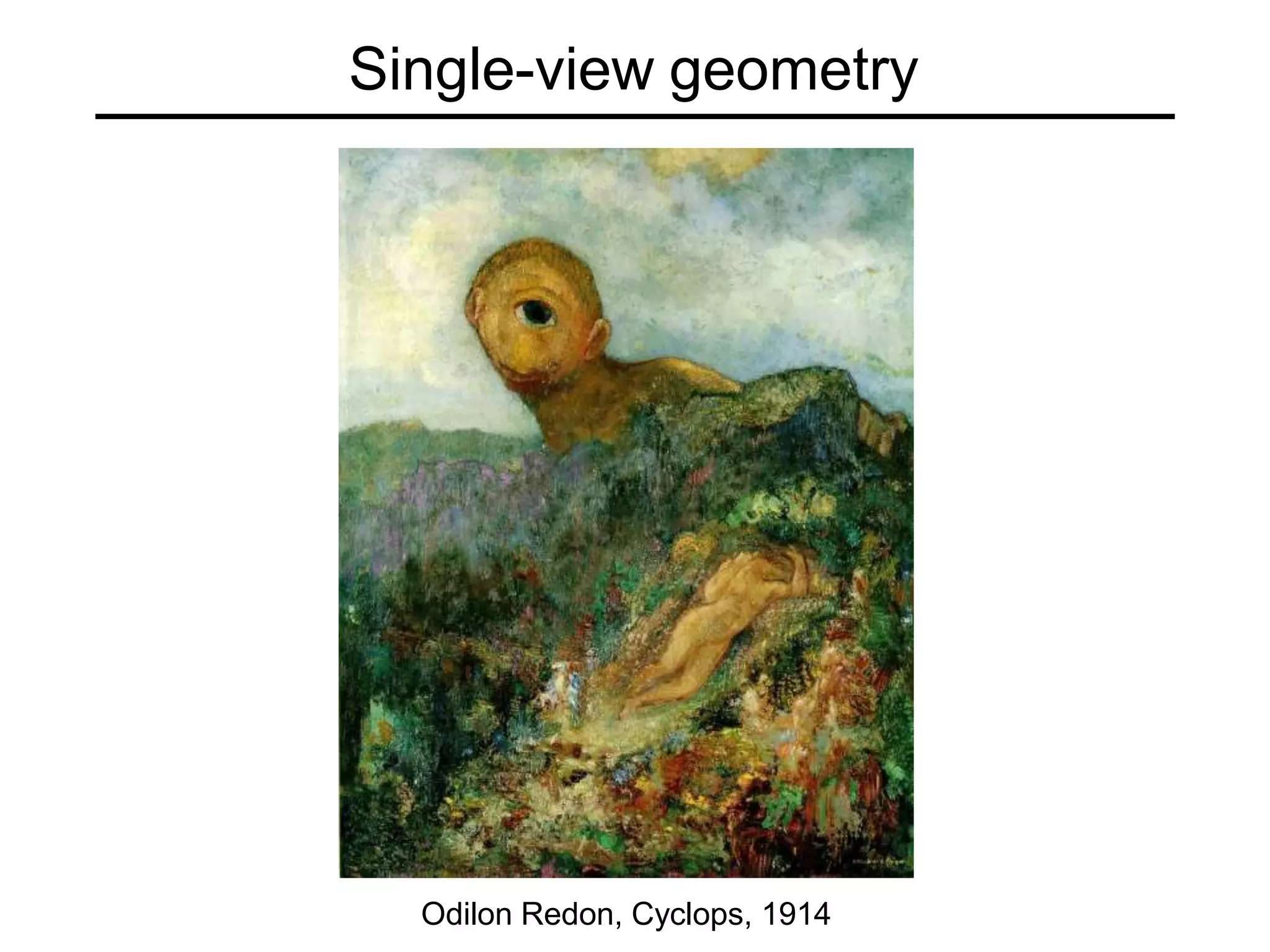
Odilon Redon, Cyclops, 1914
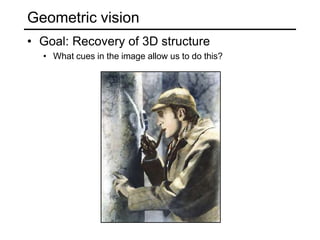
Geometric vision
• Goal: Recovery of 3D structure
• What cues in the image allow us to do this?
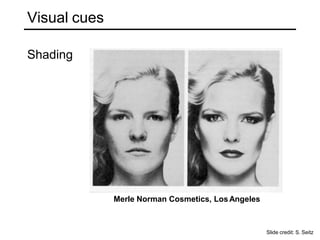
Shading
Visual cues
Merle Norman Cosmetics, LosAngeles
Slide credit: S. Seitz
Visual cues
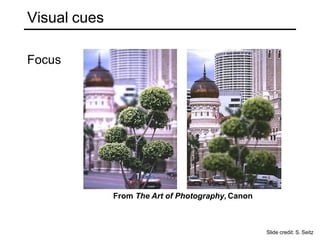
From The Art of Photography, Canon
Focus
Slide credit: S. Seitz
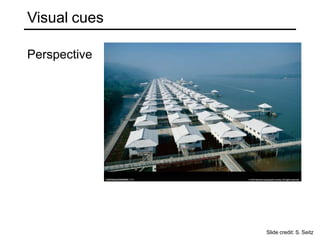
Visual cues
Perspective
Slide credit: S. Seitz
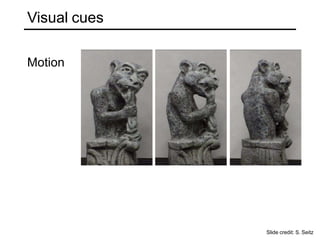
Visual cues
Motion
Slide credit: S. Seitz
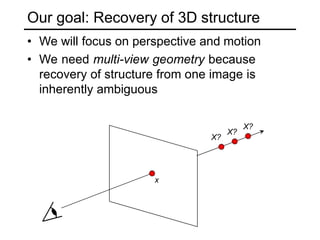
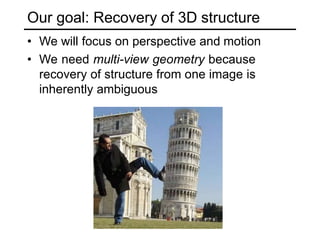
Our goal: Recovery of 3D structure
• We will focus on perspective and motion
• We need multi-view geometry because
recovery of structure from one image is
inherently ambiguous
x
X?
X?
X?
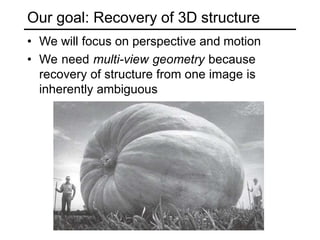
Our goal: Recovery of 3D structure
• We will focus on perspective and motion
• We need multi-view geometry because
recovery of structure from one image is
inherently ambiguous
Our goal: Recovery of 3D structure
• We will focus on perspective and motion
• We need multi-view geometry because
recovery of structure from one image is
inherently ambiguous
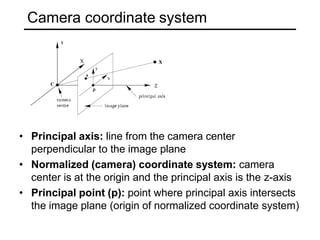
Camera coordinate system
• Principal axis: line from the camera center
perpendicular to the image plane
• Normalized (camera) coordinate system: camera
center is at the origin and the principal axis is the z-axis
• Principal point (p): point where principal axis intersects
the image plane (origin of normalized coordinate system)
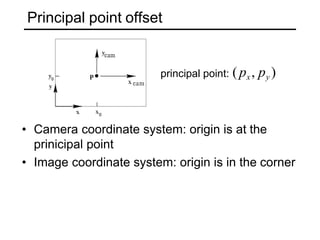
Principal point offset
• Camera coordinate system: origin is at the
prinicipal point
• Image coordinate system: origin is in the corner
principal point: (px, py )
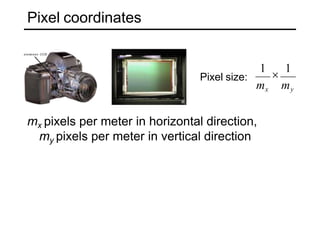
Pixel coordinates
mx pixels per meter in horizontal direction,
my pixels per meter in vertical direction
Pixel size:
mx my
1

1
~ ~

~
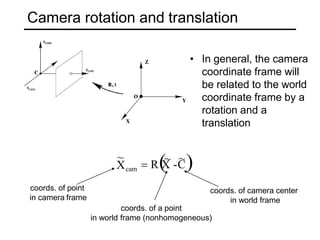
Xcam  R X -C
Camera rotation and translation
• In general, the camera
coordinate frame will
be related to the world
coordinate frame by a
rotation and a
translation
coords. of point
in camera frame
coords. of camera center
in world frame
coords. of a point
in world frame (nonhomogeneous)
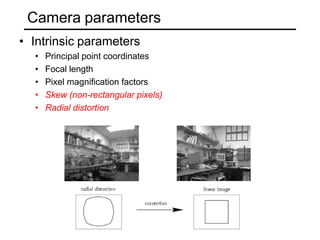
Camera parameters
• Intrinsic parameters
• Principal point coordinates
• Focal length
• Pixel magnification factors
• Skew (non-rectangular pixels)
• Radial distortion
Camera parameters
• Intrinsic parameters
• Principal point coordinates
• Focal length
• Pixel magnification factors
• Skew (non-rectangular pixels)
• Radial distortion
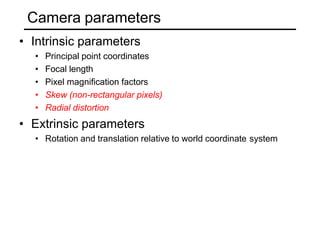
• Extrinsic parameters
• Rotation and translation relative to world coordinate system
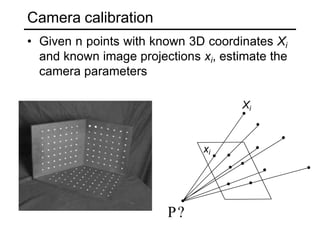
Camera calibration
P?
• Given n points with known 3D coordinates Xi
and known image projections xi, estimate the
camera parameters
Xi
xi
Two-view geometry
• Scene geometry (structure): Given
projections of the same 3D point in two or
more images, how do we compute the 3D
coordinates of that point?
• Correspondence (stereo matching):
Given a point in just one image, how does it
constrain the position of the corresponding
point in a second image?
• Camera geometry (motion): Given a set of
corresponding points in two images, what
are the cameras for the two views?
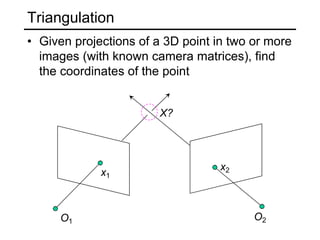
Triangulation
O1 O2
x1
x2
• Given projections of a 3D point in two or more
images (with known camera matrices), find
the coordinates of the point
X?
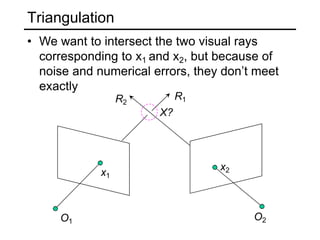
Triangulation
• We want to intersect the two visual rays
corresponding to x1 and x2, but because of
noise and numerical errors, they don’t meet
exactly
O1 O2
x1
x2
X?
R1
R2
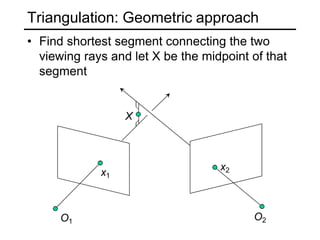
Triangulation: Geometric approach
O1 O2
x1
x2
• Find shortest segment connecting the two
viewing rays and let X be the midpoint of that
segment
X

Lec11 single view-converted

  • 1.
  • 2.
    Geometric vision • Goal:Recovery of 3D structure • What cues in the image allow us to do this?
  • 3.
    Shading Visual cues Merle NormanCosmetics, LosAngeles Slide credit: S. Seitz
  • 4.
    Visual cues From TheArt of Photography, Canon Focus Slide credit: S. Seitz
  • 5.
  • 6.
  • 7.
    Our goal: Recoveryof 3D structure • We will focus on perspective and motion • We need multi-view geometry because recovery of structure from one image is inherently ambiguous x X? X? X?
  • 8.
    Our goal: Recoveryof 3D structure • We will focus on perspective and motion • We need multi-view geometry because recovery of structure from one image is inherently ambiguous
  • 9.
    Our goal: Recoveryof 3D structure • We will focus on perspective and motion • We need multi-view geometry because recovery of structure from one image is inherently ambiguous
  • 10.
    Camera coordinate system •Principal axis: line from the camera center perpendicular to the image plane • Normalized (camera) coordinate system: camera center is at the origin and the principal axis is the z-axis • Principal point (p): point where principal axis intersects the image plane (origin of normalized coordinate system)
  • 11.
    Principal point offset •Camera coordinate system: origin is at the prinicipal point • Image coordinate system: origin is in the corner principal point: (px, py )
  • 12.
    Pixel coordinates mx pixelsper meter in horizontal direction, my pixels per meter in vertical direction Pixel size: mx my 1  1
  • 13.
    ~ ~  ~ Xcam R X -C Camera rotation and translation • In general, the camera coordinate frame will be related to the world coordinate frame by a rotation and a translation coords. of point in camera frame coords. of camera center in world frame coords. of a point in world frame (nonhomogeneous)
  • 14.
    Camera parameters • Intrinsicparameters • Principal point coordinates • Focal length • Pixel magnification factors • Skew (non-rectangular pixels) • Radial distortion
  • 15.
    Camera parameters • Intrinsicparameters • Principal point coordinates • Focal length • Pixel magnification factors • Skew (non-rectangular pixels) • Radial distortion • Extrinsic parameters • Rotation and translation relative to world coordinate system
  • 16.
    Camera calibration P? • Givenn points with known 3D coordinates Xi and known image projections xi, estimate the camera parameters Xi xi
  • 17.
    Two-view geometry • Scenegeometry (structure): Given projections of the same 3D point in two or more images, how do we compute the 3D coordinates of that point? • Correspondence (stereo matching): Given a point in just one image, how does it constrain the position of the corresponding point in a second image? • Camera geometry (motion): Given a set of corresponding points in two images, what are the cameras for the two views?
  • 18.
    Triangulation O1 O2 x1 x2 • Givenprojections of a 3D point in two or more images (with known camera matrices), find the coordinates of the point X?
  • 19.
    Triangulation • We wantto intersect the two visual rays corresponding to x1 and x2, but because of noise and numerical errors, they don’t meet exactly O1 O2 x1 x2 X? R1 R2
  • 20.
    Triangulation: Geometric approach O1O2 x1 x2 • Find shortest segment connecting the two viewing rays and let X be the midpoint of that segment X