© 2020 Wael Badawy
11
Single-View Modeling
— Computer Vision —
DISCLAIMER:
This video is optimized for HD large display using
patented and patent-pending “Nile Codec”, the first
Egyptian Video Codec for more information,
PLEASE check https://NileCodec.com
Also available as a PodCast
© 2020 Wael Badawy
Copyright © 2020 Wael Badawy. All rights reserved
 This video is subject to copyright owned by Wael Badawy “WB”. Any
reproduction or republication of all or part of this video is expressly prohibited
unless WB has explicitly granted its prior written consent. All other rights
reserved.
 This video is intended for education and information only and is offered AS IS,
without any warranty of the accuracy or the quality of the content. Any other
use is strictly prohibited. The viewer is fully responsible to verify the accuracy
of the contents received without any claims of costs or liability arising .
 The names, trademarks service marked as logos of WB or the sponsors
appearing in this video may not be used in any any product or service,
without prior express written permission from WB and the video sponsors
 Neither WB nor any party involved in creating, producing or delivering
information and material via this video shall be liable for any direction,
incidental, consequential, indirect of punitive damages arising out of access
to, use or inability to use this content or any errors or omissions in the
content thereof.
 If you will continue to watch this video, you agree to the terms above and
other terms that may be available on http://nu.edu.eg & https://caiwave.net
2
© 2020 Wael Badawy
© 2020 Wael Badawy
Single-View Modeling
 Readings
 Mundy, J.L. and Zisserman, A., Geometric Invariance in Computer Vision, Appendix:
Projective Geometry for Machine Vision, MIT Press, Cambridge, MA, 1992,
(read 23.1 - 23.5, 23.10)
 available online: http://www.cs.cmu.edu/~ph/869/papers/zisser-mundy.pdf
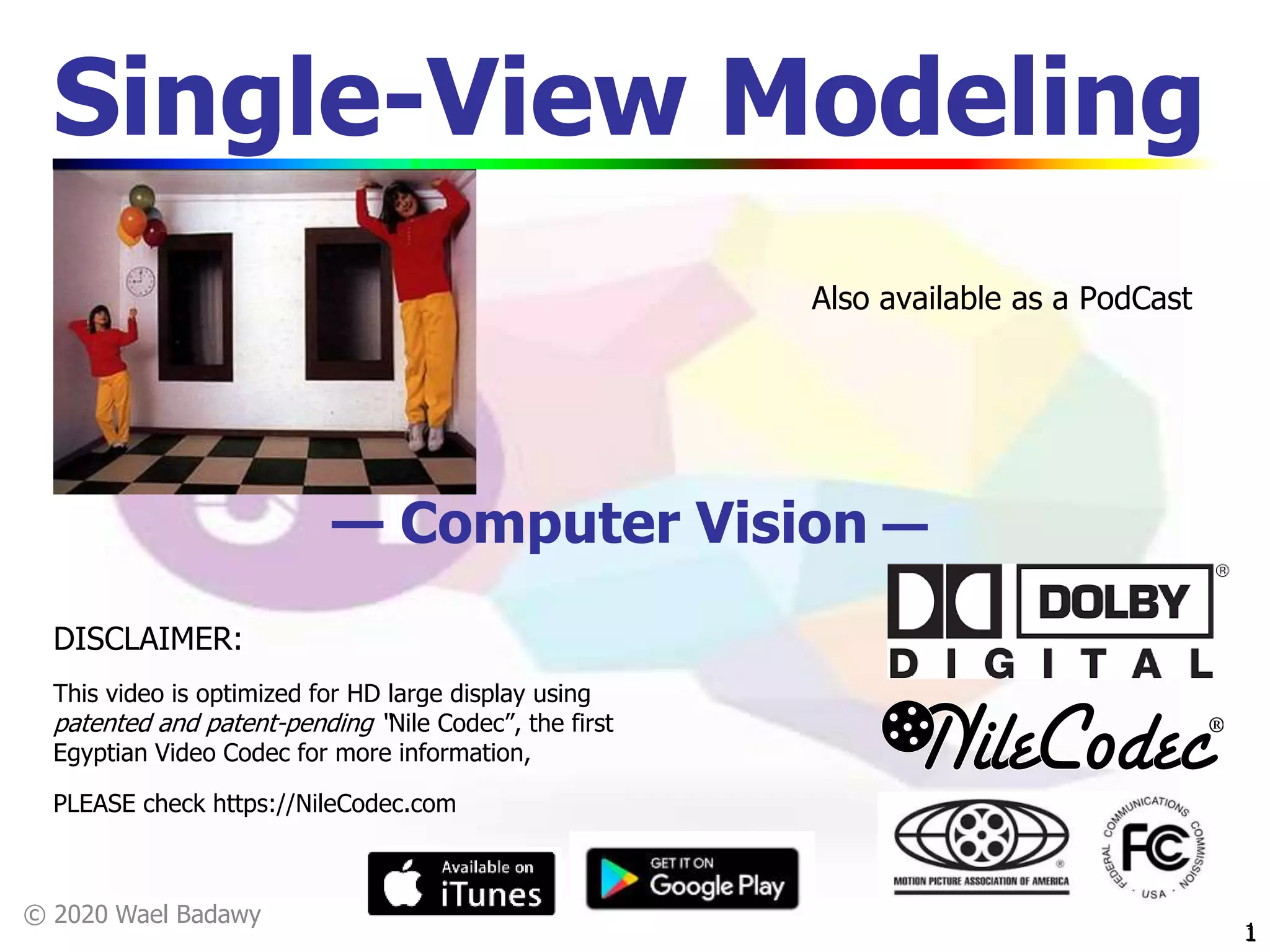
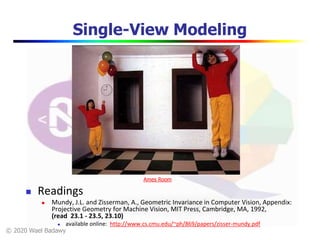
Ames Room
© 2020 Wael Badawy
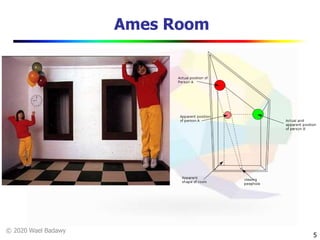
Ames Room
5
© 2020 Wael Badawy
Projective geometry—what’s it good for?
 Uses of projective geometry
 Drawing
 Measurements
 Mathematics for projection
 Undistorting images
 Camera pose estimation
 Object recognition
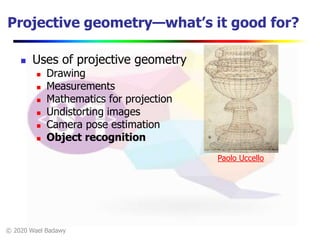
Paolo Uccello
© 2020 Wael Badawy
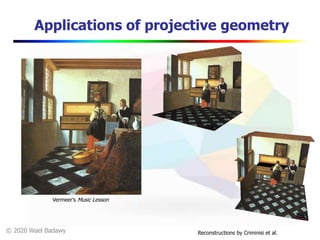
Applications of projective geometry
Vermeer’s Music Lesson
Reconstructions by Criminisi et al.
© 2020 Wael Badawy
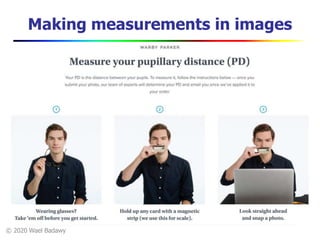
Making measurements in images
© 2020 Wael Badawy
1 2 3 4
1
2
3
4
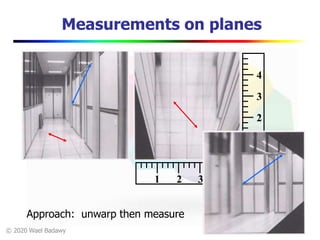
Measurements on planes
Approach: unwarp then measure
© 2020 Wael Badawy
Homogeneous coordinates and lines
 (X,Y,W) same as (SX,SY,SW)
 Line in projective plane
 ax + by + c = 0
 aX + bY + cW = 0
 uTp = pTu =0
 u = [a,b,c] T and p = [X,Y,W] T
 (x,y) Euclidean = (X/W,Y/W)
 W = 0? Ideal points, points at infinity (X,Y,0)
© 2020 Wael Badawy
l
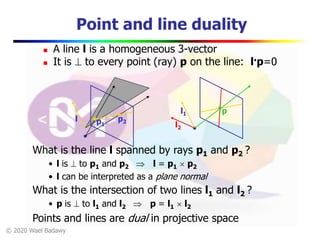
Point and line duality
 A line l is a homogeneous 3-vector
 It is  to every point (ray) p on the line: l.p=0
p1
p2
What is the intersection of two lines l1 and l2 ?
• p is  to l1 and l2  p = l1  l2
Points and lines are dual in projective space
l1
l2
p
What is the line l spanned by rays p1 and p2 ?
• l is  to p1 and p2  l = p1  p2
• l can be interpreted as a plane normal
© 2020 Wael Badawy
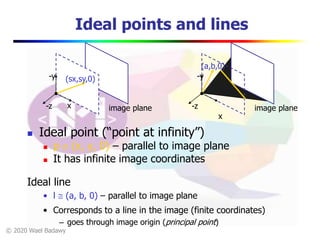
Ideal points and lines
 Ideal point (“point at infinity”)
 p  (x, y, 0) – parallel to image plane
 It has infinite image coordinates
(sx,sy,0)-y
x-z image plane
Ideal line
• l  (a, b, 0) – parallel to image plane
(a,b,0)
-y
x
-z image plane
• Corresponds to a line in the image (finite coordinates)
– goes through image origin (principal point)
© 2020 Wael Badawy
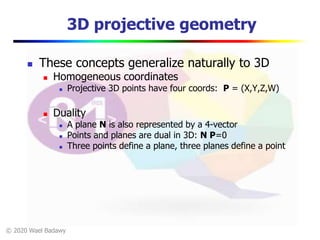
3D projective geometry
 These concepts generalize naturally to 3D
 Homogeneous coordinates
 Projective 3D points have four coords: P = (X,Y,Z,W)
 Duality
 A plane N is also represented by a 4-vector
 Points and planes are dual in 3D: N P=0
 Three points define a plane, three planes define a point
© 2020 Wael Badawy
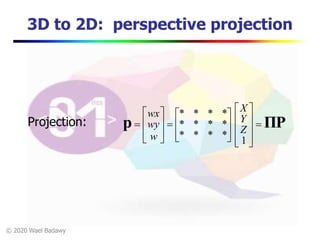
3D to 2D: perspective projection
Projection: ΠPp 




























1
****
****
****
Z
Y
X
w
wy
wx
© 2020 Wael Badawy
© 2020 Wael Badawy
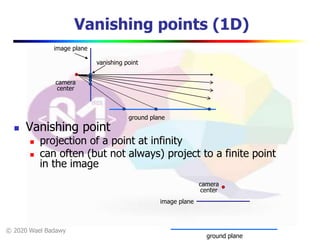
Vanishing points (1D)
 Vanishing point
 projection of a point at infinity
 can often (but not always) project to a finite point
in the image
image plane
camera
center
ground plane
vanishing point
camera
center
image plane
ground plane
© 2020 Wael Badawy
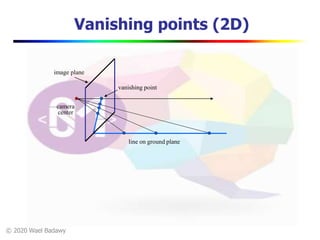
Vanishing points (2D)
image plane
camera
center
line on ground plane
vanishing point
© 2020 Wael Badawy
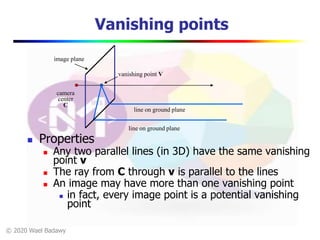
Vanishing points
 Properties
 Any two parallel lines (in 3D) have the same vanishing
point v
 The ray from C through v is parallel to the lines
 An image may have more than one vanishing point
 in fact, every image point is a potential vanishing
point
image plane
camera
center
C
line on ground plane
vanishing point V
line on ground plane
© 2020 Wael Badawy
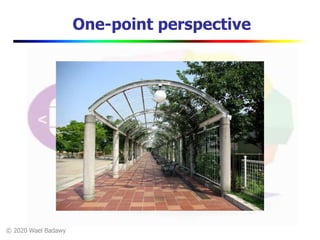
One-point perspective
© 2020 Wael Badawy
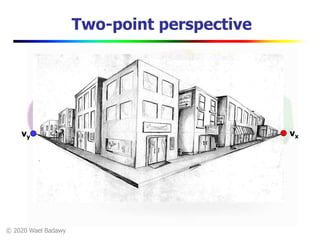
Two-point perspective
vxvy
© 2020 Wael Badawy
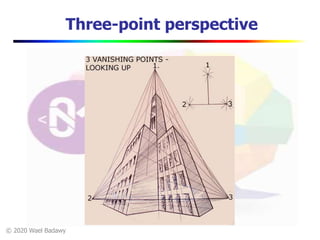
Three-point perspective
© 2020 Wael Badawy
Questions?
© 2020 Wael Badawy
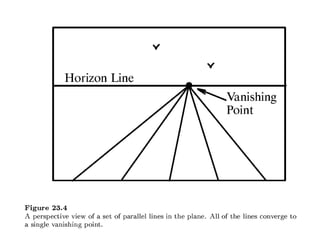
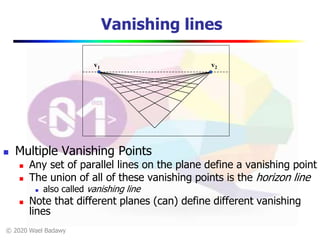
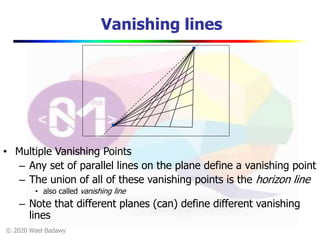
Vanishing lines
 Multiple Vanishing Points
 Any set of parallel lines on the plane define a vanishing point
 The union of all of these vanishing points is the horizon line
 also called vanishing line
 Note that different planes (can) define different vanishing
lines
v1 v2
© 2020 Wael Badawy
Vanishing lines
• Multiple Vanishing Points
– Any set of parallel lines on the plane define a vanishing point
– The union of all of these vanishing points is the horizon line
• also called vanishing line
– Note that different planes (can) define different vanishing
lines
© 2020 Wael Badawy
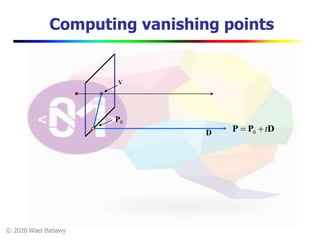
Computing vanishing points
V
DPP t 0
P0
D
© 2020 Wael Badawy
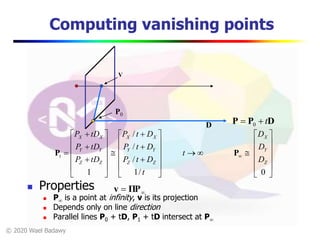
Computing vanishing points
 Properties
 P is a point at infinity, v is its projection
 Depends only on line direction
 Parallel lines P0 + tD, P1 + tD intersect at P
V
DPP t 0












































 
0/1
/
/
/
1
Z
Y
X
ZZ
YY
XX
ZZ
YY
XX
t
D
D
D
t
t
DtP
DtP
DtP
tDP
tDP
tDP
PP
 ΠPv
P0
D
© 2020 Wael Badawy
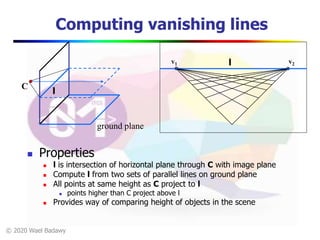
Computing vanishing lines
 Properties
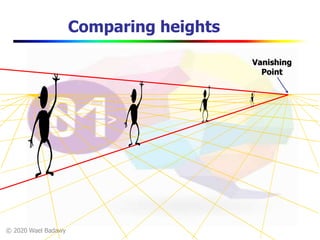
 l is intersection of horizontal plane through C with image plane
 Compute l from two sets of parallel lines on ground plane
 All points at same height as C project to l
 points higher than C project above l
 Provides way of comparing height of objects in the scene
ground plane
l
C
v1 v2l
© 2020 Wael Badawy
© 2020 Wael Badawy
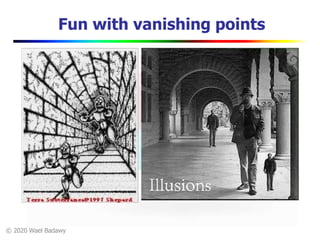
Fun with vanishing points
© 2020 Wael Badawy
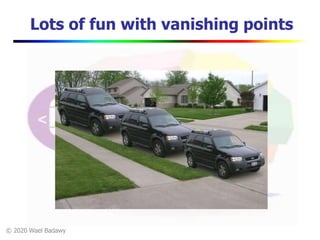
Lots of fun with vanishing points
© 2020 Wael Badawy
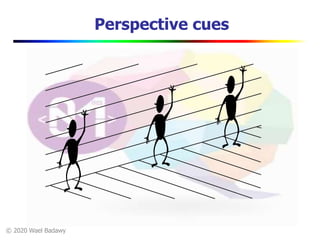
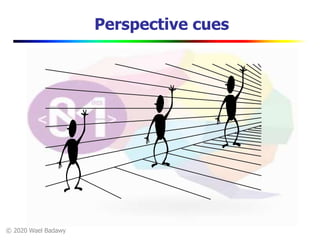
Perspective cues
© 2020 Wael Badawy
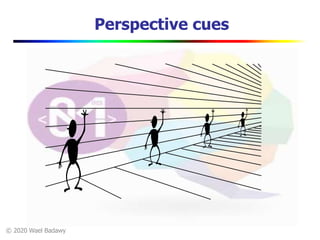
Perspective cues
© 2020 Wael Badawy
Perspective cues
© 2020 Wael Badawy
Comparing heights
Vanishing
Point
© 2020 Wael Badawy
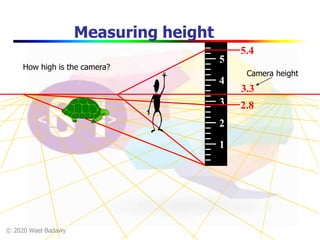
Measuring height
1
2
3
4
5
5.4
2.8
3.3
Camera height
How high is the camera?
© 2020 Wael Badawy
q1
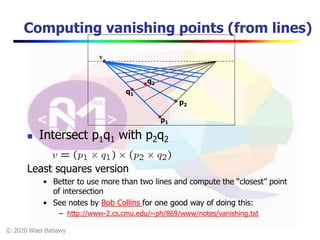
Computing vanishing points (from lines)
 Intersect p1q1 with p2q2
v
p1
p2
q2
Least squares version
• Better to use more than two lines and compute the “closest” point
of intersection
• See notes by Bob Collins for one good way of doing this:
– http://www-2.cs.cmu.edu/~ph/869/www/notes/vanishing.txt
© 2020 Wael Badawy
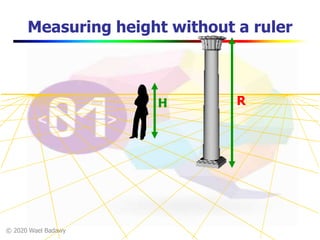
Measuring height without a ruler
H R
© 2020 Wael Badawy
C
Measuring height without a ruler
ground plane
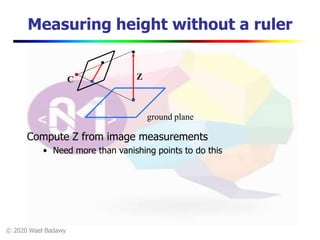
Compute Z from image measurements
• Need more than vanishing points to do this
Z
© 2020 Wael Badawy
The cross ratio
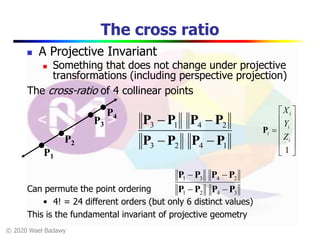
 A Projective Invariant
 Something that does not change under projective
transformations (including perspective projection)
P1
P2
P3
P4
1423
2413
PPPP
PPPP


The cross-ratio of 4 collinear points
Can permute the point ordering
• 4! = 24 different orders (but only 6 distinct values)
This is the fundamental invariant of projective geometry













1
i
i
i
i
Z
Y
X
P
3421
2431
PPPP
PPPP


© 2020 Wael Badawy
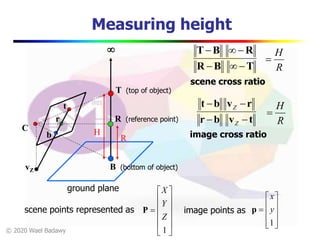
vZ
r
t
b
tvbr
rvbt


Z
Z
image cross ratio
Measuring height
B (bottom of object)
T (top of object)
R (reference point)
ground plane
HC
TBR
RBT


scene cross ratio














1
Z
Y
X
P











1
y
x
pscene points represented as image points as
R
H

R
H

R
© 2020 Wael Badawy
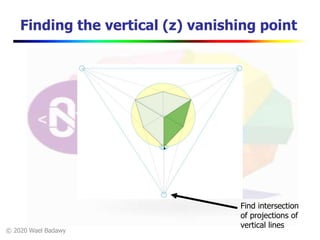
Finding the vertical (z) vanishing point
Find intersection
of projections of
vertical lines
© 2020 Wael Badawy
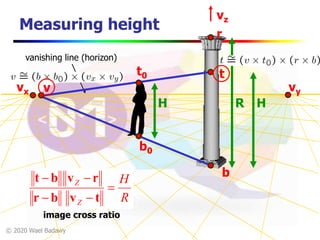
Measuring height
RH
vz
r
b
t
R
H
Z
Z



tvbr
rvbt
image cross ratio
H
vvx vy
vanishing line (horizon)
b0
t0
© 2020 Wael Badawy
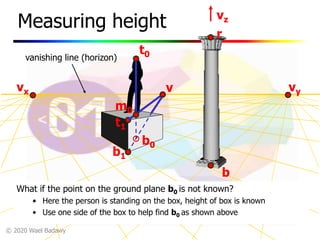
vz
r
b
vx vy
vanishing line (horizon)
t0
What if the point on the ground plane b0 is not known?
• Here the person is standing on the box, height of box is known
• Use one side of the box to help find b0 as shown above
b0
t1
b1
Measuring height
v
m0
© 2020 Wael Badawy
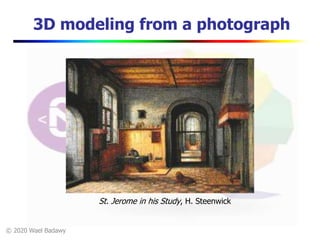
3D modeling from a photograph
St. Jerome in his Study, H. Steenwick
© 2020 Wael Badawy
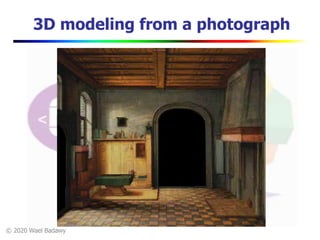
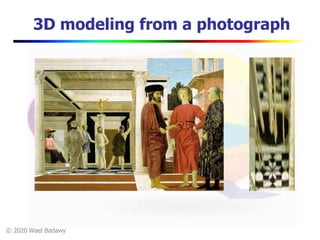
3D modeling from a photograph
© 2020 Wael Badawy
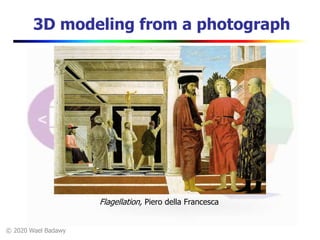
3D modeling from a photograph
Flagellation, Piero della Francesca
© 2020 Wael Badawy
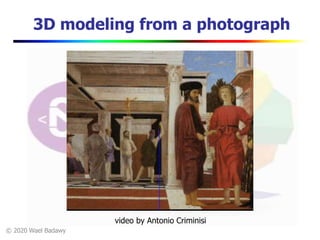
3D modeling from a photograph
video by Antonio Criminisi
© 2020 Wael Badawy
3D modeling from a photograph
© 2020 Wael Badawy
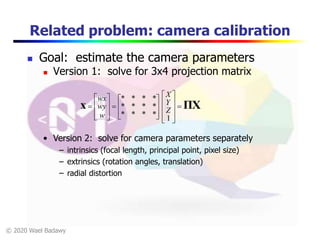
Related problem: camera calibration
 Goal: estimate the camera parameters
 Version 1: solve for 3x4 projection matrix
ΠXx 




























1
****
****
****
Z
Y
X
w
wy
wx
• Version 2: solve for camera parameters separately
– intrinsics (focal length, principal point, pixel size)
– extrinsics (rotation angles, translation)
– radial distortion
© 2020 Wael Badawy
Vanishing points and projection matrix









****
****
****
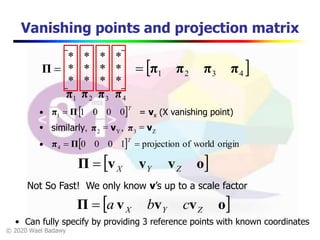
Π  4321 ππππ
1π 2π 3π 4π
 T
00011 Ππ  = vx (X vanishing point)
Z3Y2 ,similarly, vπvπ 
  originworldofprojection10004 
T
Ππ
 ovvvΠ ZYX
Not So Fast! We only know v’s up to a scale factor
 ovvvΠ ZYX cba
• Can fully specify by providing 3 reference points with known coordinates
© 2020 Wael Badawy
Calibration using a reference object
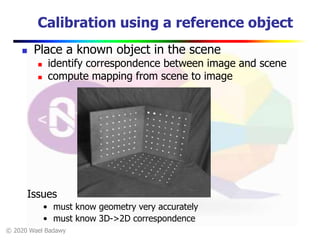
 Place a known object in the scene
 identify correspondence between image and scene
 compute mapping from scene to image
Issues
• must know geometry very accurately
• must know 3D->2D correspondence
© 2020 Wael Badawy
Chromaglyphs
Courtesy of Bruce Culbertson, HP Labs
http://www.hpl.hp.com/personal/Bruce_Culbertson/ibr98/chromagl.htm
© 2020 Wael Badawy
AR codes
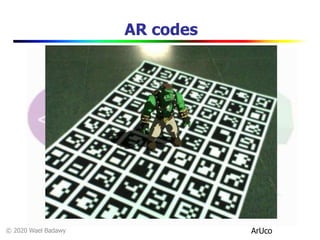
ArUco
© 2020 Wael Badawy
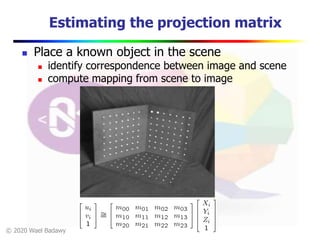
Estimating the projection matrix
 Place a known object in the scene
 identify correspondence between image and scene
 compute mapping from scene to image
© 2020 Wael Badawy
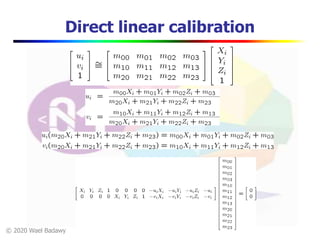
Direct linear calibration
© 2020 Wael Badawy
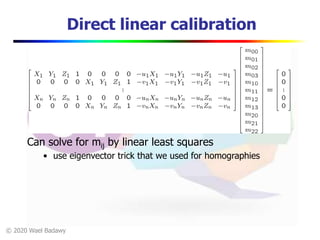
Direct linear calibration
Can solve for mij by linear least squares
• use eigenvector trick that we used for homographies
© 2020 Wael Badawy
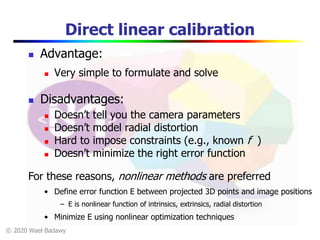
Direct linear calibration
 Advantage:
 Very simple to formulate and solve
 Disadvantages:
 Doesn’t tell you the camera parameters
 Doesn’t model radial distortion
 Hard to impose constraints (e.g., known f )
 Doesn’t minimize the right error function
For these reasons, nonlinear methods are preferred
• Define error function E between projected 3D points and image positions
– E is nonlinear function of intrinsics, extrinsics, radial distortion
• Minimize E using nonlinear optimization techniques
© 2020 Wael Badawy
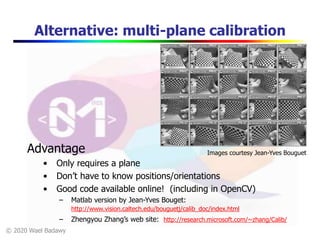
Alternative: multi-plane calibration
Images courtesy Jean-Yves BouguetAdvantage
• Only requires a plane
• Don’t have to know positions/orientations
• Good code available online! (including in OpenCV)
– Matlab version by Jean-Yves Bouget:
http://www.vision.caltech.edu/bouguetj/calib_doc/index.html
– Zhengyou Zhang’s web site: http://research.microsoft.com/~zhang/Calib/
© 2020 Wael Badawy
Some Related Techniques
 Image-Based Modeling and Photo Editing
 Mok et al., SIGGRAPH 2001
 http://graphics.csail.mit.edu/graphics/ibedit/
 Single View Modeling of Free-Form Scenes
 Zhang et al., CVPR 2001
 http://grail.cs.washington.edu/projects/svm/index.htm
 Tour Into The Picture
 Anjyo et al., SIGGRAPH 1997
 http://www.mizuno.org/gl/tip/
© 2020 Wael Badawy
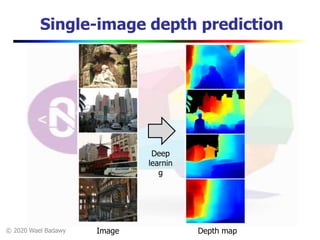
Single-image depth prediction
Image Depth map
Deep
learnin
g
© 2020 Wael Badawy
Questions?

Computer Vision single view Modelling

  • 1.
    © 2020 WaelBadawy 11 Single-View Modeling — Computer Vision — DISCLAIMER: This video is optimized for HD large display using patented and patent-pending “Nile Codec”, the first Egyptian Video Codec for more information, PLEASE check https://NileCodec.com Also available as a PodCast
  • 2.
    © 2020 WaelBadawy Copyright © 2020 Wael Badawy. All rights reserved  This video is subject to copyright owned by Wael Badawy “WB”. Any reproduction or republication of all or part of this video is expressly prohibited unless WB has explicitly granted its prior written consent. All other rights reserved.  This video is intended for education and information only and is offered AS IS, without any warranty of the accuracy or the quality of the content. Any other use is strictly prohibited. The viewer is fully responsible to verify the accuracy of the contents received without any claims of costs or liability arising .  The names, trademarks service marked as logos of WB or the sponsors appearing in this video may not be used in any any product or service, without prior express written permission from WB and the video sponsors  Neither WB nor any party involved in creating, producing or delivering information and material via this video shall be liable for any direction, incidental, consequential, indirect of punitive damages arising out of access to, use or inability to use this content or any errors or omissions in the content thereof.  If you will continue to watch this video, you agree to the terms above and other terms that may be available on http://nu.edu.eg & https://caiwave.net 2
  • 3.
  • 4.
    © 2020 WaelBadawy Single-View Modeling  Readings  Mundy, J.L. and Zisserman, A., Geometric Invariance in Computer Vision, Appendix: Projective Geometry for Machine Vision, MIT Press, Cambridge, MA, 1992, (read 23.1 - 23.5, 23.10)  available online: http://www.cs.cmu.edu/~ph/869/papers/zisser-mundy.pdf Ames Room
  • 5.
    © 2020 WaelBadawy Ames Room 5
  • 6.
    © 2020 WaelBadawy Projective geometry—what’s it good for?  Uses of projective geometry  Drawing  Measurements  Mathematics for projection  Undistorting images  Camera pose estimation  Object recognition Paolo Uccello
  • 7.
    © 2020 WaelBadawy Applications of projective geometry Vermeer’s Music Lesson Reconstructions by Criminisi et al.
  • 8.
    © 2020 WaelBadawy Making measurements in images
  • 9.
    © 2020 WaelBadawy 1 2 3 4 1 2 3 4 Measurements on planes Approach: unwarp then measure
  • 10.
    © 2020 WaelBadawy Homogeneous coordinates and lines  (X,Y,W) same as (SX,SY,SW)  Line in projective plane  ax + by + c = 0  aX + bY + cW = 0  uTp = pTu =0  u = [a,b,c] T and p = [X,Y,W] T  (x,y) Euclidean = (X/W,Y/W)  W = 0? Ideal points, points at infinity (X,Y,0)
  • 11.
    © 2020 WaelBadawy l Point and line duality  A line l is a homogeneous 3-vector  It is  to every point (ray) p on the line: l.p=0 p1 p2 What is the intersection of two lines l1 and l2 ? • p is  to l1 and l2  p = l1  l2 Points and lines are dual in projective space l1 l2 p What is the line l spanned by rays p1 and p2 ? • l is  to p1 and p2  l = p1  p2 • l can be interpreted as a plane normal
  • 12.
    © 2020 WaelBadawy Ideal points and lines  Ideal point (“point at infinity”)  p  (x, y, 0) – parallel to image plane  It has infinite image coordinates (sx,sy,0)-y x-z image plane Ideal line • l  (a, b, 0) – parallel to image plane (a,b,0) -y x -z image plane • Corresponds to a line in the image (finite coordinates) – goes through image origin (principal point)
  • 13.
    © 2020 WaelBadawy 3D projective geometry  These concepts generalize naturally to 3D  Homogeneous coordinates  Projective 3D points have four coords: P = (X,Y,Z,W)  Duality  A plane N is also represented by a 4-vector  Points and planes are dual in 3D: N P=0  Three points define a plane, three planes define a point
  • 14.
    © 2020 WaelBadawy 3D to 2D: perspective projection Projection: ΠPp                              1 **** **** **** Z Y X w wy wx
  • 15.
  • 16.
    © 2020 WaelBadawy Vanishing points (1D)  Vanishing point  projection of a point at infinity  can often (but not always) project to a finite point in the image image plane camera center ground plane vanishing point camera center image plane ground plane
  • 17.
    © 2020 WaelBadawy Vanishing points (2D) image plane camera center line on ground plane vanishing point
  • 18.
    © 2020 WaelBadawy Vanishing points  Properties  Any two parallel lines (in 3D) have the same vanishing point v  The ray from C through v is parallel to the lines  An image may have more than one vanishing point  in fact, every image point is a potential vanishing point image plane camera center C line on ground plane vanishing point V line on ground plane
  • 19.
    © 2020 WaelBadawy One-point perspective
  • 20.
    © 2020 WaelBadawy Two-point perspective vxvy
  • 21.
    © 2020 WaelBadawy Three-point perspective
  • 22.
    © 2020 WaelBadawy Questions?
  • 23.
    © 2020 WaelBadawy Vanishing lines  Multiple Vanishing Points  Any set of parallel lines on the plane define a vanishing point  The union of all of these vanishing points is the horizon line  also called vanishing line  Note that different planes (can) define different vanishing lines v1 v2
  • 24.
    © 2020 WaelBadawy Vanishing lines • Multiple Vanishing Points – Any set of parallel lines on the plane define a vanishing point – The union of all of these vanishing points is the horizon line • also called vanishing line – Note that different planes (can) define different vanishing lines
  • 25.
    © 2020 WaelBadawy Computing vanishing points V DPP t 0 P0 D
  • 26.
    © 2020 WaelBadawy Computing vanishing points  Properties  P is a point at infinity, v is its projection  Depends only on line direction  Parallel lines P0 + tD, P1 + tD intersect at P V DPP t 0                                               0/1 / / / 1 Z Y X ZZ YY XX ZZ YY XX t D D D t t DtP DtP DtP tDP tDP tDP PP  ΠPv P0 D
  • 27.
    © 2020 WaelBadawy Computing vanishing lines  Properties  l is intersection of horizontal plane through C with image plane  Compute l from two sets of parallel lines on ground plane  All points at same height as C project to l  points higher than C project above l  Provides way of comparing height of objects in the scene ground plane l C v1 v2l
  • 28.
  • 29.
    © 2020 WaelBadawy Fun with vanishing points
  • 30.
    © 2020 WaelBadawy Lots of fun with vanishing points
  • 31.
    © 2020 WaelBadawy Perspective cues
  • 32.
    © 2020 WaelBadawy Perspective cues
  • 33.
    © 2020 WaelBadawy Perspective cues
  • 34.
    © 2020 WaelBadawy Comparing heights Vanishing Point
  • 35.
    © 2020 WaelBadawy Measuring height 1 2 3 4 5 5.4 2.8 3.3 Camera height How high is the camera?
  • 36.
    © 2020 WaelBadawy q1 Computing vanishing points (from lines)  Intersect p1q1 with p2q2 v p1 p2 q2 Least squares version • Better to use more than two lines and compute the “closest” point of intersection • See notes by Bob Collins for one good way of doing this: – http://www-2.cs.cmu.edu/~ph/869/www/notes/vanishing.txt
  • 37.
    © 2020 WaelBadawy Measuring height without a ruler H R
  • 38.
    © 2020 WaelBadawy C Measuring height without a ruler ground plane Compute Z from image measurements • Need more than vanishing points to do this Z
  • 39.
    © 2020 WaelBadawy The cross ratio  A Projective Invariant  Something that does not change under projective transformations (including perspective projection) P1 P2 P3 P4 1423 2413 PPPP PPPP   The cross-ratio of 4 collinear points Can permute the point ordering • 4! = 24 different orders (but only 6 distinct values) This is the fundamental invariant of projective geometry              1 i i i i Z Y X P 3421 2431 PPPP PPPP  
  • 40.
    © 2020 WaelBadawy vZ r t b tvbr rvbt   Z Z image cross ratio Measuring height B (bottom of object) T (top of object) R (reference point) ground plane HC TBR RBT   scene cross ratio               1 Z Y X P            1 y x pscene points represented as image points as R H  R H  R
  • 41.
    © 2020 WaelBadawy Finding the vertical (z) vanishing point Find intersection of projections of vertical lines
  • 42.
    © 2020 WaelBadawy Measuring height RH vz r b t R H Z Z    tvbr rvbt image cross ratio H vvx vy vanishing line (horizon) b0 t0
  • 43.
    © 2020 WaelBadawy vz r b vx vy vanishing line (horizon) t0 What if the point on the ground plane b0 is not known? • Here the person is standing on the box, height of box is known • Use one side of the box to help find b0 as shown above b0 t1 b1 Measuring height v m0
  • 44.
    © 2020 WaelBadawy 3D modeling from a photograph St. Jerome in his Study, H. Steenwick
  • 45.
    © 2020 WaelBadawy 3D modeling from a photograph
  • 46.
    © 2020 WaelBadawy 3D modeling from a photograph Flagellation, Piero della Francesca
  • 47.
    © 2020 WaelBadawy 3D modeling from a photograph video by Antonio Criminisi
  • 48.
    © 2020 WaelBadawy 3D modeling from a photograph
  • 49.
    © 2020 WaelBadawy Related problem: camera calibration  Goal: estimate the camera parameters  Version 1: solve for 3x4 projection matrix ΠXx                              1 **** **** **** Z Y X w wy wx • Version 2: solve for camera parameters separately – intrinsics (focal length, principal point, pixel size) – extrinsics (rotation angles, translation) – radial distortion
  • 50.
    © 2020 WaelBadawy Vanishing points and projection matrix          **** **** **** Π  4321 ππππ 1π 2π 3π 4π  T 00011 Ππ  = vx (X vanishing point) Z3Y2 ,similarly, vπvπ    originworldofprojection10004  T Ππ  ovvvΠ ZYX Not So Fast! We only know v’s up to a scale factor  ovvvΠ ZYX cba • Can fully specify by providing 3 reference points with known coordinates
  • 51.
    © 2020 WaelBadawy Calibration using a reference object  Place a known object in the scene  identify correspondence between image and scene  compute mapping from scene to image Issues • must know geometry very accurately • must know 3D->2D correspondence
  • 52.
    © 2020 WaelBadawy Chromaglyphs Courtesy of Bruce Culbertson, HP Labs http://www.hpl.hp.com/personal/Bruce_Culbertson/ibr98/chromagl.htm
  • 53.
    © 2020 WaelBadawy AR codes ArUco
  • 54.
    © 2020 WaelBadawy Estimating the projection matrix  Place a known object in the scene  identify correspondence between image and scene  compute mapping from scene to image
  • 55.
    © 2020 WaelBadawy Direct linear calibration
  • 56.
    © 2020 WaelBadawy Direct linear calibration Can solve for mij by linear least squares • use eigenvector trick that we used for homographies
  • 57.
    © 2020 WaelBadawy Direct linear calibration  Advantage:  Very simple to formulate and solve  Disadvantages:  Doesn’t tell you the camera parameters  Doesn’t model radial distortion  Hard to impose constraints (e.g., known f )  Doesn’t minimize the right error function For these reasons, nonlinear methods are preferred • Define error function E between projected 3D points and image positions – E is nonlinear function of intrinsics, extrinsics, radial distortion • Minimize E using nonlinear optimization techniques
  • 58.
    © 2020 WaelBadawy Alternative: multi-plane calibration Images courtesy Jean-Yves BouguetAdvantage • Only requires a plane • Don’t have to know positions/orientations • Good code available online! (including in OpenCV) – Matlab version by Jean-Yves Bouget: http://www.vision.caltech.edu/bouguetj/calib_doc/index.html – Zhengyou Zhang’s web site: http://research.microsoft.com/~zhang/Calib/
  • 59.
    © 2020 WaelBadawy Some Related Techniques  Image-Based Modeling and Photo Editing  Mok et al., SIGGRAPH 2001  http://graphics.csail.mit.edu/graphics/ibedit/  Single View Modeling of Free-Form Scenes  Zhang et al., CVPR 2001  http://grail.cs.washington.edu/projects/svm/index.htm  Tour Into The Picture  Anjyo et al., SIGGRAPH 1997  http://www.mizuno.org/gl/tip/
  • 60.
    © 2020 WaelBadawy Single-image depth prediction Image Depth map Deep learnin g
  • 61.
    © 2020 WaelBadawy Questions?