3D Sensing and Reconstruction
Readings: Ch 12: 12.5-6, Ch 13: 13.1-3, 13.9.4
• Perspective Geometry
• Camera Model
• Stereo Triangulation
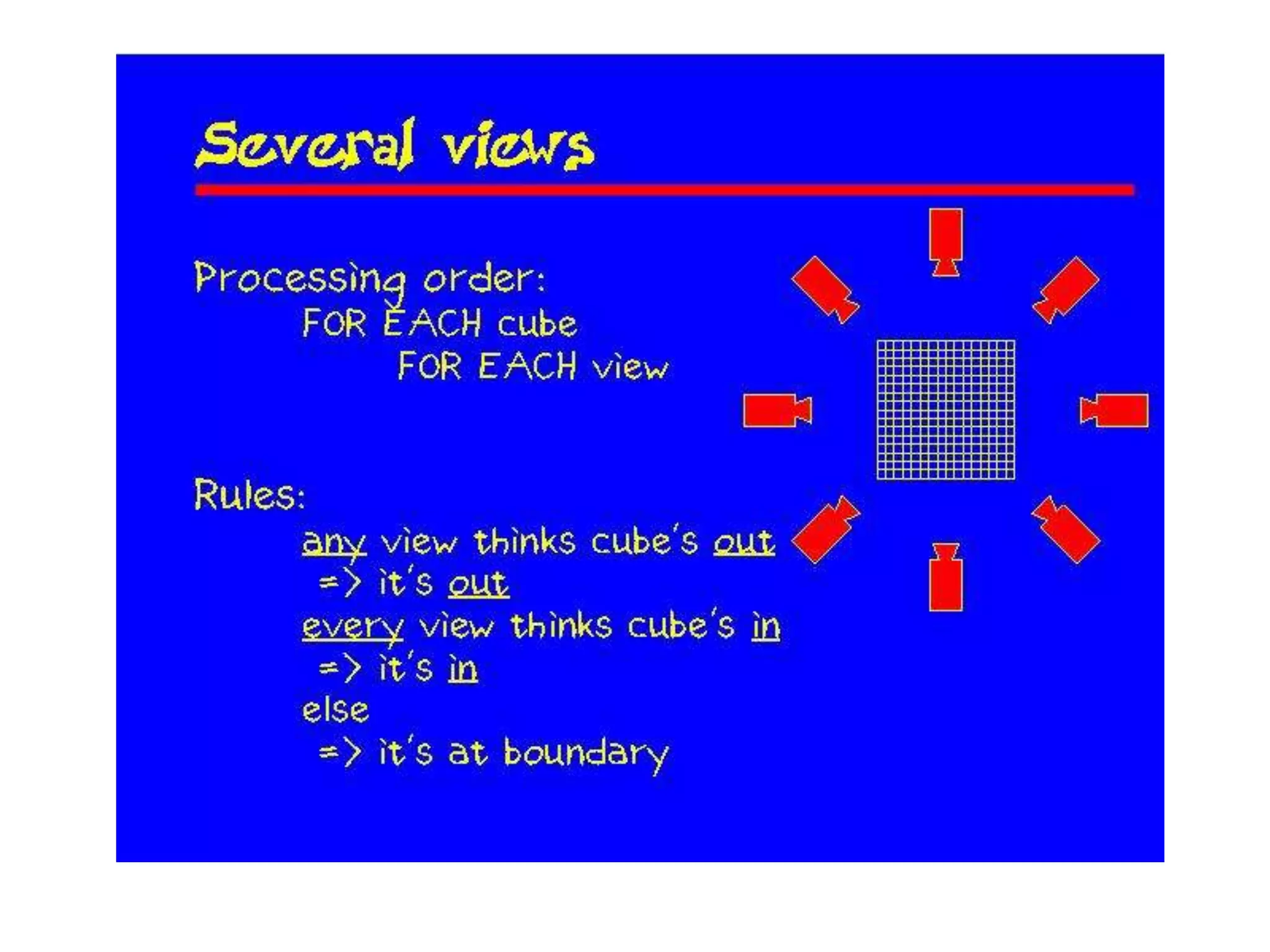
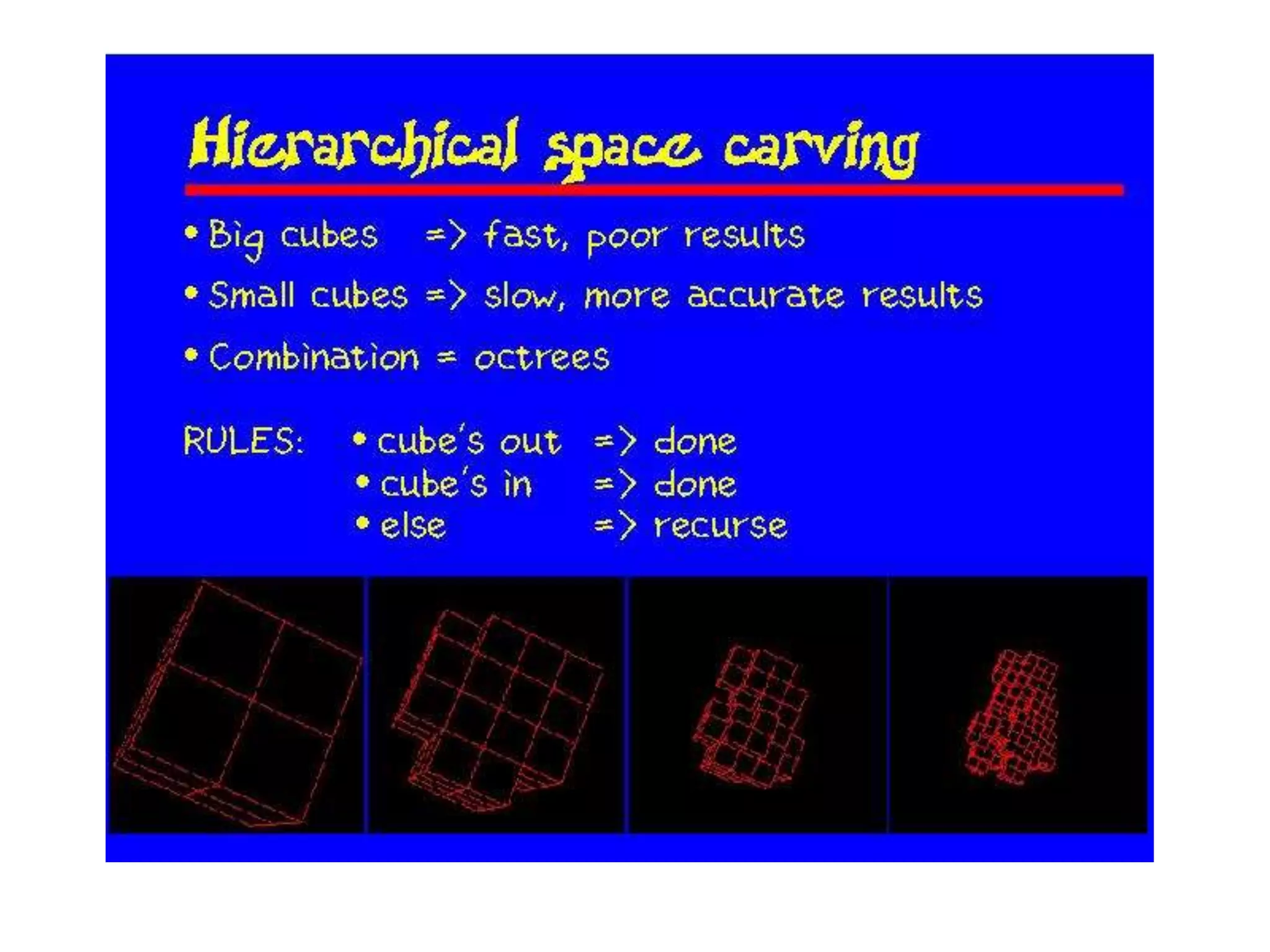
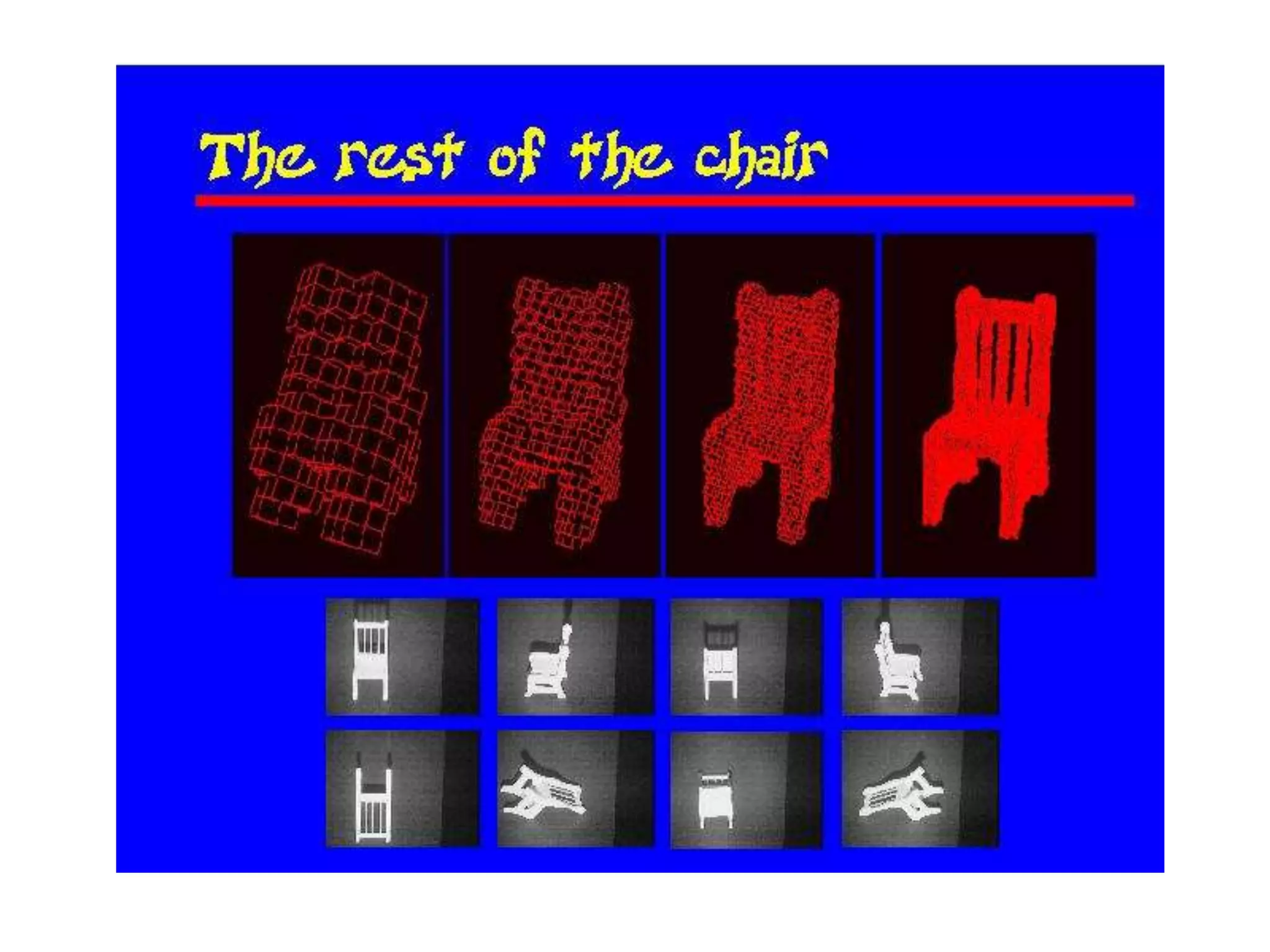
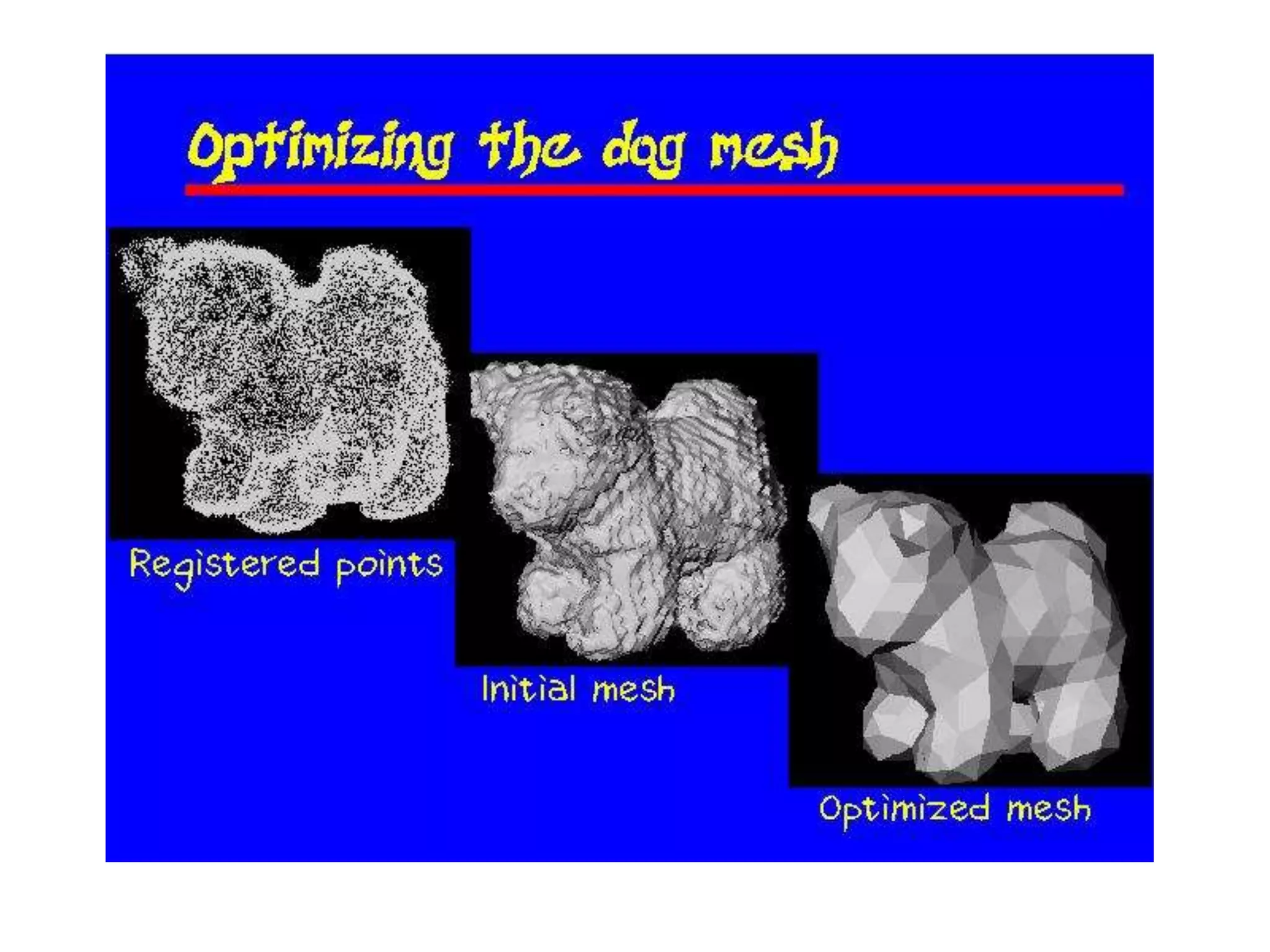
• 3D Reconstruction by Space Carving
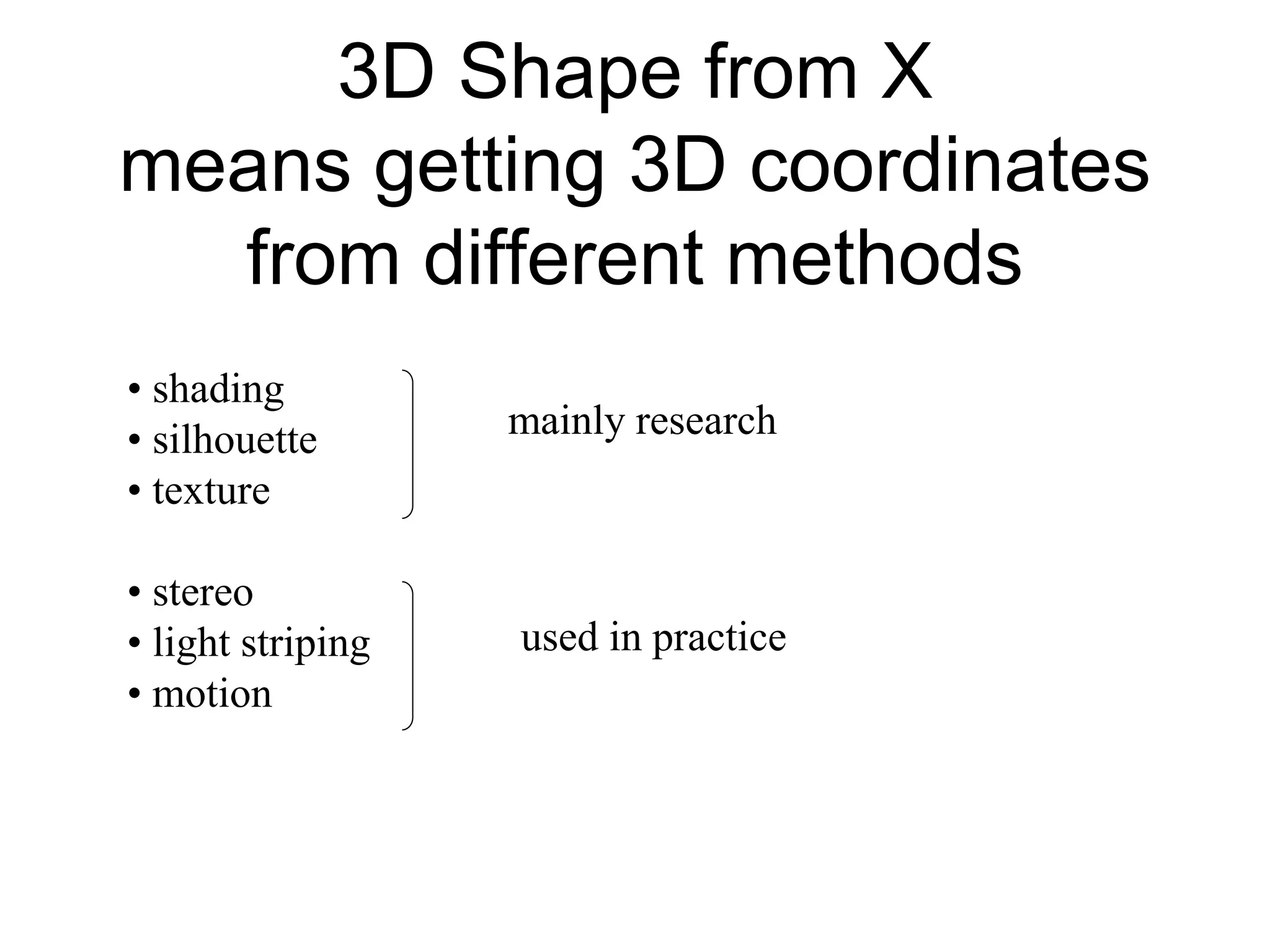
3D Shape from X
means getting 3D coordinates
from different methods
• shading
• silhouette
• texture
• stereo
• light striping
• motion
mainly research
used in practice
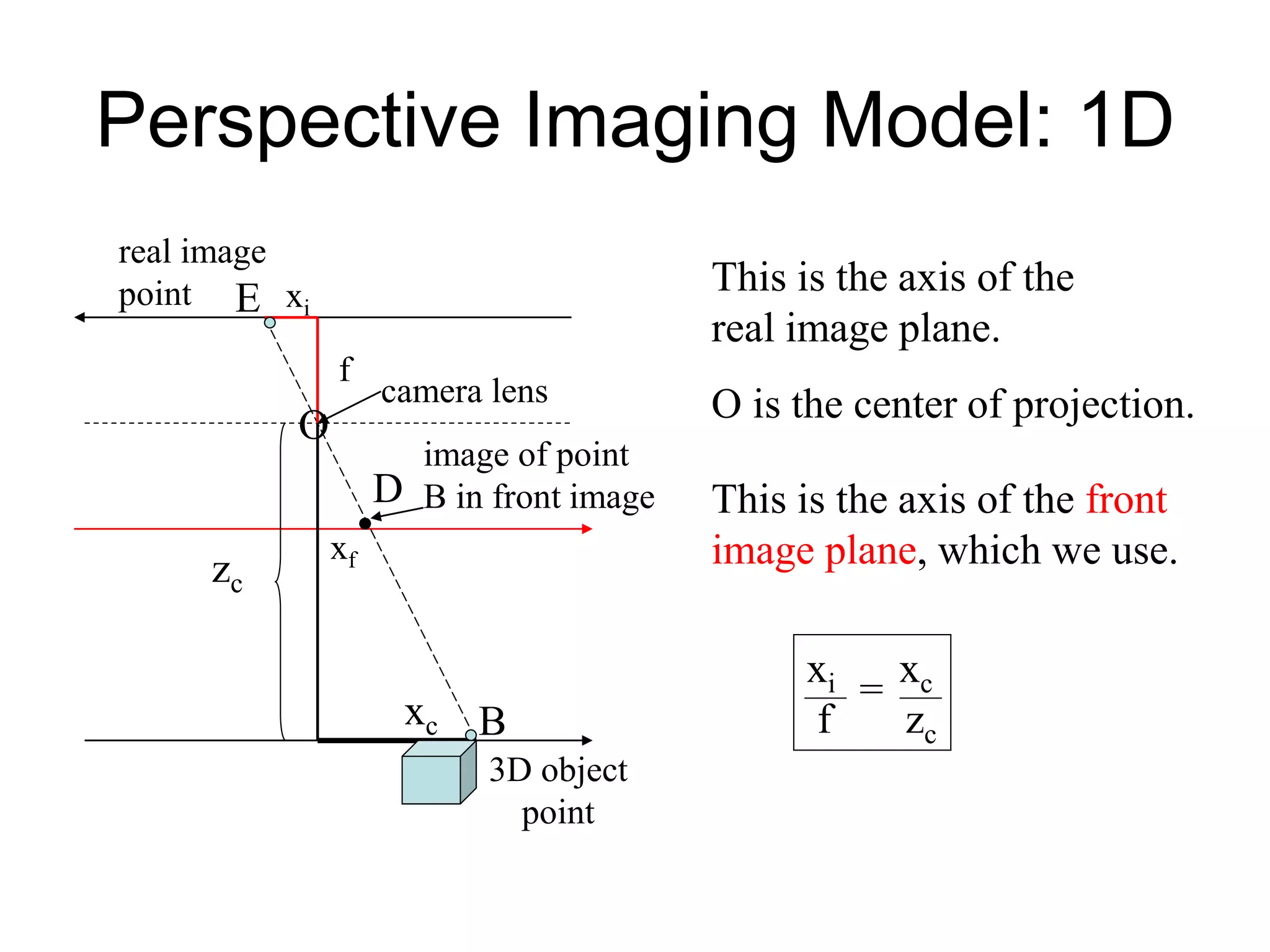
Perspective Imaging Model: 1D
xi
xf
f
This is the axis of the
real image plane.
O
O is the center of projection.
This is the axis of the front
image plane, which we use.
zc
xc
xi xc
f zc
=
camera lens
3D object
point
B
D
E
image of point
B in front image
real image
point
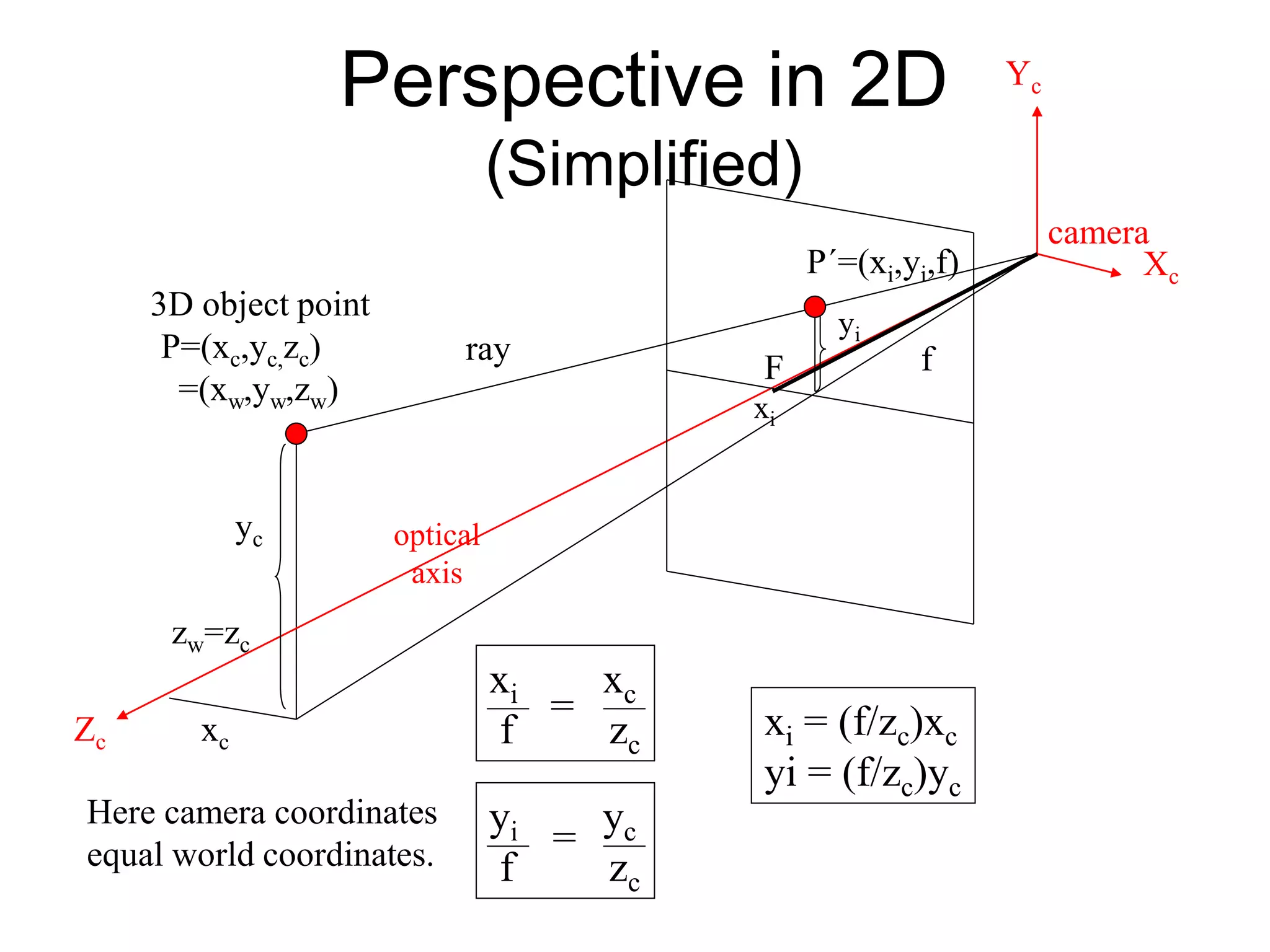
Perspective in 2D
(Simplified)
P=(xc,yc,zc)
=(xw,yw,zw)
3D object point
xc
yc
zw=zc
yi
Yc
Xc
Zc
xi
F f
camera
P´=(xi,yi,f)
xi xc
f zc
yi yc
f zc
=
=
xi = (f/zc)xc
yi = (f/zc)yc
Here camera coordinates
equal world coordinates.
optical
axis
ray
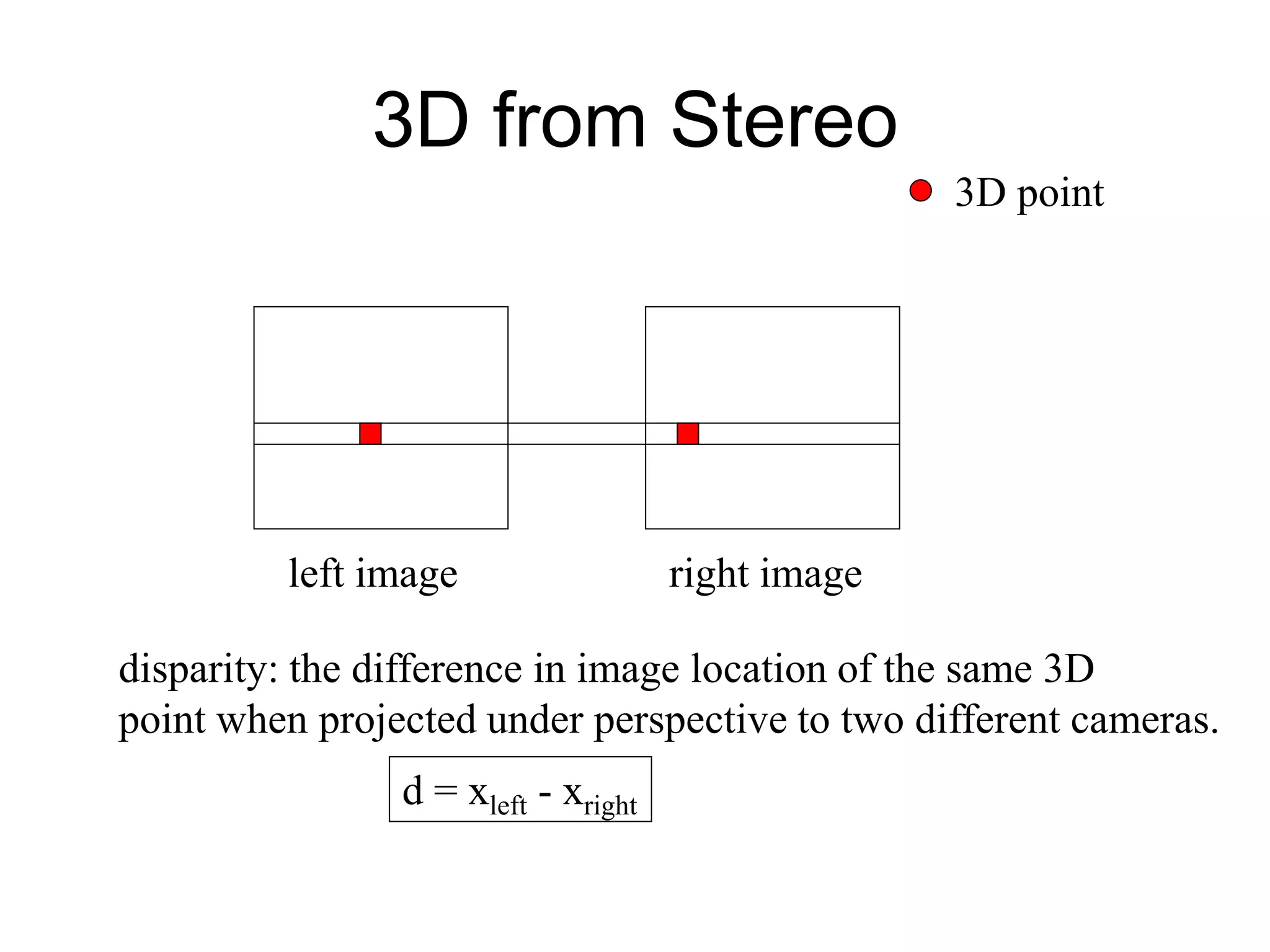
3D from Stereo
left image right image
3D point
disparity: the difference in image location of the same 3D
point when projected under perspective to two different cameras.
d = xleft - xright
Depth Perception from Stereo
Simple Model: Parallel Optic Axes
f
f
L
R
camera
baseline
camera
b
P=(x,z)
Z
X
image plane
xl
xr
z
z x
f xl
=
x-b
z x-b
f xr
=
z y y
f yl yr
= =
y-axis is
perpendicular
to the page.
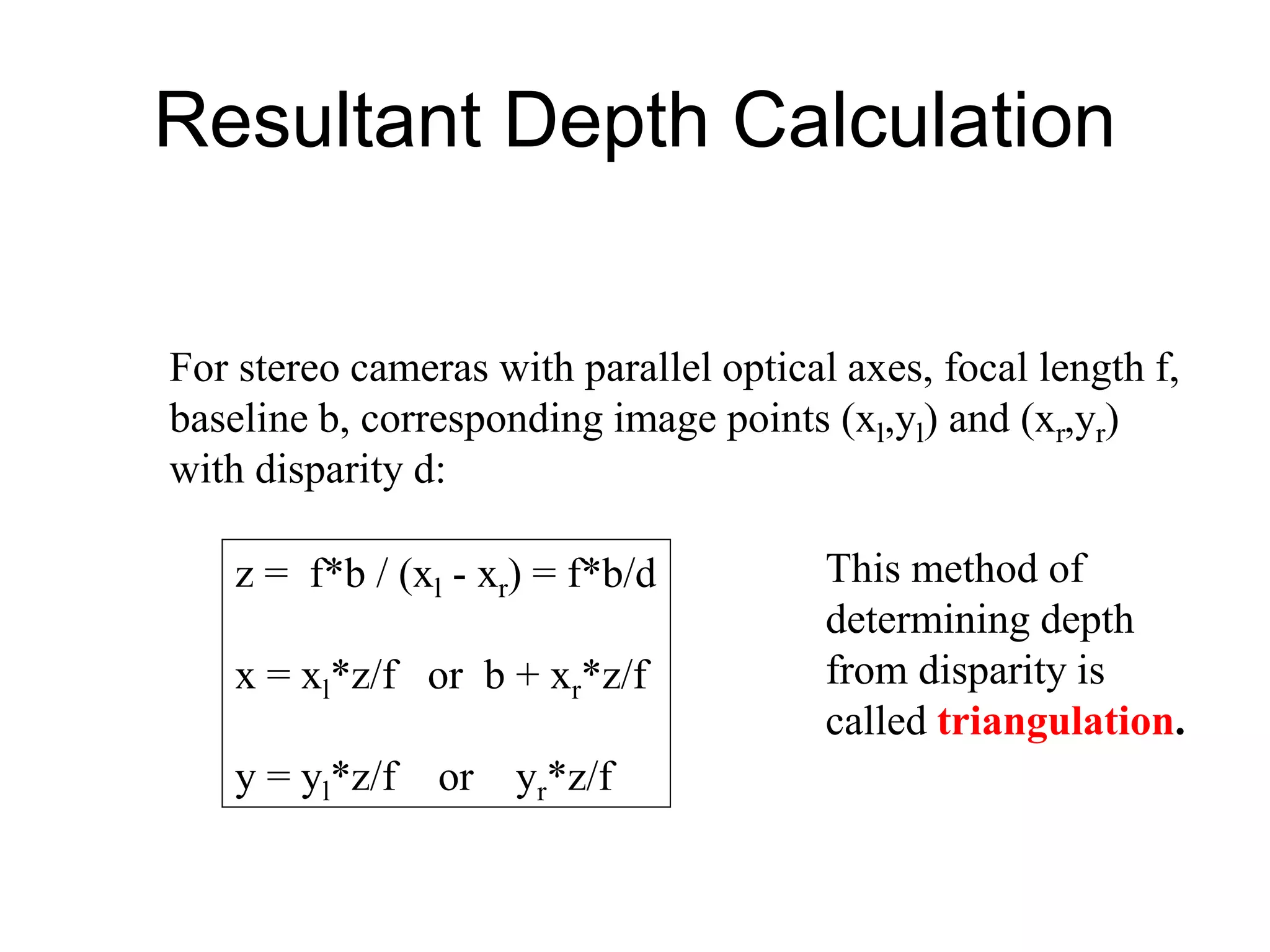
Resultant Depth Calculation
For stereo cameras with parallel optical axes, focal length f,
baseline b, corresponding image points (xl,yl) and (xr,yr)
with disparity d:
z = f*b / (xl - xr) = f*b/d
x = xl*z/f or b + xr*z/f
y = yl*z/f or yr*z/f
This method of
determining depth
from disparity is
called triangulation.
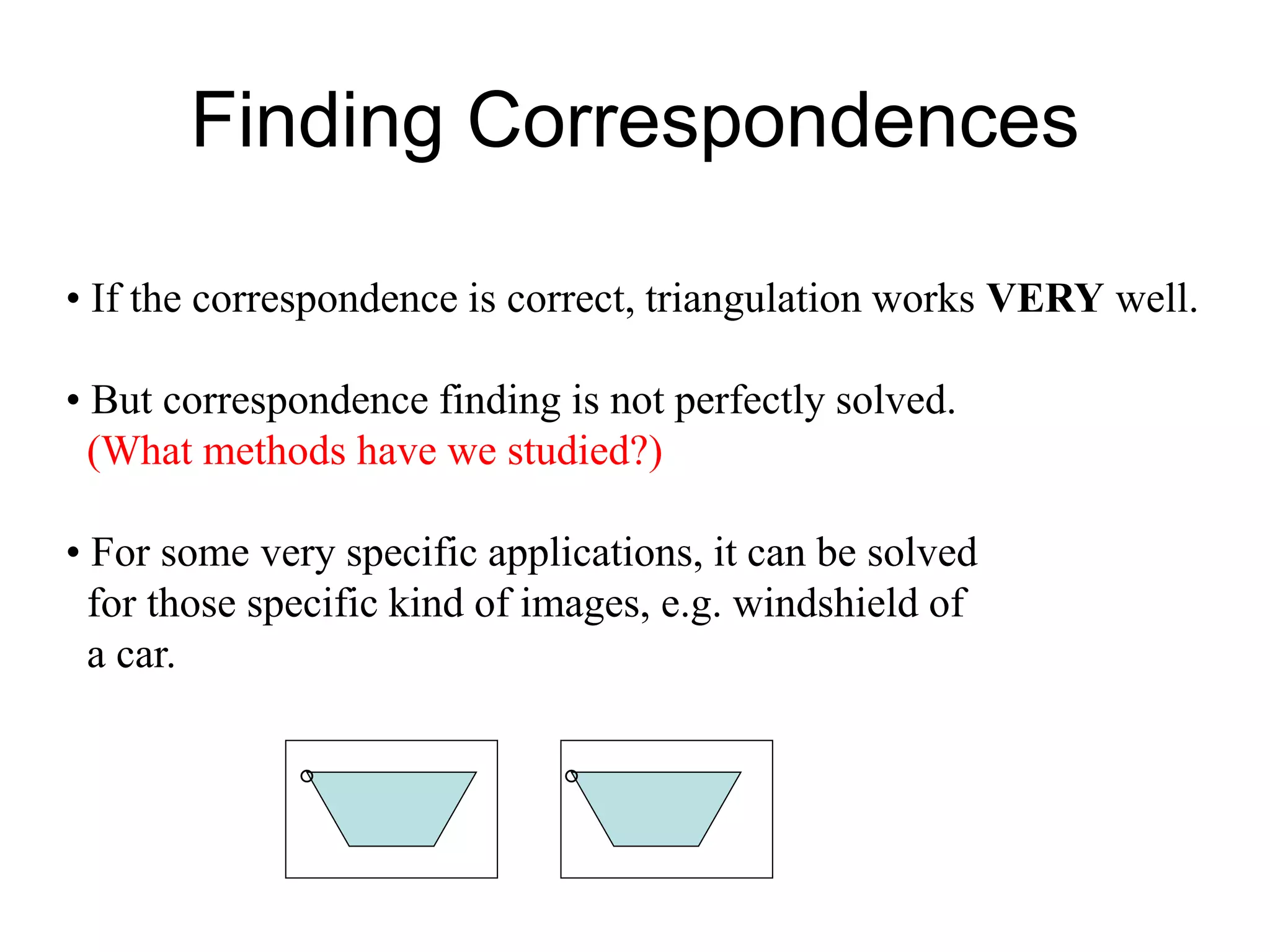
Finding Correspondences
• If the correspondence is correct, triangulation works VERY well.
• But correspondence finding is not perfectly solved.
(What methods have we studied?)
• For some very specific applications, it can be solved
for those specific kind of images, e.g. windshield of
a car.
° °
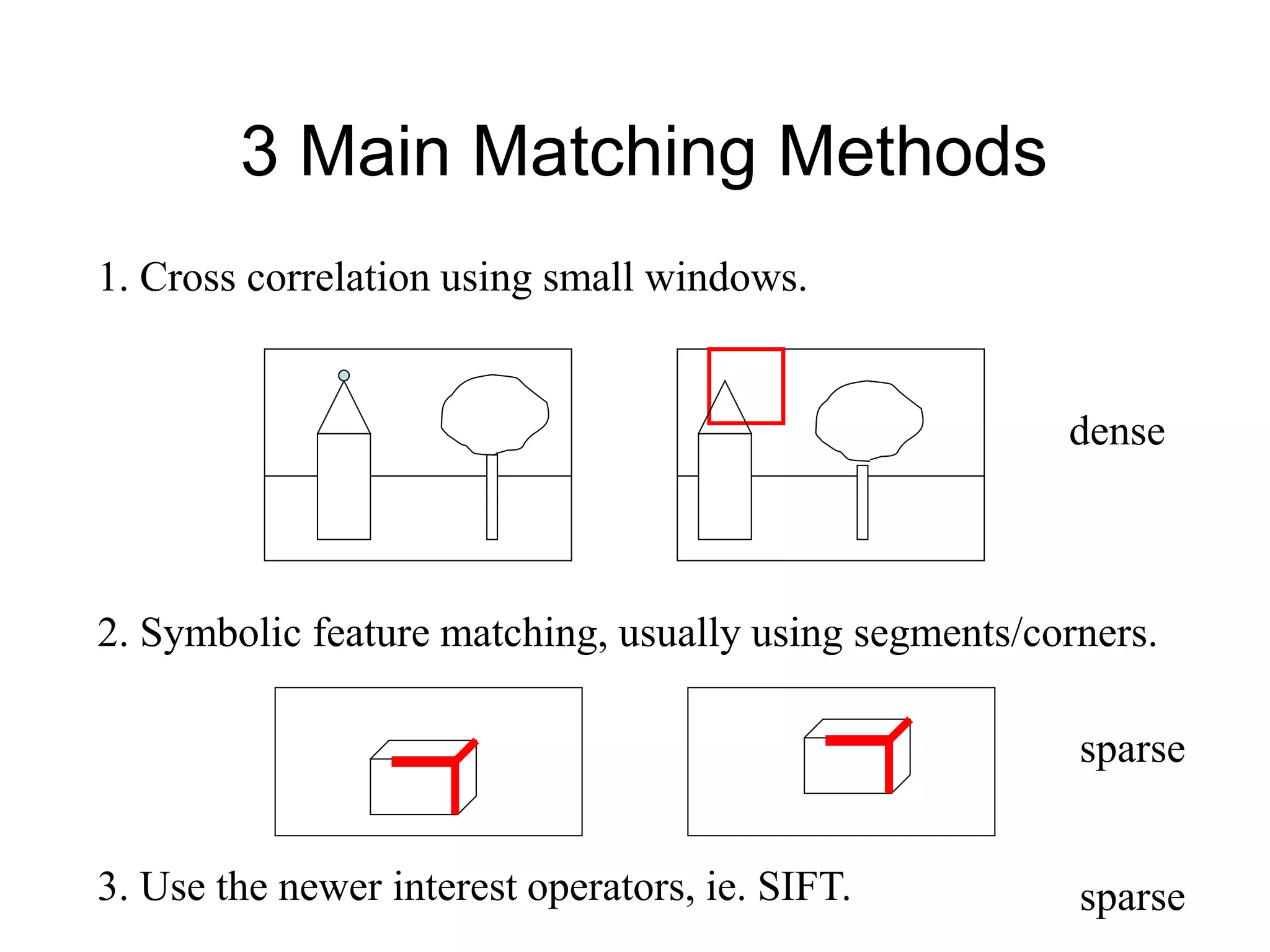
3 Main Matching Methods
1. Cross correlation using small windows.
2. Symbolic feature matching, usually using segments/corners.
3. Use the newer interest operators, ie. SIFT.
dense
sparse
sparse
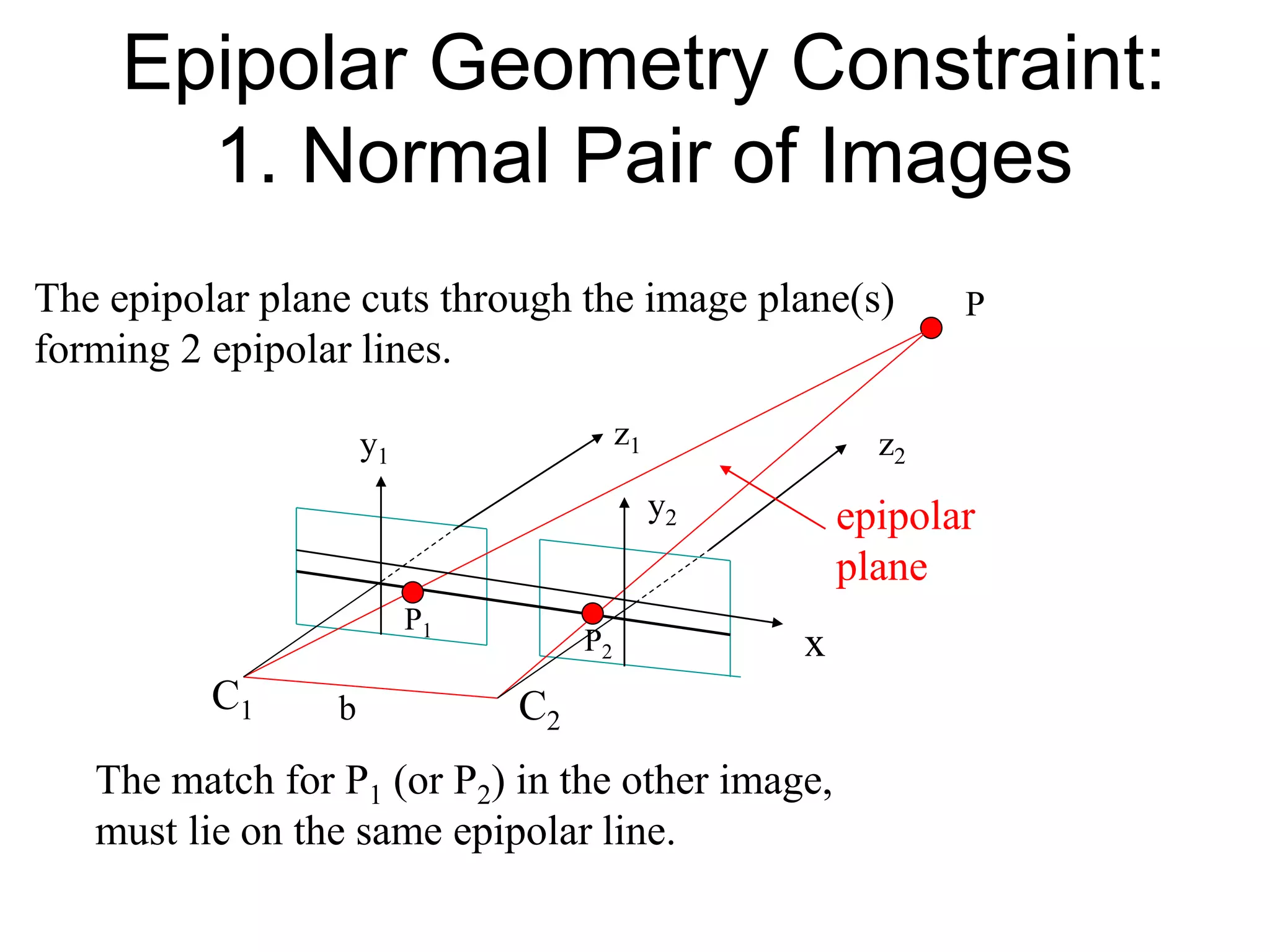
Epipolar Geometry Constraint:
1. Normal Pair of Images
x
y1
y2
z1 z2
C1 C2
b
P
P1
P2
epipolar
plane
The epipolar plane cuts through the image plane(s)
forming 2 epipolar lines.
The match for P1 (or P2) in the other image,
must lie on the same epipolar line.
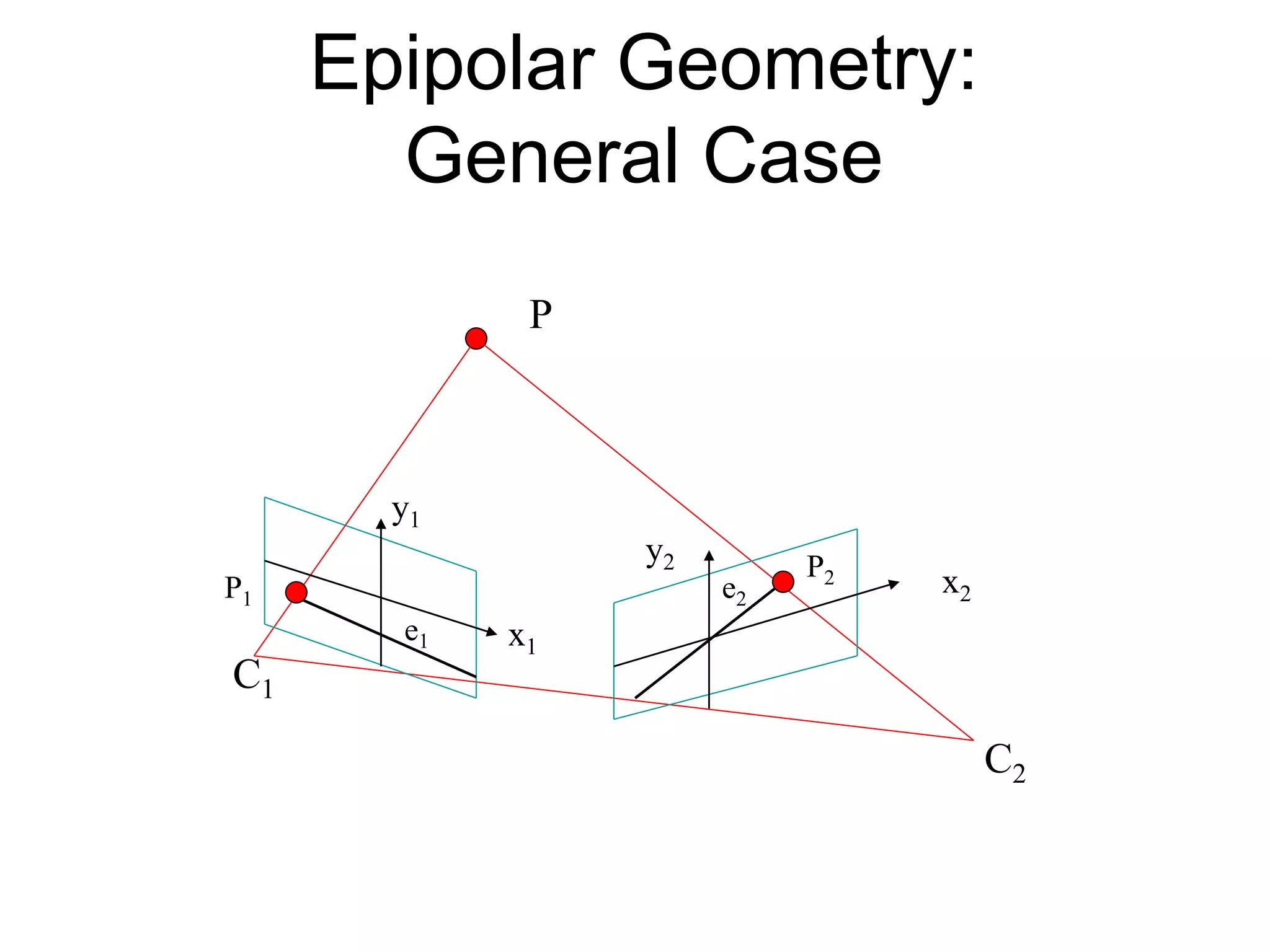
Epipolar Geometry:
General Case
P
P1
P2
y1
y2
x1
x2
e1
e2
C1
C2
Constraints
P
e1
e2
C1
C2
1. Epipolar Constraint:
Matching points lie on
corresponding epipolar
lines.
2. Ordering Constraint:
Usually in the same
order across the lines.
Q
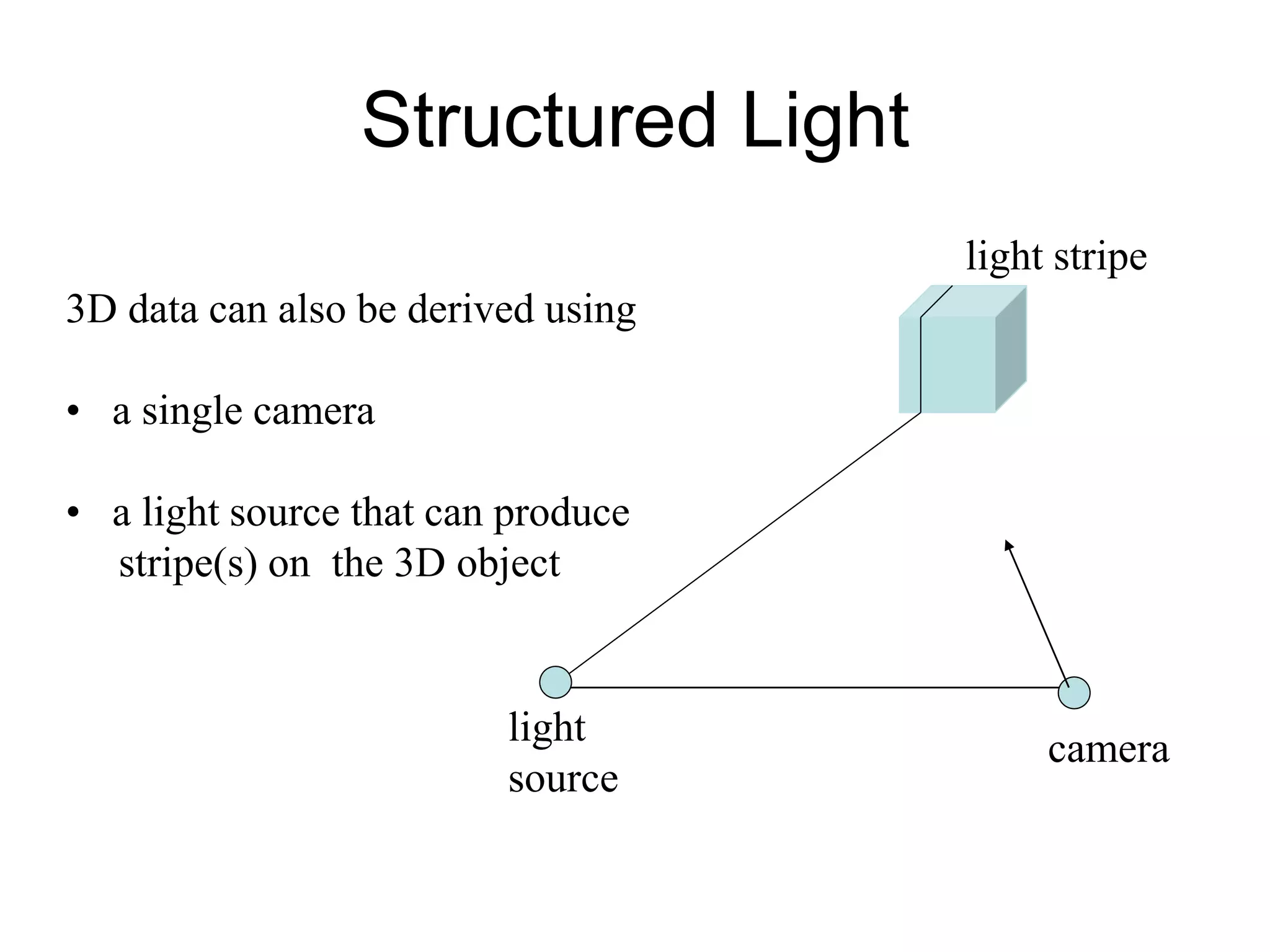
Structured Light
3D data can also be derived using
• a single camera
• a light source that can produce
stripe(s) on the 3D object
light
source
camera
light stripe
Structured Light
3D Computation
3D data can also be derived using
• a single camera
• a light source that can produce
stripe(s) on the 3D object
light
source
x axis
f
(x´,y´,f)
3D point
(x, y, z)

b
b
[x y z] = --------------- [x´ y´ f]
f cot  - x´
(0,0,0)
3D image
Depth from Multiple Light
Stripes
What are these objects?
Our (former) System
4-camera light-striping stereo
projector
rotation
table
cameras
3D
object
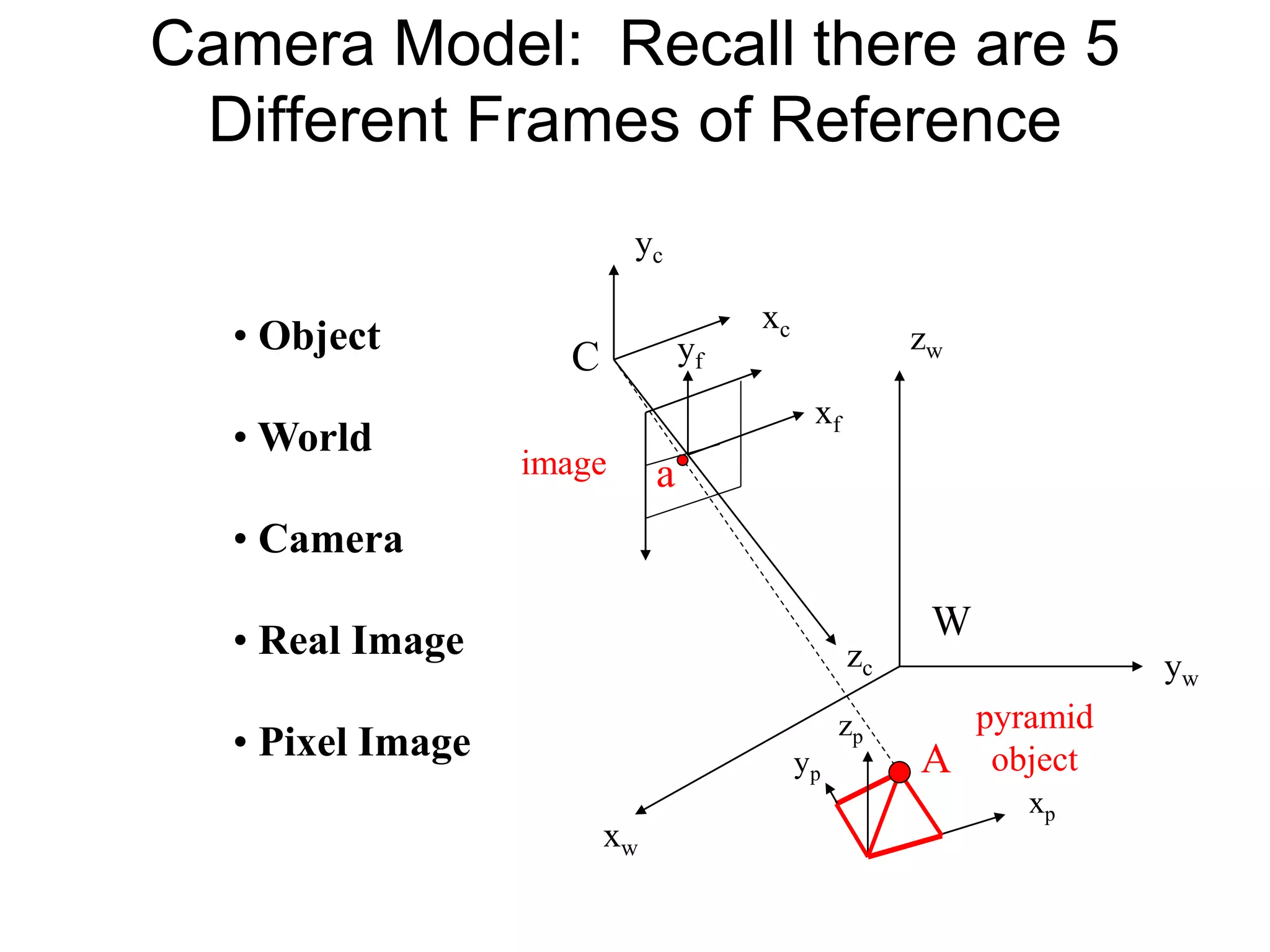
Camera Model: Recall there are 5
Different Frames of Reference
• Object
• World
• Camera
• Real Image
• Pixel Image
yc
xc
zc
zw
C
W
yw
xw
A
a
xf
yf
xp
yp
zp
pyramid
object
image
The Camera Model
How do we get an image point IP from a world point P?
c11 c12 c13 c14
c21 c22 c23 c24
c31 c32 c33 1
s IPr
s IPc
s
Px
Py
Pz
1
=
image
point
camera matrix C world
point
What’s in C?
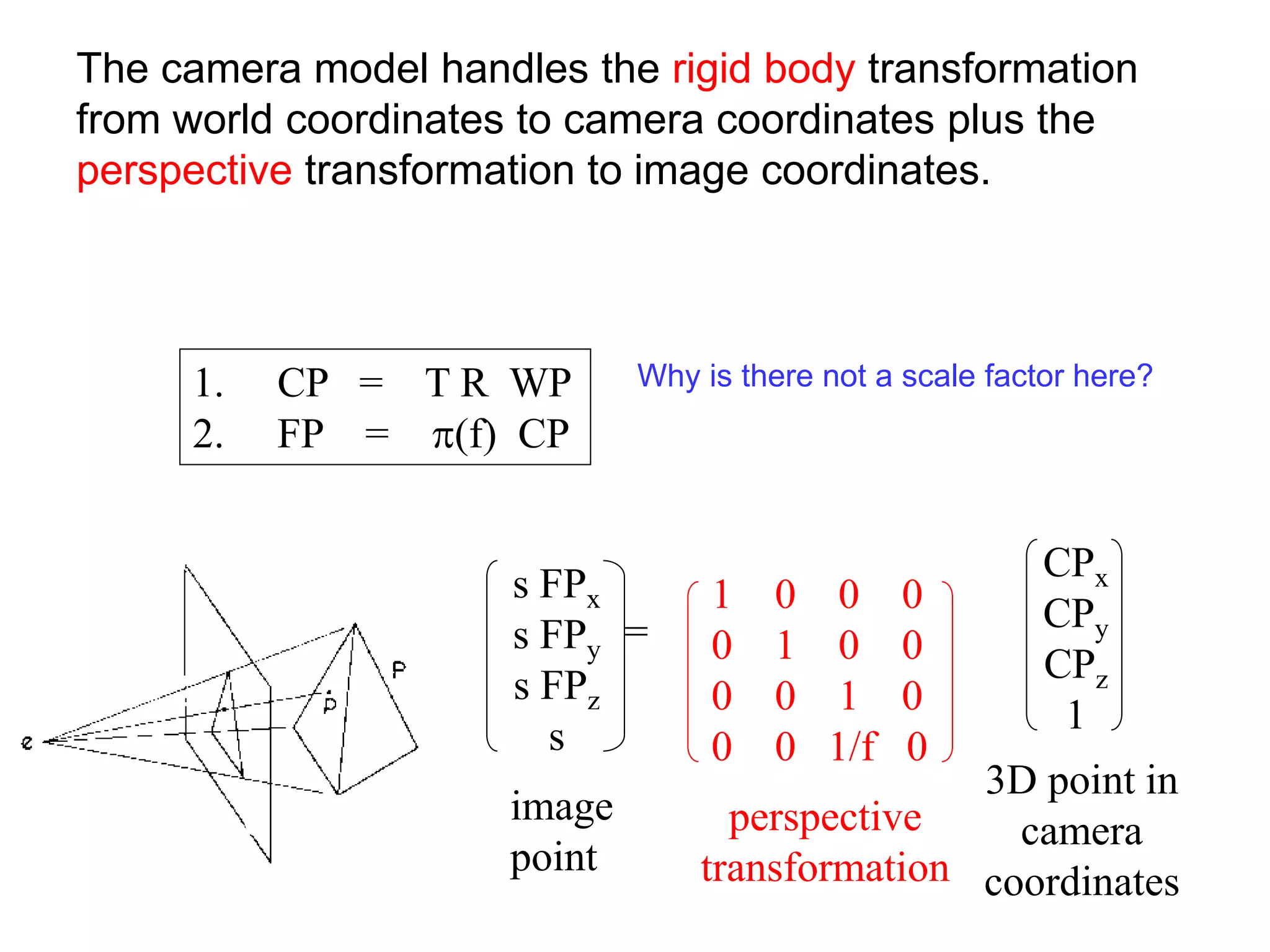
The camera model handles the rigid body transformation
from world coordinates to camera coordinates plus the
perspective transformation to image coordinates.
1. CP = T R WP
2. FP = (f) CP
s FPx
s FPy
s FPz
s
1 0 0 0
0 1 0 0
0 0 1 0
0 0 1/f 0
CPx
CPy
CPz
1
=
perspective
transformation
image
point
3D point in
camera
coordinates
Why is there not a scale factor here?
Camera Calibration
• In order work in 3D, we need to know the parameters
of the particular camera setup.
• Solving for the camera parameters is called calibration.
yw
xw
zw
W
yc
xc
zc
C
• intrinsic parameters are
of the camera device
• extrinsic parameters are
where the camera sits
in the world
Intrinsic Parameters
• principal point (u0,v0)
• scale factors (dx,dy)
• aspect ratio distortion factor 
• focal length f
• lens distortion factor 
(models radial lens distortion)
C
(u0,v0)
f
Extrinsic Parameters
• translation parameters
t = [tx ty tz]
• rotation matrix
r11 r12 r13 0
r21 r22 r23 0
r31 r32 r33 0
0 0 0 1
R = Are there really
nine parameters?
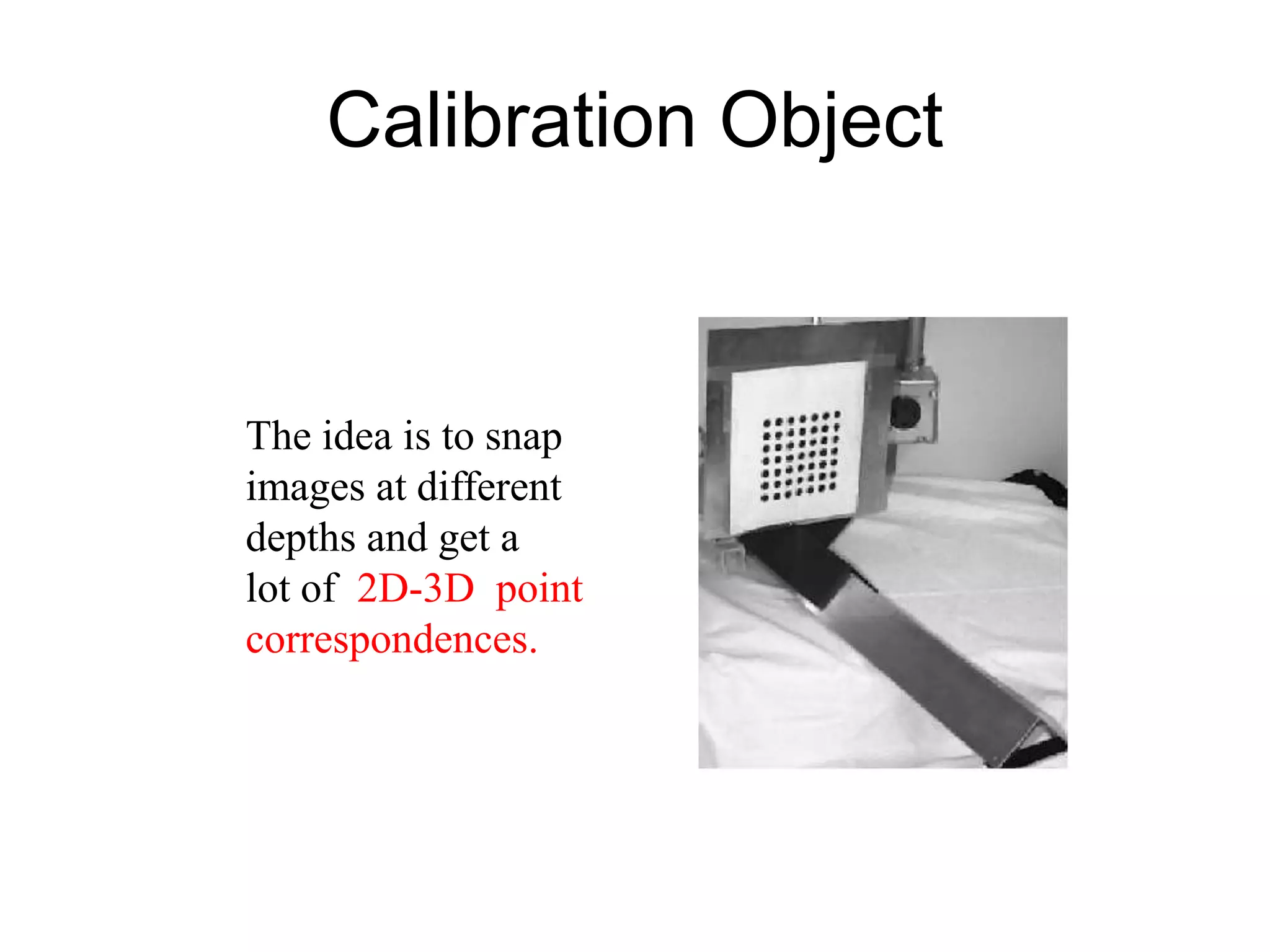
Calibration Object
The idea is to snap
images at different
depths and get a
lot of 2D-3D point
correspondences.
The Tsai Procedure
• The Tsai procedure was developed by Roger Tsai
at IBM Research and is most widely used.
• Several images are taken of the calibration object
yielding point correspondences at different distances.
• Tsai’s algorithm requires n > 5 correspondences
{(xi, yi, zi), (ui, vi)) | i = 1,…,n}
between (real) image points and 3D points.
• Lots of details in Chapter 13.
We use the camera parameters of
each camera for general stereo.
P
P1=(r1,c1)
P2=(r2,c2)
y1
y2
x1
x2
e1
e2
B
C
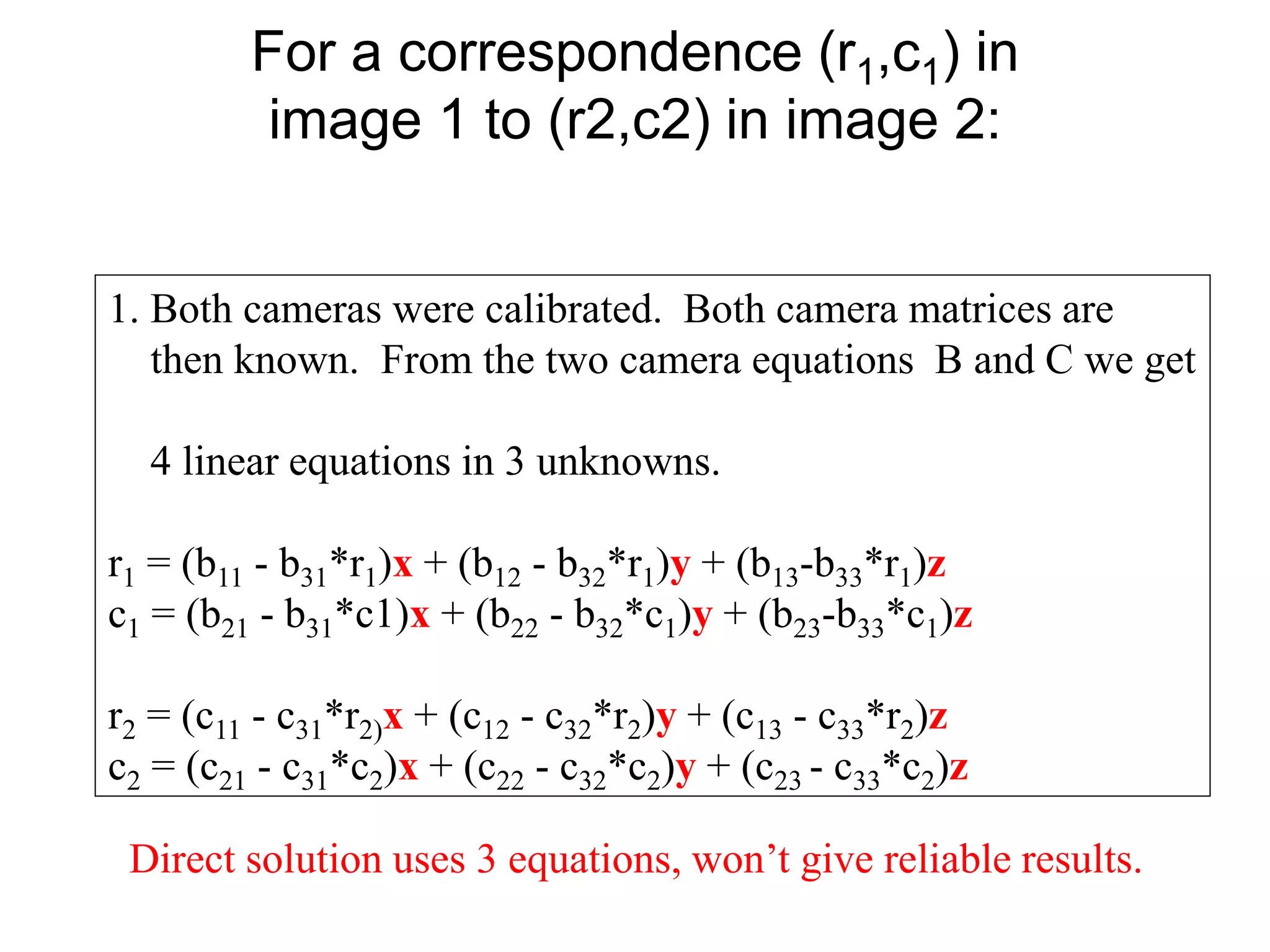
For a correspondence (r1,c1) in
image 1 to (r2,c2) in image 2:
1. Both cameras were calibrated. Both camera matrices are
then known. From the two camera equations B and C we get
4 linear equations in 3 unknowns.
r1 = (b11 - b31*r1)x + (b12 - b32*r1)y + (b13-b33*r1)z
c1 = (b21 - b31*c1)x + (b22 - b32*c1)y + (b23-b33*c1)z
r2 = (c11 - c31*r2)x + (c12 - c32*r2)y + (c13 - c33*r2)z
c2 = (c21 - c31*c2)x + (c22 - c32*c2)y + (c23 - c33*c2)z
Direct solution uses 3 equations, won’t give reliable results.
Solve by computing the closest
approach of the two skew rays.
V
If the rays intersected perfectly in 3D, the intersection would be P.
Instead, we solve for the shortest line segment connecting the two rays
and let P be its midpoint.
P1
Q1
P
solve for
shortest
V = (P1 + a1*u1) – (Q1 + a2*u2)
(P1 + a1*u1) – (Q1 + a2*u2) · u1 = 0
(P1 + a1*u1) – (Q1 + a2*u2) · u2 = 0
u1
u2
3DSensing.ppt
3DSensing.ppt
3DSensing.ppt
3DSensing.ppt
3DSensing.ppt
3DSensing.ppt
3DSensing.ppt
3DSensing.ppt
3DSensing.ppt
3DSensing.ppt
3DSensing.ppt
3DSensing.ppt
3DSensing.ppt

3DSensing.ppt

  • 1.
    3D Sensing andReconstruction Readings: Ch 12: 12.5-6, Ch 13: 13.1-3, 13.9.4 • Perspective Geometry • Camera Model • Stereo Triangulation • 3D Reconstruction by Space Carving
  • 2.
    3D Shape fromX means getting 3D coordinates from different methods • shading • silhouette • texture • stereo • light striping • motion mainly research used in practice
  • 3.
    Perspective Imaging Model:1D xi xf f This is the axis of the real image plane. O O is the center of projection. This is the axis of the front image plane, which we use. zc xc xi xc f zc = camera lens 3D object point B D E image of point B in front image real image point
  • 4.
    Perspective in 2D (Simplified) P=(xc,yc,zc) =(xw,yw,zw) 3Dobject point xc yc zw=zc yi Yc Xc Zc xi F f camera P´=(xi,yi,f) xi xc f zc yi yc f zc = = xi = (f/zc)xc yi = (f/zc)yc Here camera coordinates equal world coordinates. optical axis ray
  • 5.
    3D from Stereo leftimage right image 3D point disparity: the difference in image location of the same 3D point when projected under perspective to two different cameras. d = xleft - xright
  • 6.
    Depth Perception fromStereo Simple Model: Parallel Optic Axes f f L R camera baseline camera b P=(x,z) Z X image plane xl xr z z x f xl = x-b z x-b f xr = z y y f yl yr = = y-axis is perpendicular to the page.
  • 7.
    Resultant Depth Calculation Forstereo cameras with parallel optical axes, focal length f, baseline b, corresponding image points (xl,yl) and (xr,yr) with disparity d: z = f*b / (xl - xr) = f*b/d x = xl*z/f or b + xr*z/f y = yl*z/f or yr*z/f This method of determining depth from disparity is called triangulation.
  • 8.
    Finding Correspondences • Ifthe correspondence is correct, triangulation works VERY well. • But correspondence finding is not perfectly solved. (What methods have we studied?) • For some very specific applications, it can be solved for those specific kind of images, e.g. windshield of a car. ° °
  • 9.
    3 Main MatchingMethods 1. Cross correlation using small windows. 2. Symbolic feature matching, usually using segments/corners. 3. Use the newer interest operators, ie. SIFT. dense sparse sparse
  • 10.
    Epipolar Geometry Constraint: 1.Normal Pair of Images x y1 y2 z1 z2 C1 C2 b P P1 P2 epipolar plane The epipolar plane cuts through the image plane(s) forming 2 epipolar lines. The match for P1 (or P2) in the other image, must lie on the same epipolar line.
  • 11.
  • 12.
    Constraints P e1 e2 C1 C2 1. Epipolar Constraint: Matchingpoints lie on corresponding epipolar lines. 2. Ordering Constraint: Usually in the same order across the lines. Q
  • 13.
    Structured Light 3D datacan also be derived using • a single camera • a light source that can produce stripe(s) on the 3D object light source camera light stripe
  • 14.
    Structured Light 3D Computation 3Ddata can also be derived using • a single camera • a light source that can produce stripe(s) on the 3D object light source x axis f (x´,y´,f) 3D point (x, y, z)  b b [x y z] = --------------- [x´ y´ f] f cot  - x´ (0,0,0) 3D image
  • 15.
    Depth from MultipleLight Stripes What are these objects?
  • 16.
    Our (former) System 4-cameralight-striping stereo projector rotation table cameras 3D object
  • 17.
    Camera Model: Recallthere are 5 Different Frames of Reference • Object • World • Camera • Real Image • Pixel Image yc xc zc zw C W yw xw A a xf yf xp yp zp pyramid object image
  • 18.
    The Camera Model Howdo we get an image point IP from a world point P? c11 c12 c13 c14 c21 c22 c23 c24 c31 c32 c33 1 s IPr s IPc s Px Py Pz 1 = image point camera matrix C world point What’s in C?
  • 19.
    The camera modelhandles the rigid body transformation from world coordinates to camera coordinates plus the perspective transformation to image coordinates. 1. CP = T R WP 2. FP = (f) CP s FPx s FPy s FPz s 1 0 0 0 0 1 0 0 0 0 1 0 0 0 1/f 0 CPx CPy CPz 1 = perspective transformation image point 3D point in camera coordinates Why is there not a scale factor here?
  • 20.
    Camera Calibration • Inorder work in 3D, we need to know the parameters of the particular camera setup. • Solving for the camera parameters is called calibration. yw xw zw W yc xc zc C • intrinsic parameters are of the camera device • extrinsic parameters are where the camera sits in the world
  • 21.
    Intrinsic Parameters • principalpoint (u0,v0) • scale factors (dx,dy) • aspect ratio distortion factor  • focal length f • lens distortion factor  (models radial lens distortion) C (u0,v0) f
  • 22.
    Extrinsic Parameters • translationparameters t = [tx ty tz] • rotation matrix r11 r12 r13 0 r21 r22 r23 0 r31 r32 r33 0 0 0 0 1 R = Are there really nine parameters?
  • 23.
    Calibration Object The ideais to snap images at different depths and get a lot of 2D-3D point correspondences.
  • 24.
    The Tsai Procedure •The Tsai procedure was developed by Roger Tsai at IBM Research and is most widely used. • Several images are taken of the calibration object yielding point correspondences at different distances. • Tsai’s algorithm requires n > 5 correspondences {(xi, yi, zi), (ui, vi)) | i = 1,…,n} between (real) image points and 3D points. • Lots of details in Chapter 13.
  • 25.
    We use thecamera parameters of each camera for general stereo. P P1=(r1,c1) P2=(r2,c2) y1 y2 x1 x2 e1 e2 B C
  • 26.
    For a correspondence(r1,c1) in image 1 to (r2,c2) in image 2: 1. Both cameras were calibrated. Both camera matrices are then known. From the two camera equations B and C we get 4 linear equations in 3 unknowns. r1 = (b11 - b31*r1)x + (b12 - b32*r1)y + (b13-b33*r1)z c1 = (b21 - b31*c1)x + (b22 - b32*c1)y + (b23-b33*c1)z r2 = (c11 - c31*r2)x + (c12 - c32*r2)y + (c13 - c33*r2)z c2 = (c21 - c31*c2)x + (c22 - c32*c2)y + (c23 - c33*c2)z Direct solution uses 3 equations, won’t give reliable results.
  • 27.
    Solve by computingthe closest approach of the two skew rays. V If the rays intersected perfectly in 3D, the intersection would be P. Instead, we solve for the shortest line segment connecting the two rays and let P be its midpoint. P1 Q1 P solve for shortest V = (P1 + a1*u1) – (Q1 + a2*u2) (P1 + a1*u1) – (Q1 + a2*u2) · u1 = 0 (P1 + a1*u1) – (Q1 + a2*u2) · u2 = 0 u1 u2