Networking
Fundamentals
Instructor: Shahzad Ali
Lec#1
27th Oct, 2015
Punjab Group of Colleges, Pakpattan Campus
Course Instructor
Shahzad Ali
Email: shahzadali039@gmail.com
Introductions to Computer
Networks
Introductory Lecture
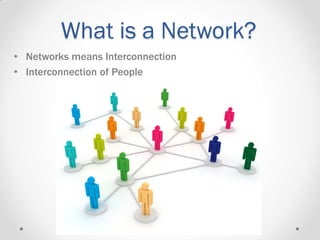
What is a Network?
• Networks means Interconnection
• Interconnection of People
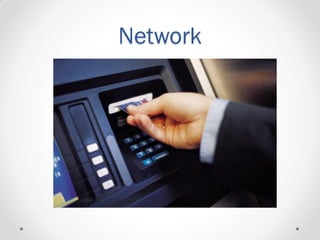
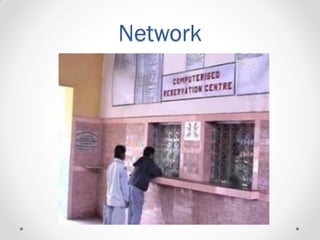
Network
Network
Computer Network
• In information technology, a network is a series of points or
nodes interconnected by communication paths.
• A collection of computing devices that are connected in
various ways in order to communicate and share resources
• Usually, the connections between computers in a network
are made using physical wires or cables
 However, some connections are wireless, using radio waves or infrared signals
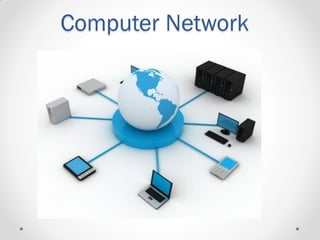
Computer Network
Computer Network
• Simply referred to as a network
• Collection of hardware components and software
• Interconnected by communication channels
• Allow sharing of resources and information
• Example:
o Two computers connecting together is an example of a network.
Classification of Networks
• Area Networks
• Network Design
• Network Topology
• Network Protocols
• Wired vs. Wireless
Area Networks
• LAN – Local Area Network
• MAN – Metropolitan Area Network
• WAN – Wide Area Network
• PAN – Personal Area Network
Personal Area Network
• Small Computer network
• A personal area network, or PAN, is a computer network
organized around an individual person within a single building
• A PAN may include wired and wireless devices
• The reach of a PAN typically extends to 10 meters
o Wired – USB
o Wireless- Bluetooth and Infrared
• Some examples of devices are
o PCs
o Printers
o Fax machines
o Scanners, etc.
Local Area Network
• A network that connects computers and devices in a
limited geographical area such as
 Home
 School
 Computer laboratory
 Office building
Metropolitan Area Network
• A computer network that usually spans a city or a large
campus
• A MAN usually interconnects a number of LANs
• Uses a high-capacity backbone technology, such as fiber-
optical links
• Within limits of a city
• Example:
o Cable TV Network
Wide Area Network
• WAN spans a large physical distance
• The Internet is the best largest WAN spanning the Earth.
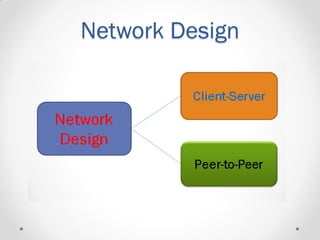
Network Design
17
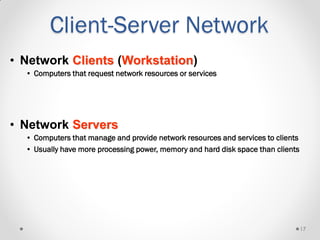
• Network Clients (Workstation)
• Computers that request network resources or services
• Network Servers
• Computers that manage and provide network resources and services to clients
• Usually have more processing power, memory and hard disk space than clients
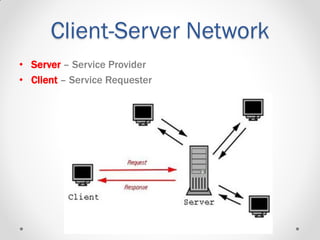
Client-Server Network
• Server – Service Provider
• Client – Service Requester
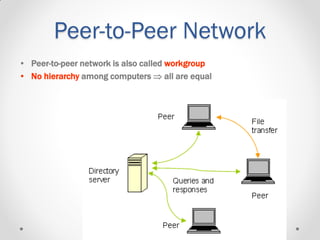
Peer-to-Peer Network
• Peer-to-peer network is also called workgroup
• No hierarchy among computers  all are equal
Network Topology
• Topology
 Design of Network
 Or refers to the layout of connected devices
 Think of a topology as a network’s virtual shape or structure
Network Topology
Types of topology
• Physical
o Actual layout of the computer cables and other network devices
• Logical
o The way in which the network appears to the devices that use it
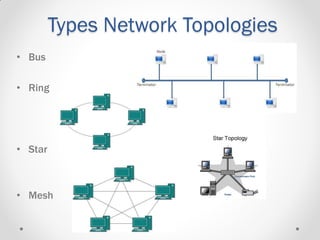
Types Network Topologies
• Bus
• Ring
• Star
• Mesh
Network Protocols
• An agreed-upon set of rules for transmitting data between
two devices.
• Protocols specify interactions between the communicating
entities.
Network Protocols
Types of Protocols Used
• Proprietary Systems
o A system that uses technologies kept private by a particular
commercial vendor
• Open systems
o Systems based on a common model of network architecture and a
suite of protocols used in its implementation
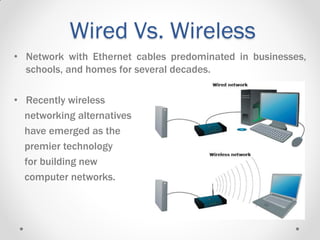
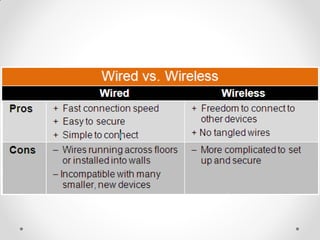
Wired Vs. Wireless
• Network with Ethernet cables predominated in businesses,
schools, and homes for several decades.
• Recently wireless
networking alternatives
have emerged as the
premier technology
for building new
computer networks.
Q&A
?

Computer Networks Lec#1

  • 1.
    Networking Fundamentals Instructor: Shahzad Ali Lec#1 27thOct, 2015 Punjab Group of Colleges, Pakpattan Campus
  • 2.
    Course Instructor Shahzad Ali Email:shahzadali039@gmail.com
  • 3.
  • 4.
    What is aNetwork? • Networks means Interconnection • Interconnection of People
  • 5.
  • 6.
  • 7.
    Computer Network • Ininformation technology, a network is a series of points or nodes interconnected by communication paths. • A collection of computing devices that are connected in various ways in order to communicate and share resources • Usually, the connections between computers in a network are made using physical wires or cables  However, some connections are wireless, using radio waves or infrared signals
  • 8.
  • 9.
    Computer Network • Simplyreferred to as a network • Collection of hardware components and software • Interconnected by communication channels • Allow sharing of resources and information • Example: o Two computers connecting together is an example of a network.
  • 10.
    Classification of Networks •Area Networks • Network Design • Network Topology • Network Protocols • Wired vs. Wireless
  • 11.
    Area Networks • LAN– Local Area Network • MAN – Metropolitan Area Network • WAN – Wide Area Network • PAN – Personal Area Network
  • 12.
    Personal Area Network •Small Computer network • A personal area network, or PAN, is a computer network organized around an individual person within a single building • A PAN may include wired and wireless devices • The reach of a PAN typically extends to 10 meters o Wired – USB o Wireless- Bluetooth and Infrared • Some examples of devices are o PCs o Printers o Fax machines o Scanners, etc.
  • 13.
    Local Area Network •A network that connects computers and devices in a limited geographical area such as  Home  School  Computer laboratory  Office building
  • 14.
    Metropolitan Area Network •A computer network that usually spans a city or a large campus • A MAN usually interconnects a number of LANs • Uses a high-capacity backbone technology, such as fiber- optical links • Within limits of a city • Example: o Cable TV Network
  • 15.
    Wide Area Network •WAN spans a large physical distance • The Internet is the best largest WAN spanning the Earth.
  • 16.
  • 17.
    17 • Network Clients(Workstation) • Computers that request network resources or services • Network Servers • Computers that manage and provide network resources and services to clients • Usually have more processing power, memory and hard disk space than clients Client-Server Network
  • 18.
    Client-Server Network • Server– Service Provider • Client – Service Requester
  • 19.
    Peer-to-Peer Network • Peer-to-peernetwork is also called workgroup • No hierarchy among computers  all are equal
  • 20.
    Network Topology • Topology Design of Network  Or refers to the layout of connected devices  Think of a topology as a network’s virtual shape or structure
  • 21.
    Network Topology Types oftopology • Physical o Actual layout of the computer cables and other network devices • Logical o The way in which the network appears to the devices that use it
  • 22.
    Types Network Topologies •Bus • Ring • Star • Mesh
  • 23.
    Network Protocols • Anagreed-upon set of rules for transmitting data between two devices. • Protocols specify interactions between the communicating entities.
  • 24.
    Network Protocols Types ofProtocols Used • Proprietary Systems o A system that uses technologies kept private by a particular commercial vendor • Open systems o Systems based on a common model of network architecture and a suite of protocols used in its implementation
  • 25.
    Wired Vs. Wireless •Network with Ethernet cables predominated in businesses, schools, and homes for several decades. • Recently wireless networking alternatives have emerged as the premier technology for building new computer networks.
  • 27.