COMPUTER NETWORKING
GROUP A
Aadarsh Shrestha
Deekshya Rana
Samikchhya Amatya
Sangam K.C.
TABLE OF CONTENT
• Introduction
• Characteristics
• Application Of Computer Network
• Disadvantages
• Types of Networks
• Network Services
• Transmission Medium
• Protocols
• Conclusion
INTRODUCTION
• Set of autonomous computers connected by medium
to exchange information
• Link maybe copper wire, fiber optics, etc.
• Computer or Router on the network called node
• The shared resources can be files, folders, software,
hardware applications
• It makes easy to share data
CHARACTERISTICS
• To share the resources
• To communicate efficiently
• To access remote information
• To allow flexible working environment
• Used for electronic commerce
APPLICATION OF COMPUTER
NETWORK
• Business Application
• Home Application
• Mobile Uses
• Social Uses
DISADVANTAGES
• Expensive
• Security of Data
• Needs special technical knowledge
TYPES OF NETWORKS
• Local Area Network (LAN)
• Metropolitan Area Network (MAN)
• Wide Area Network (WAN)
LOCAL AREA NETWORK
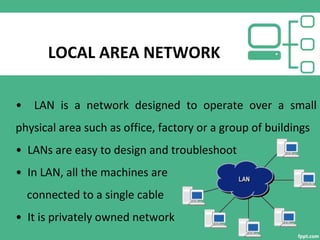
• LAN is a network designed to operate over a small
physical area such as office, factory or a group of buildings
• LANs are easy to design and troubleshoot
• In LAN, all the machines are
connected to a single cable
• It is privately owned network
METROPOLITAN AREA
NETWORK
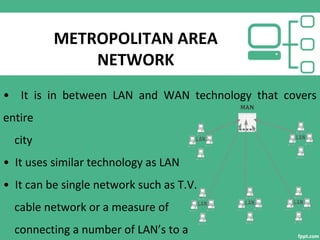
• It is in between LAN and WAN technology that covers
entire
city
• It uses similar technology as LAN
• It can be single network such as T.V.
cable network or a measure of
connecting a number of LAN’s to a
WIDE AREA NETWORK
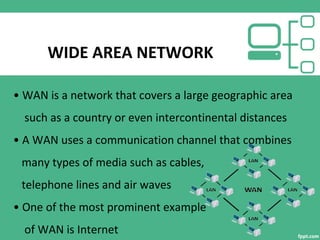
• WAN is a network that covers a large geographic area
such as a country or even intercontinental distances
• A WAN uses a communication channel that combines
many types of media such as cables,
telephone lines and air waves
• One of the most prominent example
of WAN is Internet
NETWORK SERVICES
NETWORK SERVICES
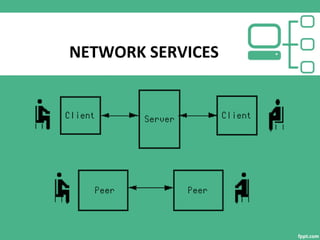
• Servers
- Service providers
- Makes resources available to other computers
- Run network serve software
- Fulfill a specific network service role
NETWORK SERVICES
Cont’d
• Clients
- Service requesters
- Uses the resources
- Run network client software
NETWORK SERVICES
Cont’d
• Peers
- Both service providers and service requesters
- Designed so that peers perform the similar function
- Some common peer-to-peer networks include
windows for workgroups and personal network
TRANSMISSION MEDIUM
• Wired • Wireless
Twisted Pair Radio Link
Co-axial Cable Satellite
Fiber Optics Bluetooth
WIRED
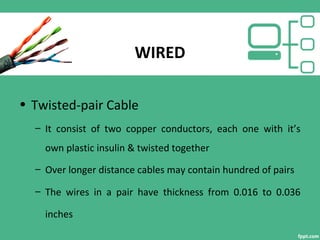
• Twisted-pair Cable
– It consist of two copper conductors, each one with it’s
own plastic insulin & twisted together
– Over longer distance cables may contain hundred of pairs
– The wires in a pair have thickness from 0.016 to 0.036
inches
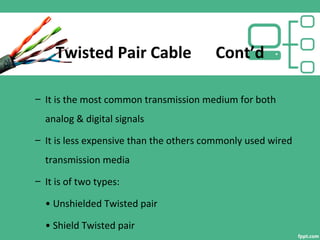
Twisted Pair Cable Cont’d
– It is the most common transmission medium for both
analog & digital signals
– It is less expensive than the others commonly used wired
transmission media
– It is of two types:
• Unshielded Twisted pair
• Shield Twisted pair
WIRED Cont’d
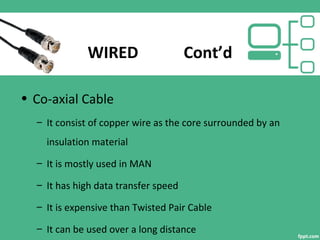
• Co-axial Cable
– It consist of copper wire as the core surrounded by an
insulation material
– It is mostly used in MAN
– It has high data transfer speed
– It is expensive than Twisted Pair Cable
– It can be used over a long distance
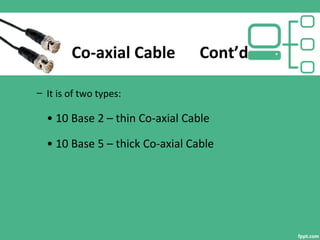
Co-axial Cable Cont’d
– It is of two types:
• 10 Base 2 – thin Co-axial Cable
• 10 Base 5 – thick Co-axial Cable
WIRED Cont’d
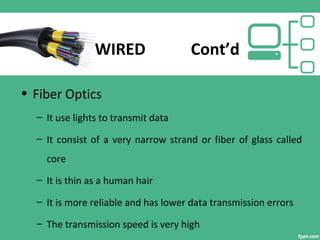
• Fiber Optics
– It use lights to transmit data
– It consist of a very narrow strand or fiber of glass called
core
– It is thin as a human hair
– It is more reliable and has lower data transmission errors
– The transmission speed is very high
WIRELESS
• Radio Link Transmission
– It is the line of straight transmission
– Transmit station must be visible in contact with receive
station
– Widely used for long distance communication
– It is relatively inexpensive
WIRELESS Cont’d
• Satellite
– It is also a kind of straight transmission
– Satellite set in geo-stationary, orbits directly over equator
– These orbits are placed 35,786 km above earth’s surface
– Communication carries through uplinks and downlinks
– The area shadowed by the satellite in which the
information can be transmitted is called footprints
WIRELESS Cont’d
• Bluetooth
– It is a standard and communication protocol
– It lets devices to communicate with each other
when in range
– Devices uses radio communication system
– To communicate, Bluetooth devices must be
PROTOCOLS
• Set of rules that allows different machines to
communicate with each other
• Provides guidance to the network
• Guidance promotes harmonious connectivity among
the many network machines
• Network protocols are combined with transmission
media and topologies to create network standard
CONCLUSION
• Computer Network is a set of autonomous computer
connected by communication link or medium to
exchange the information
• It’s characteristics are to share the resources, to
communicate efficiently, to access information, etc.
• The network models are LAN, MAN and WAN
CONCLUSION Cont’d
• A system consists of three basic elements: Network
Services, Transmission Media and Network Protocols
• Network Services are the things networks do, which
can take on various role servers, clients and peers
• Transmission media includes cables and wireless
technologies
• Network protocols are the set of rules
ANY QUERIES ??

Computer Network

  • 1.
    COMPUTER NETWORKING GROUP A AadarshShrestha Deekshya Rana Samikchhya Amatya Sangam K.C.
  • 2.
    TABLE OF CONTENT •Introduction • Characteristics • Application Of Computer Network • Disadvantages • Types of Networks • Network Services • Transmission Medium • Protocols • Conclusion
  • 3.
    INTRODUCTION • Set ofautonomous computers connected by medium to exchange information • Link maybe copper wire, fiber optics, etc. • Computer or Router on the network called node • The shared resources can be files, folders, software, hardware applications • It makes easy to share data
  • 4.
    CHARACTERISTICS • To sharethe resources • To communicate efficiently • To access remote information • To allow flexible working environment • Used for electronic commerce
  • 5.
    APPLICATION OF COMPUTER NETWORK •Business Application • Home Application • Mobile Uses • Social Uses
  • 6.
    DISADVANTAGES • Expensive • Securityof Data • Needs special technical knowledge
  • 7.
    TYPES OF NETWORKS •Local Area Network (LAN) • Metropolitan Area Network (MAN) • Wide Area Network (WAN)
  • 8.
    LOCAL AREA NETWORK •LAN is a network designed to operate over a small physical area such as office, factory or a group of buildings • LANs are easy to design and troubleshoot • In LAN, all the machines are connected to a single cable • It is privately owned network
  • 9.
    METROPOLITAN AREA NETWORK • Itis in between LAN and WAN technology that covers entire city • It uses similar technology as LAN • It can be single network such as T.V. cable network or a measure of connecting a number of LAN’s to a
  • 10.
    WIDE AREA NETWORK •WAN is a network that covers a large geographic area such as a country or even intercontinental distances • A WAN uses a communication channel that combines many types of media such as cables, telephone lines and air waves • One of the most prominent example of WAN is Internet
  • 11.
  • 12.
    NETWORK SERVICES • Servers -Service providers - Makes resources available to other computers - Run network serve software - Fulfill a specific network service role
  • 13.
    NETWORK SERVICES Cont’d • Clients -Service requesters - Uses the resources - Run network client software
  • 14.
    NETWORK SERVICES Cont’d • Peers -Both service providers and service requesters - Designed so that peers perform the similar function - Some common peer-to-peer networks include windows for workgroups and personal network
  • 15.
    TRANSMISSION MEDIUM • Wired• Wireless Twisted Pair Radio Link Co-axial Cable Satellite Fiber Optics Bluetooth
  • 16.
    WIRED • Twisted-pair Cable –It consist of two copper conductors, each one with it’s own plastic insulin & twisted together – Over longer distance cables may contain hundred of pairs – The wires in a pair have thickness from 0.016 to 0.036 inches
  • 17.
    Twisted Pair CableCont’d – It is the most common transmission medium for both analog & digital signals – It is less expensive than the others commonly used wired transmission media – It is of two types: • Unshielded Twisted pair • Shield Twisted pair
  • 18.
    WIRED Cont’d • Co-axialCable – It consist of copper wire as the core surrounded by an insulation material – It is mostly used in MAN – It has high data transfer speed – It is expensive than Twisted Pair Cable – It can be used over a long distance
  • 19.
    Co-axial Cable Cont’d –It is of two types: • 10 Base 2 – thin Co-axial Cable • 10 Base 5 – thick Co-axial Cable
  • 20.
    WIRED Cont’d • FiberOptics – It use lights to transmit data – It consist of a very narrow strand or fiber of glass called core – It is thin as a human hair – It is more reliable and has lower data transmission errors – The transmission speed is very high
  • 21.
    WIRELESS • Radio LinkTransmission – It is the line of straight transmission – Transmit station must be visible in contact with receive station – Widely used for long distance communication – It is relatively inexpensive
  • 22.
    WIRELESS Cont’d • Satellite –It is also a kind of straight transmission – Satellite set in geo-stationary, orbits directly over equator – These orbits are placed 35,786 km above earth’s surface – Communication carries through uplinks and downlinks – The area shadowed by the satellite in which the information can be transmitted is called footprints
  • 23.
    WIRELESS Cont’d • Bluetooth –It is a standard and communication protocol – It lets devices to communicate with each other when in range – Devices uses radio communication system – To communicate, Bluetooth devices must be
  • 24.
    PROTOCOLS • Set ofrules that allows different machines to communicate with each other • Provides guidance to the network • Guidance promotes harmonious connectivity among the many network machines • Network protocols are combined with transmission media and topologies to create network standard
  • 25.
    CONCLUSION • Computer Networkis a set of autonomous computer connected by communication link or medium to exchange the information • It’s characteristics are to share the resources, to communicate efficiently, to access information, etc. • The network models are LAN, MAN and WAN
  • 26.
    CONCLUSION Cont’d • Asystem consists of three basic elements: Network Services, Transmission Media and Network Protocols • Network Services are the things networks do, which can take on various role servers, clients and peers • Transmission media includes cables and wireless technologies • Network protocols are the set of rules
  • 27.