COMPUTER NETWORKING
INTRODUCTION-What  is networking? A network is a collection of computers and devices connected to each other. The network allows computers to communicate with each other and share resources and information.
In other words networking can be defined as inter-connection of two or more computers for sharing the resources(hardware and software)and provide security on them.
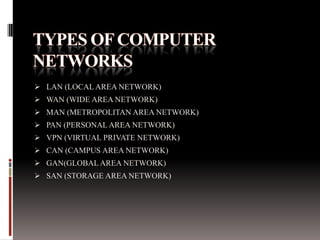
 Networks are built with a combination of computer hardware and computer software. Types of computer networks LAN (LOCAL AREA NETWORK)
WAN (WIDE AREA NETWORK)
MAN (METROPOLITAN AREA NETWORK)
PAN (PERSONAL AREA NETWORK)
VPN (VIRTUAL PRIVATE NETWORK)
CAN (CAMPUS AREA NETWORK)
GAN(GLOBAL AREA NETWORK)
SAN (STORAGE AREA NETWORK)LOCAL AREA NETWORK(LAN)Local area networks (LANs) are computer networks ranging in size from a few computers in a single office to hundreds or even thousands of devices spread across several buildings.
LANs in turn may be plugged into larger networks, such as larger LANs or wide area networks (WANs), connecting many computers within an organization to each other and/or to the Internet.
Typically, connected devices share the resources of a single processor or server within a small geographic area (for example, within an office building).
Usually, the server has applications and data storage that are shared in common by multiple computer users.Wide area network(wan)A wide area network (WAN) is a computer network that covers a broad area (i.e. any network whose communications links cross metropolitan, regional, or national boundaries).
WAN is a network that uses routers and public communications links.
The largest and most well-known example of a WAN is the Internet. A WAN is a data communications network that covers a relatively broad geographic area (i.e. one city to another and one country to another country) and that often uses transmission facilities provided by common carriers, such as telephone companies.
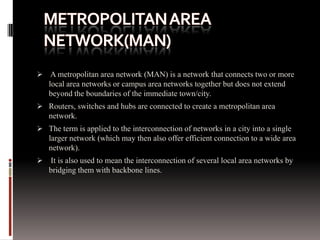
WAN technologies generally function at the lower three layers of the OSI reference model: the physical layer, the data link layer, and the network layer.Metropolitan area network(man) A metropolitan area network (MAN) is a network that connects two or more local area networks or campus area networks together but does not extend beyond the boundaries of the immediate town/city.
Routers, switches and hubs are connected to create a metropolitan area network.
The term is applied to the interconnection of networks in a city into a single larger network (which may then also offer efficient connection to a wide area network).
 It is also used to mean the interconnection of several local area networks by bridging them with backbone lines.PERSONAL AREA NETWORK(PAN)A personal area network (PAN) is a computer network used for communication among computer devices close to one person.
Examples of devices that are used in a PAN are :printers, fax machines, telephones, PDAs and scanners.
The reach of a PAN is typically about 20-30 feet approximately 6-9 meters.GLOBAL  AREA NETWORK(GAN)A global area networks (GAN) specification is in development by several groups, and there is no common definition.
In general, however, a GAN is a model for supporting mobile communications across an arbitrary number of wireless LANs, satellite coverage areas, etc. VIRTUAL PRIVATE NETWORK(VPN)A virtual private network (VPN) is a computer network in which some of the links between nodes are carried by open connections or virtual circuits in some larger network (e.g., the Internet) instead of by physical wires.
A VPN may have best-effort performance, or may have a defined service level agreement (SLA) between the VPN customer and the VPN service provider. Generally, a VPN has a topology more complex than point-to-point.
A VPN allows computer users to appear to be editing from an IP address location other than the one which connects the actual computer to the Internet.CAMPUS AREA NETWORK(CAN)A campus area network (CAN) is a computer network made up of an interconnection of local area networks (LANs) within a limited geographical area.
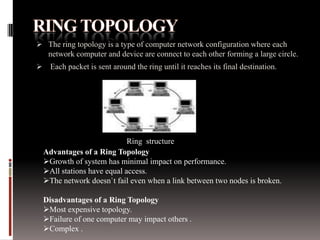
 It can be considered one form of a metropolitan area network, specific to an academic setting.NETWORK TOPOLOGYA network consists of two or more computers that are linked in order to share resources (such as printers and CD-ROMs), exchange files, or allow electronic communications.

Networking presentation

  • 1.
  • 2.
    INTRODUCTION-What isnetworking? A network is a collection of computers and devices connected to each other. The network allows computers to communicate with each other and share resources and information.
  • 3.
    In other wordsnetworking can be defined as inter-connection of two or more computers for sharing the resources(hardware and software)and provide security on them.
  • 4.
    Networks arebuilt with a combination of computer hardware and computer software. Types of computer networks LAN (LOCAL AREA NETWORK)
  • 5.
  • 6.
  • 7.
  • 8.
  • 9.
  • 10.
  • 11.
    SAN (STORAGE AREANETWORK)LOCAL AREA NETWORK(LAN)Local area networks (LANs) are computer networks ranging in size from a few computers in a single office to hundreds or even thousands of devices spread across several buildings.
  • 12.
    LANs in turnmay be plugged into larger networks, such as larger LANs or wide area networks (WANs), connecting many computers within an organization to each other and/or to the Internet.
  • 13.
    Typically, connected devicesshare the resources of a single processor or server within a small geographic area (for example, within an office building).
  • 14.
    Usually, the serverhas applications and data storage that are shared in common by multiple computer users.Wide area network(wan)A wide area network (WAN) is a computer network that covers a broad area (i.e. any network whose communications links cross metropolitan, regional, or national boundaries).
  • 15.
    WAN is anetwork that uses routers and public communications links.
  • 16.
    The largest andmost well-known example of a WAN is the Internet. A WAN is a data communications network that covers a relatively broad geographic area (i.e. one city to another and one country to another country) and that often uses transmission facilities provided by common carriers, such as telephone companies.
  • 17.
    WAN technologies generallyfunction at the lower three layers of the OSI reference model: the physical layer, the data link layer, and the network layer.Metropolitan area network(man) A metropolitan area network (MAN) is a network that connects two or more local area networks or campus area networks together but does not extend beyond the boundaries of the immediate town/city.
  • 18.
    Routers, switches andhubs are connected to create a metropolitan area network.
  • 19.
    The term isapplied to the interconnection of networks in a city into a single larger network (which may then also offer efficient connection to a wide area network).
  • 20.
    It isalso used to mean the interconnection of several local area networks by bridging them with backbone lines.PERSONAL AREA NETWORK(PAN)A personal area network (PAN) is a computer network used for communication among computer devices close to one person.
  • 21.
    Examples of devicesthat are used in a PAN are :printers, fax machines, telephones, PDAs and scanners.
  • 22.
    The reach ofa PAN is typically about 20-30 feet approximately 6-9 meters.GLOBAL AREA NETWORK(GAN)A global area networks (GAN) specification is in development by several groups, and there is no common definition.
  • 23.
    In general, however,a GAN is a model for supporting mobile communications across an arbitrary number of wireless LANs, satellite coverage areas, etc. VIRTUAL PRIVATE NETWORK(VPN)A virtual private network (VPN) is a computer network in which some of the links between nodes are carried by open connections or virtual circuits in some larger network (e.g., the Internet) instead of by physical wires.
  • 24.
    A VPN mayhave best-effort performance, or may have a defined service level agreement (SLA) between the VPN customer and the VPN service provider. Generally, a VPN has a topology more complex than point-to-point.
  • 25.
    A VPN allowscomputer users to appear to be editing from an IP address location other than the one which connects the actual computer to the Internet.CAMPUS AREA NETWORK(CAN)A campus area network (CAN) is a computer network made up of an interconnection of local area networks (LANs) within a limited geographical area.
  • 26.
    It canbe considered one form of a metropolitan area network, specific to an academic setting.NETWORK TOPOLOGYA network consists of two or more computers that are linked in order to share resources (such as printers and CD-ROMs), exchange files, or allow electronic communications.