Basics of Compression
• Goals:
• to understand how image/audio/video signals are
compressed to save storage and increase
transmission efficiency
• to understand in detail common formats like GIF,
JPEG and MPEG
What does compression do
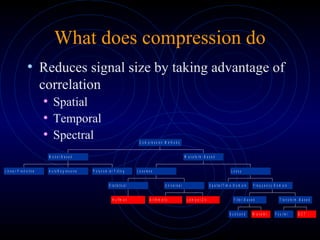
• Reduces signal size by taking advantage of
correlation
• Spatial
• Temporal
• Spectral
L in e a r P r e d ic t iv e A u t o R e g r e s s iv e P o ly n o m ia l F it t in g
M o d e l- B a s e d
H u ffm a n
S t a t is t ic a l
A r it h m e t ic L e m p e l- Z iv
U n iv e r s a l
L o s s le s s
S p a t ia l/ T im e - D o m a in
S u b b a n d W a v e le t
F ilt e r - B a s e d
F o u r ie r D C T
T r a n s fo r m - B a s e d
F r e q u e n c y - D o m a in
L o s s y
W a v e fo r m - B a s e d
C o m p r e s s io n M e t h o d s
Compression Issues
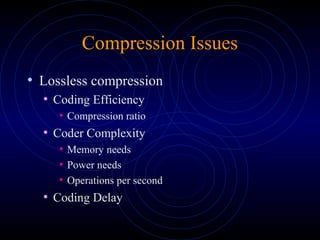
• Lossless compression
• Coding Efficiency
• Compression ratio
• Coder Complexity
• Memory needs
• Power needs
• Operations per second
• Coding Delay
Compression Issues
• Additional Issues for Lossy Compression
• Signal quality
• Bit error probability
• Signal/Noise ratio
• Mean opinion score
Compression Method Selection
• Constrained output signal quality? – TV
• Retransmission allowed? – interactive sessions
• Degradation type at decoder acceptable?
• Multiple decoding levels? – browsing and retrieving
• Encoding and decoding in tandem? – video editing
• Single-sample-based or block-based?
• Fixed coding delay, variable efficiency?
• Fixed output data size, variable rate?
• Fixed coding efficiency, variable signal quality? CBR
• Fixed quality, variable efficiency? VBR
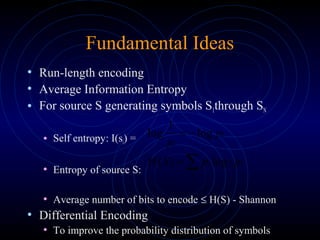
Fundamental Ideas
• Run-length encoding
• Average Information Entropy
• For source S generating symbols S1through SN
• Self entropy: I(si) =
• Entropy of source S:
• Average number of bits to encode ≤ H(S) - Shannon
• Differential Encoding
• To improve the probability distribution of symbols
i
i
p
p
log
1
log −=
∑=
i
ii ppSH 2log)(
Huffman Encoding
• Let an alphabet have N symbols S1 … SN
• Let pi be the probability of occurrence of Si
• Order the symbols by their probabilities
p1 ≥ p2 ≥ p3 ≥ … ≥ pN
• Replace symbols SN-1 and SN by a new symbol HN-1
such that it has the probability pN-1+ pN
• Repeat until there is only one symbol
• This generates a binary tree
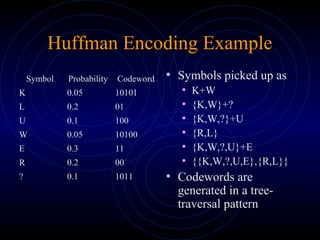
Huffman Encoding Example
• Symbols picked up as
• K+W
• {K,W}+?
• {K,W,?}+U
• {R,L}
• {K,W,?,U}+E
• {{K,W,?,U,E},{R,L}}
• Codewords are
generated in a tree-
traversal pattern
Symbol Probability Codeword
K 0.05 10101
L 0.2 01
U 0.1 100
W 0.05 10100
E 0.3 11
R 0.2 00
? 0.1 1011
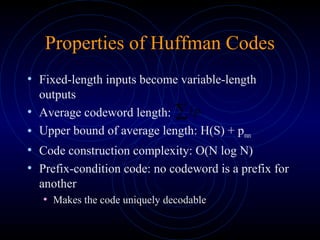
Properties of Huffman Codes
• Fixed-length inputs become variable-length
outputs
• Average codeword length:
• Upper bound of average length: H(S) + pmax
• Code construction complexity: O(N log N)
• Prefix-condition code: no codeword is a prefix for
another
• Makes the code uniquely decodable
∑ iipl
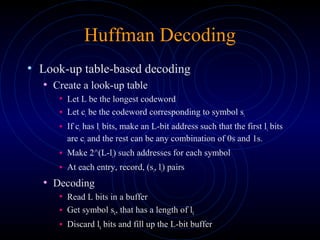
Huffman Decoding
• Look-up table-based decoding
• Create a look-up table
• Let L be the longest codeword
• Let ci be the codeword corresponding to symbol si
• If ci has li bits, make an L-bit address such that the first li bits
are ci and the rest can be any combination of 0s and 1s.
• Make 2^(L-li) such addresses for each symbol
• At each entry, record, (si, li) pairs
• Decoding
• Read L bits in a buffer
• Get symbol sk, that has a length of lk
• Discard lk bits and fill up the L-bit buffer
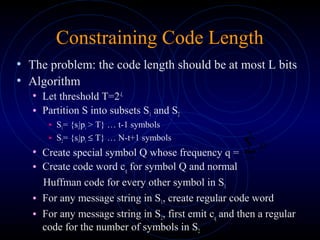
Constraining Code Length
• The problem: the code length should be at most L bits
• Algorithm
• Let threshold T=2-L
• Partition S into subsets S1 and S2
• S1= {si|pi > T} … t-1 symbols
• S2= {si|pi ≤ T} … N-t+1 symbols
• Create special symbol Q whose frequency q =
• Create code word cq for symbol Q and normal
Huffman code for every other symbol in S1
• For any message string in S1, create regular code word
• For any message string in S2, first emit cq and then a regular
code for the number of symbols in S2
∑=
N
ti
ip
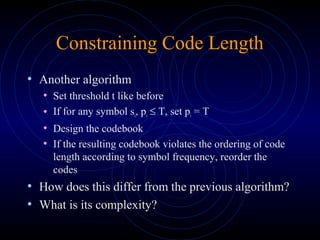
Constraining Code Length
• Another algorithm
• Set threshold t like before
• If for any symbol si, pi ≤ T, set pi = T
• Design the codebook
• If the resulting codebook violates the ordering of code
length according to symbol frequency, reorder the
codes
• How does this differ from the previous algorithm?
• What is its complexity?
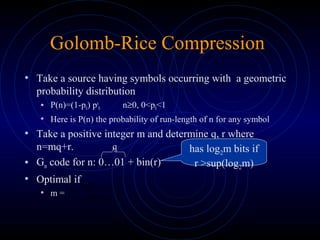
Golomb-Rice Compression
• Take a source having symbols occurring with a geometric
probability distribution
• P(n)=(1-p0) pn
0 n≥0, 0<p0<1
• Here is P(n) the probability of run-length of n for any symbol
• Take a positive integer m and determine q, r where
n=mq+r.
• Gm code for n: 0…01 + bin(r)
• Optimal if
• m =
q has log2m bits if
r >sup(log2m)





 +
−
)log(
)1log(
0
0
p
p
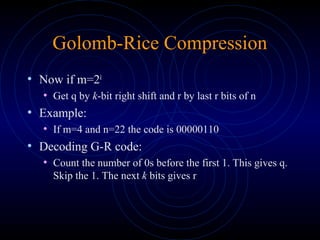
Golomb-Rice Compression
• Now if m=2k
• Get q by k-bit right shift and r by last r bits of n
• Example:
• If m=4 and n=22 the code is 00000110
• Decoding G-R code:
• Count the number of 0s before the first 1. This gives q.
Skip the 1. The next k bits gives r
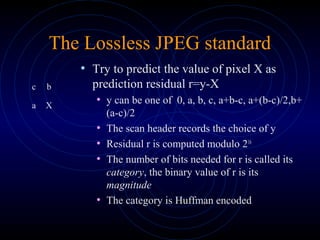
The Lossless JPEG standard
• Try to predict the value of pixel X as
prediction residual r=y-X
• y can be one of 0, a, b, c, a+b-c, a+(b-c)/2,b+
(a-c)/2
• The scan header records the choice of y
• Residual r is computed modulo 216
• The number of bits needed for r is called its
category, the binary value of r is its
magnitude
• The category is Huffman encoded
c b
a X

Mmclass2

  • 1.
    Basics of Compression •Goals: • to understand how image/audio/video signals are compressed to save storage and increase transmission efficiency • to understand in detail common formats like GIF, JPEG and MPEG
  • 2.
    What does compressiondo • Reduces signal size by taking advantage of correlation • Spatial • Temporal • Spectral L in e a r P r e d ic t iv e A u t o R e g r e s s iv e P o ly n o m ia l F it t in g M o d e l- B a s e d H u ffm a n S t a t is t ic a l A r it h m e t ic L e m p e l- Z iv U n iv e r s a l L o s s le s s S p a t ia l/ T im e - D o m a in S u b b a n d W a v e le t F ilt e r - B a s e d F o u r ie r D C T T r a n s fo r m - B a s e d F r e q u e n c y - D o m a in L o s s y W a v e fo r m - B a s e d C o m p r e s s io n M e t h o d s
  • 3.
    Compression Issues • Losslesscompression • Coding Efficiency • Compression ratio • Coder Complexity • Memory needs • Power needs • Operations per second • Coding Delay
  • 4.
    Compression Issues • AdditionalIssues for Lossy Compression • Signal quality • Bit error probability • Signal/Noise ratio • Mean opinion score
  • 5.
    Compression Method Selection •Constrained output signal quality? – TV • Retransmission allowed? – interactive sessions • Degradation type at decoder acceptable? • Multiple decoding levels? – browsing and retrieving • Encoding and decoding in tandem? – video editing • Single-sample-based or block-based? • Fixed coding delay, variable efficiency? • Fixed output data size, variable rate? • Fixed coding efficiency, variable signal quality? CBR • Fixed quality, variable efficiency? VBR
  • 6.
    Fundamental Ideas • Run-lengthencoding • Average Information Entropy • For source S generating symbols S1through SN • Self entropy: I(si) = • Entropy of source S: • Average number of bits to encode ≤ H(S) - Shannon • Differential Encoding • To improve the probability distribution of symbols i i p p log 1 log −= ∑= i ii ppSH 2log)(
  • 7.
    Huffman Encoding • Letan alphabet have N symbols S1 … SN • Let pi be the probability of occurrence of Si • Order the symbols by their probabilities p1 ≥ p2 ≥ p3 ≥ … ≥ pN • Replace symbols SN-1 and SN by a new symbol HN-1 such that it has the probability pN-1+ pN • Repeat until there is only one symbol • This generates a binary tree
  • 8.
    Huffman Encoding Example •Symbols picked up as • K+W • {K,W}+? • {K,W,?}+U • {R,L} • {K,W,?,U}+E • {{K,W,?,U,E},{R,L}} • Codewords are generated in a tree- traversal pattern Symbol Probability Codeword K 0.05 10101 L 0.2 01 U 0.1 100 W 0.05 10100 E 0.3 11 R 0.2 00 ? 0.1 1011
  • 9.
    Properties of HuffmanCodes • Fixed-length inputs become variable-length outputs • Average codeword length: • Upper bound of average length: H(S) + pmax • Code construction complexity: O(N log N) • Prefix-condition code: no codeword is a prefix for another • Makes the code uniquely decodable ∑ iipl
  • 10.
    Huffman Decoding • Look-uptable-based decoding • Create a look-up table • Let L be the longest codeword • Let ci be the codeword corresponding to symbol si • If ci has li bits, make an L-bit address such that the first li bits are ci and the rest can be any combination of 0s and 1s. • Make 2^(L-li) such addresses for each symbol • At each entry, record, (si, li) pairs • Decoding • Read L bits in a buffer • Get symbol sk, that has a length of lk • Discard lk bits and fill up the L-bit buffer
  • 11.
    Constraining Code Length •The problem: the code length should be at most L bits • Algorithm • Let threshold T=2-L • Partition S into subsets S1 and S2 • S1= {si|pi > T} … t-1 symbols • S2= {si|pi ≤ T} … N-t+1 symbols • Create special symbol Q whose frequency q = • Create code word cq for symbol Q and normal Huffman code for every other symbol in S1 • For any message string in S1, create regular code word • For any message string in S2, first emit cq and then a regular code for the number of symbols in S2 ∑= N ti ip
  • 12.
    Constraining Code Length •Another algorithm • Set threshold t like before • If for any symbol si, pi ≤ T, set pi = T • Design the codebook • If the resulting codebook violates the ordering of code length according to symbol frequency, reorder the codes • How does this differ from the previous algorithm? • What is its complexity?
  • 13.
    Golomb-Rice Compression • Takea source having symbols occurring with a geometric probability distribution • P(n)=(1-p0) pn 0 n≥0, 0<p0<1 • Here is P(n) the probability of run-length of n for any symbol • Take a positive integer m and determine q, r where n=mq+r. • Gm code for n: 0…01 + bin(r) • Optimal if • m = q has log2m bits if r >sup(log2m)       + − )log( )1log( 0 0 p p
  • 14.
    Golomb-Rice Compression • Nowif m=2k • Get q by k-bit right shift and r by last r bits of n • Example: • If m=4 and n=22 the code is 00000110 • Decoding G-R code: • Count the number of 0s before the first 1. This gives q. Skip the 1. The next k bits gives r
  • 15.
    The Lossless JPEGstandard • Try to predict the value of pixel X as prediction residual r=y-X • y can be one of 0, a, b, c, a+b-c, a+(b-c)/2,b+ (a-c)/2 • The scan header records the choice of y • Residual r is computed modulo 216 • The number of bits needed for r is called its category, the binary value of r is its magnitude • The category is Huffman encoded c b a X